
Judge, 1924-07-05 · page 22 of 36
Judge — July 5, 1924 — page 22: what you’re looking at
What you’re looking at
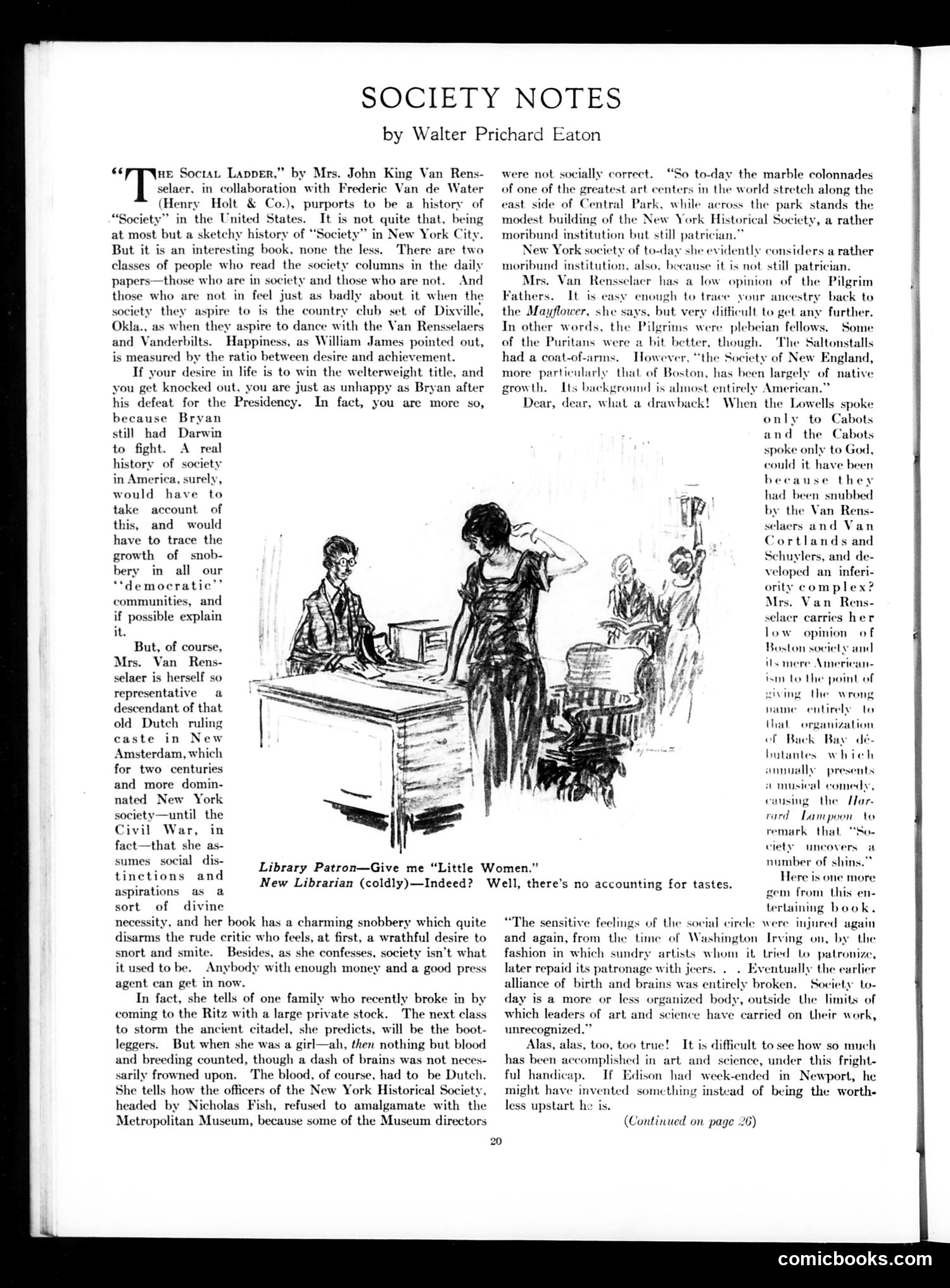
This page contains a book review by Walter Prichard Eaton of "The Social Ladder" by Mrs. John King Van Rensselaer, a history of New York City society. **The cartoon** shows a library patron asking for "Little Women" while a librarian responds coldly that "there's no accounting for tastes"—a mild joke suggesting the patron has poor literary judgment. **The satire's main target** is Mrs. Van Rensselaer herself, a descendant of old Dutch aristocracy who wrote about American social hierarchies. Eaton mocks her assumption that social distinctions are divinely ordained while acknowledging that modern society (including bootleggers) can now "buy in" with money. **Key irony**: He references the famous Brahmin saying "The Lowells speak only to Cabots, and the Cabots speak only to God," suggesting Boston's superiority complex may stem from being snubbed by New York's Dutch families—inverting her authority. The piece critiques inherited privilege and suggests America's "democratic" communities are fundamentally snobbish, contradicting their democratic ideals.
📄 Transcribed text from this page (OCR, searchable)
Machine-transcribed from the original scan — historical spelling and the odd misread are preserved.
SOCIETY NOTES by Walter Prichard Eaton selaer, in collaboration with Frederic Van de Water (Henry Holt & Co.), purports to be a history of “Society” in the United States. It is not quite that, being at most but a sketchy history of “Society” in New York City. But it is an interesting book, none the less. There are two classes of people who read the society columns in the daily papers—those who are in society and those who are not. And those who are not in feel just as badly about it when the society they aspire to is the country club set of Dixville, Okl when they aspire to dance with the Van Rensselaers and Vanderbilts. Happiness, as William James pointed out, is measured by the ratio between desire and achievement. If your desire in life is to win the welterweight title, and you get knocked out, you are just as unhappy as Bryan after his defeat for the Presidency. In fact, you are more so, because Bryan still had Darwin to fight. A real history of society in America, surely, would have to take account of th and would have to trace the growth of snob- bery in all our “‘democratic’’ communities, and if possible explain it. But, of course, Mrs. Van Rens- selaer is herself so representative a descendant of that old Dutch ruling caste in New Amsterdam, which for two centuries and more domin- nated New York society—until the Civil War, in fact—that she as- sumes social dis tinetions and aspirations as a sort of divine necessity, and her book has a charming snobbery which quite disarms the rude critic who feels, at first, a wrathful desire to snort and smite. Besides, as she confesses, society isn't what it used to be. Anybody with enough money and a good press agent can get in now. In fact, she tells of one family who recently broke in by coming to the Ritz with a large private stock. The next class to storm the ancient citadel, she predicts, will be the boot- leggers. But when she was a girl—ah, then nothing but blood and breeding counted, though a dash of brains was not neces- sarily frowned upon. The blood, of course, had to be Dutch. She tells how the officers of the New York Historical Society, headed by Nicholas Fish, refused to amalgamate with the Metropolitan Museum, because some of the Museum directors ie Socrat Lapper,” by Mrs. John King Van Rens- New Librarian (coldly)—Indeed? Library Patron—Give me “Little Women.” Well, there’s no accounting for tastes. were not socially correct. “So to-day the marble colonnades of one of the greatest art centers in the world stretch along the east side of Central Park, while across the park stands the modest building of the New York Historical Society, a rather moribund institution but still patrician.” New York society of to-day she evidently considers a rather moribund institution, also, | ause it is not still patrician. Mrs. Van Rensse' er has a low opinion of the Pilgrim Fathers. It is easy enough to trace your ancestry back to the Mayflower, she . but very difficult to get any further. In other words, the Pilgrims were plebeian fello of the Puritans were a bit bette had a coat-o! Some though. ‘The Saltonstalls the Society of New England, more particularly that of Boston, has been largely of native growth. Its background is almost entirely American.” Dear, dear, what a drawback! When the Lowells spoke only to Cabots and the Cabots spoke only to God, could it have been because they had been snubbed by the Van Rens- selaers and Van Cortlands and Schuylers, and de- veloped an inferi- ority complex? Mrs. Van Rens- selaer carries her low opinion of ms. Howeve' Boston society and Wsamere American- ism to the point of siving the wrong name entirely to that organization of Back Bay dé- hutantes whieh annually presents a musical comedy, Hor- rard Lampoon to remark that “So- ciety causing the uncovers a number of shins.” Here is one more gem from this en- terlaining book. “The sensitive feelings of the social circle were injured again and again, from the time of Washington Irving on, by the fashion in which sundry artists whom it tried lo patronize, later repaid its patronage with jeers. .. Eventually the earlier alliance of birth and brains was entirely broken. Soci to- day is a more or less organized body, outside the limits of which leaders of art and science have carried on their work, unrecognized.” Alas, has been It is difficult to see how so much complished in art and science, under this fright- ful handicap. If Edison had week-ended in Newport, he might have invented something instead of being the worth. less upstart he is. (Continued on page 26) alas, too, too true! comicbooks.com