
Judge, 1924-07-05 · page 28 of 36
Judge — July 5, 1924 — page 28: what you’re looking at
What you’re looking at
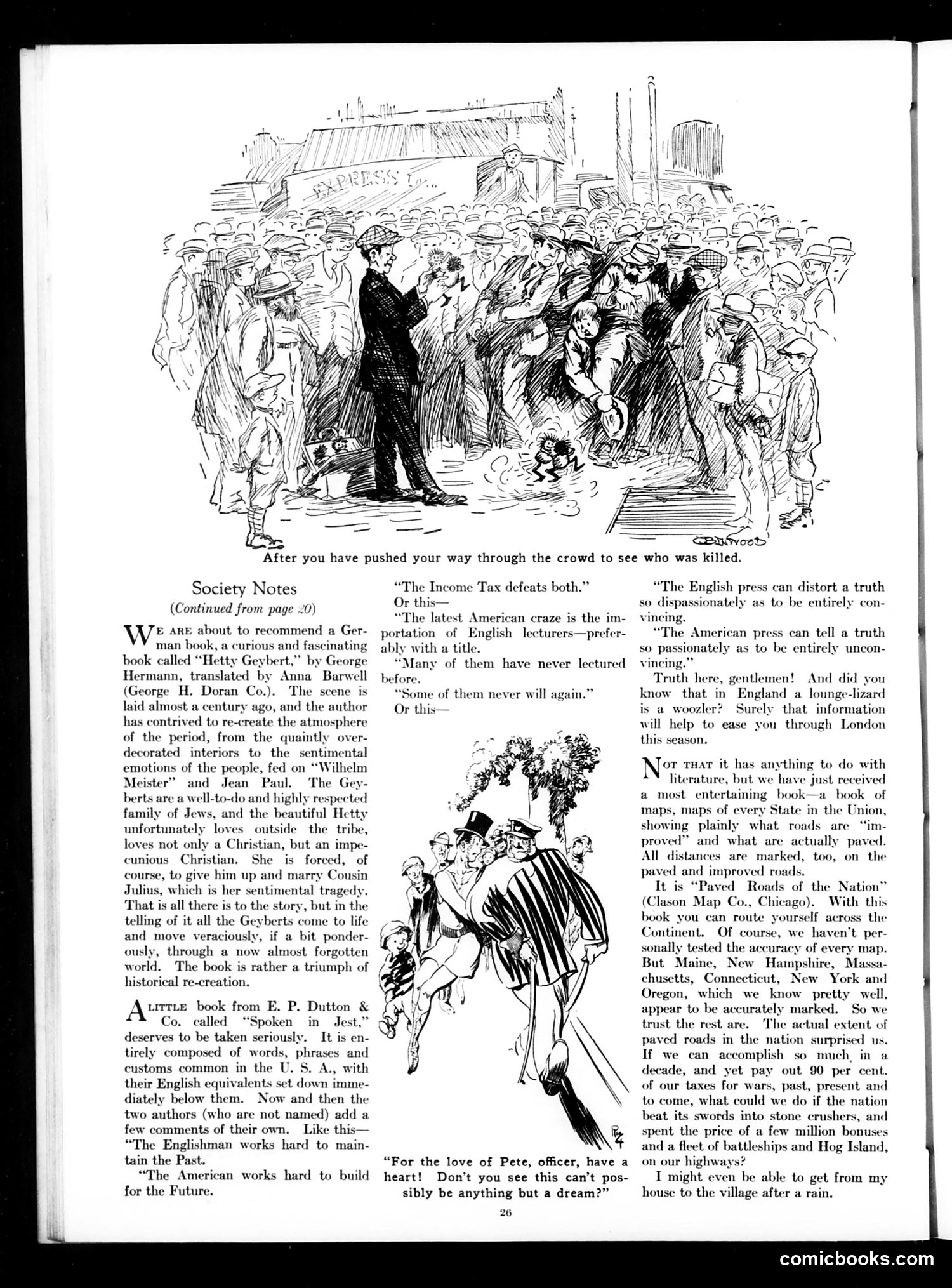
The page contains a **society/book review column** rather than a traditional political cartoon. The sketch at top shows a crowd scene after an accident or disaster—the caption suggests morbid curiosity drawing onlookers. The reviews discuss three books, with satirical commentary interspersed. A key section compares American and English national character through paired observations: "The Englishman works hard to maintain the Past. The American works hard to build for the Future." This reflects early-20th-century anxieties about American vs. European values. The most pointed satire appears in contrasts about press truthfulness—the English distort dispassionately (convincingly), Americans tell truth passionately (unconvincingly)—poking fun at both nations' media. The final review of "Paved Roads of the Nation" becomes genuinely political: it mocks government priorities, arguing that if America can build extensive road networks on limited budgets, imagine what could be accomplished if military spending ("swords into stone crushers") were redirected to infrastructure. This reflects Progressive-era critiques of military expenditure.
📄 Transcribed text from this page (OCR, searchable)
Machine-transcribed from the original scan — historical spelling and the odd misread are preserved.
2S After you have pushed your way through the crowd to see who was killed. Society Notes (Continued from page 20) V E ARE about to recommend a Ger- man bool curious and fascinating book called “Hetty Geybert,” by George Hermann, translated by Anna Barwell (George H. Doran Co.). The scene is laid almost a century ago, and the author has contrived to re-create the atmosphere of the period, from the quaintly over- decorated interiors to the sentimental emotions of the people, fed on “Wilhelm Meister” and Jean Paul. The Gey- berts are a well-to-do and highly respected family of Jews, and the beautiful Hetty unfortunately loves outside the tribe, loves not only a Christian, but an impe- cunious Christian. She is forced, of course, to give him up and marry Cousin Julius, which is her sentimental tragedy. That is all there is to the story, but in the telling of it all the Geyberts come to life and move veraciously, if a bit ponder- ously, through a now almost forgotten world. The book is rather a triumph of historical re-creation. Aue book from E. P. Dutton & Co. called poken in Jest,” deserves to be taken seriously. It is en- tirely composed of words, phrases and customs common in the U. § their English equivalents set down imme- diately below them. Now and then the two authors (who are not named) add a few comments of their own. Like this “The Englishman works hard to main- tain the Past. “The American works hard to build for the Future. “The Income Tax defeats both.” Or this— “The latest American craze is the im- portation of English lecturers—prefer- ably with a title. Tany of them have never lectured befor “Some of them never will again.” Or this— “For the love of Pete, officer, have a heart! Don’t you see this can’t pos- sibly be anything but a dream?” 26 “The English press can distort a truth so dispassionately as to be entirely con- vincing. “The American press can tell a truth assionately as to be entirely uncon- And did you England a lounge-lizard Surely that information will help to ease you through London this season. Truth here, gentlemen! know that in is a woozler? vith N™ THAT it has anything to do +™ literature, but we have just received a most entertaining book—a book of State in the Union, showing plainly what roads are “‘im- proved” and what are actually paved. All distances are marked, too, on the paved and improved roads. It is “Paved Roads of the Nation” (Clason Map Co., Chicago). With this book you can route yourself across the Continent. Of course, we haven't per- sonally tested the accuracy of every map. But Maine, New Hampshire, Mas chusetts, Connecticut, New York and Oregon, which we know pretty well, appear to be accurately marked. So we trust the rest are. The actual extent of paved roads in the nation surprised us. If we can accomplish so much, in a decade, and yet pay out 90 per cent. of our taxes for wars, past, present and to come, what could we do if the nation beat its swords into stone crushers, and spent the price of a few million bonuses and a fleet of battleships and Hog Island, on our highways? I might even be able to get from my house to the village after a rain. maps, maps of eve! comicbooks.com