
Judge, 1924-07-05 · page 20 of 36
Judge — July 5, 1924 — page 20: what you’re looking at
What you’re looking at
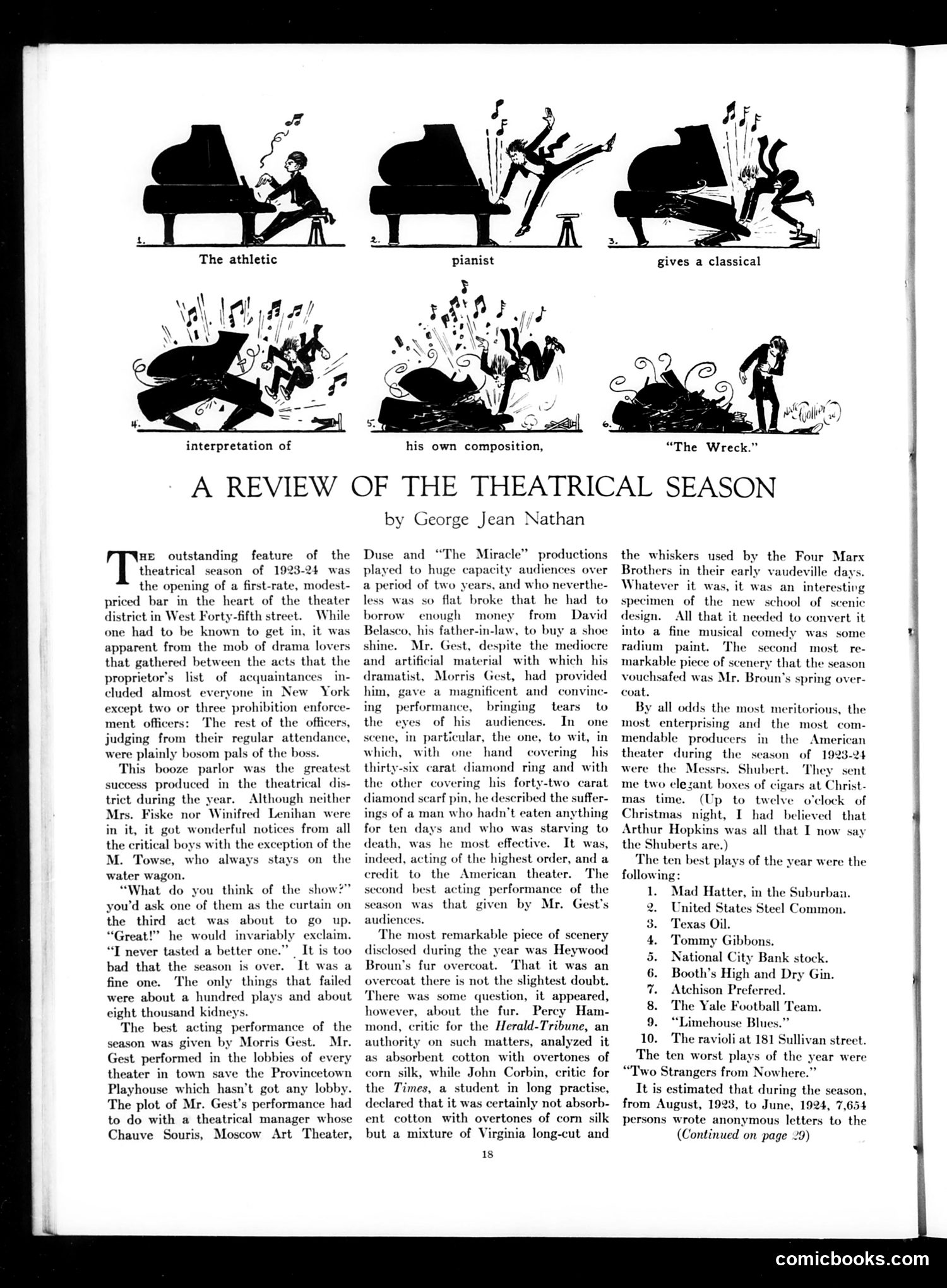
The top cartoons satirize different pianists' performance styles: "The athletic pianist" plays with exaggerated physical gyrations; "gives a classical interpretation" shows restrained, proper technique; and "his own composition" depicts chaotic, explosive performance. These mock various concert pianists' showmanship tendencies. The main text by George Jean Nathan is a satirical review of Broadway's 1923-24 season. Its central joke: **the real theatrical highlight wasn't any play, but a speakeasy** (illegal bar) operating on West 45th Street during Prohibition. Nathan quips that even prohibition enforcement officers frequented it regularly—a dig at widespread corruption and the failure of Prohibition enforcement. Secondary targets include producer Morris Gest (mocked for his grandiose performances and evident wealth despite claimed poverty) and theater critic Heywood Broun's shabby fur overcoat, which Nathan and fellow critics debate sarcastically: is it cotton with corn silk, or Virginia tobacco and Marx Brothers' whiskers? The joke emphasizes critics' pretentious over-analysis of trivial matters.
📄 Transcribed text from this page (OCR, searchable)
Machine-transcribed from the original scan — historical spelling and the odd misread are preserved.
The athletic \ \ \ i I) ‘Bh 1 4 4/ i interpretation of Ti outstanding feature of the theatrical season of 1923-24 was the opening of a first-rate, modest- priced bar in the heart of the theater district in West Forty-fifth street. While one had to be known to get in, it was apparent from the mob of drama lovers that gathered between the acts that the proprietor's list of acquaintances in- cluded almost everyone in New York except two or three prohibition enforce- ment officers: The rest of the officers, judging from their regular attendance, were plainly bosom pals of the boss. This booze parlor was the greatest s ss produced in the theatrical dis- trict during the r. Although neither Mrs. Fiske nor Winifred Lenihan were in it, it got wonderful notices from all the critical boys with the exception of the M. Towse, who always stays on the water wagon. “What do you think of the show?” you'd ask one of them as the curtain on the third act was about to go up. “Great!” he would invariably exclaim. “T never tasted a better one.” | It is too bad that the It was a fine one. The only things that failed were about a hundred plays and about eight thousand kidneys. The best acting performance of the season was given by Morris Gest. Mr. Gest performed in the lobbies of every theater in town save the Provincetown Playhouse which hasn't got any lobby. The plot of Mr. Gest’s performance had to do with a theatrical manager whose Chauve Souris, Moscow Art Theater, son is over. his own composition, Duse and “The Miracle” productions played to huge capacity audiences over a period of two years, and who neverthe- less was so flat broke that he had to enough money from David Belasco, his father-in-law, to buy a shoe shine. Mr. Gest, despite the mediocre and artificial material with which his dramatist, Morris Gest, had provided him, gave a magnificent and convinc- ing performance, bringing tears to of his audiences. In one scene, in particular, the one, to wit, in which, with one hand covering his thirty-six carat diamond ring and with the other covering his forty-two carat diamond scarf pin, he described the suffer- ings of a man who hadn't eaten anything for ten days and who was starving to death, was he most effective. It was, indeed, acting of the highest order, and a credit to the American theater. The second best acting performance of the season was that given by Mr. Gest’s audiences. borrow the eyes The most remarkable piece of scenery disclosed during the year was Heywood Broun’s fur overcoat. That it was an overcoat there is not the slightest doubt. There was some question, it appeared, however, about the fur. Percy Ham- mond, critic for the Herald-Tribune, an authority on such matters, analyzed it as absorbent cotton with overtones of corn silk, while John Corbin, critic for the Times, a student in long practise, declared that it was certainly not absorb- ent cotton with overtones of corm silk but a mixture of Virginia long-cut and 18 gives a classical “The Wreck.” A REVIEW OF THE THEATRICAL SEASON by George Jean Nathan the whiskers used by the Four Marx Brothers in their early vaudeville days. Whatever it was, it was an interesting specimen of the new school of scenic design. All that it needed to convert it into a fine musical comedy was some radium paint. The second most re- markable piece of scenery that the season vouchsafed was Mr. Broun’s spring over- coat. By all odds the most meritorious, the most enterprising and the most com- mendable producers in the American theater during the season of 1923-24 were the Messrs. Shubert. They sent me two elezant boxes of cigars at Christ- mas time. (Up to twelve o'clock of Christmas night, I had believed that Arthur Hopkins was all that I now say the Shuberts are.) The ten best plays of the year were the following: 1. Mad Hatter, in the Suburban. 2. United States Steel Common. 3. Texas Oil. 4. Tommy Gibbons. 5. National City Bank stock. 6. Booth’s High and Dry Gin. 7. Atchison Preferred. 8. The Yale Football Team. 9. “Limehouse Blues.” 10. The ravioli at 181 Sullivan street. The ten worst plays of the year were “Two Strangers from Nowhere.” It is estimated that during the season, from August, 1923, to June, 1924, 7,654 persons wrote anonymous letters to the (Continued on page 29) cnc eect ae ~ eee comicbooks.com