
Judge, 1924-07-05 · page 19 of 36
Judge — July 5, 1924 — page 19: what you’re looking at
What you’re looking at
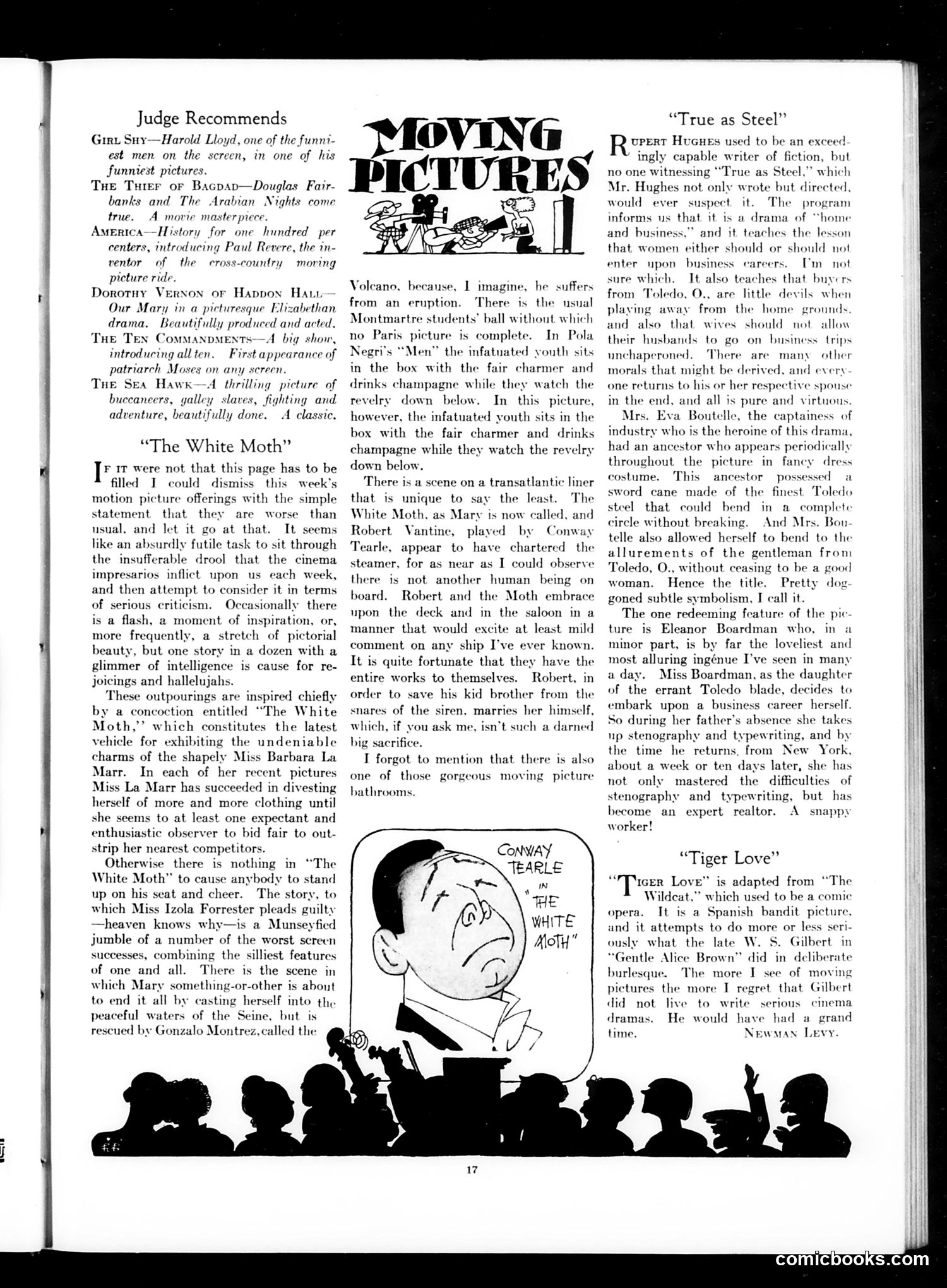
This page reviews several silent films from the 1920s. The main review criticizes "The White Moth," starring Barbara La Marr, as typical Hollywood drivel featuring a tired plot: a woman contemplating suicide in Paris, rescued by a man named "Volcano" (Conway Tearle), leading to marriage. The critic notes La Marr's progressive undressing across her recent films and mocks the film's clichés—Montmartre balls, transatlantic scenes—suggesting the couple has chartered an entire ship alone. The cartoon shows Conway Tearle as the exasperated "Volcano" character, overwhelmed by an audience—satirizing both the melodramatic acting style and the absurdity of the film's premise. The page also recommends Harold Lloyd and Douglas Fairbanks comedies positively, and reviews "True as Steel," directed by Rupert Hughes, dismissing it as proof that capable writers don't necessarily make competent filmmakers. The overall tone reflects 1920s film criticism's condescension toward plot-driven dramatic pictures while favoring comedy and spectacle.
📄 Transcribed text from this page (OCR, searchable)
Machine-transcribed from the original scan — historical spelling and the odd misread are preserved.
oe Judge Recommends Girt Suy—Harold Lloyd, one of the funni- est men on the screen, in one of his Sunniest pictures. Tue Tuer or Bacpap—Douglas Fair- banks and The Arabian Nights come true. America—History for one hundred per centers, introducing Paul Revere, the in- ventor of the picture ride. Dorotuy Vernon or Happon Haut Our Mary in a picturesque Elizabethan drama. Beautifully produced and acted. Tue Ten CommanpMeNts—A big show, introducing all ten. A movie masterpiece. cross-country moving First appearance of patriarch Moses on any screen. Tue Sea Hawk—A thrilling picture of buccaneers, galley slaves, fighting and adventure, beautifully done. A classic. “The White Moth” i IT were not that this page has to be filled I could dismiss this week's motion picture offerings with the simple statement that they are than usual, and let it go at that. It seems like an absurdly futile task to sit through the insufferable drool that the cinema impresarios inflict upon us each week, and then attempt to consider it in terms of serious criticism. Occasionally there is a flash, 2 moment of inspiration, or, more frequently, a stretch of pictorial beauty, but one story in a dozen with a glimmer of intelligence is cause for re- joicings and hallelujahs. These outpourings are inspired chiefly by a concoction entitled “The White Moth,’’ which constitutes the latest vehicle for exhibiting the undeniable charms of the shapely Miss Barbara La Marr. In each of her recent pictures Miss La Marr has succeeded in divesting herself of more and more clothing until she seems to at least one expectant and enthusiastic observer to bid fair to out- strip her nearest competitors. Otherwise there is nothing in “The White Moth” to cause anybody to stand up on his seat and ch The story, to which Miss Izola Forrester pleads guilty —heaven knows why—is a Munseyfied jumble of a number of the worst screen successes, combining the silliest features of one and all. There is the scene in which Mary something-or-other is about to end it all by casting herself into the peaceful waters of the Seine, but is rescued by Gonzalo Montrez, called the worse Volcano, because, 1 imagine, he suffers from an eruption. There is the usual Montmartre students’ ball without which no Paris picture is complete. In Pola Negri’s “Men” the infatuated youth sits in the box with the fair charmer and drinks champagne while they watch the revelry how box with the fair charmer and drinks down below. In. this picture, ver, the infatuated youth sits in the champagne while they watch the revelry down below. There is a scene on a transatlantic liner that is unique to say the least. The White Moth, as Mary is now called, and Robert Vantine, Tearle, appear to have chartered the steamer, for as near as I could observe played by Conway there is not another human being on Robert and the Moth embrace upon the di board. and in the saloon in a manner that would excite at least mild comment on any ship I’ve ever known. It is quite fortunate that they have the entire works to themselves. Robert, in order to save his kid brother from the snares of the siren, marries her himself, which, if you ask me, isn’t such a darned hig sacrifice. I forgot to mention that there is also one of those gorgeous moving picture bathrooms. “True as Steel” upERT HuGues used to be an exceed ingly capable writer of fiction, but no one witnessing “True as Steel,” which Mr. Hughes not only wrote but directed, would ever suspect it. The prog informs us that it is a drama of “home nd it teaches the lesson m and business. that women either should or should not business careers. [im not It also teaches that buyers Toledo, O., are little devils when enter upon sure which. from playing away from the home grounds and also that wives should not allow their husbands to go on. business trips unchaperoned. ‘There are other morals that might be derived, and every many one returns to his or her respective spouse in the end, and all is pure and virtuous Mrs. Eva Boutelle, the captainess of industry who is the heroine of this drama, had an ancestor who appears periodically throughout the picture in faney costume. This sword cane made of the finest Toledo steel that could dress ancestor possessed a bend in a complet: circle without breaking. And Mrs. Bou telle also allowed herself to bend to the allurements of the gentleman from Toledo, O., without ceasing to be a good woman. Hence the title. Pretty dog goned subtle symbolism, I call it. The one redeeming feature of the pic- ture is Eleanor Boardman who, in a minor part, is by far the loveliest and most alluring ingénue I've seen in many a day. Miss Boardman, as the daughter of the errant Toledo blade, decides to embark upon a business career herself. So during her father’s absence she takes up stenography and typewriting, and by the time he returns, from New York, about a week or ten days later, she has not only mastered the difficulties of stenography and typewriting, but has become an expert realtor. A worker! snappy “Tiger Love” “rTucen Love” is adapted from “The Wildcat.” which used to be a comic opera. It is a Spanish bandit picture, and it attempts to do more or less seri- ously what the late W. S. Gilbert in entle Alice Brown” did in deliberate burlesque. The more I see of moving pictures the more I regret that Gilbert did not live to write cinema He would have had a grand Newman Levy. serious dramas. time.