
A complete issue · 36 pages · 1923
Judge — August 25, 1923
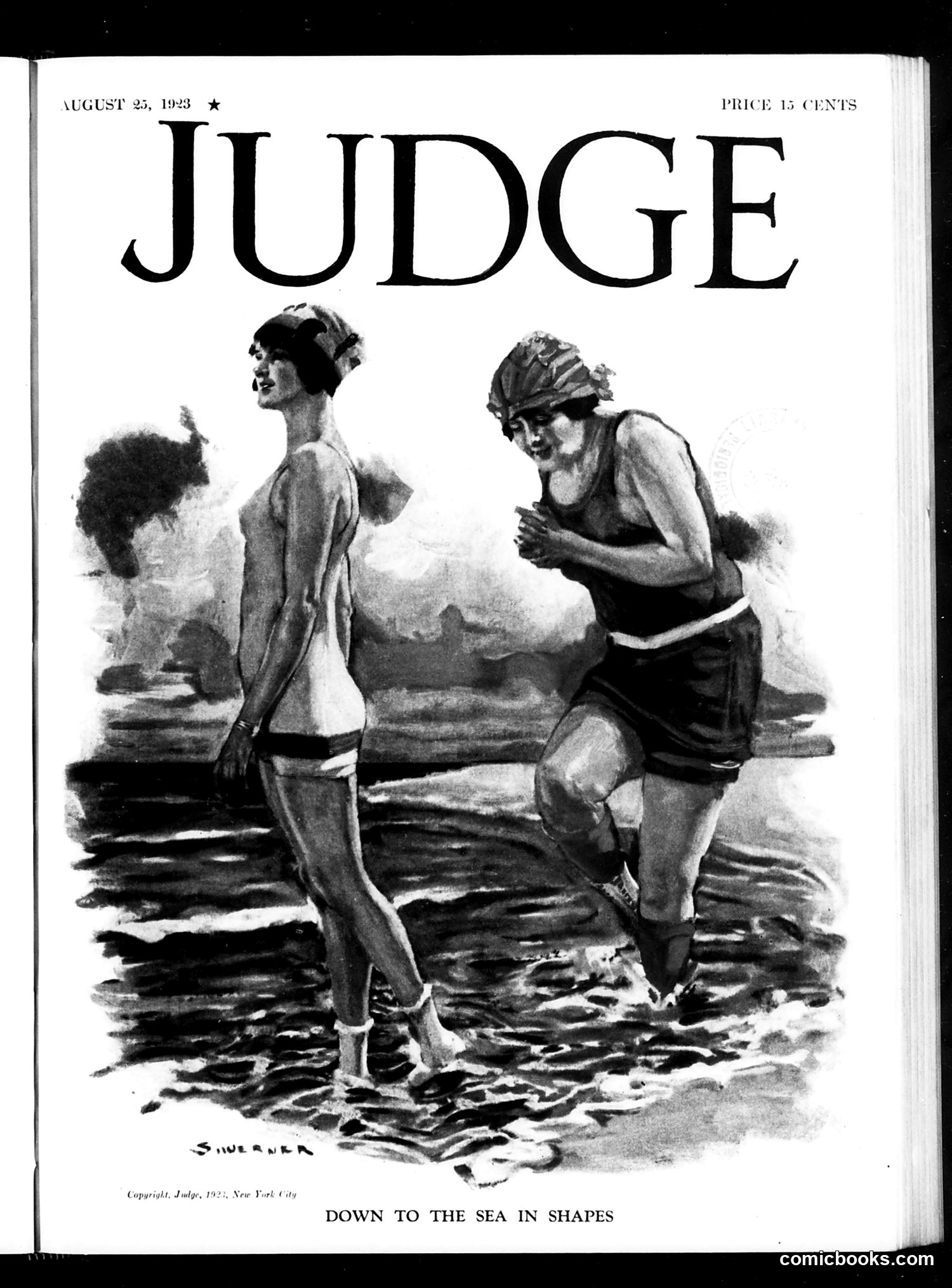
This Judge magazine cover from August 25, 1923 shows three figures in swimwear at a beach, titled "Down to the Sea in Shapes." The illustration by Shermund appears to be social satire about women's body types and fashion. The cartoon likely mocks contemporary debates about women's swimwear and changing body standards in the 1920s—the "flapper" era when women's clothing became less restrictive. The three figures represent different body shapes, with the composition suggesting commentary on beauty standards or fashion industry expectations. Without additional context, the specific satirical point remains unclear—whether it's critiquing women's fashion choices, beauty standards, or social attitudes toward female bodies during this period of significant social change for women.
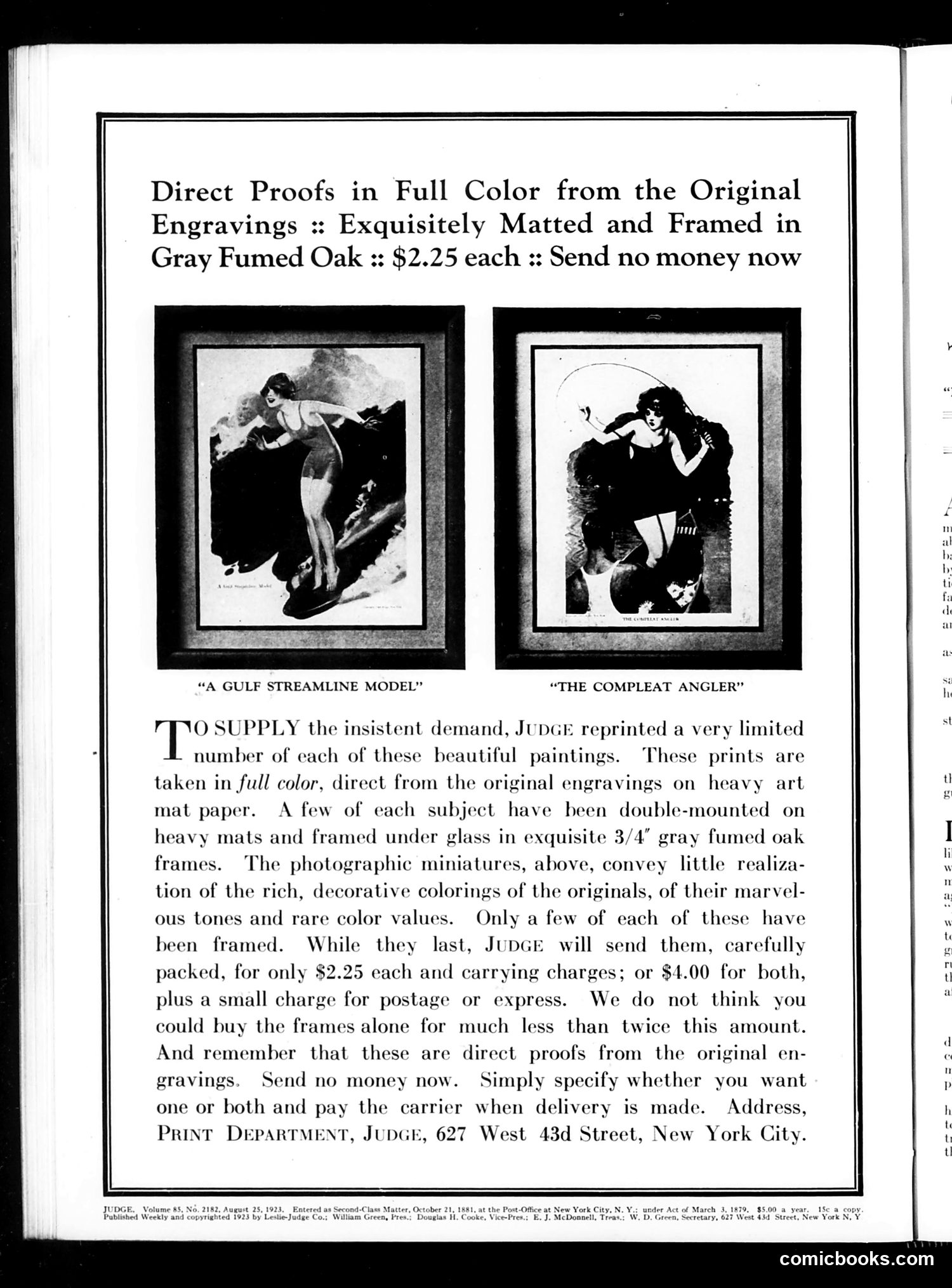
This page is primarily **advertising**, not editorial content. It promotes framed art prints offered by Judge magazine's Print Department. The two images shown—"A Gulf Streamline Model" and "The Compleat Angler"—appear to be **decorative prints featuring stylized figures of women** in fashionable poses, rendered in full color from "original engravings." The ad emphasizes luxury presentation: the prints are matted on heavy art paper and some are double-mounted in "exquisite 3/4" gray fumed oak frames" for $2.25 each (or both for $4.00). The language stresses exclusivity ("very limited number") and quality, claiming the frames alone would cost considerably more. This reflects 1920s consumer culture where Judge marketed lifestyle products to affluent readers through its pages.
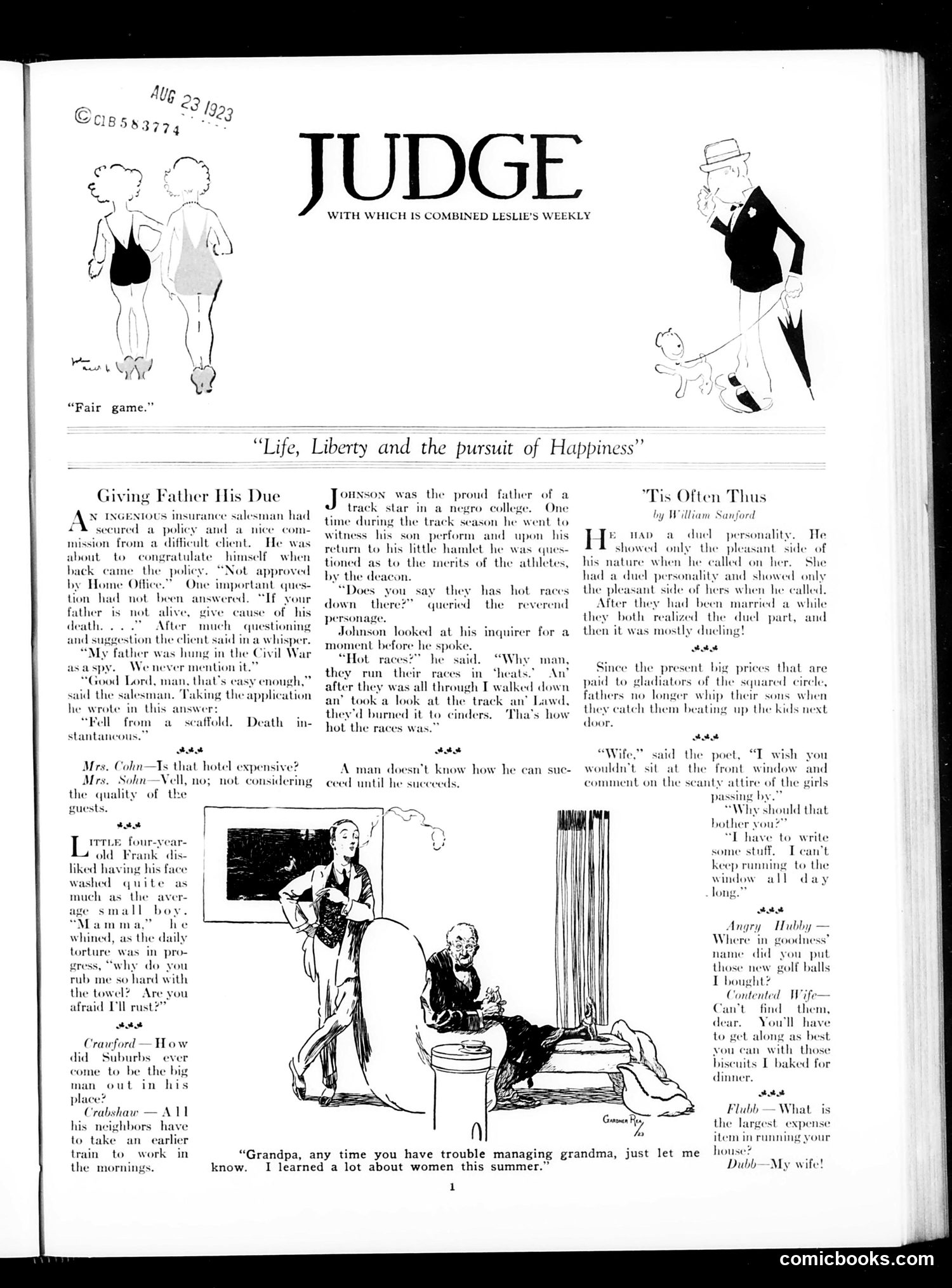
This page contains humor pieces and a central cartoon satirizing domestic life. The main illustration depicts a grandfather figure managing his granddaughter while her parents are away—the caption reads: "Grandpa, any time you have trouble managing grandma, just let me know. I learned a lot about women this summer." The joke relies on generational humor: the young man claims to have mastered "managing" women (likely through summer romance or courtship), then humorously applies this to his grandfather's marital dynamics. This reflects 1920s attitudes about gender relations and family hierarchy during a period of changing social norms. The surrounding text pieces address courtship, family obligations, and social etiquette—typical Judge magazine fare satirizing middle-class American life during the Jazz Age.
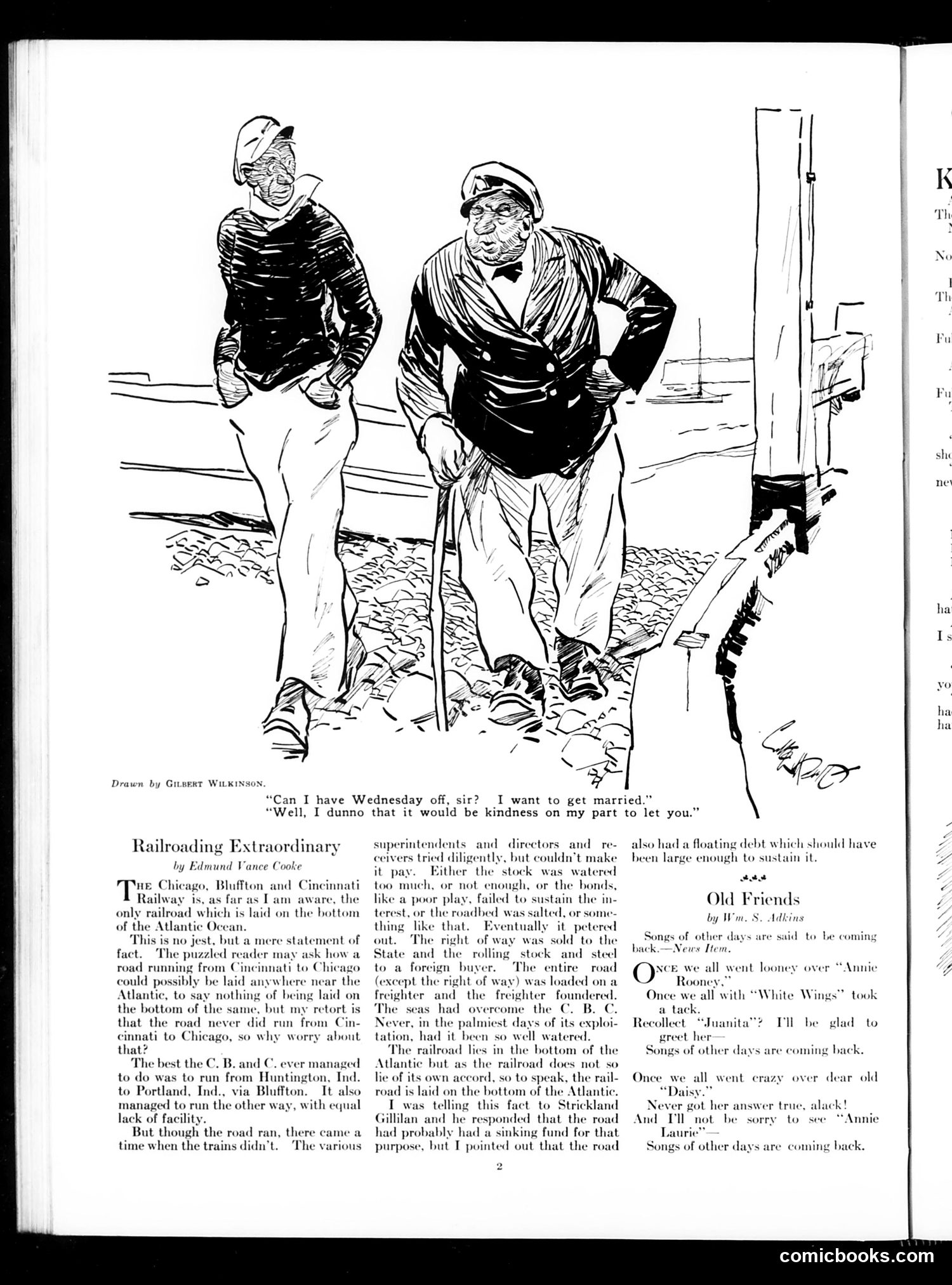
The top cartoon by Gilbert Wilkinson depicts two men on a beach near a boat. One asks his boss for Wednesday off, saying "I want to get married." The boss replies, "Well, I dunno that it would be kindness on my part to let you." This is workplace satire—mocking how employers of the era treated personal milestones as company business. The joke suggests the boss views an employee's marriage as a loss of productivity rather than a life event deserving accommodation. It reflects early 20th-century labor dynamics where worker autonomy was limited and employers held paternalistic control over employees' personal lives. The bottom section titled "Old Friends" contains nostalgic song lyrics referencing people like "Annie Rooney" and "Daisy"—likely popular entertainers or cultural figures of an earlier era, suggesting Judge's editorial reflection on changing times.
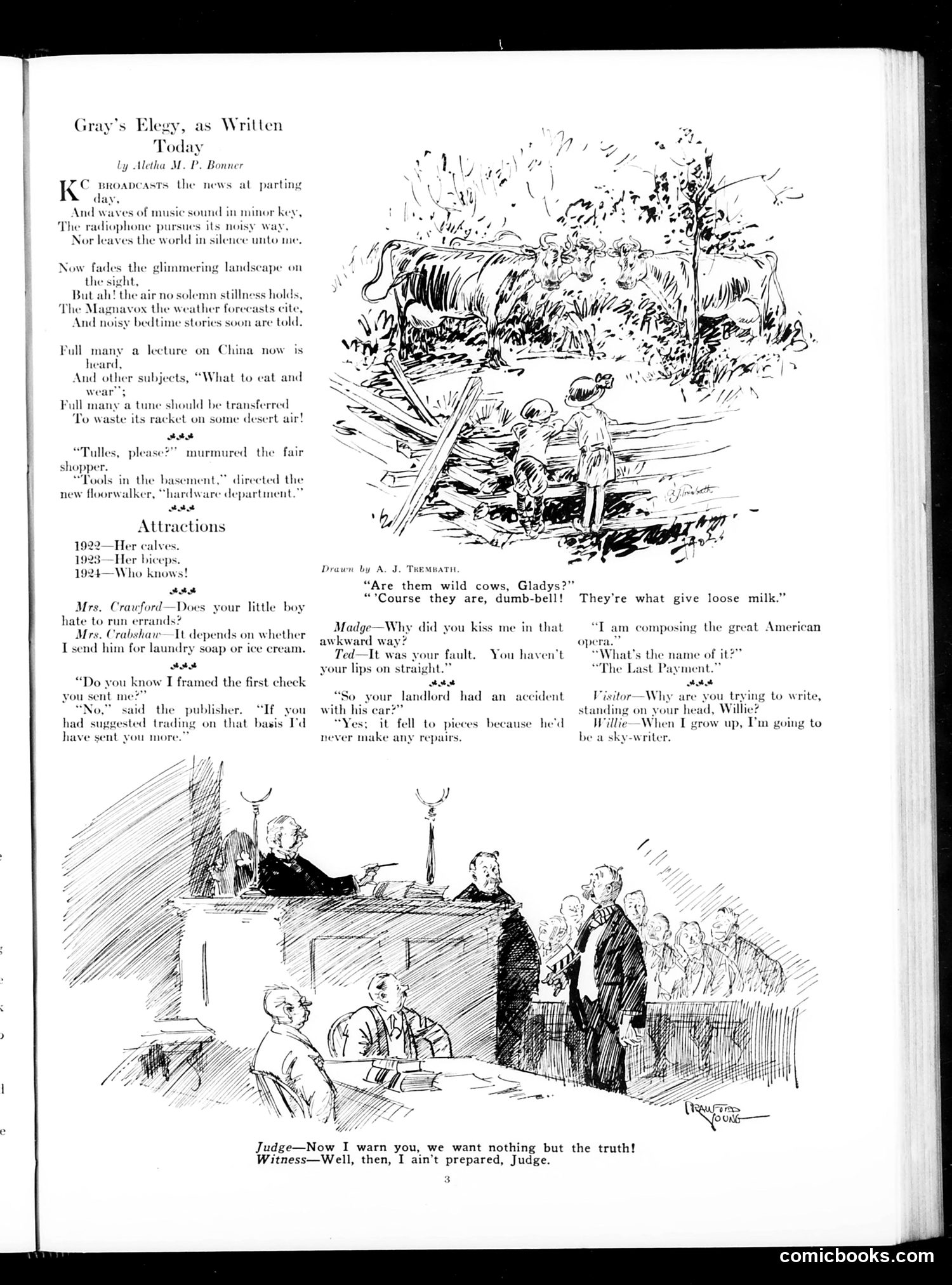
This page contains **Gray's Elegy as Written Today** by Matha M.P. Binner—a parody of Thomas Gray's famous 18th-century poem, updated with modern (early 20th-century) complaints about contemporary life: music in minor keys, weather forecasts, lectures on China, and waste of time and money. The **top illustration** by A.J. Tremerath shows rural cows, accompanying a dialogue about "dumb-bell" loose milk. The **lower cartoon** depicts a courtroom scene where a **Judge demands truth from a Witness**, who responds "I ain't prepared, Judge"—satirizing how unprepared witnesses commonly appeared in court proceedings, undercutting the legal system's search for truth. Both pieces mock modern inefficiency and unpreparedness.
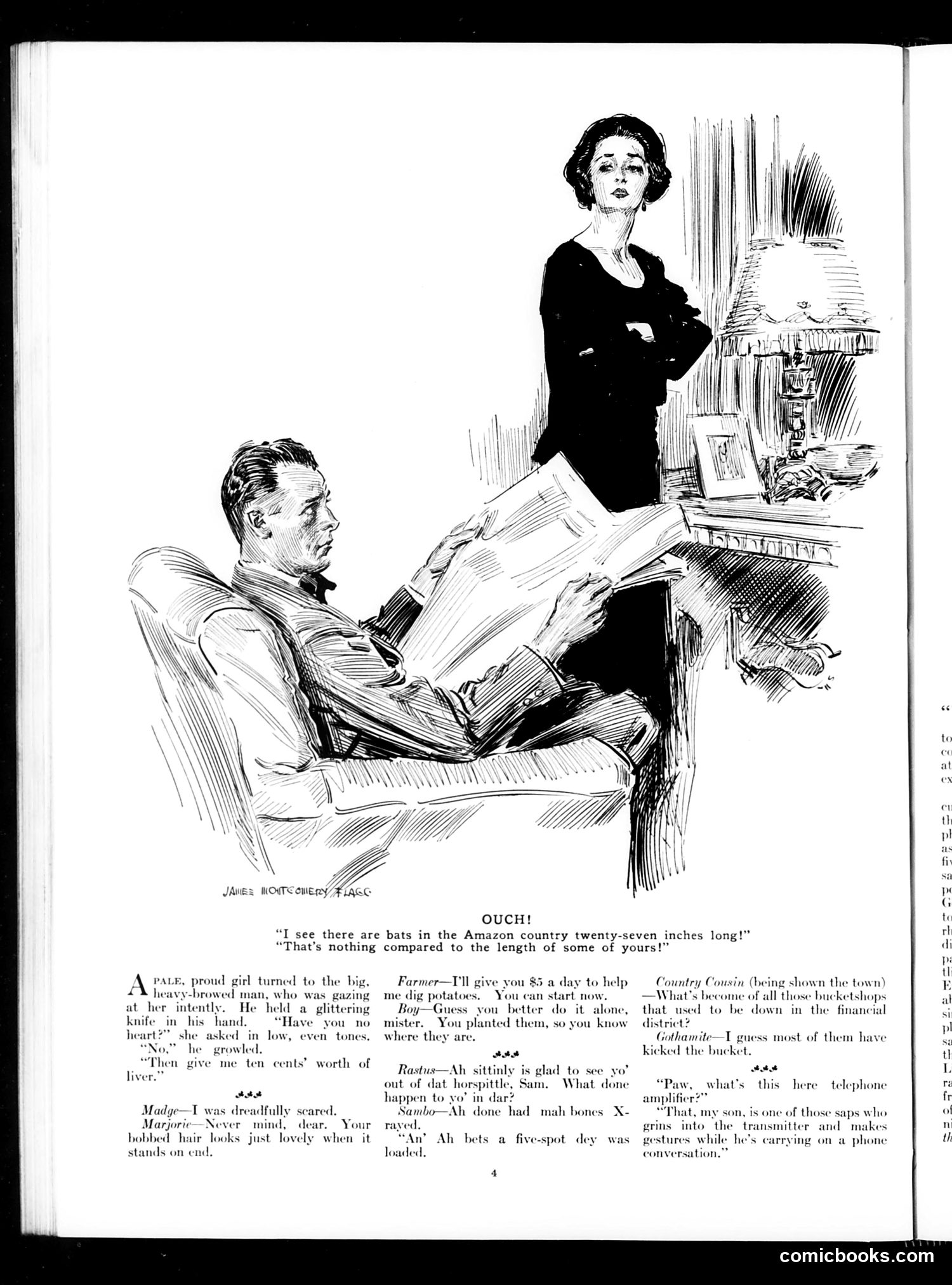
This cartoon satirizes gender dynamics and marital tensions of the early 20th century. A man reads a newspaper while a woman stands nearby, and he exclaims about Amazonian bats "twenty-seven inches long," to which she replies his are longer—a cutting insult about his ears or physical features. The dialogue below reveals domestic conflict: a woman complains her husband ignores her, while he counters that her "bobbed hair looks just lovely when it stands on end"—mocking the fashionable bob hairstyles women were adopting during this era. The humor targets both emasculated husbands and the "modern woman," reflecting anxieties about changing gender roles and the independence women were asserting during the 1920s.
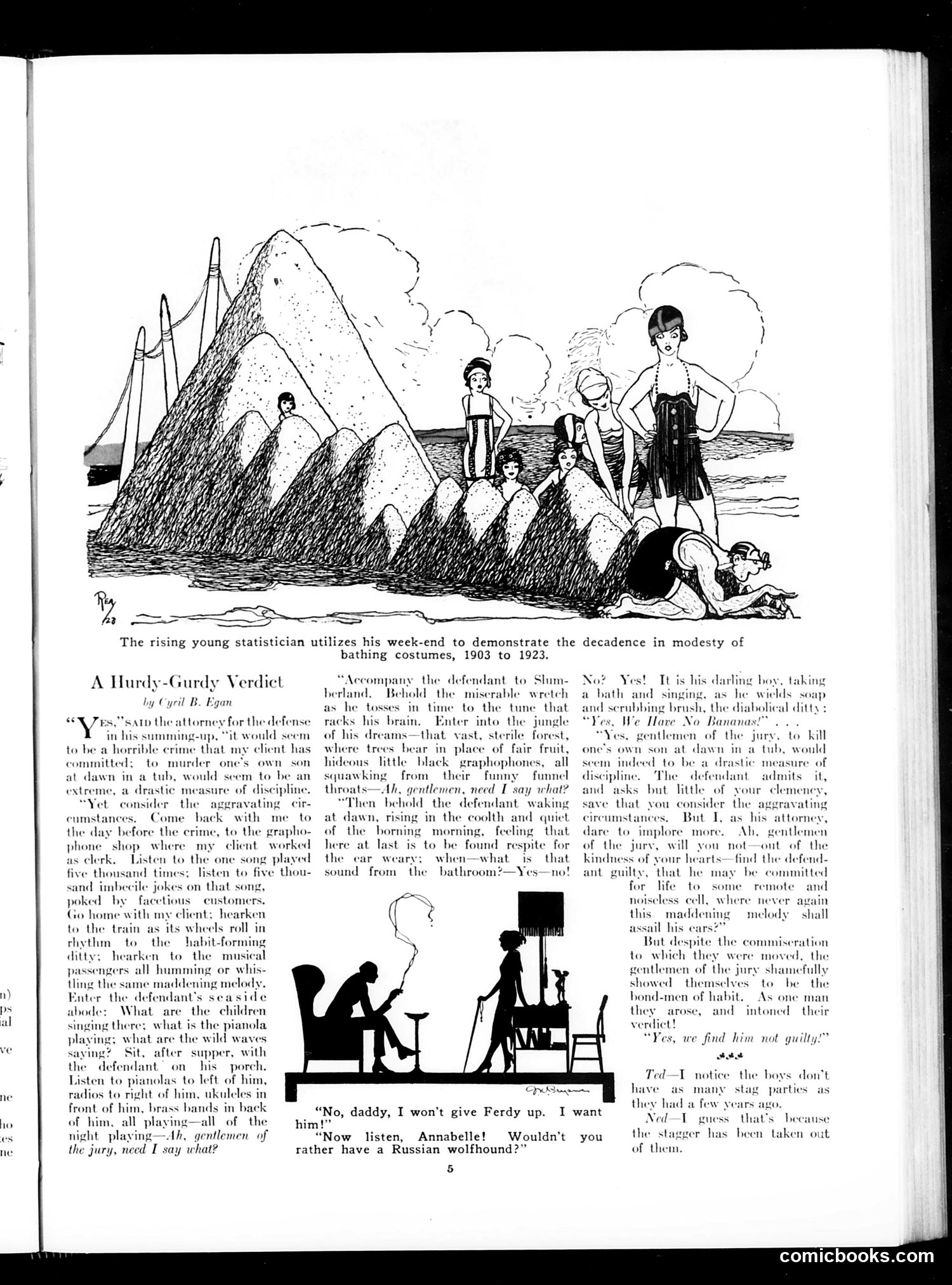
This satire mocks the popular song "Yes! We Have No Bananas" (1923), which had become ubiquitously played and ridiculously catchy. The cartoon shows a legal defense attorney arguing that a man who murdered his own son in a bathtub should be acquitted—because the boy was singing this maddening tune while bathing. The joke works through escalating absurdity: the attorney catalogs how the song follows the defendant everywhere (phonograph shops, trains, radios, pianolas, brass bands) until driving him to murder. The visual at top shows a "rising young statistician" documenting the decline in modesty of bathing costumes (1903-1923), perhaps suggesting modern society's broader moral decay. The verdict parody suggests the jury, driven to sympathy by this relatable torment, inexplicably finds the defendant "not guilty"—implying even they recognize the song as genuinely unbearable punishment. The satire targets both the song's overwhelming popularity and how mass media inescapably intrudes on daily life.
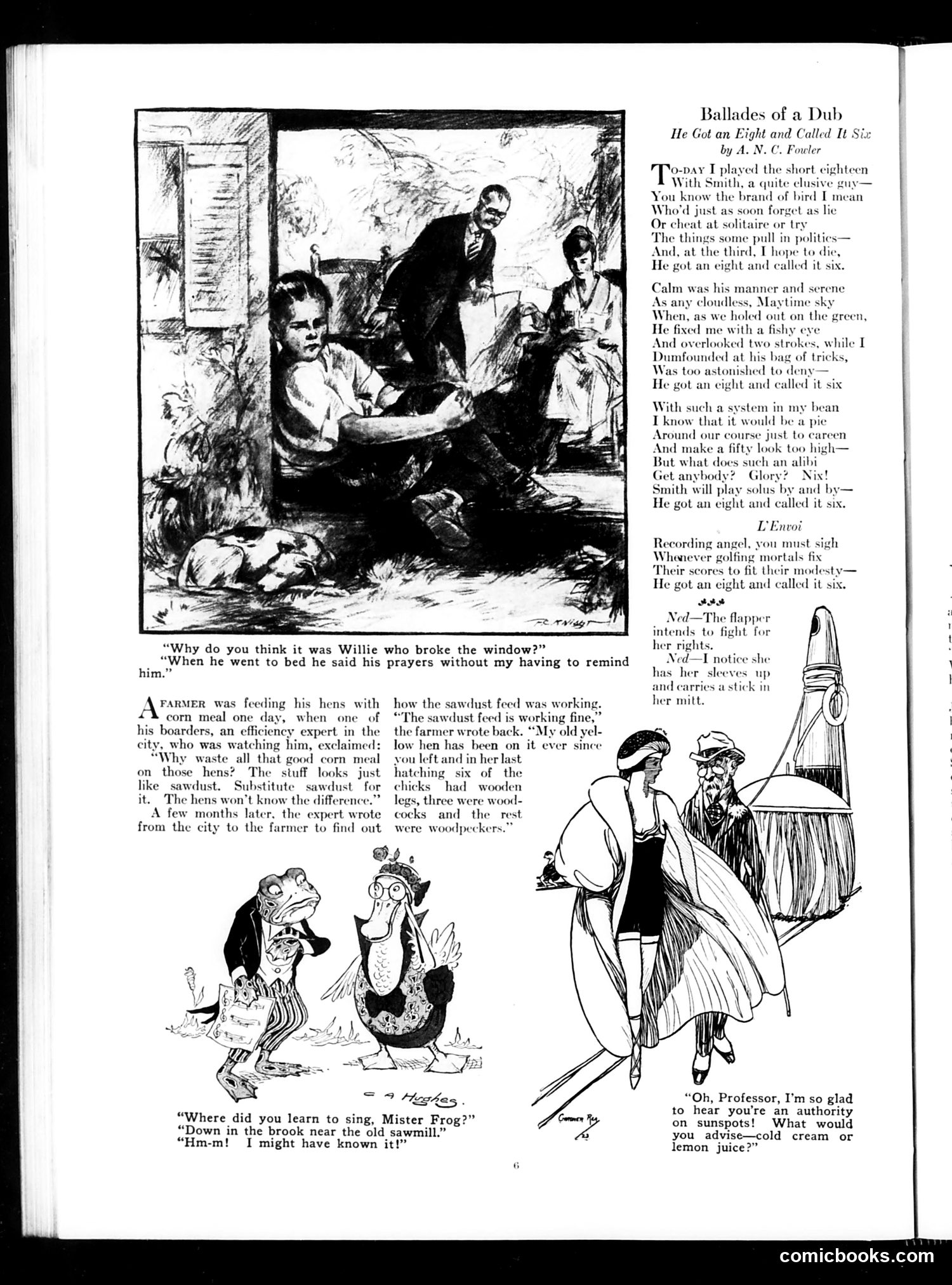
This page satirizes golf cheating and dishonesty through multiple sketches. The main ballad mocks a golfer named Smith who scores an eight but claims a six—a common form of golf fraud. The poem's repeated refrain "He got an eight and called it six" emphasizes how petty dishonesty pervades social circles, from golf courses to politics (referenced in verse one). The secondary cartoons extend the theme: a farmer's expert friend suggests substituting sawdust for expensive corn meal, resulting in hens with wooden legs—mocking false economy advice. Another sketch shows a woman ("the flapper") aggressively defending her rights, while the frog joke plays on misheard origins. The unifying message: American society is riddled with liars and cheaters—from golf partners fudging scores to con artists peddling bad advice. The satire targets masculine dishonesty, social pretense, and the difficulty of trusting anyone's word.
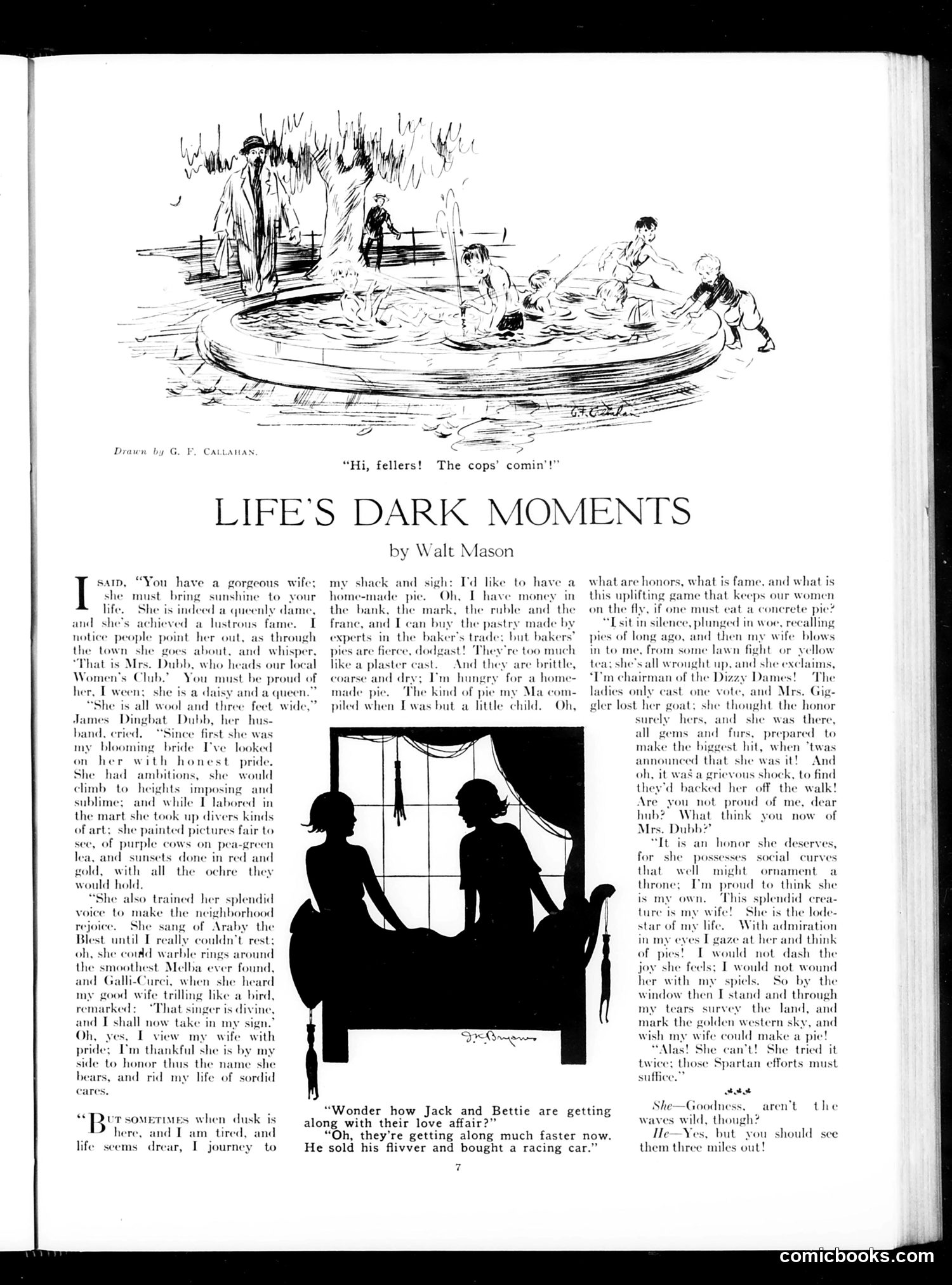
This page contains two distinct pieces by Walt Mason from Judge magazine: **Top cartoon**: A sketch of children playing in what appears to be a large circular pool or basin, with an adult warning "Hi, fellers! The cops' comin'!" The humor derives from the children's illicit recreation—likely trespassing or using a public/private space without permission—and the comedic panic at authority's approach. This reflects early 20th-century urban childhood mischief. **Main story**: A domestic satire contrasting a husband's pride in his accomplished wife (chair of the "Dizzy Dames" club, accomplished singer/artist) with his actual complaint: she cannot bake a decent pie. The joke mocks how husbands valued wives' domestic cooking skills above their social accomplishments and cultural achievements—a pointed critique of misplaced male priorities. **Bottom anecdote**: A brief joke about a couple "Jack and Bettie" whose romance accelerates when he trades his car (a "flivver") for a faster "racing car"—implying superficial relationship growth driven by automotive thrills rather than genuine affection. All pieces satirize early 20th-century social values and gender expectations.
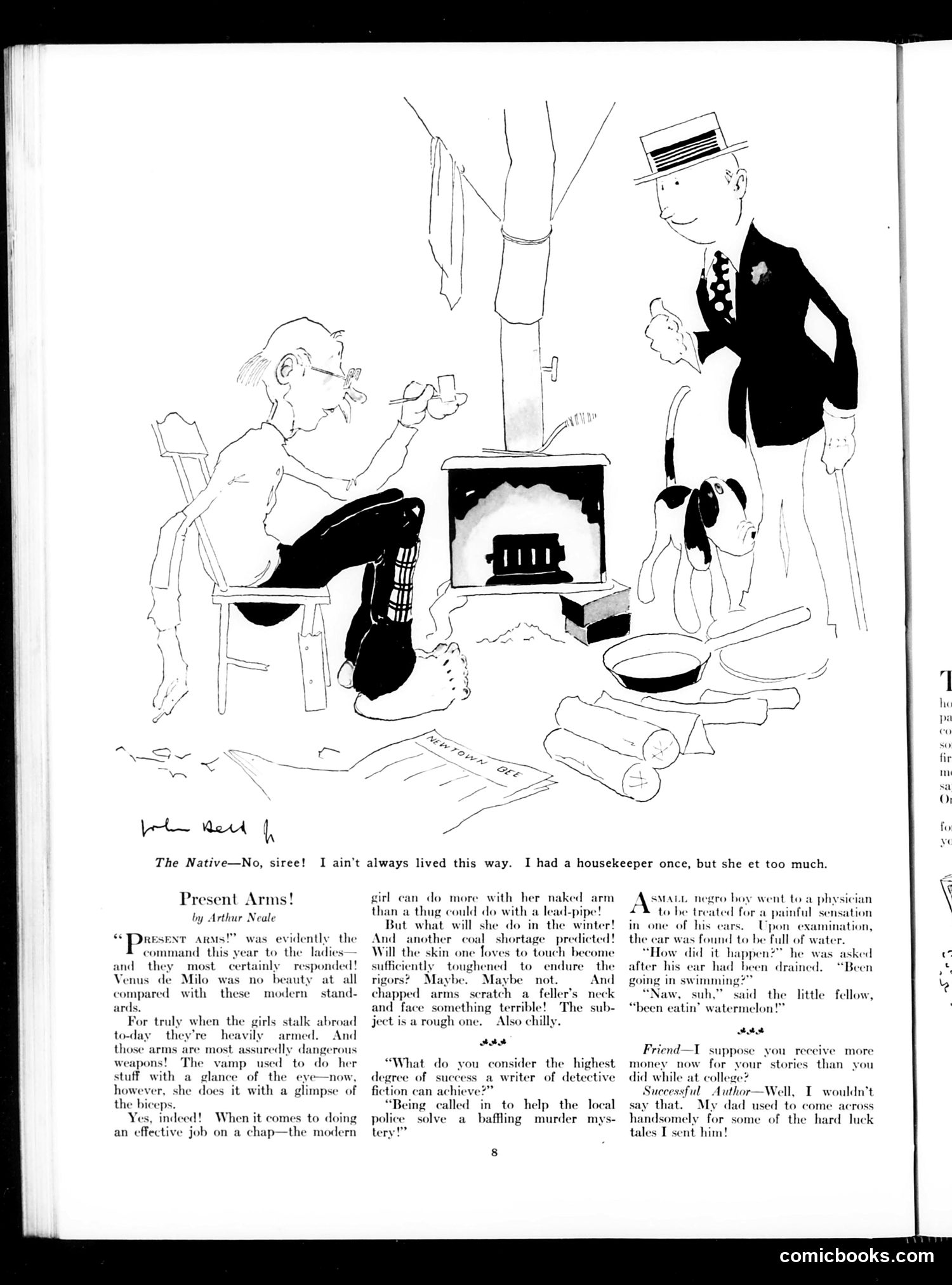
This page contains two distinct pieces of satirical content: **Main Cartoon ("Present Arms!"):** Satirizes the "modern woman" of the era (appears to be 1920s) and changing gender norms. The joke centers on women's exposed arms as a new form of attraction and power—replacing the demure "Venus de Milo" aesthetic with muscular, "armed" femininity. The satire mocks both the trend itself and practical concerns: what happens when coal shortages require warm clothing? Chapped arms scratching men's necks during intimacy? It's social commentary on women's liberation and changing beauty standards presented as absurd. **Sidebar Content:** Three brief humorous anecdotes mocking pretension and human nature—a Black boy mishearing "swimming" as "watermelon" (reflecting period racial stereotypes), and a writer admitting his father paid him more for fictional "hard luck" sob stories than he now earns professionally. The overall tone is light mockery of social change and contemporary foibles typical of Judge's satirical approach.
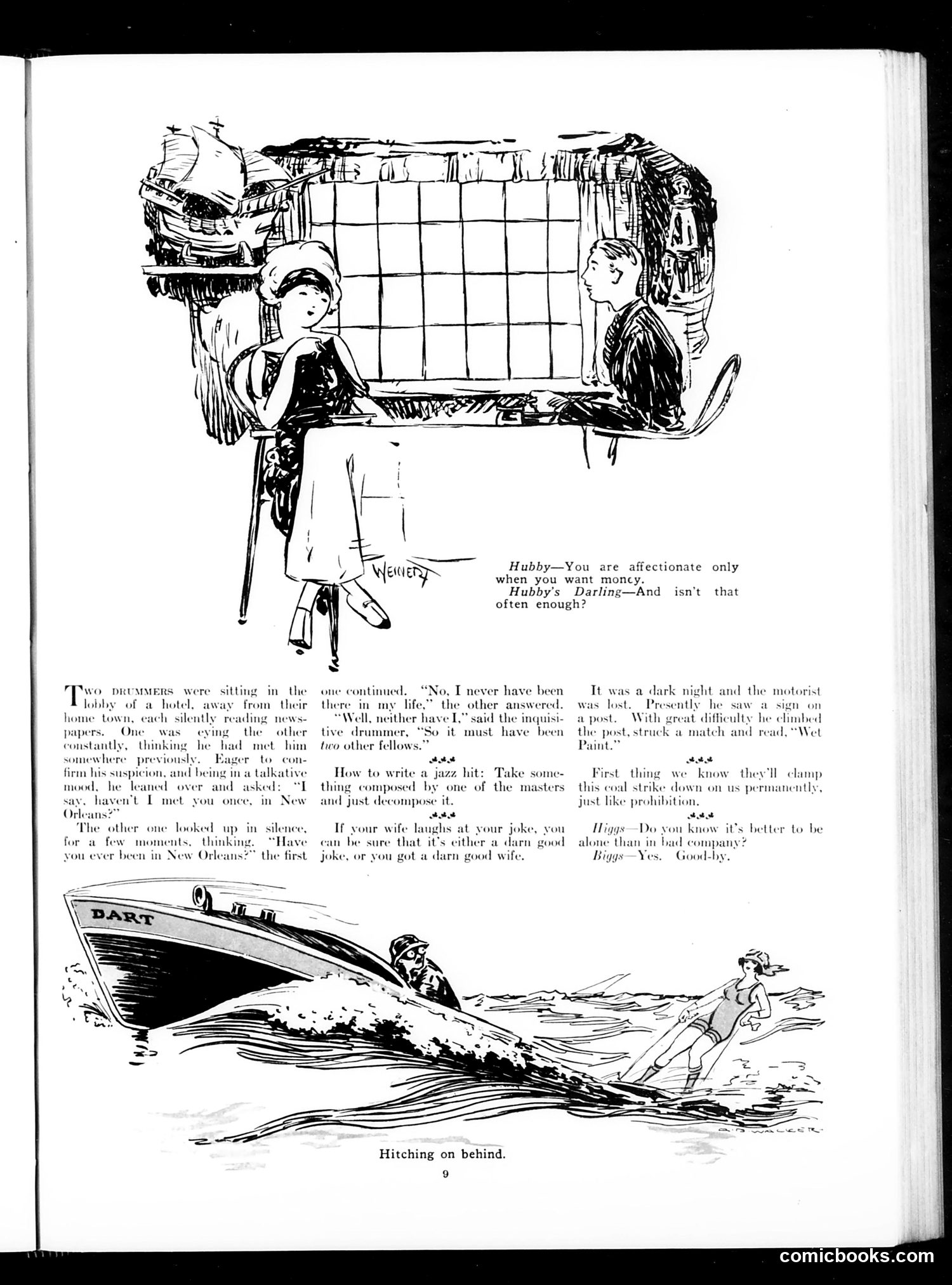
This page contains several unrelated short jokes and comic vignettes typical of Judge magazine's format: **Top cartoon**: Two traveling salesmen ("drummers") in a hotel lobby attempt conversation, each suspecting they've met before in New Orleans—but neither has actually been there. The joke plays on awkward small-talk and false familiarity among strangers. **Marital humor**: A husband complains his wife only shows affection when wanting money; she counters it happens "often enough"—satirizing transactional marriage dynamics. **Jazz joke**: Mocks 1920s jazz composition by suggesting taking classical masters' work and "decomposing" it—contemporary criticism of jazz as crude or derivative. **Bottom illustration**: Titled "Hitching on behind," shows a motorist who stopped at night, climbed a post to read a sign in the dark, only to find it says "Wet Paint"—absurdist humor about misplaced effort. The remaining quips target coal strikes, spousal relationships, and social etiquette. These reflect post-WWI American attitudes: skepticism of labor movements, domestic comedy, and period slang ("darn good").
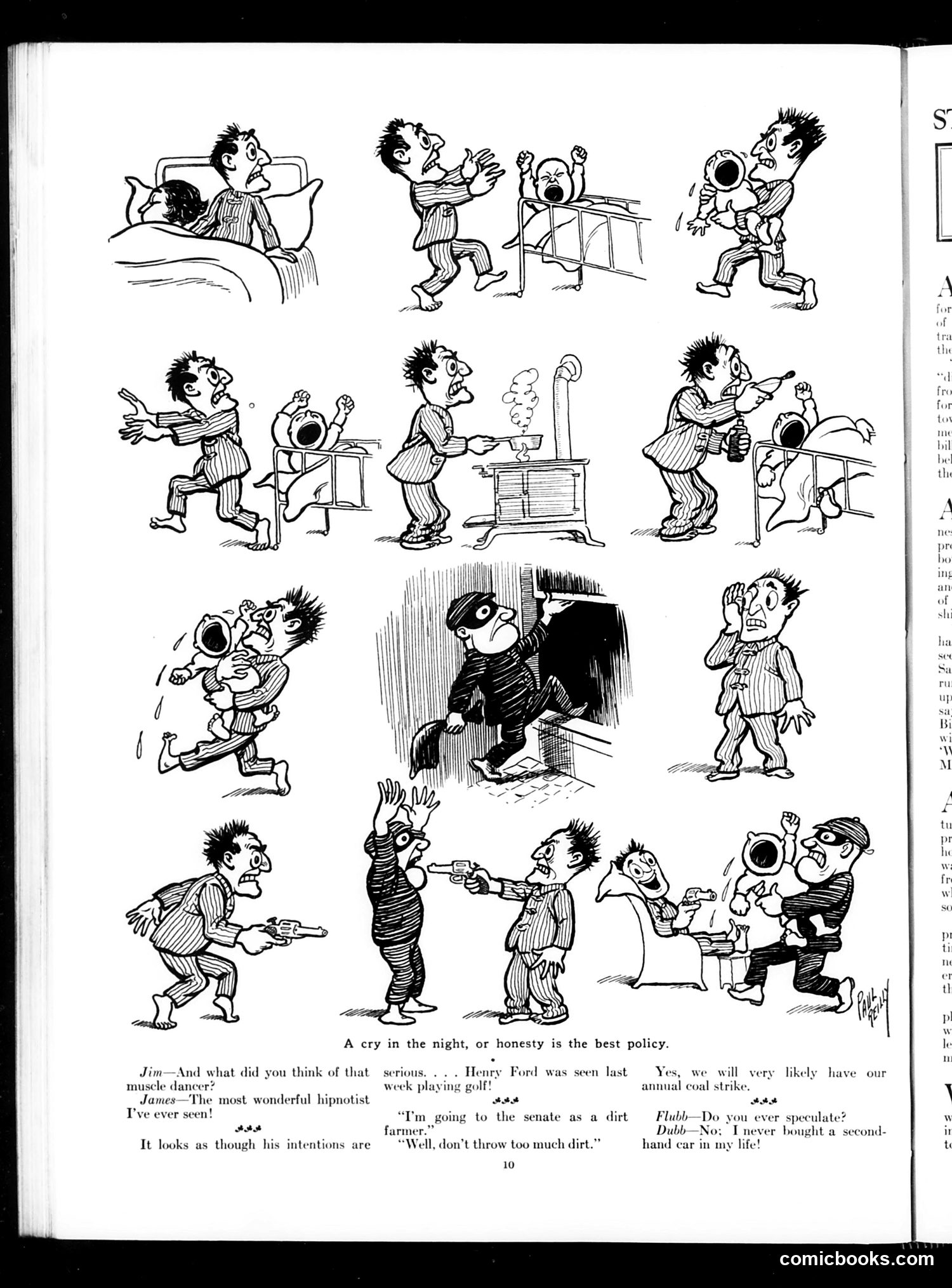
This page from *Judge* magazine presents a comic strip narrative about a domestic dispute. The central large panel shows a uniformed police officer intervening in what appears to be a marital conflict at night. The surrounding smaller panels depict escalating chaos—a man and woman arguing, children crying, furniture being thrown, and general household turmoil. The dialogue references Henry Ford and automobiles, suggesting commentary on American consumer culture and financial irresponsibility. The closing exchange between "Flubb" and "Dubb" mocks buying second-hand cars, implying poor financial decisions. The moral—"honesty is the best policy"—suggests the cartoon satirizes domestic discord stemming from deception or financial disputes during an era of rapid automobile ownership and consumer debt.
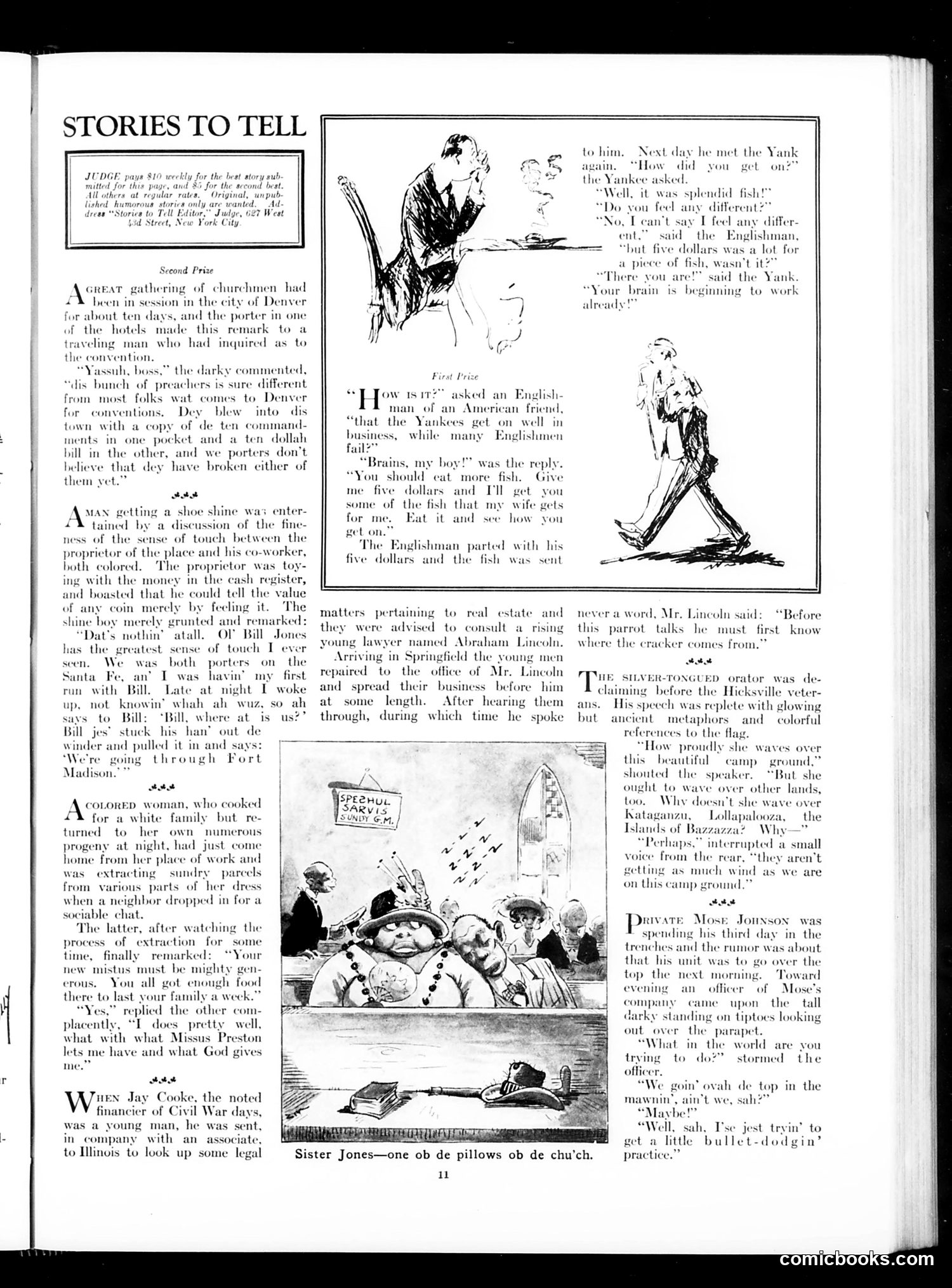
This page contains several short humorous stories exploiting racial stereotypes common to early 20th-century American comedy. The primary targets are African American dialect speakers and ethnic/national caricatures. **Key stories:** 1. **Denver clergy anecdote**: A porter jokes that visiting churchmen are unusually virtuous, carrying the Ten Commandments and money without breaking either—gentle satire on religious hypocrisy. 2. **Shoe-shine touch contest**: Two Black workers compete over sensory abilities; one claims his friend could identify locations by sticking his hand from a moving train—absurdist humor. 3. **Domestic worker theft**: A cook extracts food parcels from her dress, implied to be stealing from her employer. 4. **Yankee vs. Englishman**: The American claims eating fish improves brain function; the satire suggests both men are foolish. 5. **Orator's geography**: A speaker invents ridiculous place names; hecklers mock his wind metaphor. The cartoons and stories rely on period stereotypes about race, class, and national character that modern readers would find offensive.
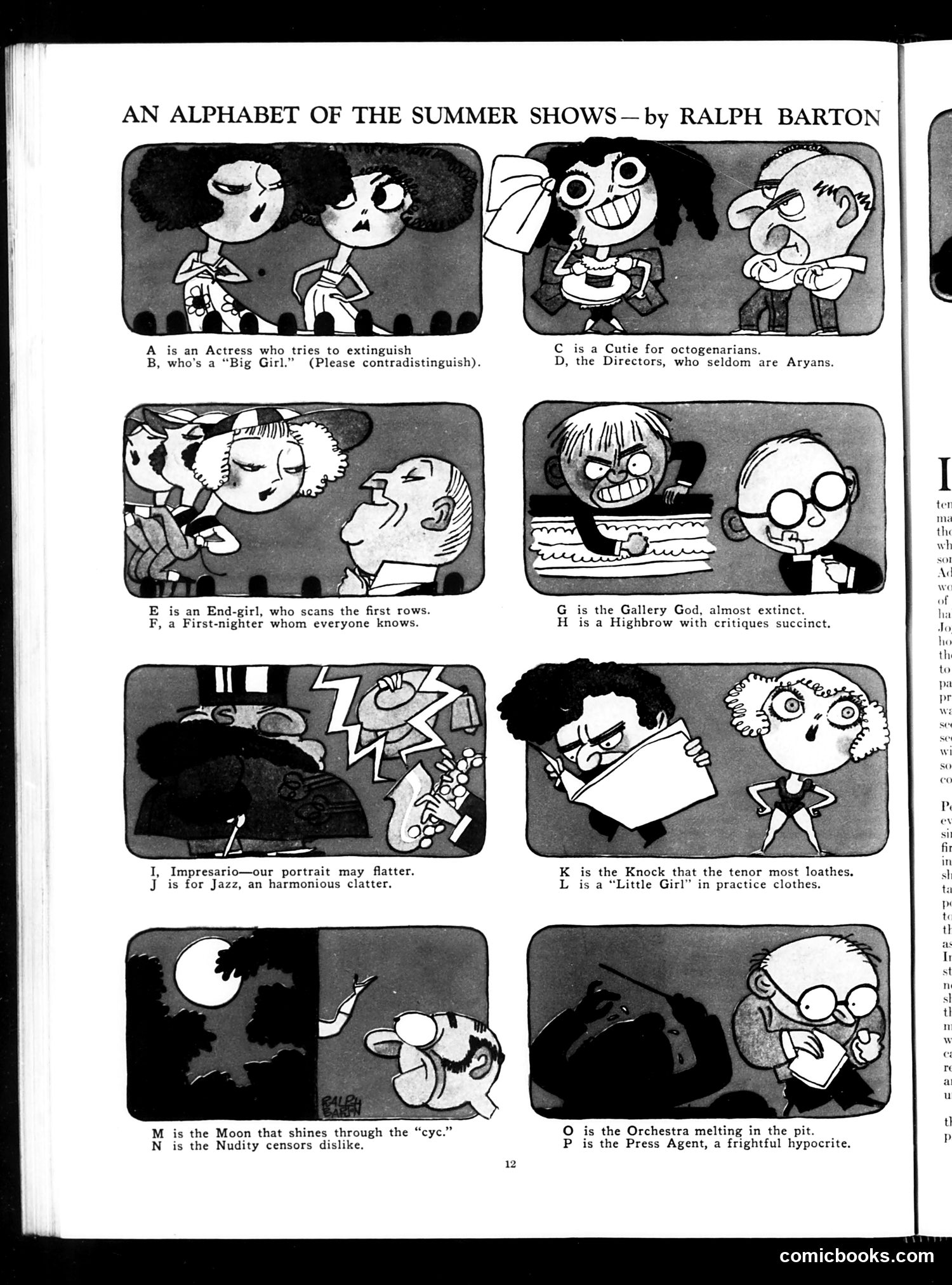
This is a satirical alphabet lampooning Broadway theater culture of the 1920s-30s. Barton caricatures various theater types and practices: actresses trying to upstage each other, chorus girls ("Big Girl," "End-girl"), pretentious impresarios and critics, and backstage personnel. The humor targets industry absurdities: jazz as "harmonious clatter," directors who "seldom are Aryans" (an antisemitic jab), sweating orchestras in theater pits, and hypocritical press agents. References to "nudity censors," tenors' sensitivity to stage noise, and "Little Girls in practice clothes" reflect period theatrical conventions and anxieties. The tone is insider mockery—Barton presents Broadway as vain, chaotic, and morally questionable, using exaggerated caricature to satirize both performers and the entertainment industry's superficiality.
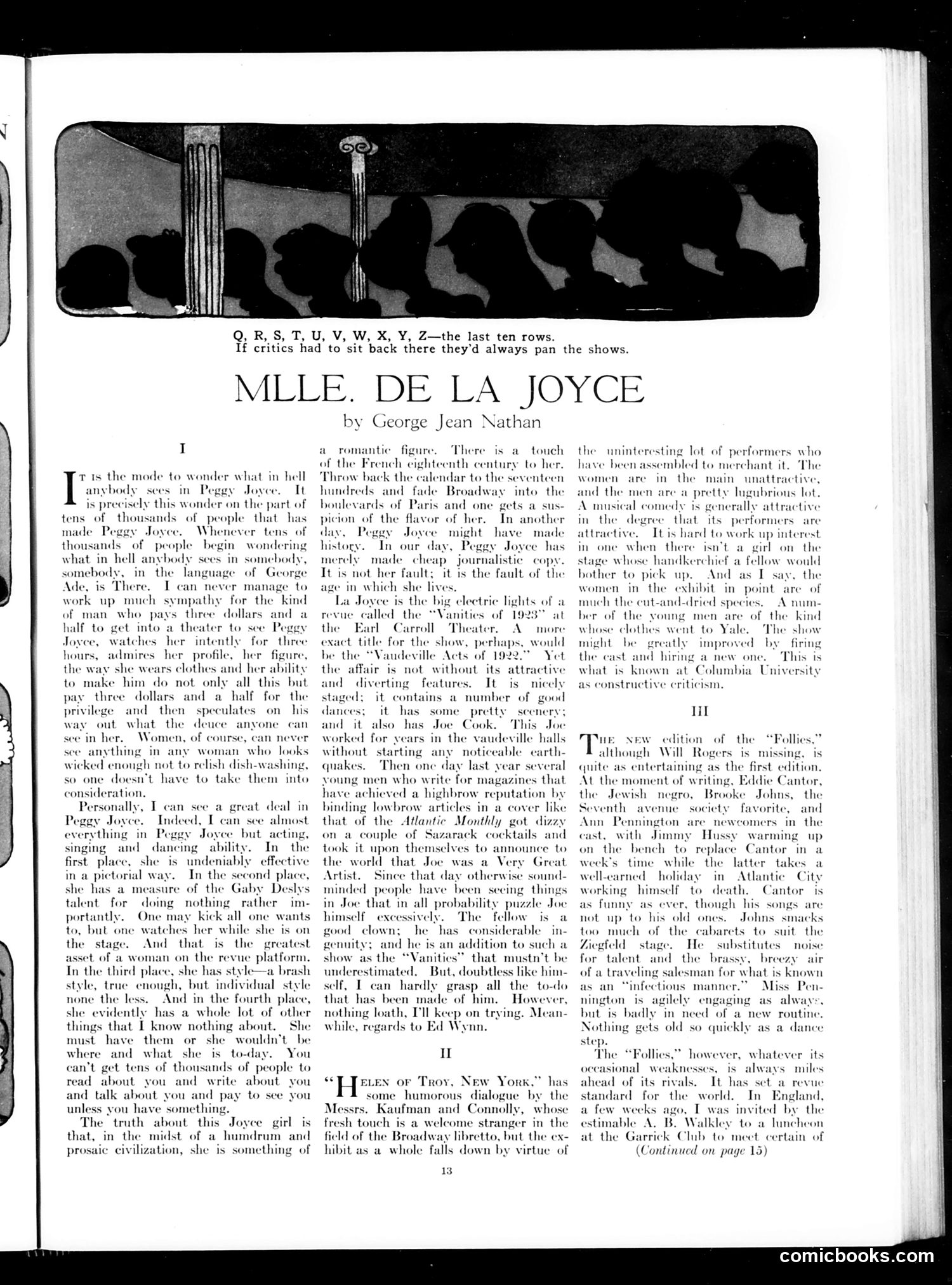
The silhouette cartoon at the top satirizes theater seating arrangements. The caption references rows "Q, R, S, T, U, V, W, X, Y, Z"—the back rows of a theater—and jokes that critics forced to sit there would "always pan the shows," suggesting critics' harsh reviews stem from poor sightlines rather than artistic merit. The article below reviews **Mlle. de la Joyce**, a popular Broadway performer of the early 1920s. Critic George Jean Nathan examines her appeal, acknowledging she attracts massive audiences despite lacking genuine talent in singing, dancing, or acting. He attributes her success to her glamorous "pictorial" presence and romantic mystique—she represents escapism in "humdrum and prosaic civilization." Nathan also discusses the revue "Vanities of 1923," praising performer Joe Cook while mocking intellectuals who suddenly declared him a "Very Great Artist" after reading highbrow magazine coverage, suggesting critics and tastemakers were prone to absurd reversals of opinion. The satire targets both celebrity culture and critical inconsistency.
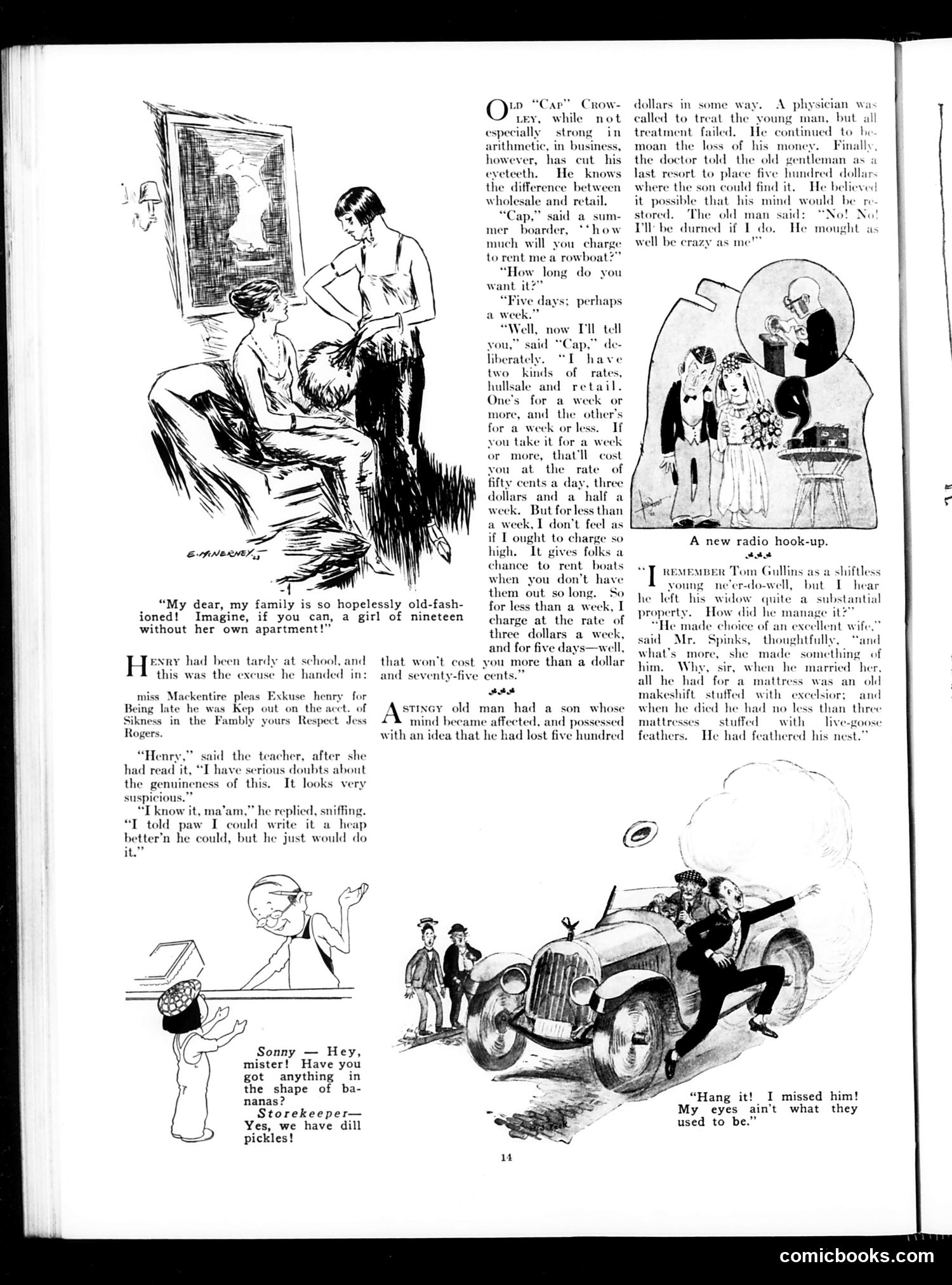
This page contains multiple satirical vignettes typical of early-20th-century American humor: **Top story**: "Cap" Crowley, a businessman with arithmetic skills but no sentimentality, refuses to help his emotionally devastated son recover from financial loss—even when a physician suggests placing money where the son might find it. Cap's refusal ("He mought as well be crazy as me") satirizes miserly fathers and the era's tension between fiscal responsibility and emotional support. **Rowboat rental dialogue**: Mocks overly complicated pricing schemes—"wholesale" versus "retail" rates for boat rentals—poking fun at small-business owners who overcomplicate simple transactions. **Tom Gullins anecdote**: Ironically praises a "shiftless" man who somehow left his widow substantial property, suggesting either hidden virtue or luck rewarding the undeserving. **School excuse**: A boy's deliberately bad handwriting in a tardiness note satirizes poorly educated parents trying to write formal documents. **Final joke**: A confused child asks for bananas but gets dill pickles instead—a play on miscommunication or the storekeeper's poor hearing.
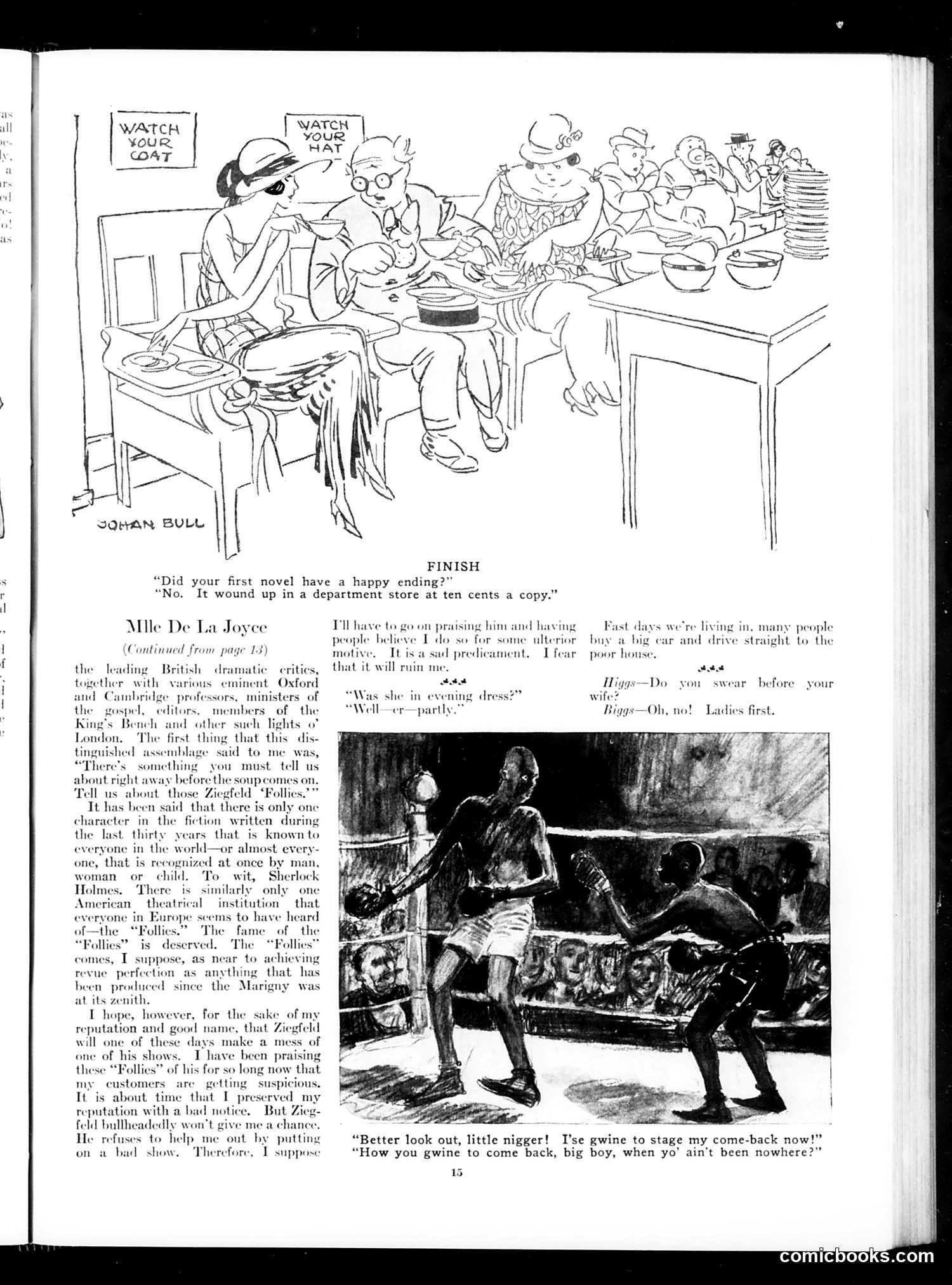
**Top Cartoon (by Johan Bull):** A humorous commentary on publishing failures. A writer boasts his novel had "no happy ending"—it ended up remaindered in a department store at discount prices, suggesting commercial failure rather than artistic tragedy. **Main Article:** A theater critic discusses the Ziegfeld Follies, a famous Broadway revue production. The text explains the Follies' outsized cultural fame—comparable to Sherlock Holmes in literature—and notes the critic's long praise of the shows has made customers suspicious of his motives. **Bottom Illustration & Dialogue:** This uses deeply offensive racial stereotypes and dialect ("I'se gwine," "little nigger") depicting what appears to be a theatrical comeback scenario. This reflects early 20th-century minstrelsy traditions that were prevalent in entertainment. **Context for Modern Readers:** This page illustrates period attitudes toward theater, publishing, and entertainment, but also demonstrates the casual racism embedded in contemporary American popular media—elements modern readers should recognize as historically significant but morally objectionable.
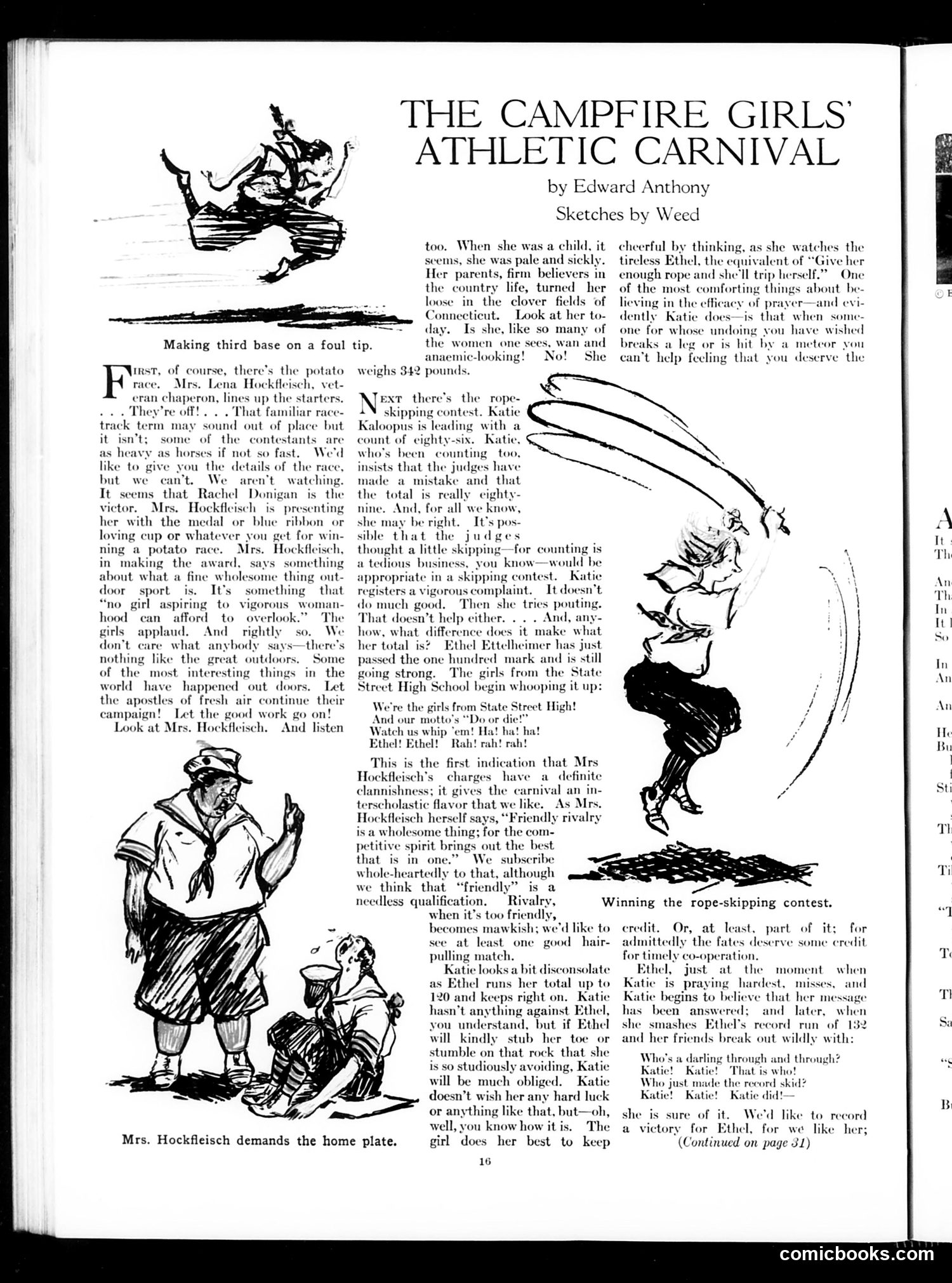
This 1910s humor piece satirizes the Campfire Girls organization through an athletic competition. The unnamed author mocks both the girls' physical extremes and their social pretensions. Mrs. Hockfleisch, the adult chaperone, embodies the satire's central target: she weighs 342 pounds despite preaching the healthful virtues of outdoor sport and "vigorous womanhood"—an obvious contradiction. The humor lies in exposing hypocrisy: she champions fresh air and athleticism while being the least athletic person present. The rope-skipping and potato races reveal competitive cattiness beneath claims of "friendly rivalry." Katie secretly hopes Ethel fails, and the State Street High School girls' "whooping" suggests clannish school loyalty rather than wholesome sportsmanship. The satire suggests the Campfire Girls' rhetoric about character-building masks ordinary teenage rivalries and social climbing. The phrase "friendly rivalry is a wholesome thing" is presented as naive corporate-speak masking actual mawkishness and competitiveness—typical Judge magazine critique of progressive-era organizations.
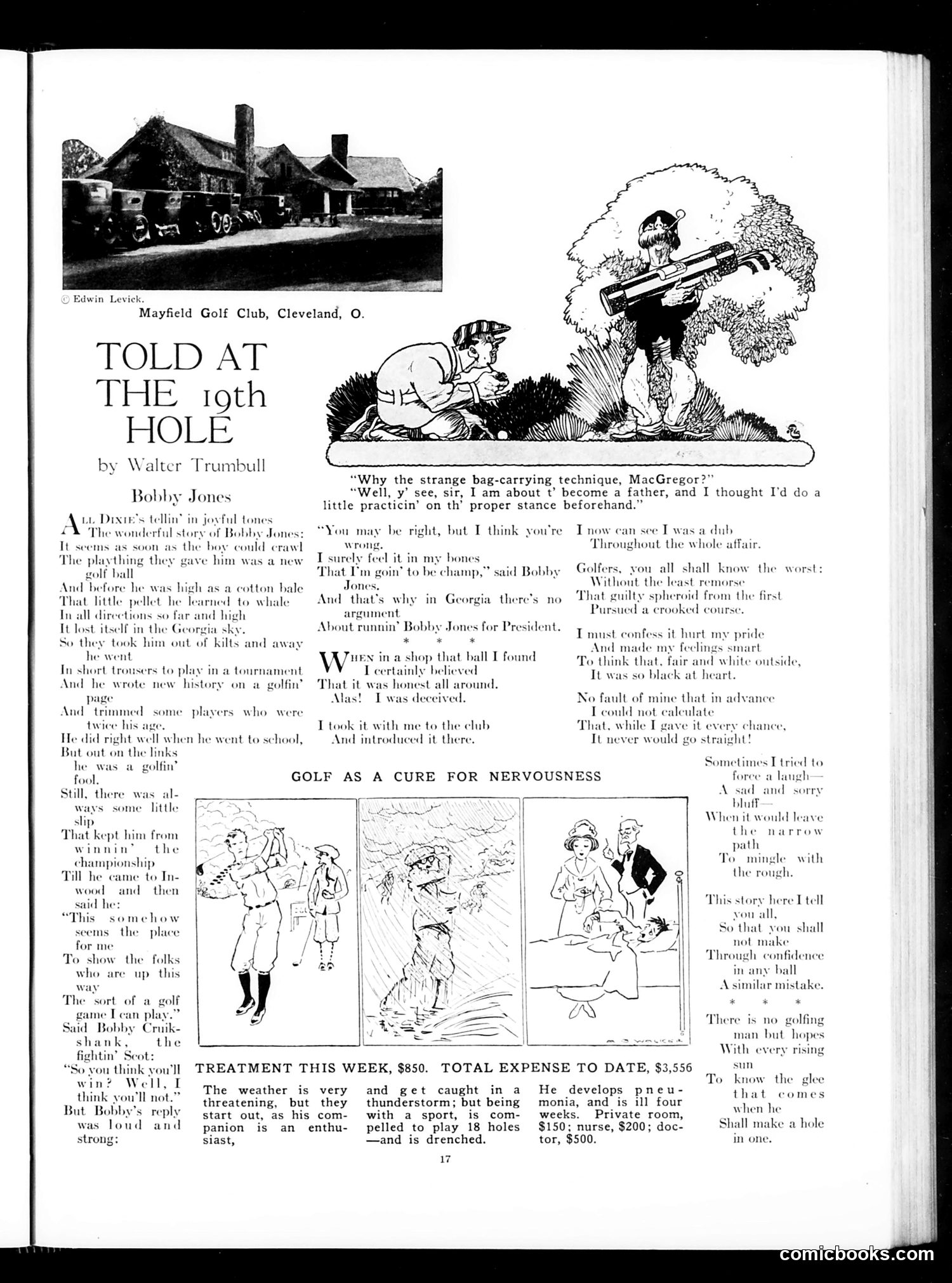
This page contains two distinct pieces about golf: **Main Story: "Bobby Jones"** by Walter Trumbull celebrates the real golfer Bobby Jones, a dominant American player of the 1920s. The narrative follows Jones from childhood through tournament success, with the joke that he's so skilled Georgians want to run him for President. The closing poem humorously personifies a dishonest golf ball with a dark interior ("fair and white outside, / It was so black at heart")—likely a racial joke typical of the era. **Lower Section: "Golf as a Cure for Nervousness"** satirizes wealthy sanitarium culture. Comic panels show a nervous patient prescribed golf treatment costing $850/week. He catches pneumonia after playing in a thunderstorm and becomes severely ill, with total expenses reaching $3,556—suggesting the absurdity of "cure" treatments that actually worsen patient health. This mocks both medical quackery and the leisured class's frivolous spending. The Mayfield Golf Club photograph establishes golf as an upper-class pursuit.
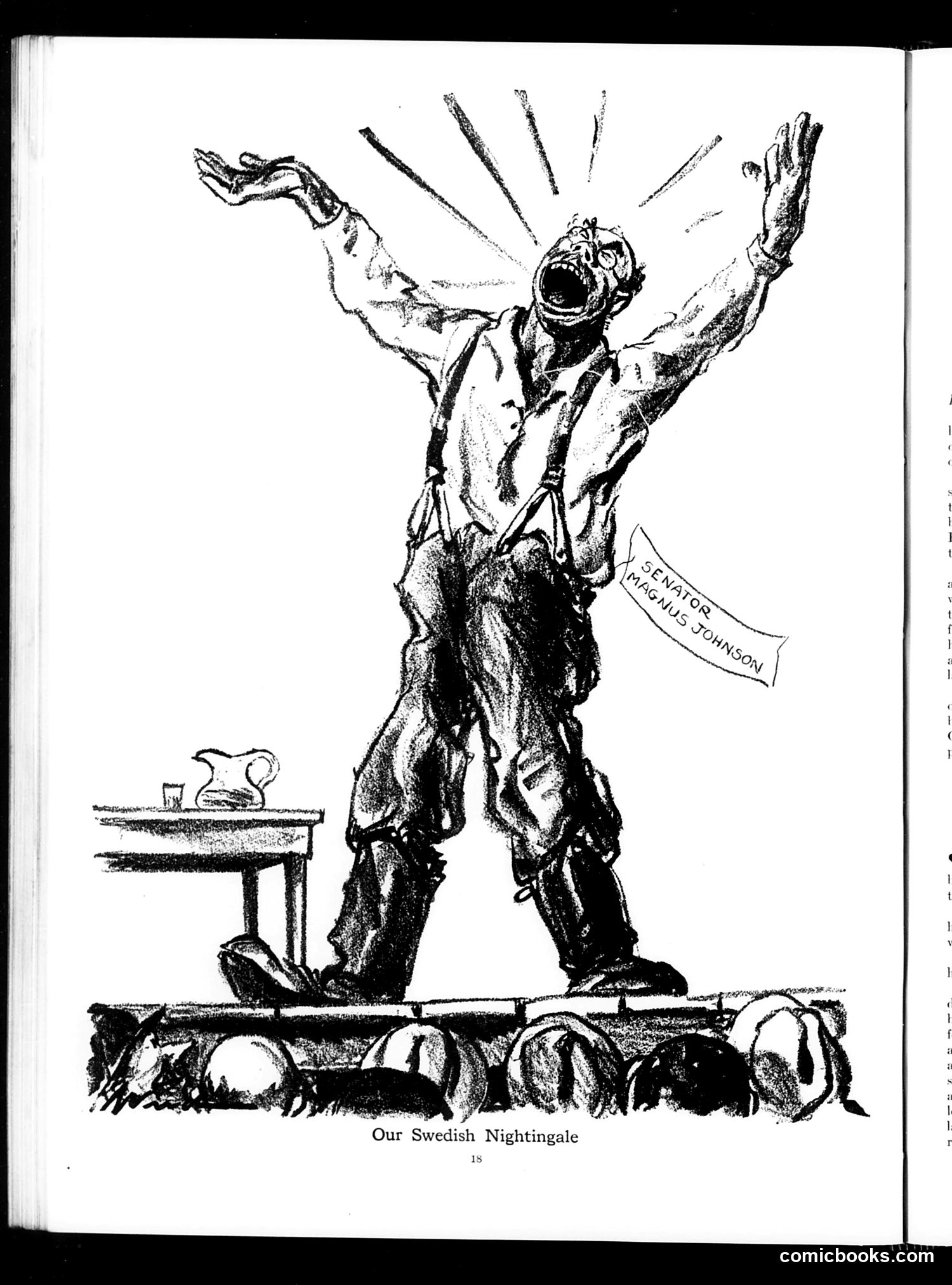
This cartoon depicts a triumphant figure with arms raised exultantly, standing on a platform surrounded by what appear to be bowler hats (suggesting an audience or crowd). The label credits "Senator Magnus Johnson," and the title references "Our Swedish Nightingale"—a nickname historically associated with Jenny Lind, the famous 19th-century Swedish opera singer. The satire likely mocks Senator Magnus Johnson (a real Minnesota politician of Swedish descent) by comparing him to the celebrated opera singer, perhaps suggesting he's receiving excessive praise or adulation, or mockingly elevating his status. The theatrical, triumphant pose emphasizes the satirical exaggeration. Without additional context about Johnson's specific recent actions or statements, the precise political target remains somewhat unclear, but the cartoon ridicules him through flattering-yet-ironic comparison.
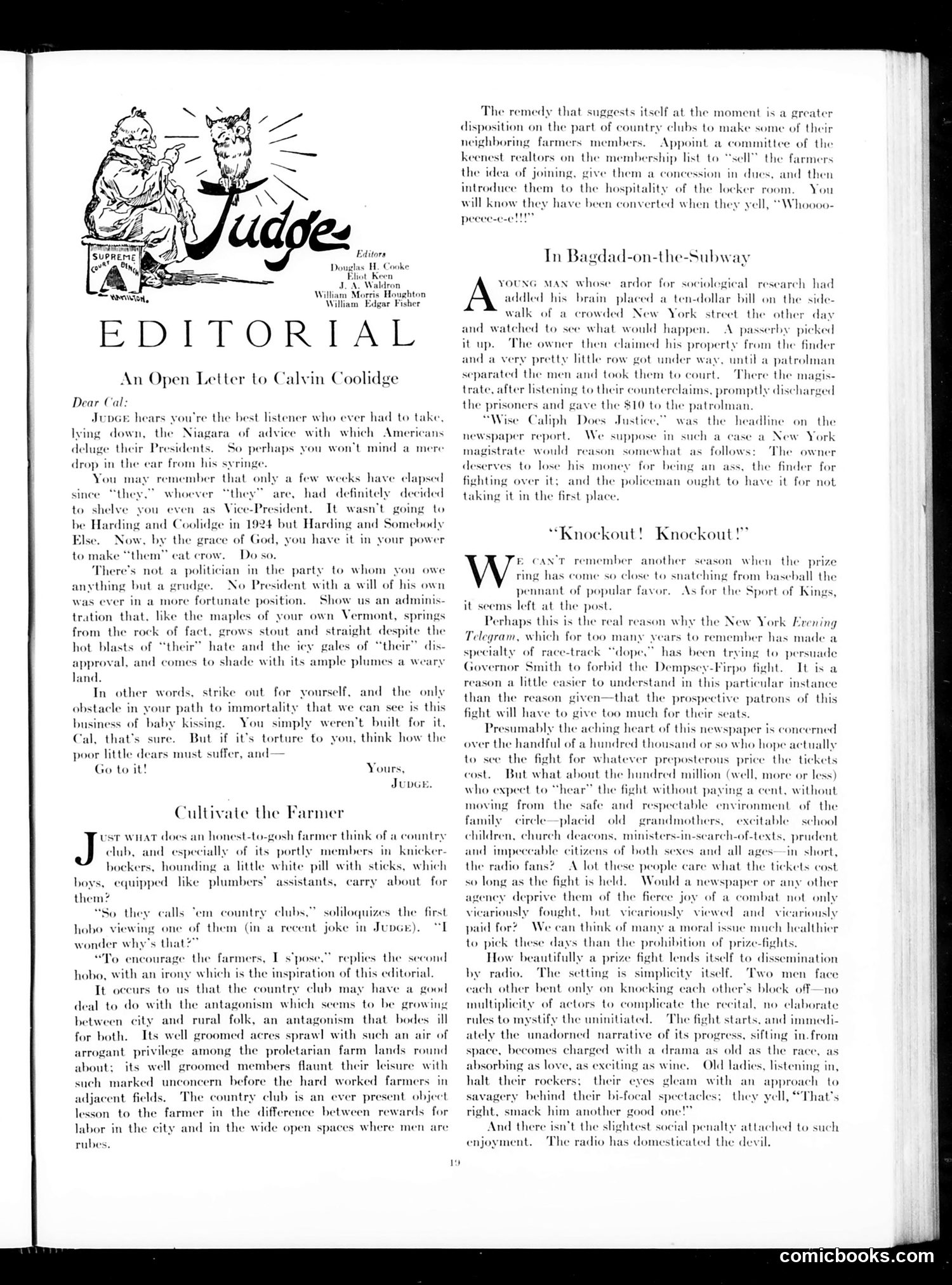
This page contains **two separate editorials** addressing different social issues circa the 1920s. **"An Open Letter to Calvin Coolidge"** urges the newly-ascended President (following Harding's death) to act independently rather than be controlled by party interests ("they"). The letter advises Coolidge to "strike out for yourself" and establish an administration grounded in fact rather than political manipulation—though it jokes that his one weakness is "baby kissing" (a required political ritual he apparently dislikes). **"Cultivate the Farmer"** critiques the growing urban-rural divide. It mocks country clubs as symbols of urban privilege flaunting leisure before hardworking farmers in adjacent fields. The satire suggests clubs should recruit farmers as members to bridge this antagonism, predicting farmers would become "converted" once experiencing club hospitality. **"In Bagdad-on-the-Subway"** (partially visible) satirizes a peculiar incident where a sociologist's experiment with a dropped $10 bill resulted in a court case—with the patrolman, not the claimants, receiving the money. The headline "Wise Caliph Does Justice" treats New York courts ironically.
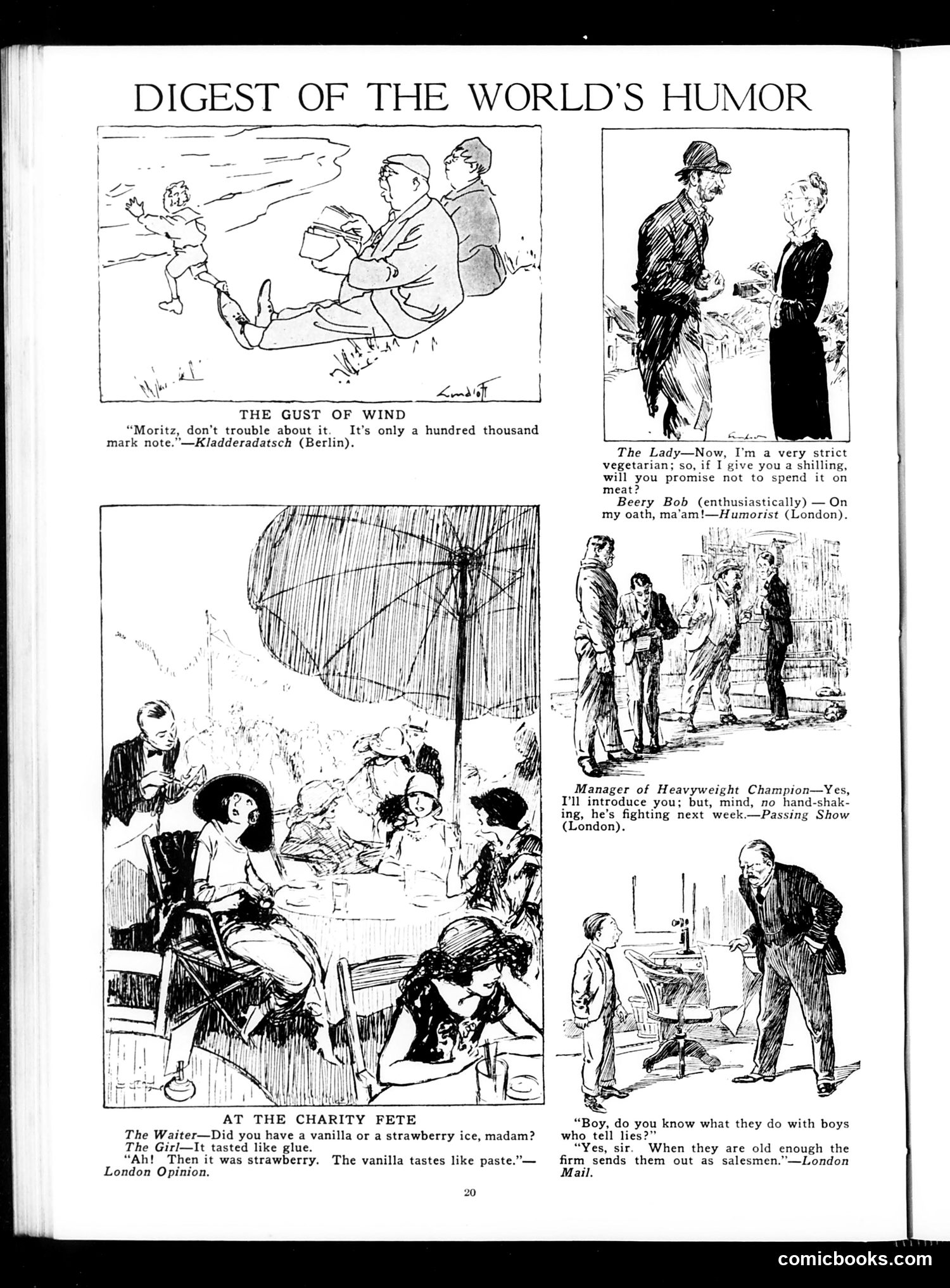
This page collects brief comic strips and jokes from international satirical publications, showcasing early 20th-century humor across different countries. **Key jokes explained:** 1. **"Gust of Wind"** (Berlin): A man loses a hundred-thousand mark note—likely referencing German hyperinflation, when currency became nearly worthless. 2. **"The Lady/Beery Bob"** (London): A teetotaler gives a beggar money with conditions he won't buy alcohol; he swears an oath he won't—the joke being his obvious dishonesty. 3. **"Charity Fete"** (London): A waiter confuses vanilla and strawberry ice flavors, both tasting terrible—slapstick restaurant humor. 4. **Heavyweight Champion** (London): A boxer's manager warns against handshakes before a fight, treating the boxer's hands as precious commodities. 5. **Final joke** (London): Boys who lie become salesmen—cynical commentary suggesting salesmen are inherently dishonest. The page represents Judge's practice of reprinting international humor to amuse American readers with global wit.
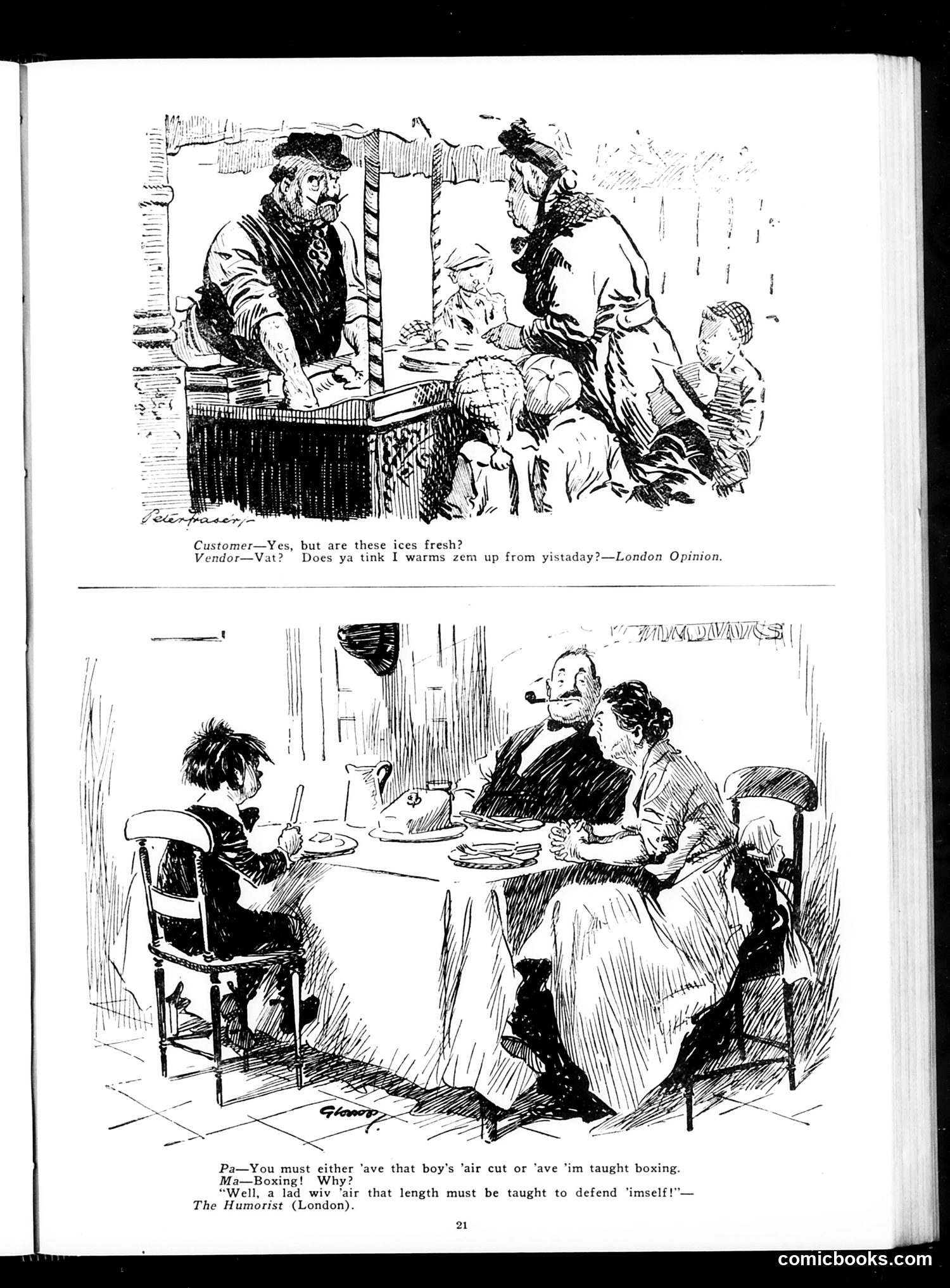
This page contains two separate cartoons reprinted from British humor magazines. **Top cartoon** mocks an ice vendor with a heavy accent (rendered phonetically: "Vat?" for "What?") who's being questioned about product freshness. The joke plays on the vendor's defensive response and implied poor hygiene practices. **Bottom cartoon** satirizes working-class parental attitudes about masculinity and grooming. A father insists his long-haired son either get a haircut or learn boxing—reasoning that long hair on a boy will invite fights, so he'd better be able to defend himself. The joke targets both the father's crude logic and the period's anxieties about masculine appearance and toughness among working-class youth. Both cartoons use dialect and class markers for comedic effect, reflecting early 20th-century British humor conventions.
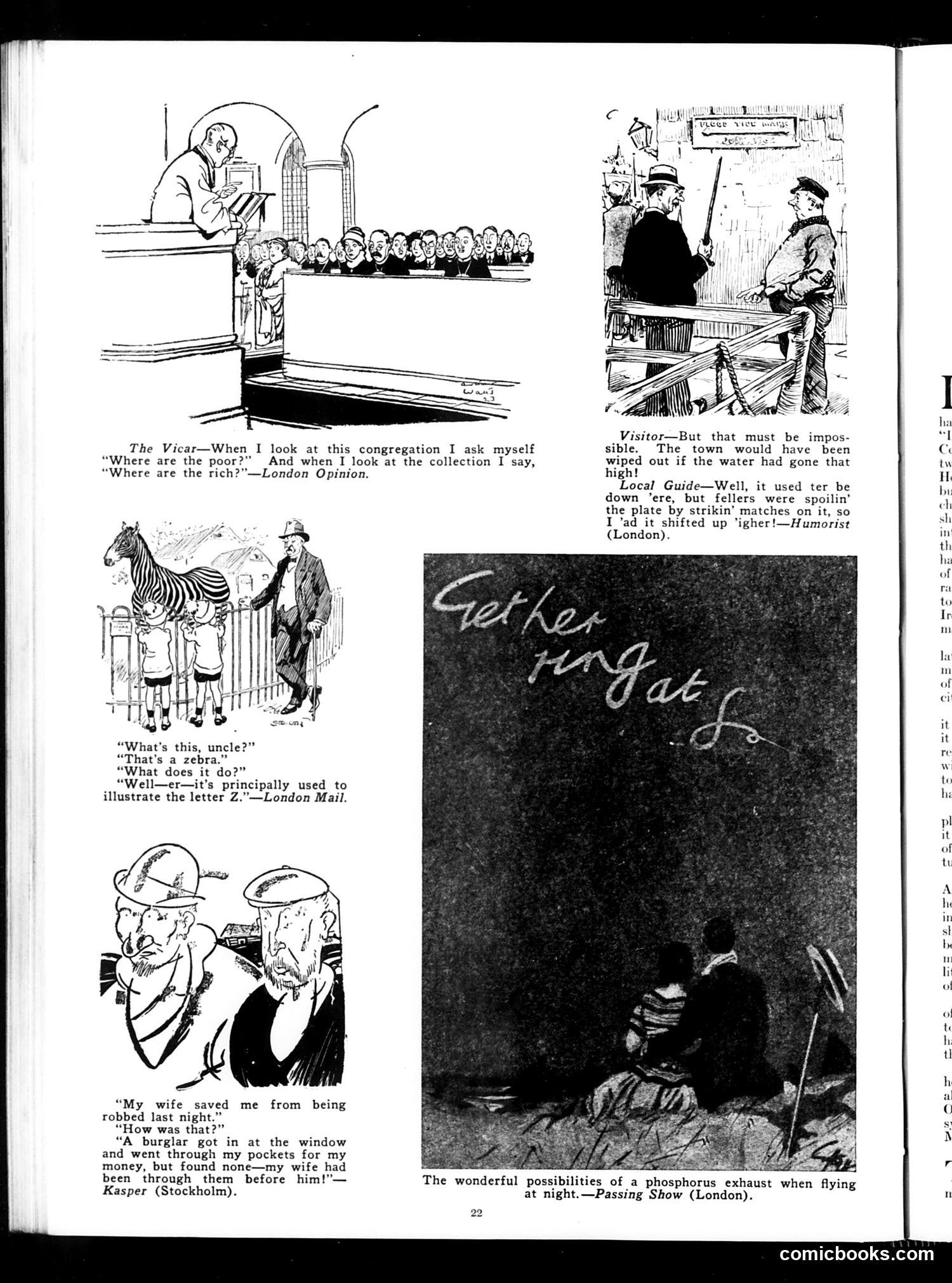
This page collects several brief satirical jokes typical of early 20th-century humor magazines: **Top cartoon**: A vicar (Anglican priest) observes his congregation is neither poor nor rich—a joke about the middle-class respectability of his church. The punchline satirizes that church collections reveal economic reality: the poor can't afford to give much, the rich don't contribute generously. **Zebra joke**: A child's innocent question about what zebras do is answered with a pun—zebras "illustrate the letter Z"—typical wordplay humor of the era. **Burglar joke**: A man thanks his wife for saving him from robbery because she'd already emptied his pockets—darkly comic commentary on marital finances and nagging wives, a common trope. **Bottom image**: A photograph (not cartoon) showing phosphorus exhaust from night aviation—presented as visually spectacular, reflecting contemporary fascination with early aviation technology. The page demonstrates Judge's formula: mixing social commentary, puns, and contemporary marvel coverage for middle-class readers.
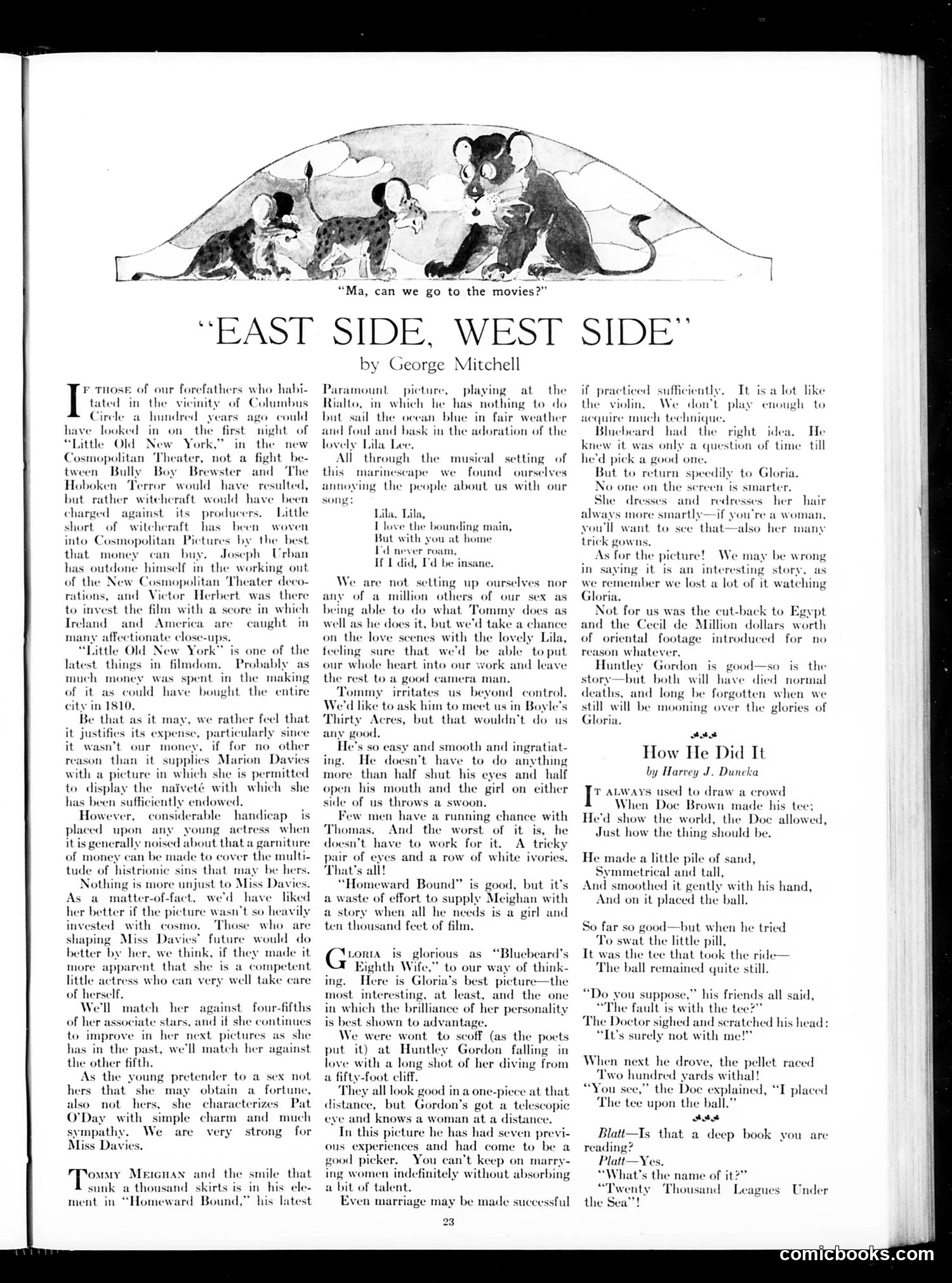
The cartoon at top shows mice asking their mother, "Ma, can we go to the movies?"—a visual pun on the review below about "East Side, West Side," a film featuring Tommy Meighan and Lila Lee. The article is a film review from *Judge* magazine praising Marion Davies' performance in "Little Old New York" while gently mocking the excessive spending on its production. The reviewer suggests Davies is competent but overshadowed by her film's lavish investment. The second review praises Tommy Meighan's charm in "Homeward Bound," sarcastically noting he needs only to "half shut his eyes" and "half open his mouth" to make actresses swoon—he's so naturally charismatic he doesn't need to act. The reviewer ironically wishes to challenge him physically ("Boyle's Thirty Acres") but admits Meighan's effortless appeal is irresistible. Both reviews reflect 1920s fan-magazine style: mixing genuine critique with playful celebrity gossip about Hollywood's biggest stars and expensive productions.
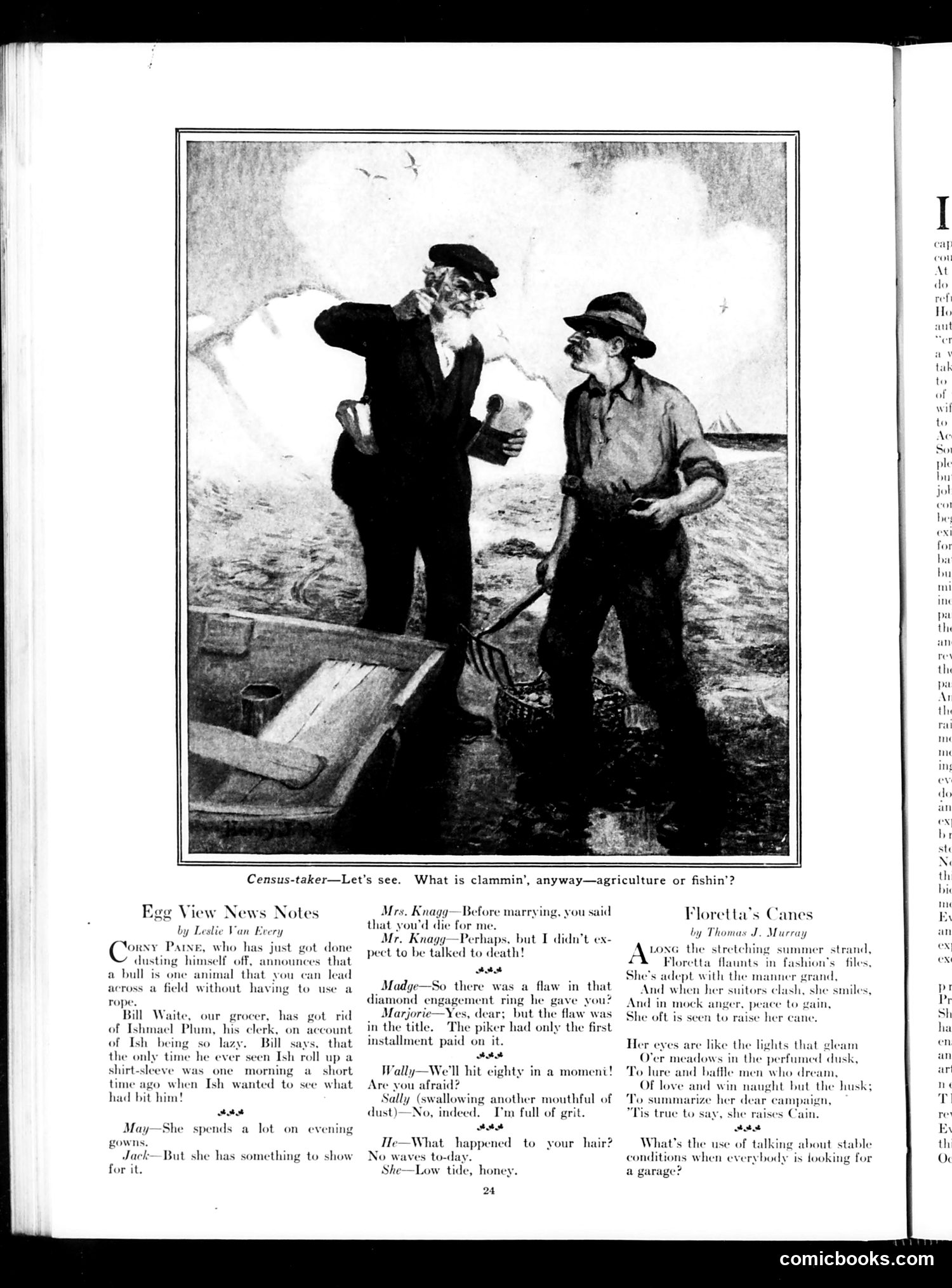
This page from Judge combines brief humorous anecdotes with a satirical cartoon and poetry. The main cartoon shows a census-taker questioning two working-class men about their occupation, asking whether "clammin'" (clamming—harvesting clams) counts as agriculture or fishing. The joke satirizes bureaucratic confusion and rigid categorization—the census bureau's difficulty in classifying unconventional labor. The "Egg View News Notes" section offers short jokes about everyday life: a lazy clerk, a husband henpecked by his talkative wife, and a woman whose diamond ring has an unpaid loan attached (satirizing consumer debt and fraud). "Floretta's Canes" is light verse praising a fashionable woman who playfully threatens suitors with her cane. The final quip mocks the contemporary real-estate boom, suggesting that talk of economic "stability" is meaningless when everyone obsesses over acquiring garages (implying the auto industry's rapid growth and the status symbol of car ownership).
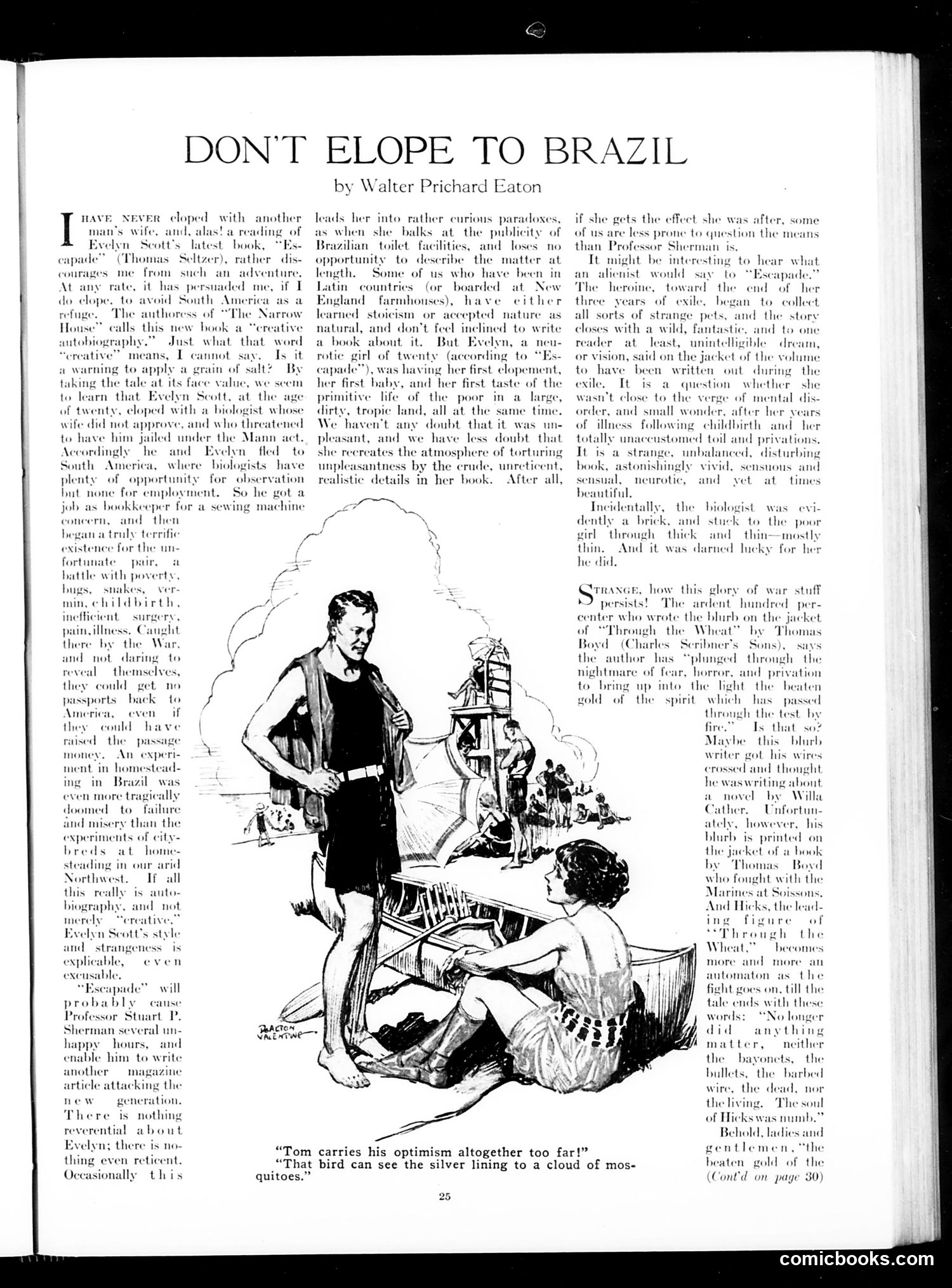
This article by Walter Prichard Eaton reviews Evelyn Scott's autobiographical novel about her real elopement with a biologist to Brazil around World War I. The satirical point targets both Scott and literary critics of the era. **The satire works on two levels:** 1. **Against Scott**: Her book details genuine hardship—poverty, tropical disease, childbirth without proper medical care—yet Eaton questions why she's publishing such intimate misery. He suggests her "creative" styling of autobiography blurs fact and fiction suspiciously. 2. **Against war-literature trends**: Eaton mocks contemporary writers who glorify suffering and trauma as noble artistic subjects. He references a dust-jacket blurb using militaristic language ("nightmare of fear, horror") to romanticize what was simply personal disaster. The cartoon shows the couple's primitive conditions; the caption jokes that Tom's relentless optimism ("that bird can see the silver lining") is absurdly misplaced amid actual mosquitoes and misery—a dig at both their naïveté and critics who aestheticize real suffering.
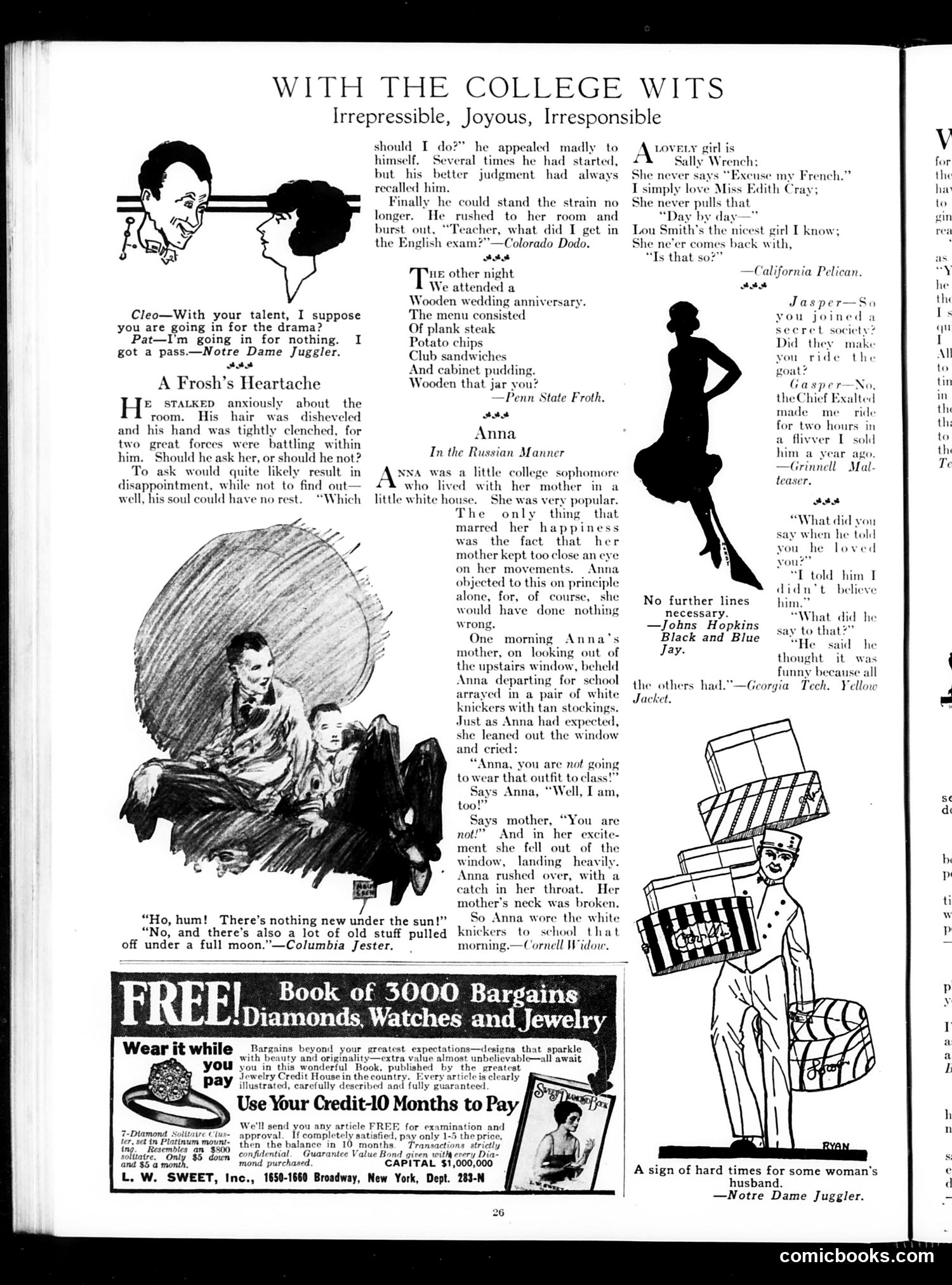
This page from Judge magazine presents college humor through several short comedic pieces targeting student readers: **"A Frosh's Heartache"** depicts a nervous freshman's internal struggle about whether to ask a girl out—a relatable anxiety for college men of the era. The illustration shows his anguished deliberation. **"Anna: In the Russian Manner"** is a dark humor story about a college sophomore whose overprotective mother monitors her clothing choices. When Anna wears white knickers to class despite her mother's objection, the mother literally falls out the window and breaks her neck—a grotesque punchline suggesting Anna's newfound freedom from maternal surveillance. The page also includes brief joke exchanges about college life (frat initiations, car rides, dating) sourced from various college newspapers like Notre Dame, Penn State, and Cornell. **Context**: This reflects 1920s college culture where strict parental (especially maternal) control over young women was common, and "modern" fashion choices like visible knickers represented generational rebellion. The crude humor and dark punchlines were typical of Judge's irreverent satirical style. A jewelry advertisement occupies the lower half—standard magazine content of the period.
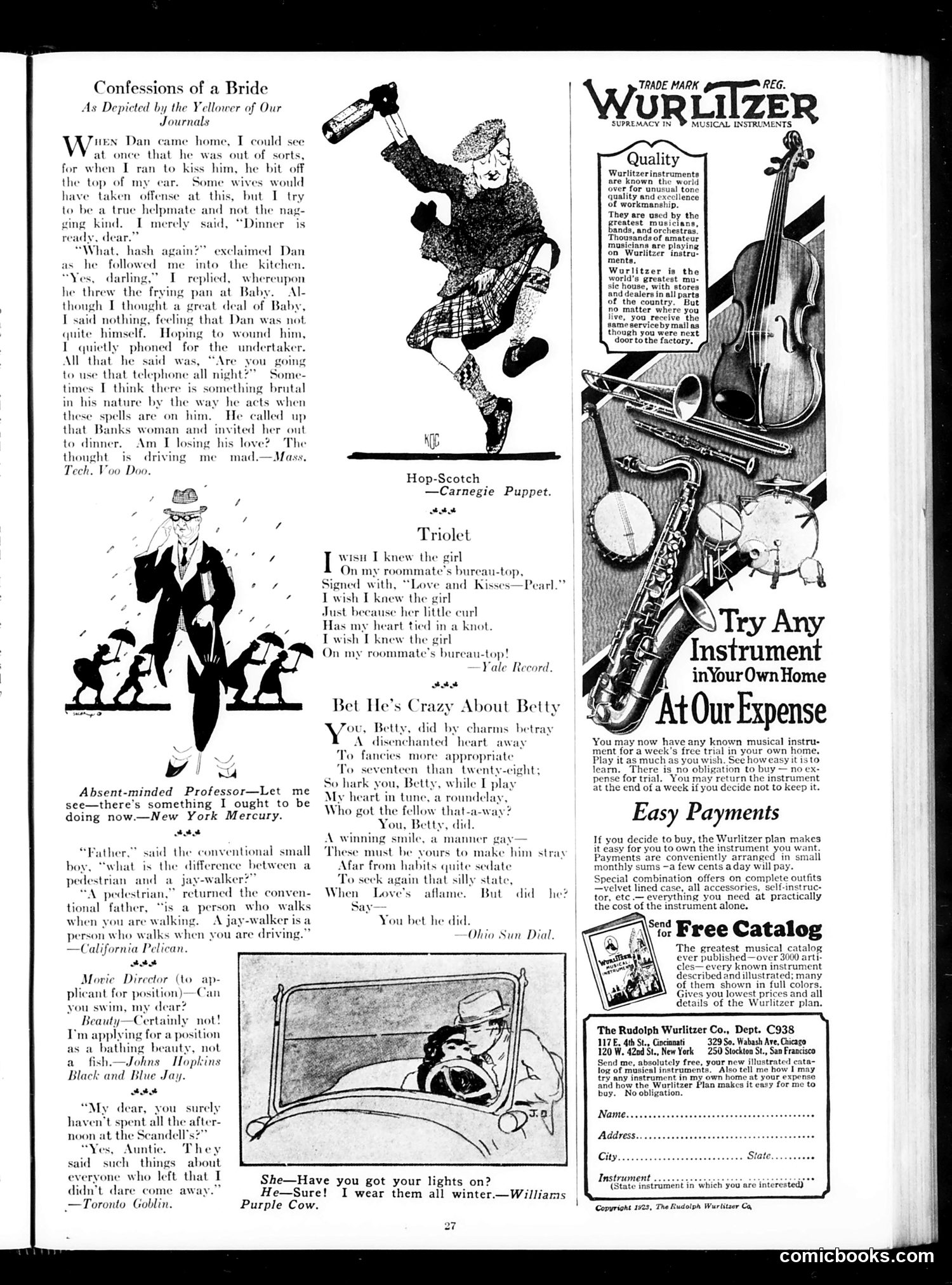
This page contains satirical humor pieces and advertisements typical of early 20th-century Judge magazine. **The Confessions & Cartoons:** The opening "Confessions of a Bride" satirizes marriage dynamics through exaggeration—a wife tolerates her husband's abuse (biting her ear, throwing pans at the baby) while suspecting infidelity. The joke mocks both domestic discord and the wife's passive acceptance. Other humor pieces ("Triolet," "Bet He's Crazy About Betty") use conventional romantic poetry and dialogue to create mild, gentle satire about courtship and relationships—typical light fare for the era. **The Cartoons:** Small single-panel cartoons mock absent-minded professors, pedestrians vs. jaywalkers, and a beauty contestant who can't swim. These are general social observations rather than political satire. **The Advertisement:** The right side features a Wurlitzer musical instruments ad promoting in-home trials and easy payment plans—a significant sales innovation for the period, emphasizing accessibility to middle-class consumers. The overall tone is genteel humor aimed at educated readers, lacking sharp political edge.
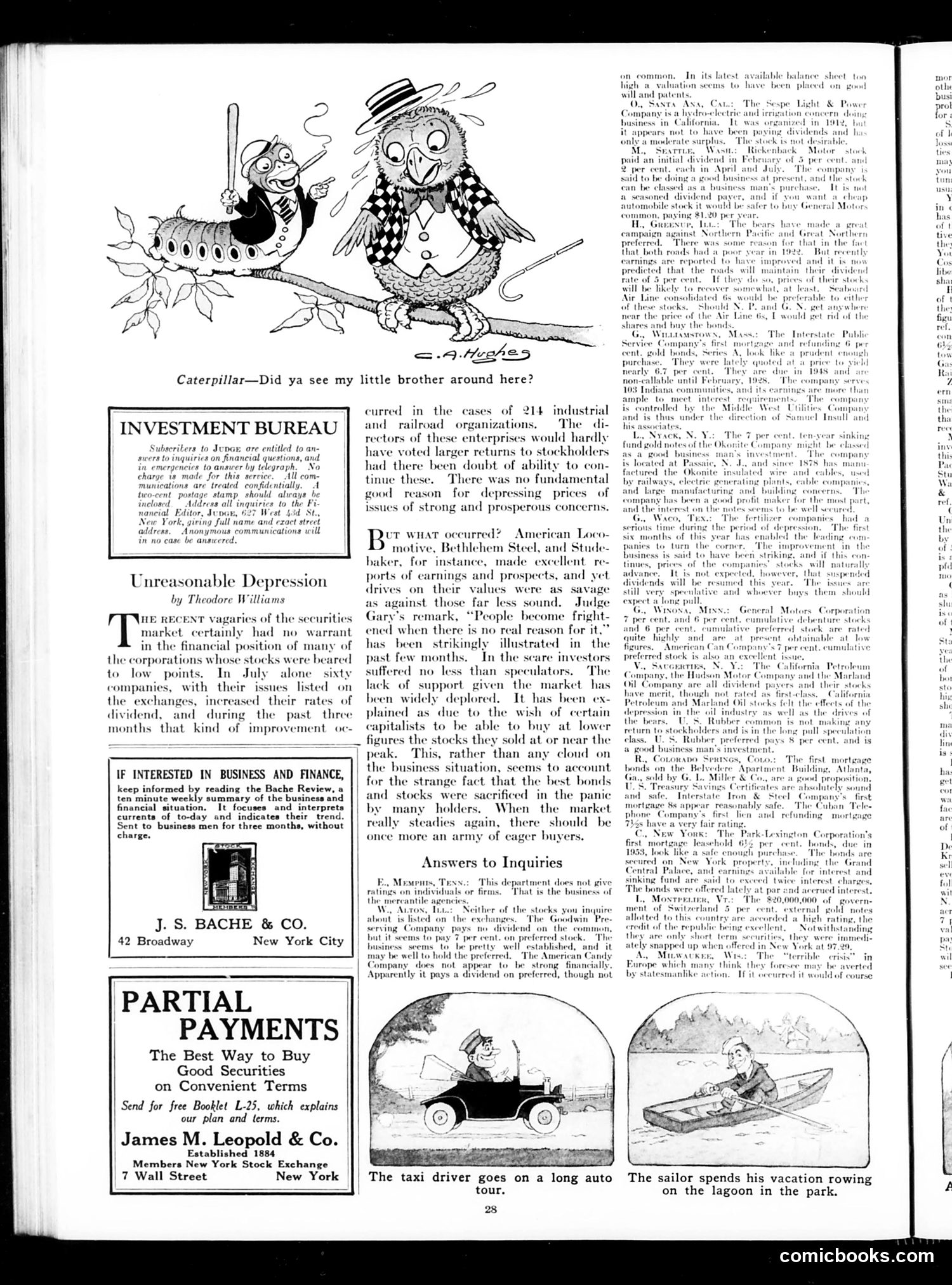
This cartoon depicts a caterpillar and a anthropomorphized bird (or owl) perched on a branch, with the caterpillar asking "Did ya see my little brother around here?" The joke plays on the natural life cycle—the bird represents the predator that would eat the caterpillar's "brother," implying the sibling has been consumed. The cartoon appears disconnected from the surrounding financial content (articles about stock market depression and investment advice). It functions as light comic relief on a page dominated by serious business analysis and financial advertisements from firms like J.S. Bache & Co. and James M. Leopold & Co. The page itself is primarily **advertising and financial journalism** aimed at business readers during what appears to be an economic downturn period, with the cartoon serving as occasional entertainment rather than social or political commentary.
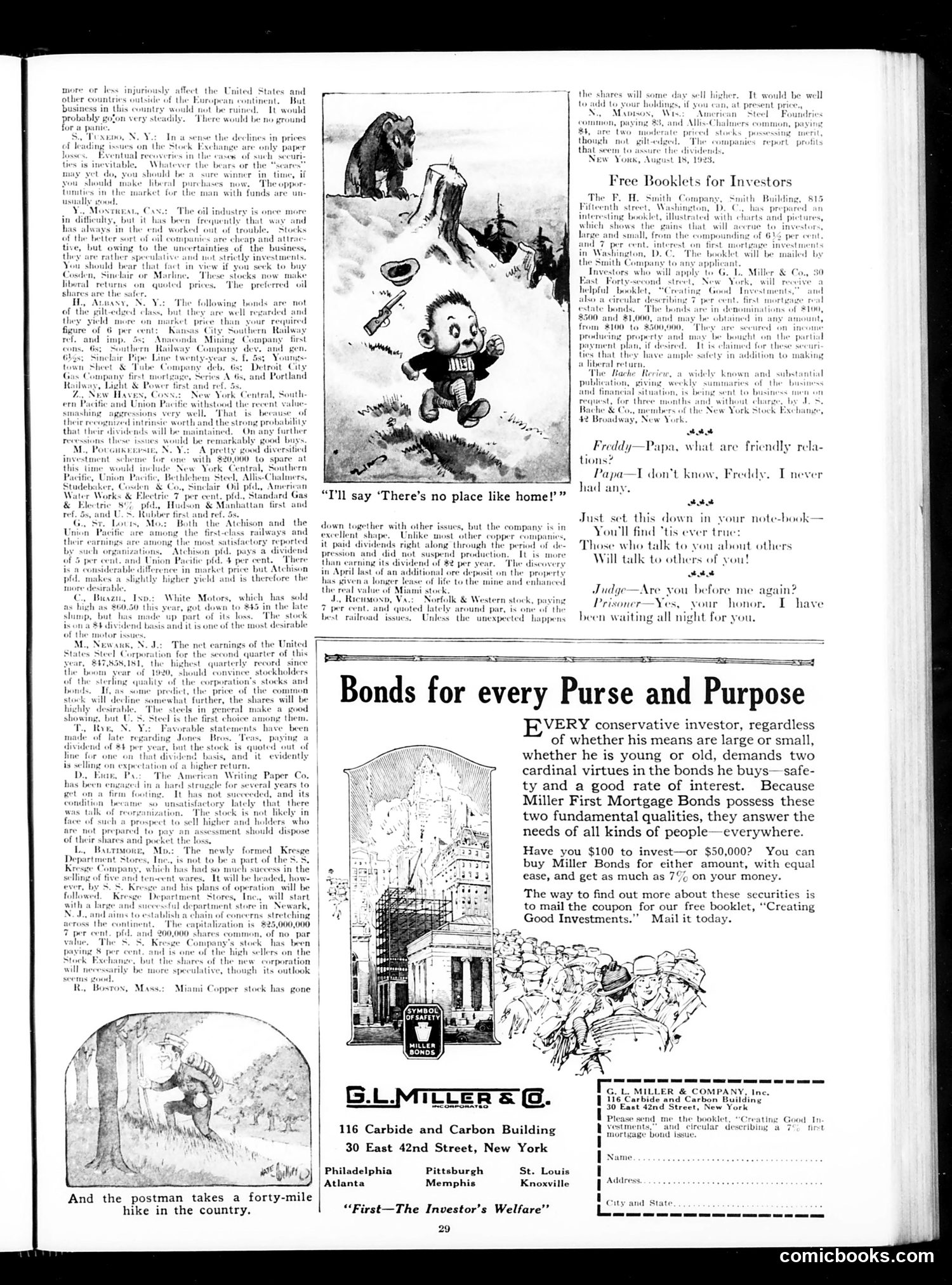
This page is primarily **financial advice and investment advertising**, typical of Judge's content during the prosperous 1920s. The small cartoon at bottom-left shows a postman exhausted after a "forty-mile hike," captioning "I'll say 'There's no place like home!'" — a gentle joke about rural mail delivery hardships, playing on the popular phrase. The main content consists of a **stock market advice column** answering readers' questions about bond and stock investments (copper companies, railroads, utilities). The large advertisement for **G.L. Miller & Co.** promotes bonds as safe investments "for every Purse and Purpose." **Context for modern readers**: This reflects pre-Depression 1920s optimism about stock market investing. The casual tone treating speculation as accessible to ordinary people, combined with confident promises of steady returns, represents the financial culture that preceded the 1929 crash. The emphasis on "safety" and "good rate of interest" shows how investment was marketed to middle-class readers before regulations protecting investors existed. The page otherwise contains no political satire—it's straight business content.
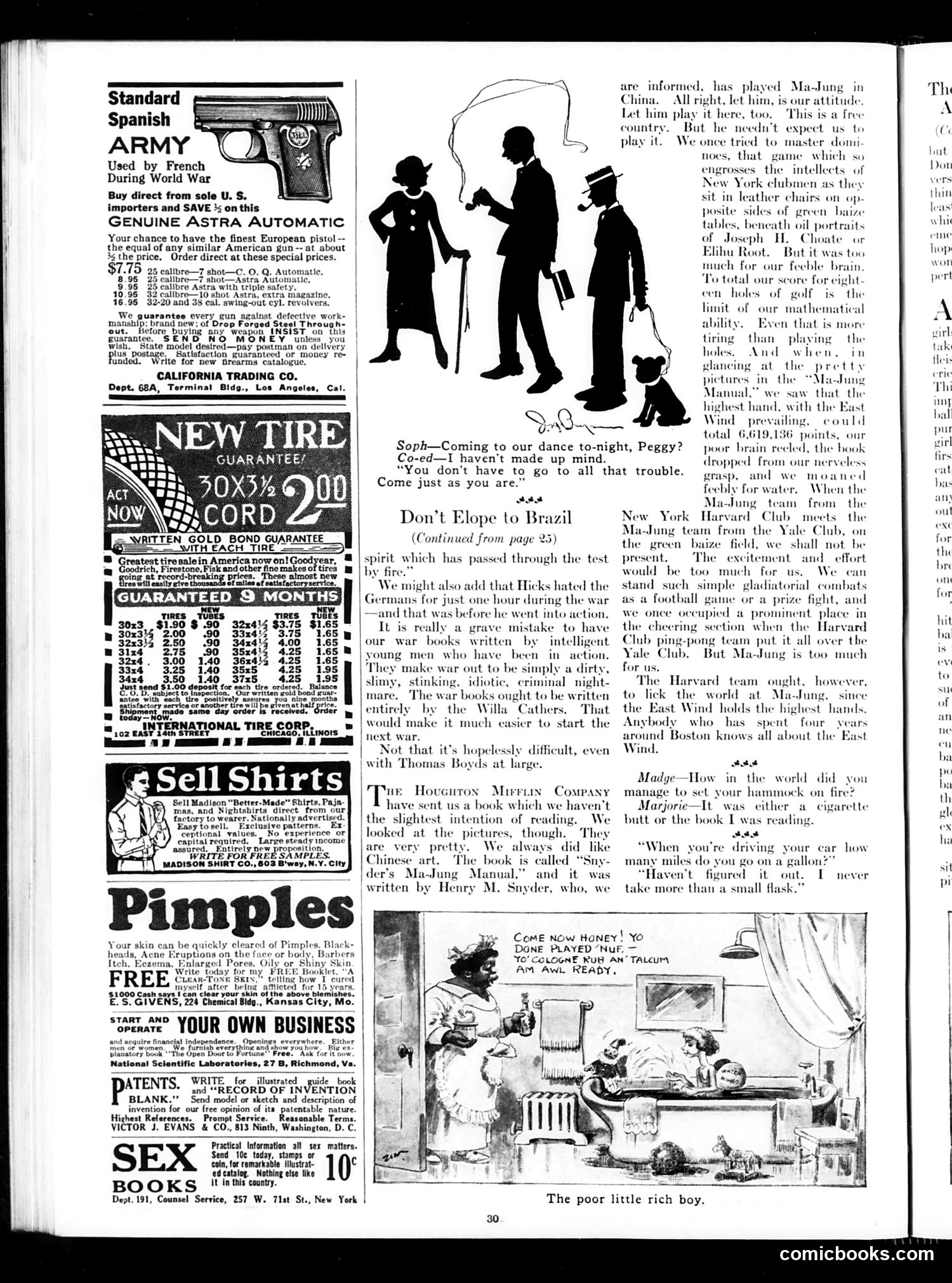
This page contains several distinct elements. The main cartoon shows three silhouetted figures (two adults and a child) labeled "Soph—Coming to our dance to-night, Peggy?" with dialogue about attendance, likely satirizing college social conventions of the era. The larger article, "Don't Elope to Brazil," critiques war literature and writers. It mocks Willa Cather and Thomas Boyd for writing "realistic" war accounts that portray combat as "dirty, slimy, stinking, idiotic, criminal nightmare"—implying Judge magazine preferred romanticized portrayals. The author sarcastically suggests such honest depictions make starting future wars more difficult, a pointed jab at pro-war attitudes. A secondary section humorously reviews a "Ma-Jung Manual," dismissing the Chinese game as too intellectually challenging, using self-deprecating humor about the author's mathematical abilities. The remaining content is primarily **period advertisements**—for firearms, tires, books, and dubious remedies—typical of Judge's commercial pages.
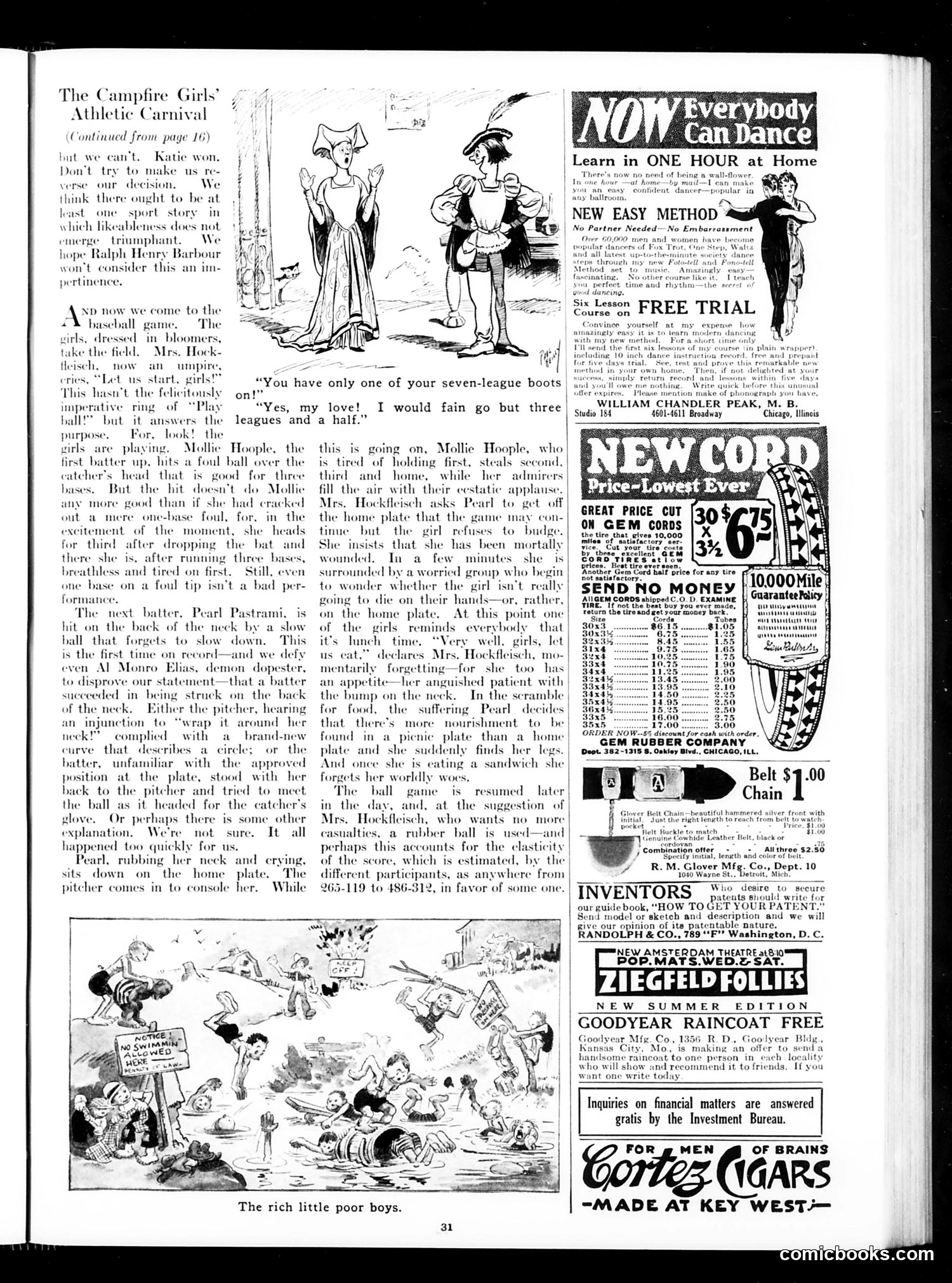
This page contains two distinct elements: **Left side - "The Campfire Girls' Athletic Carnival"**: A humorous short story (continued from earlier) about a girls' baseball game. The satire targets the sentimental conventions of children's literature, particularly author Ralph Henry Barbour's stories where "likableness" determines outcomes. Here, events are deliberately absurd: a batter is struck in the neck (unprecedented in baseball history), an injured player refuses to leave home plate, and the game collapses when lunchtime arrives—with the "wounded" player suddenly recovering once food appears. The joke mocks both the melodrama of period youth fiction and the casual attitudes of these young athletes. **Right side - Advertisements**: Typical Judge magazine revenue. These include dance lessons, tire sales, and other commercial offers targeting readers. The bottom illustration, "The rich little poor boys," appears to show chaotic street activity but lacks sufficient context in the visible text to definitively explain its satirical point.
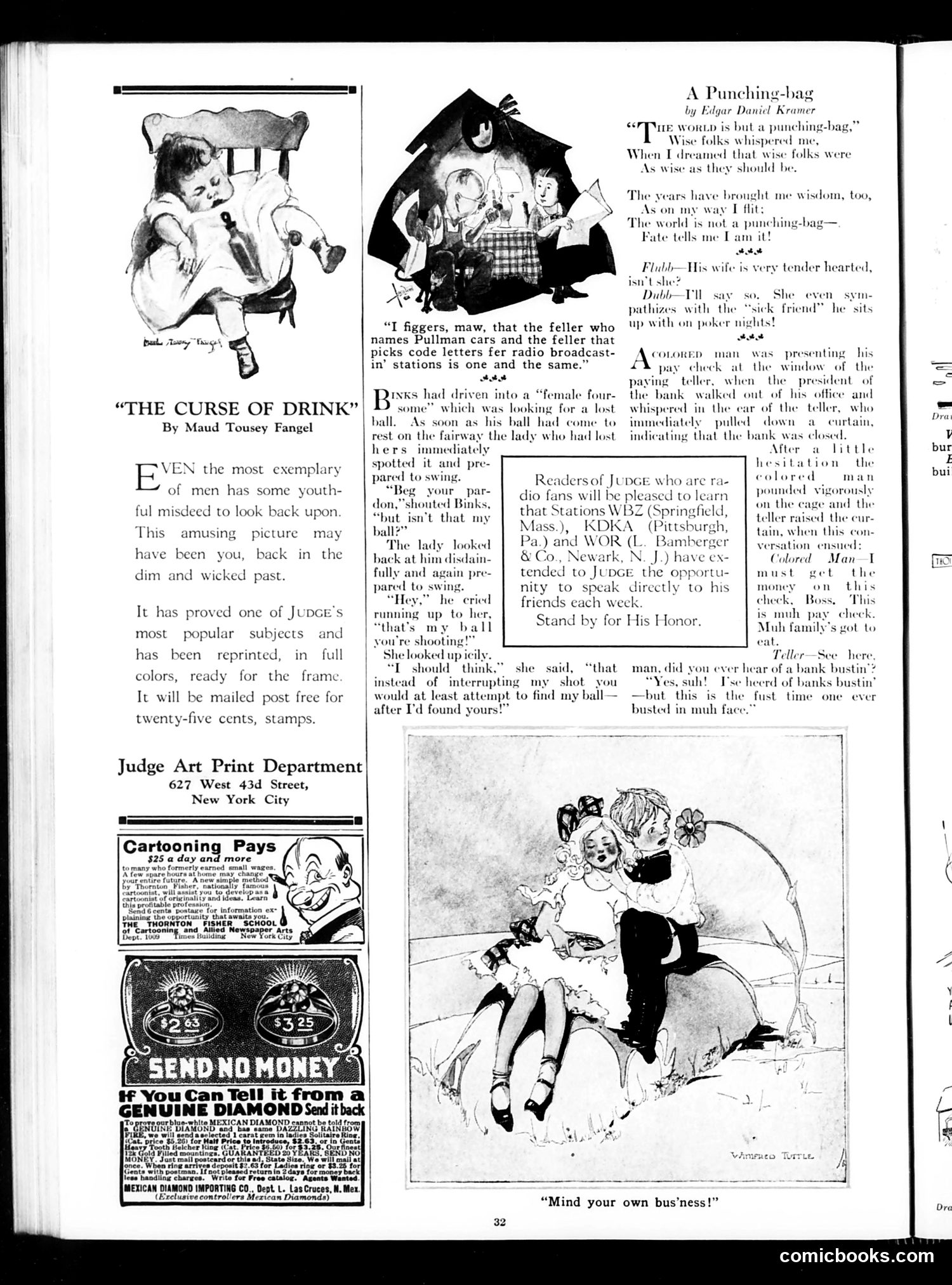
This page contains several separate cartoons and advertisements from *Judge* magazine: **"The Curse of Drink"** (top left): A cautionary illustration showing a child with alcohol bottles, promoting a reprinted cartoon available for purchase—part of *Judge's* merchandising. **"A Punching-bag"** (top right): A philosophical poem by Edgar Daniel Kramer about life's hardships. The metaphor suggests the world treats people roughly, like a punching bag. **The Golf Anecdote**: A brief humorous story about a woman golfer who, after Binks helps her find her lost ball, refuses to help him find his, claiming she should search for it instead—satirizing selfish entitlement. **"Colored Man" Cartoon** (bottom): A racist-era joke depicting a Black man trying to cash a paycheck at a bank that closes when he arrives. The humor relies on offensive stereotypes and segregation-era attitudes about racial discrimination in banking. **Advertisements**: Including cartooning lessons ($25/day) and diamond sales pitches. The page reflects early 20th-century American humor and attitudes, including casual racism standard to the period.
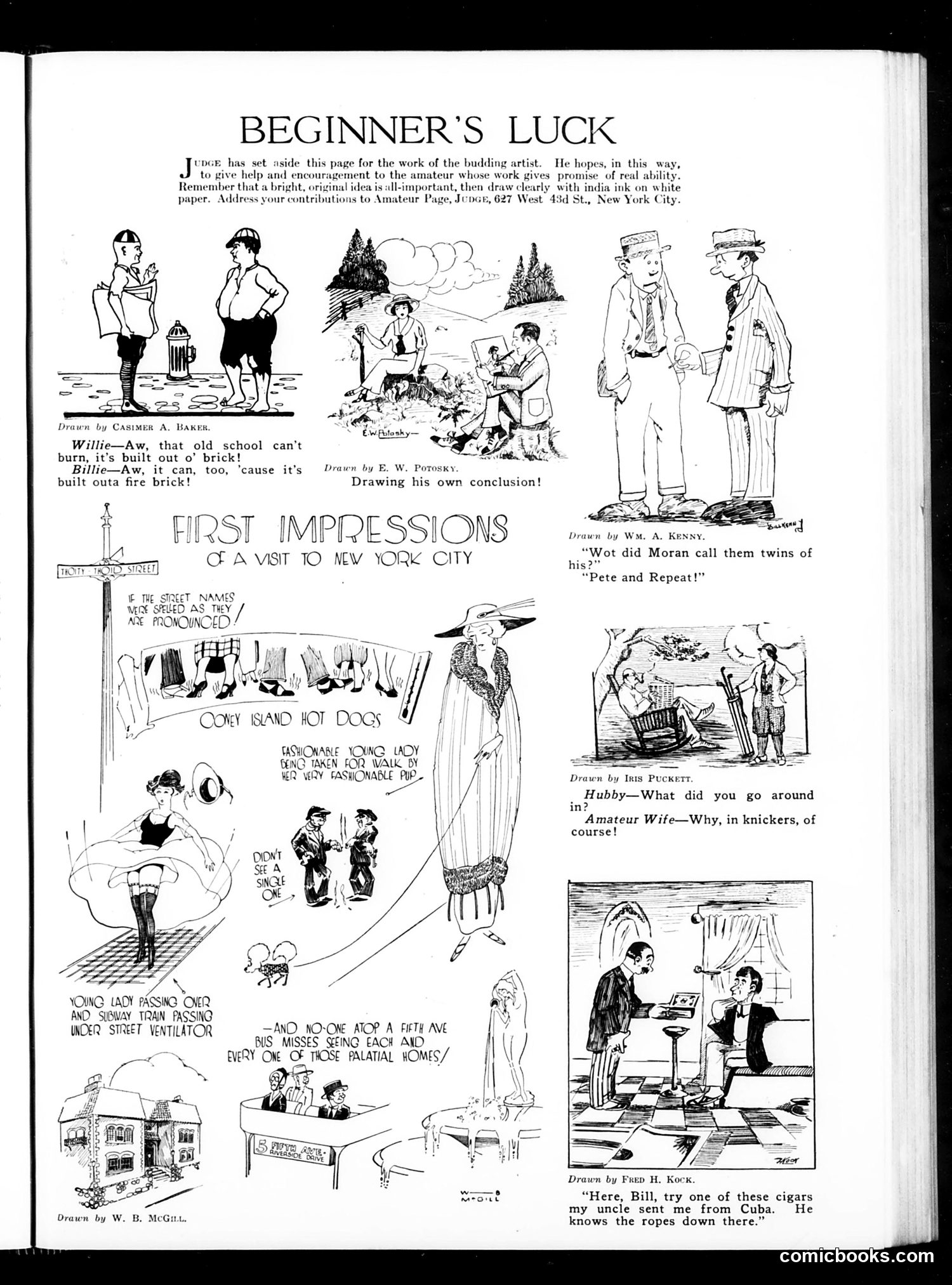
This is a showcase page for amateur cartoonists, featuring multiple humorous sketches about New York City life and general humor. **Key content:** - **Top cartoons**: Simple joke about school construction (fire brick wordplay) and a landscape scene - **"First Impressions of a Visit to NYC"**: A multi-panel sketch satirizing urban observations—fashionable women being walked by small dogs, subway ventilators blowing up skirts, wealthy Fifth Avenue residents, and street scenes - **Right-side cartoons**: Visual gags about identical twins ("Pete and Repeat"), a wife's beach attire ("knickers"), and a joke about Cuban cigars (the phrase "knows the ropes down there" suggests illicit knowledge, likely referencing Prohibition-era smuggling) The page celebrates amateur artistic talent, inviting contributions. The humor targets familiar urban stereotypes—fashion-obsessed socialites, infrastructure quirks, and contemporary slang. No specific political figures or events are referenced; these are gentle, observational jokes about early 20th-century American city life.
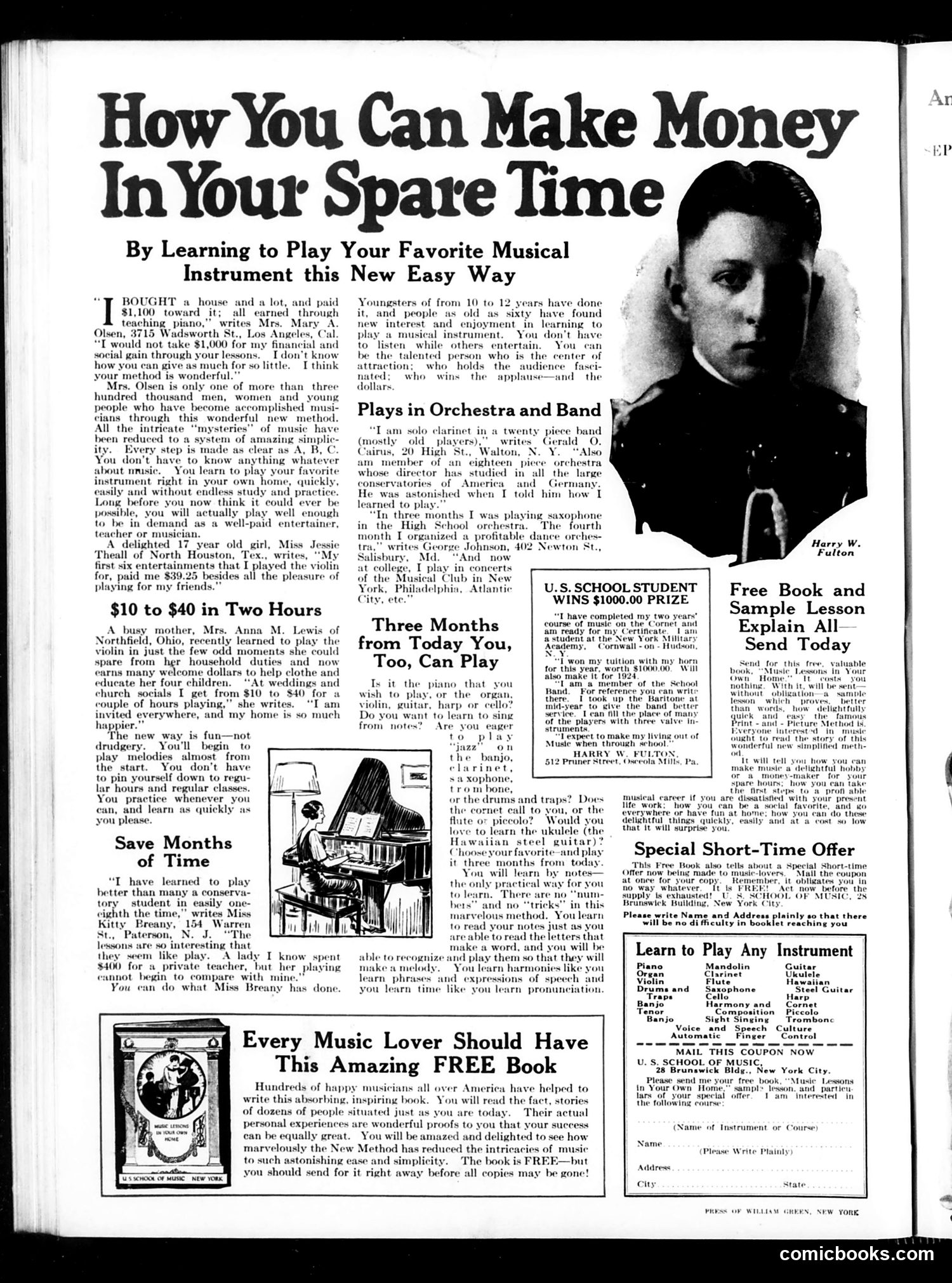
This is primarily an **advertising supplement**, not satire or political cartoon. It promotes the "U.S. School of Music," a mail-order music instruction service offering to teach instruments quickly at home. The page uses **testimonial marketing**—featuring supposed real students (Mrs. Mary A. North, Miss Jessie Theall, Mrs. Anna M. Lewis, Harry W. Fulton) claiming they learned instruments rapidly and earned money performing. One student claims to have won a $1,000 tuition prize. The appeals target **working-class aspiration**: mothers earning "pin money" during spare hours, children learning faster than traditional lessons, people becoming entertainers and earning $10-$40 per performance. The imagery shows a woman at a piano and lists available instruments (Piano, Violin, Guitar, Saxophone, etc.). This reflects **early 20th-century consumer culture**—promising self-improvement and income through correspondence courses, a common advertising pitch of the era. There is no satire here; it's straightforward commercial promotion appearing in *Judge*.