
Judge, 1923-08-25 · page 15 of 36
Judge — August 25, 1923 — page 15: what you’re looking at
What you’re looking at
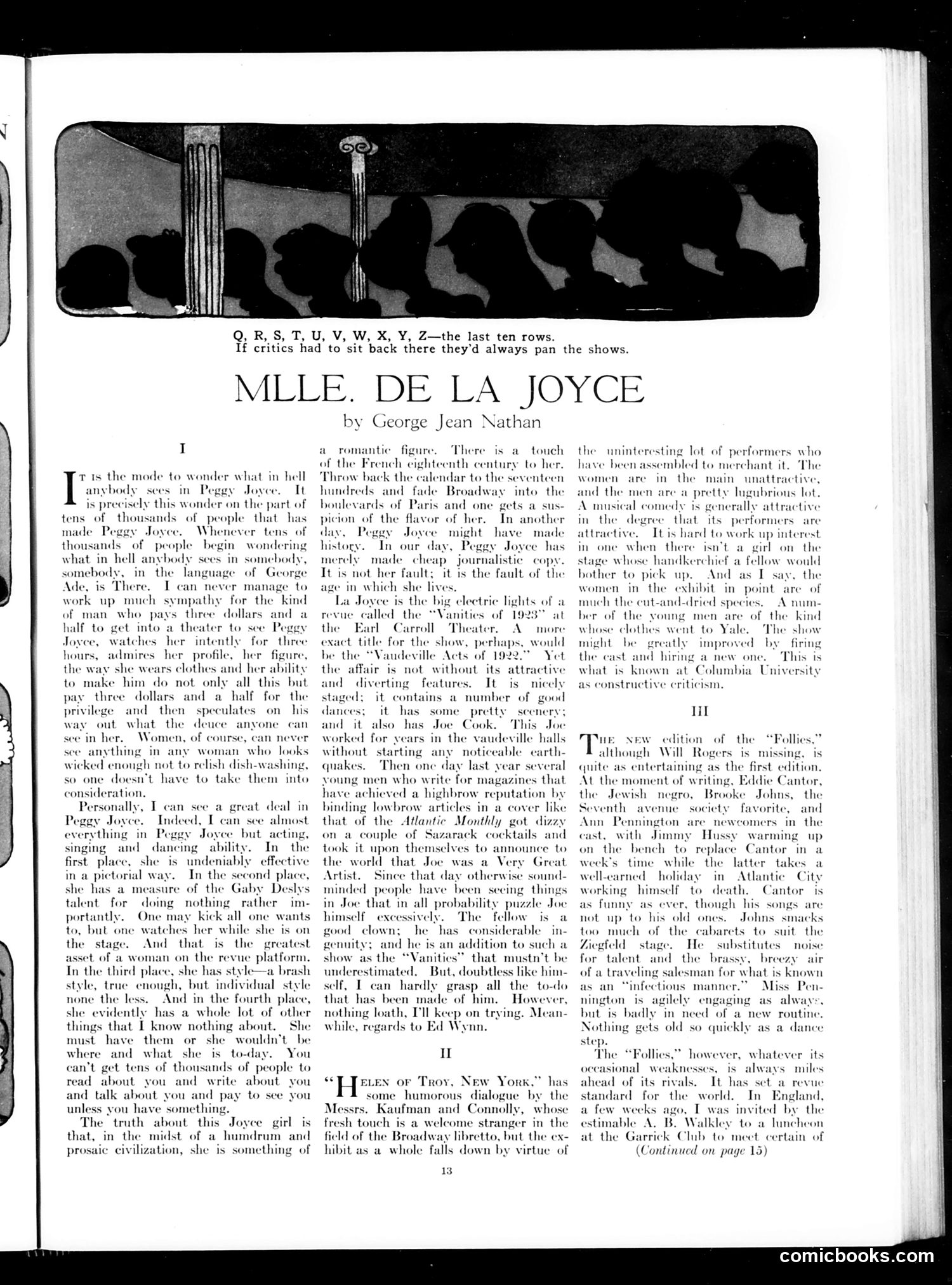
The silhouette cartoon at the top satirizes theater seating arrangements. The caption references rows "Q, R, S, T, U, V, W, X, Y, Z"—the back rows of a theater—and jokes that critics forced to sit there would "always pan the shows," suggesting critics' harsh reviews stem from poor sightlines rather than artistic merit. The article below reviews **Mlle. de la Joyce**, a popular Broadway performer of the early 1920s. Critic George Jean Nathan examines her appeal, acknowledging she attracts massive audiences despite lacking genuine talent in singing, dancing, or acting. He attributes her success to her glamorous "pictorial" presence and romantic mystique—she represents escapism in "humdrum and prosaic civilization." Nathan also discusses the revue "Vanities of 1923," praising performer Joe Cook while mocking intellectuals who suddenly declared him a "Very Great Artist" after reading highbrow magazine coverage, suggesting critics and tastemakers were prone to absurd reversals of opinion. The satire targets both celebrity culture and critical inconsistency.
📄 Transcribed text from this page (OCR, searchable)
Machine-transcribed from the original scan — historical spelling and the odd misread are preserved.
Q, R, S, T, U, V, W, X, Y, Z—the last ten rows. If critics had to sit back there they'd always pan the shows. MLLE. DE LA JOYCE I anybody Peggy Jovee. It is precisely this wonder on the part of tens of thousands of people that has made Peggy Whenever tens of thousands ‘of people begin what in hell anybody sees in somebody, somebody, in the language of George Ade, is There. IT can never manage to work up much sympathy for the kind f man who pays three dollars and a half to get into a theater to see Peggy Joyce, watches her intently for thr hours, admires her profile, her figure, the way she wears clothes and her ability to make him do not only all this but pay three dollars and a half for the privilege and then speculates on his way what the deuce anyone can see in her. Women, of course, can never see anything in any woman who looks wicked enough not to relish dish-washing, have to take them into sees in I 1s the mode to wonder what in hell yee. wondering out so one doesn't consideration, Personally, 1 ean’see ‘a great deal in Peggy Joyce. Indeed, I can see almost everything in Peggy Joyce but acting, singing and dancing ability. In_ the first place, she is undeniably effective in a pictorial way. In the second place, she has a measure of the Gaby Deslys talent. for doing nothing rather im- portantly. One may kick all one wants to, but one watches her while she is on the stage. And that is the greatest asset of a woman on the revue platform. In the third pl. she has style—a brash style, true enough, but individual. style none the less. And in the fourth place, she evidently has a whole lot of other things that I know nothing about. She must have them or she wouldn't be where and what to-day. You can’t get tens of thousands of people to read about you and write about you and talk about you and pay to sce you unless you have something. The truth about this Joyce girl is that, in the midst of a humdrum and prosaic civilization, she is something of she is by George Jean Nathan a romantic figure. There is a touch of the French eighteenth century to her. Throw back the calendar to the seventeen hundreds and fade Broadway into the boulevards of Paris and one gets a sus- picion of the favor of her, In another day Joyce might have made history. In our day, Peggy Joyce has merely made. cheap’ journalistic copy. It is not her fault; it is the fault of the age in which she lives. La Joy revue callec the E Peggy is the big electric lights of a the “Vanities of 19237 at ai Carroll The A exact title for the show, perhaps, would be the “Vaudeville Acts of 1922.7 Yet the affair is not without its attractive and diverting features. It is nicely staged; it contains a number of good dances; it pretty ‘ and it also has Joe Cook. worked for years in the vaudeville without starting any noticeable quakes. ‘Then one day last ve: young men who write for m: have achieved a highbrow rept binding lowbrow articles in a cover like that of the Atlantic Monthly got dizzy on a couple of Sazarack cocktails and took it upon themselves to announce to the world that Joe was a Very Great Artist. Since that day otherwise sound- minded people have been secing things in Joe that in all probability puzzle Joc himself excessively. The fellow is good clown; he has. considerable in- genuity; and he is an addition to such a show as the “Vanities” that mustn't be underestimated. But, doubtless like him- self, I can hardly grasp all the to-do that has been made of him. However, nothing loath, I'll keep on trying. Mean- while, regards to Ed Wynn. more has some II “Fees oF Thor, New Your.” has some humorous dialogue by the Messrs. Kaufman and Connolly, whose fresh touch is a welcome stranger in the field of the Broadway libretto, but the ex- hibit as a whole falls down by virtue of 13 the uninteresting lot of performers who have been assembled to merchant it. The women are in the main unattractive, and the men are a pretty lugubrious lot. A musical comedy is generally attractive in the degree that its performers attractive. It is hard to work up interest in one when there isn’t a girl on the st whose handkerchief a fellow would bother to pick up. And as Tsay, the women in the exhibit. in point are of much the cut-and-dried species. A num- ber of the young men > of the kind whose clothes went to The show might be greatly improved by firing the cast and hiring a new one, This is what is known at Columbia University as constructive criticism, lil edition of Will the “Follies,” Rogers is missing. is TT NEW although quite as entertaining as the first edition. At the moment of writing, Eddie Cantor, Johns, the favorite, and the Jewish negro, Bre Seventh avenue society Ann Pennington are newcomers in’ the cast, with Jimmy Hussy warming up on the bench to replace Cantor in a week's while the latter takes a well-earned holiday in Atlantic City working himself to death. Cantor is as funny as ever, though his songs not up to his old ones. too much of time are Johns smacks the cabarets to suit’ the Ziegfeld He substitutes noise for talent and the brassy, breezy of a trav as an “in stage. air ing salesman for what is known Miss Pen- nington is agilely engaging as alwayy, but is badly in need of a new routin Nothing gets old so quickly as a dance step. sctious manner.” The “Follies,” however, whatever its occasional weaknesses, is always miles ahead of its rivals. It has seta revue standard for the world. In England, a few weeks ago, T was invited by the estimable A. B. Walkley to a luncheon at the Garrick Club to meet certain of (Continued on page 15) comicbooks.com