
Judge, 1923-08-25 · page 21 of 36
Judge — August 25, 1923 — page 21: what you’re looking at
What you’re looking at
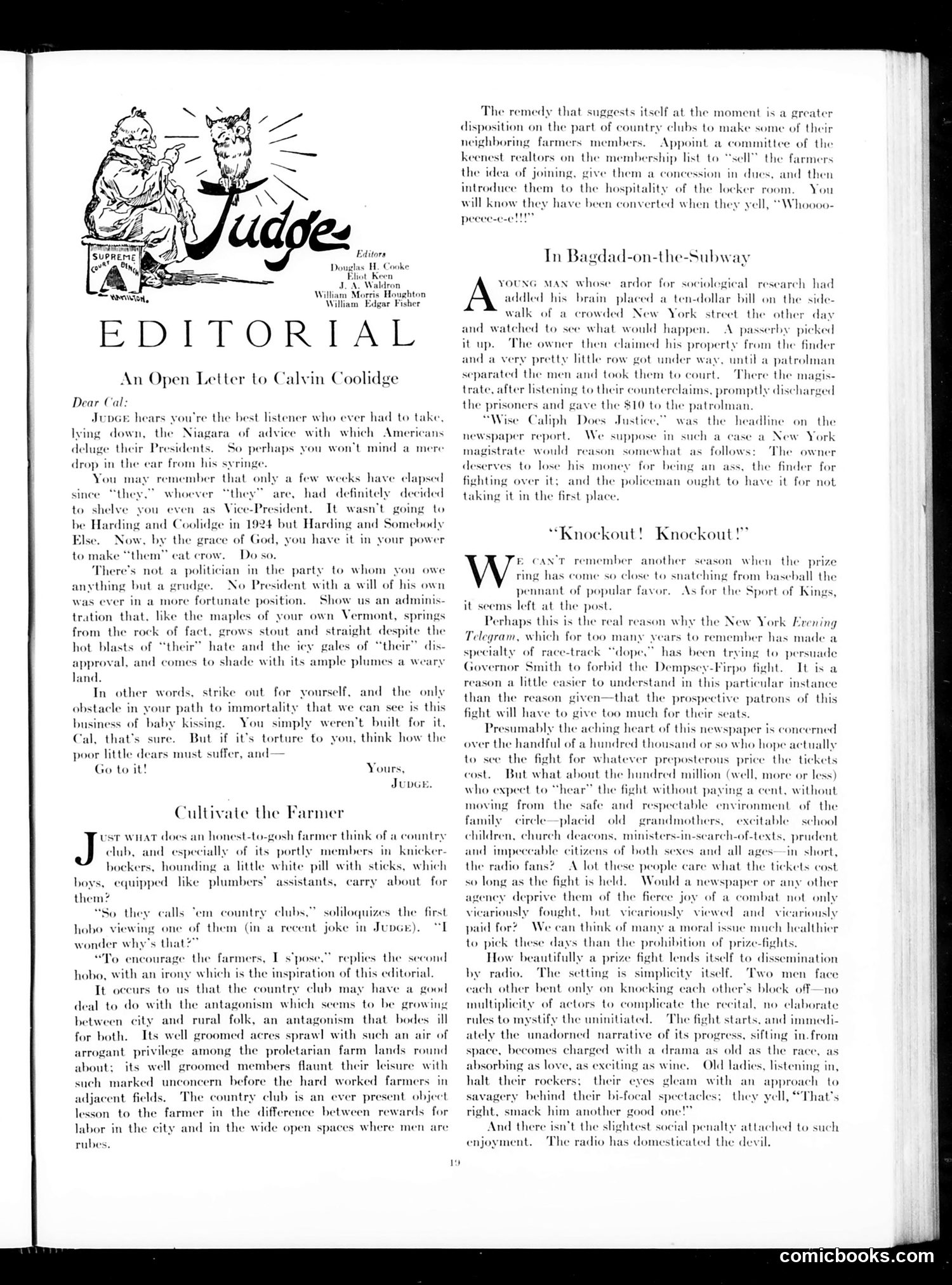
This page contains **two separate editorials** addressing different social issues circa the 1920s. **"An Open Letter to Calvin Coolidge"** urges the newly-ascended President (following Harding's death) to act independently rather than be controlled by party interests ("they"). The letter advises Coolidge to "strike out for yourself" and establish an administration grounded in fact rather than political manipulation—though it jokes that his one weakness is "baby kissing" (a required political ritual he apparently dislikes). **"Cultivate the Farmer"** critiques the growing urban-rural divide. It mocks country clubs as symbols of urban privilege flaunting leisure before hardworking farmers in adjacent fields. The satire suggests clubs should recruit farmers as members to bridge this antagonism, predicting farmers would become "converted" once experiencing club hospitality. **"In Bagdad-on-the-Subway"** (partially visible) satirizes a peculiar incident where a sociologist's experiment with a dropped $10 bill resulted in a court case—with the patrolman, not the claimants, receiving the money. The headline "Wise Caliph Does Justice" treats New York courts ironically.
📄 Transcribed text from this page (OCR, searchable)
Machine-transcribed from the original scan — historical spelling and the odd misread are preserved.
J. A, Waldron William Morris Houghton William, Fisher EDITORIAL An Open Letter to Calvin Coolidge Dear Cal: JuvcE hears you're the best listener who ever had to take, lying down, the Niagara with deluge their Presidents. drop in the You may remember that only a few weeks have elapsed “they,” to shelve you even as Vice-President. It ing and Coolid; of advice which Americans So perhaps you won't mind a mere from his syringe. since whoever “they” are, had definitely decided wasn't going to $ but Harding and Somebody wv, by the grace of God, you have it in your power Do so. an in the party to whom you owe No President with a will of his own was ever in a more fortunate position. to mak There’s not a pol them” eat crow. anything but a gruc Show us an adminis- tration that, like the maples of your own Vermont, springs from the rock of fact, grows stout and straight despite the hot blasts of “their” and the icy gales of “their” dis- approval, and comes to shade with its ample plumes a weary land. In other words, strike out for yourself. and the only hate obstacle in your path to immortality that we can see is this business of baby kissing. Cal, that’s sure. poor little Go to it! J You simply weren't built for it, But if it's torture to you, think how the ars must suffer, and— Yours, Jevor. Cultivate the Farmer 4p witat does an honest-to-gosh farmer think of a country club, and especially of its portly members in knicker: bockers, hounding a little white pill with sticks, which boys, equipped like plumbers’ assistants, carry about for them? » they calls “em country clubs,” soliloquizes. the first hobo viewing one of them (in a recent joke in JupGe). “I wonder why’s that?” ‘© encourage the farmers, I s‘pose.” replies the second hobo, with an irony which is the inspiration of this editorial. It occurs to us that the country club may have a good deal to do with the antagonism which seems to be growing between city and rural folk, an antagonism that bodes ill for both. Its well groomed acres sprawl with such an air of arrogant privilege among the proletarian farm lands round about; its well groomed members flaunt their leisure with such marked unconcern before the hard worked farmers in adjacent fields, The country club is an ever present object lesson to the farmer in the difference between rewards for labor in the city and in the wide open spaces where men are rubes, The remedy that suggests itself at the moment is a greater disposition on the part of country clubs to make some of their neighboring farmers members. Appoint a committee of the keenest realtors on the membership list to “sell” the farn the idea of joining, give them a concession in dues, and then introduce them to the hospitality of the locker room. You will know they have been converted when they yell, “Whoooo- peece-c- In Bagdad-on-the-Subway YOUNG MAN whose ardor for sociological research had A addled his brain placed a ten-dollar bill on the side walk of a crowded New York street the other day and watched to see what would happen. A passerby picked it up. The owner then claimed his property from the finder and a very pretty little row got under way, until a patrolman separated the men and took them to court. ‘There the magis- trate, after listening to their counterclaims, promptly discharged the prisoners and gave the $10 to the patrolman. “Wise Caliph) Does Justice.” hewspaper report. was the headline on the We suppose in such a case a New York as follows: The owner deserves to lose his money for being an ass, the finder for fighting over it; and the policeman ought to have it for not taking it in the first place. magistrate would reason somewhat “Knockout! Knockout!” FE CAN'T remember another season when the prize ring has come so close to snatching from baseball the pennant of popular favor ns left at the post. Perhaps this is the real reason why the New York Evening Telegram, which for too many years to remember has made a specialty of track has been trying to persuade Governor Smith to forbid the Dempsey-Firpo fight. It is a reason a little easier to understand in this particular instance than the reason given—that the prospective patrons of this fight will have to give too much for their seats. As for the Sport of Kings, it se Presumably the aching heart of this newspaper is concerned over the handful of a hundred thousand or so who hope actually to see the fight for whatever preposterous price the tickets But wh who expect to cost. about the hundred million (well, more or less) hear” the fight without paying a cent, without moving from the safe and respectable environment of the family cirele—placid old gr: excitable | school children, church deacons, ministers-in-scarch-of-texts, prudent and impeccable citizens of both sexes and all ages rdmothers, in short, the tickets cost Would a newspaper or any other the radio fans? A lot these people care whi so long as the fight is held. ageney deprive them of the fierce joy of a combat not only vicariously fought, but and vicariously paid for? We can think of many a moral issue much healthier to pick these days than the prohibition of prize-fights How beautifully a prize fight lends itself to dissemination by radio. vicariously viewed The setting is simplicity itself. Two men face each other bent only on knocking each other's block off—no multiplicity of actors to complicate the recital, no clabe rules to mystify the uninitiated. The fight starts, and immedi- ately the unadorned narrative of its progress, sifting in.from space, becomes charged with a drama as old as the race, as absorbing as love, as exciting as wine, halt their rockers; savagery Old ladies, listening in, their eyes gleam with an approach to behind their bi-fe spectacles; they yell, right, smack him another good one!” And there isn’t the slightest social penalty attached to such enjoyment. The radio has domesticated the devil. comicbooks.com