
Judge, 1923-08-25 · page 4 of 36
Judge — August 25, 1923 — page 4: what you’re looking at
What you’re looking at
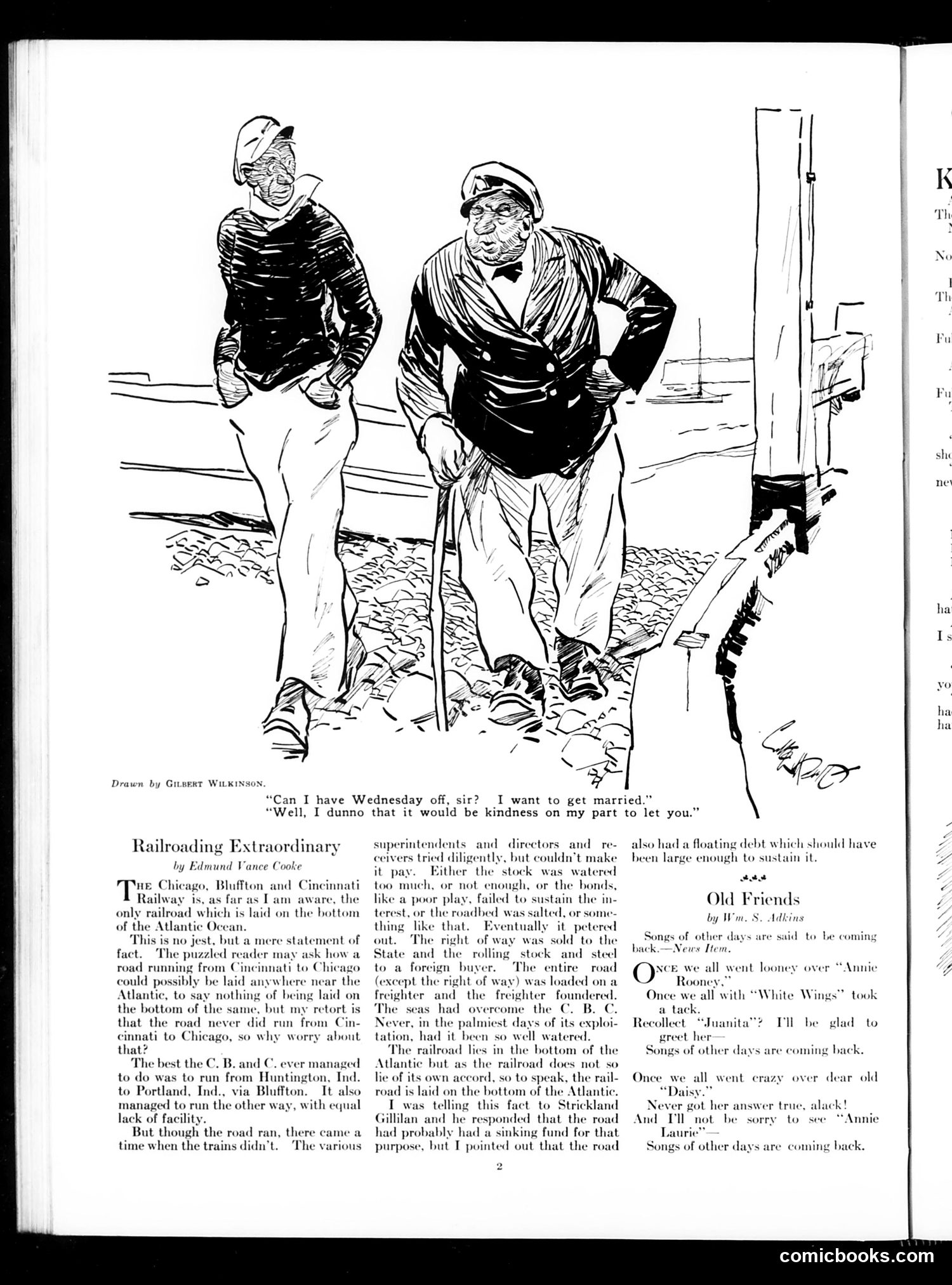
The top cartoon by Gilbert Wilkinson depicts two men on a beach near a boat. One asks his boss for Wednesday off, saying "I want to get married." The boss replies, "Well, I dunno that it would be kindness on my part to let you." This is workplace satire—mocking how employers of the era treated personal milestones as company business. The joke suggests the boss views an employee's marriage as a loss of productivity rather than a life event deserving accommodation. It reflects early 20th-century labor dynamics where worker autonomy was limited and employers held paternalistic control over employees' personal lives. The bottom section titled "Old Friends" contains nostalgic song lyrics referencing people like "Annie Rooney" and "Daisy"—likely popular entertainers or cultural figures of an earlier era, suggesting Judge's editorial reflection on changing times.
📄 Transcribed text from this page (OCR, searchable)
Machine-transcribed from the original scan — historical spelling and the odd misread are preserved.
Drawn by GiLwekT WILKINSON “Can I have Wednesday off, sir? I want to get married.” “Well, I dunno that it would be kindness on my part to let you.” Railroading Extraordinary by Edmund Vance Cooke Tue Chicago, Bluffton and Cincinnati Way is, as far as Tam aware, the lroad which is laid on the bottom Atlantic Ocean. This is no jest, but a mere statement of fact. The puzzled reader may ask how a road running from Cincinnati to Chicago could possibly be laid anywhere near the Atlantic, to say nothing of being laid on the bottom of the same, but my retort is that the road never did run from Cin- cinnati to Chicago, so why worry about that? The best the C. B. and C. ever managed to do was to run from Huntington, Ind. to Portland, Ind., via Bluffton. It also managed to run the other way, with equal lack of facility. But though the road ran, there came a time when the trains didn’t. The various superintendents and directors and re- ceivers tried diligently, but couldn't make it pay. Either the stock was wa too much, or not enough, or the like a poor play, terest, or the r thing like entu out. The right of way v State and the rolling to a foreign buyer. The entire road (except the right of way) was loaded on a freighter and the freighter foundered. The seas had overcome the C. B.C. Never, in the palmiest days of its exploi- tation, had it been so well watered. The railroad lies in the bottom of the Atlantic but as the railroad does not so lie of its own accord, so to speak, the rail- road is laid on the bottom of the Atlantic. I was telling this fact to Strickland Gillilan and he responded that the road had probably had a sinking fund for that purpose, but T pointed out that the road vonds, failed to sustain the in- dbed was salted, or some- ly it petered s sold to the tock and_ steel also had a floating debt which should have been large enough to sustain it, Old Friends Adkins Songs of other days are said to Le coming O™ BE we all Roonc Once we all with “White Wings” a tack. Recollect “Juanita? greet her Songs of other days are coming back. by Wm. S vent looney over “Annie took Til be glad to Once we all went crazy over dear old “Daisy.” Never got her answer true, alack! And TH not be. sorry “Annie Laurie” Songs of other di to see sare coming back. comicbooks.com