
Judge, 1923-08-25 · page 7 of 36
Judge — August 25, 1923 — page 7: what you’re looking at
What you’re looking at
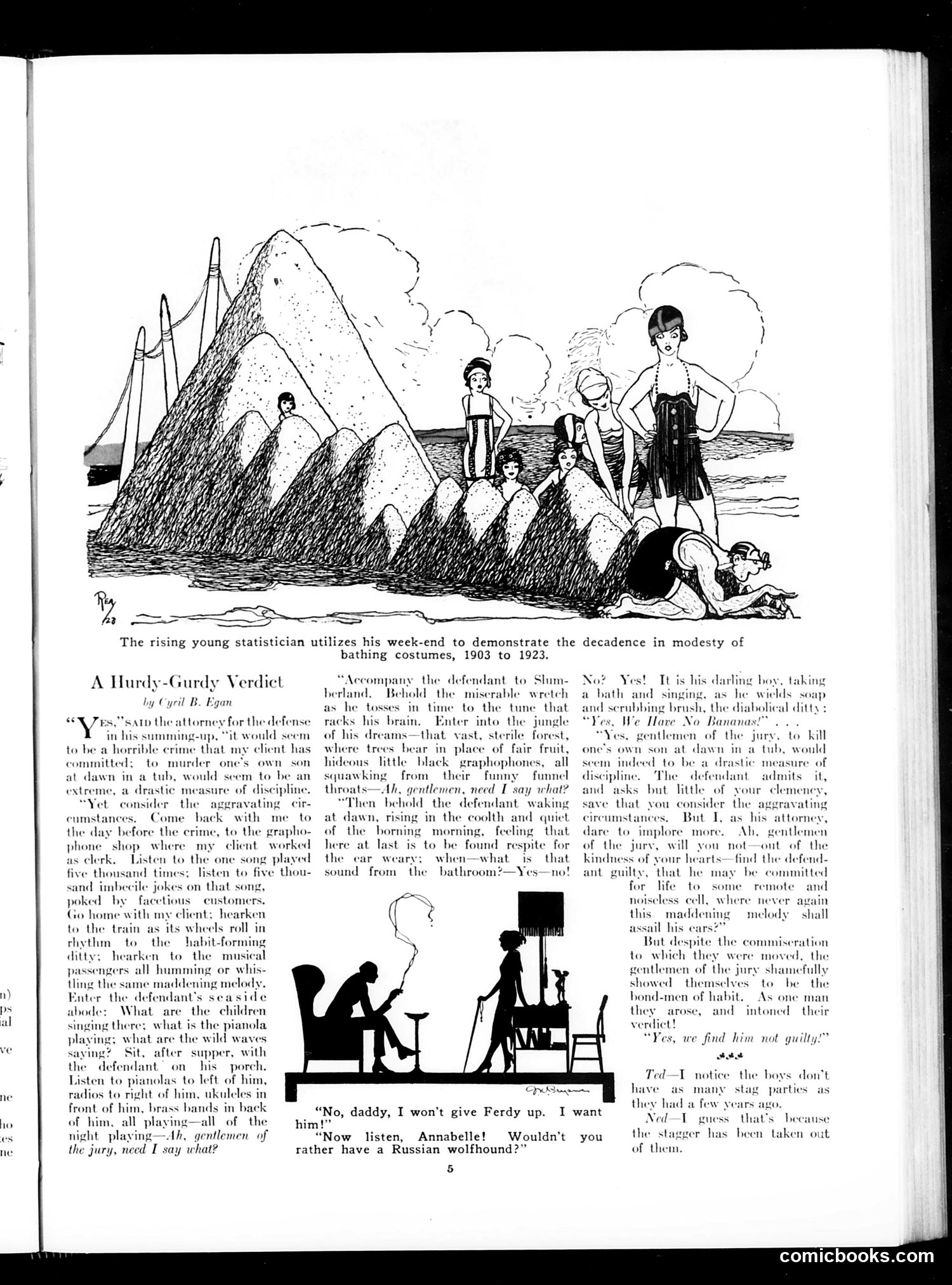
This satire mocks the popular song "Yes! We Have No Bananas" (1923), which had become ubiquitously played and ridiculously catchy. The cartoon shows a legal defense attorney arguing that a man who murdered his own son in a bathtub should be acquitted—because the boy was singing this maddening tune while bathing. The joke works through escalating absurdity: the attorney catalogs how the song follows the defendant everywhere (phonograph shops, trains, radios, pianolas, brass bands) until driving him to murder. The visual at top shows a "rising young statistician" documenting the decline in modesty of bathing costumes (1903-1923), perhaps suggesting modern society's broader moral decay. The verdict parody suggests the jury, driven to sympathy by this relatable torment, inexplicably finds the defendant "not guilty"—implying even they recognize the song as genuinely unbearable punishment. The satire targets both the song's overwhelming popularity and how mass media inescapably intrudes on daily life.
📄 Transcribed text from this page (OCR, searchable)
Machine-transcribed from the original scan — historical spelling and the odd misread are preserved.
Yi! WY’ The rising young statistician utilizes his week-end to demonstrate the decadence in modesty of A Hurdy-Gurdy Verdict hy Cyril B. Egan 6° 7es,”’satp the attorney for the defense in his summing-up, “it would seem to be a horrible crime that my client has committed; to murder one’s own at dawn in a tub, would seem to be an extreme, a drastic measure of discipline. “Yet consider the aggravating cir- cumstances. Come kK with to the day before the crime, to the grapho- phone shop where my. client worked as clerk. Listen to the one song played five thousand times; listen to five thou- sand imbecile jokes on that song, poked by facetious customers. Go home with my client; hearken to the train as its wheels roll in thythm to the —habit-forming ditty; hearken to the musical passengers all humming or whis- tling the same maddening melody. Enter the defendant's seaside abode: What are the children ing there; what is the pianola at are the wild waves it, after supper, with t on his porch. Listen to pianolas to left of him, radios to right of him, ukuleles in front of him, brass bands in back of him, all playing—all_ of the night playing—Ah, gentlemen of the jury, need I say what? son bathing costumes, 1903 to 1923. fendant to Slum. herland, the miserable wretch as he tosses in time to the tune that racks his brain. Enter into the jungle of his dreams—that vast, sterile forest, where trees bear in place of fair fruit, hideous. little black graphophones, all squawking from their funny funnel ; ‘Ah, gentlemen, need T say what? Then behold the defendant. waking at dawn, rising in the coolth and quiet of the borning morning, feeling that here at last is to be found respite for the ear weary; when—what that sound from. the bathroom? no! OR “Now listen, Annabelle! Wouldn't rather have a Russian wolfhound?” 5 No, daddy, I won't give Ferdy up. I want him!” No? Yes! Tt is his darling boy, taking a bath and singing, as he wields soap and scrubbing brush, the diabolical ditty : “Ves, We Have No Bananas!’ 5 . gentlemen of the jury, to kill one’s own son at dawn in a tub, would seem indeed to be a drastic measure of discipline. The defendant admits it, and asks but little of your « save that you consider the circumstances. But I, as his attorn dare to implore more. Ah, gentk of the jury, will you not—out of the kindness of your hearts—find the defend- ant guilty, that he may be commit for life to remot noiseless cell, where never this. maddening — melody assail his ears?” But despite the commiseration to which they were moved, the gentlemen of the jury shamefully showed themselves to the bond-men of habit. As one man they arose, intoned their some n shall he and s, we find him not guilty!” ae the | Ted—1 have notice many they had a few years a Ned—I that’s the stagger has been taken out of them. because you comicbooks.com