
Judge, 1923-08-25 · page 17 of 36
Judge — August 25, 1923 — page 17: what you’re looking at
What you’re looking at
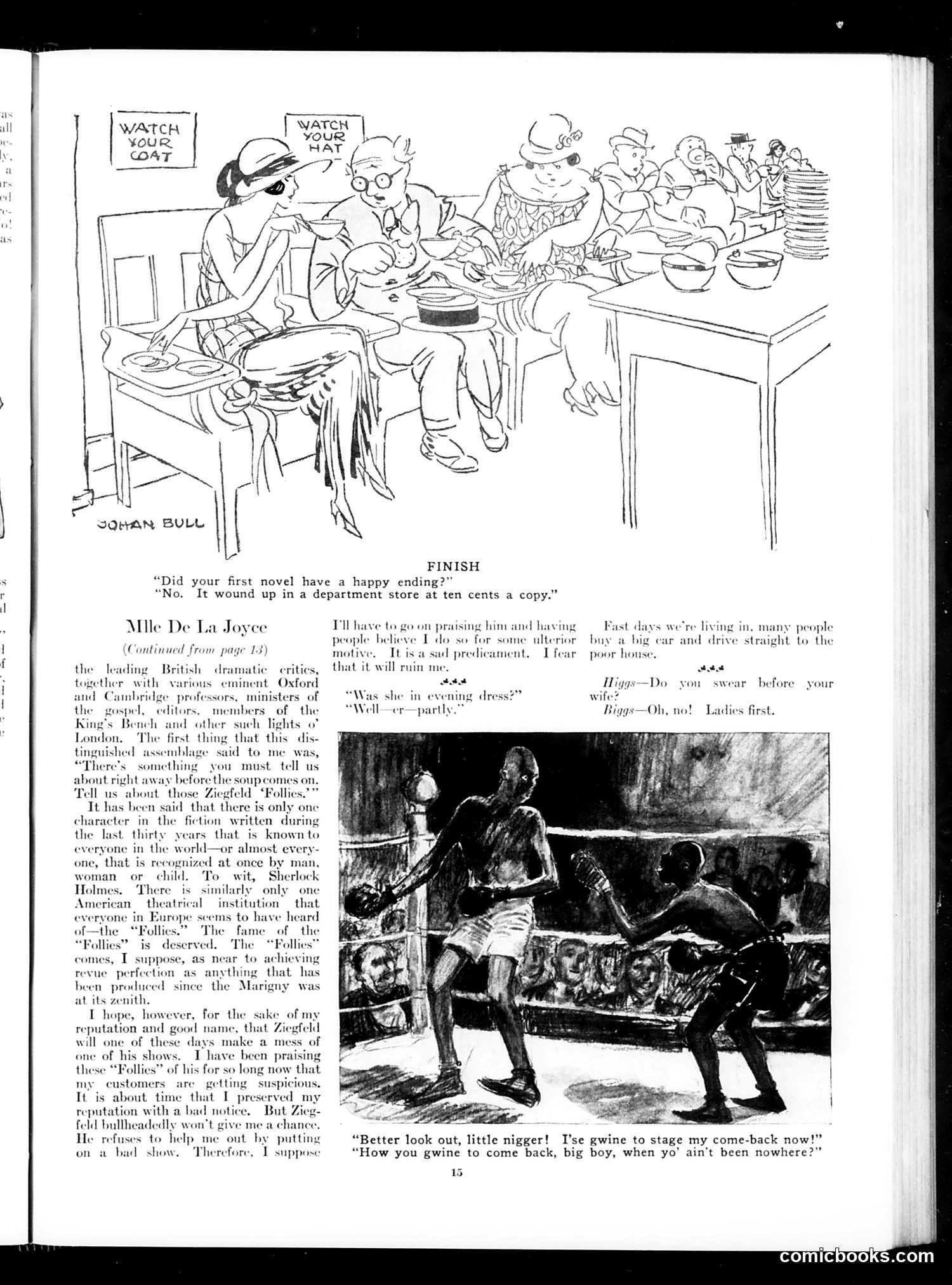
**Top Cartoon (by Johan Bull):** A humorous commentary on publishing failures. A writer boasts his novel had "no happy ending"—it ended up remaindered in a department store at discount prices, suggesting commercial failure rather than artistic tragedy. **Main Article:** A theater critic discusses the Ziegfeld Follies, a famous Broadway revue production. The text explains the Follies' outsized cultural fame—comparable to Sherlock Holmes in literature—and notes the critic's long praise of the shows has made customers suspicious of his motives. **Bottom Illustration & Dialogue:** This uses deeply offensive racial stereotypes and dialect ("I'se gwine," "little nigger") depicting what appears to be a theatrical comeback scenario. This reflects early 20th-century minstrelsy traditions that were prevalent in entertainment. **Context for Modern Readers:** This page illustrates period attitudes toward theater, publishing, and entertainment, but also demonstrates the casual racism embedded in contemporary American popular media—elements modern readers should recognize as historically significant but morally objectionable.
📄 Transcribed text from this page (OCR, searchable)
Machine-transcribed from the original scan — historical spelling and the odd misread are preserved.
FINISH “Did your first novel have a happy ending?” “No. It wound up in a department store at ten cents a copy.” Mile De La Joyce Continued from page 13) the leading British dramatic critics, together with various eminent Oxford and Cambridge professors, ministers of the gospel, editors, members of the King’s Bench and other such lights 0° London. The first thing that this dis- tinguished assemblage said to me was, “There’s something you must. tell us about right away before the soup comes on. Tell us about those Ziegfeld ‘Follies.’” It has been said that there is only one character in the fiction written during the last thirty years that is known to everyone in the world—or almost every- one, that is recognized at once by man, woman or child. To wit, Sherlock Holmes. There is similarly only one theatrical institution — that i ems to have heard The fame of the lies” is deserved. The Hies™ comes, I suppose, as near to achieving revue perfection as anything that has been produced since the Marigny was at its zenith. I hope, however, for the sake of my reputation and good name, that Ziegfeld will one of these days make a mess of one of his shows. I have been praising these “Follies” of his for so long now that my customers are getting suspicious. It is about time that I preserved my reputation with a bad notice. But feld bullheadedly won't give me a chance. He refuses to help me out by putting on a bad show. Therefore, 1 suppose Til have to goon praising him and having Fast days we're living in, many people people believe Ido so for some ulterior buy a big car and drive straight to the motive. It isa sad predicament. I fear poor house. that it will ruin me. ttt rd Higgs—Do you swear before “Was she in evening dress?” wife? “Well—er—partly.” Biggs—Oh, no! Ladies first. “Better look out, little nigger! I’se gwine to stage my come-back now!” “How you gwine to come back, big boy, when yo’ ain't been nowhere?” 15