
A complete issue · 36 pages · 1923
Judge — May 26, 1923
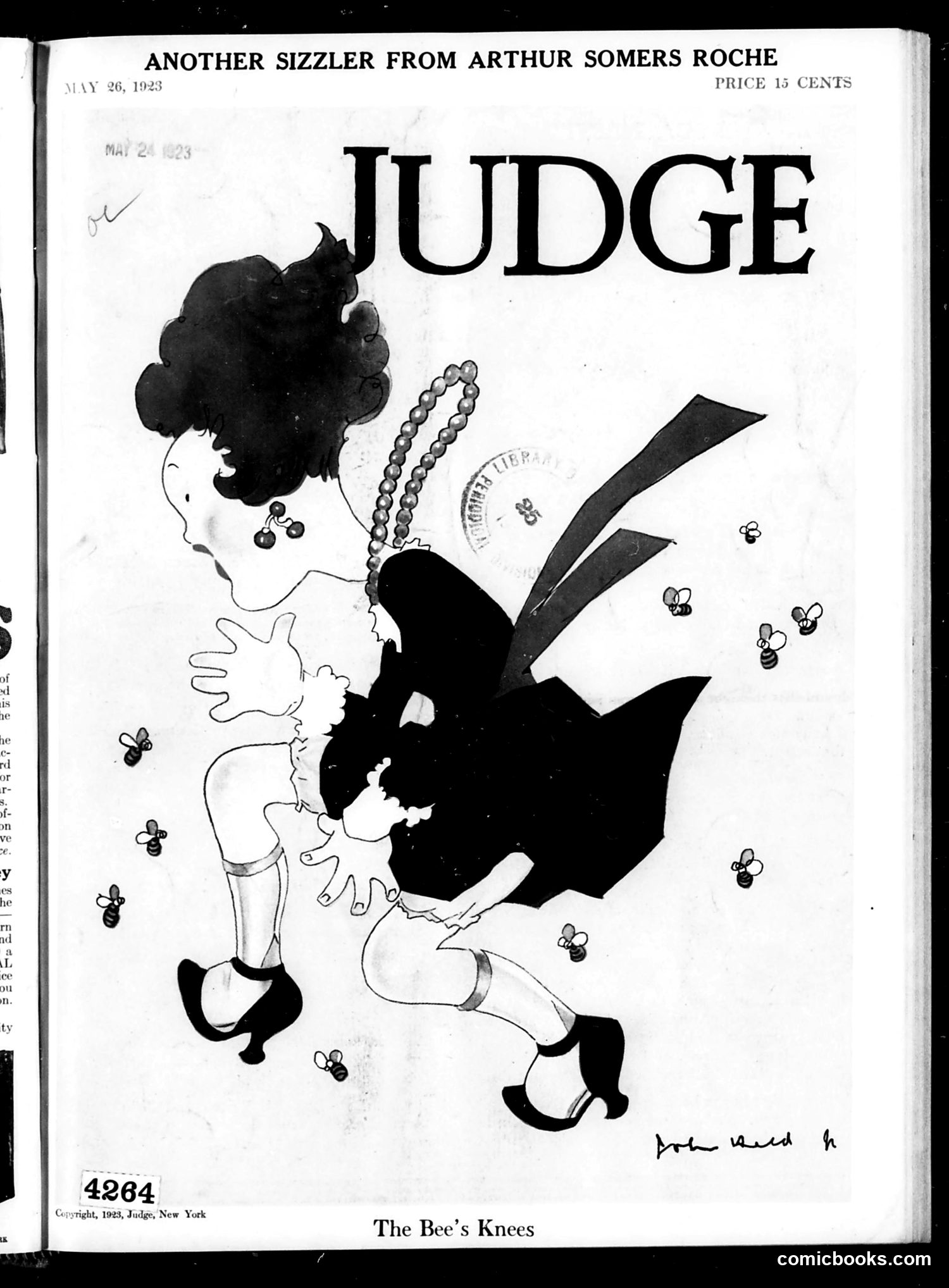
This cartoon illustrates the popular 1920s slang phrase "the bee's knees" (meaning something excellent or fashionable). The image shows a flapper—a young woman embodying 1920s modernity with bobbed hair, pearl necklaces, and a short skirt—being attacked by bees swarming around her knees. The joke plays on the literal phrase: the bees are literally targeting her knees. It's a pun-based visual gag typical of Judge's humor. The flapper represents the era's cultural shift toward youth rebellion, looser social codes, and new fashion standards that scandalized conservative Americans. The cartoon gently mocks both the trendy slang and the fashion-forward young women who embodied the "modern" 1920s.
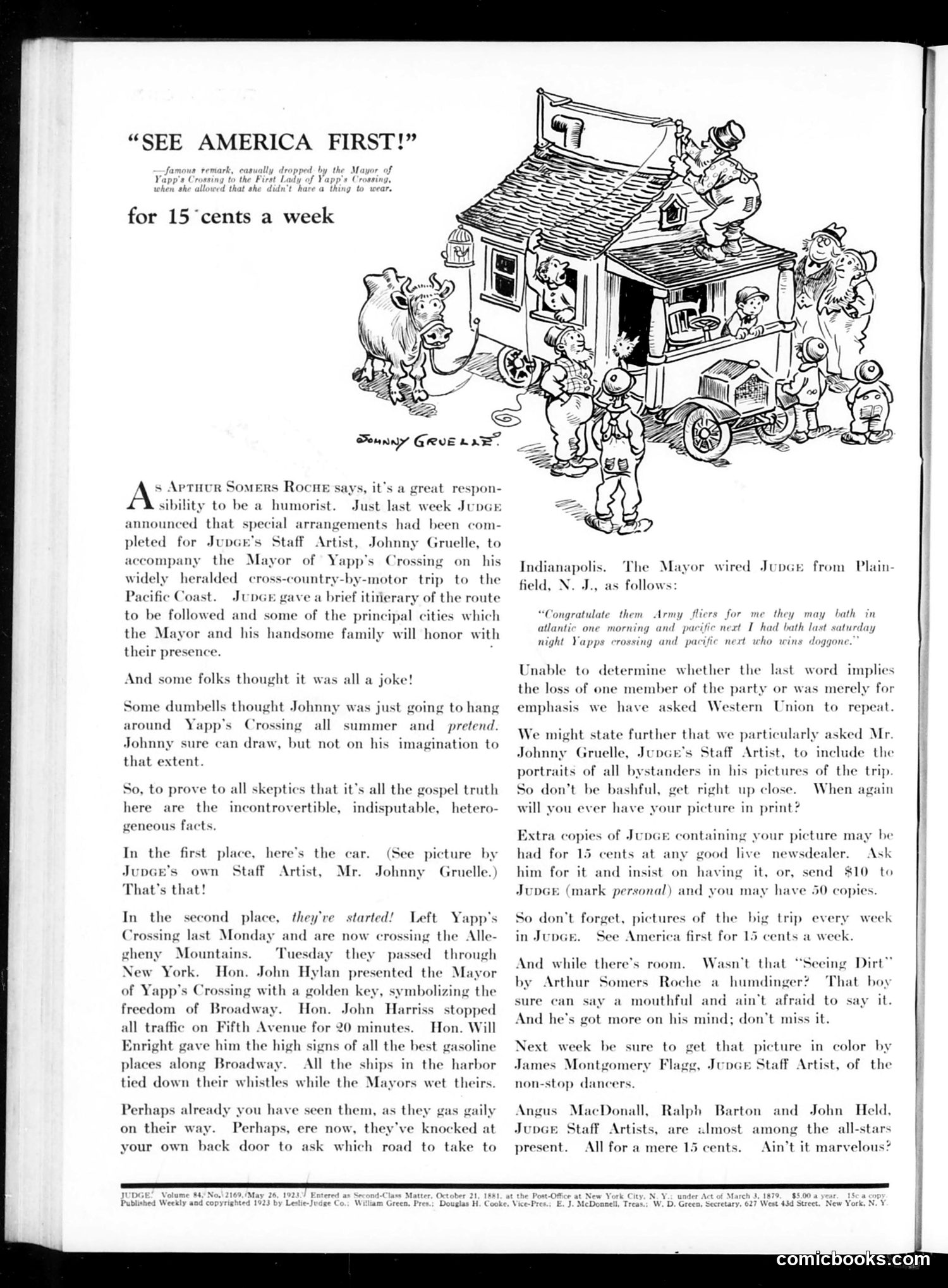
This 1922 **Judge** magazine page satirizes a cross-country publicity tour. The Mayor of Yapp's Crossing is traveling by motor-car to the Pacific Coast, accompanied by Johnny Gruelle (Judge's staff artist), to promote domestic tourism with the slogan "See America First!" The satire mocks several targets: skeptics who doubted the trip's authenticity, the inflated promotional hype around a minor town's mayor, and the emerging American auto-tourism culture. The elaborate illustration of the crowded motorcar surrounded by townspeople emphasizes the carnival-like spectacle. The piece presents this as both genuine news (with verified facts) and absurdist humor—poking fun at small-town boosterism and the era's growing obsession with cross-country automobile adventures as markers of American progress.
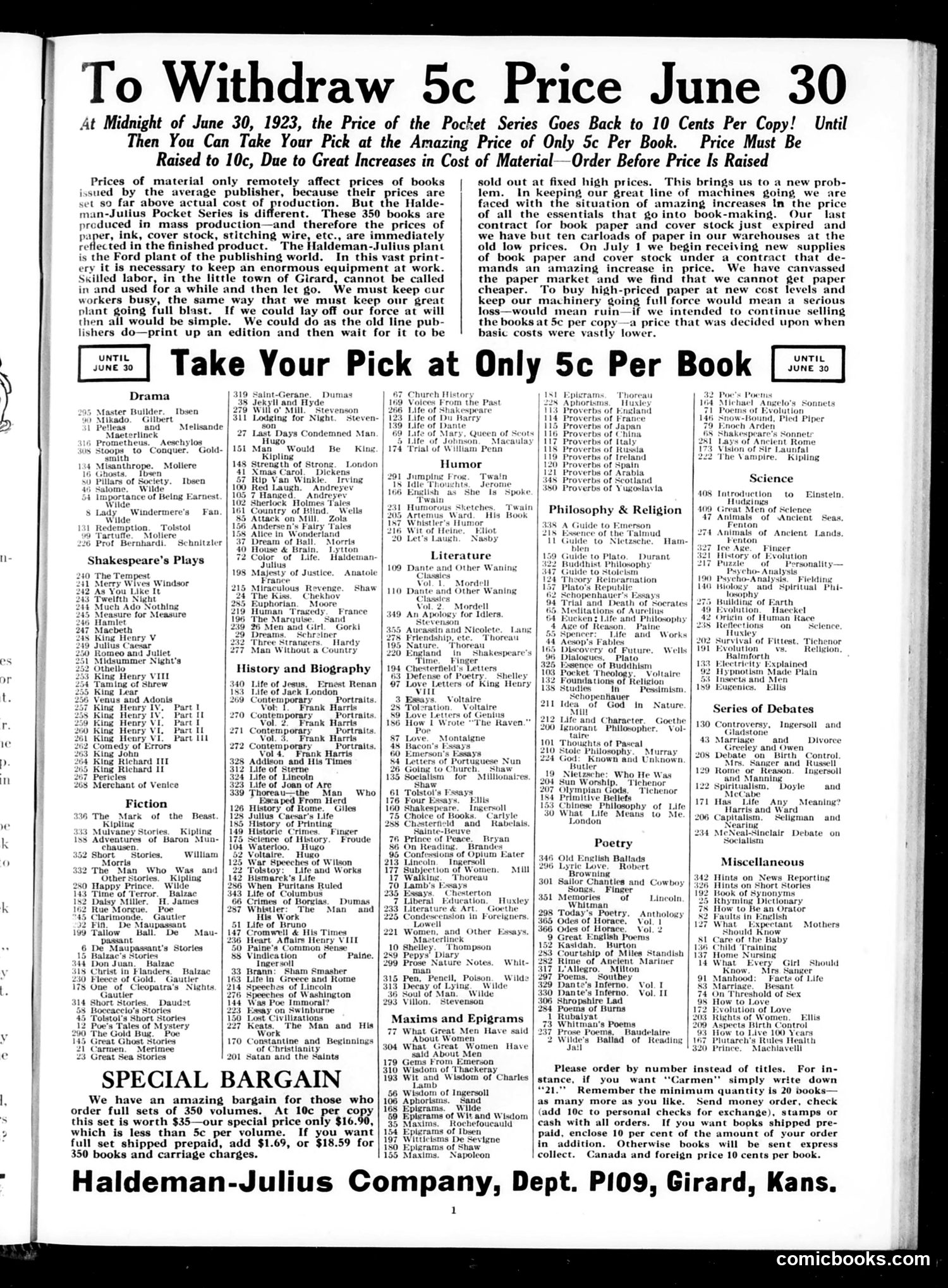
This page is **primarily advertising**, not satire or political commentary. It's a book catalog from Haldeman-Julius Company advertising their "Pocket Series" books. The main content explains a **price change**: books were being withdrawn from a 5-cent price point and returning to 10 cents per copy on June 30, 1923. The publisher justifies this by citing rising costs for paper, ink, and materials, arguing they cannot sustain the 5-cent price. The bulk of the page consists of **numbered book listings** across multiple categories (Drama, Shakespeare's Plays, Fiction, Literature, Science, Philosophy & Religion, Poetry, and others), allowing customers to order by number. There is **no political cartoon or satirical commentary** visible. This is a straightforward commercial announcement and mail-order catalog page.
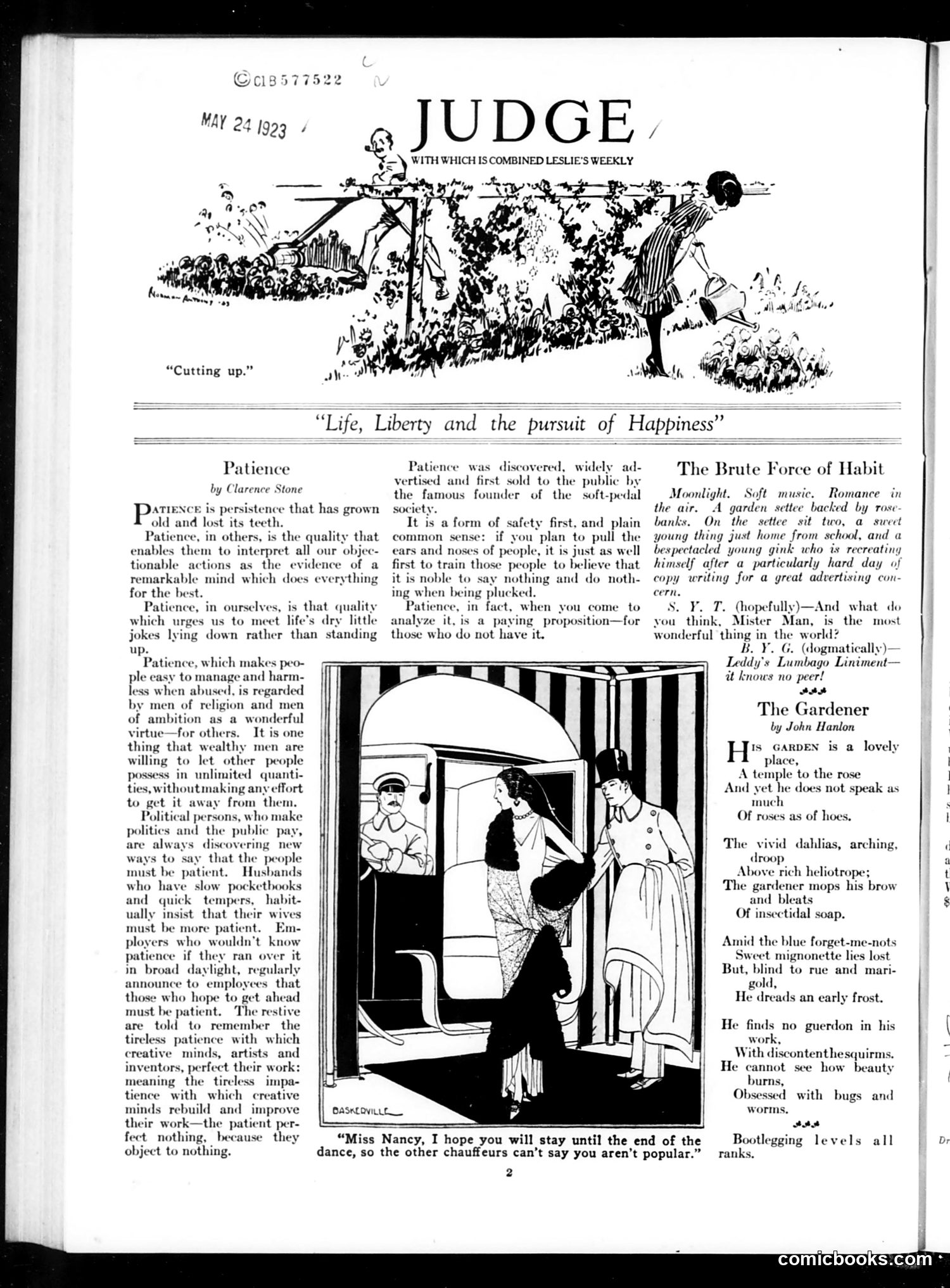
The page features articles on "Patience" by Clarence Stone and poetry ("The Gardener" by John Hanlon), alongside a cartoon captioned "Cutting up." The main cartoon depicts a social scene: a woman in a car speaks to a man outside, saying "Miss Nancy, I hope you will stay until the end of the dance, so the other chauffeurs can't say you aren't popular." The humor satirizes social pretense and status-consciousness of the era—specifically, the shallow measure of popularity by the number of available chauffeurs (indicating wealthy suitors with cars). The cartoon mocks how people perform social importance through visible displays of romantic attention, particularly among the wealthy class of the 1920s.
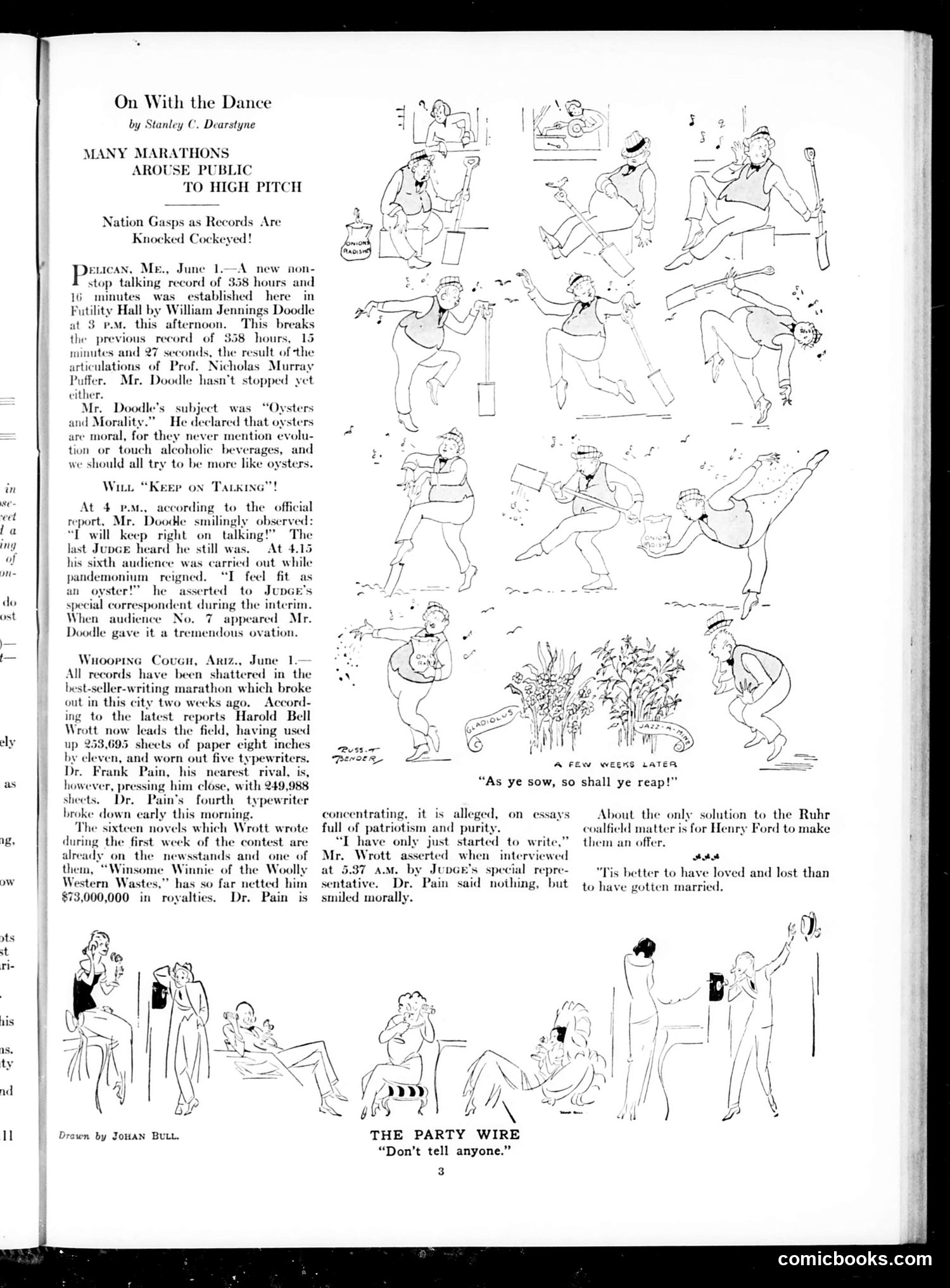
This page satirizes 1920s marathon culture through absurdist humor. The top illustration shows dancers in increasingly ridiculous and exhausted poses, mocking the era's dangerous endurance contests—particularly dance marathons that caused public health concerns. The text references real record-breakers like William Jennings Doodle's 338-hour non-stop talking marathon and competitive typewriter speed records. The satire targets the obsessive record-breaking mania of the Jazz Age, where contestants pushed dangerous physical limits for publicity and prize money. "The Party Wire" cartoon below comments on gossip and socialite scandal-mongering with the caption "Don't tell anyone"—ironically, given it's published widely. Overall, the page ridicules contemporary excess and the public's fascination with pointless endurance spectacles.
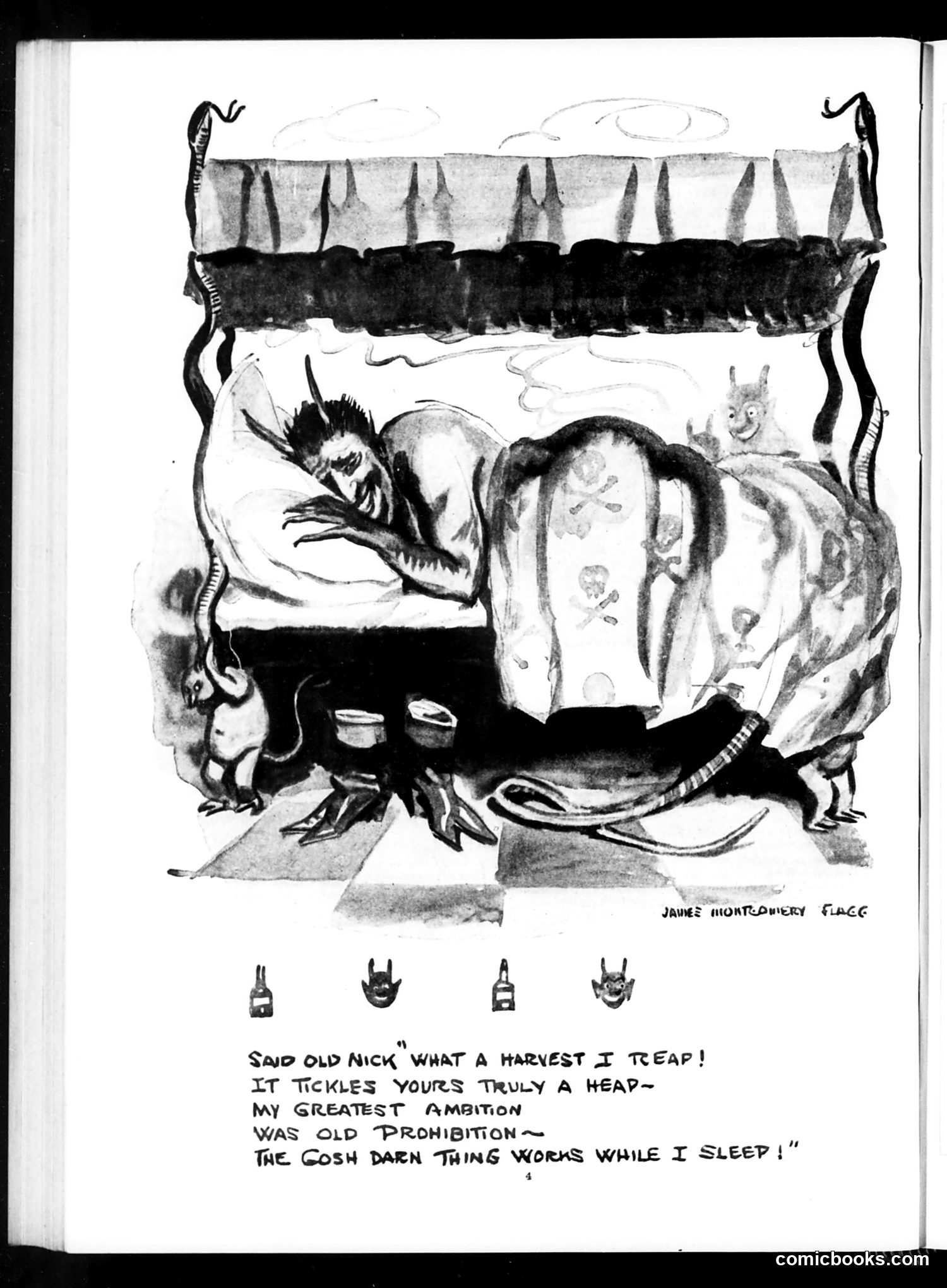
This appears to be a satirical illustration by James Montgomery Flagg depicting a nightmare scene. The central figure in bed is likely representing someone involved with Prohibition enforcement, based on the dialogue mentioning "old Prohibition" as their "greatest ambition." The grotesque creatures surrounding the sleeping figure—appearing demonic or nightmarish—suggest anxiety about Prohibition's consequences or enforcement. The quote "What a harvest I reap! It tickles your newly a head—My greatest ambition was old Prohibition—The gosh darn thing works while I sleep!" indicates ironic commentary: perhaps that Prohibition's enforcement is creating unintended chaos or criminality despite the reformer's intentions. The symbols at the bottom (appearing to be bottles or alcohol-related imagery) reinforce the alcohol/Prohibition theme typical of Judge magazine's satirical commentary on American policy debates.
This is satirical fiction by Arthur Somers Roche presenting a cynical take on presidential ambition. The narrator initially refuses a presidential nomination, citing lack of qualifications and moral objections to the job's demands (kissing babies, meeting congressmen, pleasing the public). The satire's target: American political hypocrisy and materialism. The narrator only accepts after his wife points out financial benefits—magazines will pay double rates, books will sell millions. He then celebrates this mercenary decision as patriotic duty and noble service. The joke mocks how politicians rationalize self-interest as public service, and how easily principles collapse before profit motives. References to needing approval from "the church, the financial interests, the prohibitionists, and the bootleggers" suggest corruption across institutions. This reflects 1920s-era cynicism about political leadership and the commercialization of public office.
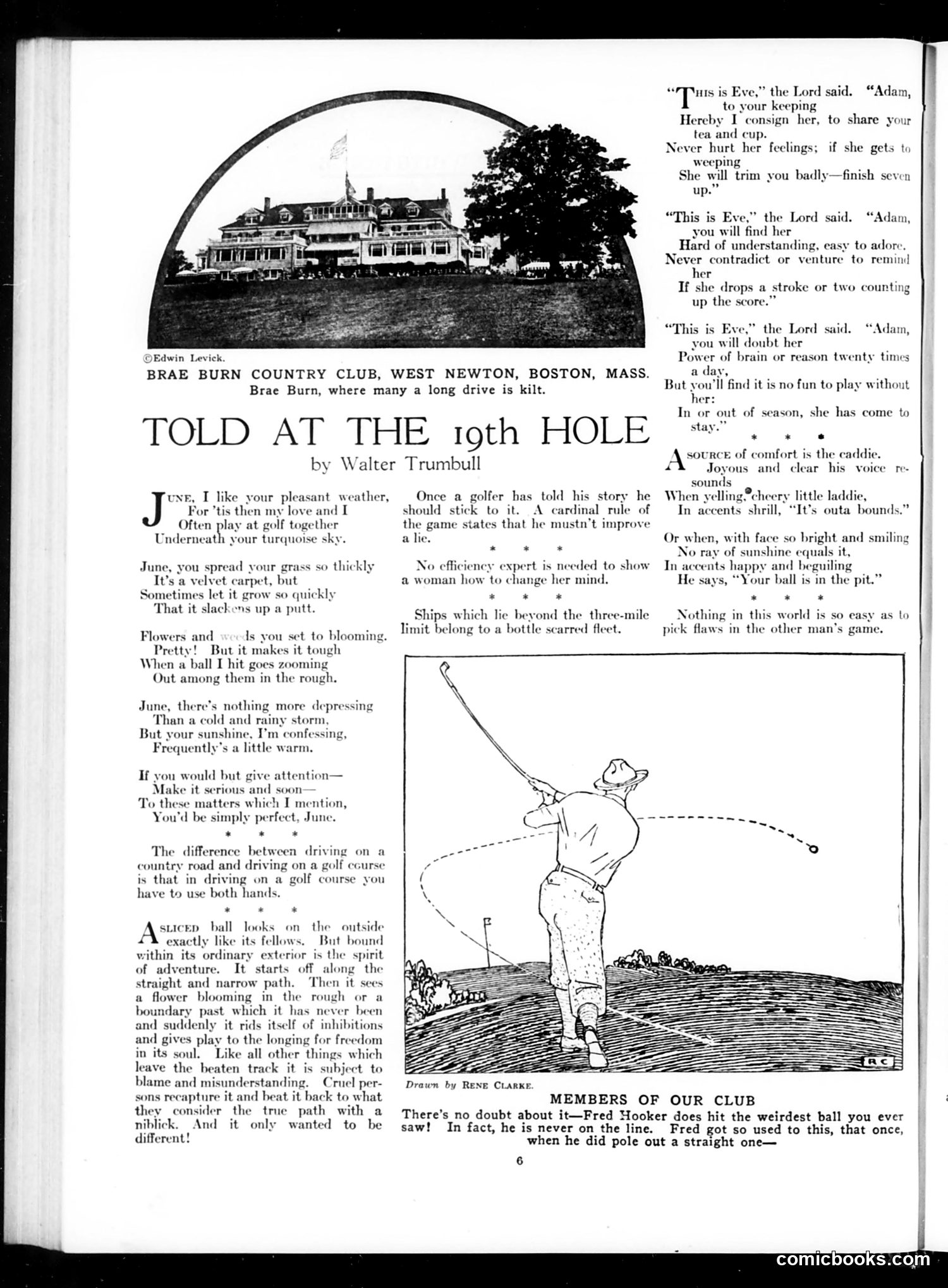
This page from *Judge* magazine presents humorous observations about golf and golfers at an exclusive country club (Brae Burn, near Boston). The content consists of: **Main Poem** by Walter Trumbull: Addressed to "June," personifying the month while critiquing its effects on golf—pleasant weather but overgrown grass, blooming flowers creating rough hazards, and unpredictable warmth. **Satirical Observations**: Brief jokes about golfers' behavior and excuses. Notable is the extended metaphor comparing a golf ball to a person seeking freedom but being "beat back" by society—a lighthearted commentary on conformity. **The Cartoon**: Shows a golfer mid-swing with an exaggerated arc, illustrating typical club member behavior. **Final Joke**: About "Fred Hooker," a member whose ball always flies off-line so consistently that when he once hits straight, nobody recognizes it as his shot. The satire targets wealthy golfers' pretensions, their elaborate excuses for poor play, and their quirky personalities—typical *Judge* fodder mocking upper-class leisure culture.
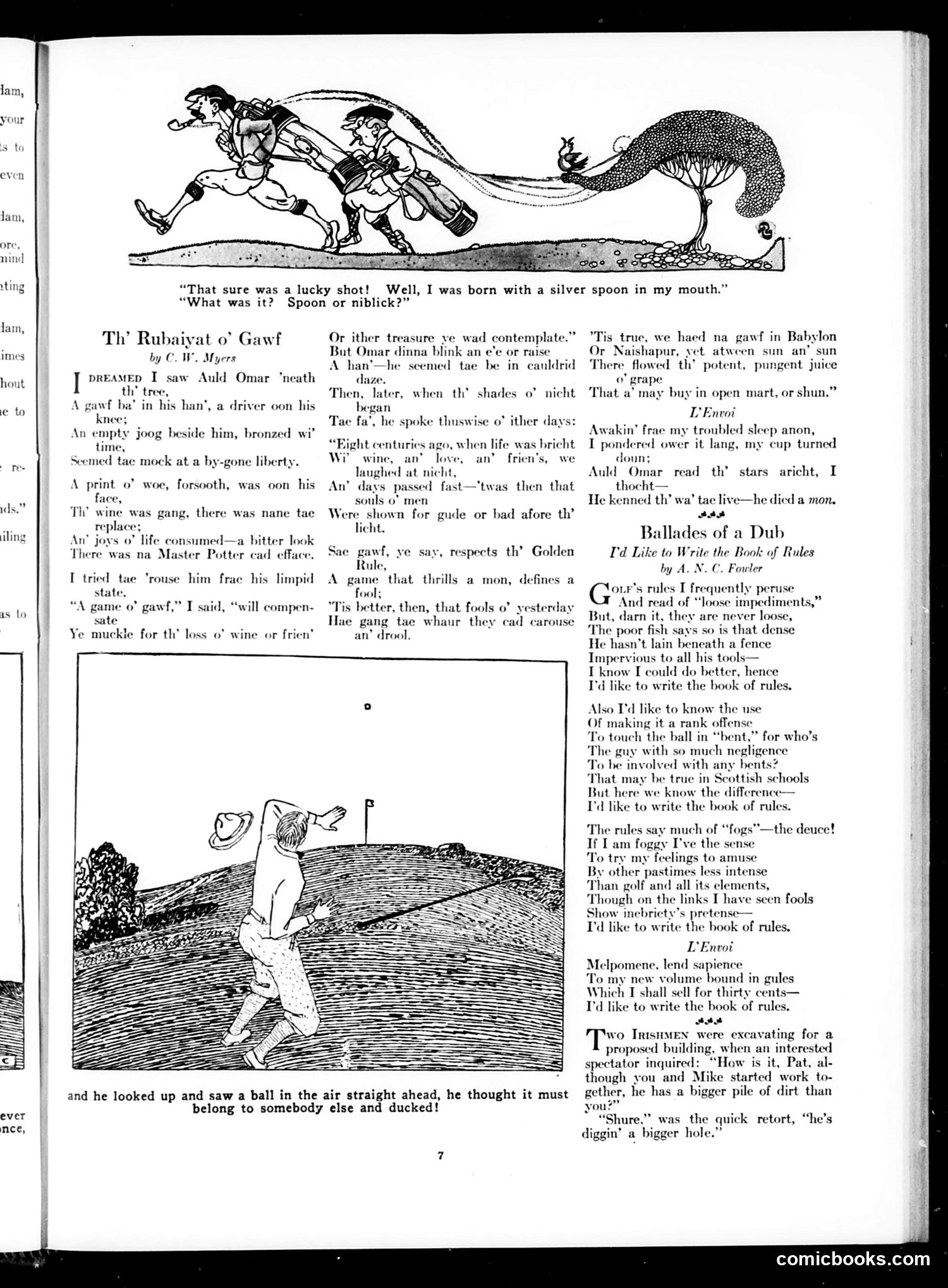
**Top Cartoon:** Two figures flee from a large snake while golfing. The caption jokes about a "lucky shot"—one asks if it was a "spoon or niblick" (golf clubs). The humor relies on the absurdity of treating a dangerous snake encounter as a golf discussion. **"Th' Rubaiyat o' Gawf":** This is a parody of Omar Khayyam's famous Persian poetry collection *Rubaiyat of Omar Khayyam* (rendered in Scottish dialect). It presents golf as a modern substitute for the wine, love, and philosophical reflection of Omar's original work. The satire mocks golf's cultural elevation—suggesting it fills the void that wine and companionship once did. **Bottom Cartoon:** Two Irishmen dig. When asked why one has more dirt, he replies his partner is "diggin' a bigger hole." This plays on Irish-American ethnic stereotypes common to the era, presenting them as dim-witted laborers. **"Ballades of a Dub":** Complains about arbitrary golf rules, wishing to write "the book of rules" himself—gentle satire of golf's pedantic rule-obsessiveness.
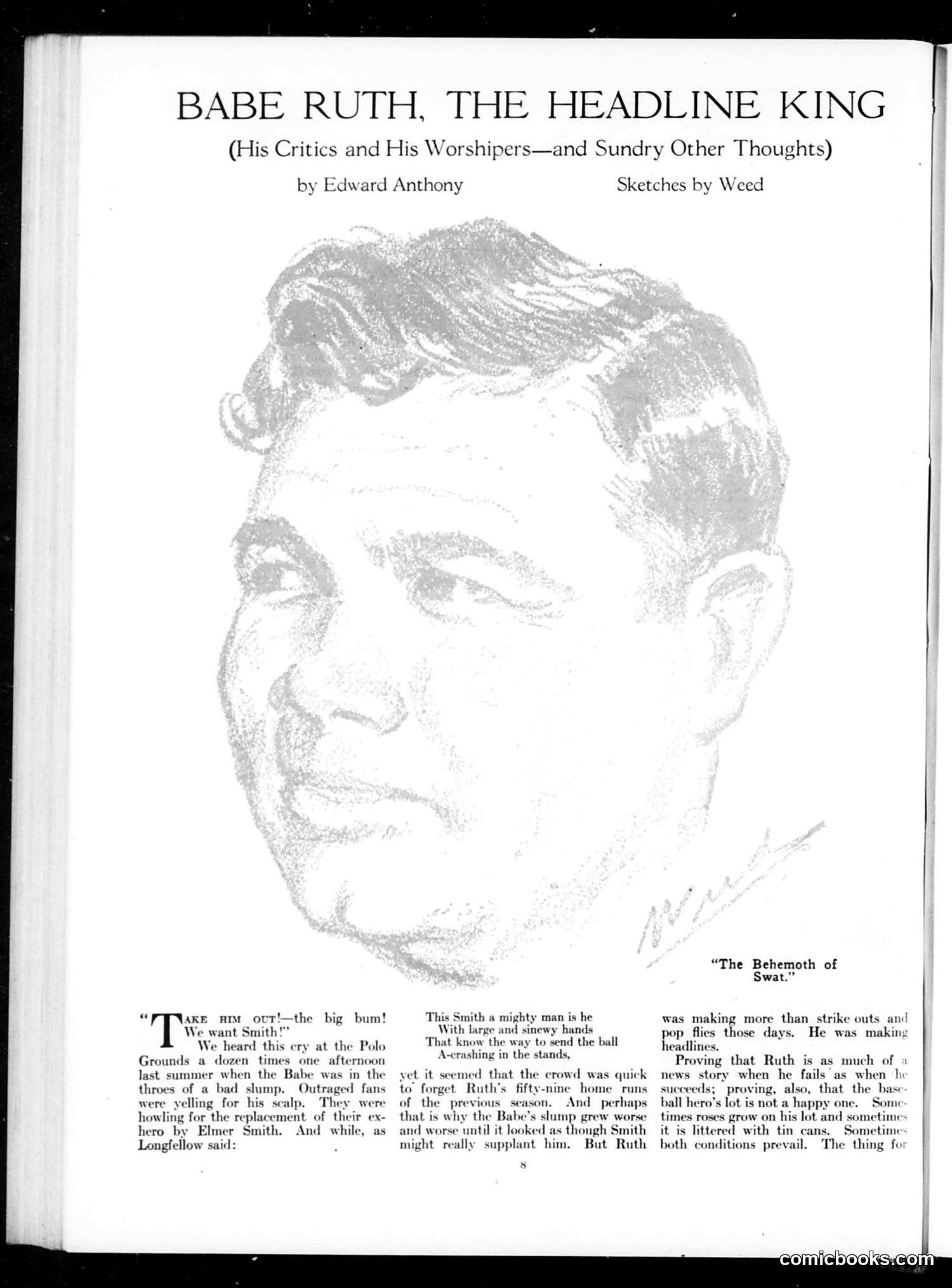
This article satirizes Babe Ruth's relationship with American baseball fans and the press. The sketch shows Ruth during a batting slump at the Polo Grounds, where fans vocally demanded his replacement with teammate Elmer Smith—despite Ruth's impressive 59 home runs the previous season. The satire's point: fans are fickle and forgetful, quickly abandoning heroes during performance dips. More significantly, it critiques how Ruth generates headlines regardless of success or failure. The article suggests Ruth's real power lies not in athletic consistency but in his ability to dominate newspaper coverage. Whether striking out or hitting home runs, he remains "the Headline King"—making him simultaneously celebrated and vulnerable to public derision. The piece comments on how celebrity and media attention create an unstable, often unhappy existence for sports figures, caught between worship and scorn.
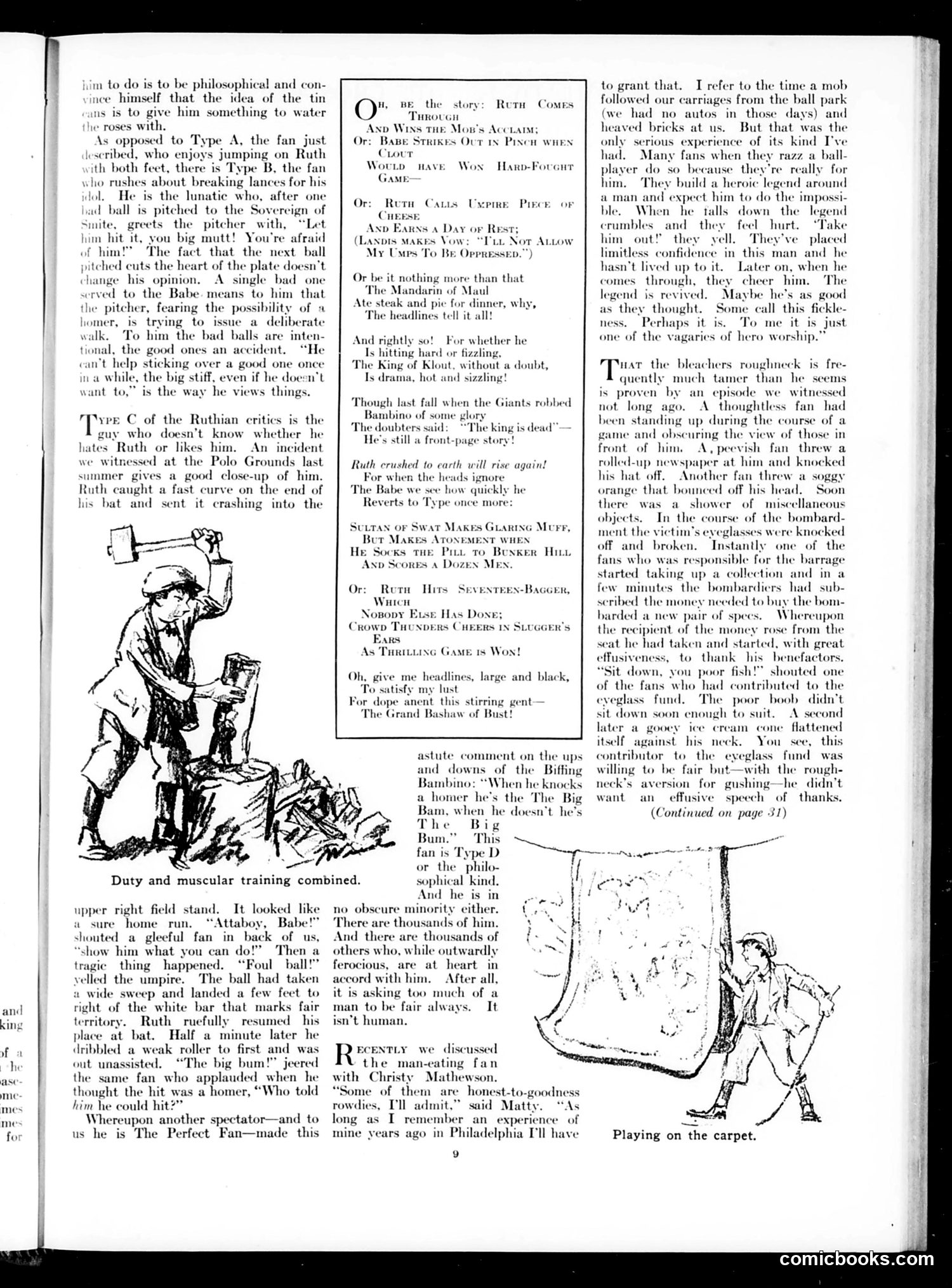
This page satirizes different types of baseball fans obsessed with Babe Ruth, the famous baseball player. The text describes four "Types" of Ruth fans: **Type A & B:** Enthusiastic fans who either support or irrationally defend Ruth regardless of performance. **Type C:** The inconsistent fan illustrated in the cartoon—shown beating a baseball with a club. He cheers Ruth's home runs but viciously criticizes him for failures, calling him "the big bum" moments after praising "Attaboy Babe!" **Type D:** The philosophical fan who accepts Ruth's inconsistency as human nature. The satire mocks how average fans are emotionally invested in Ruth's every at-bat, creating sensational newspaper headlines whether he succeeds or fails. Ruth's celebrity status means even his strikeouts become front-page news. The piece gently ridicules fan irrationality and the media's obsession with sports drama, while acknowledging this behavior is "not obscure" but widespread.
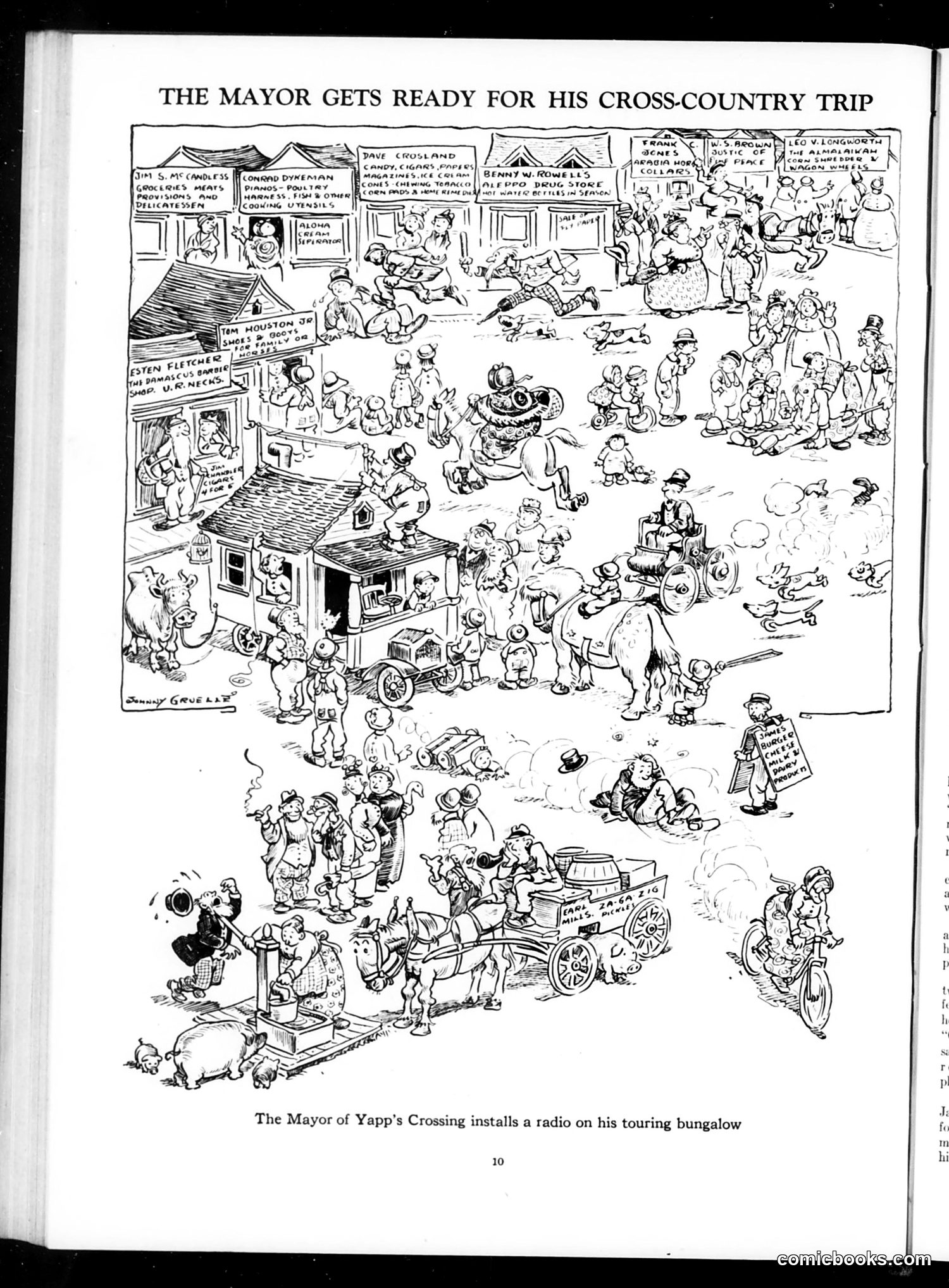
This satirical cartoon depicts "The Mayor of Yapp's Crossing" preparing for a cross-country trip by installing a radio on his touring bungalow. The humor centers on small-town civic pride and the clash between modern technology and provincial life. The chaotic street scene shows townsfolk gathering around the mayor's elaborate mobile setup—featuring horses, wagons, bicycles, and various contraptions. The satire appears to mock how a small-town mayor might grandiosely equip himself with cutting-edge 1920s radio technology for what's essentially a local excursion, treating it as a major expedition. Store signs visible in the background suggest this is meant to represent an ordinary town, making the over-the-top preparations even more absurd. The cartoon satirizes small-town pretension and the era's fascination with new communication technology.
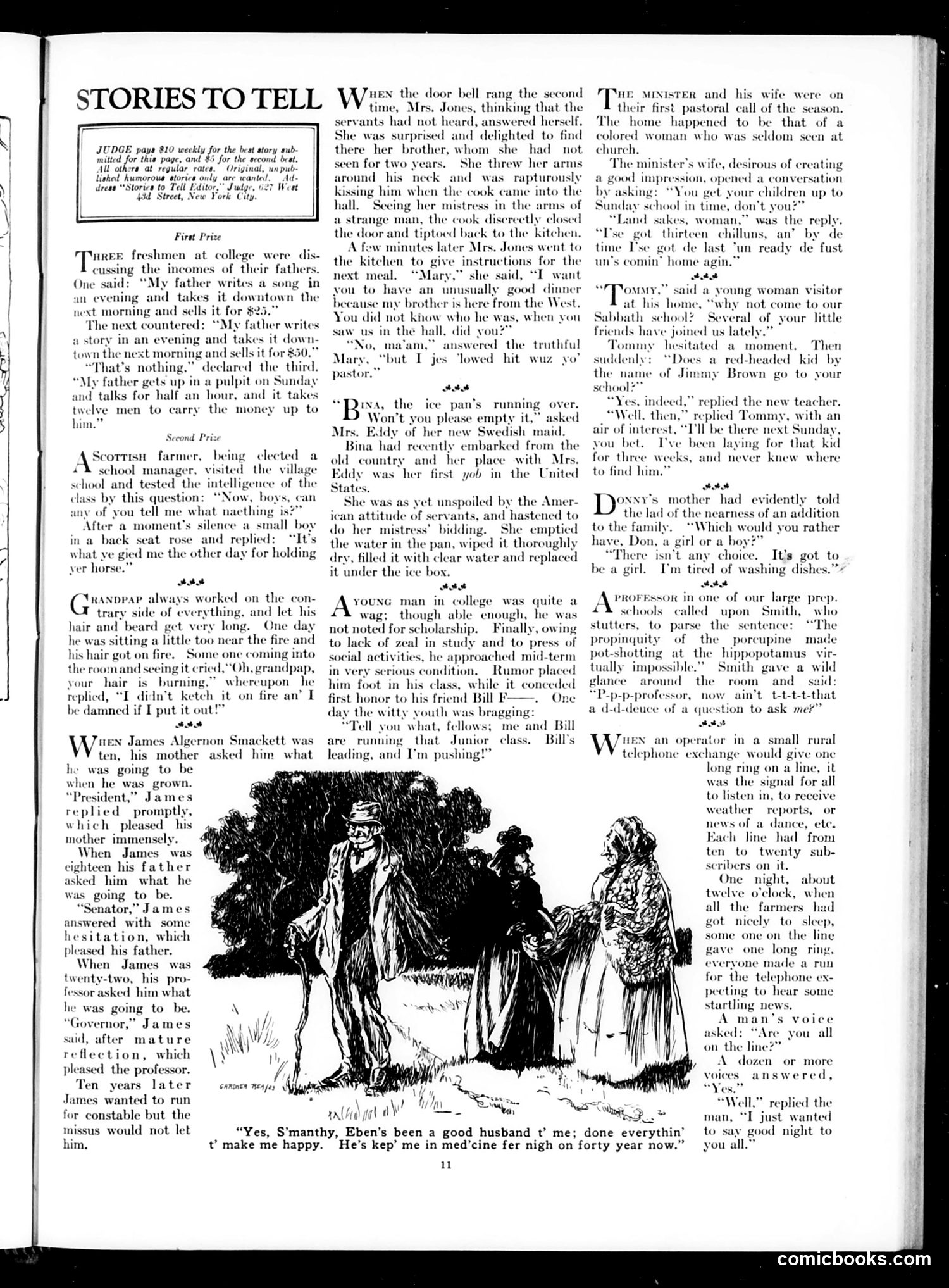
This page from *Judge* magazine contains six humorous short stories that rely on wordplay, misunderstandings, and social commentary typical of early 20th-century American humor. **Key stories:** 1. **College fathers' incomes**: A minister's earning power is satirized—he "talks for half an hour" and "takes twelve men to carry the money up to him," mocking clergy's financial support from congregations. 2. **Scottish farmer and "naething"**: A schoolboy defines "nothing" as what the farmer gave him for holding his horse—mocking rural Scots dialect and rural-urban class distinctions. 3. **James Algernon Smackett's ambitions**: A man's aspirations decline with age (President → Senator → Governor → constable), with his wife ultimately preventing even that, satirizing how marriage and practicality diminish male ambition. 4. **Mistaken identity**: A cook misinterprets her employer's embrace of a strange man, creating comedic tension around class relationships. 5. **Swedish maid and ice water**: A literal-minded immigrant servant misunderstands instructions, poking fun at foreign servants' unfamiliarity with American customs. 6. **College wit and scholarship**: A student brags about "pushing" while his friend leads academically—mocking false credit-taking. The humor targets clergy wealth, rural dialects, masculine ambition, class dynamics, and immigrant "otherness."
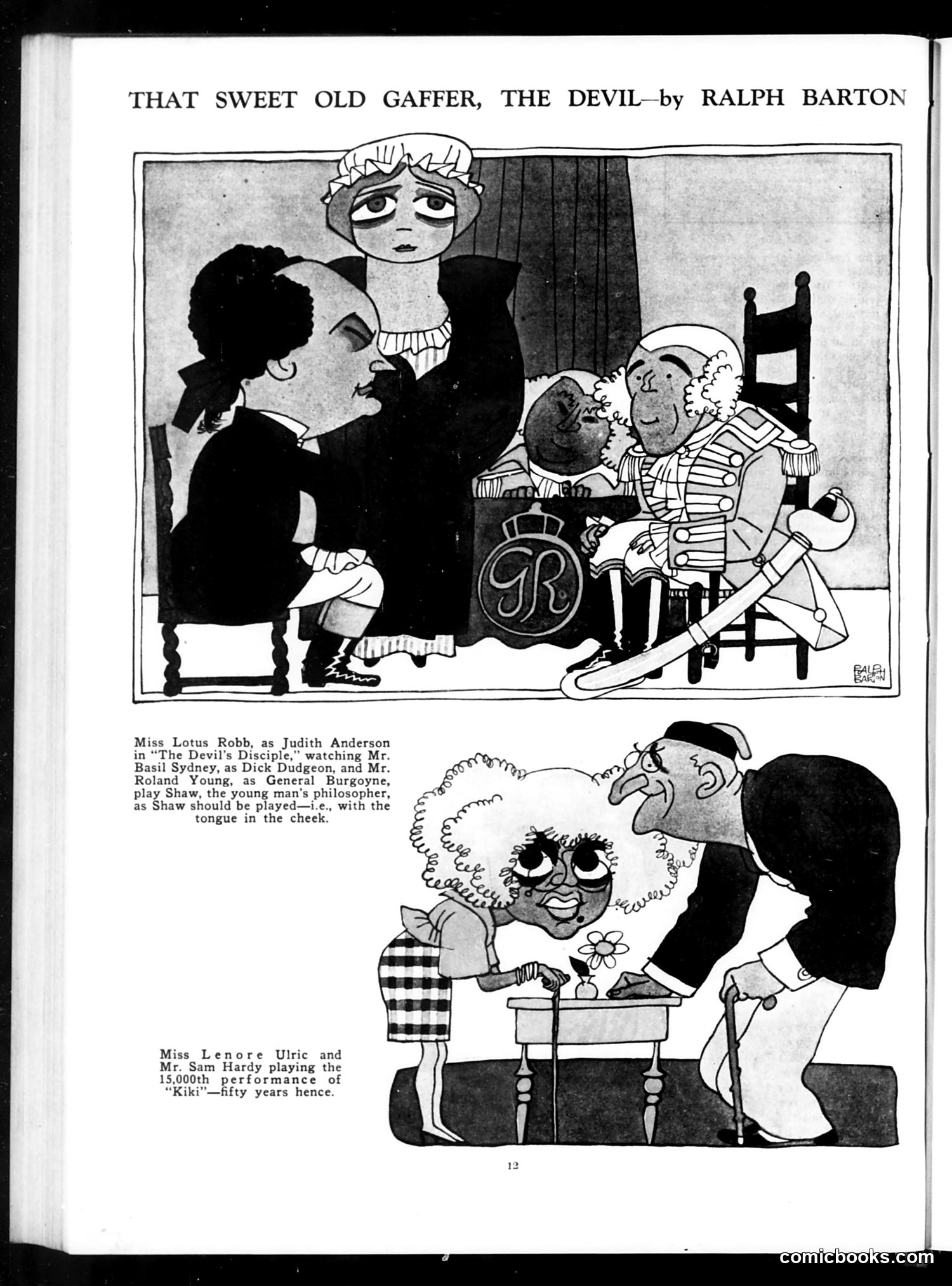
This page features two theatrical caricatures by Ralph Barton satirizing performances of plays with devil characters. The top image shows a scene from "The Devil's Disciple" with Miss Lotus Robb as Judith Anderson, watched by other actors. The caption notes Shaw should be played "with tongue in cheek"—meaning ironically, not earnestly. The bottom cartoon depicts Miss Lenore Ulric and Mr. Sam Hardy in a comedic vision of "Kiki" at its 15,000th performance "fifty years hence." The exaggerated aging and grotesque caricatures mock the idea of the play running indefinitely—a satirical jab at either the play's quality or theatrical longevity. Both images use Barton's characteristic sharp caricature style to mock theatrical conventions and actors' interpretations of dramatic material.
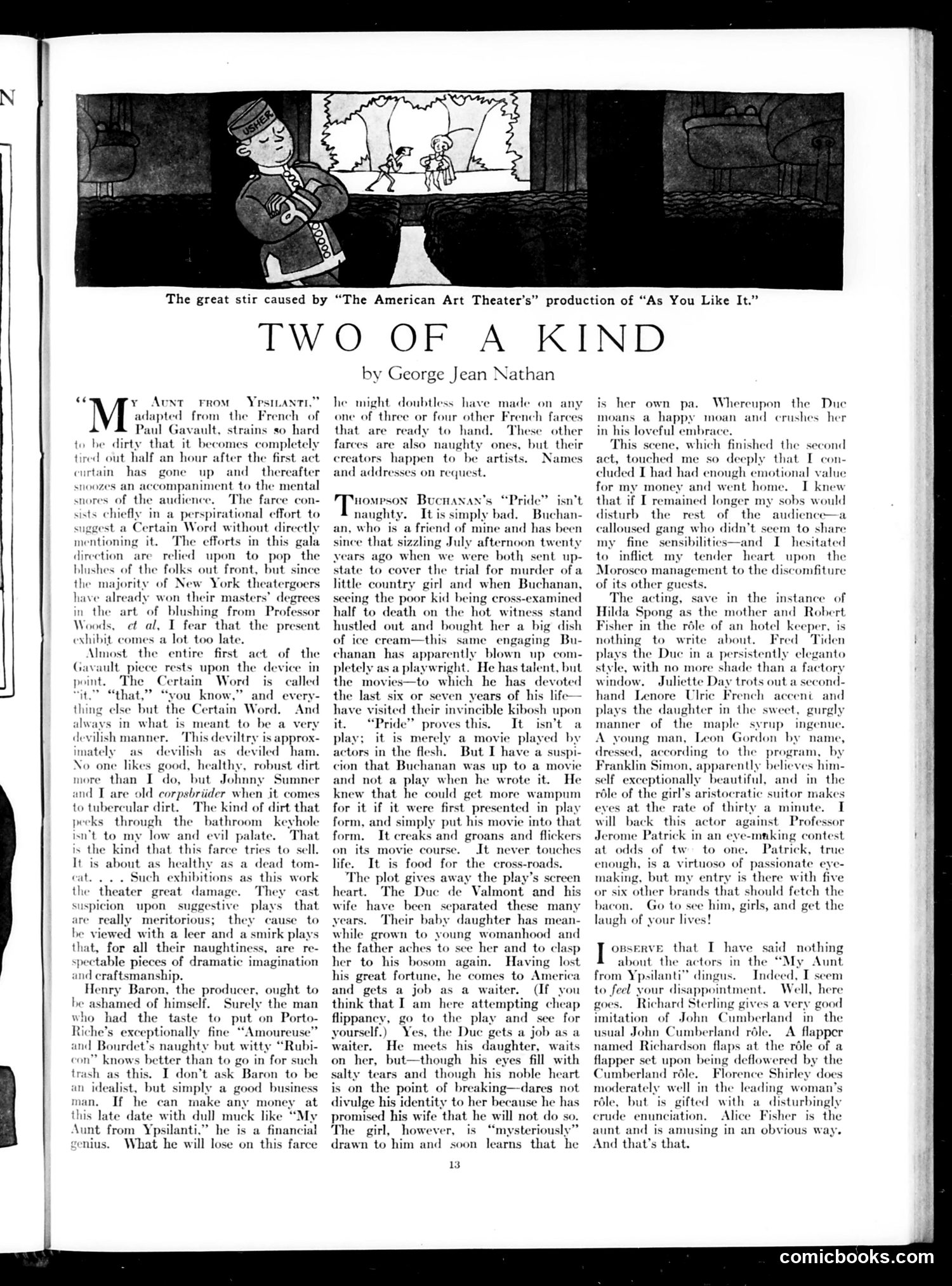
This page contains two theater reviews by George Jean Nathan, a prominent Judge magazine critic. The cartoon at top satirizes "The American Art Theater's" production of Shakespeare's "As You Like It." Nathan reviews two contemporary French farces with contrasting harshness: 1. **"My Aunt from Ypsilanti"**: Nathan lambasts this adaptation as relying entirely on crude innuendo—repeatedly dancing around "the Certain Word" without saying it—to generate laughs. He dismisses it as unhealthy "tubercular dirt" that damages theater's reputation and wastes producer Henry Baron's talents (evidenced by his earlier success with more sophisticated French plays). 2. **"Pride"** by Professor Buchanan: Nathan critiques this as simply bad playwriting, suspecting Buchanan adapted a movie into play form merely for profit. The plot's transparent mechanics—a separated couple and their grown daughter—lack artistic merit. Nathan's consistent point: theatrical success requires artistic integrity, not crude tricks or commercial cynicism.
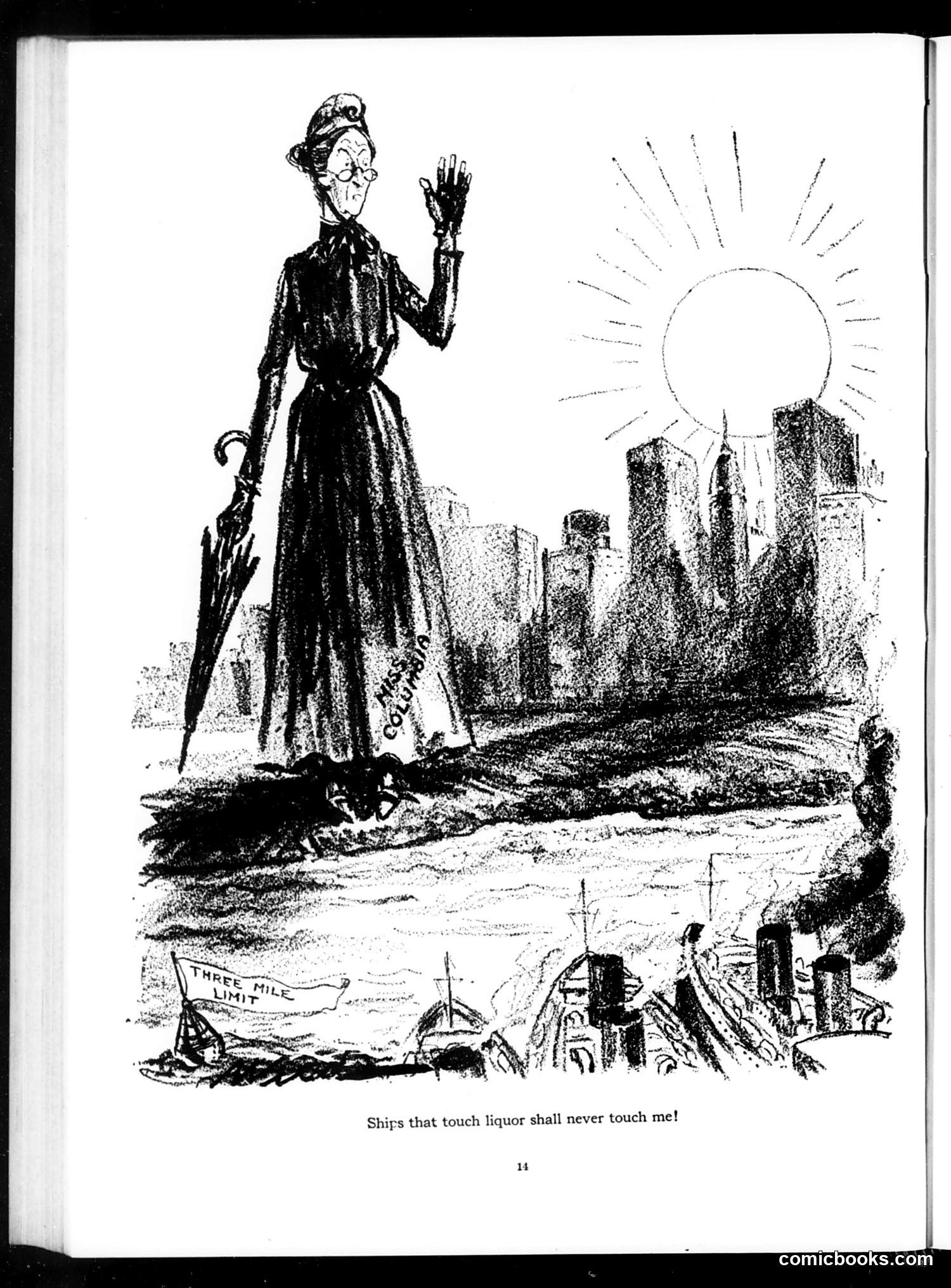
This appears to be a temperance or Prohibition-era cartoon, likely from the early 20th century. The illustration depicts a tall, austere woman (possibly representing a temperance advocate or moral authority figure) standing on a pedestal overlooking a city, holding a torch aloft—evoking the Statue of Liberty imagery. Her declaration—"Ships that touch liquor shall never touch me!"—is a satire of strict temperance ideology. The cartoon mocks the absolutist stance of Prohibition supporters by personifying their moral position as an unrealistic, grandiose figure making impossible demands on commerce and shipping. The ships at the harbor below represent the practical reality of international trade and alcohol distribution, contrasting with the cartoon's critique of temperance movement's refusal to acknowledge economic realities.
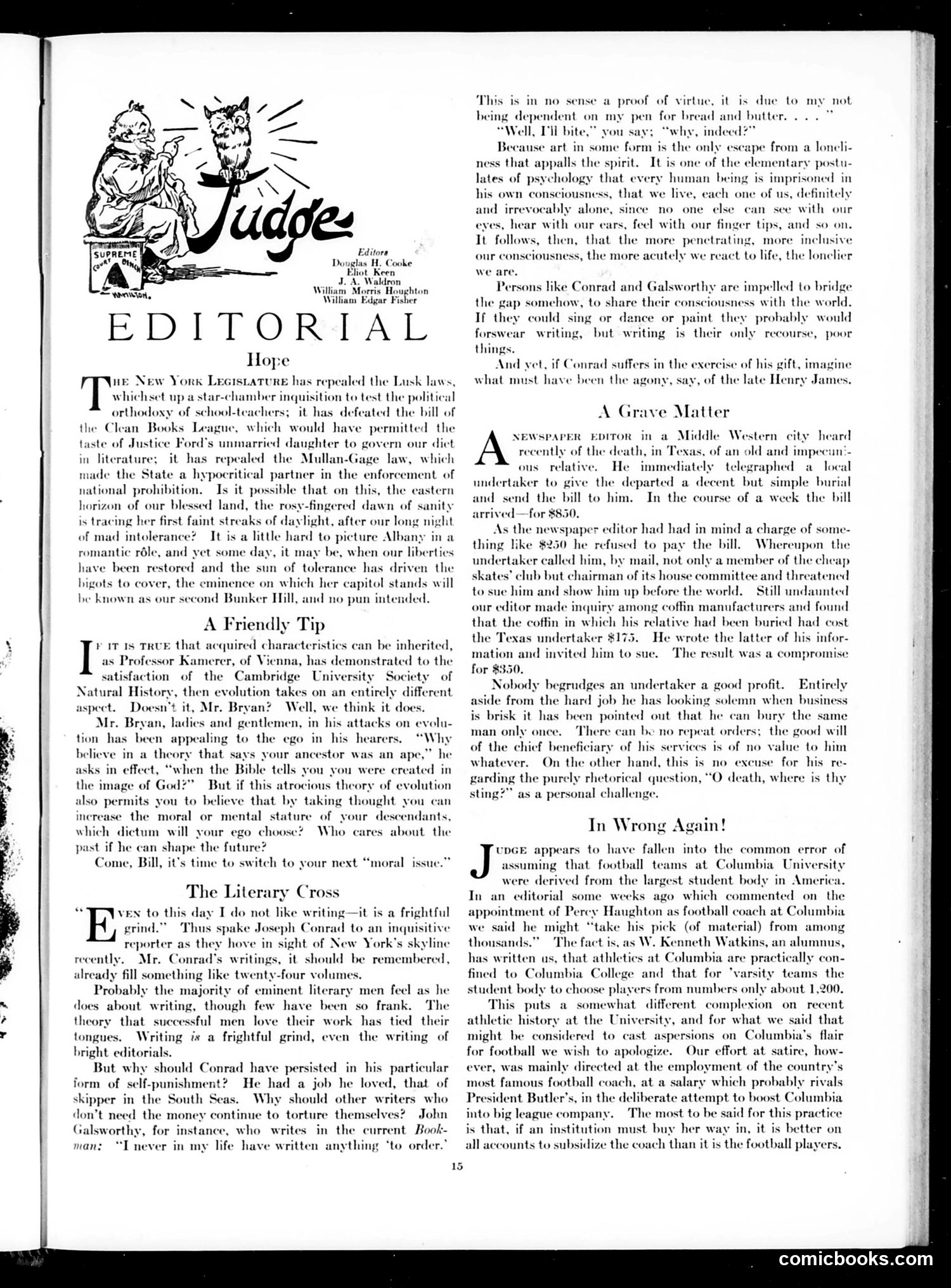
This editorial page satirizes several targets of 1920s American progressivism and anti-intellectualism: **"Hope" Editorial**: Celebrates New York's repeal of restrictive laws—the Lusk laws (anti-communist teacher loyalty tests), the Clean Books League censorship bill, and Prohibition enforcement (Mullan-Gage law). Judge praises this as "sanity" returning to Albany. **"A Friendly Tip"**: Mocks William Jennings Bryan's anti-evolution arguments. The cartoon shows a confrontation (unclear details) related to Bryan's ego-based appeals against Darwinism. Judge suggests Bryan's own logic—that inherited acquired characteristics improve descendants—actually supports evolutionary thinking, turning his argument against him. **"The Literary Cross"**: Defends serious writers (Conrad, Galsworthy) who claim writing is torturous labor despite success. Judge argues artists bridge human isolation through their work, justifying their "self-punishment" as noble rather than masochistic. The page reflects Judge's cosmopolitan, anti-censorship, pro-modernist stance during the cultural conflicts of the 1920s.
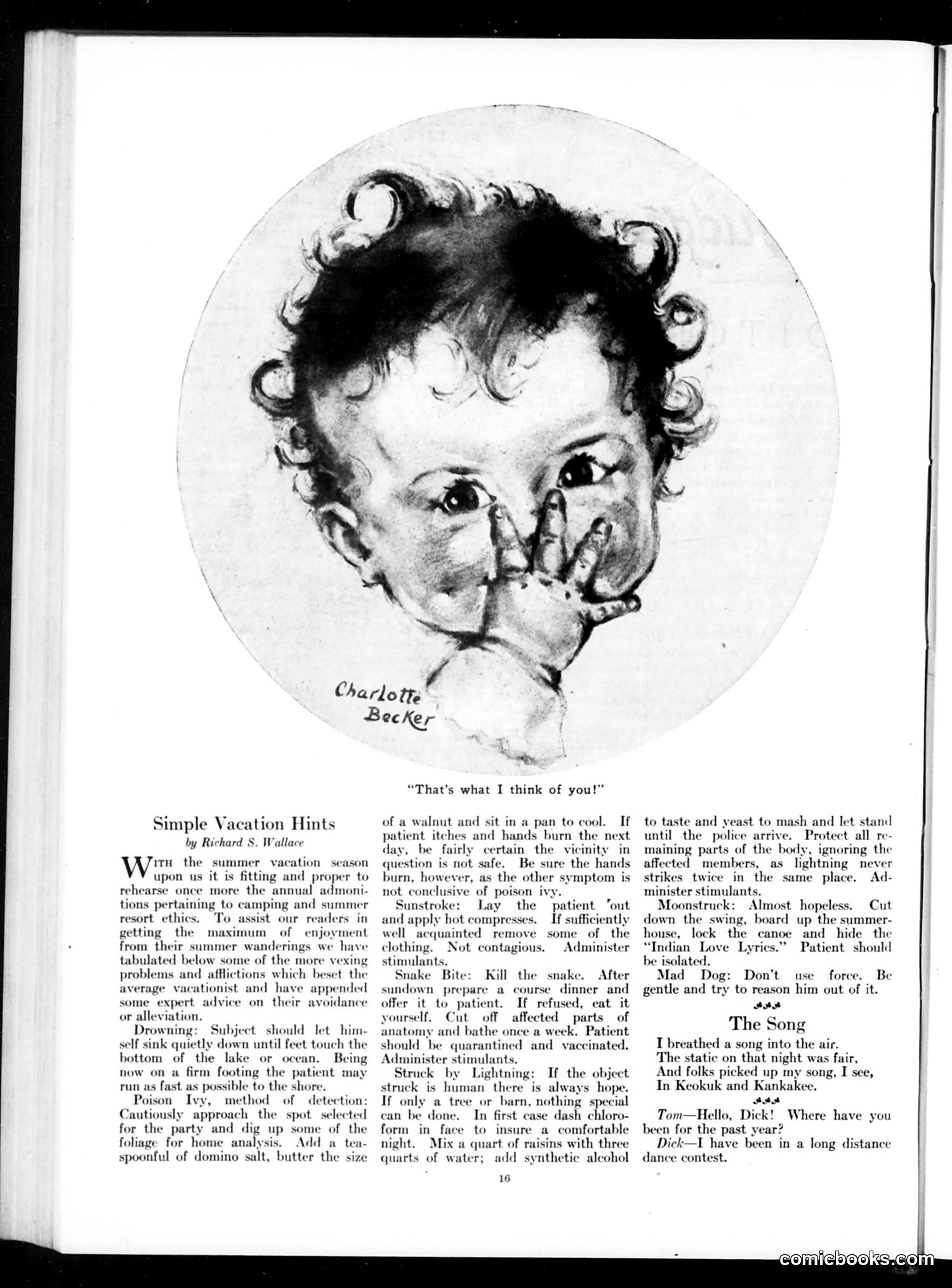
This page combines a portrait sketch with satirical vacation advice. The circular illustration at top, signed "Charlotte Becker," depicts a young person with curled hair making a dismissive gesture—captioned "That's what I think of you!" The bulk of the page presents Richard S. Wallace's "Simple Vacation Hints," which is **absurdist satire mocking amateur medical advice**. The humor lies in deliberately terrible remedies for summer mishaps: for poison ivy, you're told to dig up foliage and test it by letting it burn your hands; for snakebite, kill the snake then feed the patient dinner; for lightning strike, use chloroform; for moonstroke, board up the summerhouse. This satirizes the era's widespread folk remedies and the casual, often dangerous "advice" circulating in popular culture. The exaggerated logic—"if your hands burn, you'll know it's poison ivy"—highlights how absurd such guidance actually was. The page also includes "The Song," a brief comic poem about broadcasting a song that was picked up on radio static, and a joke about someone in a "long distance dance contest."
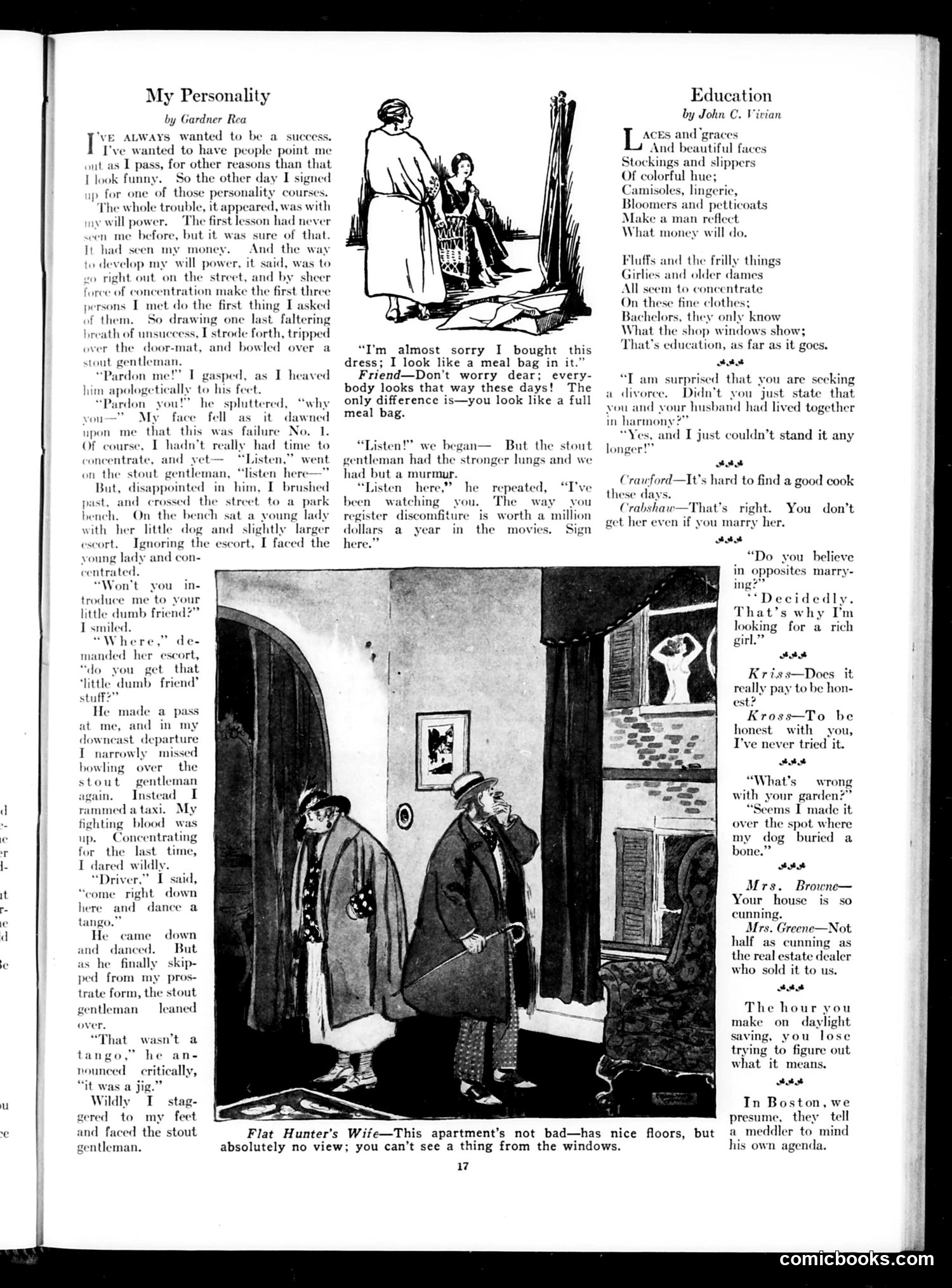
This page contains two satirical pieces typical of Judge magazine's humor: **"My Personality"** (left) mocks the self-help industry popular in the early 20th century. The narrator pays for a "personality course" promising to develop his willpower through concentration exercises. Each attempt backfires comically—he trips a gentleman, gets punched by a protective escort, and commandeers a taxi driver to dance. The punchline reveals the "stout gentleman" he keeps encountering is actually impressed by his "discomfiture" and offers him a movie contract, suggesting the absurdity of personality "improvement" and Hollywood's low standards. **"Education"** (right) satirizes gender relations and materialistic courtship. The poem suggests men's "education" is merely window-shopping for fashionable women's clothing (camisoles, stockings, petticoats), while the short comic dialogues mock marriage, cooking, honesty, and real estate fraud—typical social observations of the era presented as cynical quips. Both pieces reflect Jazz Age skepticism toward self-improvement schemes and gender dynamics of the 1920s-30s.
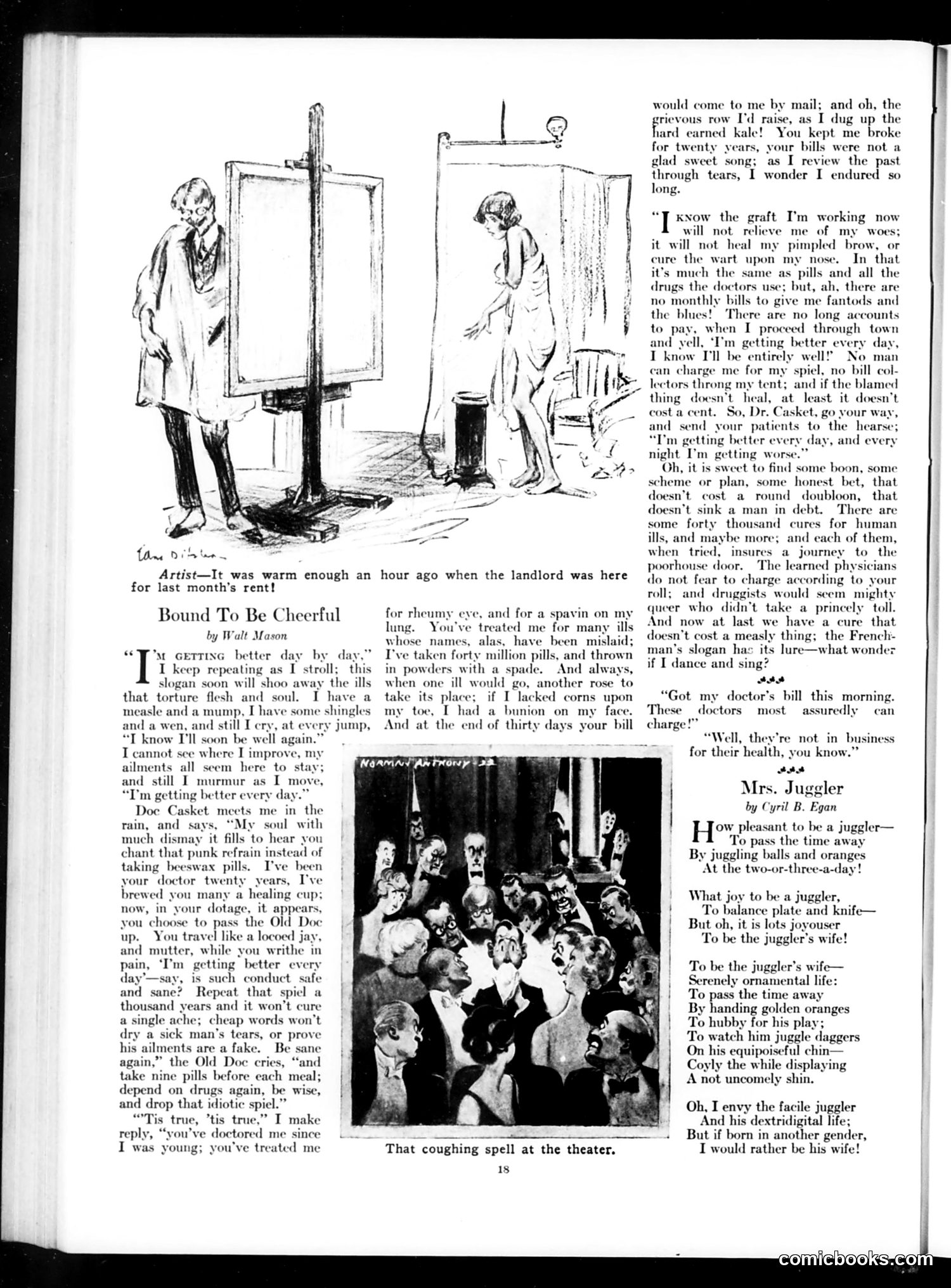
**"Bound To Be Cheerful"** (main cartoon/story by Walt Mason): A sick man obsessively repeats "I'm getting better every day" despite suffering measles, mumps, and shingles. His long-suffering doctor, Dr. Casket, confronts him, noting that pills and medical care cost money but this empty optimism costs nothing. The satire targets both pseudoscientific positive-thinking crazes and the financial burden of medical bills on poor patients. The joke: the man prefers his free delusion to expensive actual treatment, since at least his cheerfulness "doesn't cost a cent." **"Mrs. Juggler"** (poem by Cyril B. Egan, with accompanying theatrical photograph): A lighthearted poem contrasting the juggler's exciting public life with his wife's dull domestic role—she merely hands him props while he performs. The satire gently mocks traditional gender roles and the invisible labor of wives supporting their husbands' careers. Both pieces reflect early 20th-century concerns: medical exploitation of the poor and rigid domestic hierarchy.
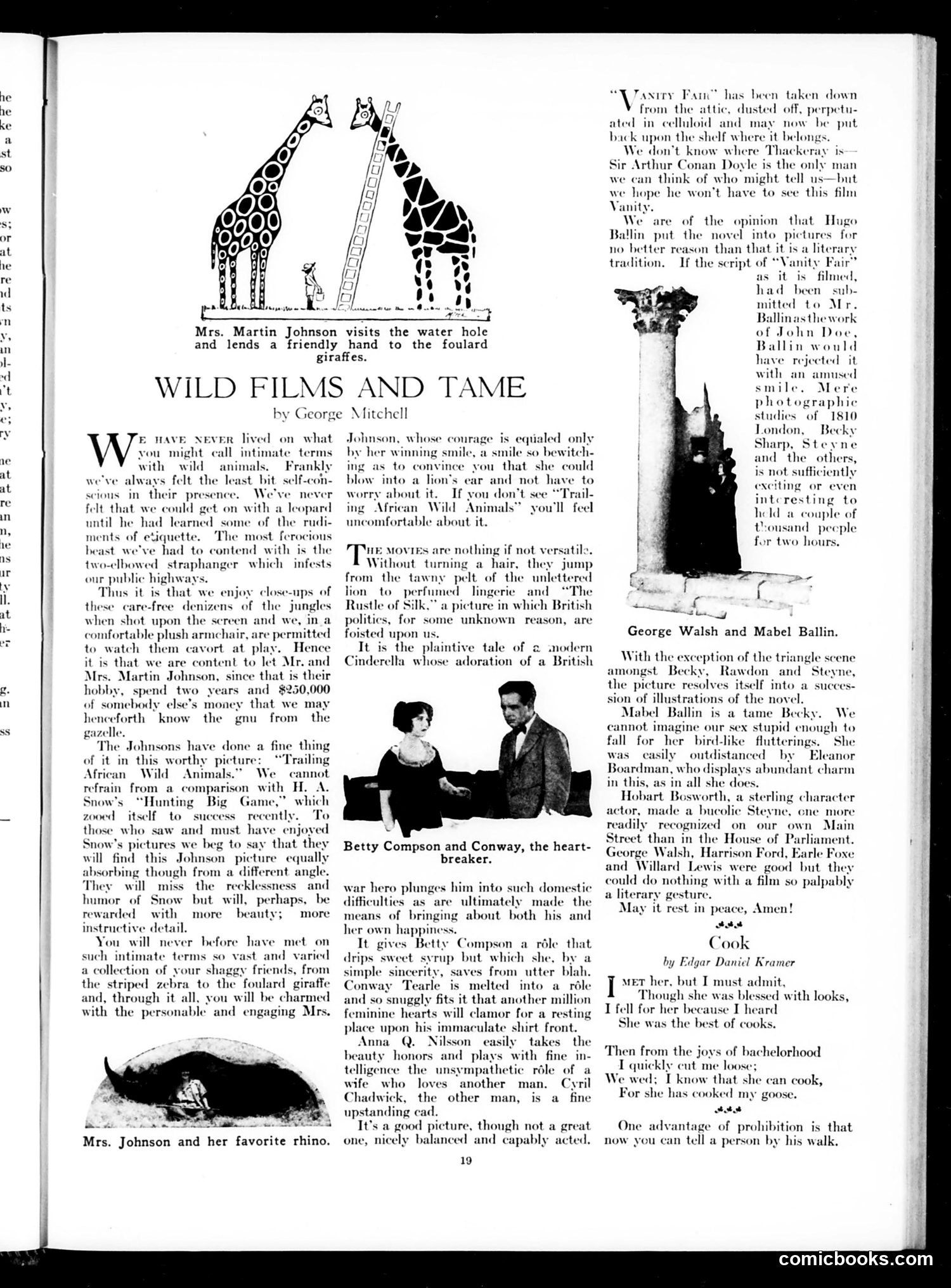
This page reviews three films: the Johnsons' wildlife documentary "Trailing African Wild Animals," a romantic drama with Betty Compson and Conway Tearle, and a film adaptation of Thackeray's *Vanity Fair* directed by Hugo Ballin. The satire targets **literary pretension**: the critic mocks Ballin for adapting *Vanity Fair* merely because "it is a literary tradition," suggesting the film would never succeed on its own merits—implying filmmakers blindly pursue classics for prestige rather than quality. The **wildlife footage** receives praise because it offers genuine entertainment value: close-ups of exotic animals from Mrs. Johnson's actual expedition, which the critic finds more honest than artificial dramatic productions. The humor stems from contrasting **authentic spectacle** (real animals) against **hollow literary adaptation** (famous novel, mediocre execution). The critique suggests Hollywood should prioritize entertainment over cultural respectability.
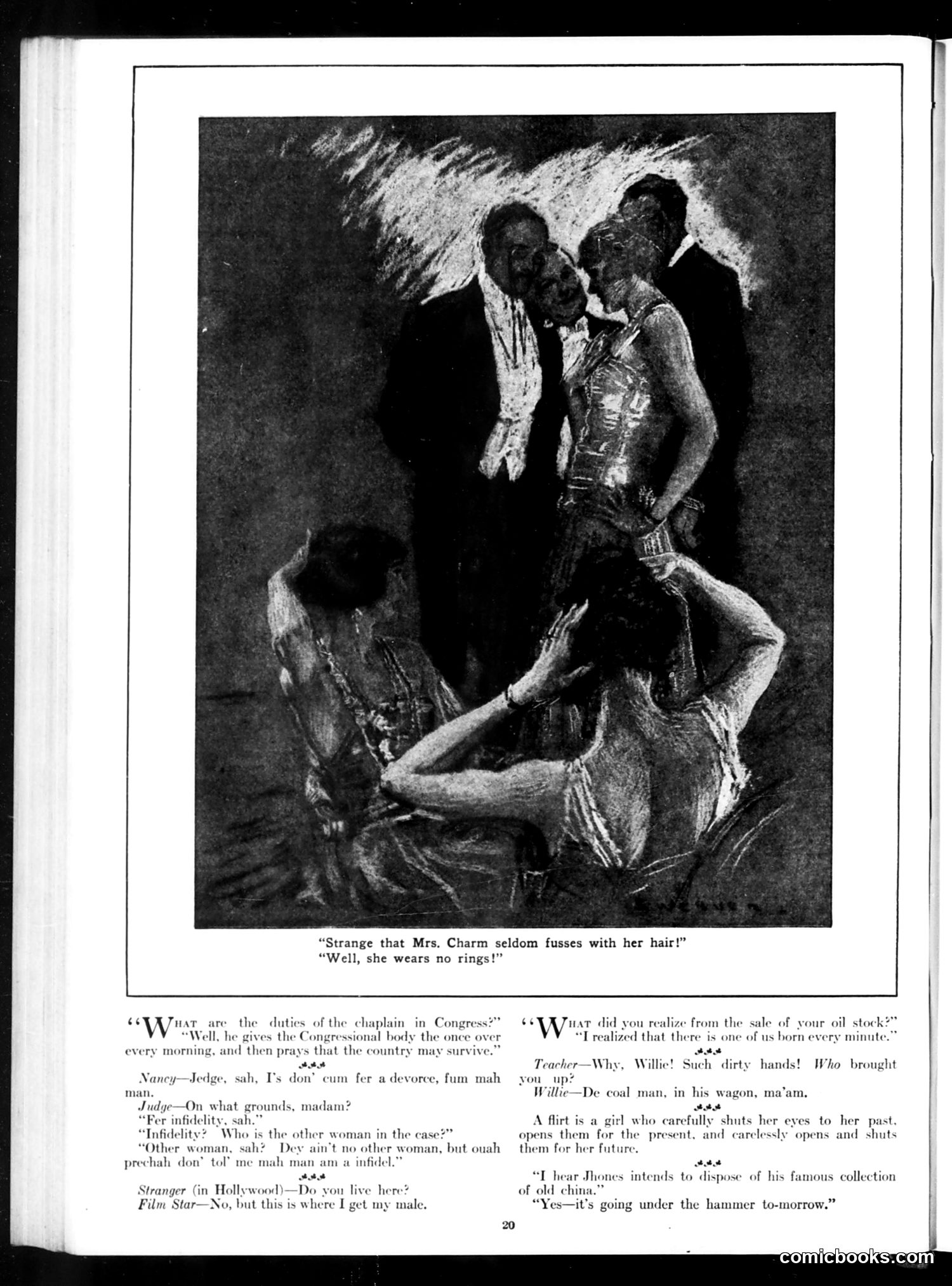
This page contains multiple brief satirical jokes typical of early 20th-century American humor magazines. The central illustration depicts what appears to be a séance or spiritualist gathering—a popular subject for satire during this era when such practices attracted credulous participants. The accompanying jokes target various social themes: 1. **Congressional chaplaincy**: Mocks the chaplain's role as merely providing morning prayers while the nation requires actual protection. 2. **Marital infidelity**: A racial-dialect joke (common to the period) where a woman seeks divorce because her preacher called her husband an "infidel" (non-believer), misunderstanding the religious meaning. 3. **Hollywood materialism**: Jokes about film stars' romantic/transactional relationships. 4. **Social observations**: Brief witticisms about flirtation, materialism, and working-class life. The page reflects Judge's formula: topical satire mixed with wordplay and observational humor, using racial stereotypes typical of the era's mainstream publications.
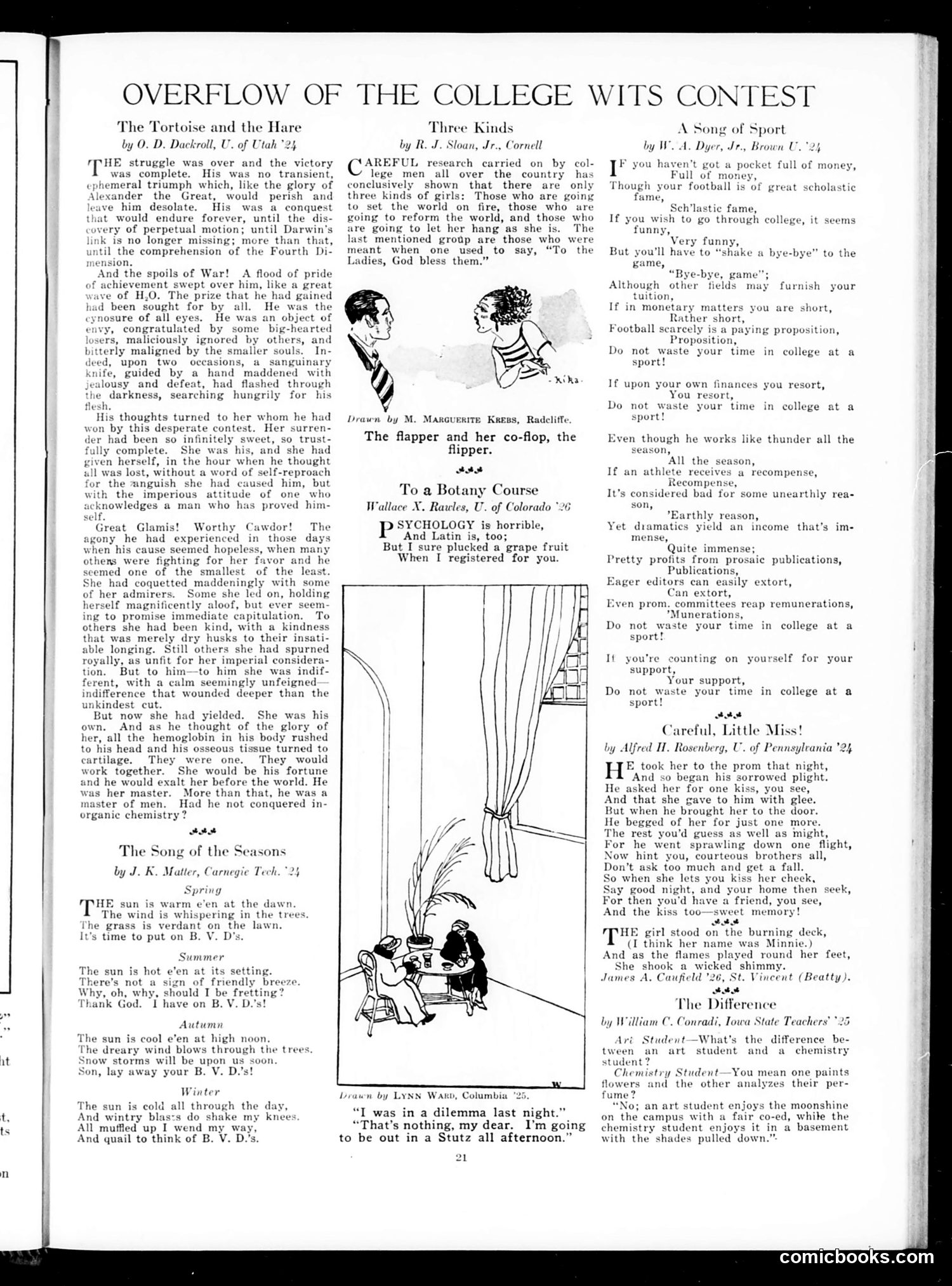
This page collects humorous student writings and illustrations from college contributors (circa 1924). The content reflects 1920s college life and attitudes: **"The Tortoise and the Hare"** uses overwrought, pseudo-academic language to mock pretentious student writing—the narrator obsesses melodramatically over winning a competition and a girl, culminating in the absurd reveal: he merely conquered organic chemistry. **"The Song of the Seasons"** is product placement humor, mentioning B.V.D.'s (a popular underwear brand) in each seasonal verse as a running gag about necessity versus comfort. **"Three Kinds"** satirizes college men's reductive categorization of women into types: world-changers, reformers, or passive observers—reflecting contemporary gender attitudes. The cartoon shows a botany student examining plant specimens, likely illustrating academic pretension or romantic miscues. The overall tone is self-aware college humor mocking student pomposity and dating anxieties of the Jazz Age era.
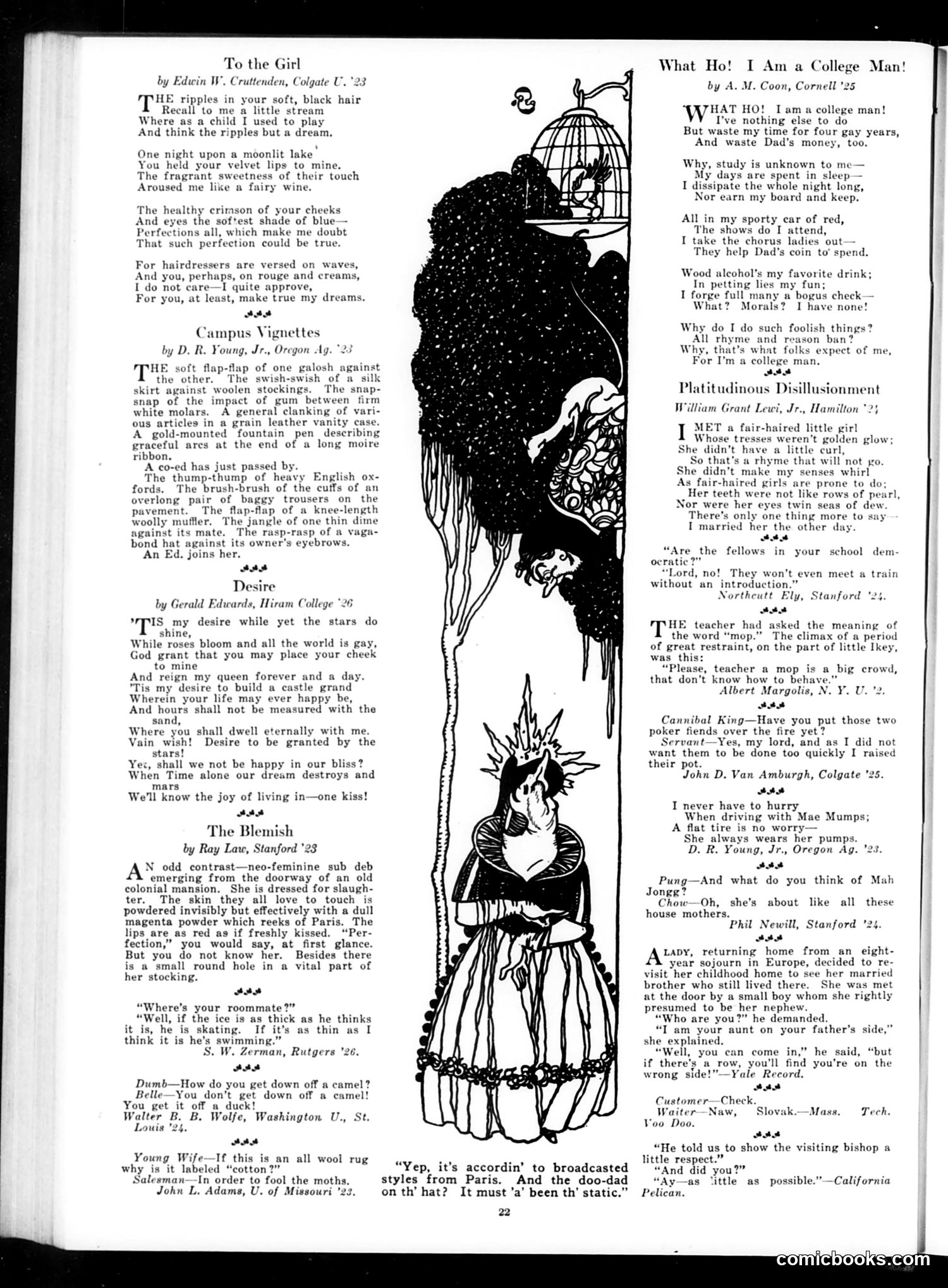
This page from Judge magazine (circa 1923-1926) contains student poetry and humor pieces mocking college life and dating customs of the 1920s. The central cartoon depicts a flapper—a young woman embodying the modern, liberated "New Woman" of the Jazz Age. She's shown with bobbed hair, fashionable dress, and a birdcage, likely satirizing both female independence and the era's obsession with style. The accompanying poems mock college stereotypes: - "What Ho! I Am a College Man!" ridicules wealthy college boys who waste their fathers' money on parties, showgirls, and alcohol instead of studying - "The Blemish" jokes about young women's obsession with beauty and makeup, despite flaws - "Campus Vignettes" humorously catalogs the sounds of modern college students The humor targets the younger generation's perceived frivolousness, materialism, and disregard for serious study—common 1920s anxiety about youth culture. The pieces are credited to various college authors, reflecting Judge's tradition of publishing student satirical work.
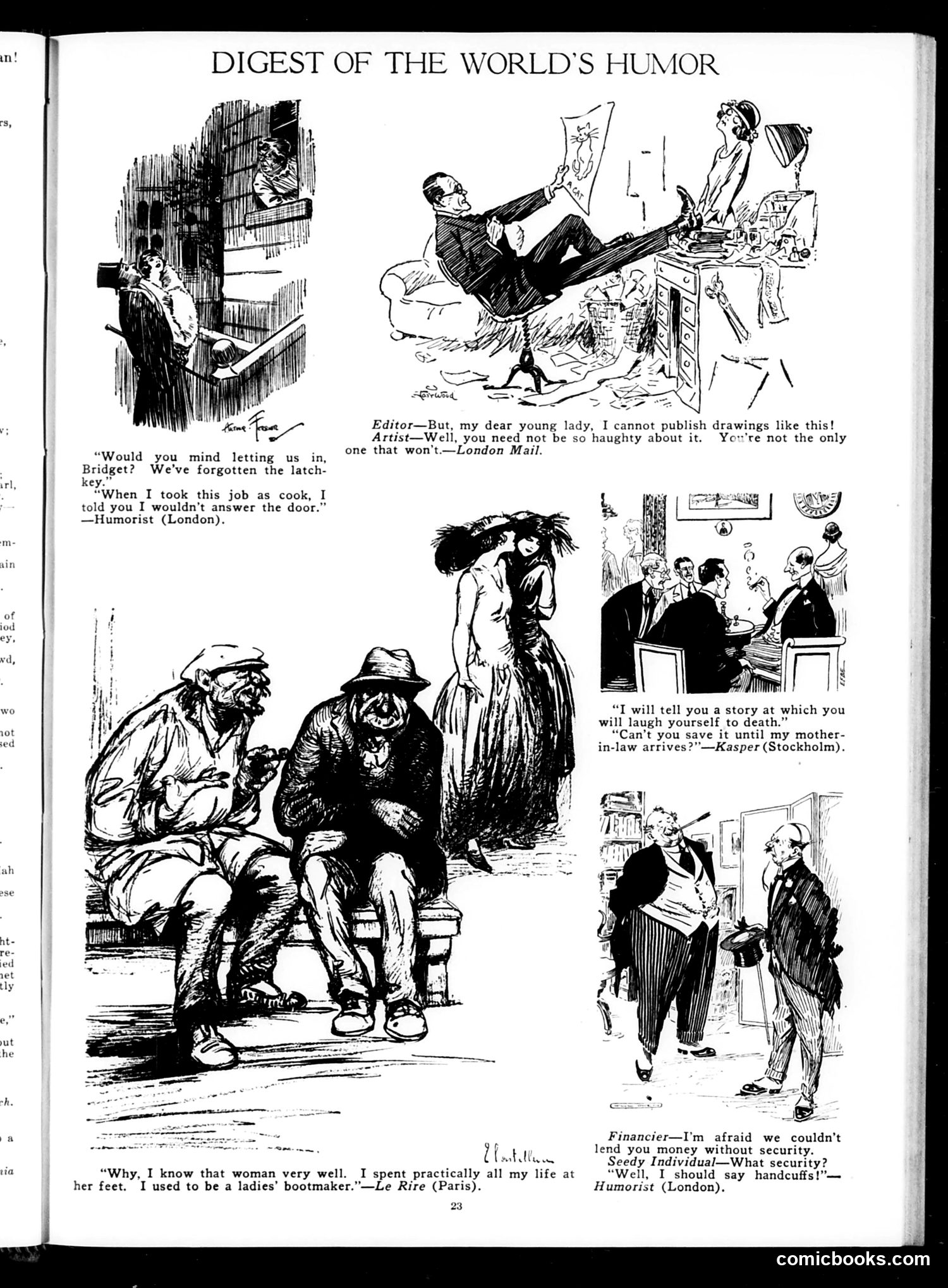
This page collects brief humorous anecdotes from international satirical magazines, each with a simple joke or social observation. The cartoons depict: 1. **Editor rejecting artwork**: An artist argues her rejected drawings aren't uniquely bad—other publications reject them too. This satirizes editorial gatekeeping and artistic rejection. 2. **Servant refusing to answer door**: A cook won't open the door because her job description didn't include that duty. This plays on rigid working-class employment contracts and the divide between job duties. 3. **Mother-in-law joke**: A man offers to tell a hilarious story, but the listener begs him to wait until his mother-in-law arrives—implying her presence will make anything seem funny by comparison. This reflects period contempt for mothers-in-law. 4. **Bootmaker's confession**: A man claims intimate knowledge of a woman because he spent time "at her feet" as a bootmaker—a crude double entendre about past romantic involvement. 5. **Handcuffs as security**: A financier demands security for a loan; the borrower jokes that handcuffs would be appropriate security, implying he's a criminal. These represent typical early 20th-century international humor: domestic servant comedy, family mockery, and working-class ribaldry.
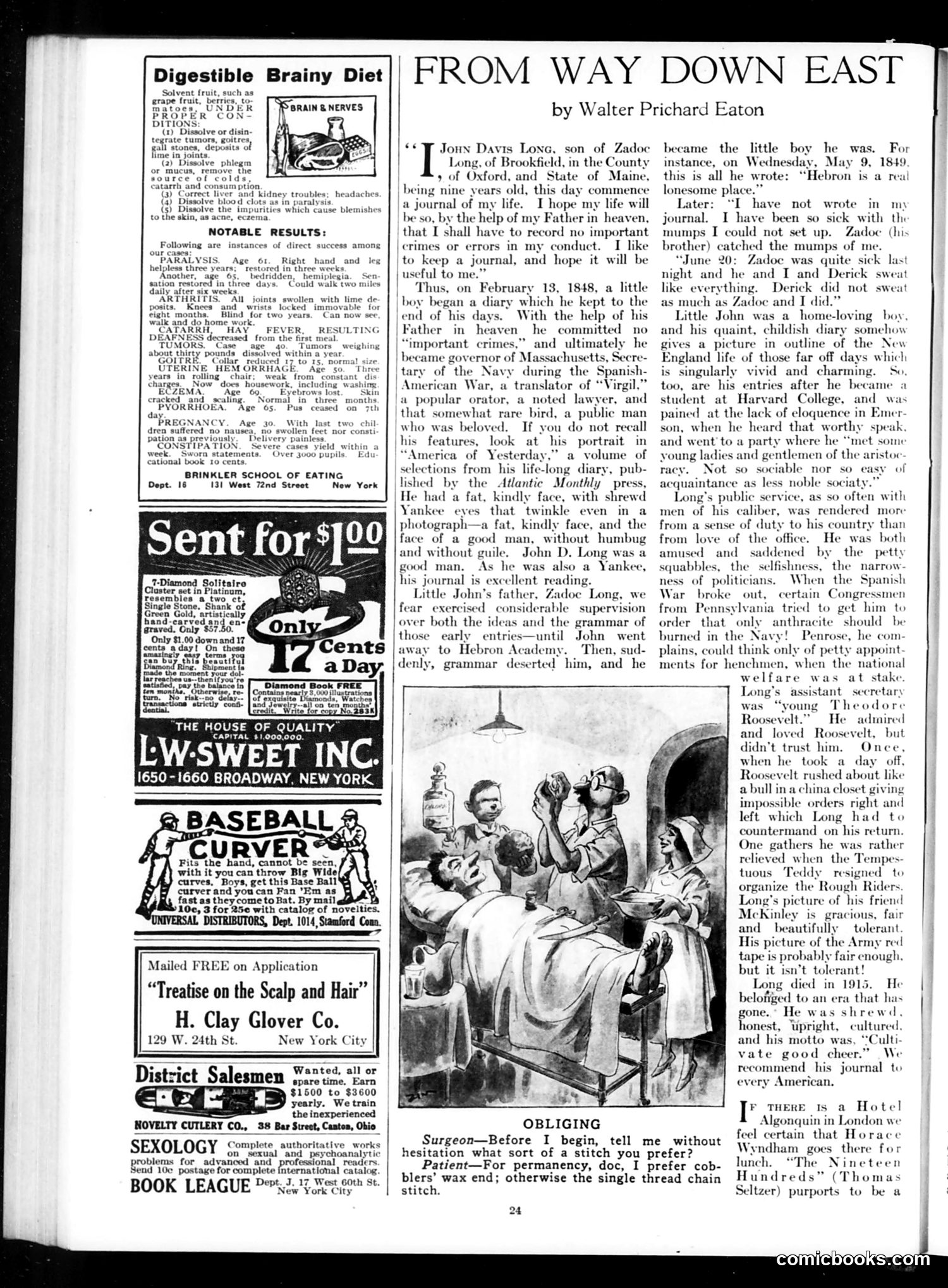
This page is primarily **advertising**, not political satire. The main article is a nostalgic biographical essay titled "From Way Down East" by Walter Prichard Eaton, about **John Davis Long**—a 19th-century Maine-born figure who became governor, Navy Secretary during the Spanish-American War, and published diarist. The accompanying illustration shows a **period domestic scene** (surgeon and patient), accompanying an "Obliging" humor caption about surgical stitching preferences—unrelated to the main article. The page is dominated by commercial advertisements for health products ("Digestible Brainy Diet"), novelty items (baseball curver), hair treatments, cutlery, books on sexuality, and sales positions. These reflect early 20th-century patent medicine and mail-order culture typical of *Judge* magazine's revenue model. **No political cartoon or satire is present on this page.** It's a standard magazine layout mixing nostalgic Americana with period advertising.
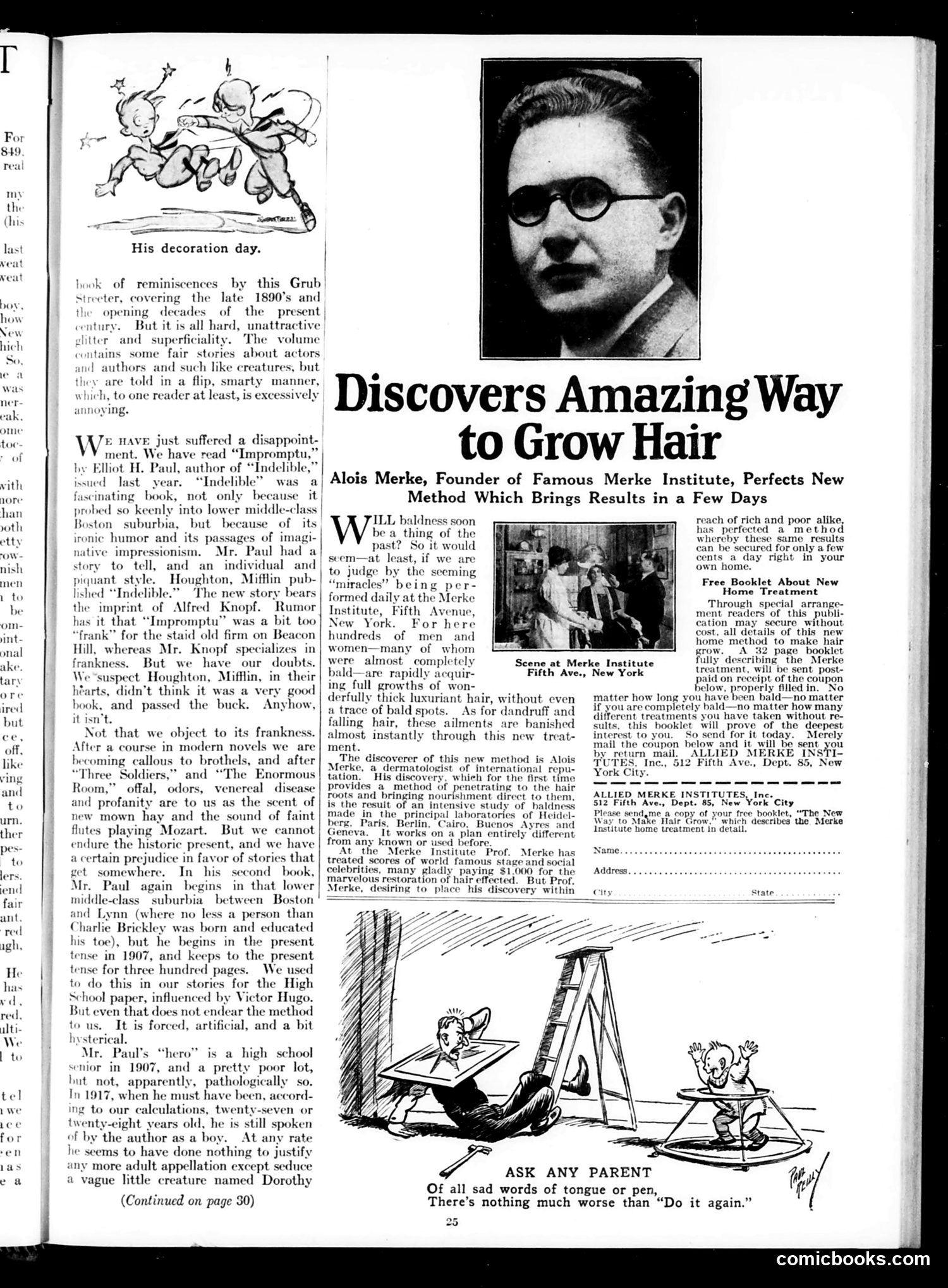
This page combines literary criticism with an advertisement for a dubious hair-growth treatment. **The Main Content:** The left column reviews "Impromptu" by Elliot H. Paul, criticizing the novel's excessive use of present tense narration and its protagonist—a morally mediocre high school boy in 1907 who accomplishes nothing noteworthy over ten years. The reviewer finds the narrative technique "forced, artificial, and a bit hysterical." **The Advertisement (right side):** A prominent ad claims Alois Merke has discovered a miraculous hair-growth method at his institute on Fifth Avenue in New York. It promises rapid results for baldness, dandruff, and hair loss, allegedly validated by wealthy celebrities paying $1,000 for the treatment. **The Satire:** The juxtaposition is likely intentional—the page's frivolous, exaggerated advertisement for a dubious medical "cure" mirrors the shallow, unsubstantial novel being reviewed. Both represent early 20th-century American hucksterism and superficial culture that Judge satirized. The bottom cartoon ("His decoration day") appears unrelated, showing cherubs in a comedic scene.
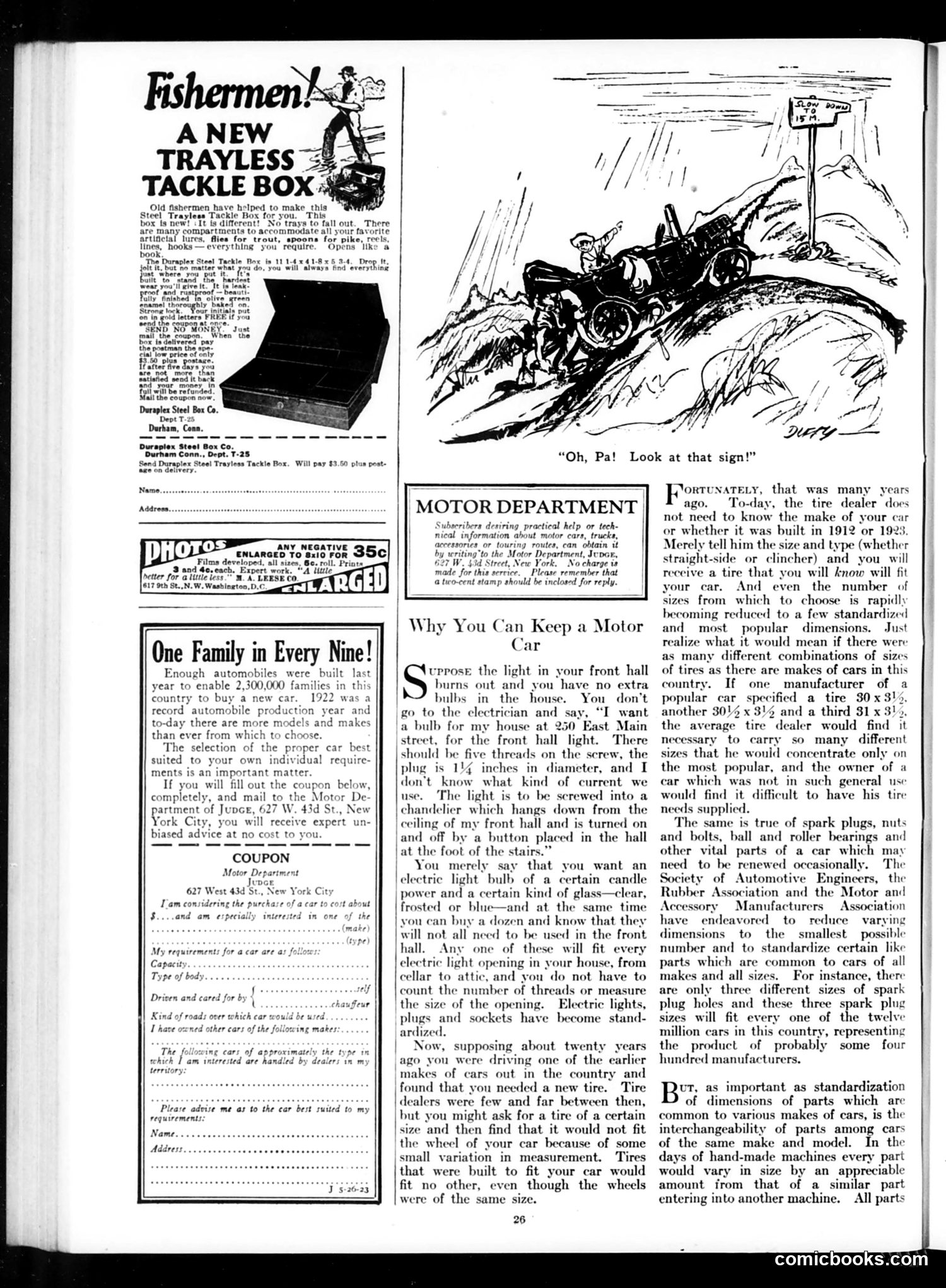
This page from *Judge* magazine contains primarily **advertising and consumer advice content** rather than political satire. The main cartoon depicts a family in a car on a mountain road, with a child exclaiming "Oh, Pa! Look at that sign!"—likely referencing a roadside advertisement or warning sign (though the specific sign isn't clearly visible). The bulk of the page features: 1. **Fishing tackle box advertisement** (top left) 2. **"One Family in Every Nine"** section promoting automobile ownership and a Motor Department advice column 3. **"Why You Can Keep a Motor Car"** article explaining automotive standardization The content advocates for **parts standardization in automobiles**—how tire sizes, spark plugs, and electrical components have become standardized across manufacturers, making car maintenance easier and more affordable for owners. This reflects 1920s progress in industrial standardization and consumer convenience, presented as practical consumer education rather than satire.
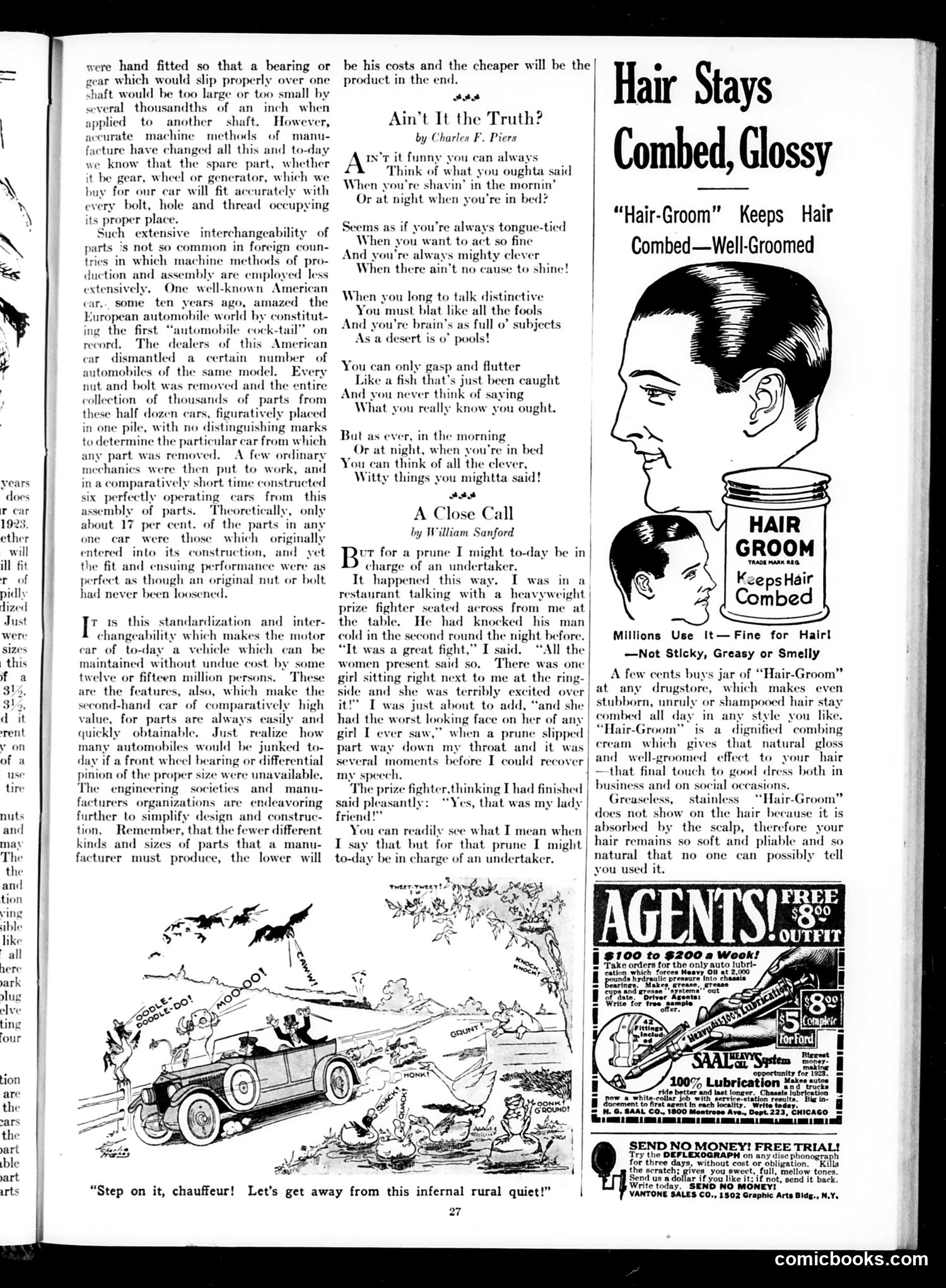
This page from the satirical magazine *Judge* contains three distinct pieces: **Left column:** A technical article about automotive standardization and interchangeability of parts—how modern manufacturing allows car components to be swapped between vehicles, making automobiles affordable and maintainable for average consumers. This is presented as genuinely informative content, not satire. **Center:** A humorous poem titled "Ain't It the Truth?" by Charles F. Piers about the universal experience of witty comebacks arriving only *after* the moment has passed—when shaving or lying in bed at night, rather than during actual conversation. This is relatable, non-political humor. **Bottom:** A short story by William Sanford called "A Close Call" describing a near-disaster: the narrator almost insults a prize fighter's girlfriend mid-conversation but is saved when food literally catches in his throat, preventing him from speaking. The joke is slapstick timing. **Right side:** Advertisements for "Hair-Groom" hair product and a recruitment ad for sales agents. The page is primarily light entertainment and advertising rather than political satire.
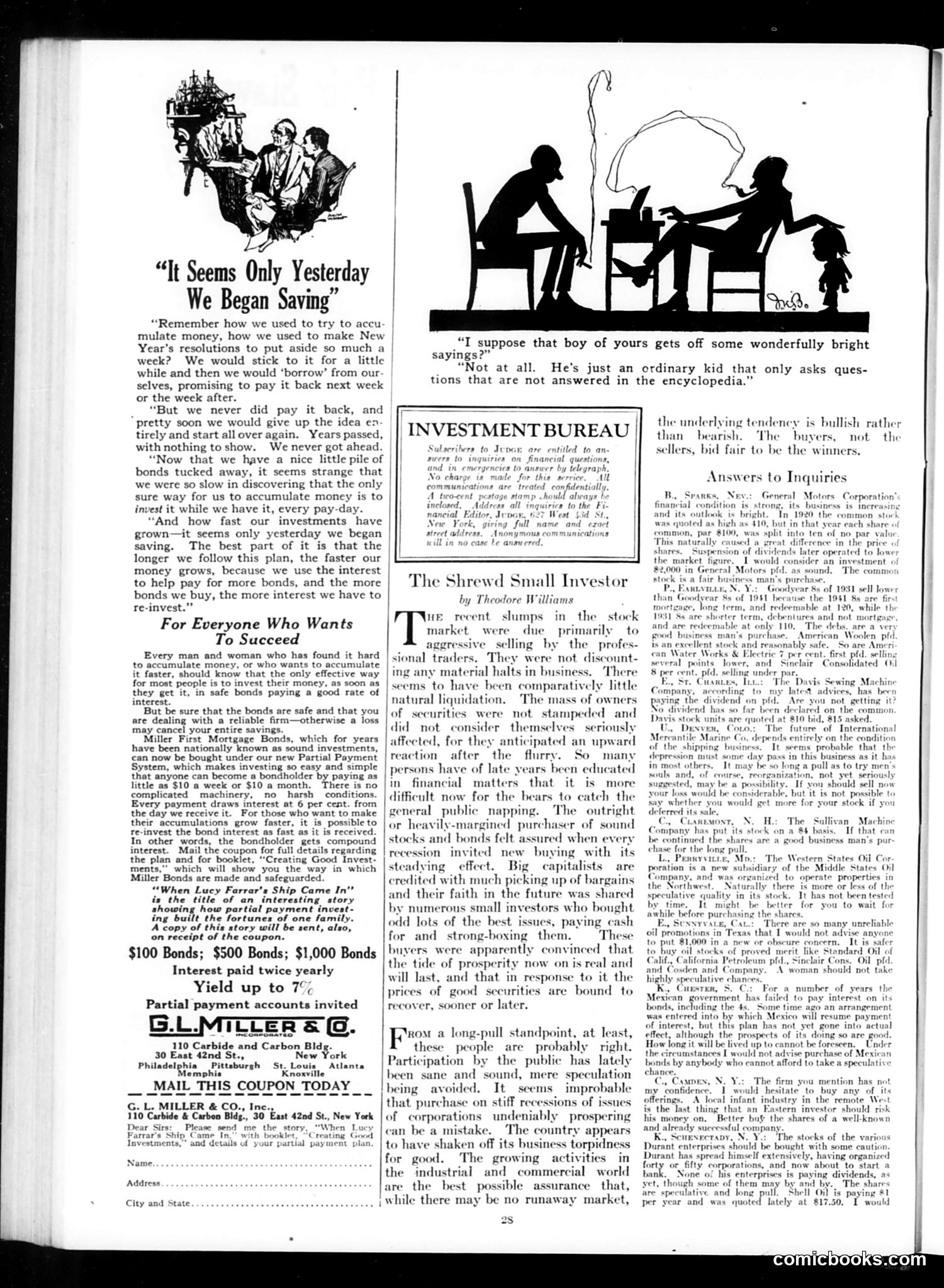
This page from *Judge* magazine contains satirical commentary on American savings and investment culture, paired with advertising. **Top Cartoon**: "It Seems Only Yesterday We Began Saving" mocks Americans' historical inability to save money. The narrative voice nostalgically recalls failed New Year's resolutions and borrowing from personal savings accounts—a common middle-class experience. The satire suggests that only now (implied: post-WWI era) have Americans learned disciplined investing through bonds. **Bottom Cartoon**: A silhouetted domestic scene depicts a parent and child at desks. The parent asks if the boy makes "wonderfully bright savings" comments; the child replies he simply asks unanswered encyclopedia questions. The joke satirizes both parental pride in children's precocity and the limits of popular knowledge sources. **Context**: Both cartoons support the facing **G.L. Miller & Co. advertisement** promoting accessible bond investments through installment payments ($10 weekly). The editorial content primes readers to feel financially inadequate—then positions Miller Bonds as the solution—a common advertising strategy combining aspirational messaging with gentle social criticism.
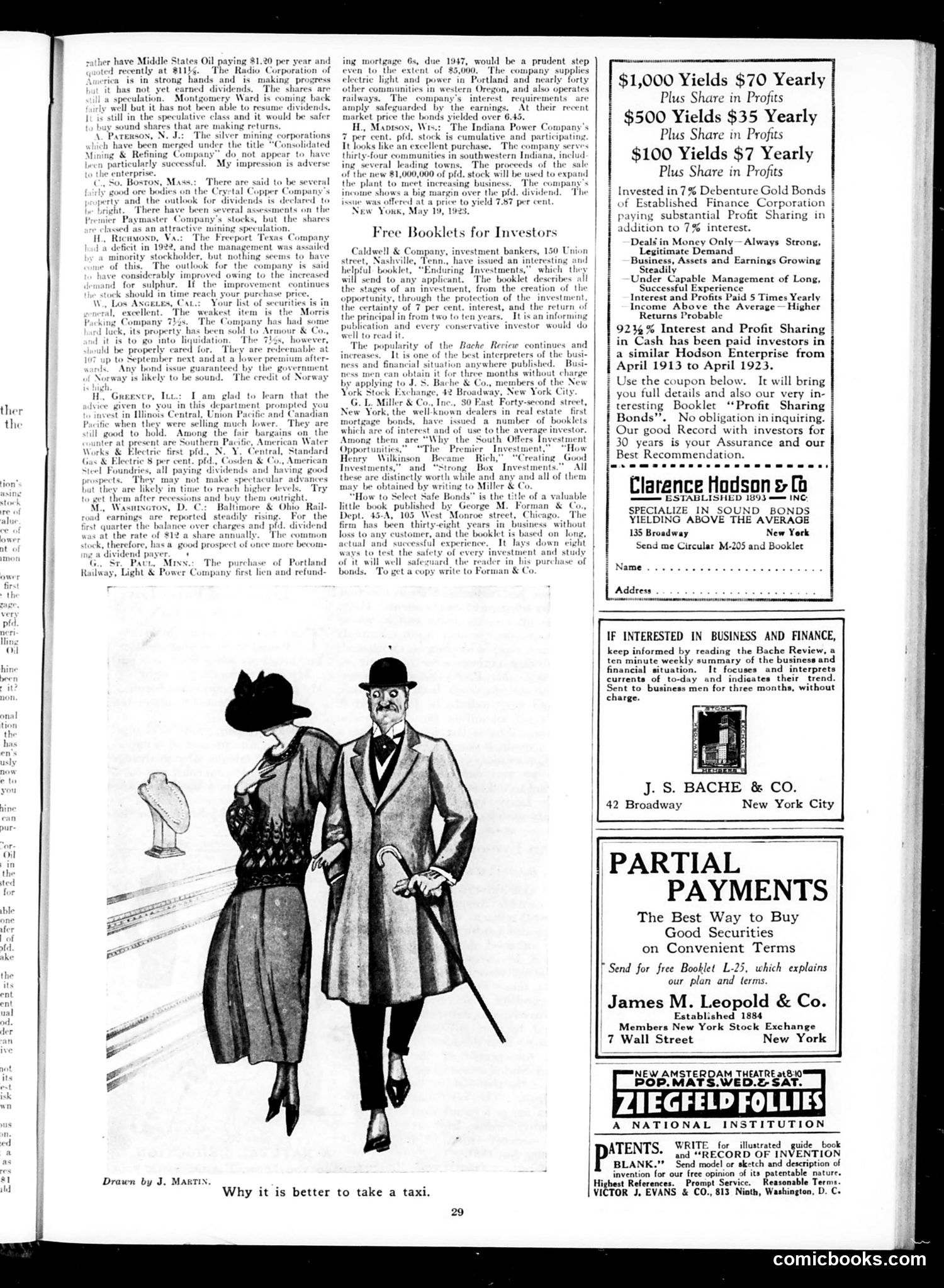
This page is primarily **financial advertising** with one small cartoon at bottom left. The cartoon shows a well-dressed man and woman (appearing to be from the 1920s) with the caption "Why it is better to take a taxi." The humor appears to be a social commentary on urban transportation choices. The illustration, credited to J. Martin, depicts fashionable people who would naturally prefer the convenience and modernity of a taxi over other transit options—likely a jab at those clinging to older, less convenient transportation methods or at the pretensions of city dwellers seeking status through modern conveniences. The rest of the page is dominated by **investment advertisements** for various bonds and financial products (Established Finance Corporation, Clarence Hodson & Co., James M. Leopold & Co., etc.), reflecting Judge magazine's typical mix of satire and financial industry advertising common in 1920s publications.
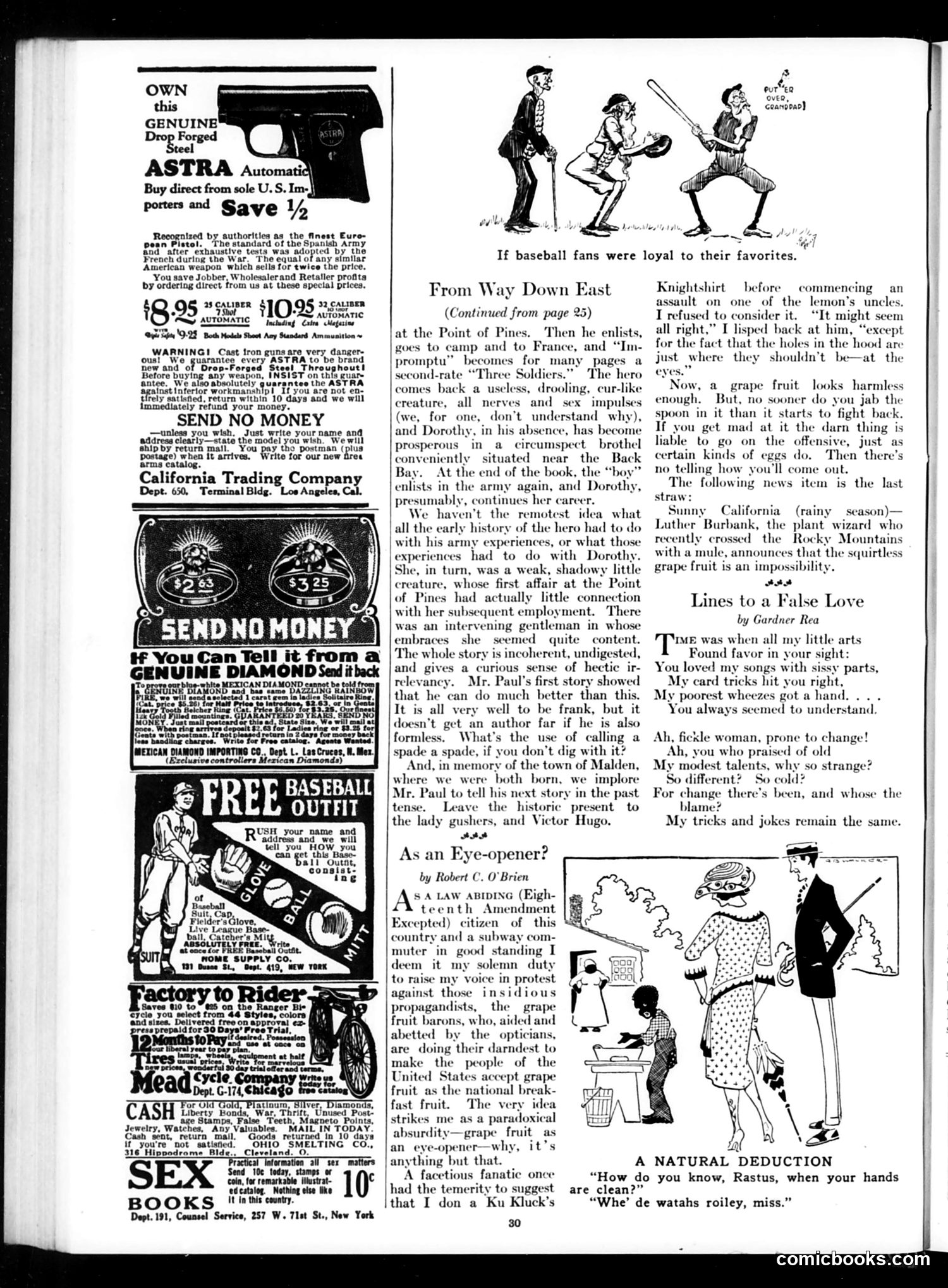
This page mixes advertisements with three distinct articles/cartoons: **Top cartoon**: Three baseball players depicted as disloyal fans—showing exaggerated, ridiculous behavior (swinging wildly, posture absurd). The caption "If baseball fans were loyal to their favorites" is satirical, suggesting actual fans act absurdly inconsistent. **"From Way Down East"**: A book review criticizing a novel about a soldier returning from WWI with psychological damage and his relationship with a woman now working in a brothel. The critic finds the narrative incoherent and formless despite frank subject matter. **"As an Eye-opener?"**: A humorous essay complaining about grapefruit industry propaganda promoting grapefruit as America's breakfast fruit. The author sarcastically calls it an "eye-opener" (ironic, since grapefruit doesn't truly open one's eyes), and oddly ends referencing the Ku Klux Klan without clear context—likely incomplete OCR or an unclear joke. The page is primarily **advertising** (guns, bicycles, mail-order goods), typical of 1920s magazine content.
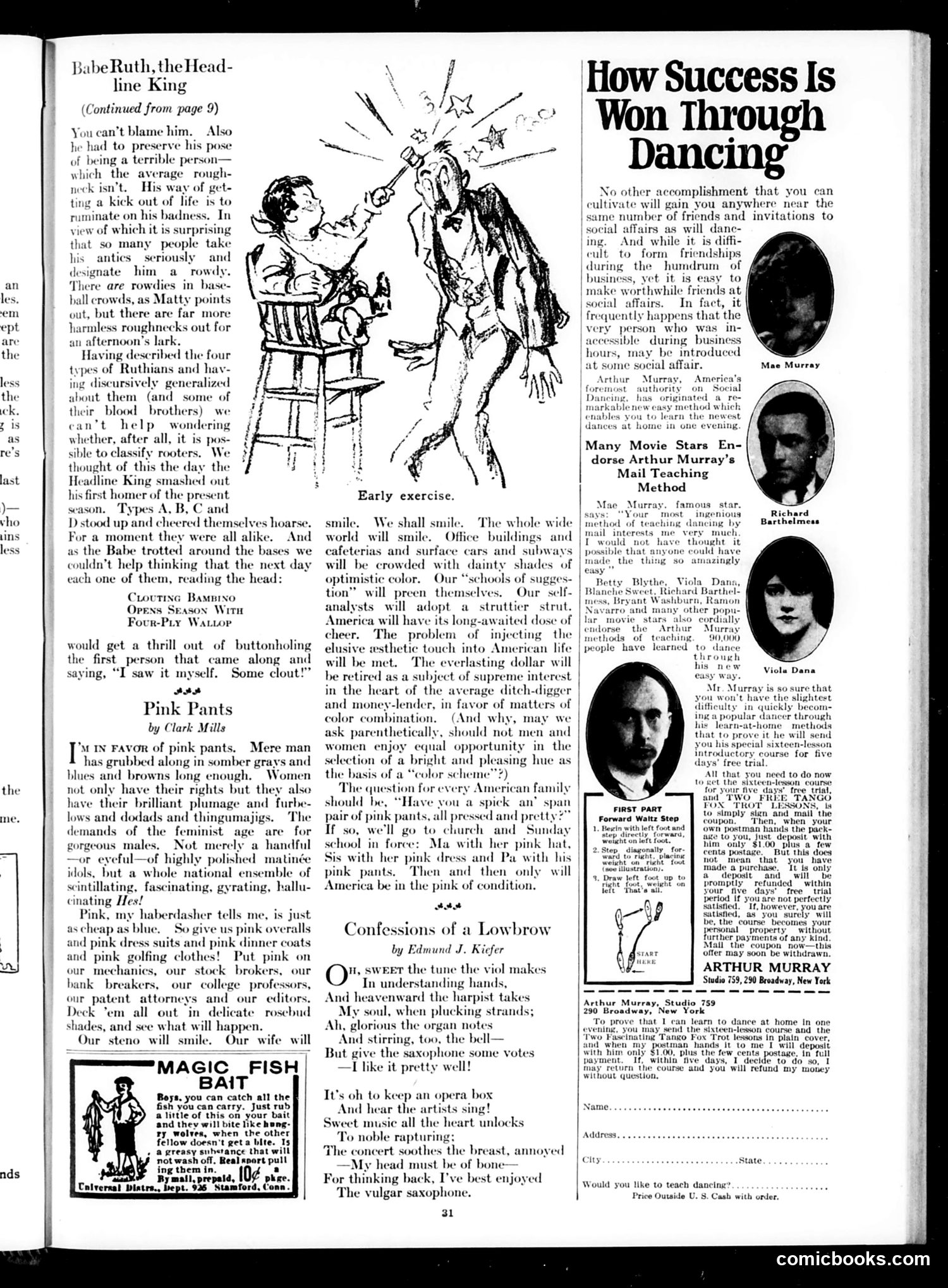
This page from Judge magazine (undated, but appearing early-20th century based on typography and advertising) contains three distinct pieces: **"Babe Ruth, the Headline King"**: A satirical essay on the famous baseball player, analyzing different "types" of fans his exploits excite. The accompanying cartoon shows Ruth as a boisterous, exaggerated figure striking a theatrical pose—the satire targeting both Ruth's cultivated "bad boy" persona and the various ways ordinary people respond to celebrity athletes. **"Pink Pants"**: A humorous essay advocating that men adopt brightly colored clothing (specifically pink) to enliven American life and aesthetics. The satire mocks American drabness and conformity, suggesting that widespread adoption of pink clothes would somehow transform society's outlook. **"Confessions of a Lowbrow"**: A short poem about musical preferences, likely satirizing lowbrow versus highbrow cultural tastes. The page also advertises Arthur Murray's dancing lessons—the irony being that the "How Success Is Won Through Dancing" article appears alongside these satirical pieces about fame and social advancement, suggesting Judge was mocking Americans' aspirations through entertainment and self-improvement.
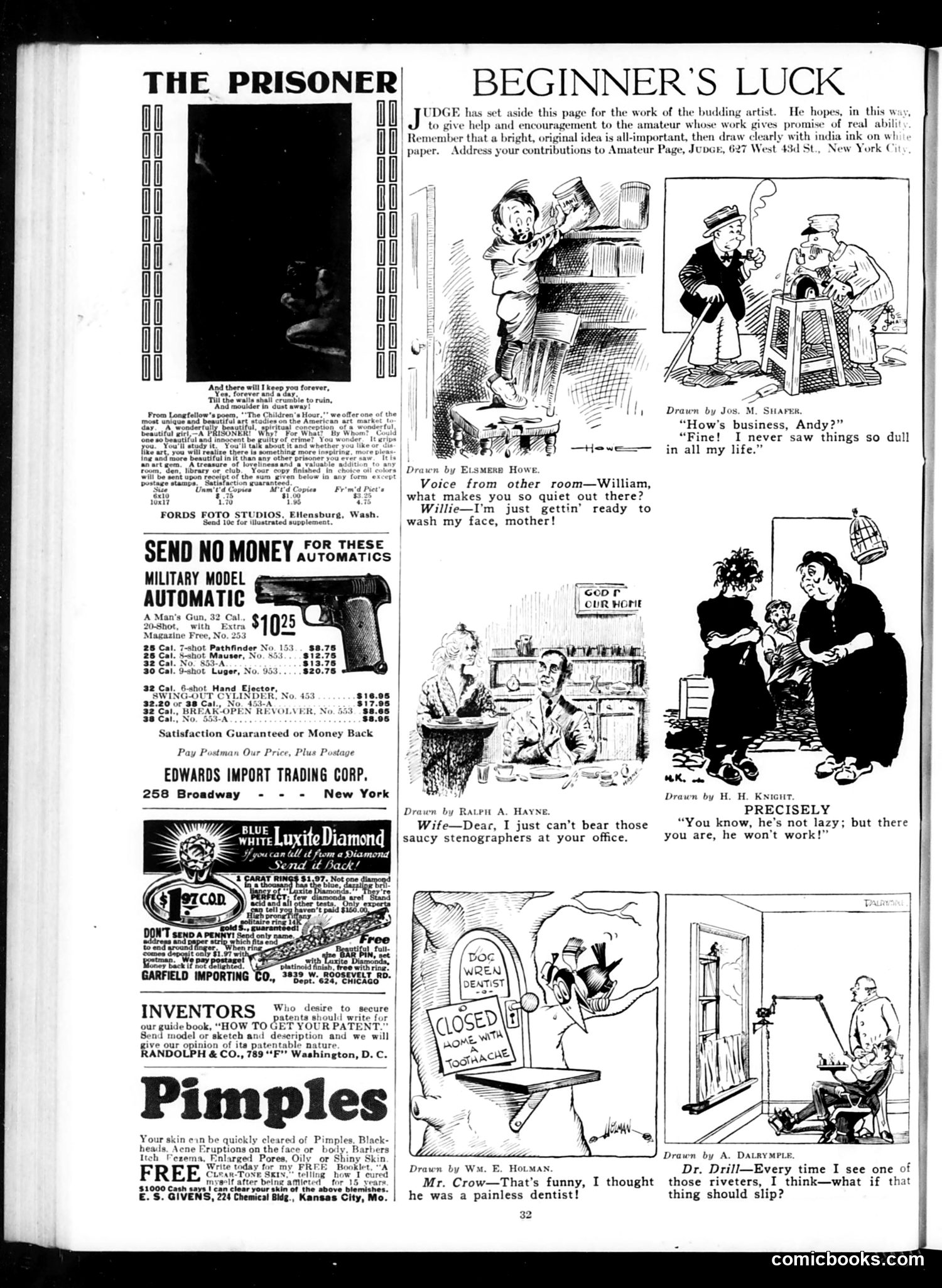
This is primarily an **advertising and humor comics page** from *Judge* magazine. The right side features several single-panel gag cartoons satirizing everyday domestic and workplace situations: **Key cartoons:** - A child named Willie quieting down to wash his face, prompting his mother's surprise - A husband's stenographers causing marital discord (poking fun at workplace tension and gender dynamics) - A dentist's office humorously "closed" due to a patient's violent reaction - A wife criticizing her lazy husband, suggesting he won't work despite not being inherently lazy - A factory worker nervously eyeing industrial riveters **The humor** reflects early 20th-century concerns: **workplace anxiety, marital friction, class differences**, and the discomforts of modern industrial life. The "Beginner's Luck" header indicates these are submissions from amateur cartoonists. **The left side is dominated by advertisements**—firearms, diamonds, patent services, and acne treatments—typical *Judge* revenue sources. The cartoons are lighthearted domestic comedy requiring minimal historical context to understand.
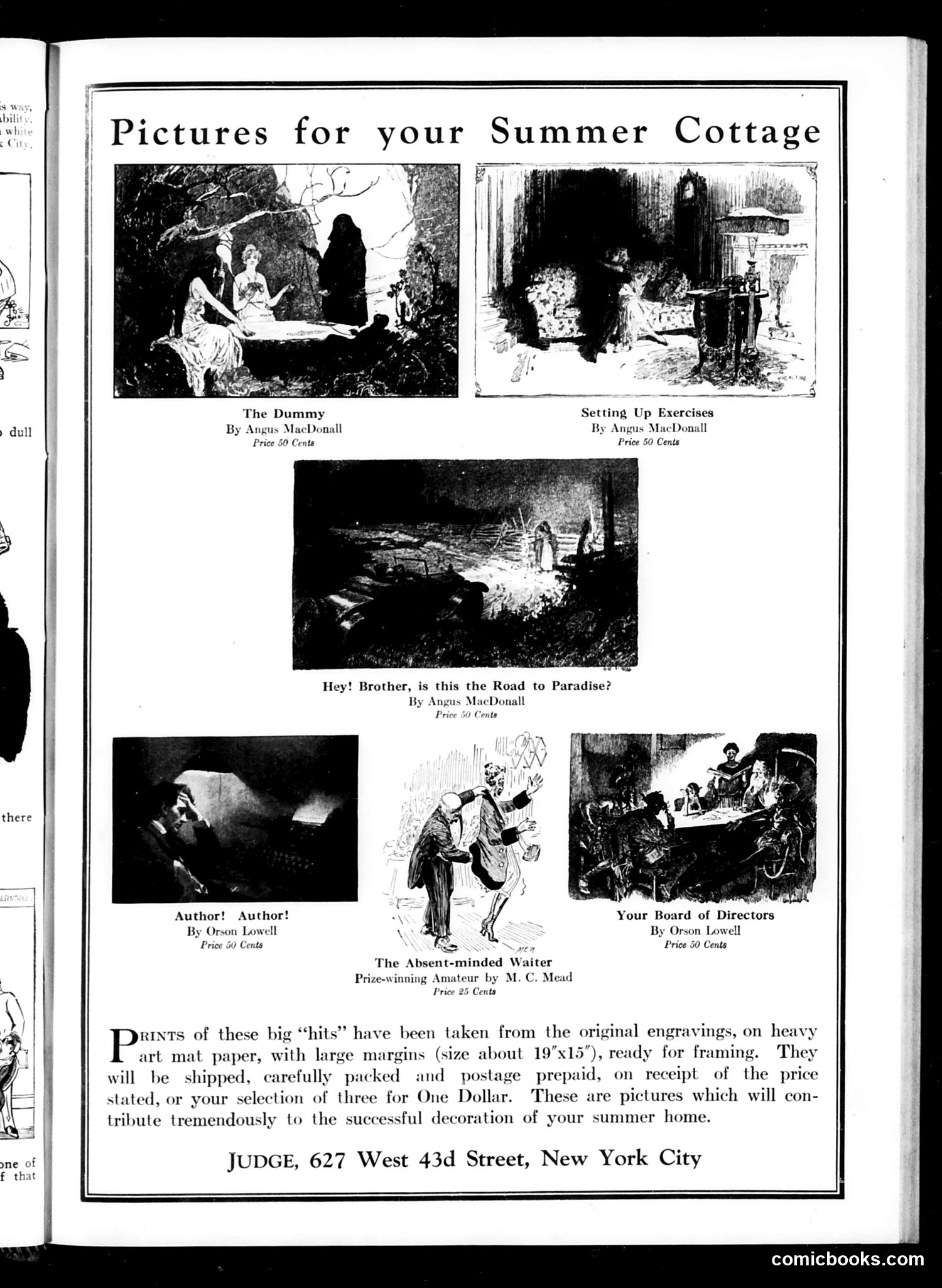
This is primarily an **advertisement for framed prints**, not political commentary. Judge magazine is selling reproductions of cartoons from the publication, marketed as decoration for summer cottages. The featured cartoons appear to be humorous domestic/social satire typical of early 20th-century Judge material: - **"The Dummy"** and **"Setting Up Exercises"** — likely jokes about fitness or physical culture trends - **"Hey! Brother, is this the Road to Paradise?"** — appears to depict travelers, possibly satirizing journey/quest narratives - **"Author! Author!"** (by Orson Lowell) — theatrical satire, likely mocking writers or performers - **"Your Board of Directors"** — social satire about business management - **"The Absent-minded Waiter"** — slapstick humor about service industry The ad emphasizes these are "big 'hits'"—popular cartoons—and offers them affordably (three for one dollar) as home decoration. This reflects the era's commercialization of magazine content into mass-market prints for middle-class consumers.
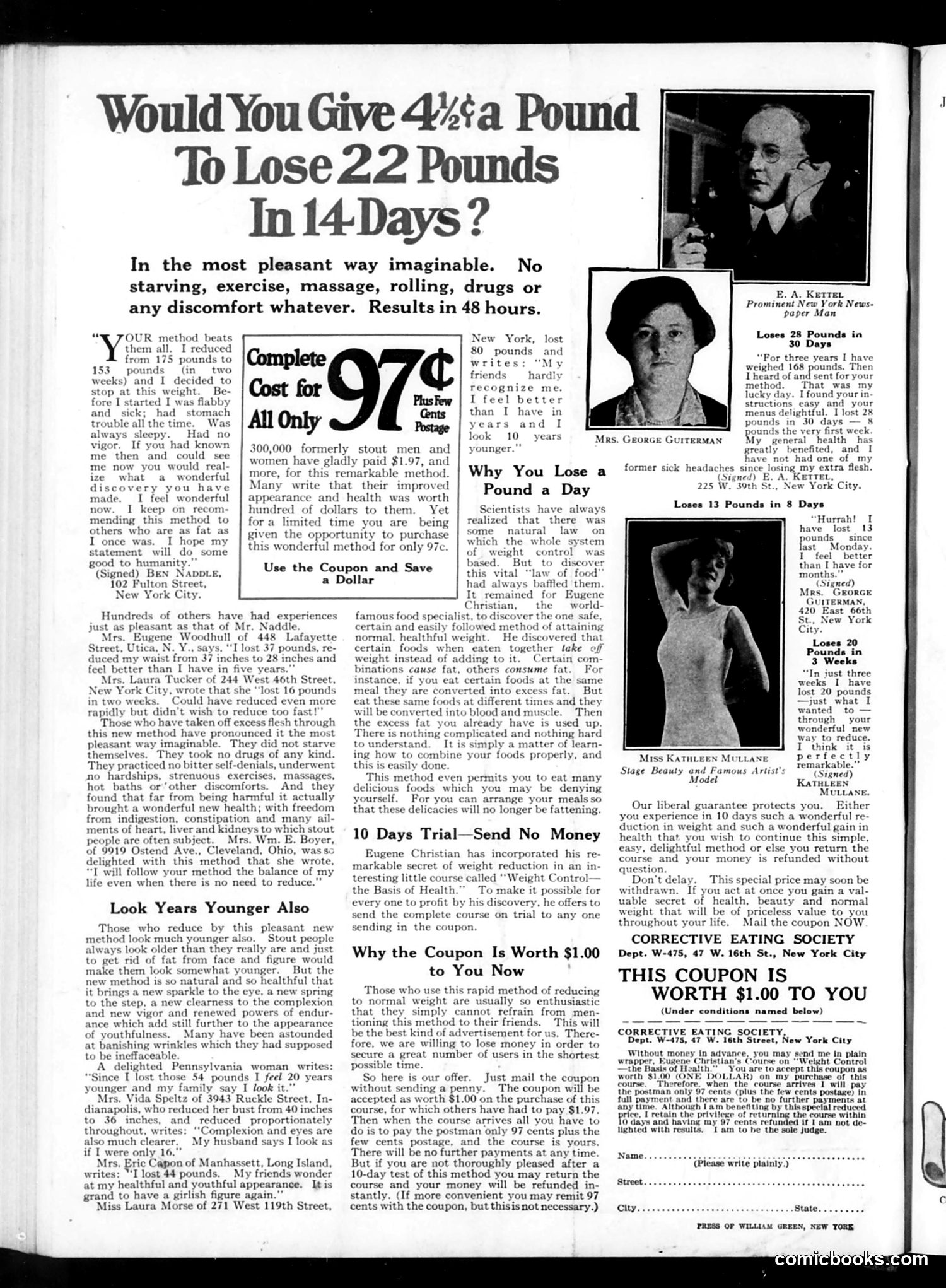
This page is primarily **weight-loss advertising**, not political satire. It promotes Eugene Christian's "Corrective Eating" diet method, offering a complete course for 97¢ (plus postage). The testimonials from named women (Mrs. George Gutterman, Miss Kathleen Mullane, etc.) claim rapid weight loss without "starving, exercise, massage, rolling, drugs or any discomfort." The appeal emphasizes not just slimness but youthfulness and renewed vigor—reflecting early 20th-century anxieties about aging and appearance. The photographs show before-and-after images of satisfied customers. The coupon at bottom promises a "liberal guarantee" and refund within 10 days. **Historical context:** This represents naive pre-FDA diet promotion, when such claims faced minimal regulation. The pseudoscientific language about "vital force" and food combinations reflects period nutritional theories now debunked. The emphasis on women's appearance and the promise of effortless results reflect era-specific beauty standards and marketing tactics targeting insecurity. This is **advertising content**, not editorial satire.