
Judge, 1923-05-26 · page 15 of 36
Judge — May 26, 1923 — page 15: what you’re looking at
What you’re looking at
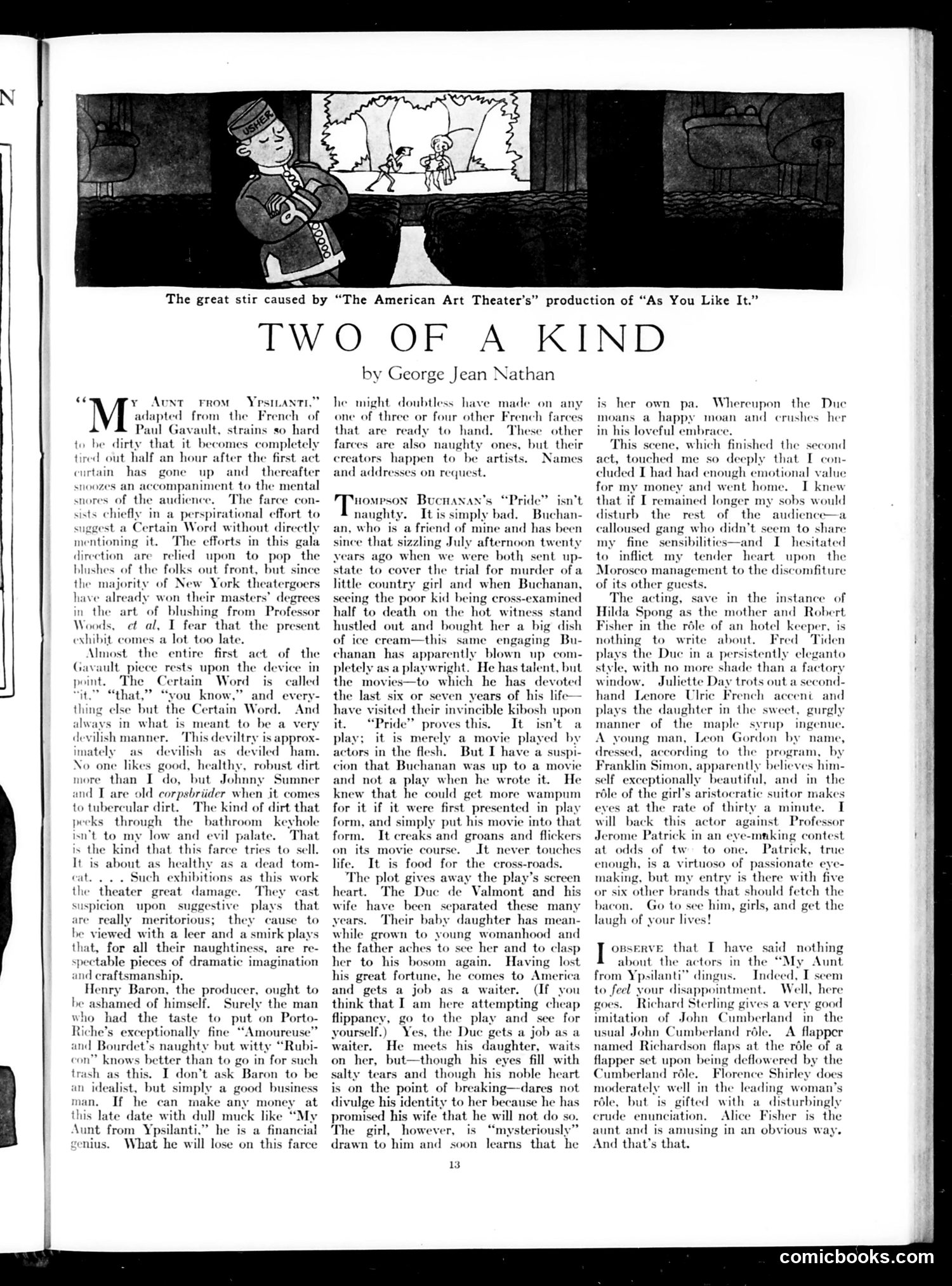
This page contains two theater reviews by George Jean Nathan, a prominent Judge magazine critic. The cartoon at top satirizes "The American Art Theater's" production of Shakespeare's "As You Like It." Nathan reviews two contemporary French farces with contrasting harshness: 1. **"My Aunt from Ypsilanti"**: Nathan lambasts this adaptation as relying entirely on crude innuendo—repeatedly dancing around "the Certain Word" without saying it—to generate laughs. He dismisses it as unhealthy "tubercular dirt" that damages theater's reputation and wastes producer Henry Baron's talents (evidenced by his earlier success with more sophisticated French plays). 2. **"Pride"** by Professor Buchanan: Nathan critiques this as simply bad playwriting, suspecting Buchanan adapted a movie into play form merely for profit. The plot's transparent mechanics—a separated couple and their grown daughter—lack artistic merit. Nathan's consistent point: theatrical success requires artistic integrity, not crude tricks or commercial cynicism.
📄 Transcribed text from this page (OCR, searchable)
Machine-transcribed from the original scan — historical spelling and the odd misread are preserved.
The great stir caused by “The American Art Theater’s” production of “As You Like It.” TWO OF A KIND “ y Aunt From YpsiLanti,” adapted from the French of Paul Gavault, strains so hard to be dirty that it becomes comple tired out half an hour after the first act curtain has gone up and _ thereafter oozes an accompaniment to the mental snores of the audience. The farce con- chiefly in a perspirational effort to 1 t a Certain Word without directly mentioning it. The efforts in this gala direction are relied upon to pop the blushes of the folks out front, but since the majority of New York theatergoers have already won their masters’ degrees in the art of blushing from Professor Woods, ct al, I fear that the present exhibit come lot too late. Almost the entire first act of Gavyault_ piece rests upon the dev The Certain Word i ve that ‘vou know,” and every. thing else but the Certain Word, And always in what is meant to be a very devilish manner. ‘This deviltry is approx- imately as devilish as deviled ham. No one likes good, healthy, robust dirt more than I do, but Johnny Sumner and T are old corpsbriider when it comes to tubercular dirt. The kind of dirt that pecks through the bathroom keyhole isn’t to my low and evil palate. ‘That is the kind that this farce tries to sell. It is about as healthy as a dead tom- eat... . Such exhibitions as this work the theater great damage. They cast suspicion upon suggestive plays that are really meritorious; they cause to be viewed with a leer and a smirk plays that, for all their naughtiness, are re- spectable pieces of dramatic imagination and craftsmanship. Henry Baron, the producer, ought to be ashamed of himself. Surely the man who had the taste to put on Porto- Riche’s exceptionally fine “Amoureuse” Bourdet’s naughty but witty “Rubi- knows better than to go in for such trash this. I don’t ask Baron to be an idealist, but simply a good business man, If he can make any money at this late date with dull muck like Iy \unt from Ypsilanti,” he is a financial genius. What he will lose on this farce con by George Jean Nathan he might doubtless have made on any one of three or four other French farces that are ready to hand. These other farces are also naughty ones, but their creators happen to be artists. Names and addresses on request. "Puoursow Bucnanan’s “Pride” isn’t naughty. Itis simply bad, Buchan- a friend of mine and has been that sizzling July afternoon twenty rs ago when we were both sent up- state to cover the trial for murder of a little country girl and when Buchanan, seeing the poor kid being cross-examined half to death on the hot witness stand hustled out and bought her a big dish of ice cream—this engaging Bu- chanan has apparently blown up com- pletely as a playwright. alent, but the movies—to which he has devoted the last six or seven years of his life— have visited their invincible kibosh upon “Pride” proves this. It isn’t a it is merely a movie played by ‘tors in the flesh, But I have a suspi- on that Buchanan was up to a movie and not a play when he wrote it. He knew that he could get more wampum for it if it were first presented in play form, and simply put his movie into that form. It creaks and groans and flickers on its movie course. It never touches life. It is food for the cross-roads. The plot gives away the pk heart. The Due de Valmont and _ his have been separated these many years. Their baby daughter has me while grown to young womanhood and the father aches to see her and to clasp her to his bosom again. Having lost his great fortune, he comes to America and gets a job as a waiter. (If you think that I am here attempting cheap flippancy, go to the pla nd see for yourself.) Yes, the Duc gets a job as a waiter. He meets his daughter, waits on her, but—though his eyes fill with salty tears and though his noble heart is on the point of breaking—dares not divulge his identity to her because he has promised his wife that he will not do so. The girl, however, is “mysteriously” drawn to him and soon learns that he 13 sinc same is her own pa. Whereupon the Duc moans a happy moan and crushes her in his loveful embrace. This scene, which finished the act, touched me so deeply that I con- cluded I had had enough emotional value for my money and went home. I knew that if I remained longer my sobs would disturb the rest of the audience—a calloused gang who didn’t seem to share my fine sensibilities—and I hesitated to inflict my tender heart upon the Morosco management to the discomfiture of its other guests. The acting, save in the instance of Hilda Spong as the mother and Robert Fisher in the réle of an hotel keeper, is nothing to write about. Fred Tiden plays the Due in a persistently cleganto style, with no more shade than tory window. Juliette Day trots out a second- hand Lenore Ulric French aceeni and plays the daughter in the sweet, gurgly manner of the maple syrup ingenue. A young man, Leon Gordon by name, dressed, according to the program, by Franklin pparently believes him- self ex role of the girl ‘aristocratic suitor makes eyes at the rate of thirty a minute. will back this actor against Professor Jerome Patrick in an eye-making contest at odds of tw) to one. Patrick, true enough, is a virtuoso of passionate ey making, but my entry is there with five or six other brands that should fetch the bacon. Go to see him, girls, and get the laugh of your lives! | Cpccete that I have said nothing about the actors in the “My Aunt from Ypsilanti” dingus. Indeed, T seem to feel your disappointment. Well, here goes. Richard Sterling gives a very good imitation of John Cumberland in the usual John Cumberland rdle. A flapper named Richardson flaps at the role of a flapper set upon being deflowered by the Cumberland réle. Florence Shirley does moderately well in the leading woman’s role, but is gifted with a disturbingly crude enunciation, Alice Fisher is the aunt and is amusing in an obvious way. And that’s that. comicbooks.com