
Judge, 1923-05-26 · page 17 of 36
Judge — May 26, 1923 — page 17: what you’re looking at
What you’re looking at
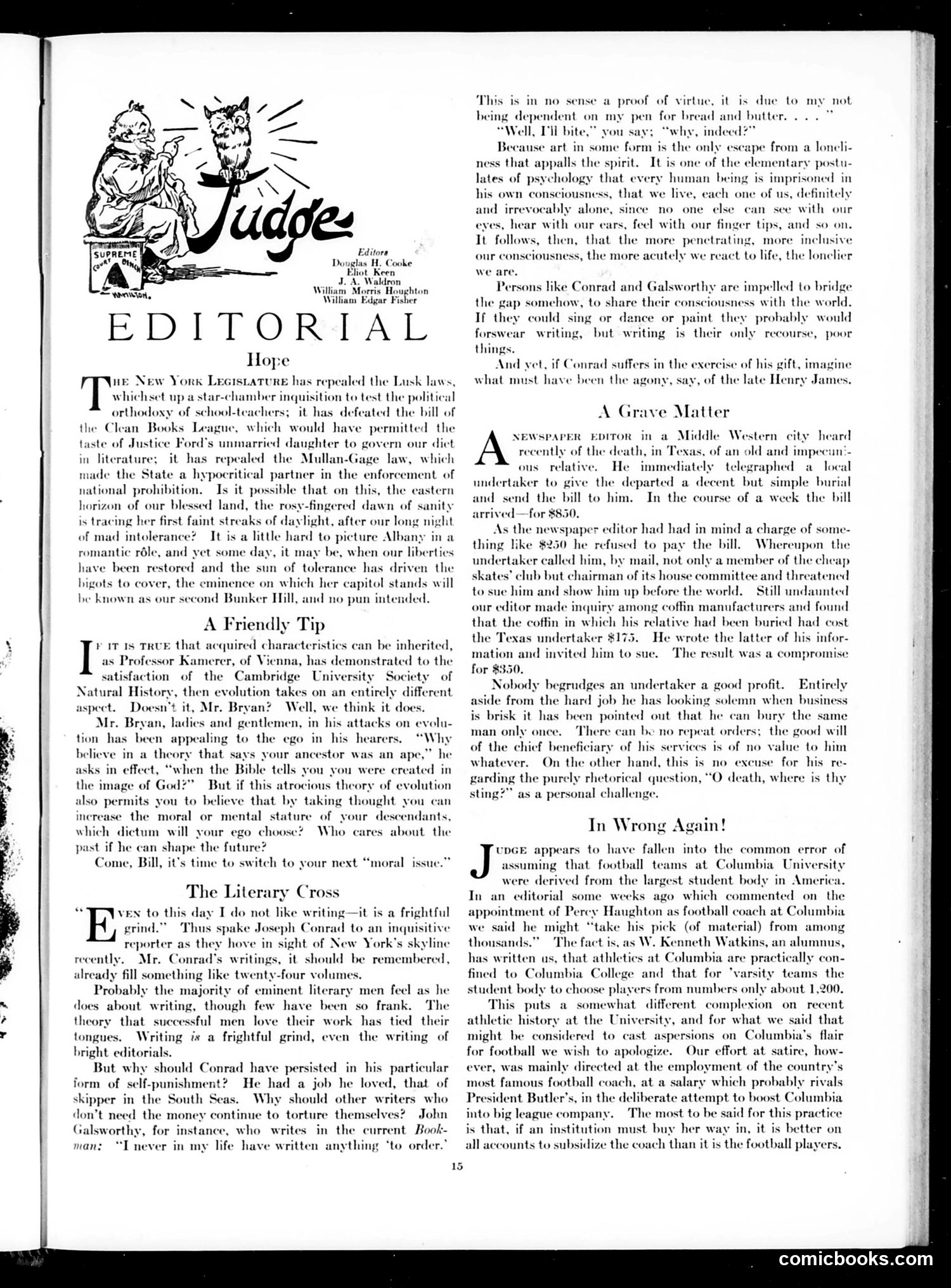
This editorial page satirizes several targets of 1920s American progressivism and anti-intellectualism: **"Hope" Editorial**: Celebrates New York's repeal of restrictive laws—the Lusk laws (anti-communist teacher loyalty tests), the Clean Books League censorship bill, and Prohibition enforcement (Mullan-Gage law). Judge praises this as "sanity" returning to Albany. **"A Friendly Tip"**: Mocks William Jennings Bryan's anti-evolution arguments. The cartoon shows a confrontation (unclear details) related to Bryan's ego-based appeals against Darwinism. Judge suggests Bryan's own logic—that inherited acquired characteristics improve descendants—actually supports evolutionary thinking, turning his argument against him. **"The Literary Cross"**: Defends serious writers (Conrad, Galsworthy) who claim writing is torturous labor despite success. Judge argues artists bridge human isolation through their work, justifying their "self-punishment" as noble rather than masochistic. The page reflects Judge's cosmopolitan, anti-censorship, pro-modernist stance during the cultural conflicts of the 1920s.
📄 Transcribed text from this page (OCR, searchable)
Machine-transcribed from the original scan — historical spelling and the odd misread are preserved.
Editors Douglas H, Cooke Pliot Keen J. A. Waldron William Morris Hou William Edgar F BDITORTAL Hope ne New York Lecistature has repealed the Lusk laws, FT wicket upas mber inquisition to test the political orthodoxy of school-teachers; it has defeated the bill of the Clean Books League, which would have permitted the taste of Justice Ford's unmarried daughter to govern our dict it has repealed the Mullan-Gage law, which made the State a hypocritical partner in the enforcement of national prohibition. Is it possible that on this, the eastern horizon of our blessed land, the rosy-fingered dawn of sanity int streaks of daylight, after our long night ? It isa little hard to picture Albany in a be, when our liberties ve has driven the in literature is tracing her first fi of mad intolerance romantic réle, and yet some day, it m have been restored and the sun of toleran bigots to cover, the eminence on which her capitol stands will be known as our second Bunker Hill, and no pun intended. A Friendly Tip ¥ IT 18 TRUE that acquired characteristics can be inherited, as Professor Kamerer, of Vienna, has demonstrated to the satisfaction of the Cambridge University Society of Natural History, then evolut s on an entirely different aspect. Doesn't it, Mr. Bryan? . we think it does, Mr. Bryan, ladics and gentlemen, in his attacks on evolu- tion has been appealing to the ego in his hearers. “Why believe in a theory that s: your ancestor was an ape,” he asks in-effect;, “when. the Bible tells'you your were created in the image of God?” But if this atrocious theory of evolution also permits you to believe that by taking thought you can the moral or mental stature of your descendants, dictum will your ego vse? Who cares about the incre whic peat it hevean Glape the fatun ‘Come, Bill, it’s tinie to switch to your next’“moral’ tawue:” The Literary Cross s VEN to this day I do not like writing—it is a fri EK grind.” ‘Thusispake Joseph Conrad to an inquisiti reporter as they hove in sight of New York’s skyline recently, Mr. Conrad's writings, it should be remembered, already fill something like twenty-four volumes. Probably. the majority: of ‘eminent literary imen feel ae he lées-about writing. Gicugh faw have been go franks, ‘The theory that successful men love their work has tied their tongues. Writing is a frightful grind, even the wriling of bright editorials. But why should Conrad have persisted in his particular ® ‘He hada job he loved! that of skipper in the South Seas. Why should other writers who don’t need the money continue to torture themselves? John Galsworthy, for instance, who writes in the current Book- “Thever inany life Nave written anything "to order’ form of self-punishmer man: This is in no sense a proof of virtue, it is due to my not being dependent on my pen for bread and butter...” “Well, I'M bite,” Because art in some form is the only esc ness that appalls the spirit, It is one of tl lates of psychology that every human being is imprisoned in +h one of us, definitely you say; “why, indeed?” pe from a loneli- Jementary postu- his own consciousness, that we live, and irrevocably alone, since no one else can see with our s, hear with our ears, feel with our finger tips, and so on. It follows, then, that the more penetrating, more inclusive our consciousness, the more acutely we react to life, the lonelier we are. Persons like Conrad and Galsworthy are impelled to bridge the gap somehow, to share th If they could sing or dance or paint they probably would ing is their only recourse, poor forswear writing, but wri things. And yet, if Conrad suffers in the exercise of his gift, im: what must have been the agony, say, of the late Henry James. A Grave Matter NEWSPAPER EDITOR in a Middle Western city heard recently of the death, in Texas, of an old and impecun'- ative. He immediately telegraphed a local the departed a decent but simple burial In the course of a week the bill ous. re undertaker to g and send the bill to him. arrived —for $850. As the newspaper editor had had in mind a charge of some- thing like $250 he refused to pay the bill. Whereupon the undertaker called him, by mail, not only a member of the cheap skates’ club but chairman of its house committee and threatened to sue him and show him up before the world. Still undaunted our editor made inquiry among coffin manufacturers and found that the coffin in which his relative had been buried had cost the Texas undertaker $175. He wrote the latter of his infor- mation and invited him to sue. The result was a compromise for $350. Nobody begrudges an undertaker a good profit. Entirely aside from the hard job he has looking solemn when business is brisk it has been pointed out that he can bury the same man only once. There can be no repeat orders; the good will of the chief beneficiary of his services is of no value to him whatever. On the other hand, this is no excuse for his re- garding the purely rhetorical question, “O death, where is thy sting?” as a personal challenge. In Wrong Again! Ur appears to have fallen into the common error of assuming that football teams at Columbia University were derived from the largest student body in America. In an editorial some weeks ago which commented on the appointment of Percy Haughton as football coach at Columbia ke his pick (of material) from among ss W. Kenneth Watkins, an alumnus, are practically con- we said he might * thousands.” The fact is, ¢ has written us, that athletics at Columb fined to Columbia College and that for ‘varsity teams the student body to choose players from numbers only about 1,200. This puts a somewhat different complexion on recent athletic history the University, and for what we said that might be considered to cast aspersions on Columbia's flair for football we wish to apologiz Our effort at satire, how ever, was mainly directed at the employment of the count most famous football coach, salary which probably ri President Butler’s, in the deliberate attempt to boost Columbia into big league company. The most to be said for this practice is that, if an institution must buy her way in, it is better on all accounts to subsidize the coach than it is the football players. comicbooks.com