
Judge, 1923-05-26 · page 7 of 36
Judge — May 26, 1923 — page 7: what you’re looking at
What you’re looking at
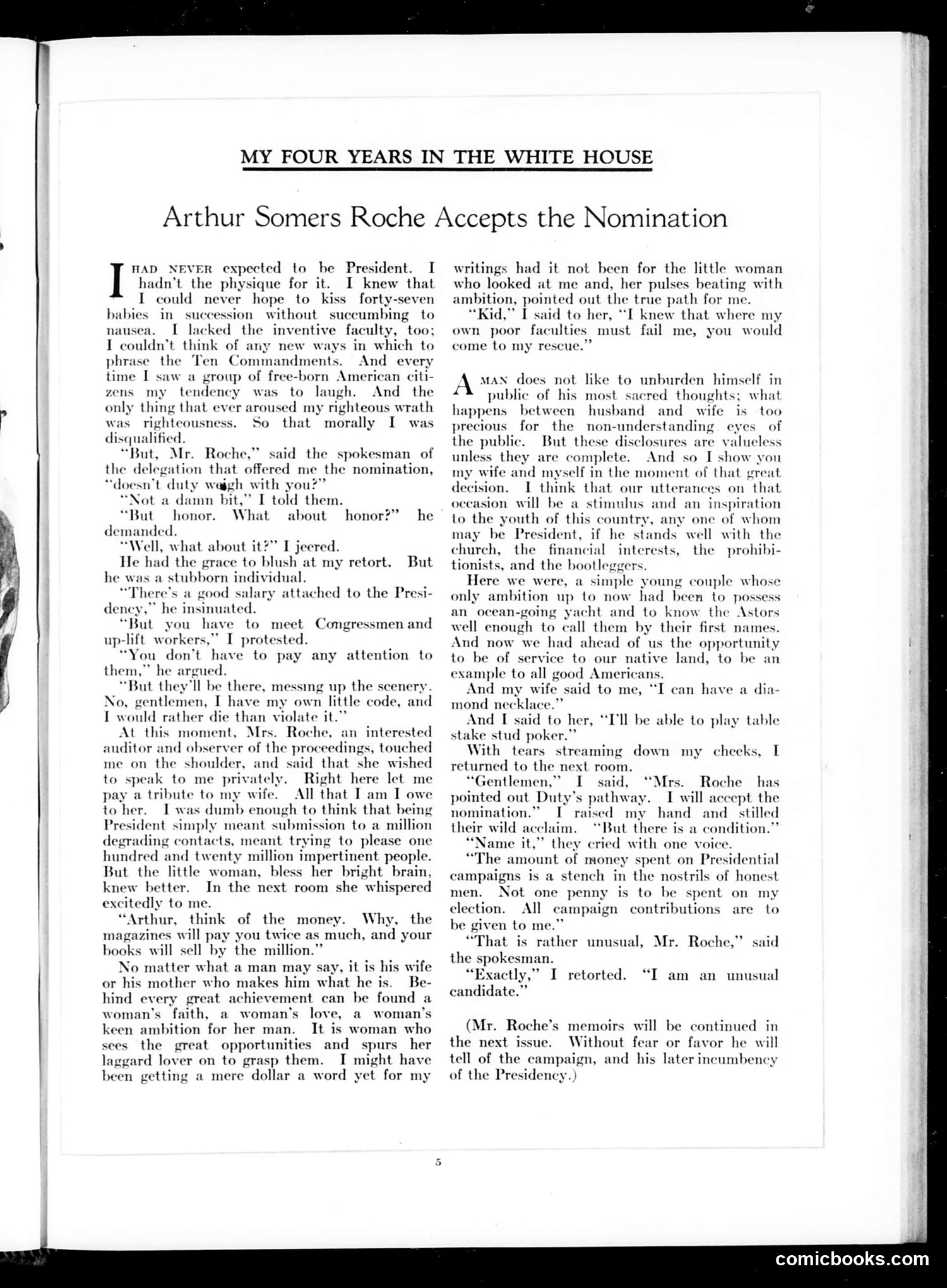
This is satirical fiction by Arthur Somers Roche presenting a cynical take on presidential ambition. The narrator initially refuses a presidential nomination, citing lack of qualifications and moral objections to the job's demands (kissing babies, meeting congressmen, pleasing the public). The satire's target: American political hypocrisy and materialism. The narrator only accepts after his wife points out financial benefits—magazines will pay double rates, books will sell millions. He then celebrates this mercenary decision as patriotic duty and noble service. The joke mocks how politicians rationalize self-interest as public service, and how easily principles collapse before profit motives. References to needing approval from "the church, the financial interests, the prohibitionists, and the bootleggers" suggest corruption across institutions. This reflects 1920s-era cynicism about political leadership and the commercialization of public office.
📄 Transcribed text from this page (OCR, searchable)
Machine-transcribed from the original scan — historical spelling and the odd misread are preserved.
HAD NEVER expected to be President. I I hadn't the physique for it. I knew that I could never hope to kiss forty-seven babies in succession without succumbing to nausea. I lacked the inventive faculty, too; I couldn’t think of any new ways in which to phrase the Ten Commandments. And every time I saw a group of free-born American citi- zens my tendency was to laugh. And_ the only thing that ever aroused my righteous wrath that morally I was was righteousness. So disqualified. “But, Mr. Roche,” said the spokesman of the delegation t offered me the nomination, “doesn't duty waigh with you?” “Not a damn bit,” I told them. “But honor. What about demanded. “Well, what about it?” I jeered. He had the grace to blush at my retort. he was a stubborn individual. “There's a good salary attached to the Presi- 1. honor?” he But dency,” he insin “But you | to meet Congressmen and up-lift workers,” I protested. “You don’t have to pay any attention to them,” he argued. “But they'll be there, messing up the scenery. No, gentlemen, I have my own little code, and I would rather die than violate it.” At this moment, Mrs. Roche, an interested auditor and observer of the proceedings, touched me on the shoulder, and said that she wished to speak to me privately. Right here let me pay a tribute to my wife. All that I am I owe to her. I was dumb enough to think that being President simply meant submission to a million degrading contacts, meant trying to please one hundred and twenty million impertinent people. But the little woman, bless her bright brain, knew better. In the next room she whispered excitedly to me. “Arthur, think of the magazines will pay you twic books will sell by the million No matter what a man may say, it is his wife or his mother who makes him what he is. Be- hind every great achievement can be found a woman's faith, a woman's love, a woman's keen ambition for her man. It is woman who the great opportunities and spurs_ her laggard lover on to grasp them. I might have been getting a mere dollar a word yet for my money. Why, the s much, and your sees MY FOUR YEARS IN THE WHITE HOUSE Arthur Somers Roche Accepts the Nomination been for the little woman writings had it not who looked at me and, her pulses beating with ambition, pointed out the true path for me. “Kid,” I said to own poor faculties come to my rescue.” rer, “IT knew that where my must fail me, you would MAN does not like to unburden himself in public of his most sacred thoughts; what happens between husband and wife is too for the non-understanding eyes of the public. But these disclosures are valueless unless they are complete. And so I show you my wife and myself in the moment of that great decision. I think that our utterances on that oceasion will be a stimulus and an inspiration to the youth of this country, any one of whom may be President, if he stands well with the church, the financial interests, the prohibi- tionists, and the bootleggers. Here we were, a simple young couple whose only ambition up to now had been to possess an ocean-going yacht and to know the Astors well enough to call them by their first: names. And now we had ahead of us the opportunity to be of service to our native land, to be an example to all good Americans. And my wife said to me, “I can have a dia- mond neck And I said to her, “I'll be able to play table stake stud poker.” With tears streaming down my cheeks, I returned to the next room. “Gentlemen,” I said, “Mrs. Roche has pointed out Duty’s pathway. I will accept the nomination.” I raised my hand and_ stilled m. “But there is a condition.” they cried with one voice. “The amount of money spent on Presidential campaigns is a stench in the nostrils of honest men. Not one penny is to be spent on my election. All campaign contributions are to be given to me.” “That is rather unusual, Mr. Roche,” the spokesman. I retorted. “I said unusual am an candidate.” (Mr. Roche’s memoirs will be continued in the next issue. Without fear or favor he will tell of the campaign, and his later incumbency of the Presidency.) comicbooks.com