
A complete issue · 36 pages · 1923
Judge — April 14, 1923
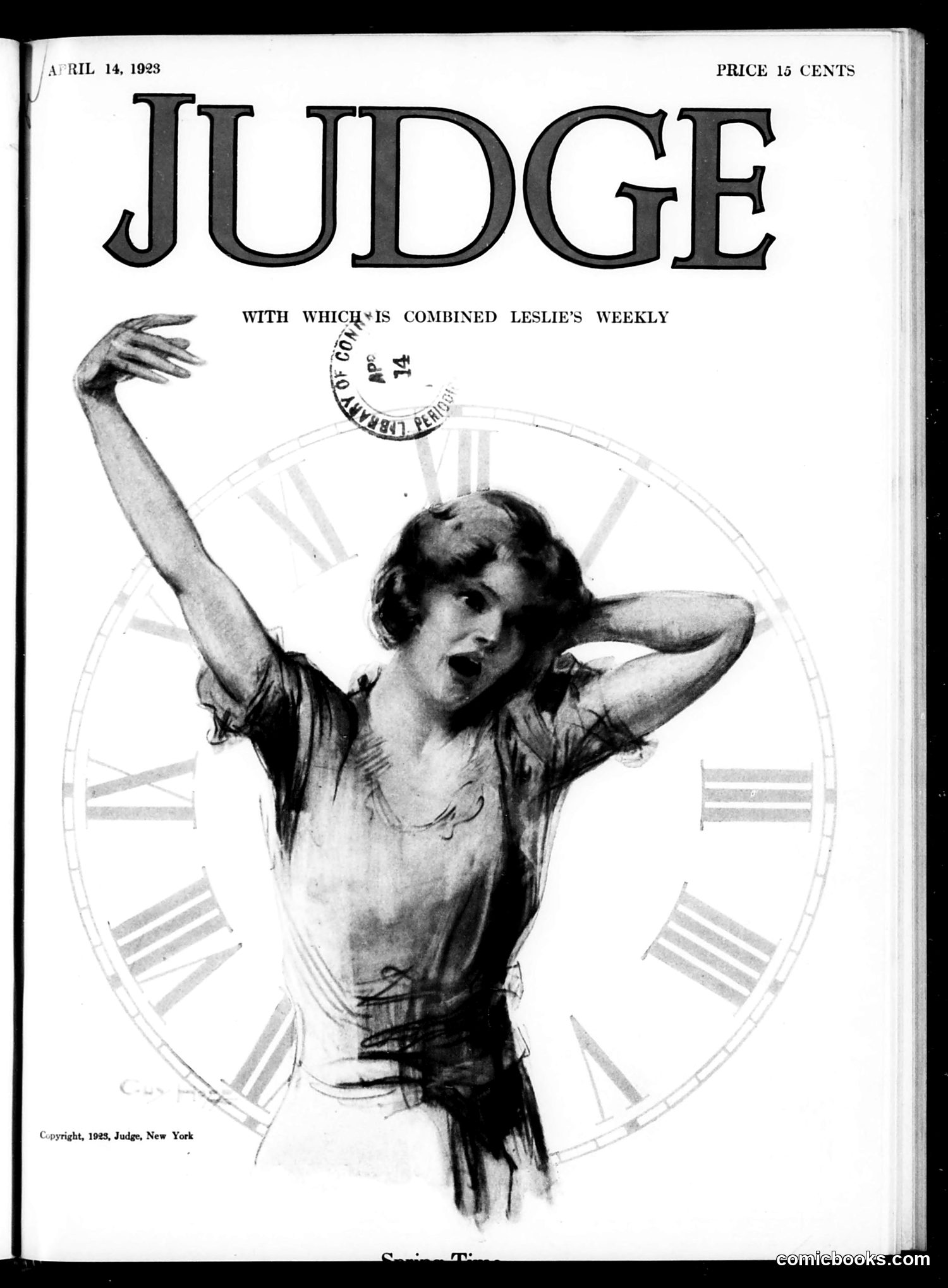
This cover features a woman in a revealing, form-fitting dress posing against a large clock face. The image appears to be satirizing 1920s youth culture and changing social mores—specifically the "flapper" era's rejection of Victorian propriety. The clock imagery likely references the phrase "the times are changing" or commentary on modernity. The woman's confident, somewhat provocative pose—with one arm raised and dress clinging to her figure—reflects anxiety among older generations about women's increasing freedom and sexual liberation during the Jazz Age. The satire targets conservative anxieties about 1920s "modern women" who defied traditional dress codes and behavioral expectations. Judge, as a satirical publication, used such imagery to comment on (and often mock) these social transformations and generational conflict.
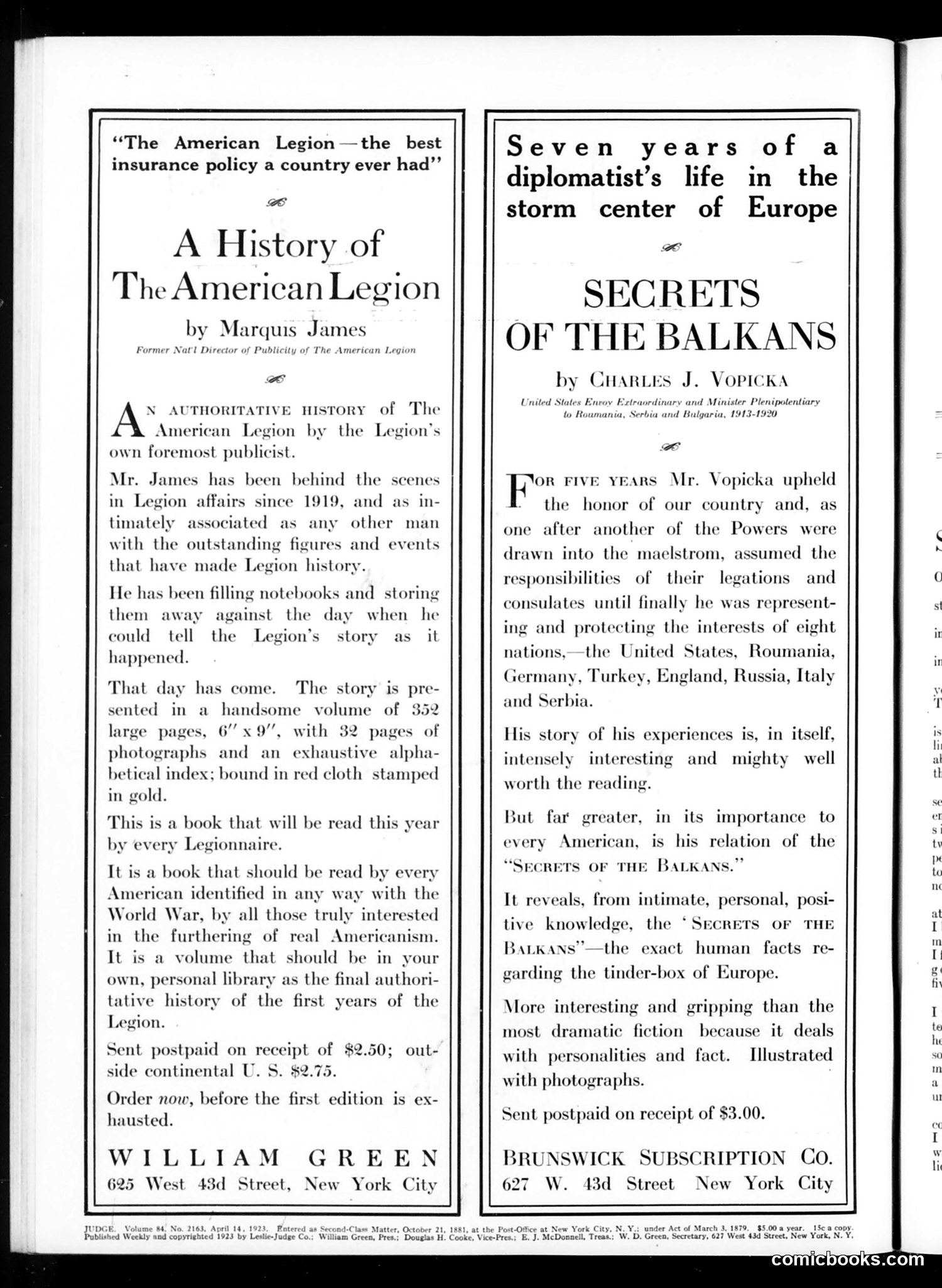
This page contains **two book advertisements**, not political cartoons or satire. **Left ad:** Promotes "A History of The American Legion" by Marquus James, published by William Green. The Legion is described as "the best insurance policy a country ever had." The ad targets Legionnaires and World War I-affiliated Americans, emphasizing this as the definitive early history of the organization. **Right ad:** Advertises "Secrets of the Balkans" by Charles J. Vopicka, a U.S. diplomat who served in Romania, Serbia, and Bulgaria (1913-1920). The ad positions this as an insider account revealing European political secrets during the post-WWI period. Both advertisements use period marketing language targeting educated readers interested in military history and international affairs.
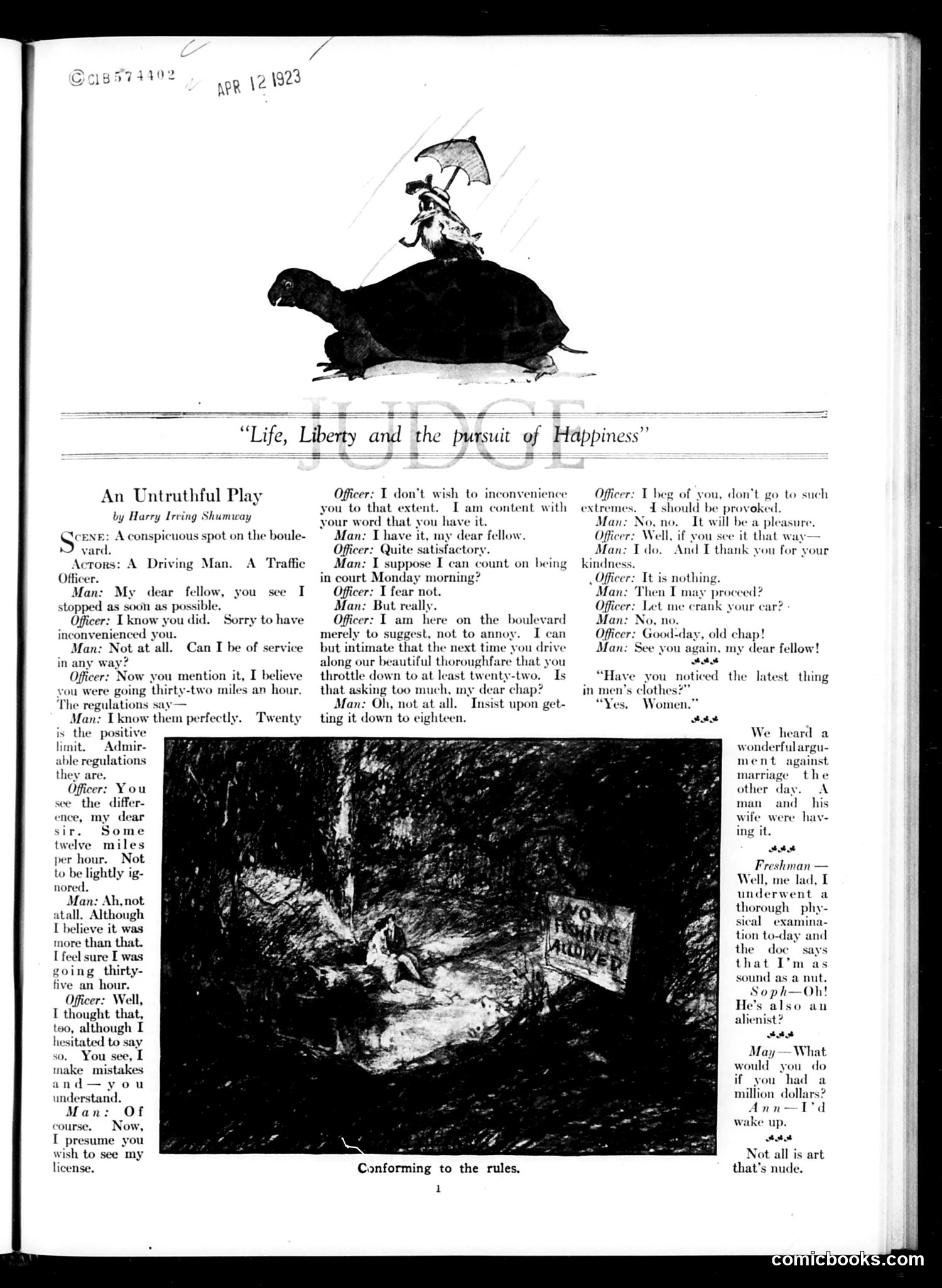
**Main Content:** A satirical play titled "Life, Liberty and the Pursuit of Happiness" by Harry Irving Shumway, featuring a dialogue between a Man and a Traffic Officer on a boulevard. **The Satire:** The joke targets traffic enforcement and speed regulations. A man complains about being stopped for speeding, claiming he was going "thirty-five" mph. The officer insists the legal limit is twenty mph and threatens a citation. The absurdist humor emerges through the man's escalating rationalization—he boasts of going "thirty-five" but then claims it was "more than that," ultimately admitting he felt he was "going thirty-five an hour." **Context:** This reflects 1920s anxieties about automobile culture, speed limits, and police enforcement of traffic laws—then relatively new regulations. The title ironically invokes the Declaration of Independence to satirize petty traffic stops.
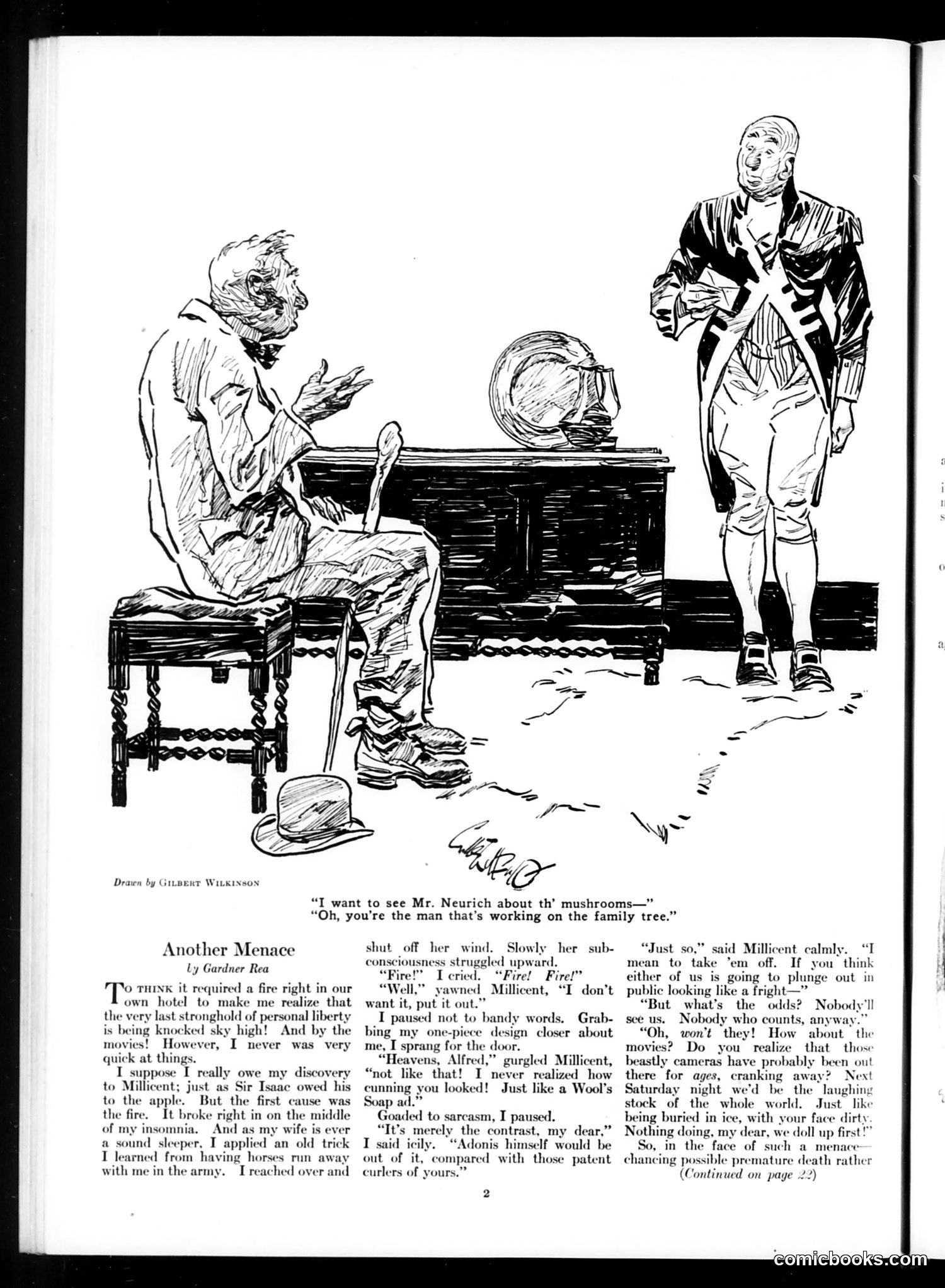
This illustration by Gilbert Wilkinson depicts a domestic dispute about family trees and genealogy research. The story "Another Menace" by Grantland Rice satirizes the growing craze of genealogy—tracing family ancestry—as a threat to domestic harmony. The scene shows a husband confronting his wife about her genealogy obsession. She's become so consumed researching family history (specifically seeking information about "Mr. Neurich" regarding "mushrooms") that she neglects household duties and social propriety. The husband's complaints—that she spends money, ignores him, and embarrasses the family publicly—mock how genealogy became an absorbing hobby that could disrupt middle-class marriages and domestic order. The satire targets the era's genealogy fad as creating marital discord.
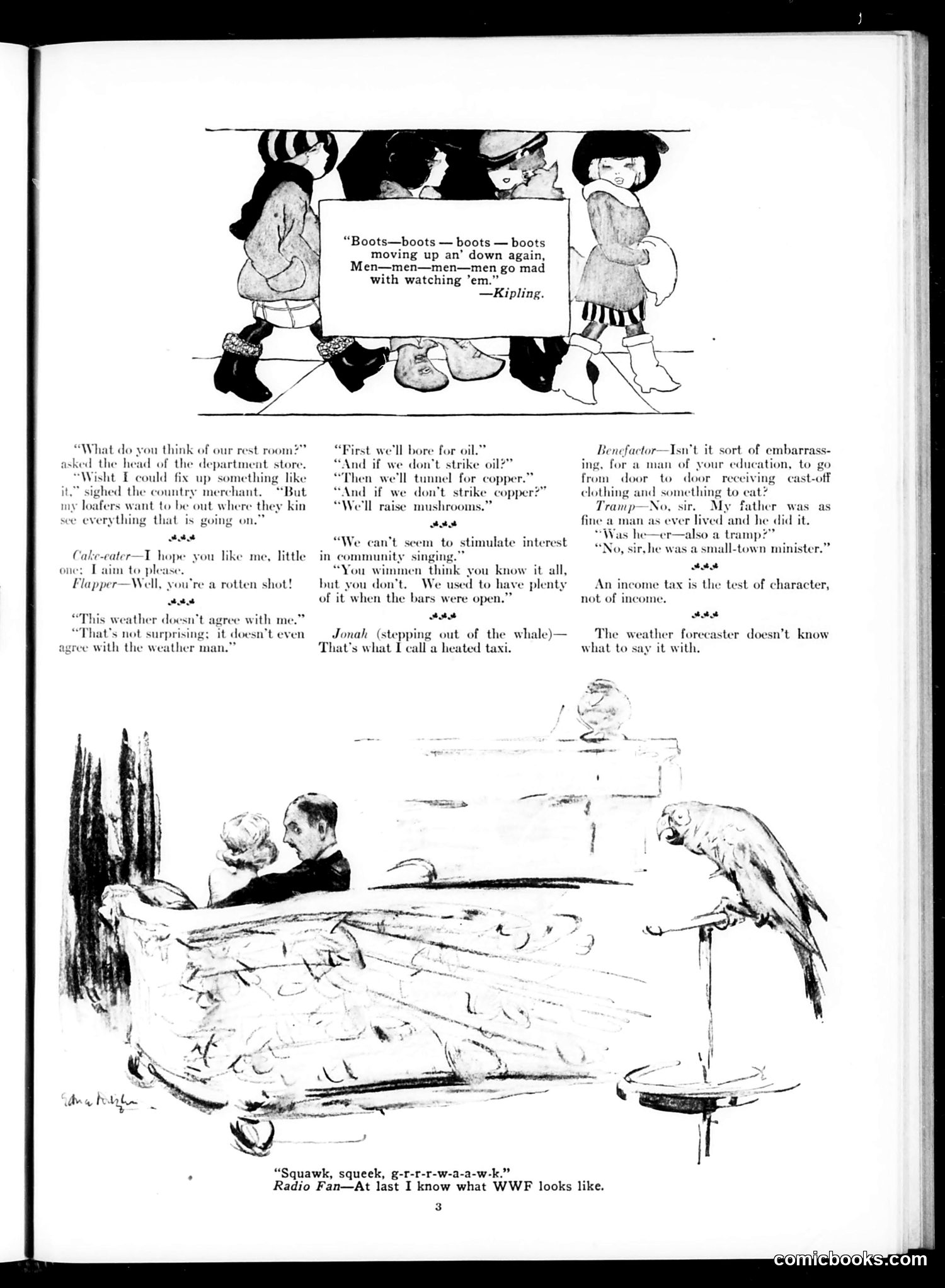
This page contains satirical dialogue and two cartoons from the World War I era (suggested by "WWF" reference, likely meaning "World War"). **Top illustration**: Four women display boots with a Kipling quote about soldiers' boots "moving up an' down again," mocking men's obsession with military matters. **Dialogue snippets**: Multiple short jokes satirize wartime concerns—strikes, resource scarcity (oil, copper, mushrooms), and public apathy about conflict. One character calls a taxi a "heated taxi," apparently a pun on "taxi" (the wartime vehicle) being heated/contentious. **Bottom cartoon**: A woman and parrot observe a map. The caption "Squawk, squeek, g-r-r-w-a-a-w-k! Radio Fan—At last I know what WWF looks like" suggests the parrot's cacophony mimics radio static or wartime broadcasts. The page satirizes homefront attitudes toward war—indifference, profiteering, and confusion.
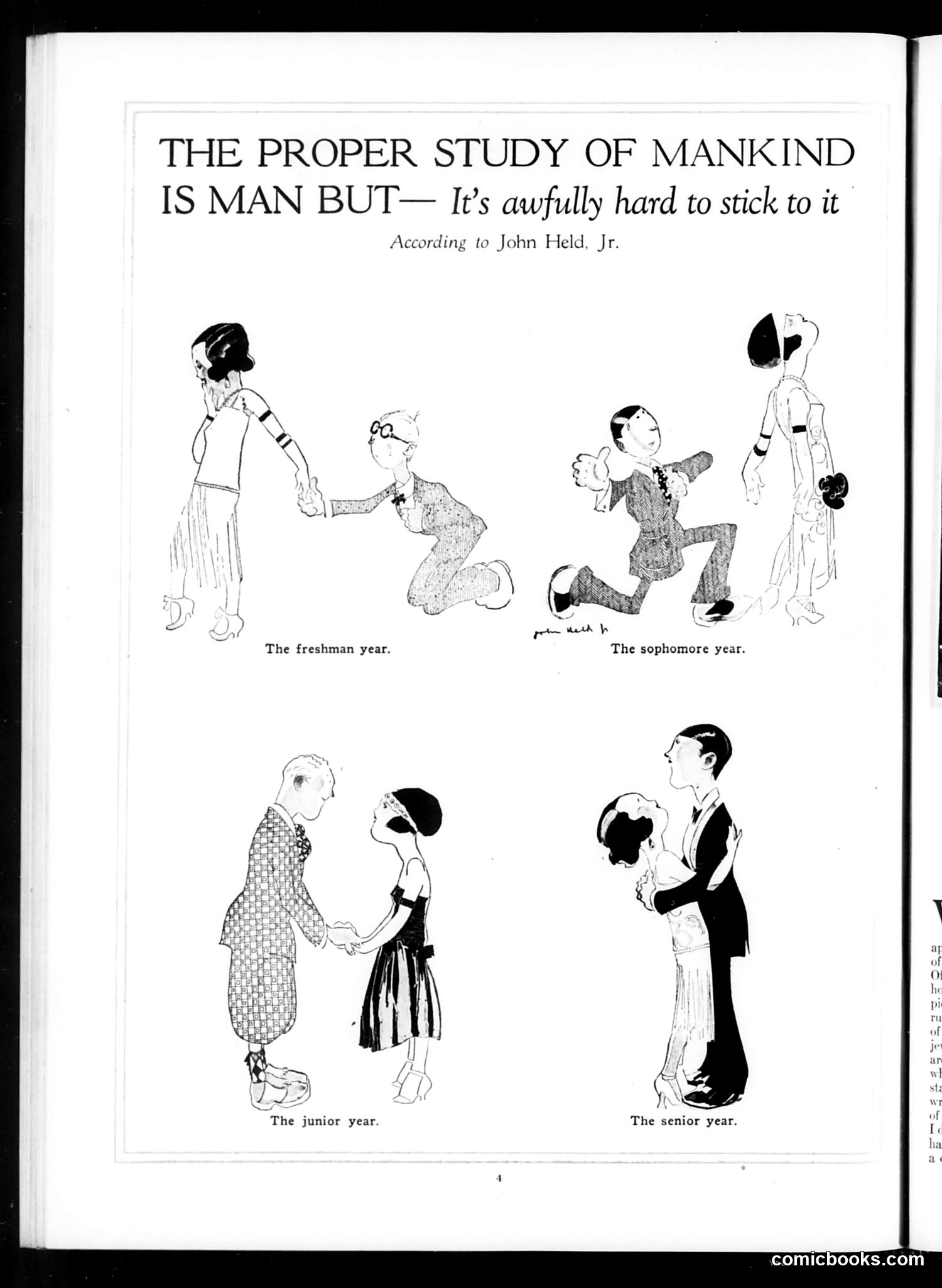
This satirical cartoon illustrates the progression of romantic/courtship behavior through four college years, attributed to John Held, Jr. (a famous Judge cartoonist of the 1920s-30s). The progression shows: - **Freshman**: Nervous, formal interaction between a male and female student - **Sophomore**: More energetic, physical pursuit - **Junior**: Casual handholding, relaxed familiarity - **Senior**: Intimate embrace, suggesting commitment or engagement The subtitle "It's awfully hard to stick to it" sardonically comments on the difficulty of maintaining romantic relationships or commitment. The cartoon satirizes how college courtship evolves from awkward formality to physical intimacy, while questioning the sustainability of such relationships. It reflects Jazz Age attitudes toward dating and changing social norms among young adults.
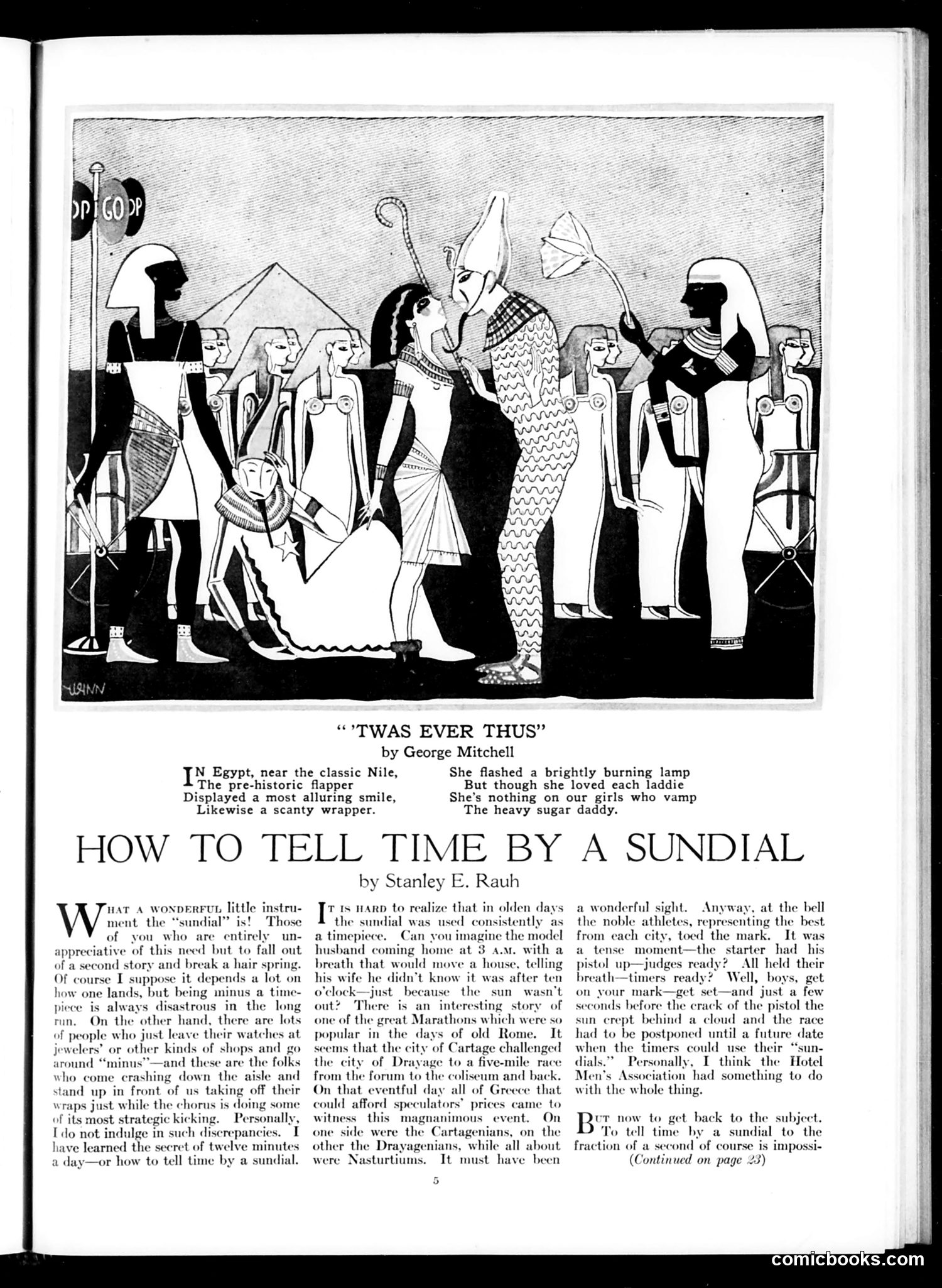
**The Cartoon ("'Twas Ever Thus"):** George Mitchell's illustration depicts an ancient Egyptian scene with a scantily-clad woman ("pre-historic flapper") flirting with men. The accompanying poem sarcastically contrasts ancient seduction with modern times, suggesting that contemporary young women ("flappers") who manipulate wealthy older men for money ("sugar daddy") are far more calculating than their historical counterparts. **The Article ("How to Tell Time by a Sundial"):** Stanley E. Rauh's humorous piece is largely a comedic ramble using the sundial as a thin pretext for jokes about timekeeping and social behavior. The extended anecdote about a Roman race (Carthage vs. Drayage) illustrates how sundials prove unreliable when clouds appear—allowing him to mock both ancient technology and modern hotel management. **Context:** This reflects 1920s Jazz Age anxieties about changing morality, particularly regarding young women's independence and their perceived manipulation of wealthy men—a recurring satirical target in Judge magazine during this era.
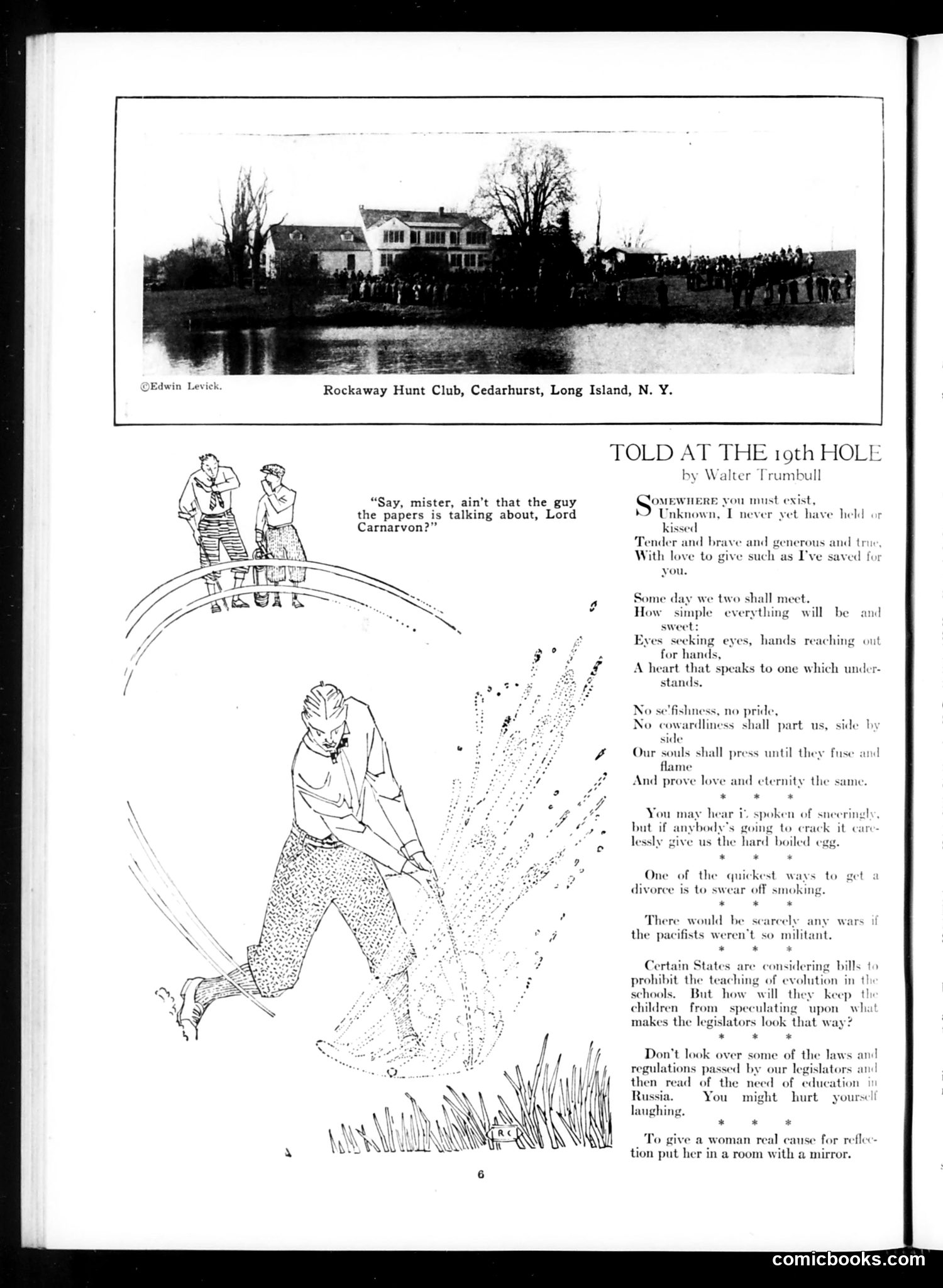
This page features a golf-themed humor column by Walter Trumbull. The cartoon depicts a golfer hitting a golf ball, with two figures observing from a bridge above—one asking if the other is "the guy the papers is talking about, Lord Carnarvon." **The Reference:** This likely alludes to Lord Carnarvon, the British aristocrat who funded Tutankhamun's tomb excavation in Egypt (early 1920s). The joke appears to be that someone notable is present at the Rockaway Hunt Club in Long Island, New York. **The Satire:** The column mixes sentimental poetry with satirical one-liners mocking contemporary issues: prohibition enforcement ("swear off smoking"), pacifism, state legislation banning evolution education, and Russian education. The humor targets legislative absurdity—particularly American lawmakers passing restrictive laws while appearing uneducated themselves. **Context for Modern Readers:** The evolution reference reflects 1920s-era fundamentalist opposition to Darwinian teaching in schools, a recurring American controversy. The column's tone is typical period satirical commentary on social attitudes and governance.
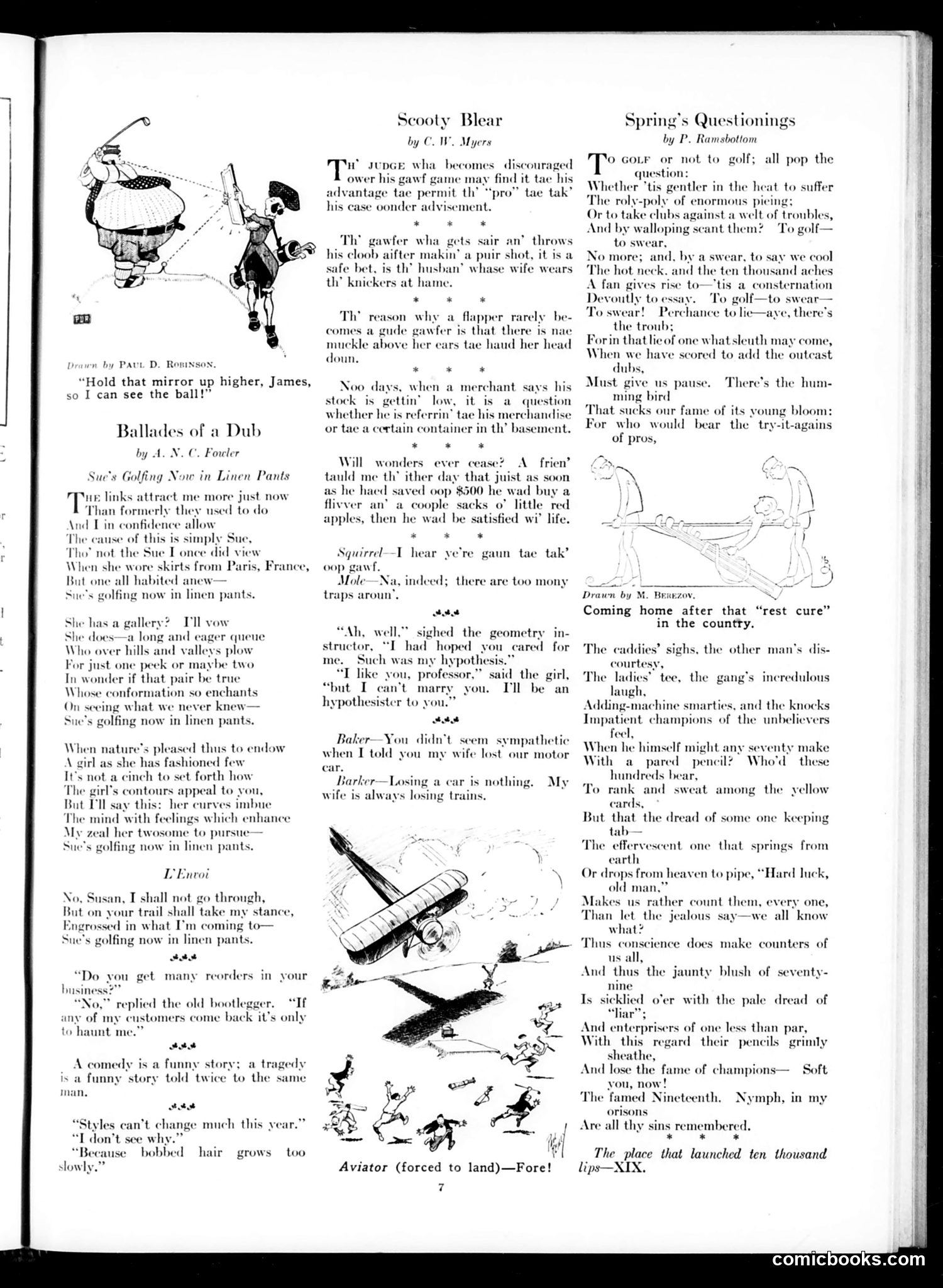
This Judge magazine page (appears to be 1920s) contains golf-themed humor reflecting post-WWI social changes. **"Hold that mirror up higher, James"**: A caddy holds a mirror so a golfer can see the ball—absurdist humor about incompetence or vanity. **"Sue's Golfing Now in Linen Pants"**: Satirizes women adopting practical athletic wear instead of traditional skirts. The poem's repeated refrain and male "gallery" following Sue suggests anxiety about women's liberation and changing gender norms—both concerning and titillating to contemporary readers. **"Scooty Blear"** (Scottish dialect): Golf aphorisms mocking both players and Prohibition-era bootlegging ("container in th' basement"). **"Spring's Questionings"**: Parodies Hamlet's soliloquy applied to golf, creating intellectual absurdist humor. The cartoons depict golfing mishaps. Overall, the page reflects 1920s preoccupations: women's changing roles, Prohibition, and golf's cultural prominence among the leisure class.
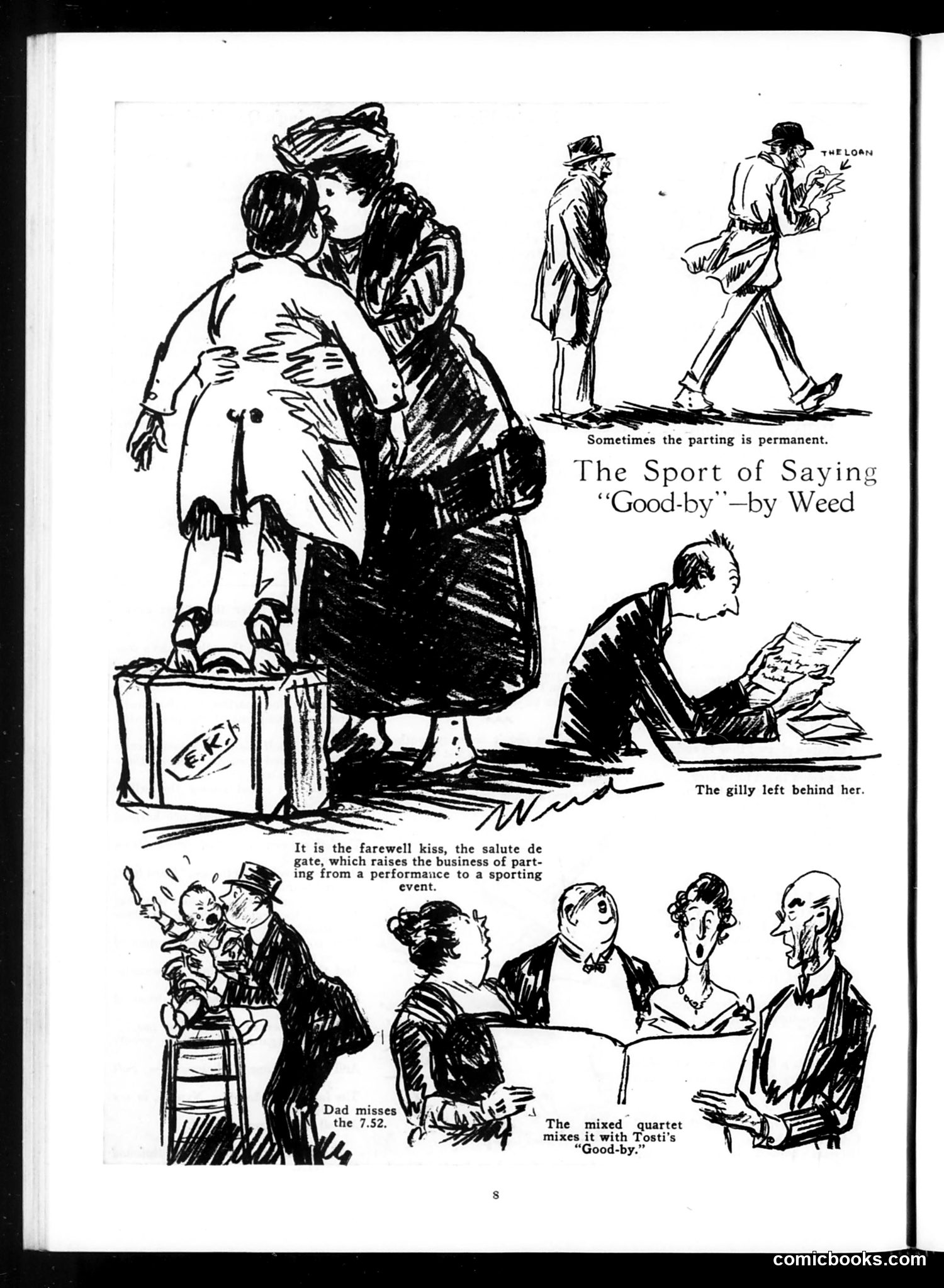
This satirical comic by Weed depicts the theatrical rituals of farewell—particularly railway station partings, a common early-20th-century scenario. The humor centers on how people transform simple goodbyes into elaborate, performative acts. The sketches show various exaggerated departure scenes: an emotional embrace with luggage, a man missing his 7:52 train while prolonging farewells, and a "mixed quartet" dramatically performing their goodbyes "with Tosti's Good-by" (referencing the sentimental song by Paolo Tosti). The satire mocks the excessive sentimentality and social pretense surrounding departures—treating mundane train journeys as dramatic theatrical events. The subtitle "sometimes the parting is permanent" adds dark humor, suggesting people stage these performances even for temporary absences. The cartoon captures period anxieties about emotional authenticity versus social performance in upper-class society.
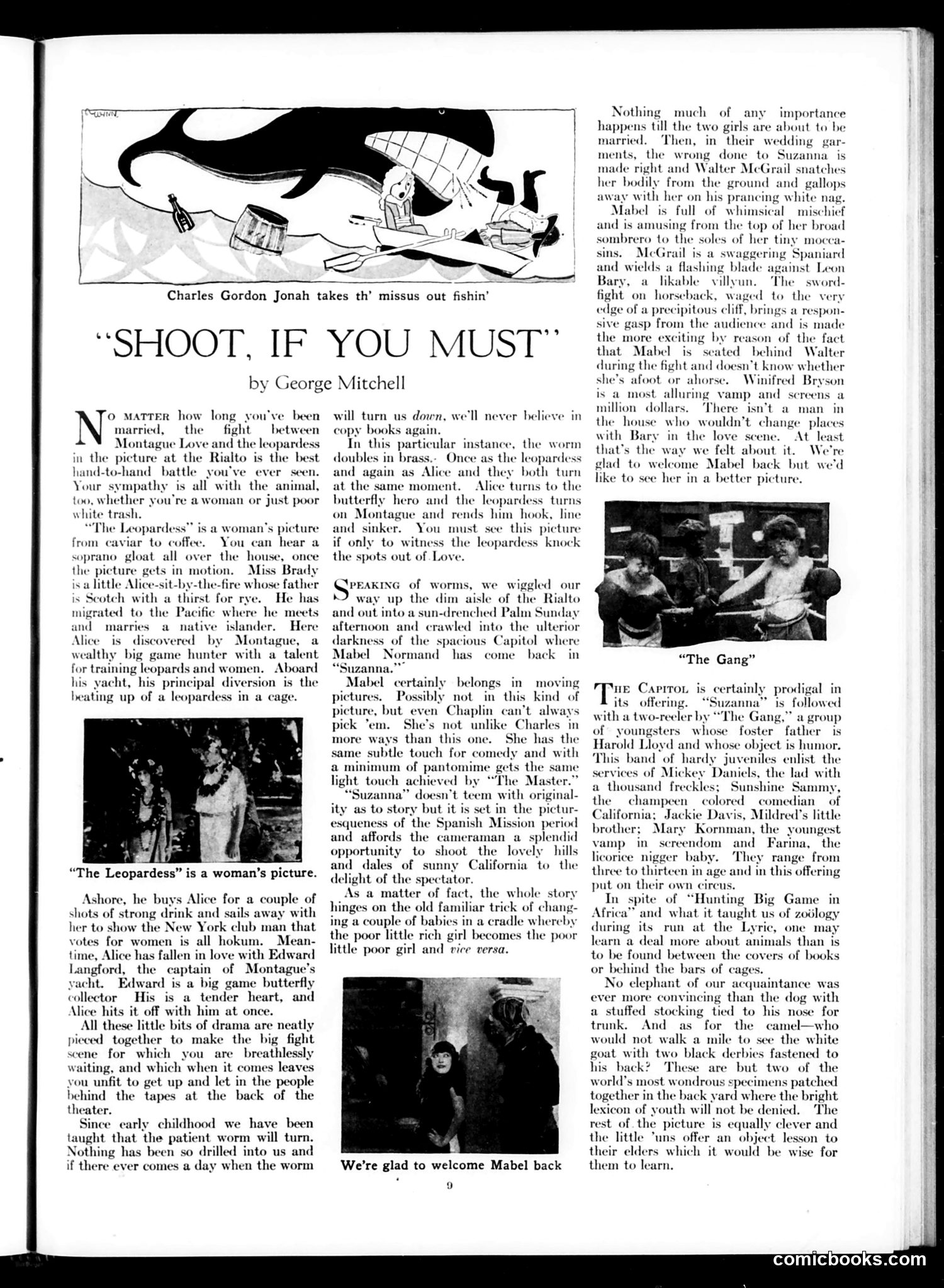
This page reviews contemporary silent films, written by George Mitchell. The main article critiques "The Leopardess," starring Alice Brady, which follows a familiar melodramatic plot: a Scotch-American father marries a Pacific Islander; his daughter Alice is purchased by a wealthy big-game hunter (Montague) but falls for the yacht captain (Edward Langford). The climax features a fight between Alice and a caged leopardess that Montague has been abusing. Mitchell's satire emphasizes that this is "a woman's picture"—aimed at female audiences—mocking the predictable drama and emotional manipulation designed to make viewers weep. He notes the film exploits the old literary trope that "the patient worm will turn," where both Alice and the leopardess simultaneously turn on their oppressor. The secondary review covers Mabel Normand's "Suzanna," featuring the familiar switched-babies plot and Spanish Mission-period scenery, praising Normand's comedic talent.
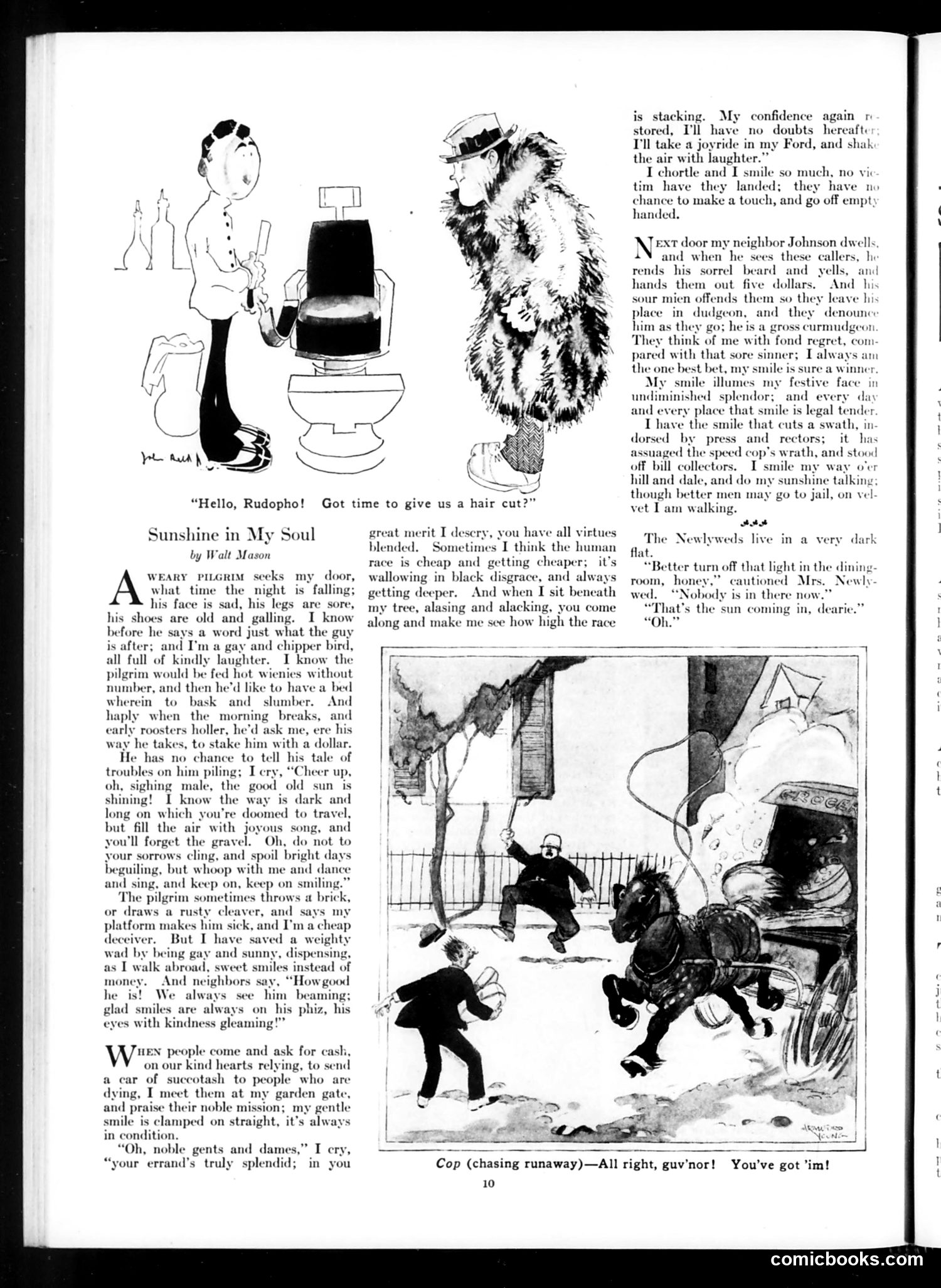
This page contains two distinct pieces: **"Sunshine in My Soul"** by Walt Mason is a humorous poem about a cheerful man who uses constant smiling and optimism to avoid giving money to poor travelers and charitable causes. The satire targets wealthy people who offer hollow encouragement ("cheer up!") instead of actual financial help. He contrasts himself favorably with his neighbor Johnson, who actually gives five dollars to needy visitors but receives complaints for his grumpiness. Mason suggests that charm and empty positivity are socially rewarded over genuine kindness—people prefer his pleasant refusals to Johnson's begrudging generosity. **The cartoons** show: 1. A barber ("Hello, Rudopho!") at a chair with a customer 2. A bearded man in shabby clothes (the "weary pilgrim") 3. A street scene labeled "Cop (chasing runaway)—All right, guv'nor! You've got 'im!"—depicting what appears to be common urban police activity The content satirizes class attitudes and shallow materialism of the era.
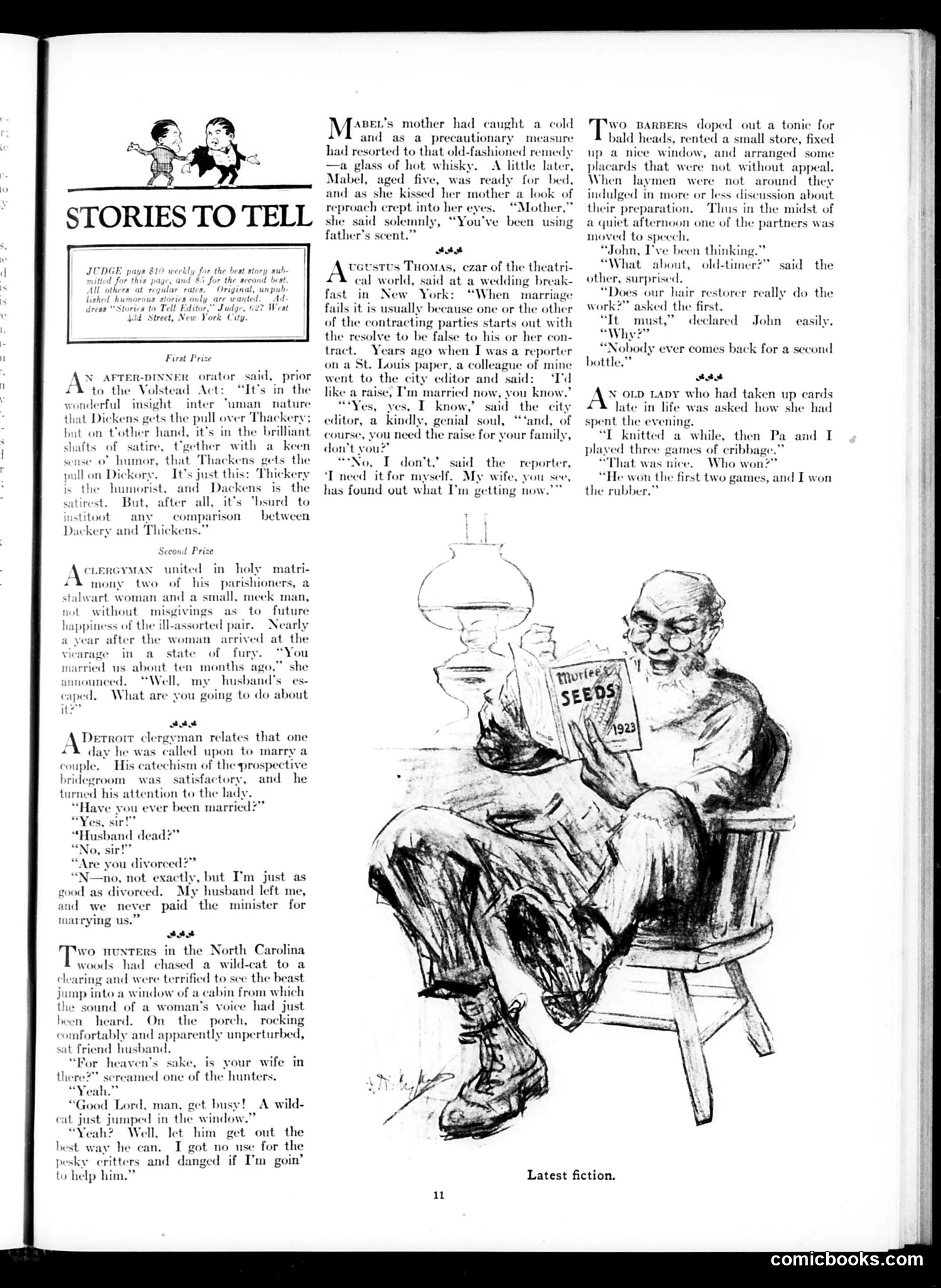
This page from *Judge* contains six humor pieces satirizing early 20th-century American life, each preceded by a prize designation. **The cartoons mock:** 1. **Pretentious literary criticism** — an orator's rambling, meaningless comparison of Dickens and Thackeray, parodying pseudo-intellectual after-dinner speeches. 2. **Clergy and marriage** — a minister officiating marriages encounters uncomfortable questions about divorced/separated wives, exposing social awkwardness around marital dissolution. 3. **Marital discord** — a husband's casual indifference when a wildcat invades his home where his wife shelters, suggesting domestic unhappiness through dark humor. 4. **Wage negotiations** — a reporter admits needing a raise not for family support but because his wife discovered his actual salary, satirizing both marital tension and workplace dynamics. 5. **Failed products** — barbers' "hair restorer" succeeds only because unsatisfied customers never return (dark irony about a fraudulent remedy). 6. **Domestic leisure** — an elderly woman's evening combining knitting with card games, gentle humor about aging domestic life. The illustration shows a man reading a seed catalog—likely promoting a new venture, fitting the entrepreneurial theme of the barber story above it.
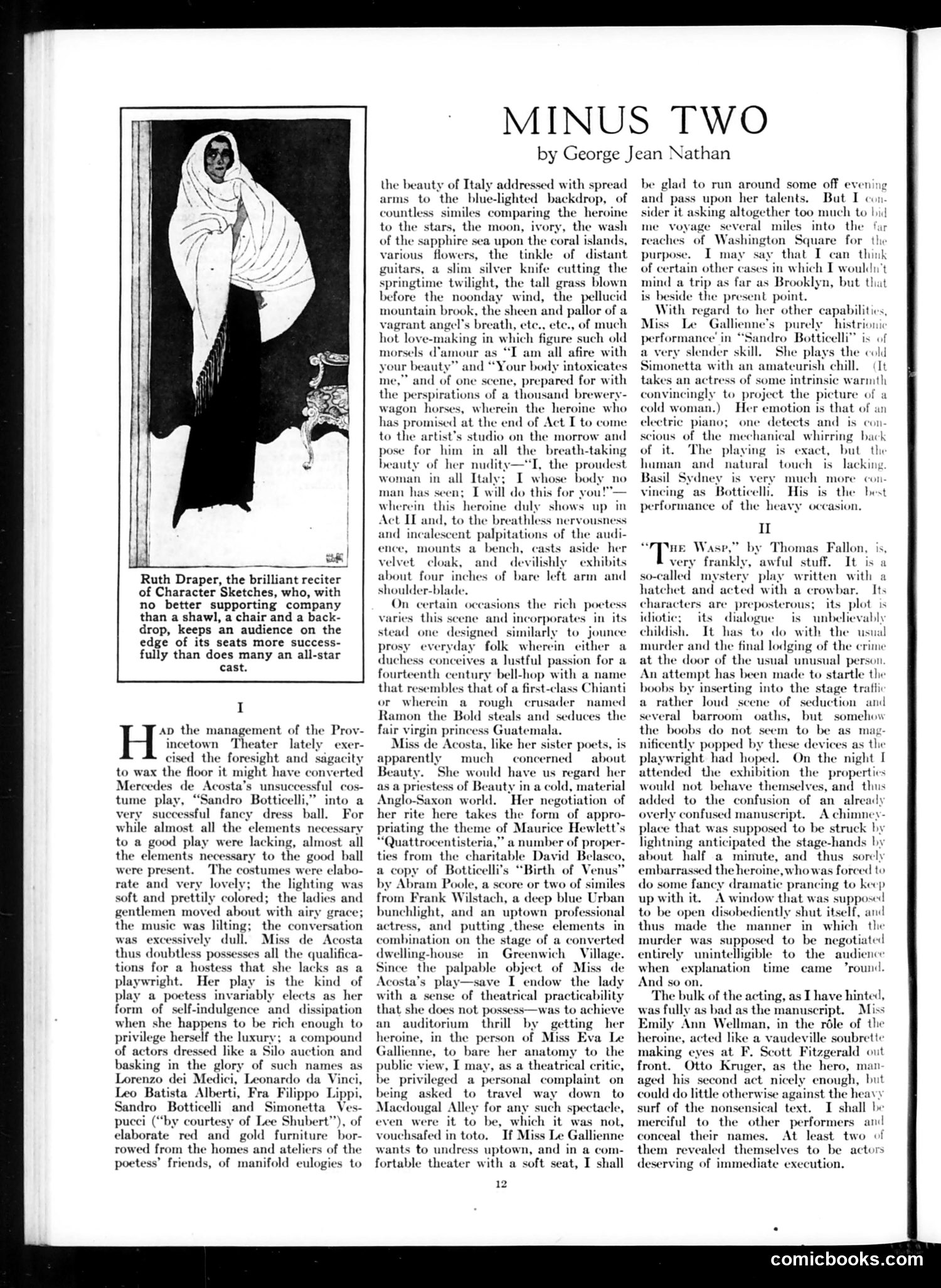
This is a theatrical review of Mercedes de Acosta's play "Sandro Botticelli," performed at the Provincetown Theater. Nathan's satire is devastating: the production succeeds as a fancy dress ball but fails as drama. **The Joke:** Nathan argues the play lacks two essential elements—plot and dialogue—making it "minus two" of theater's basics. He catalogs the production's actual strengths (elaborate costumes, atmospheric lighting, famous borrowed props including a Botticelli painting) while demolishing its pretensions. **The Satire:** Nathan mocks de Acosta's self-indulgent aestheticism and her concern with "Beauty" as an end in itself. He ridicules her overwrought romantic language ("I am all afire with your beauty") and notes the famous scene consists merely of an actress displaying four inches of bare arm—anticlimactic given elaborate buildup. **The Point:** A wealthy dilettante can create spectacle but not theater. Nathan suggests she's better suited as a society hostess than a playwright, implying wealth and artistic pretension don't substitute for dramatic craft.
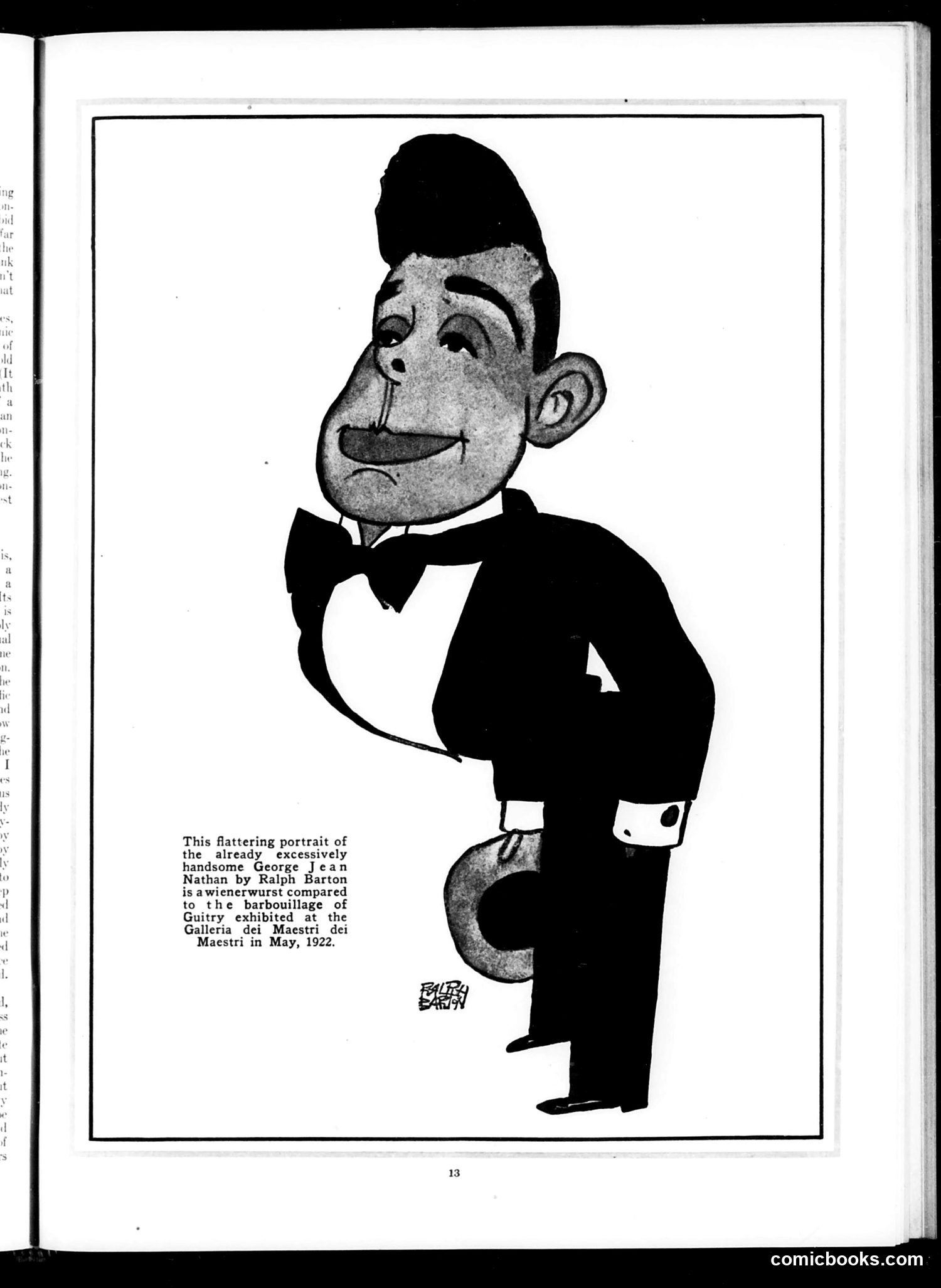
This page features a caricature by Ralph Barton of **George Jean Nathan**, a prominent American theater critic and editor of *The Smart Set* magazine. The exaggerated features—prominent nose, large ears, and stylized face—are typical of Barton's caricature style. The caption's humor relies on **self-deprecation**: it claims Barton's portrait, though flattering to Nathan, is merely a "wiener-wurst" (crude sketch) compared to works by **Sacha Guitry** (French actor/playwright) exhibited in Italy in May 1922. This appears to be mock-humble satire—Barton ironically diminishing his own skillful work while referencing contemporary European artistic circles, likely amusing readers familiar with Nathan's prominence in American theater criticism. The "excessively handsome" characterization in the caption is itself ironic, given the deliberately unflattering caricature.
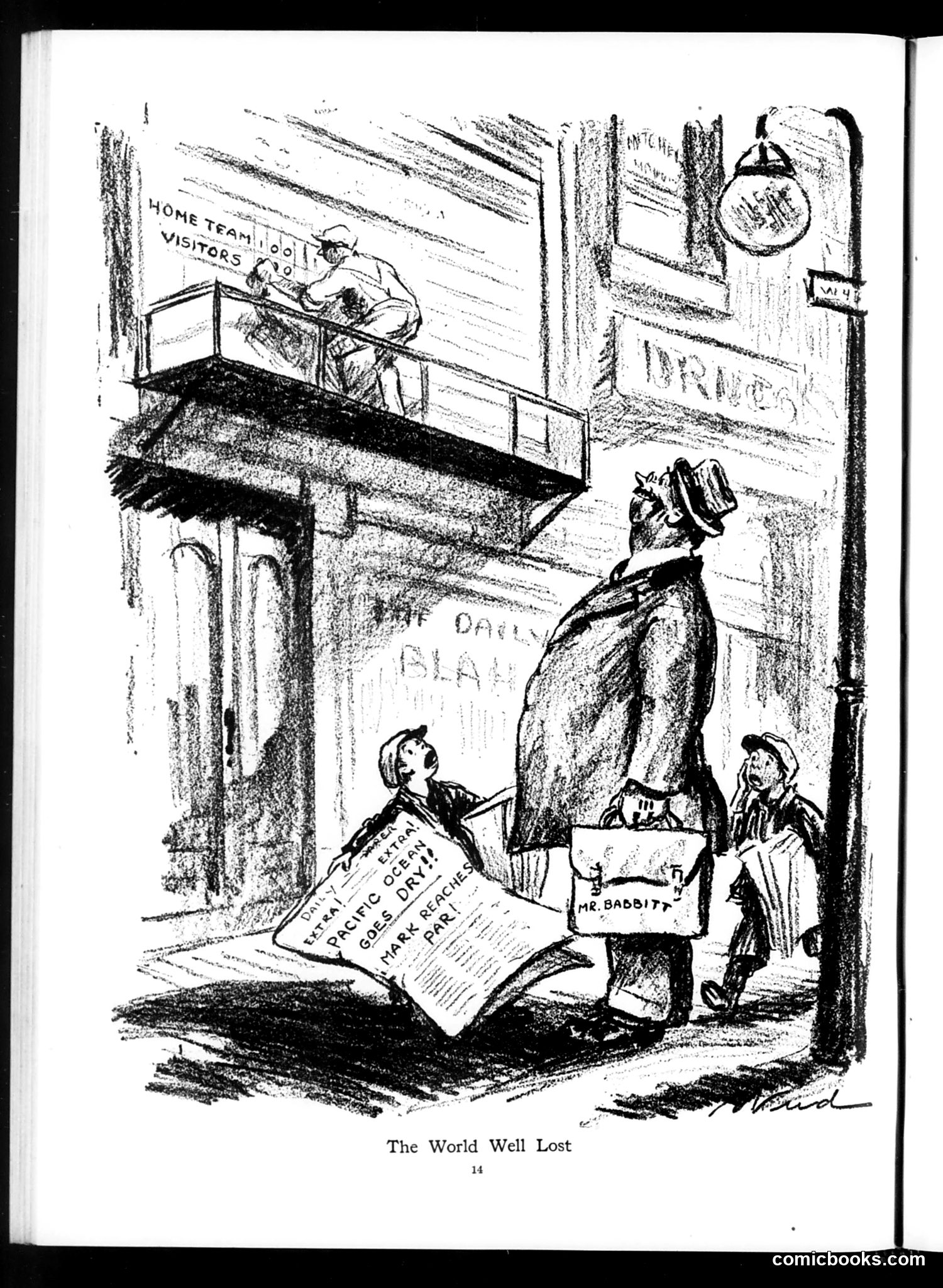
This cartoon satirizes a well-dressed gentleman (labeled "Mr. Babbitt") who appears to be a prosperous businessman or civic figure. He's positioned above street-level, observing from what looks like a sports stadium or public viewing box marked "Home Team" and "Visitors." Below him, two working-class figures hold a document labeled "Police Duties" and "Park Benches"—suggesting neglected public services. The title suggests the cartoon critiques the priorities of someone like Babbitt, implying that in pursuing worldly success or entertainment (the elevated sports viewing position), he's abandoned responsibility for basic civic welfare and public infrastructure. The satire targets middle-class indifference to social obligations.
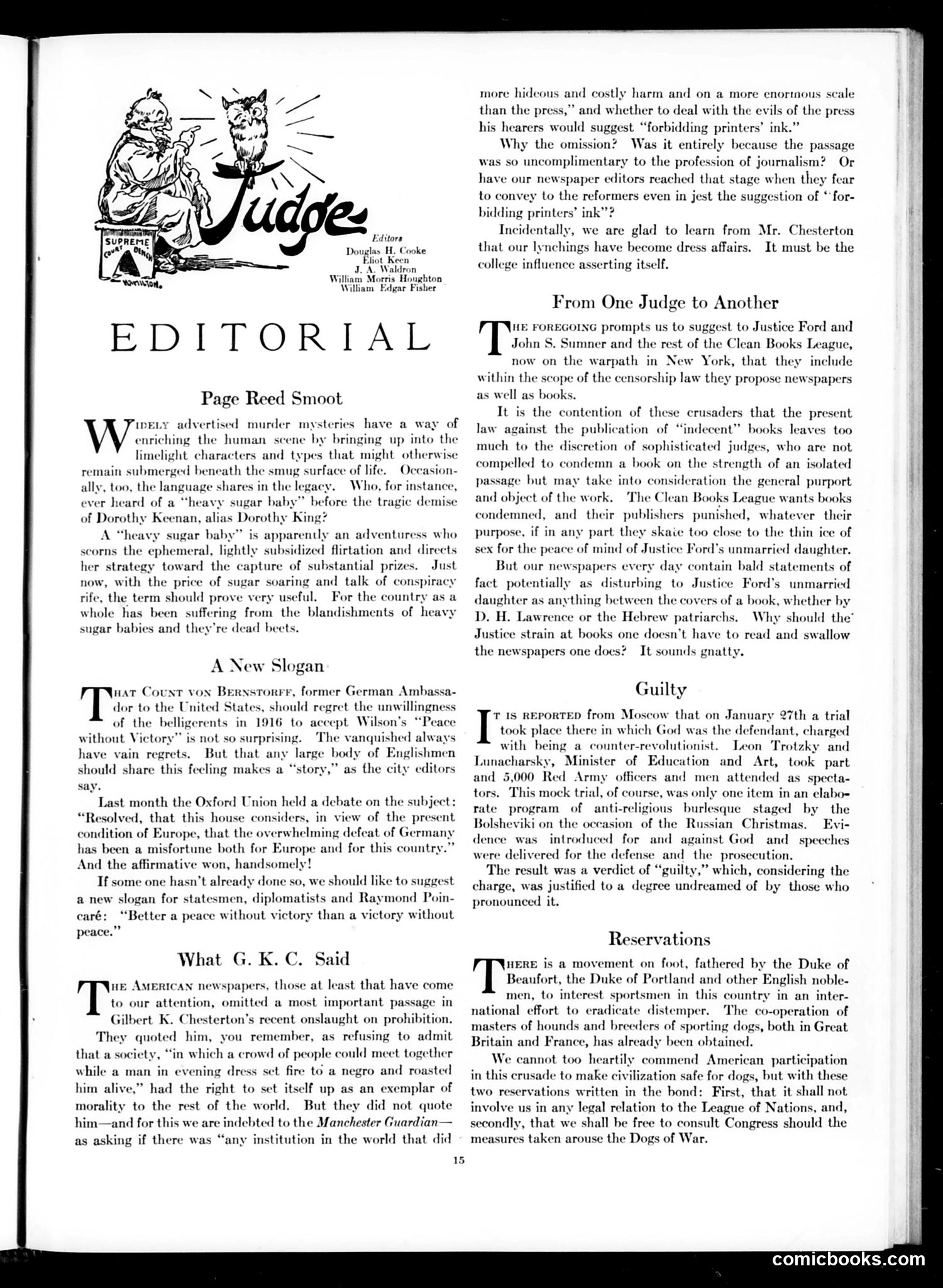
The cartoon shows a "Judge" mascot (the publication's satirical icon) as the focal point of this editorial page from early 20th-century America. **Key Editorial Topics:** 1. **"Page Reed Smoot"** — Satirizes Senator Reed Smoot (visible reference) regarding sensationalized murder trials, particularly the "Dorothy King" case, which popularized the term "heavy sugar baby" (a woman seeking wealthy patrons). Judge mocks how such trials enrich language while society suffers from actual economic problems like rising sugar prices. 2. **"What G.K.C. Said"** — Criticizes American newspapers for omitting G.K. Chesterton's pointed criticism of the press itself while quoting his attacks on prohibition. Judge notes the hypocrisy: newspapers eagerly quoted his moral criticisms but suppressed his jabs at journalism. 3. **"From One Judge to Another"** — Argues that if censorship boards like the Clean Books League regulate "indecent" publications, they should equally censor newspapers, which arguably cause greater harm than books. The page satirizes press hypocrisy and selective reporting while advocating consistent standards for public accountability.
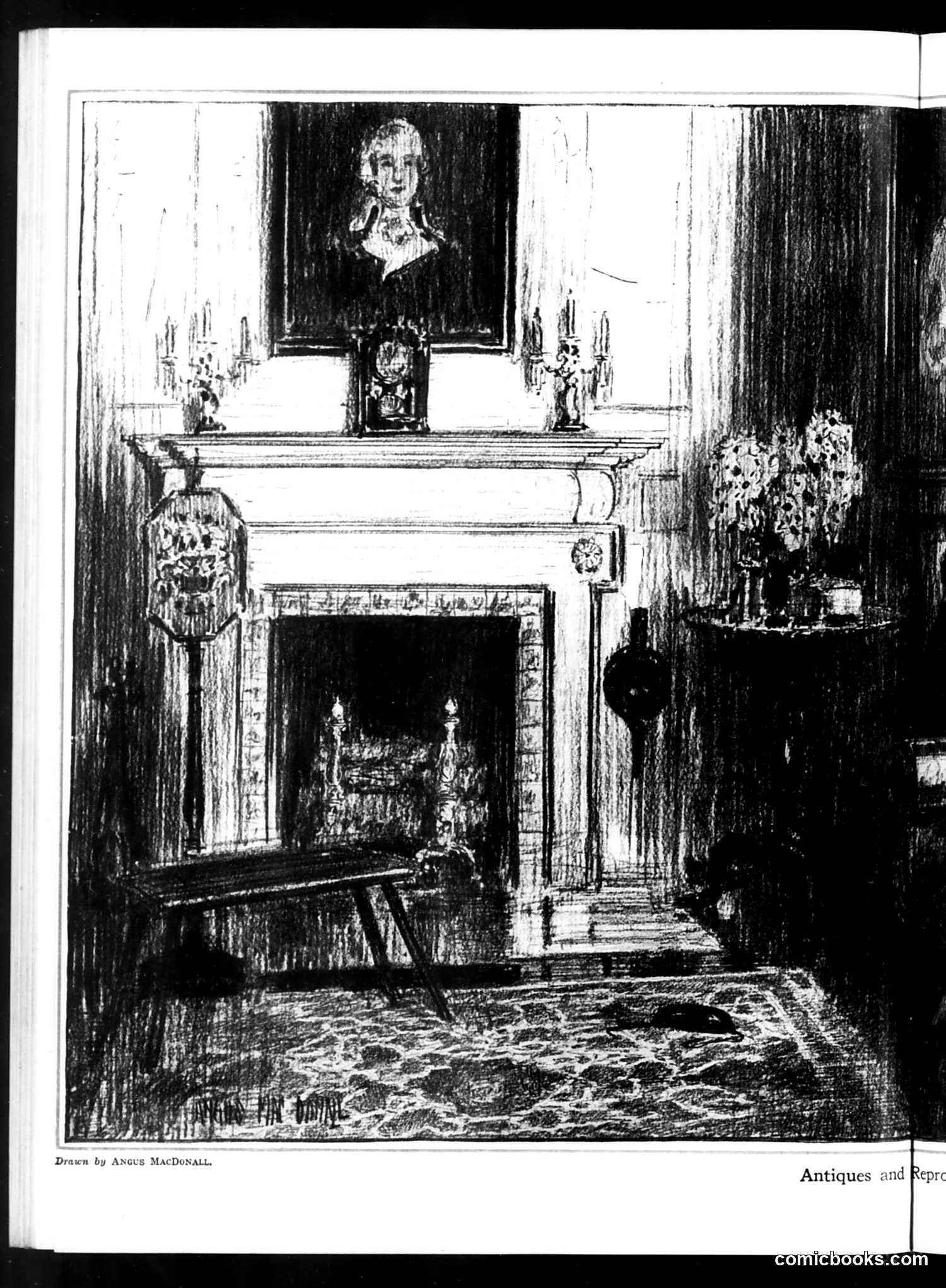
This is a black and white interior sketch by Angus MacDonall depicting an elegant Georgian or Victorian-era room with a fireplace as the focal point. A portrait hangs above the mantelpiece, flanked by candelabras and decorative objects. The room features period furnishings including what appears to be a settee or bench, potted plants, and patterned flooring. The page header reads "Antiques and Repro[ductions]" (text cut off), suggesting this illustration accompanies an article about antique furnishings and their reproductions—a common Judge magazine feature during the early-to-mid 20th century. Without additional visible text or context, this appears to be a straightforward interior design illustration rather than political satire. It likely accompanied editorial content about home decoration and period furnishings, rather than serving as a commentary piece.
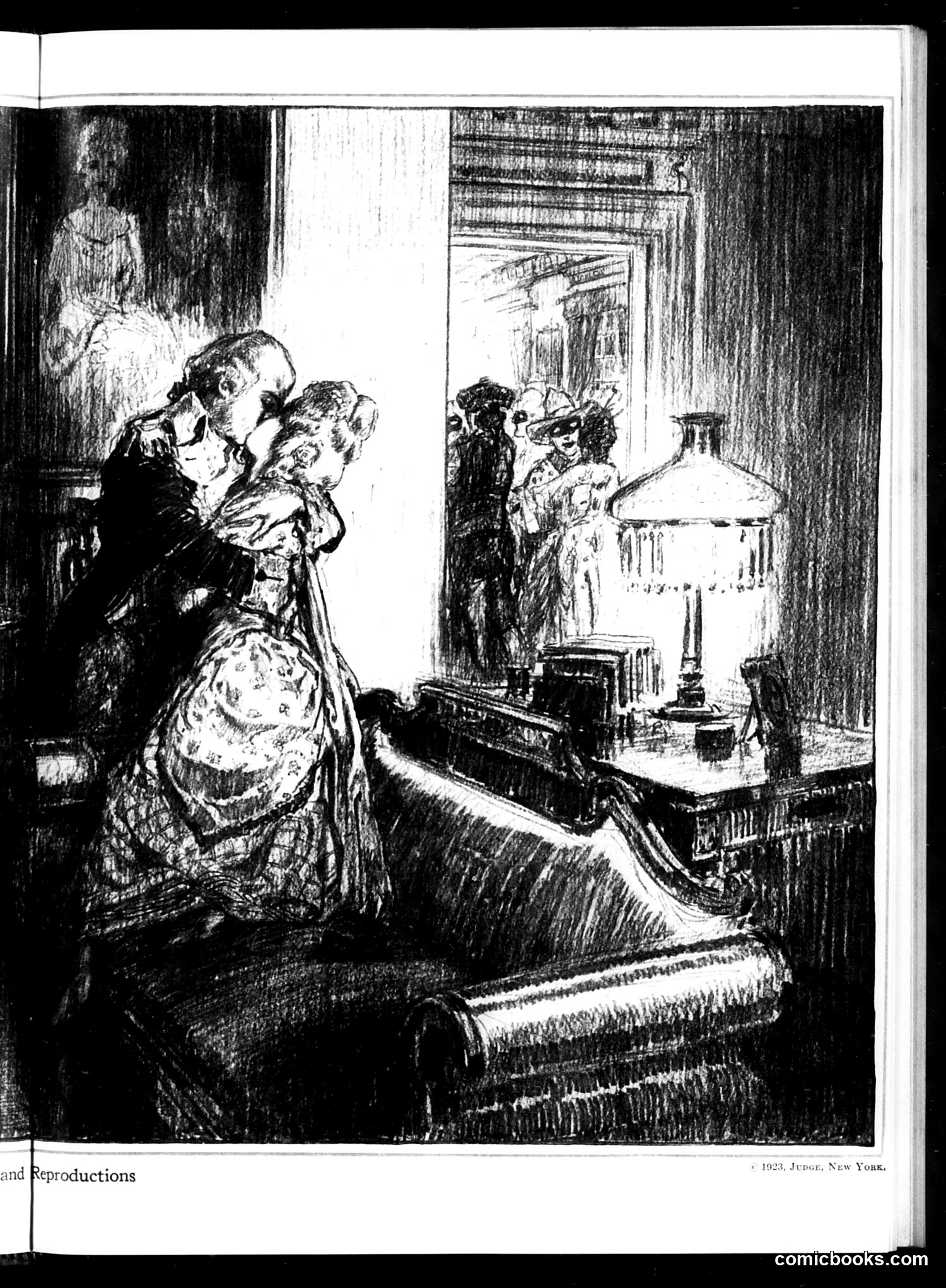
This appears to be a satirical illustration from Judge magazine (1923, New York). The sketch depicts an interior social scene with figures in formal evening wear observing what seems to be a fashionable gathering or salon. The cartoon likely satirizes high society or elite social conventions of the 1920s Jazz Age. The dramatic lighting and theatrical composition suggest commentary on the performative nature of wealthy social circles—people observing one another, concerned with appearances and status. However, without clearer identifying details or accompanying text, I cannot confidently name specific figures being caricatured or pinpoint the exact social/political target of the satire. The style and setting suggest mockery of Gilded Age or post-war upper-class pretension, but the precise historical reference remains unclear.
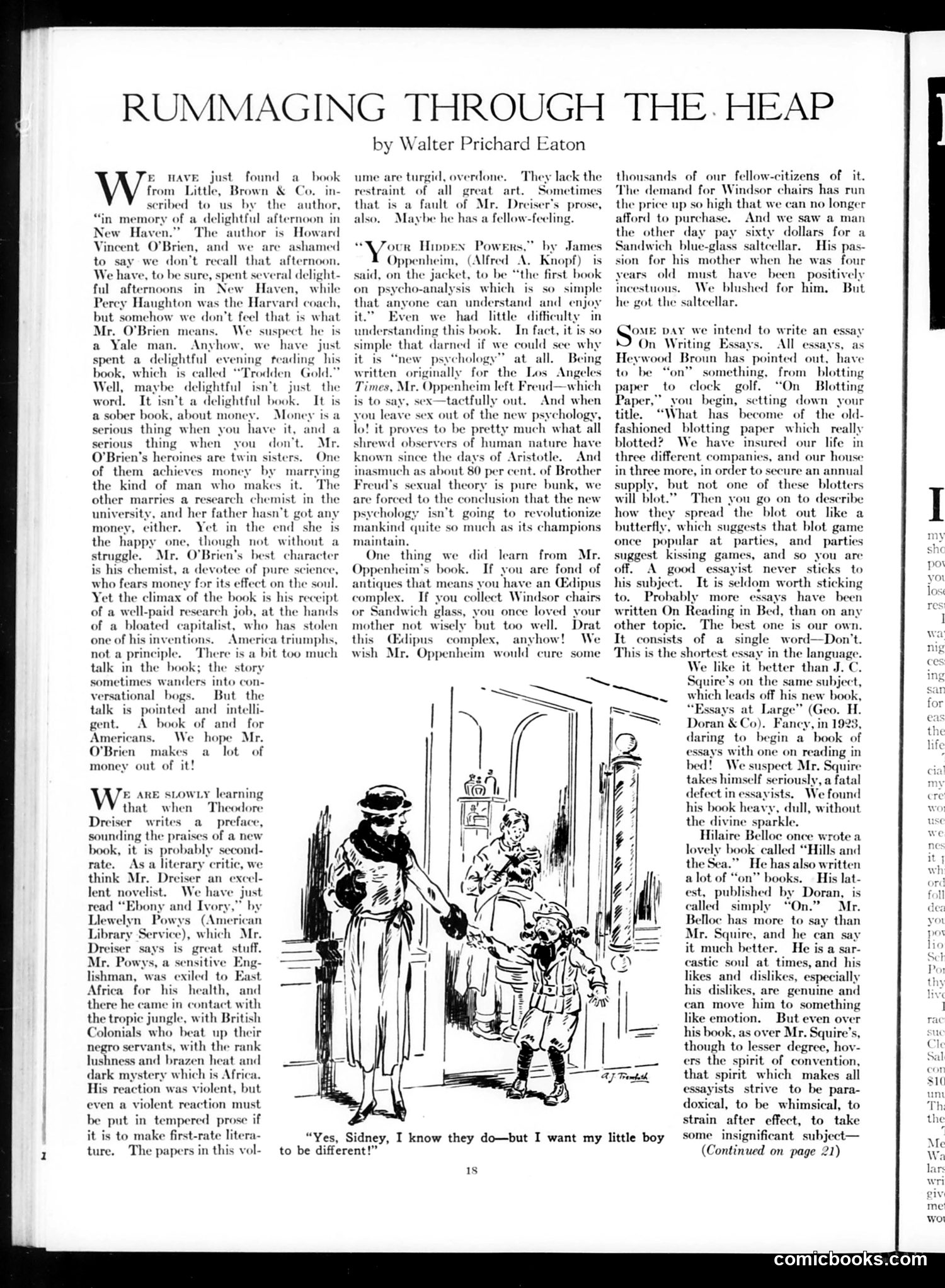
This page from *Judge* magazine contains book reviews by Walter Prichard Eaton, a prominent literary critic of the era. The main illustration depicts a woman (likely representing a wealthy or fashionable figure) with two children, captioned "Yes, Sidney, I know they do—but I want my little boy to be different!" **The satire targets Freudian psychology's popularity.** Eaton mocks James Oppenheim's book on "Your Hidden Powers," which popularized Freud's ideas. He ridicules how Freudian analysis was reducing all human behavior to sexual complexes—particularly the Oedipal complex. His joke: if collecting antiques or Windsor chairs means you loved your mother "too well," then wealthy Americans collecting these fashionable items are unconsciously revealing neuroses. **The cartoon illustrates this absurdity:** a society mother wanting her child to be "different" from other children, likely satirizing how newly psychoanalysis-conscious parents were obsessing over raising psychologically "perfect" children by Freudian principles. Eaton criticizes Dreiser's literary judgment and praises O'Brien's novel about money and ambition as genuinely American.
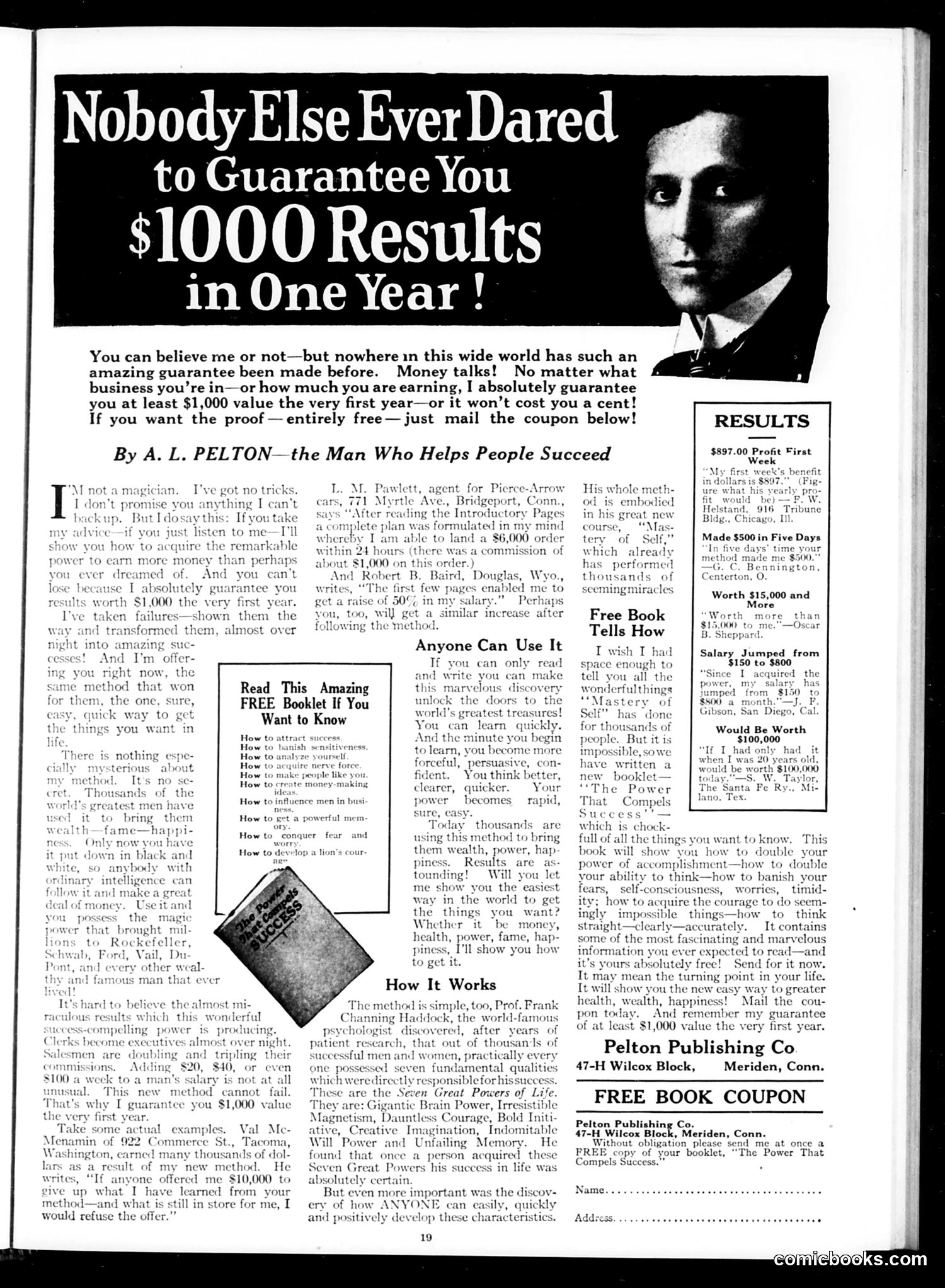
This page is primarily a **direct-mail advertisement**, not satire. It promotes "The Power That Compels Success," a self-help correspondence course by A.L. Pelton, promising $1,000 in results within one year—an audacious guarantee for the era. The ad features testimonials from purported clients (Val Mettmann, Robert B. Douglas, etc.) claiming dramatic financial gains. Pelton claims to teach "Seven Great Powers" including "Gigantic Brain Power" and "Irresistible Magnetism," drawing on pseudo-scientific psychology popular in early 20th-century self-help culture. **What modern readers should recognize:** This represents the origins of modern snake-oil sales tactics—vague promises, celebrity endorsements, guaranteed results, and free trial offers designed to capture contact information. The breathless tone and unverifiable claims would raise immediate red flags today, but such advertisements were common in magazines like *Judge*, reflecting an era of minimal consumer protection and widespread belief in self-improvement through correspondence courses.
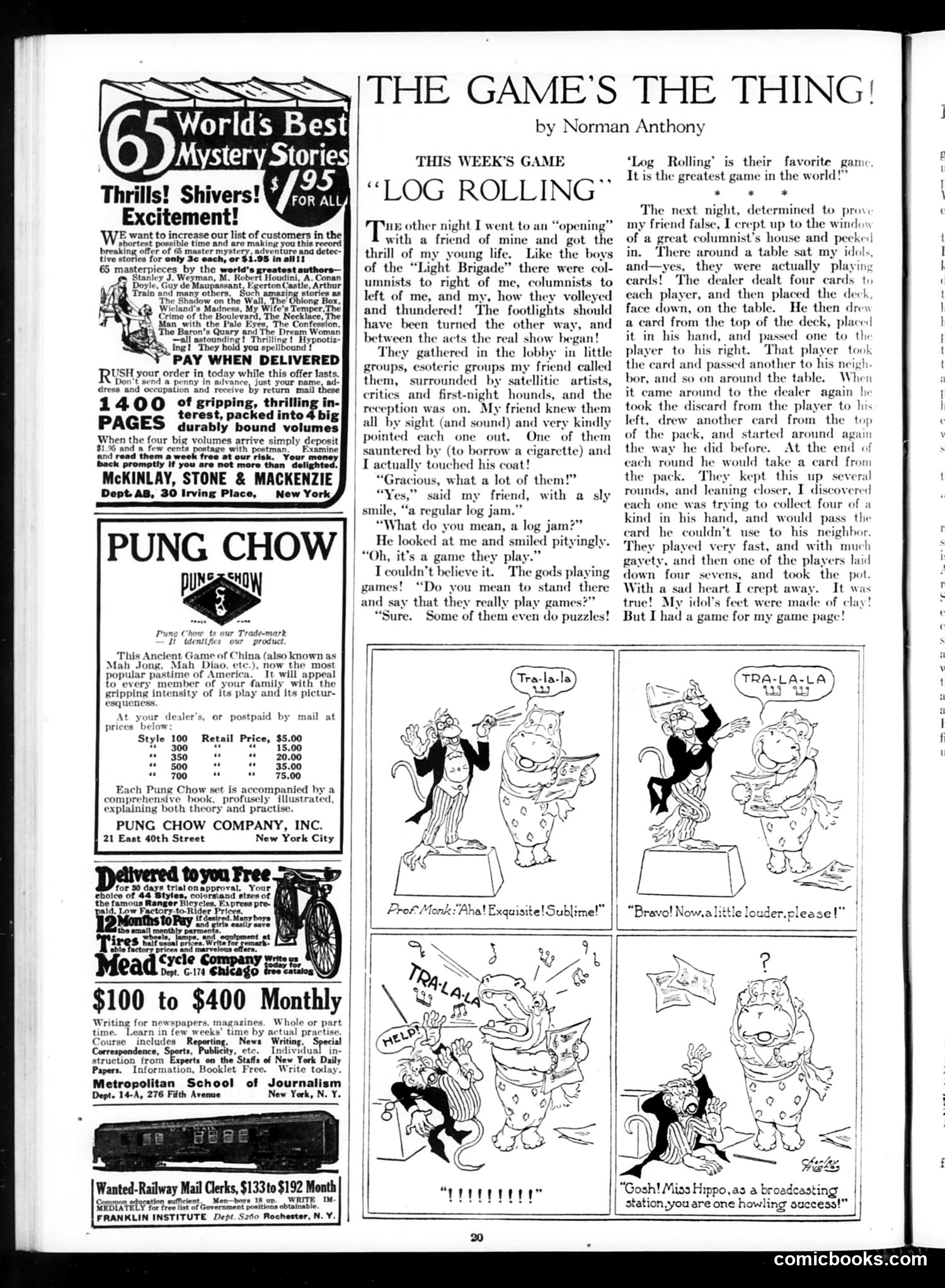
This is a satirical short story with accompanying cartoons by Norman Anthony about "log rolling"—a contemporary practice where newspaper columnists and critics mutually praise each other's work to boost their public profiles. The narrative mocks the incestuous world of theater criticism and high-society cultural gatekeepers. The protagonist observes columnists at a theatrical "opening" and learns from his friend that these critics play a game called "log rolling"—literally a card game, but metaphorically representing their habit of reciprocal backscratching. The cartoons show absurdly exaggerated characters (likely caricatures of actual columnists, though not specifically identified) engaged in frantic activity, shouting "TRA-LA-LA!" and "HELP!" The satire targets the performative, self-congratulatory nature of elite critics who promote each other rather than honestly evaluating art. This reflects early 20th-century skepticism about media collusion and manufactured cultural authority.
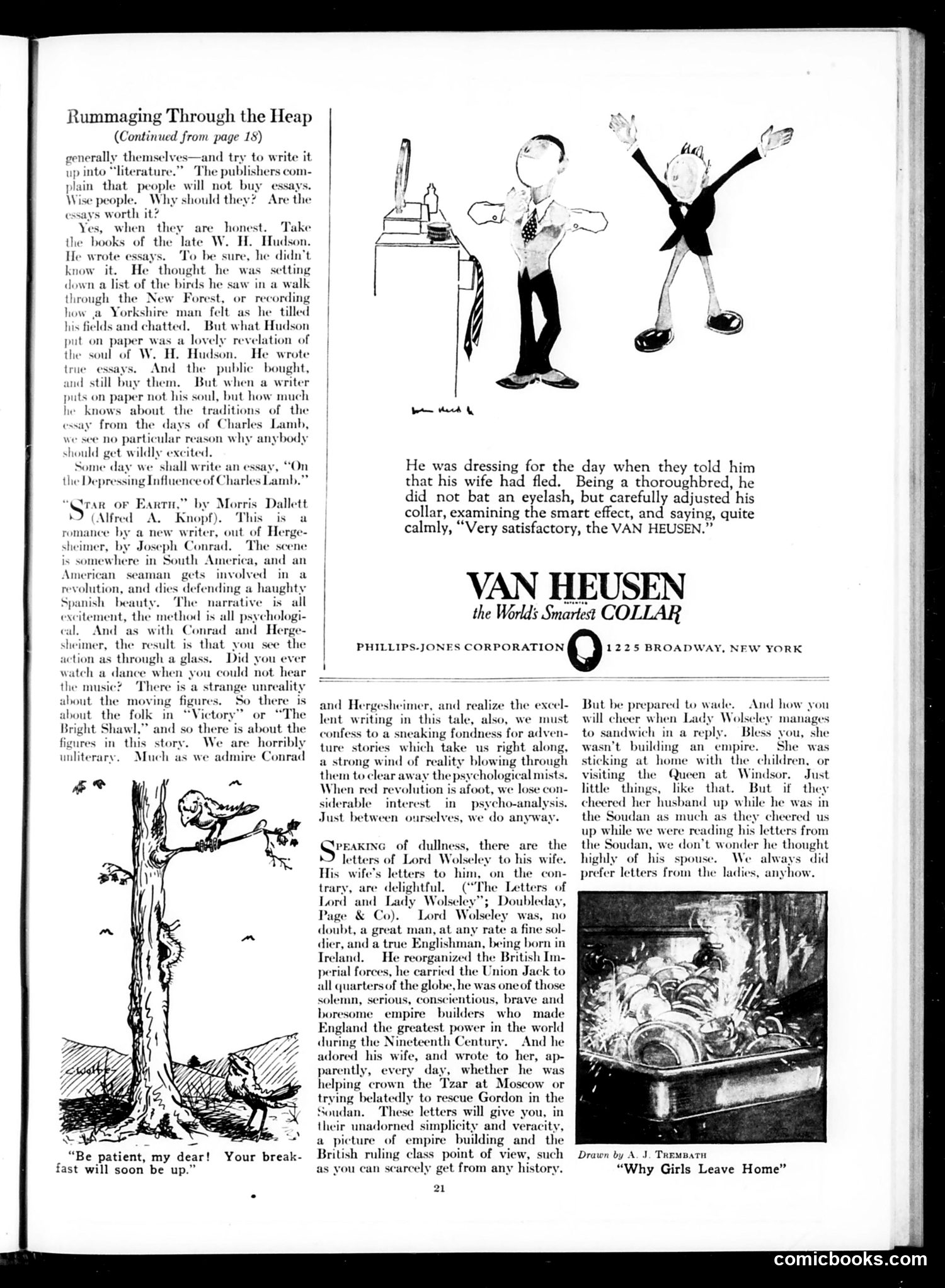
This page combines book reviews with a **Van Heusen collar advertisement**. The main satirical content critiques literary pretension—specifically essays that prioritize intellectual style over genuine human insight, and psychological novels that prioritize technique over engaging storytelling. The **cartoon shows a man learning his wife has fled**, yet he remains composed, adjusting his collar with satisfaction. This is a joke about misplaced priorities: facing marital disaster, he cares only about his appearance. The advertisement uses this domestic crisis to sell collars as a symbol of maintaining composure and propriety—"Very satisfactory, the VAN HEUSEN." The reviews reference **Lord Wolseley**, a real 19th-century British military figure whose published letters are criticized as tedious, while his wife's responses are praised as authentic and engaging. The overall message: genuine human content (honest essays, adventure stories, authentic letters) beats self-conscious artifice—though even then, some people obsess over trivial matters like collar appearance.
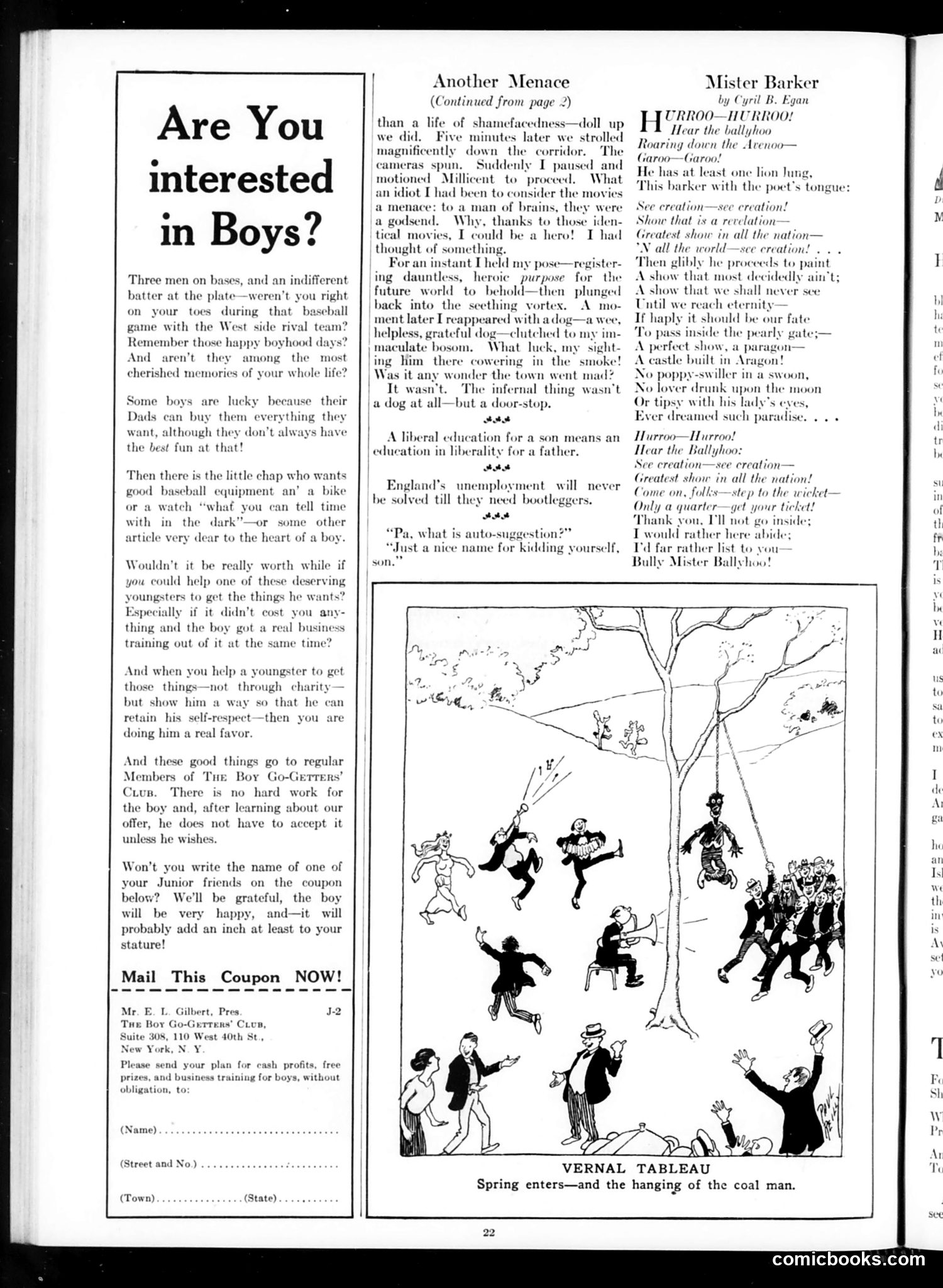
This page contains three distinct pieces: **Left side:** A Boy Scouts recruitment ad ("Boy Go-Getters' Club") encouraging adults to sponsor boys, framing it as character-building and self-improvement rather than charity. **Center:** A satirical short story titled "Another Menace" mocking movie culture. The narrator initially worries films are corrupting, then uses movie-style heroics to impress a girl—only to discover he's been dramatically cradling a *door-stop*, not a dog. The joke: cinema encourages ridiculous posturing and fakery. **Right side:** "Mister Barker" is verse satire about carnival barkers (street pitchmen). The barker's flowery language promises an impossible "greatest show" of pure imagination—spectacle without substance. The poem mocks both the barker's exaggeration and gullible audiences tempted by hype. The closing joke: the narrator declines entry, preferring the barker's *words* to the actual show. **Unifying theme:** All three pieces critique early-20th-century consumer culture, advertising manipulation, and the gap between promise and reality.
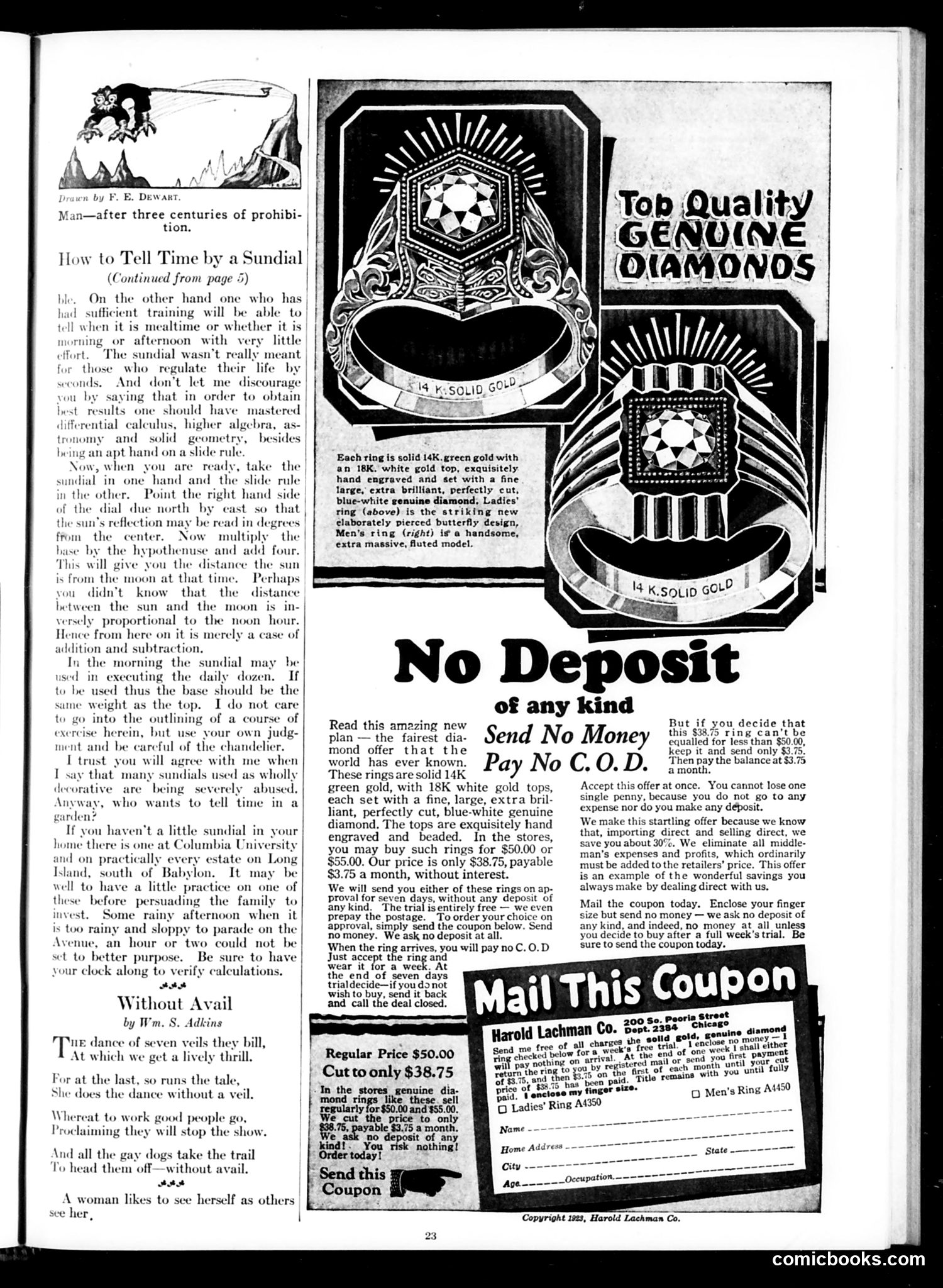
This page contains several distinct elements: **Left Column - Satirical Articles:** - "How to Tell Time by a Sundial" is absurdist humor mocking overly complicated instruction manuals. It jokingly requires mastering calculus, algebra, and astronomy just to use a simple sundial—satirizing unnecessarily complex technical writing. - "Without Avail" by William S. Adkins appears to reference Salome's "Dance of the Seven Veils," a famous theatrical performance. The satire suggests that despite moral outrage and attempts to suppress the show, public fascination ensures its success anyway—commentary on ineffective censorship or moral panic. **Right Side - Diamond Ring Advertisement:** The bulk of the page is a Harold Lachman Co. advertisement for diamond rings at $38.75 (payable in monthly installments). This represents early 20th-century mail-order jewelry marketing, emphasizing "no deposit," "no C.O.D.," and a seven-day trial period—tactics designed to overcome consumer skepticism about purchasing expensive items unseen through the mail. The page mixes satirical editorial content with commercial advertising, typical of Judge's format during this era.
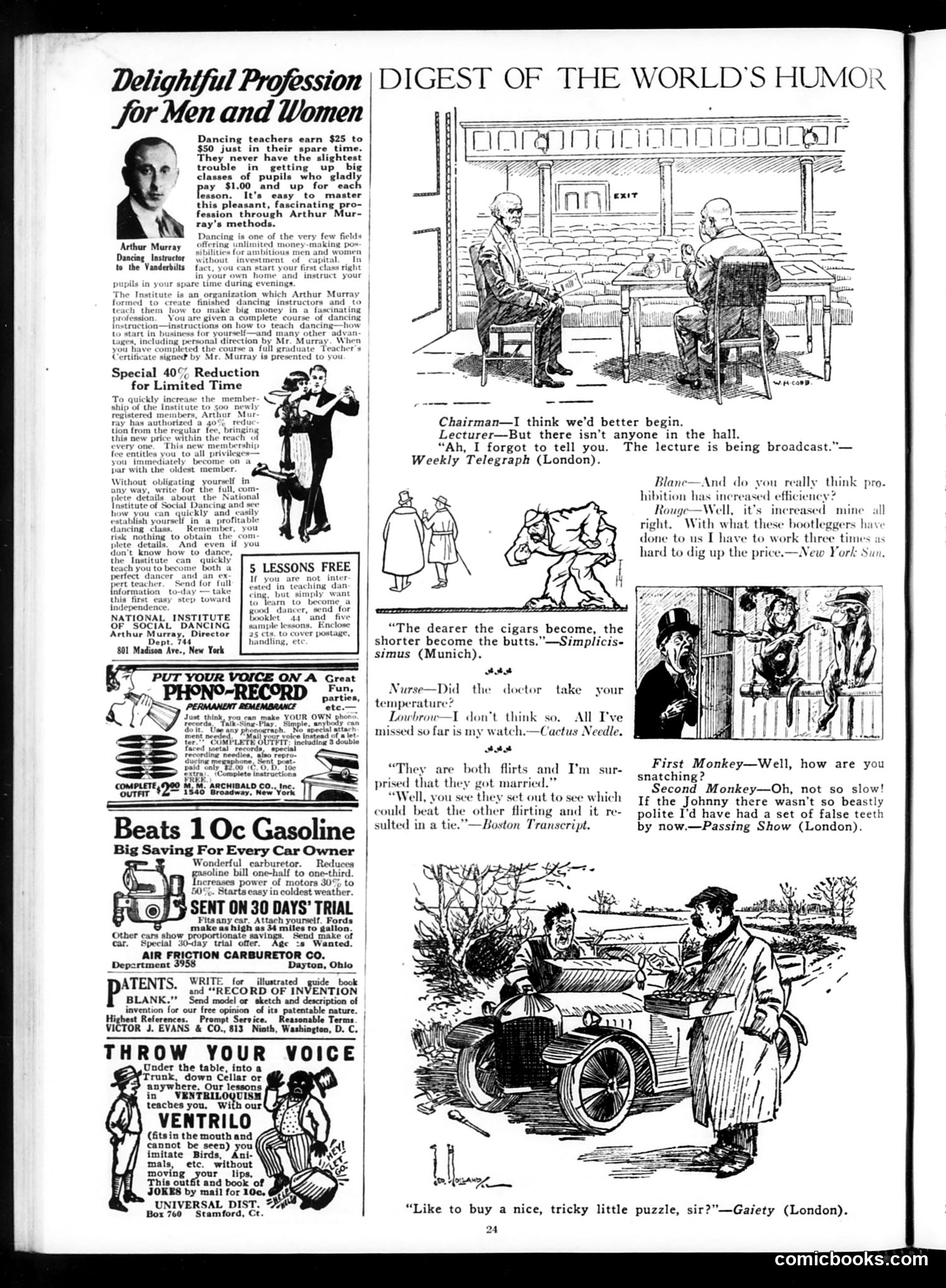
This page contains multiple humorous cartoons and joke reprints from international publications, reflecting early 20th-century satire about contemporary life. **Main cartoon** (top right): Shows a chairman and lecturer discussing a radio broadcast lecture with no in-person audience—satirizing the novelty of radio technology and how broadcasts were replacing live events. **Other jokes** address: - **Prohibition era drinking**: A "lowbrow" character jokes about a doctor visit where he lost his watch to a bootlegger—mocking both Prohibition's unpopularity and organized crime's associated theft - **Gender and flirtation**: Married couples' competitive flirting - **Workplace efficiency**: A character claims Prohibition increased work difficulty because bootleggers' inflated prices require extra labor to afford alcohol - **Monkey cartoon**: References pickpocketing/theft by an overly polite person **Context**: This reflects 1920s-30s American anxieties: radio's disruption of live entertainment, Prohibition's failure and crime wave, gender dynamics, and economic strain. The reprints from British and German sources show international humor exchange.
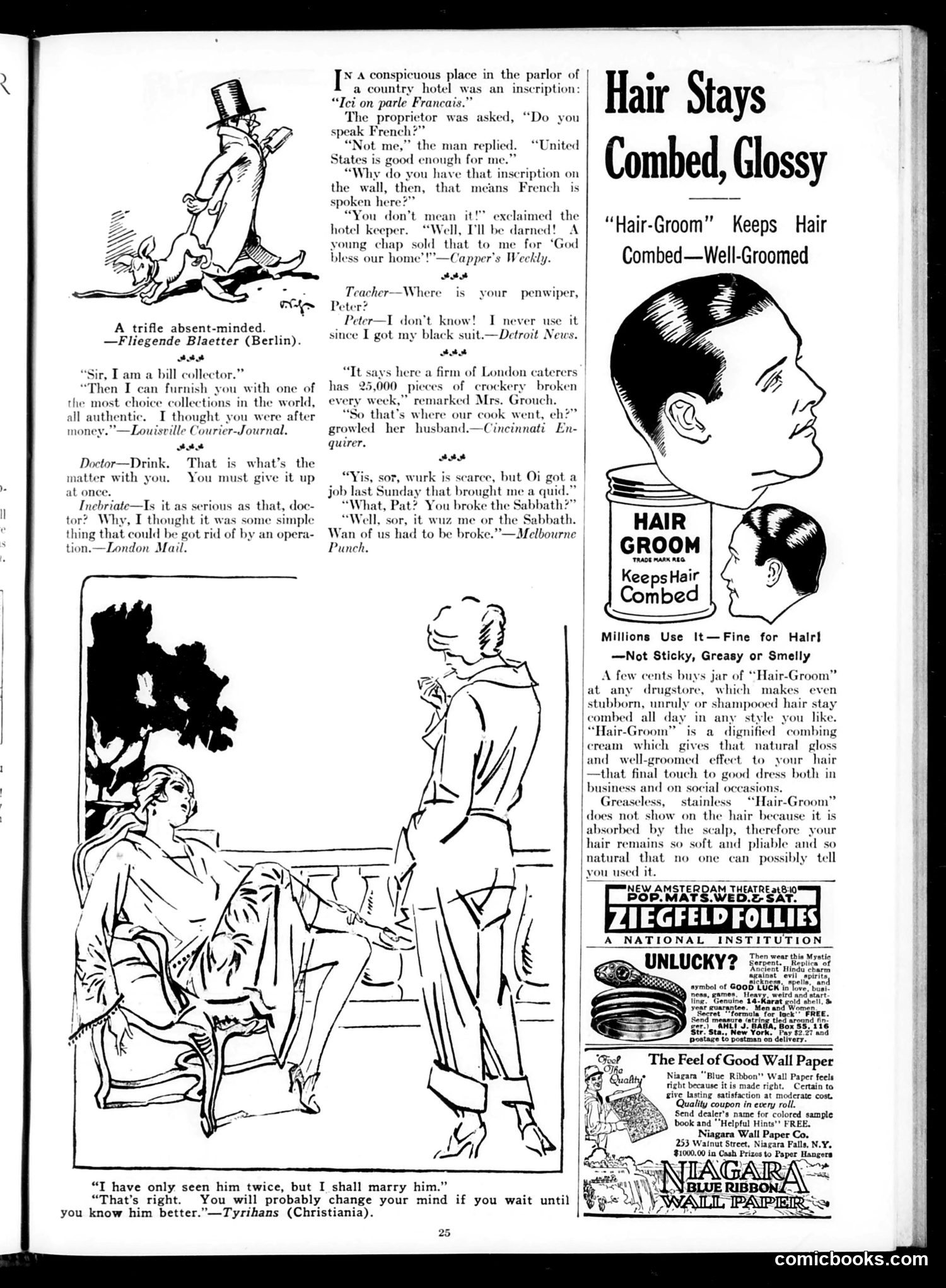
This page contains several short humorous anecdotes and one prominent advertisement. ## The Jokes The satirical pieces mock absent-mindedness and misunderstandings. One involves a hotel proprietor displaying a French sign ("Ici on parle Français") without understanding it—he thought he was buying a "God bless our home" decoration. Another features an Irish laborer forced to choose between keeping the Sabbath or earning money ("one of us had to be broke"). A third jokes about a woman planning to marry a man she's only met twice, with the implication she'll change her mind upon closer acquaintance. These are light social observations typical of *Judge*'s satirical humor—poking fun at cultural confusion, economic desperation, and romantic naiveté. ## The Advertisement The right half features a "Hair-Groom" product advertisement, showing men with slicked-back hair. It emphasizes the product keeps hair "combed, glossy" and "not sticky, greasy or smelly"—standard early 20th-century grooming product marketing targeting male consumers concerned with appearance.
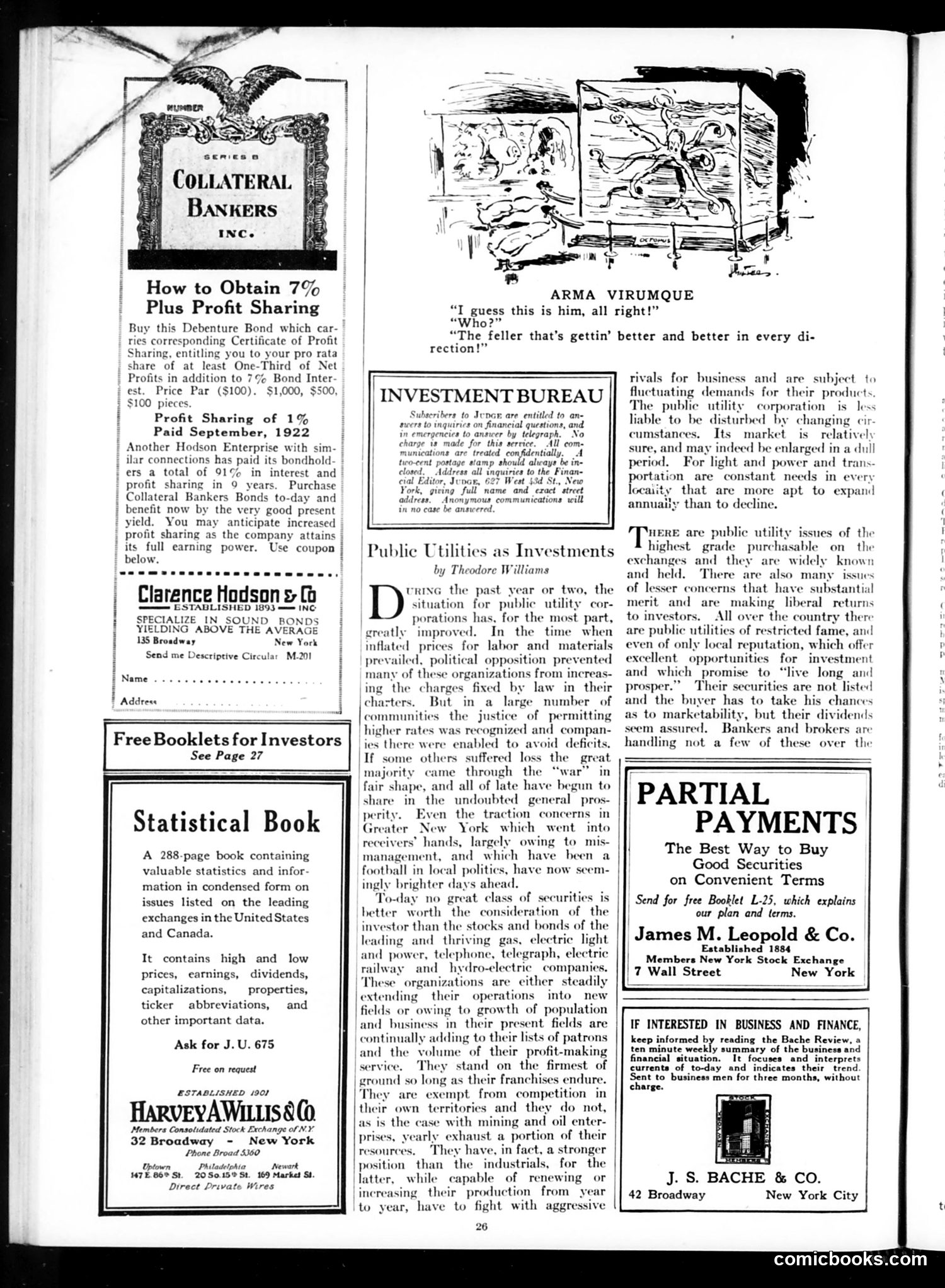
This small cartoon appears to satirize financial fraud or deception. Two figures discuss someone, with one asking "Who?" and the other responding "I guess this is him, all right!" The second speaker then praises "the feller that's gettin' better and better in every direction!" The Latin title *"Arma Virumque"* (opening words of Virgil's *Aeneid*) likely provides ironic contrast to the mundane, colloquial speech below. **The satire**: The joke seems to target financial promoters or fraudsters whose schemes keep "improving" while their actual legitimacy remains questionable. The "all right?" suggests uncertainty about identity itself—fitting for someone engaged in deceptive practices. Given the page's surrounding investment advertisements and financial content, this likely mocks the period's proliferation of questionable investment schemes and promoters operating in 1920s financial markets. The cartoon's placement among legitimate-looking financial ads amplifies the irony.
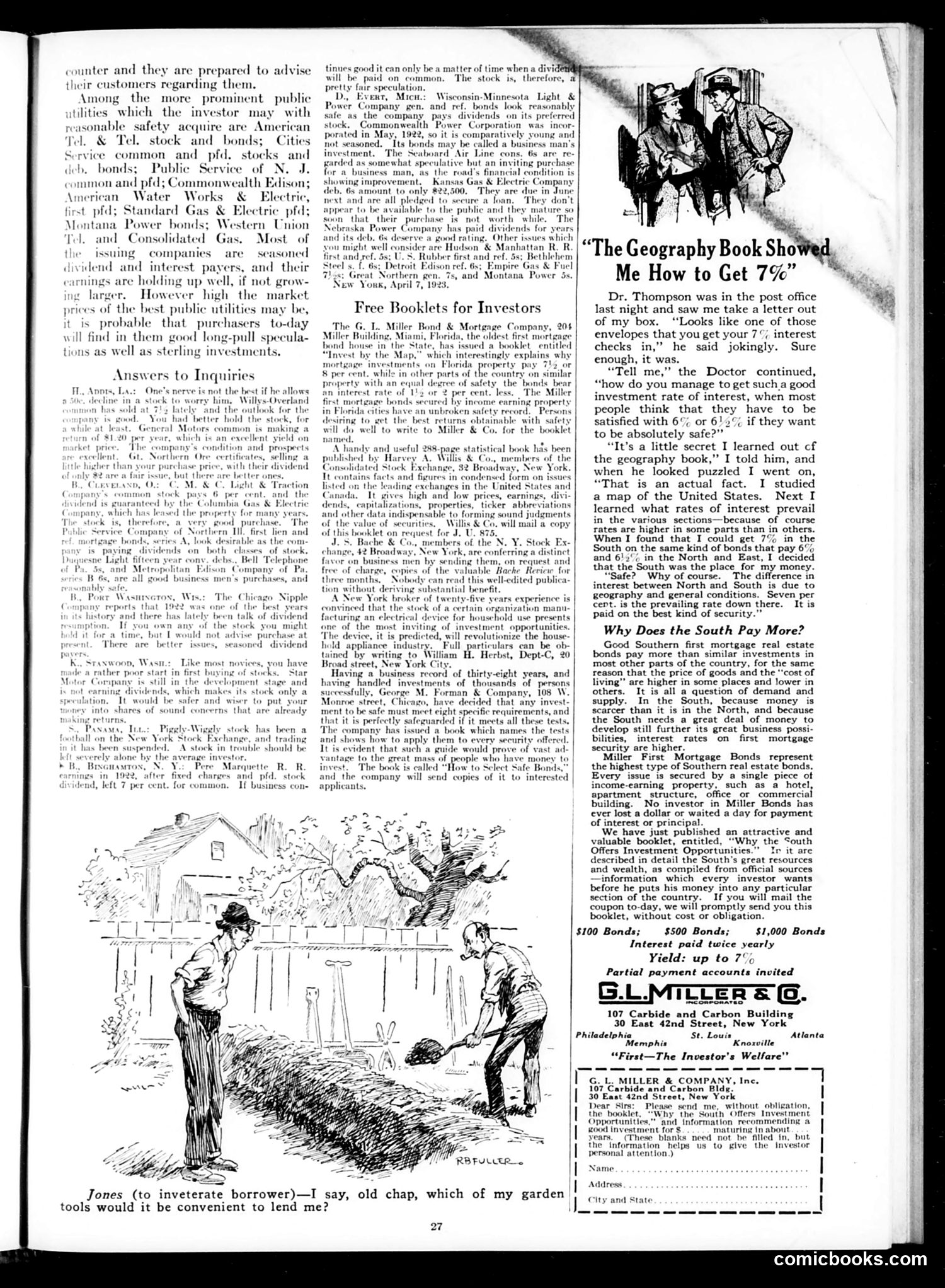
This page is primarily **financial/investment advertising and advice**, not political satire. The main cartoon shows two men discussing lending garden tools—a visual pun on "investerate borrower" (someone habitually in debt). The joke plays on the double meaning: one man asks which tools he'd lend, implying the borrower takes everything. The page's content focuses on **public utility stocks and bonds** as safe investments during what appears to be the 1920s economic boom. Text discusses American Tel. & Tel., Cities Service, and other established companies as reliable long-term investments. Multiple "Free Booklets for Investors" are advertised by financial firms like G.L. Miller & Co., promoting Florida real estate mortgages and stock exchange guides. The satirical element is mild—the cartoonist mocks chronic borrowers through the garden-tool metaphor. The page reflects an era of widespread investment enthusiasm among middle-class Americans, before the 1929 crash.
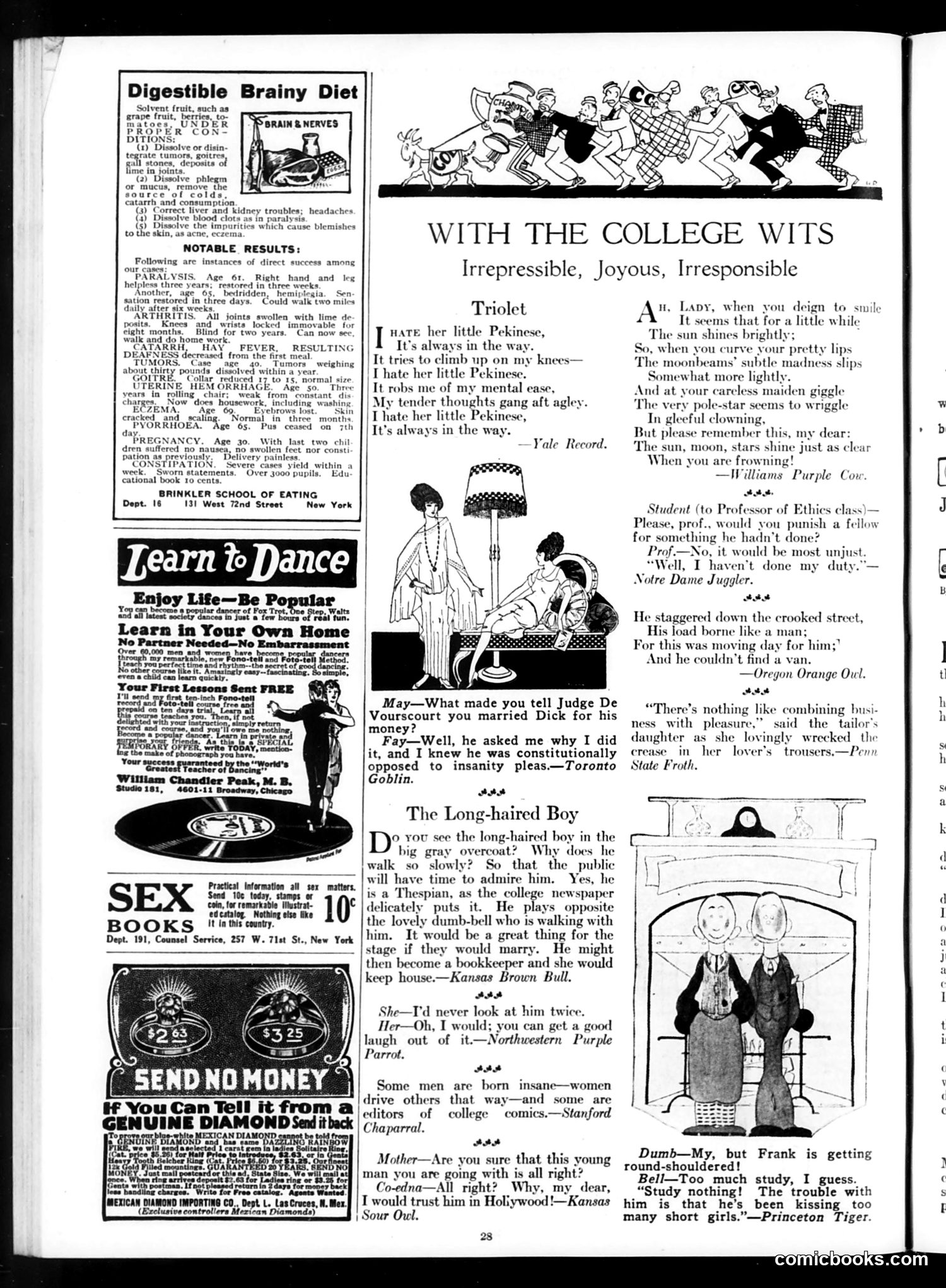
This page collects college humor and light verse typical of Judge's "College Wits" section. The content consists of brief jokes and poems mocking campus life and romantic pretension. **Key pieces:** - **"Triolet"** satirizes a woman obsessed with her lapdog, which constantly interferes with her romantic life - **"The Long-haired Boy"** mocks theatrical students who adopt affected mannerisms and walk slowly to attract attention - Various **quips** ridicule college romance, marriage for money, and academic pretense (a professor questioned about punishing a student for incomplete homework; a co-ed claiming to trust a boyfriend in Hollywood) The humor relies on gentle mockery of college stereotypes—vain drama students, materialistic women, and self-important undergraduates. The advertisements surrounding the content (dance lessons, "sex books," diamond rings) suggest the magazine's working- and middle-class readership. Nothing here references specific political events; it's purely social satire aimed at amusing readers about recognizable campus types.
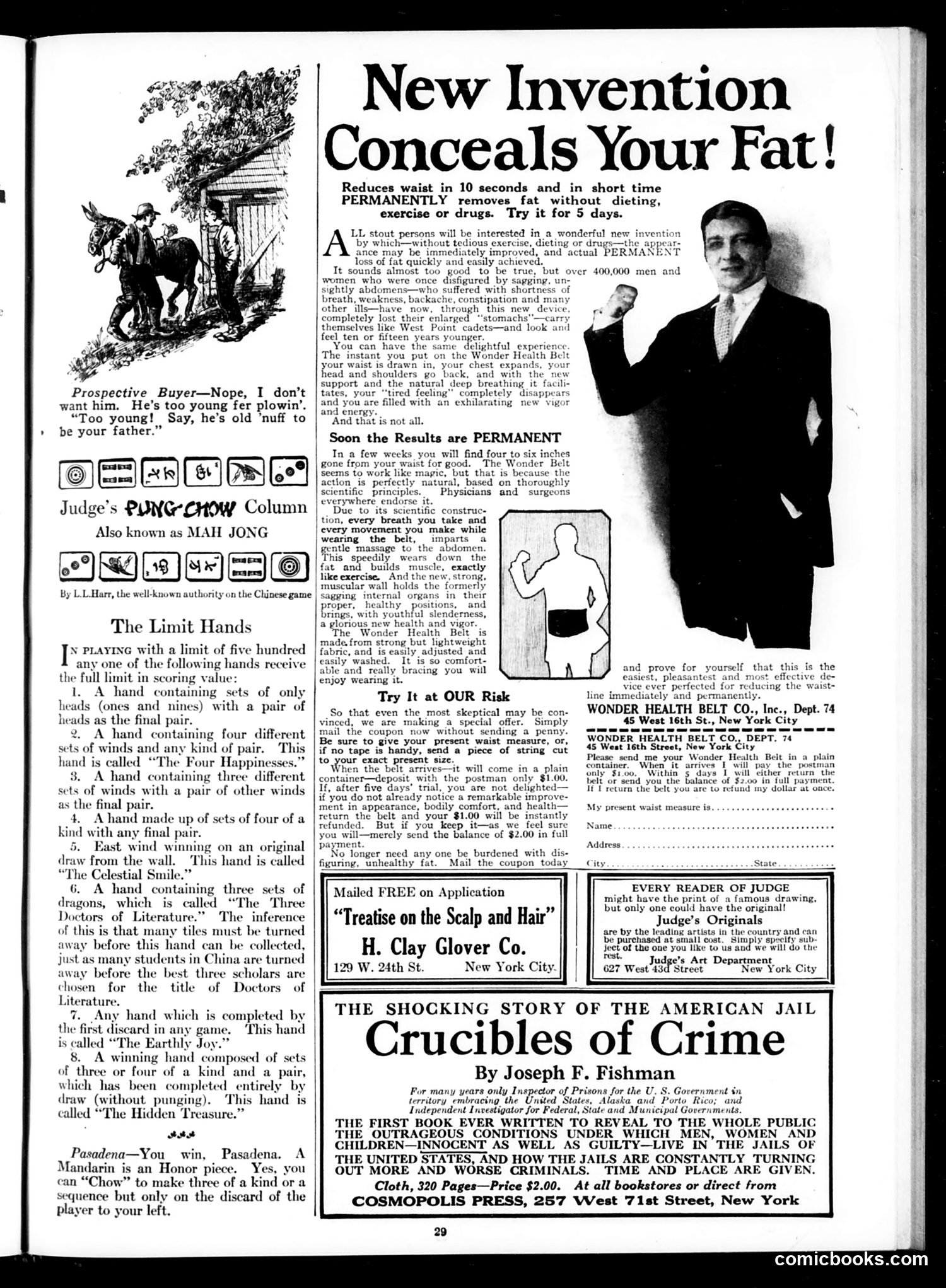
This page is primarily **advertising**, not political satire. The dominant content is a full-page advertisement for the "Wonder Health Belt"—a corset-like device claiming to permanently reduce waist size in weeks without diet or exercise. The small cartoon at top left appears to be a **rural/farming joke**: a prospective buyer rejects a young man as too young for plowing, but is told the man is old enough to be his father—likely mocking either the buyer's poor judgment or making a crude joke about the man's appearance. The remaining content includes a **Mah Jong instruction column** (a Chinese tile game popular in 1920s America) with technical rules about winning hands. The page's real interest today is **historical**: it reveals what early 20th-century Americans found credible—that a belt could permanently reduce fat through "massage" and "scientific principles." This represents pre-modern understanding of metabolism and reflects the era's desperation for quick-fix weight solutions, predating modern diet culture but showing its roots. The ad's confidence and pseudo-scientific language are now clearly dubious.
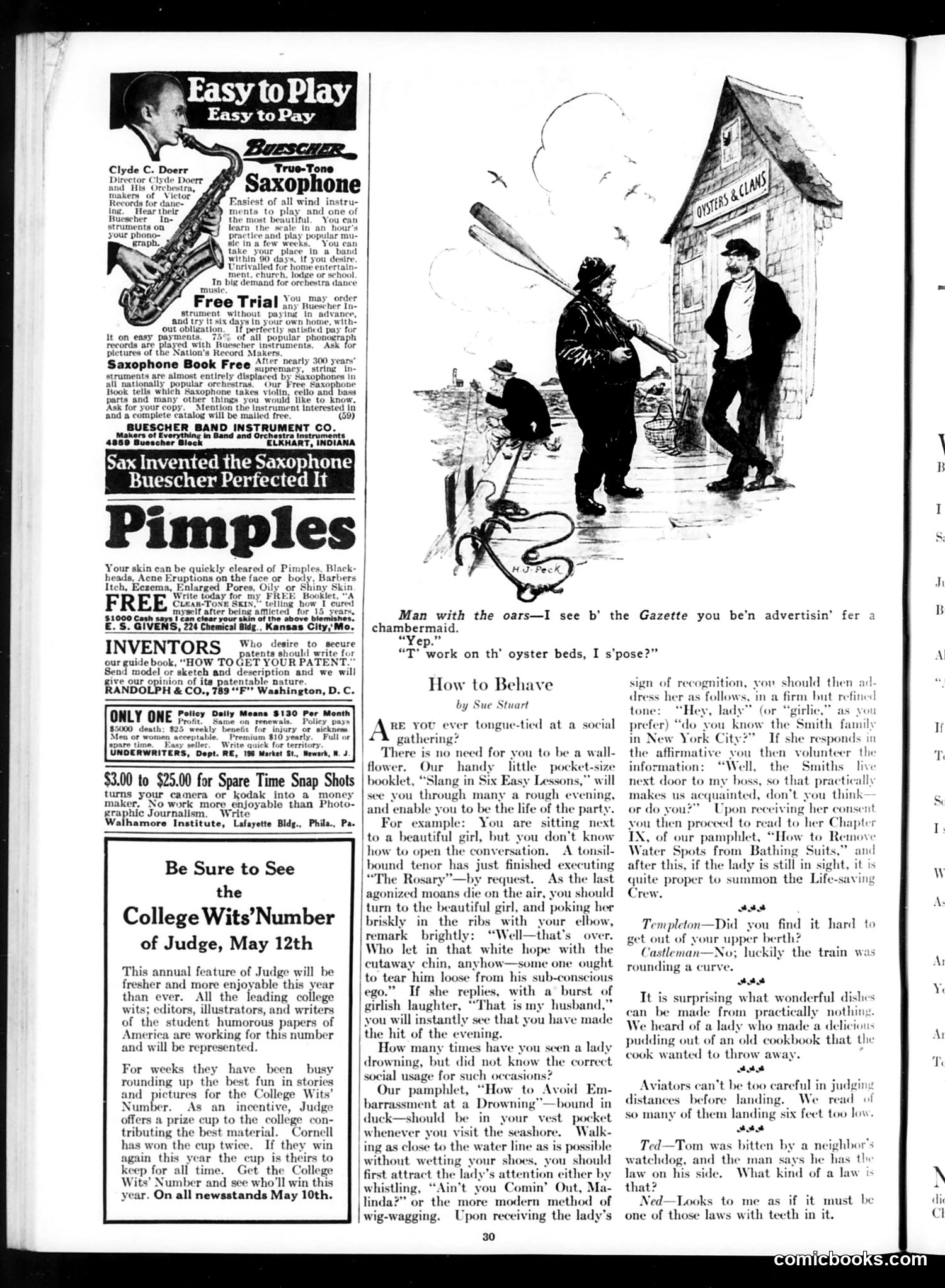
This page is primarily **advertisements and advice columns** rather than political satire. The main cartoon depicts a working-class exchange: a man with oars meets a chambermaid at what appears to be an oyster operation, with the caption showing him asking if she's advertising for oyster bed work. The humor is gentle and class-based—playing on miscommunication between laborers. The bulk of the page contains ads (saxophones, acne remedies, patent advice) typical of 1910s-20s Judge magazines, plus a faux-earnest advice column titled "How to Behave" by Sue Stuart. This column satirizes social-climbing etiquette by offering absurdly bad advice for social situations—like elbowing a beautiful woman in the ribs to start conversation, or attracting a drowning woman's attention by whistling. The satire targets both pretentious etiquette guides and social awkwardness among aspirational Americans.
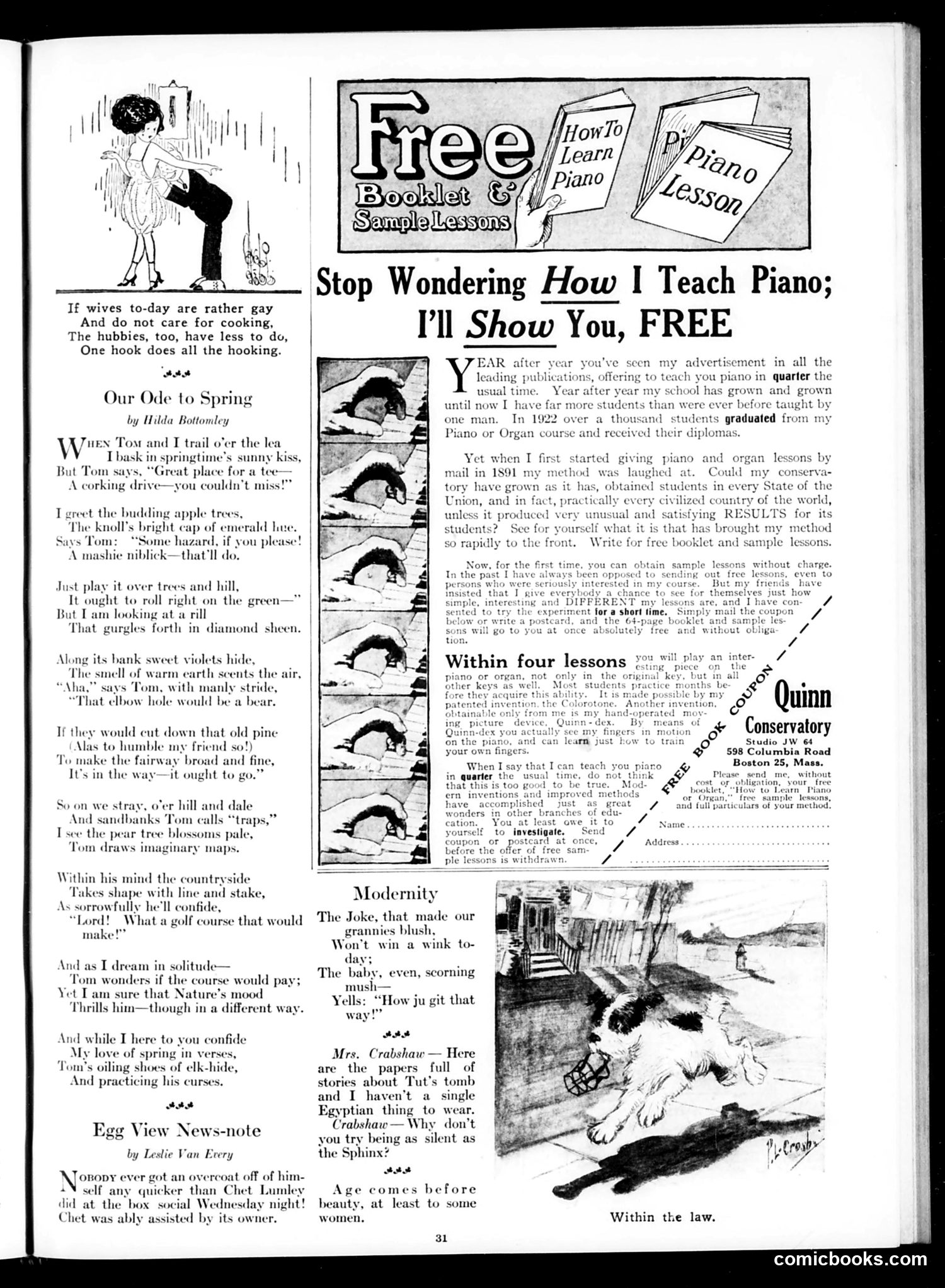
This page contains **mostly advertising and light humor pieces**, not political satire. The main content is a **piano lesson advertisement** from Quinn Conservatory promising to teach piano in a quarter of the usual time—a classic early-20th-century mail-order education pitch. The poetry and humor sections satirize **gender roles and modern marriage**: - "Our Ode to Spring" contrasts a woman appreciating nature's beauty with her husband Tom obsessively thinking about golf—mocking how men's interests override aesthetic appreciation - The opening couplet jokes that wives neglect cooking and men neglect fishing, so "one hook does all the hooking" - "Modernity" mocks how modern young women are bold and unshockable, unlike prudish grandmothers, and makes a wink at Egyptian fashion following Tutankhamun's tomb discovery (1922) The small cartoon about a wife and fishing hook and a dog/police scene have unclear context without fuller captions. This reflects **1920s social commentary on changing gender dynamics** rather than political content.
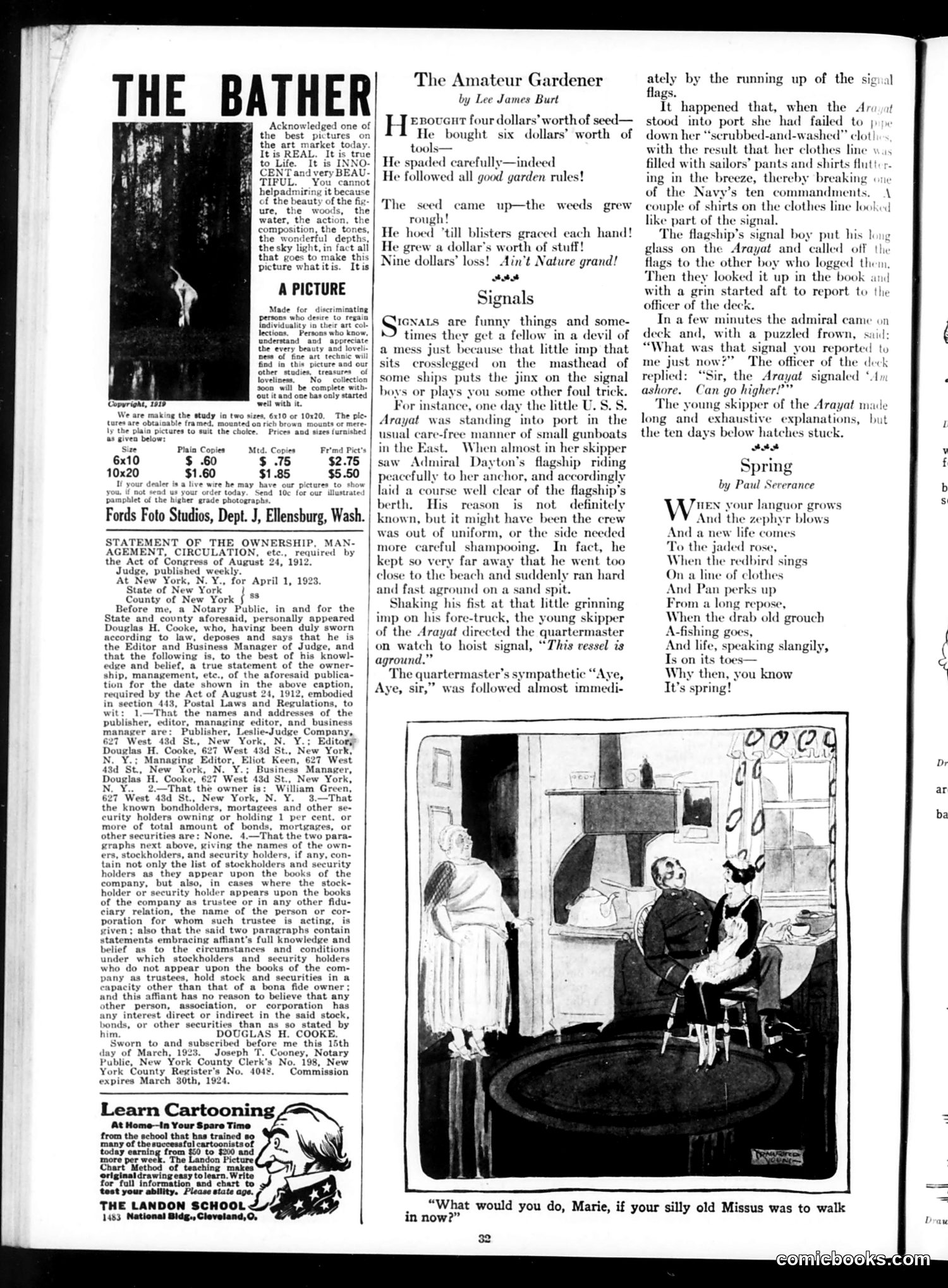
This page is primarily an **advertisement** for an art print titled "The Bather," presented as a high-quality reproduction available from Ford's Foto Studios in Ellensburg, Washington. The text emphasizes the print's artistic merit through flowery language—calling it "INNOCENT and BEAUTIFUL" with excellent "composition" and "sky light"—seemingly aimed at cultivating buyers who wanted to display tasteful, refined artwork in their homes. The unattributed cartoon illustration at bottom shows a domestic interior scene with the caption "What would you do, Marie, if your silly old Missus was to walk in now?" The humor appears to rely on a lower-class or servant character asking about being caught in an awkward situation with an authority figure ("Missus"), typical of class-based humor common in 1920s publications. The page also includes routine publishing ownership statements required by law, and an advertisement for cartooning correspondence courses.
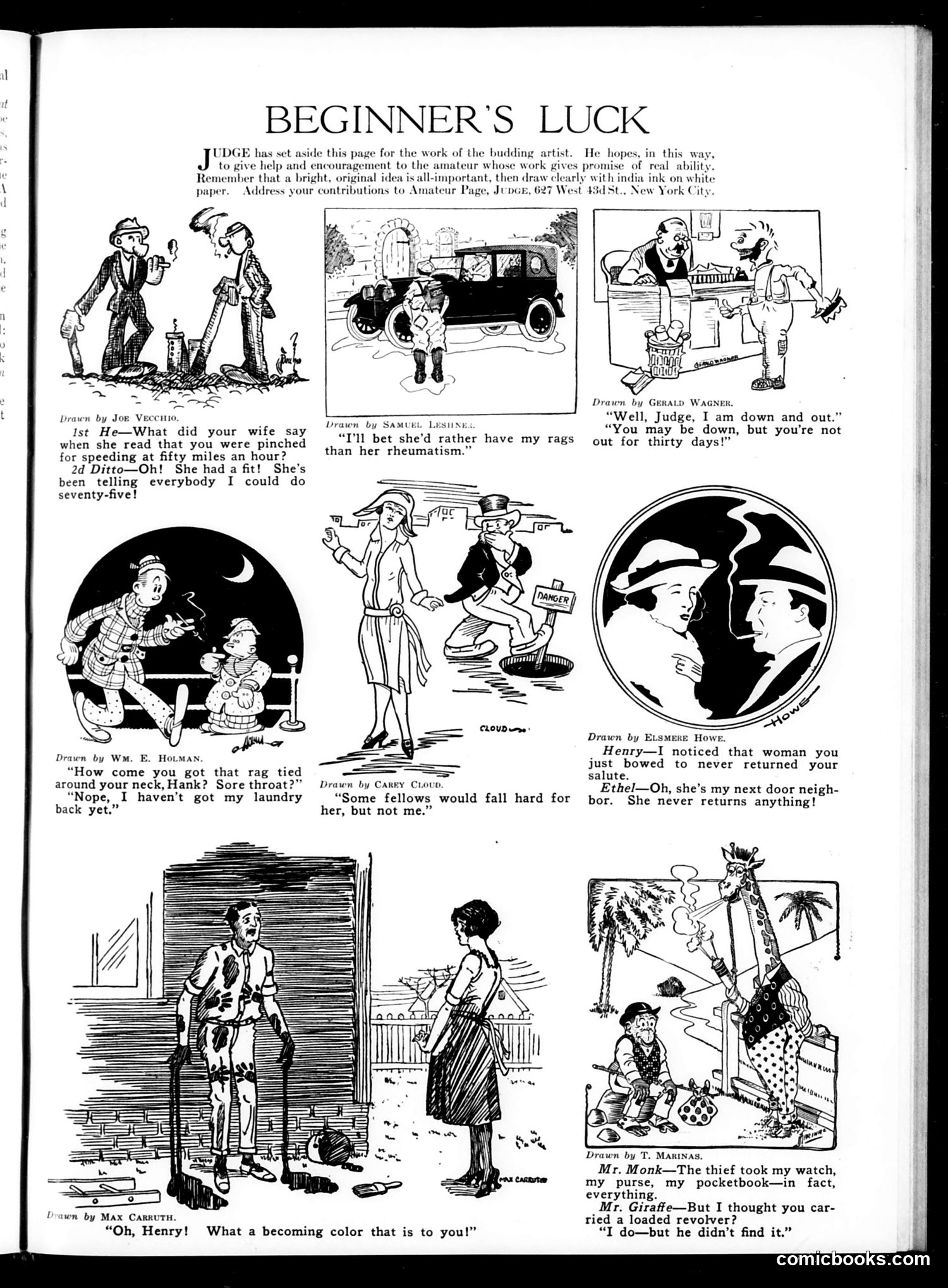
This is a submissions page showcasing amateur cartoonists' work. The header explains Judge magazine is publishing drawings from aspiring artists to encourage talent. The six comic strips feature everyday humor typical of early 20th-century American life: - **Speeding husband**: Wife brags he can do 75 mph (inverting his traffic ticket as boasting material) - **Laundry excuse**: Man ties rag around neck, claiming lost laundry rather than admitting sore throat - **Beggars/rags**: Homeless man prefers rags to woman's rheumatism - **Unfaithful woman**: Man claims indifference to attractive woman - **Judge's pun**: Prisoner told he's "down but not out for thirty days" (jail sentence wordplay) - **Neighborly theft**: Woman never returns anything—including social courtesies - **Revolver irony**: Robbery victim carried loaded gun but thief didn't find it The humor relies on domestic situations, social embarrassment, and verbal punchlines rather than political content.
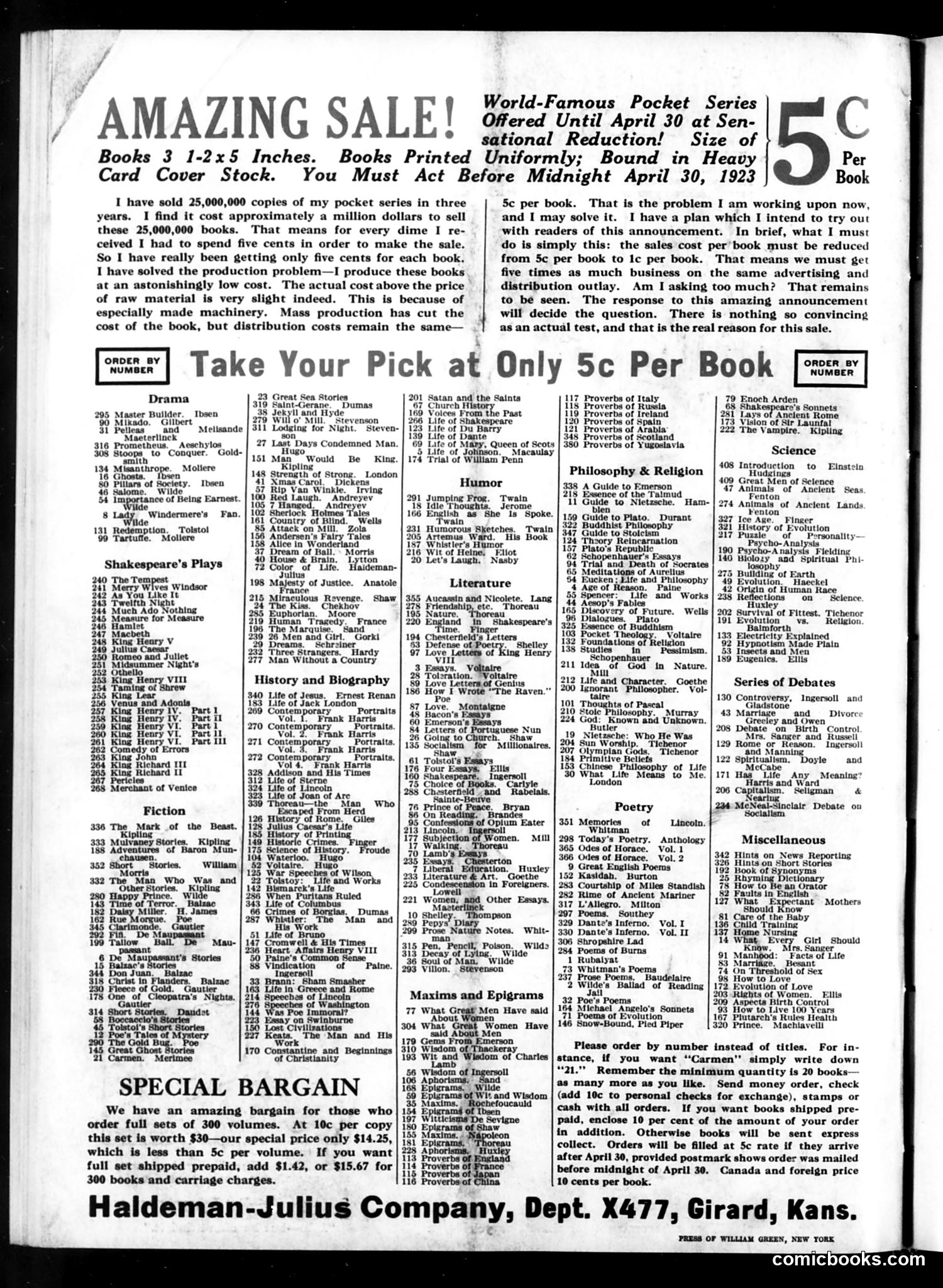
This page is **primarily a mail-order book catalog advertisement**, not a political cartoon. It announces a "Amazing Sale" by the Haldeman-Julius Company offering their "World-Famous Pocket Series" at 5 cents per book through April 30, 1923. The advertisement includes an extended pitch from the publisher explaining his business model: he's sold 25 million copies but spends five cents in distribution costs for every dime in sales. He claims to have solved production costs through mass manufacturing and now offers this sale to test whether reducing the price from 5¢ to 1¢ per book could increase volume enough to offset lower margins. The bulk of the page lists available titles across multiple categories: Shakespeare's plays, drama, fiction, history/biography, humor, literature, philosophy, science, poetry, and miscellaneous works—a typical early 20th-century popular education catalog. There is **no satirical cartoon or political content** visible on this page.