
Judge, 1923-04-14 · page 17 of 36
Judge — April 14, 1923 — page 17: what you’re looking at
What you’re looking at
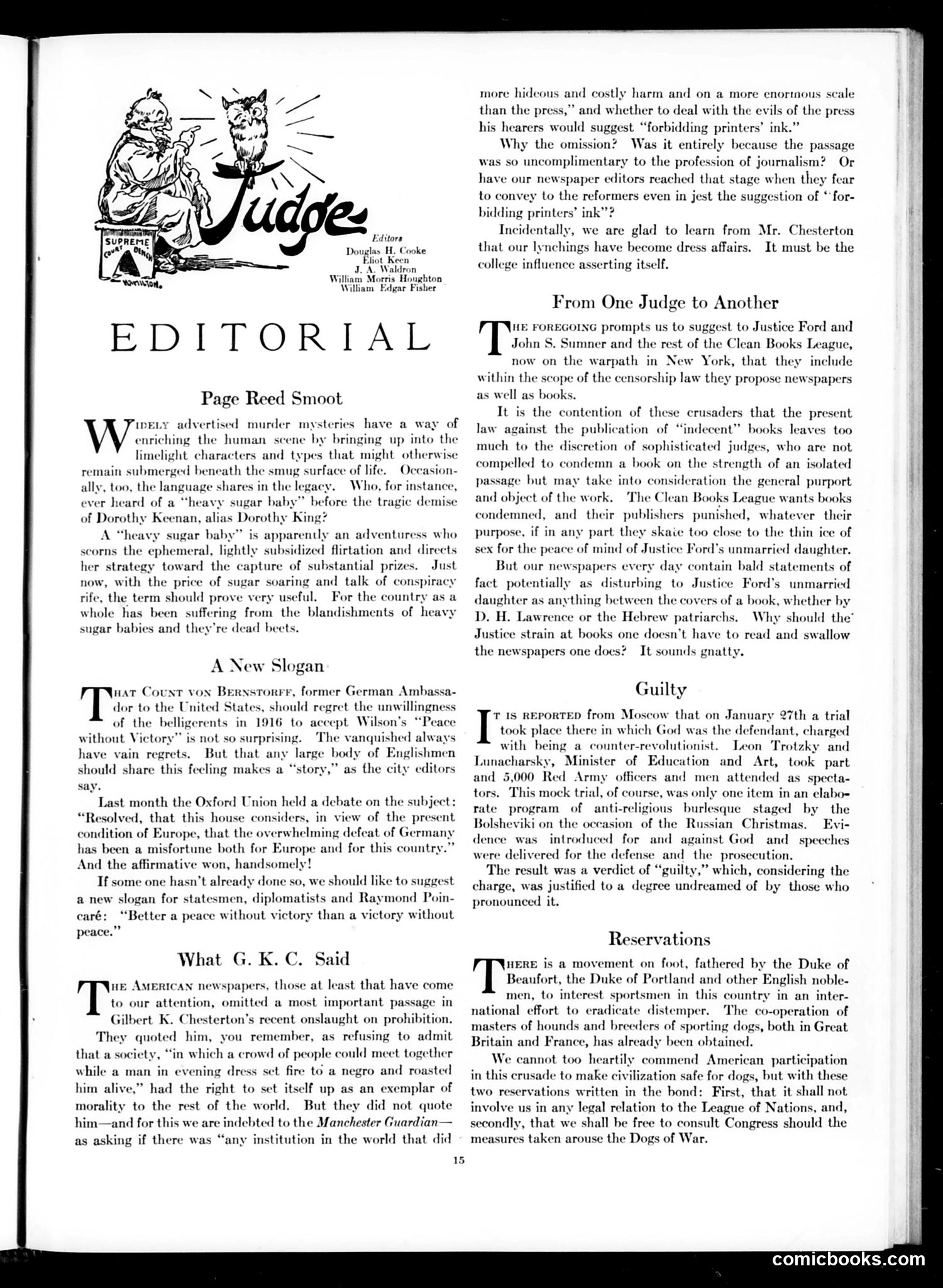
The cartoon shows a "Judge" mascot (the publication's satirical icon) as the focal point of this editorial page from early 20th-century America. **Key Editorial Topics:** 1. **"Page Reed Smoot"** — Satirizes Senator Reed Smoot (visible reference) regarding sensationalized murder trials, particularly the "Dorothy King" case, which popularized the term "heavy sugar baby" (a woman seeking wealthy patrons). Judge mocks how such trials enrich language while society suffers from actual economic problems like rising sugar prices. 2. **"What G.K.C. Said"** — Criticizes American newspapers for omitting G.K. Chesterton's pointed criticism of the press itself while quoting his attacks on prohibition. Judge notes the hypocrisy: newspapers eagerly quoted his moral criticisms but suppressed his jabs at journalism. 3. **"From One Judge to Another"** — Argues that if censorship boards like the Clean Books League regulate "indecent" publications, they should equally censor newspapers, which arguably cause greater harm than books. The page satirizes press hypocrisy and selective reporting while advocating consistent standards for public accountability.
📄 Transcribed text from this page (OCR, searchable)
Machine-transcribed from the original scan — historical spelling and the odd misread are preserved.
Editors H, Cooke : een J. A. Waldron William Morris Houghton William Edgar Fisher EDITORIAL Page Reed Smoot IDELY advertised murder mysteries have a way of nriching the human scene by bringing up into the limelight characters and types that might otherwise remain submerged beneath the smug surface of life. Occasion- ally, too, the language shares in the legacy. Who, for instance, ever heard of a “heavy sugar baby” before the tragic demise of Dorothy Keenan, alias Dorothy King? A “heavy sugar baby” is apparendy an adventuress who scorns the ephemeral, lightly subsidized flirtation and directs her strategy toward the capture of substantial prizes. Just now, with the price of sugar soaring and talk of conspiracy rife, the term should prove very useful. For the country as a whole has been suffering from the blandishments of heavy sugar babies and they're dead beets. A New Slogan dor to the United States, should regret the unwillingness of the belligerents in 1916 to accept Wilson’s ‘Peace The vanquished always arge body of Englishmen tory,” as the city editors ‘ics Count von Bernstorrr, former German Ambassa- without Victory” is not so surprising. have vain regrets. But that any should share this feeling makes sa, Last month the Oxford Union held a debate on the subject: “Resolved, that this house considers, in view of the present condition of Europe, that the overwhelming defeat of Germany has been a misfortune both for Europe and for this country.” And the affirmative won, handsomely! Tf some one hasn’t already done so, we should like to suggest a new slogan for statesmen, diplomatists and Raymond Poin- “Better a peace without victory than a victory without What G. K. C. Said HE AMERICAN newspapers, those at least that have come to our attention, omitted a most important passage in Gilbert K. Chesterton’s recent onslaught on prohibition. They quoted him, you remember, as refusing to admit that a society, “in which a crowd of people could meet together while a man in evening dress set fire to a negro and roasted him alive,” had the right to set itself up as an exemplar of morality to the rest of the world. But they did not quote him—and for this we are indebted to the Manchester Guardian— as asking if there was “any institution in the world that did more hideous and costly harm and on a more enortnous scale than the press,” and whether to deal with the evils of the press his hearers would suggest “forbidding printers’ ink.” Why the omission? Was it entirely because the passage was so uncomplimentary to the profession of journalism? Or have our newspaper editors reached that stage when they fear to convey to the reformers even in jest the suggestion of “ for- bidding printers’ ink”? Incidentally, we are glad to learn from Mr. Chesterton that our lynchings have become dress affairs. It must be the college influence asserting itself. From One Judge to Another HE FOREGOING prompts us to suggest to Justice Ford and John S. Sumner and the rest of the Clean Books League, now on the warpath in New York, that they include within the scope of the censorship law they propose newspapers as well as books. It is the contention of these law against the publication of much to the discretion of sophisticated judges, who are not crusaders that the present indecent” books leaves too compelled to condemn a book on the strength of an isolated passage but may take into consideration the general purport and object of the work. The Clean Books League wants books condemned, and their publishers punished, whatever their purpose, if in any part they skaic too close to the thin ice of sex for the peace of mind of Justice Ford’s unmarried daughter. But our newspapers every day contain bald statements of fact potentially as disturbing to Justice Ford's unmarried daughter as anything between the covers of a book, whether by D. H. Lawrence or the Hebrew patriarchs. Why should the’ Justice strain at books one doesn’t have to read and swallow It sounds gnatty. the newspapers one does? Guilty took place there in which God was the defendant, charged with being a counter-revolutionist. Leon Trotzky and Lunacharsky, Minister of Education and Art, took part and 5,000 Red Army officers and men attended as specta- tors. This mock trial, of course, was only one item in an elabo= rate program of anti-religious burlesque staged by the Bolsheviki on the occasion of the Russian Christmas. Evi- dence was introduced for and against God and speeches were delivered for the defense and the prosecution. The result was a verdict of “guilty,” which, considering the charge, was justified to a degree undreamed of by those who I IS REPORTED from Moscow that on January 27th a trial pronounced it. Reservations HERE is a movement on foot, fathered by the Duke of | Beaufort, the Duke of Portland and other English noble- men, to interest sportsmen in this country in an inter- wrt to eradicate distemper. The co-operation of hounds and breeders of sporting dogs, both in Great nd France, has already been obtained. national e Britain We cannot too heartily commend American participation in this crusade to make civilization safe for dogs, but with these two reservations written in the bond: First, that it shall not involve us in any legal relation to the League of Nations, and, secondly, that we shall be free to consult Congress should the measures taken arouse the Dogs of War. comicbooks.com