
Judge, 1923-04-14 · page 20 of 36
Judge — April 14, 1923 — page 20: what you’re looking at
What you’re looking at
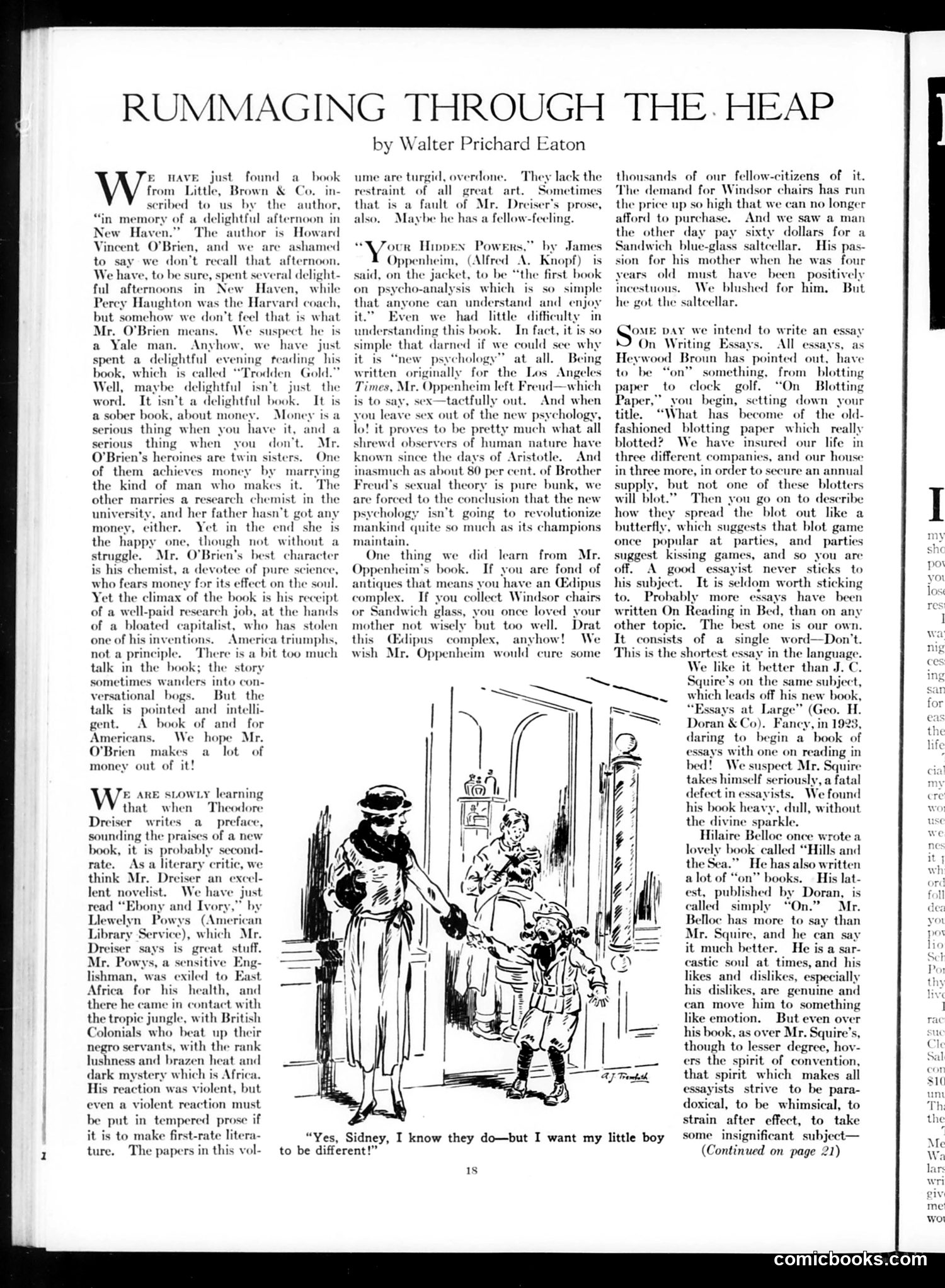
This page from *Judge* magazine contains book reviews by Walter Prichard Eaton, a prominent literary critic of the era. The main illustration depicts a woman (likely representing a wealthy or fashionable figure) with two children, captioned "Yes, Sidney, I know they do—but I want my little boy to be different!" **The satire targets Freudian psychology's popularity.** Eaton mocks James Oppenheim's book on "Your Hidden Powers," which popularized Freud's ideas. He ridicules how Freudian analysis was reducing all human behavior to sexual complexes—particularly the Oedipal complex. His joke: if collecting antiques or Windsor chairs means you loved your mother "too well," then wealthy Americans collecting these fashionable items are unconsciously revealing neuroses. **The cartoon illustrates this absurdity:** a society mother wanting her child to be "different" from other children, likely satirizing how newly psychoanalysis-conscious parents were obsessing over raising psychologically "perfect" children by Freudian principles. Eaton criticizes Dreiser's literary judgment and praises O'Brien's novel about money and ambition as genuinely American.
📄 Transcribed text from this page (OCR, searchable)
Machine-transcribed from the original scan — historical spelling and the odd misread are preserved.
RUMMAGING THROUGH THE. HEAP E HAVE just found a_ book from Little, Brown & Co, in- scribed to us by the author, “in memory of a delightful afternoon in New Haven The author is Howard Vincent O'Brien, and we are ashamed we don’t recall that afternoon, to be sure, spent several delight- ernoons in New Haven, while Percy Haughton was the Harvard coach, but somehow we don’t feel that is what Mr. O'Brien means. We suspect he is a Yale man. Anyhow, we have just spent a delightful’ evening teading’ his book, which is called *’Trodden Gold.” Well, maybe delightful isn’t just the word. It isn’t a delightful book. It is a sober book, about money. Money is a serious thing when you have it, and a serious thing when you don't. Mr. O’Brien’s heroines are twin sisters. One of them achieves money by marrying the kind of man who makes it. The other marries a research chemist in the university, and her father hasn't got any money, either. Yet in the end she is the happy one, though not without a struggle. Mr. O'Brien's best. character is his chemist, a devotee of pure science, who fears money for its effect on the soul. Yet the clir of the book is his receipt of a well-paid research job, at the hands of a bloated capitalist, who has stolen one of his inventions. America triumphs, not a principle. There is a bit too much talk in the book; the story sometimes wanders into con- versational bogs. But the talk is pointed and_ intelli- gent. A book of and for Americans. We hope Mr. O'Brien makes a lot of money out of it! E ARE SLOWLY le: that when The Dreiser writes a preface, sounding the praises of a new book, it is probably second- rate. As a literary critic, we think Mr. Dreiser an e bony and Ivory n Powys (Amer ervice), which Mr. Dreiser says is great stuff. Mr. Pow a sensitive lishman, Africa for his there he came in conta the tropic jungle, with British Colonials who beat up their negro servants, with the rank lushness and brazen heat and dark mystery which is Africa. His reaction was violent, but even a violent reaction must be put in tempered prose if it is to make first-rate litera- ture. The papers in this vol- by Walter Prichard Eaton ume are turgid, overdone, restraint of all great art that is a fault of Mr. Dreiser's prose, Maybe he has a fellow-feeling. “y Powers,” by James Oppenheim, (Alfred A. Knopf). is said, on the jacket, to be “the first book nalysis which is so simple 1 understand and enjoy we had little difficulty in iding this book. In fact, it is so rned if we could see why it is “new psychol at all. Being written originally for the Los Angeles Times, Mr. Oppenheim left Fread—which And when you leave sex out of the new psychology, lo! it proves to be pretty much what all shrewd observers of human nature have known since the days of Aristotle. And inasmuch as about 80 per cent. of Brother Freud’s sexual theory is pure bunk, we are forced to the conclusion that the new psychology isn’t going to revolutionize mankind quite so much as its champions maintain. did learn from) Mr. One thing we Oppenheim’s book. If you are fond of ean Edipus antiques that means you he complex. If you collect Windsor chairs or Sandwich glass, you once loved your mother not wisely but too well. Drat this (Edipus complex, anyhow! We wish Mr. Oppenheim would cure some also, our Hippen underst simple that « AF Trembath, 18 thousands of our fellow-citi: The demand for Windsor c! the price up so high that we afford to. pure other d Sandwich blue-glass salteellar. the ons of it. has run no longer saw a man » dollars for a His pas. ion for his mother when he was four years tious. positively But have been blushed for him, must We he got the saltcellar. Soe bay we intend to write an ess: On Writing Essays. to be paper Paper,” “What title. 1 Broun has’ pointed out; to. clock golf. All essays have from blotting “On Blotting you begin, setting down your has ‘become of the old- n”” something, fashioned blotting paper which really blotted? three different. companies, We insured our life in and our house have in three more, in order to secure ar supply, will blot.” how they spread the but not one of these Then you go on to de blot out 1 butterfly, which suggests that blot gar on pop lar at parties, and parties suggest kissing games, and so you are off. “Yes, Sidney, I know they do—but I want my little boy to be different!” A good e his subject. It to. Probably written On Reading in Be other topic. It consists of a This is the shorte ist never sticks to seldom worth sticking more essays have been than on any The best one is our own. single word—Don't. y in the language We slik "i c Doran eC 0). nC) . daring to begin a ‘book of essays with one on reading in bed! We suspect Mr. Squire takes himself seriously, a fatal defect in essayists. We found his book he dull, without the divine sparkle. Hilaire Belloc once wrote a book called “Hills and He so written His lat- Doran, is “On.” Mr. Belloc more to than Mr. Squire, and he can say it much better. He is a sar- castic soul at tim a and his likes and dislik his dislikes, are genuine and can move him to something like emotion. But even over his book, as over Mr. Squii though to er degree, hov- ers the spirit of convention, that spirit which makes all ‘ ts strive to be para- das ‘al, to be whimsical, to strain after effect, to take some insignificant subject— (Continued on page 21) comicbooks.com