
Judge, 1923-04-14 · page 23 of 36
Judge — April 14, 1923 — page 23: what you’re looking at
What you’re looking at
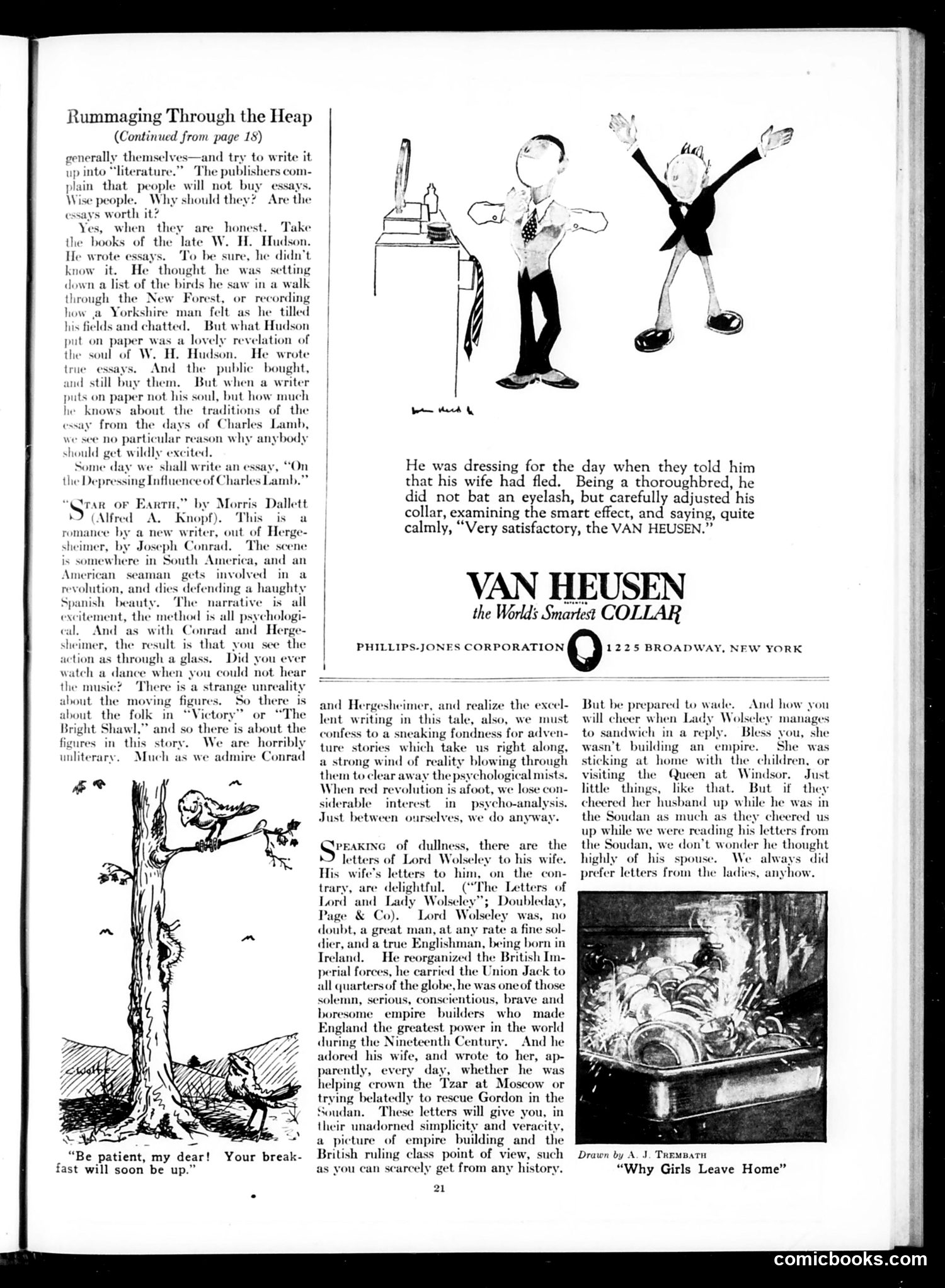
This page combines book reviews with a **Van Heusen collar advertisement**. The main satirical content critiques literary pretension—specifically essays that prioritize intellectual style over genuine human insight, and psychological novels that prioritize technique over engaging storytelling. The **cartoon shows a man learning his wife has fled**, yet he remains composed, adjusting his collar with satisfaction. This is a joke about misplaced priorities: facing marital disaster, he cares only about his appearance. The advertisement uses this domestic crisis to sell collars as a symbol of maintaining composure and propriety—"Very satisfactory, the VAN HEUSEN." The reviews reference **Lord Wolseley**, a real 19th-century British military figure whose published letters are criticized as tedious, while his wife's responses are praised as authentic and engaging. The overall message: genuine human content (honest essays, adventure stories, authentic letters) beats self-conscious artifice—though even then, some people obsess over trivial matters like collar appearance.
📄 Transcribed text from this page (OCR, searchable)
Machine-transcribed from the original scan — historical spelling and the odd misread are preserved.
Rummaging Through the Heap (Continued from page 18) generally themsel and try to write it up into “literature.” The publishers com- plain that people will not buy essays. Wise people. Why should they? Are the ys worth it? Yes, when they are honest. Take the books of the late W. H. Hudson. He wrote essays. To be sure, he didn’t know it. He thought he was setting down a list of the birds he saw in a walk through the New Forest, or recording how ,a Yorkshire man felt as he tilled his fields and chatted, But what Hudson put on paper was a lovely revelation of the soul of W. H. Hudson, He wrote true essays. And the public bought, and still buy them, But when a writer puts on paper not his soul, but how much he knows about the litions of the from the days of Charles Lamb, +See no particular reason why anybody should get wildly excited. Some day we shall write an essay, “On the Depressing Influence of Charles Lamb.” “Qrar or Eartu,” by Morris Dallett J (Alfred A. Knopf). This is a romance by a new writer, out of Herge- sheimer, by Joseph Conrad. ‘The scene is somewhere in South America, and an American seaman gets involved revolution, and dies defending Spanish beauty. The narrative excitement, the method is all psychologi- cal, And as with Cor and Herge- sheimer, the result is that you see the action as through a glass. Did you ever watch a dance when you could not hear ‘There is‘a strange unreali about the moving figures. So there is about the folk in ‘*Victo or “The Bright Shawl,” and so there is about the figures in this. stoi We are horribly unliterary. Much as we admire Conrad the music? _ “Be patient, my dear! fast will soon be up.” Your break- He was dressing for the day when they told him that his wife had fled. Being a thoroughbred, he did not bat an eyelash, but carefully adjusted his collar, examining the smart effect, and saying, quite calmly, “Very satisfactory, the VAN HEUSEN.” VAN HEUSEN the Worlds Smartet COLLAR PHILLIPS-JONES conronarion CY 1225 BROADWAY, NEW YORK and Hergesheimer, and realize the excel- lent writing in this tale, also, we must confess to a sneaking fondness for adven- ture stories which take us right along, mg wind of reality blowing through chological mists. ‘oot, we lose con- siderable interest in psycho-analy Just between ourselves, we do anyway. Grates of dullness, there are the \ letters of Lord Wolseley to his wife. His wife's letters to him, on_ the con- trary, are delightful. (“The Letters of Lord and Lady Wolseley”; Doubleday, Page & Co). Lord Wolseley was, no doubt, a great man, at any rate a fine dier, and a true Englishman, being born in Ireland. He reor, ed the British Im- perial forces, he carried the Union Jack to all quartersof the globe, he was one of those solemn, serious, conscientious, brave and boresome empire builders who made England the greatest power in the world during the Nineteenth Century. And he adored his wife, and wrote to her, ap- parently, every day, whether he was helping crown the Tzar at Moscow or trying belatedly to rescue Gordon in the Soudan. These letters will give you, in their unadorned plicity and veracity, a picture of empire building and the British ruling class point of view, such as you can scarcely get from any history. 21 But be prepared to wade. And how you will cheer when Lady Wolseley manages to sandwich in a reply. Bless you, she wasn’t building an empire. She was sticking at home with the children, or visiting the Queen at Windsor. Just little things, like that. But if they cheered her husband up while he was in the Soudan as much as they cheered us up while we were reading his letters from the Soudan, we don’t wonder he thought highly of his spouse. We always did prefer letters from the ladies, anyhow. Drawn by A. J. TREMBaTH “Why Girls Leave Home” comicbooks.com