
Judge, 1923-04-14 · page 14 of 36
Judge — April 14, 1923 — page 14: what you’re looking at
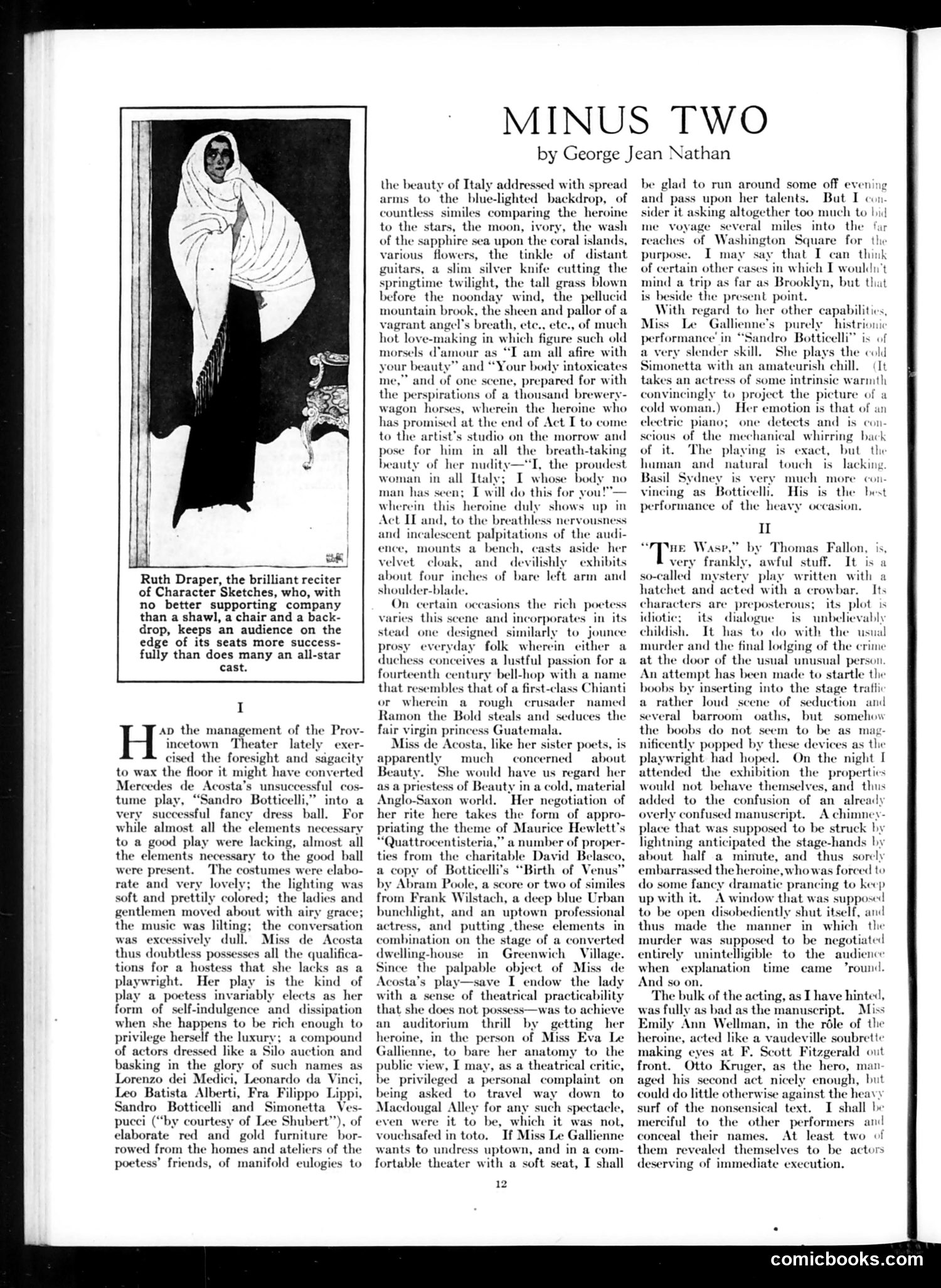
What you’re looking at
This is a theatrical review of Mercedes de Acosta's play "Sandro Botticelli," performed at the Provincetown Theater. Nathan's satire is devastating: the production succeeds as a fancy dress ball but fails as drama. **The Joke:** Nathan argues the play lacks two essential elements—plot and dialogue—making it "minus two" of theater's basics. He catalogs the production's actual strengths (elaborate costumes, atmospheric lighting, famous borrowed props including a Botticelli painting) while demolishing its pretensions. **The Satire:** Nathan mocks de Acosta's self-indulgent aestheticism and her concern with "Beauty" as an end in itself. He ridicules her overwrought romantic language ("I am all afire with your beauty") and notes the famous scene consists merely of an actress displaying four inches of bare arm—anticlimactic given elaborate buildup. **The Point:** A wealthy dilettante can create spectacle but not theater. Nathan suggests she's better suited as a society hostess than a playwright, implying wealth and artistic pretension don't substitute for dramatic craft.
📄 Transcribed text from this page (OCR, searchable)
Machine-transcribed from the original scan — historical spelling and the odd misread are preserved.
Ruth Draper, the brilliant reciter of Character Sketches, who, with no better supporting company than a shawl, a chair and a back- drop, keeps an audience on the edge of its seats more success- fully than does many an all-star cast. I Ap the management of the Prov- incetown Theater lately exe cised the foresight and sagacity to wax the floor it might have converted Mercedes de Acosta’s unsuccessful cos- tume play, “Sandro Botticelli,” into a very successful fancy dress ball. For while almost all the elements necessary to a good play were lacking, almost all the elements necessary to the good ball were present. The costumes were elabo- rate and v y; the lighting was soft and prettily colored; the ladies and gentlemen moved about with airy grace; the music was lilting; the conversation was excessively dull. Miss de Acosta thus doubtless possesses all the qualif tions for a hostess that she lacks as a playwright. Her is the kind of play a poetess in bly elects as her form of self-indulgence and dissipation when she happens to be rich enough to privilege herself the luxury; a compound of actors dressed like a Silo auction and basking in the glory of such nam Lorenzo dei Medici, Leonardo da Leo Batista Alberti, Fra Filippo Lippi, Sandro Botticelli and Simone pucci (“by courtesy of Lee Shubert”), of elaborate red and gold furniture bor- rowed fi the homes and ateliers of the poetess’ friends, of manifold eulogies to MINUS TWO by George Jean Nathan the beauty of Italy addressed with spread arms to the blue-lighted backdrop, of countless similes comparing the heroine to the stars, the moon, ivory, the wash of the sapphire sea upon the coral islands, various flowers, the tinkle of distant guitars, a slim silver knife cutting the springtime twilight, the tall grass blown before the noonday wind, the pellucid mountain brook, the sheen and pallor of a vagrant angel's breath, ete., ete., of much hot love-making in which figure such old morsels d'amour as “I am all afire with your beauty” and “Your body intoxicates me,” and of one scene, prepared for with the perspirations of a thousand brewery- wagon horses, wherein the heroine who has promised at the end of Act I to come to the artist’s studio on the morrow and pose for him in all the breath-taking beauty of her nudity—"I, the proudest woman in all Italy; I whose body man has seen; I will do this for you wherein this heroine duly shows up in Act IL and, to the breathless nervousness and incalescent palpitations of the audi- ence, mounts a bench, casts aside her velvet cloak, and devilishly exhibits about four inches of bare left arm and shoulder-blade. On certain occasions the rich poetess varies this scene and incorporates in its stead one designed similarly to jounce prosy everyday folk wherein either a duchess conceives a lustful passion for a fourteenth century bell-hop with a name that resembles that of a first-class Chianti or wherein a rough crusader named Ramon the Bold steals and seduces the fair virgin princess Guatemala. Miss de Acosta, like her sister poets, is apparently «much concerned — about auty. She would have us regard her as a priestess of Beauty in a cold. erial Anglo-Saxon world. Her negotiation of her rite here takes the form of appro- priating the theme of Maurice Hewlett’s “Quattrocentisteria,” a number of proper- ties from the charitable David Belasco, a copy of Botticelli’s “Birth of Venus” m Poole, a score or two of similes k Wilstach, a deep blue Urban ht, and an uptown professi actress, and putting .these elements in combination on the stage of a converted dwelling-house — in Since the palpable Acosta’s play—save I endow the with a sense of theatrical practicability that she does not possess—was to achieve ditorium thrill by getting her ne, in the person of Miss Eva Le llienne, to bare her anatomy to the y, as a theatrical critic, a personal complaint on being asked to travel down to Macdougal Alley for any such spectacle, : it to be, which it was not, vouchsafed in toto. If Miss Le Gallienne wants to undress uptown, and in a com- fortable theater with a soft seat, I shall 12 be glad to run around some off evening and pass upon her talents. But I sider it asking altogether too much to bid me voyage several miles into the far reaches of Washington Square for tli I may say that I can think ases in which T wouldn't mind a trip as far as Brooklyn, but tha is beside the present point. With regard to her other capabilities, Miss Le Gallienne’s purely —histrionic performance’ in “Sandro Botticelli” is of a very slender skill. She plays the cold Simonetta with an amateurish chill. (It takes an actress of some intrinsic warmth convincingly to project the picture of a cold woman.) Her emotion is that of an electric piano; detects and is con- scious of the nical whirring back ¥ is exact, but the touch is lacking \ is very much more c vincing as Botticelli. His is the best performance of the heavy occasion. II TT Wasp,” by Thomas Fallon, is, very frankly, awful stuff. It so-called mystery. play written with a hatchet and acted with a crowbar. Its characters are preposterous; its plot is idiotic; its dial > is unbelievably childish. It has to do with the usual murder and the final lodging of the crime at the door of the usual unusual person An attempt has been made to startle the boobs by inserting into the stage traflic a rather loud scene of seduction and several barroom oaths, but the boobs do not seem to be nificently popped by these devic the playwright had hoped. On the night I attended the exhibition the properties would not behave themselves, and thus added to the confusion of an already overly confused manuscript. A chimney- place that was supposed to be struck by lightning anticipated the stage-hands by about half a mimute, and thus. sorely embarrassed the heroine, whowas forced to do some fancy dramatic prancing to keep up with it. A window that was suppose: to be open disobediently shut itself, and thus made the mer in which the murder was supposed to be negotiated entirely unintelligible to the audience when explanation time came ‘round. And so on. The bulk of the acting, as I have hinted, was fully as bad as the manuscript. Miss ily Ann Wellman, in the réle of the heroine. fed like a vaudeville soubrette making ¢ rot zgerald out front. Otto Kruger, as the hero, man aged his second act n enough, but could do little otherwise against the heavy surf of the nonsensical text. I shall be merciful to the other performers ani conceal their names. At least two of them revealed themselves to be actors deserving of immediate execution. purpose. of certain other one mech is a comicbooks.com