
Judge, 1923-04-14 · page 7 of 36
Judge — April 14, 1923 — page 7: what you’re looking at
What you’re looking at
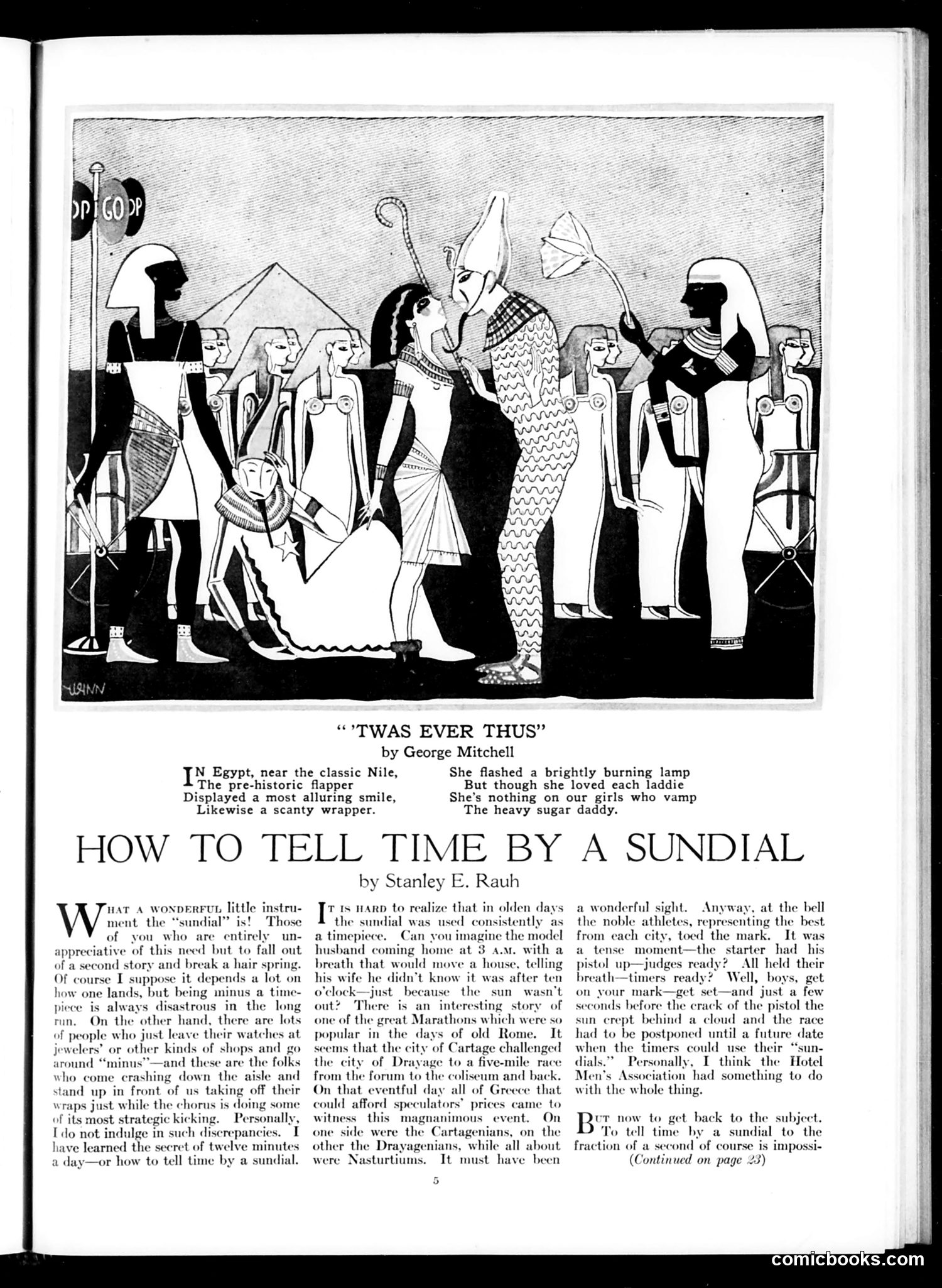
**The Cartoon ("'Twas Ever Thus"):** George Mitchell's illustration depicts an ancient Egyptian scene with a scantily-clad woman ("pre-historic flapper") flirting with men. The accompanying poem sarcastically contrasts ancient seduction with modern times, suggesting that contemporary young women ("flappers") who manipulate wealthy older men for money ("sugar daddy") are far more calculating than their historical counterparts. **The Article ("How to Tell Time by a Sundial"):** Stanley E. Rauh's humorous piece is largely a comedic ramble using the sundial as a thin pretext for jokes about timekeeping and social behavior. The extended anecdote about a Roman race (Carthage vs. Drayage) illustrates how sundials prove unreliable when clouds appear—allowing him to mock both ancient technology and modern hotel management. **Context:** This reflects 1920s Jazz Age anxieties about changing morality, particularly regarding young women's independence and their perceived manipulation of wealthy men—a recurring satirical target in Judge magazine during this era.
📄 Transcribed text from this page (OCR, searchable)
Machine-transcribed from the original scan — historical spelling and the odd misread are preserved.
IX Egypt, near the classic Nile, The pre-historic flapper Displayed a most alluring smile, Likewise a scanty wrapper. “*TWAS EVER THUS” by George Mitchell She flashed a brightly burning lamp But though she loved each laddie She’s nothing on our girls who vamp The heavy sugar daddy. HOW TO TELL TIME BY A SUNDIAL HAT A WONDERFUL little instru- ment the “sundial” is! Those of you who are entirely un- appreciative of this need but to fall out of a second story and break a hair spring. Of course I suppose it depends a lot on how one lands, but being minus a time- piece is always disastrous in the long run, On the other hand, there are lots of people who just leave their watches at jewelers’ or other kinds of shops and go around “minus”—and these are the folks who come crashing down the aisle and stand up in front of us taking off their wraps just while the chorus is doing some ic kicking. Personally, Ido not indulge in such discrepancies. I have learned the secret of twelve minutes jay—or how to tell time by a sundial. by Stanley E. Rauh " Is HARD to realize that in olden days the sundial was used consistently as a timepiece. Can you imagine the model husband coming home at 3 a.m. with a breath that would move a house, telling his wife he didn’t know it was after ten o'clock—just because the sun wasn’t out? There is an interesting story of one of the great Marathons which were so popular in the days of old Rome. It seems that the city of Cartage challenged the city of Drayage to a five-mile race from the forum to the coliseum and back. On that eventful day all of C that could afford speculators’ prices ne to witness this magnanimous event. On one side were the Cartagenians, on the other the Drayagenians, while all about were Nasturtiums. It must have been a wonderful sight. Anyway, at the bell the noble athletes, representing the best from each city, toed the mark. It wa moment—the starter had_ his ady? All held their breath—timers read. Well, boys, get on your mark—get —and just a few seconds before the crack of the pistol the sun crept behind a cloud and the race had to be postponed until a future date when the timers could use their “sun- dials.” Personally, I think the Hotel Men’s Association had something to do with the whole thing. a_ tense pistol up—judge: subject. I to the impossi- B= now to get back to the To tell time by a sundi fraction of a second of cours (Continued on page 23) comicbooks.com