
Judge, 1923-04-14 · page 11 of 36
Judge — April 14, 1923 — page 11: what you’re looking at
What you’re looking at
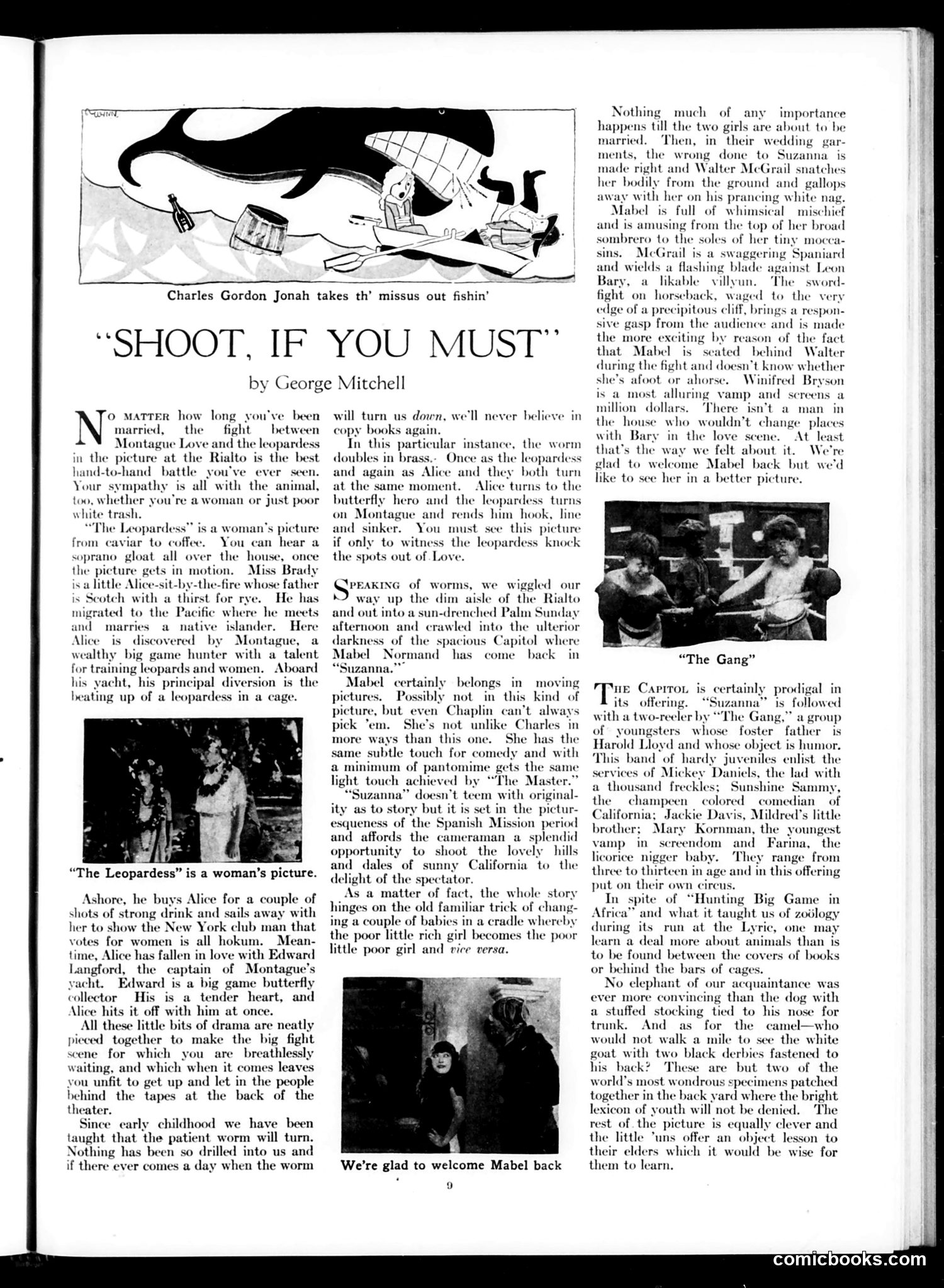
This page reviews contemporary silent films, written by George Mitchell. The main article critiques "The Leopardess," starring Alice Brady, which follows a familiar melodramatic plot: a Scotch-American father marries a Pacific Islander; his daughter Alice is purchased by a wealthy big-game hunter (Montague) but falls for the yacht captain (Edward Langford). The climax features a fight between Alice and a caged leopardess that Montague has been abusing. Mitchell's satire emphasizes that this is "a woman's picture"—aimed at female audiences—mocking the predictable drama and emotional manipulation designed to make viewers weep. He notes the film exploits the old literary trope that "the patient worm will turn," where both Alice and the leopardess simultaneously turn on their oppressor. The secondary review covers Mabel Normand's "Suzanna," featuring the familiar switched-babies plot and Spanish Mission-period scenery, praising Normand's comedic talent.
📄 Transcribed text from this page (OCR, searchable)
Machine-transcribed from the original scan — historical spelling and the odd misread are preserved.
Charles Gordon Jonah takes th’ missus out fishin’ “SHOOT, IF YOU MUST” by George Mitchell o MATTER how long you've been \ married, the — fight — between and the leopardess the picture at the Rialto is the best nd-to-hand battle you've our sympathy is all with the animal, too, whether you're a woman or just poor white trash. he Leopardess” is a woman’s picture from caviar to coffee. You can hear a soprano gloat all over the house, once the picture gets in motion. Miss Brady isa little Alice-sit-by-the-fire whose father is Scotch with a thirst for rye. He has migrated to the Pacific where he meets and marries a native islander. Here Alice is discovered by Montague, a wealthy big game hunter with a talent for training leopards and women. Aboard his yacht, his principal diversion is the beating up of a leopardess in a cage. “The Leopardess” is a woman’s picture. Ashore, he buys Alice for a couple of shots of strong drink and sails away with her to show the New York club votes for wome all hoku time, Alice has fallen in love with Edward Langford, the captain of Montague’s yacht. Edward is a big game butterfly collector His is a tender heart, and Alice hits it off with him at once. All these little bits of drama are neatly pieced together to make the big fight » for which you are breathlessly waiting, and which when it comes leaves you unfit to get up and let in the people behind the tapes at the back of the theater. Since early childhood we have been taught that the patient worm will turn. Nothing has been so drilled into us and if there ever comes a day when the worm will turn us down, we'll never believe in copy books again. In this ticular instance, the worm doubles in brass. Once as the leopardess and in as Alice and they both turn at the same moment. Alice turns to the butterfly hero and the leopardess turns on Montague and rends him hook, line and sinker. You must sce this picture if only to witness the leopardess knock the spots out of Love. SPEAKING of worms, we wiggled our ‘J way up the dim aisle of the Rialto and out into a sun-drenched Palm Sunday afternoon and crawled into the ulterior darkness of the spacious Capitol where Mabel wmand has come back in “Suzan Mabel certainly belongs in moving pictures. Possibly not in this kind of i . but even Chapl n't always m. She’s not unlike Charles in more ways than this one. She has the same subtle touch for comedy and with a minimum of pantomime gets the same light touch achieved by “The Master “Suzanna” doesn’t teem with original- ity as to story but it is set in the pictur- esqueness of the Spanish Mission period and affords the cameraman a splendid opportunity to shoot the lovely hills and dales of sunny California to the delight of the spectator. As a matter of fact, the whole story hinges on the old familiar trick of chang- ing a couple of babies in a cradle whereby the poor little rich girl becomes the poor little poor girl and vice versa. We're glad to welcome Mabel back 9 Nothing much of any importance happens till the two girls about to be married. Then, in their wedding gar- ments, the wrong done to Suzanna is made right and Walter McGrail snatches her bodily from the ground and gallops away with her on his praneing white nd Mabel is full of whimsical mischi and is amusing from the top of her broad sombrero to the soles of her tiny mocce sins. McGrail is a swaggering Spaniar and wields a flashing blade against Leon Bary, a likable villyun. The sword- fight on horseback, waged to the very edge of a precipitous cliff, brings a respon- sive gasp from the audience and is made the more exciting by reason of the fact that Mabel is seated behind Walter i he fight and doesn’t know whether ot or ahorse. Winifred Bryson is a most alluring vamp and screens a million dollars. There isn’t a man in the house who wouldn't change places with Bary in the love scene. At least that’s the - we felt about it. We're glad to welcome Mabel back but we'd like to see her in a better picture. “The Gang” 1E Capito is certainly prodigal in its offering. uzanna’” is followed with a two-reeler by “The Gang,” a group of youngsters whose foster father is Harold Lloyd and whose object is humor. This band of hardy juveniles enlist the services of Mickey Daniels, the lad with a thousand freckles; Sunshine Sammy, the champeen colored comedian — of California; Jack Mildred’s little brother; Kornman, the youngest vamp in screendom and Farina, the licorice nigger baby. ‘They range from three to thirteen in age and in this offering put on their own circus. In spite of “Hunting Big Game in Africa” and what it taught us of zoulogy during its run at the Lyric, one may learn a deal more about animals than is to be found between the covers of books or behind the bars of cages. No elephant of our acquaintance was ever more convincing than the dog with a stuffed stocking tied to his nose for trunk. And for the camel—who would not walk a mile to see the white goat with two black derbies fastened to his back? These are but two of the world’s most wondrous specimens patched together in the back yard where the bright lexicon of youth will not be denied. The rest of the picture is equally clever and the little uns offer an object lesson to their elders which it would be wise for them to learn. comicbooks.com