
A complete issue · 36 pages · 1923
Judge — March 31, 1923
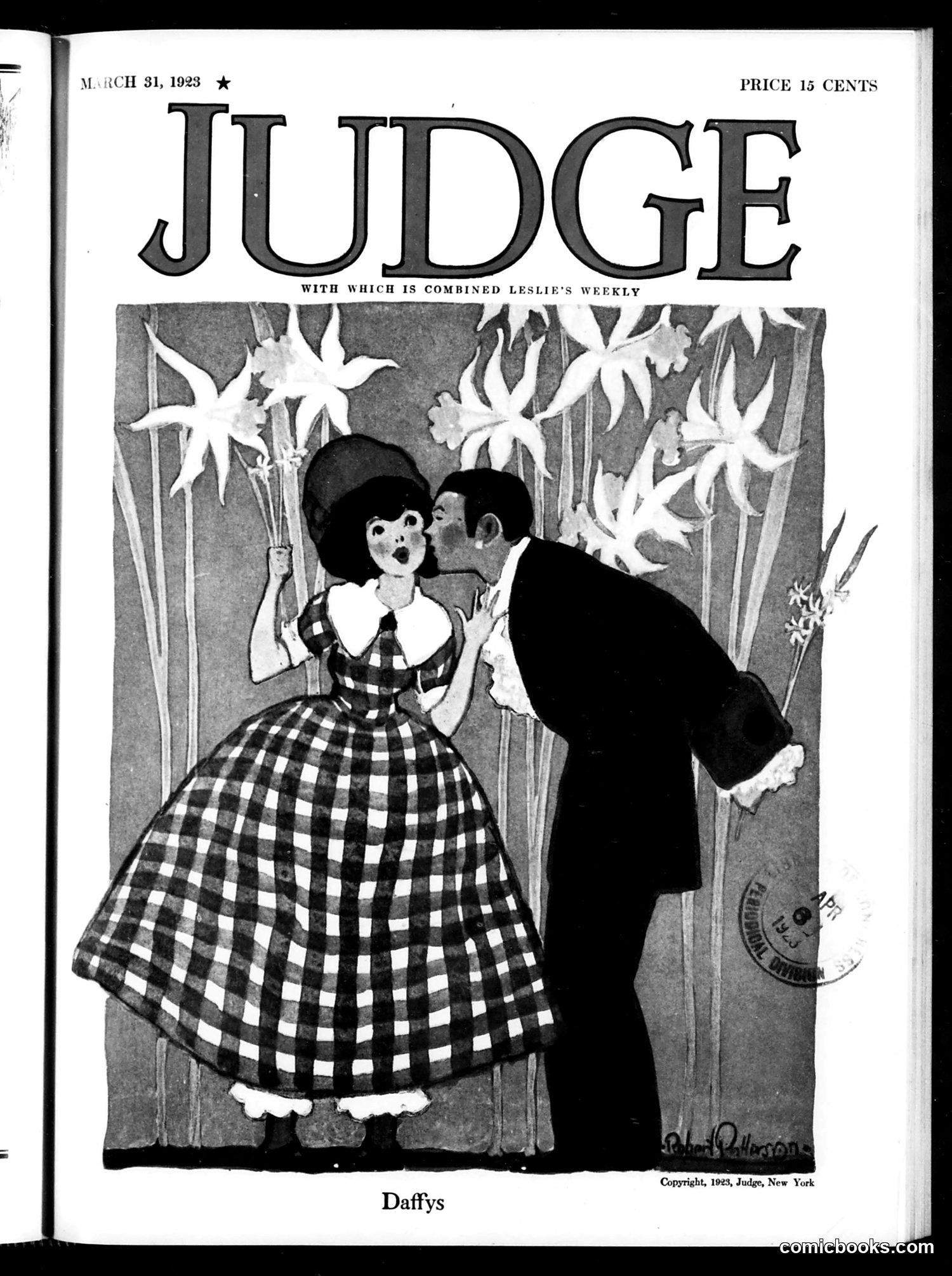
This cover illustration depicts a flirtatious spring scene with a woman in a checkered dress on a swing surrounded by blooming daffodil flowers, while a man in formal attire leans in to kiss or whisper to her. The title "Daffys" is a visual pun: the woman and man are acting silly or "daffy" (foolish/scatterbrained) while literally surrounded by daffodils in bloom. This is a light romantic/comedic illustration typical of Judge's humor content—playing on the double meaning of "daffy" to mock spring romance and courtship customs of the 1920s. The elaborate checkered dress and formal male attire reflect 1920s fashion. The humor is gentle and domestic rather than political or sharply satirical.
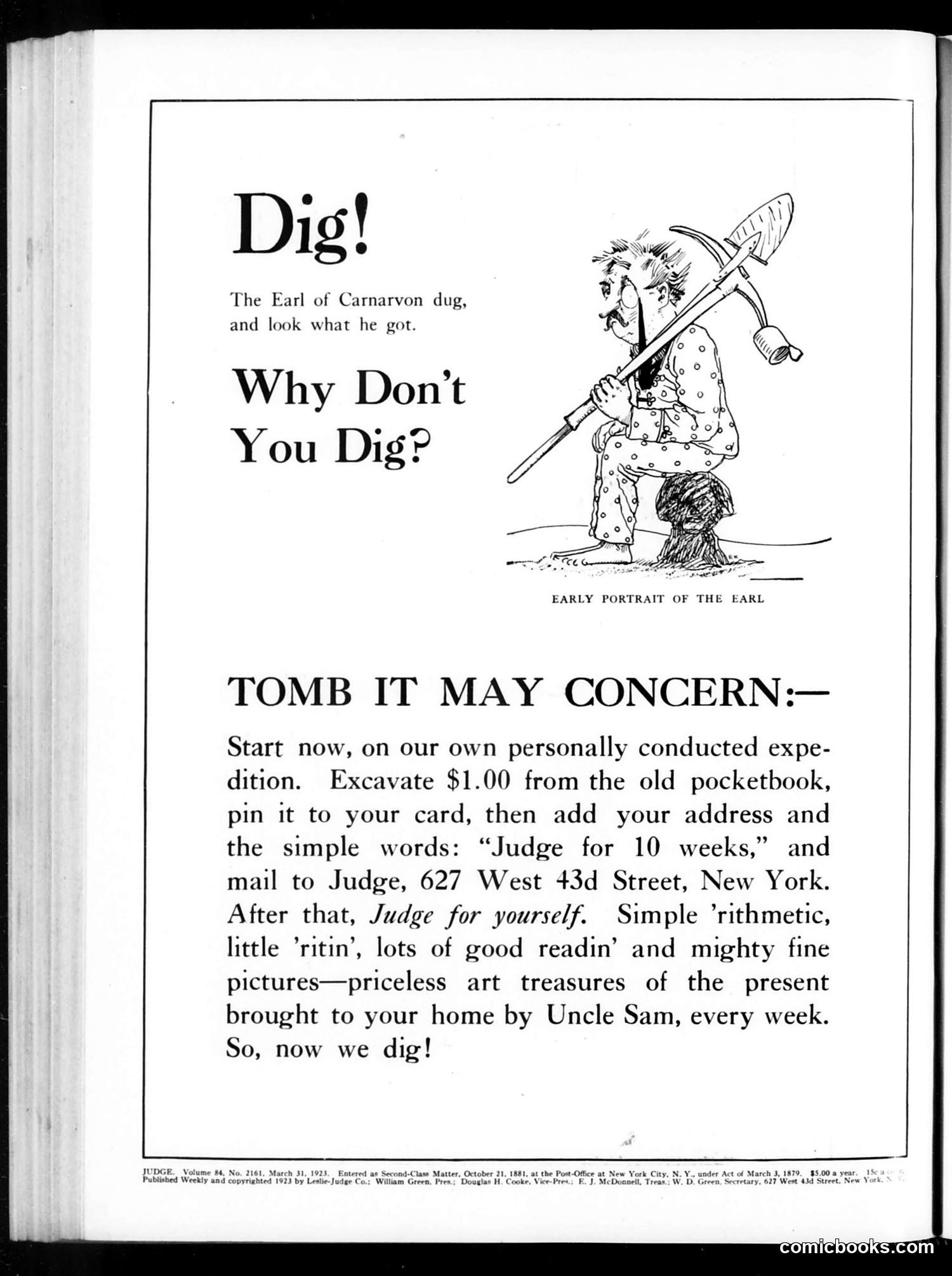
This page is primarily **advertising**, not political satire. It promotes a subscription offer for Judge magazine itself, using playful language and a cartoon illustration. The "Earl of Carnarvon" reference likely alludes to the 1922 discovery of King Tutankhamun's tomb by British archaeologist Lord Carnarvon—a major contemporary news event. The cartoon puns on this by showing a mustachioed figure digging, captioned "Early Portrait of the Earl." The advertisement pitches Judge subscriptions by urging readers to "dig" (invest $1.00) and become judges themselves of the magazine's content—"simple arithmetic, little 'ritin', lots of good readin' and mighty fine pictures." The subscription goes to an address in New York City. It's essentially a self-promotional advertisement using topical humor and wordplay to attract subscribers.
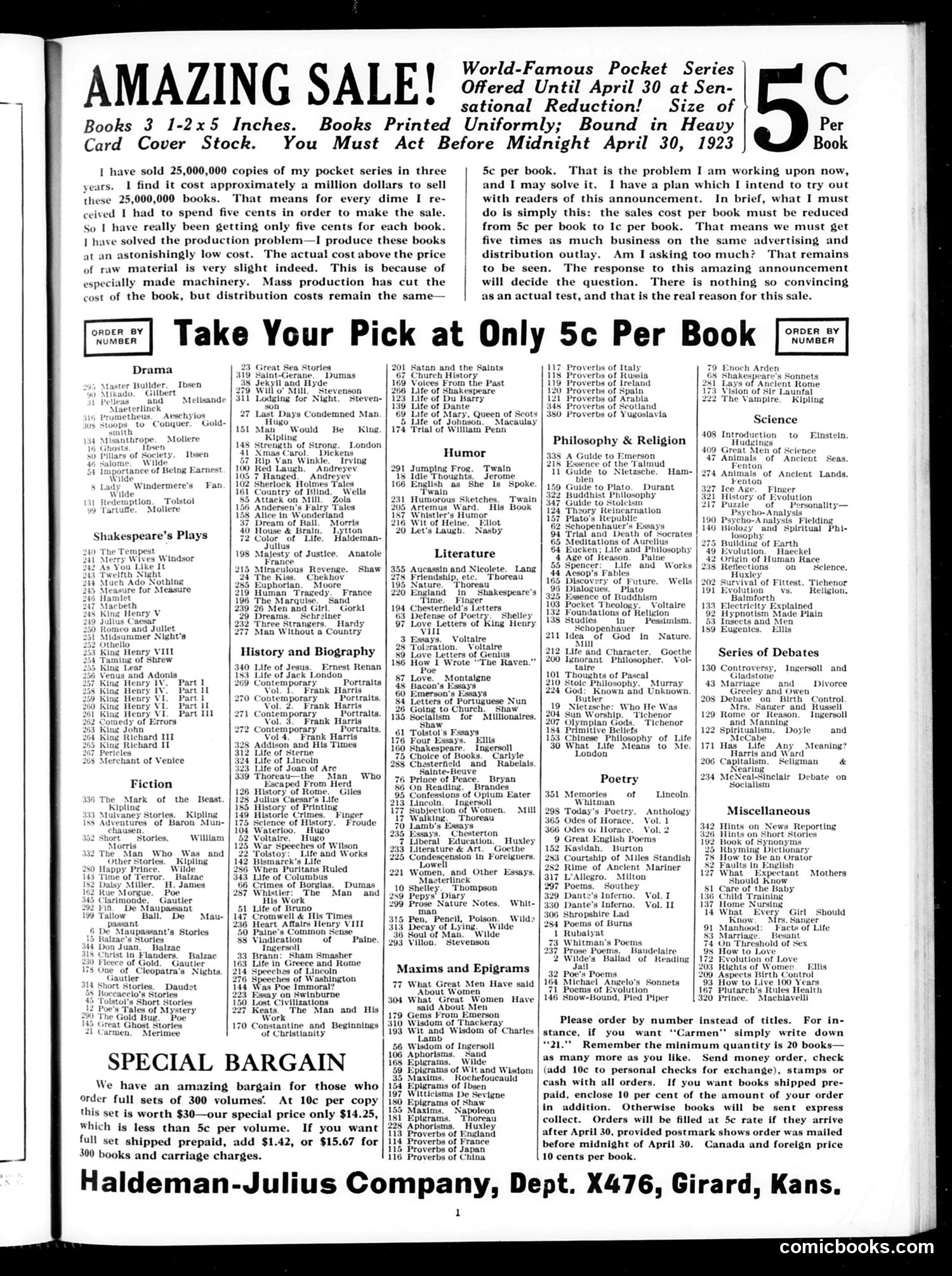
This page is primarily a book advertisement rather than political satire or commentary. It presents an "Amazing Sale" of pocket-sized books from the Haldeman-Julius Company, offering 5-cent volumes across various categories: Drama, Shakespeare's Plays, Fiction, History and Biography, Humor, Literature, Philosophy and Religion, Science, Poetry, Series of Debates, and Miscellaneous titles. The publisher emphasizes mass production economics—claiming to have sold 25 million copies—to justify the extremely low price. The text includes a pitch about reducing costs to expand readership accessibility. The page contains no political cartoons, caricatures, or satirical commentary. It is a straightforward commercial offering typical of Judge magazine's revenue-generating advertising content from the early 1920s.
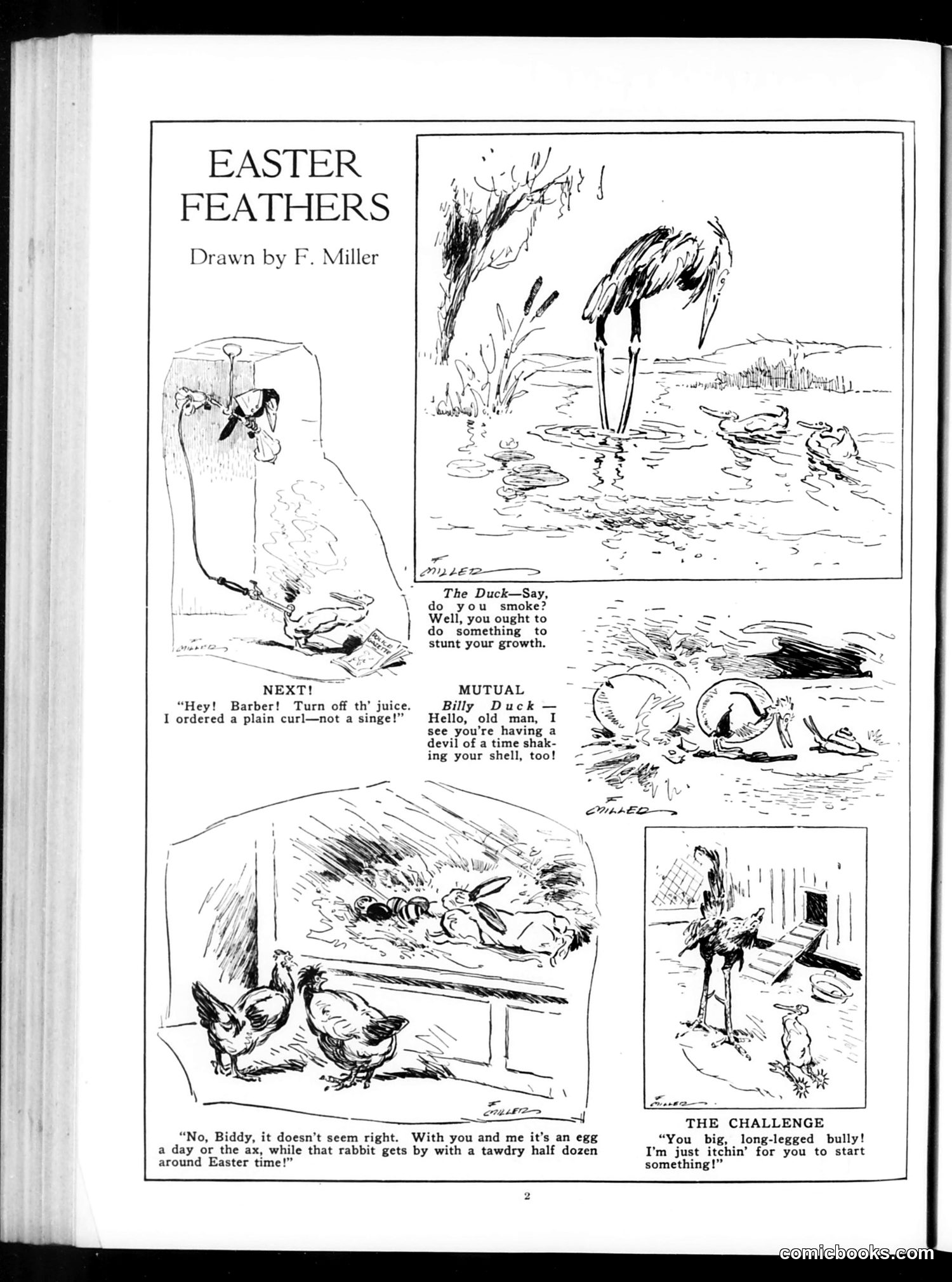
This comic page uses anthropomorphic animals to satirize human social hypocrisy and inequality. The "NEXT!" panel mocks vanity at the barber shop. The "MUTUAL" section depicts ducks criticizing each other's smoking habits while engaging in similarly destructive behavior—a jab at people who lecture others about vices they themselves practice. The central panel shows chickens disturbed by a rabbit's Easter abundance, complaining that while they labor ("egg a day or the ax"), the rabbit thrives on minimal effort. "THE CHALLENGE" depicts a rooster taunting a larger opponent, suggesting foolish bravado. The satire targets class resentment, hypocrisy, and social inequality through animal characters, typical of Judge magazine's approach to contemporary social commentary.
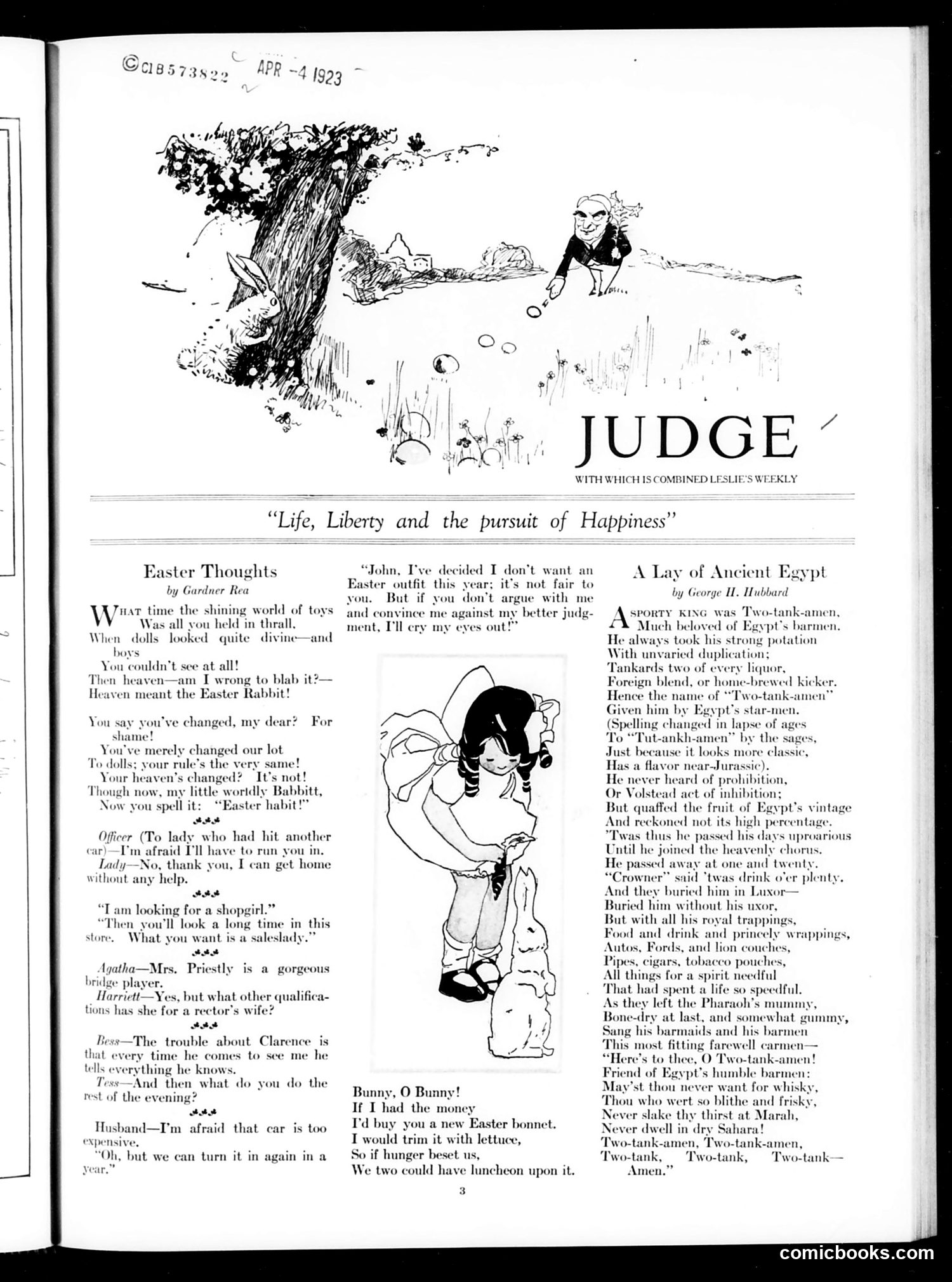
This page combines Easter-themed poetry and satirical humor. The main illustration depicts a child with a rabbit, accompanying "Bunny, O Bunny!"—a poem about purchasing Easter bonnets and rabbits for holiday celebration. The left column, "Easter Thoughts" by Gardner Rea, satirizes how people claim to have "changed" morally while their fundamental nature remains unchanged. References to "Babbitt" (likely Sinclair Lewis's 1922 satirical novel about American conformity) suggest this critiques hollow pretense in modern society. The right column, "A Lay of Ancient Egypt" by George H. Hubbard, is a humorous poem about Egyptian mummification and burial practices—typical Judge content mixing classical references with light comedy. Overall, the page reflects 1920s American cultural commentary through poetry and illustration rather than explicit political cartoons.
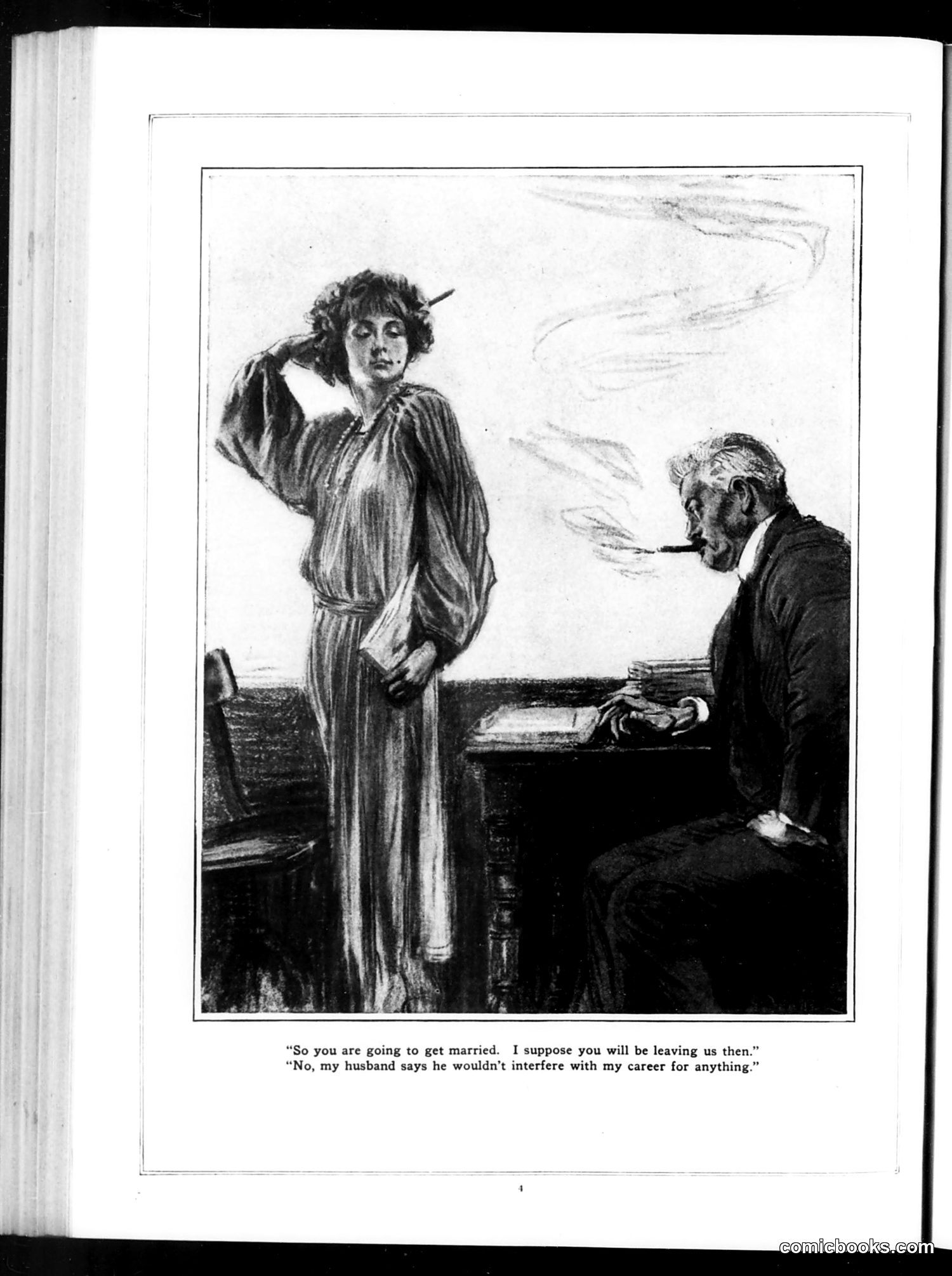
This cartoon satirizes early 20th-century attitudes toward women's careers and marriage. The scene shows a woman standing confidently while an older man (appears to be her employer or father figure) sits at a desk, expressing surprise about her impending marriage. He assumes she'll abandon her job, a common expectation of the era. Her response—that her husband won't interfere with her career—was progressive and somewhat humorous to contemporary audiences. The satire works on two levels: it mocks the man's outdated assumptions while also gently ribbing the woman's optimism about maintaining independence after marriage. This reflects real social tensions of the period, when married women, particularly working women, faced strong cultural pressure to abandon professional ambitions for domestic life. The cartoon captures a moment of changing social attitudes regarding gender and work.
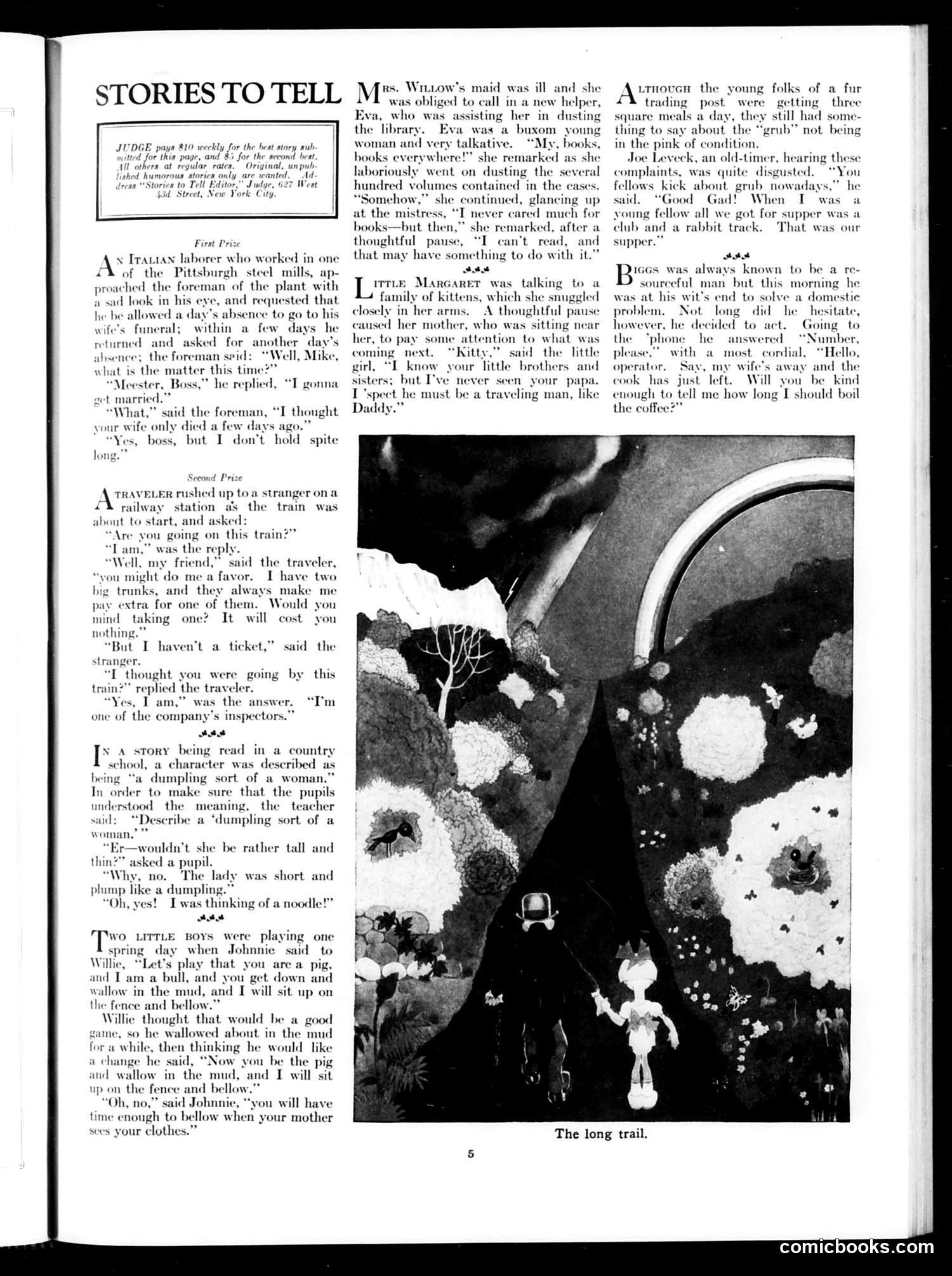
This page from *Judge* magazine presents a humor column featuring reader-submitted short stories competing for cash prizes ($10 for first place). The content reflects turn-of-the-century working-class and domestic humor. The stories employ gentle, situational comedy rather than political satire: an Italian steelworker quickly remarries after his wife's funeral; a train passenger tries to smuggle extra luggage by posing as a company inspector; schoolchildren confuse "dumpling" with "noodle"; a boy avoids wallowing in mud by letting his friend do it first; a young maid dismisses books because she can't read; a child assumes her kitten's father is a traveling salesman; and nostalgic complaints about meal quality. The accompanying illustration "The Long Trail" appears unrelated to the stories—showing a desert or wasteland scene with a figure and covered wagon, likely depicting frontier hardship themes popular in the era. The humor targets working-class life, immigrant accents, and domestic situations rather than politics.
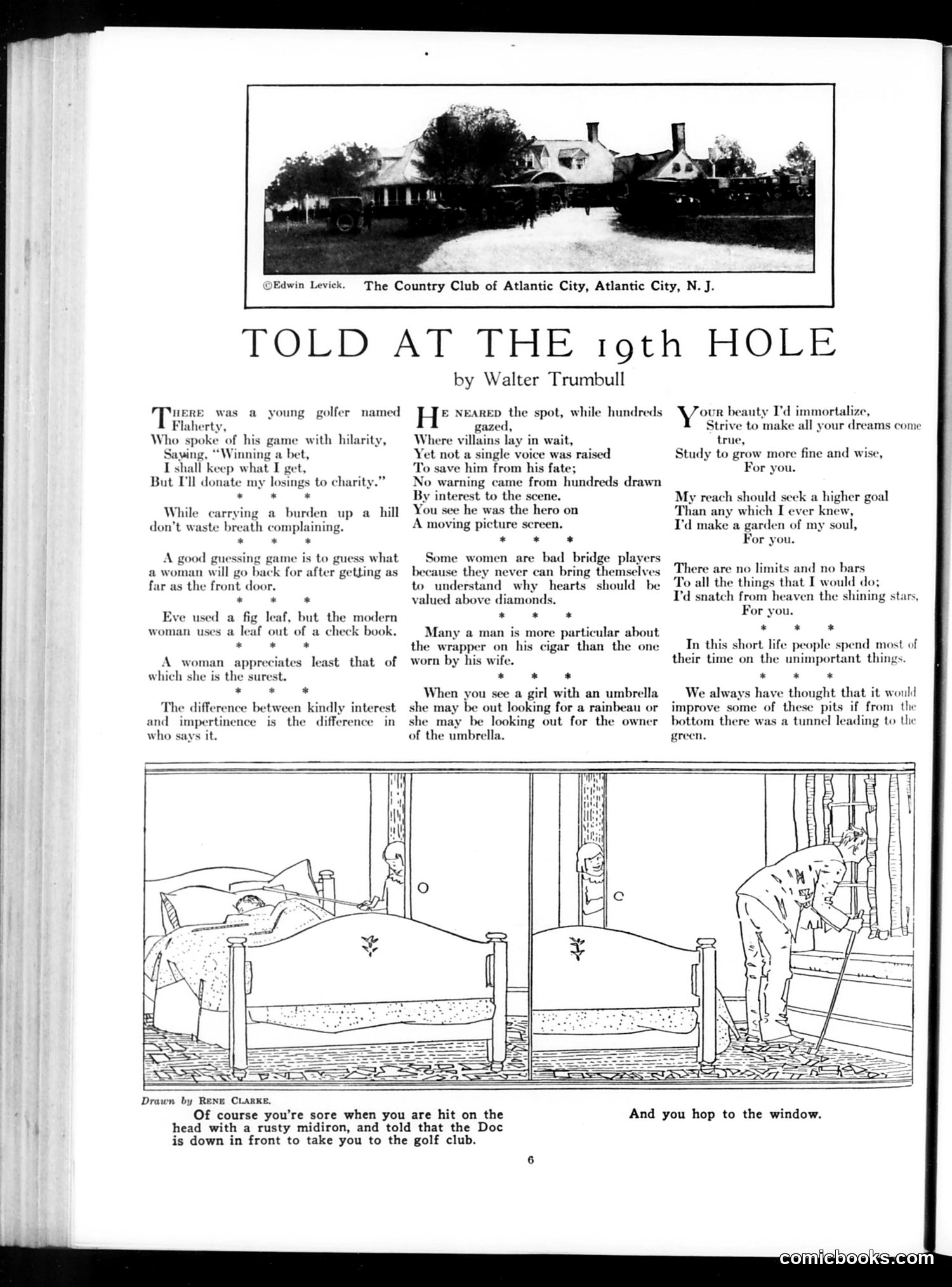
This page from *Judge* magazine presents humorous aphorisms and observations about golf, socializing, and gender relations, typical of early 20th-century American humor. **The Content:** The main piece by Walter Trumbull consists of witty one-liners and brief anecdotes told at a golf club's "19th hole" (the bar). Topics include a young golfer's charitable hypocrisy, observations about women as bridge players and wives, and golf-related complaints. **The Cartoon:** René Clarke's illustration (bottom) shows a patient in bed hit on the head with a golf club ("rusty midiron"), told a doctor will take him to the golf club—then hopefully hopping to the window. The joke: the injury is being treated dismissively, with the "treatment" being more golf. **The Satire:** The humor reflects 1920s social attitudes: gentle mockery of masculine golf culture, stereotyping of women's logic and behavior as baffling, and understated jokes about injury and domestic dynamics. The piece assumes a male audience familiar with country-club leisure culture.
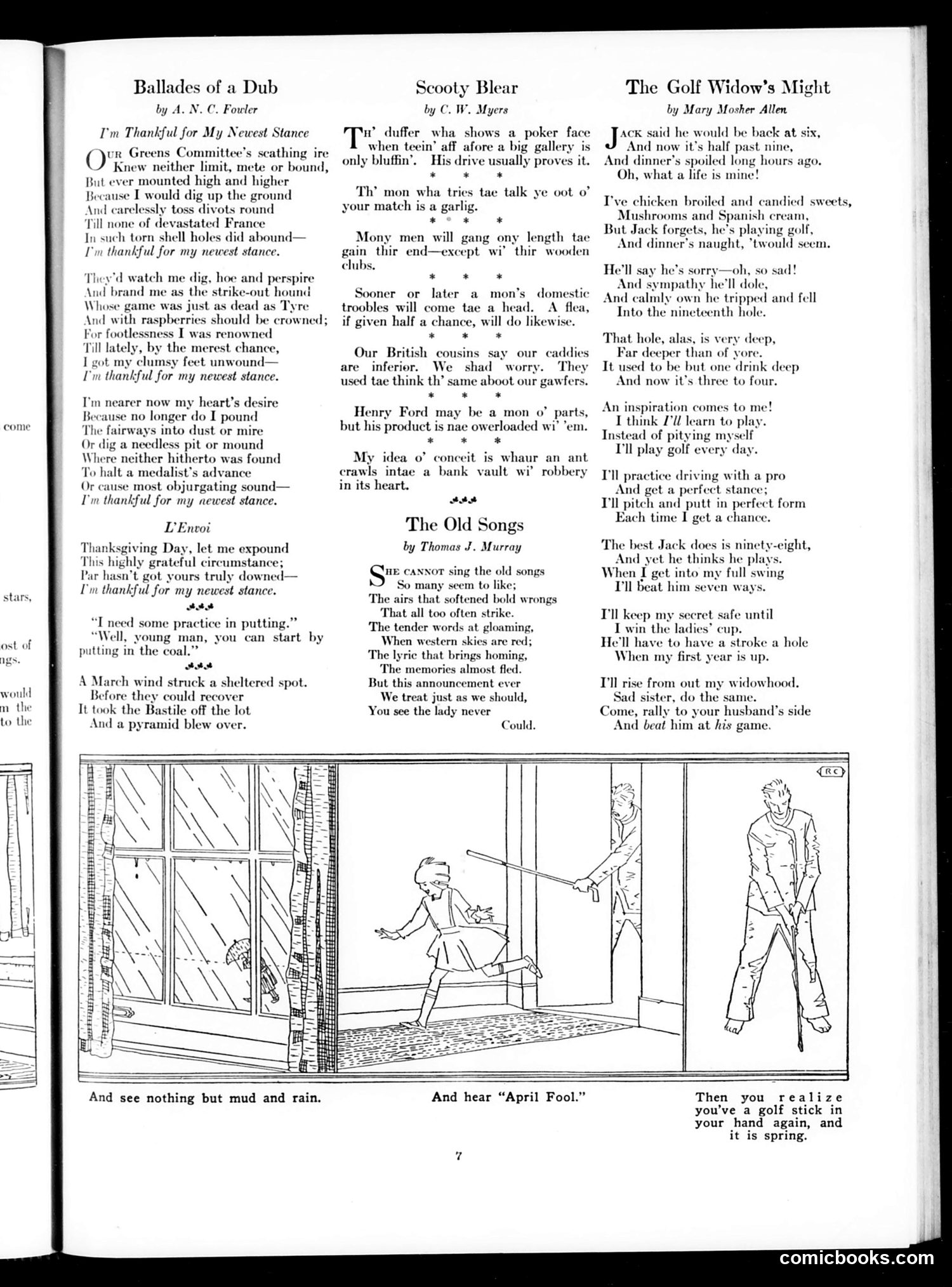
This page contains three humorous poems and accompanying illustrations satirizing early 20th-century American leisure and domestic life. **"Ballades of a Dub"** mocks an incompetent golfer who damages the greens with poor footwork and divots, but celebrates finally improving his stance—a gentle joke about amateur golf incompetence. **"Scooty Blear"** (in Scottish dialect) offers cynical observations: golfers who bluff about their abilities, the inevitability of domestic troubles, and a dig at Henry Ford's mass-produced automobiles as spiritually empty. **"The Golf Widow's Might"** satirizes the conflict between wives and golf-obsessed husbands. The wife spoils dinner waiting for her husband, who makes excuses (claiming he fell into the "nineteenth hole"—a bar). Her solution: learn golf herself to compete for his attention rather than suffer neglect. The cartoon illustrations show this domestic tension. The overall theme: golf's grip on American men and its disruption of domestic life, presented through lighthearted verse rather than sharp political critique.
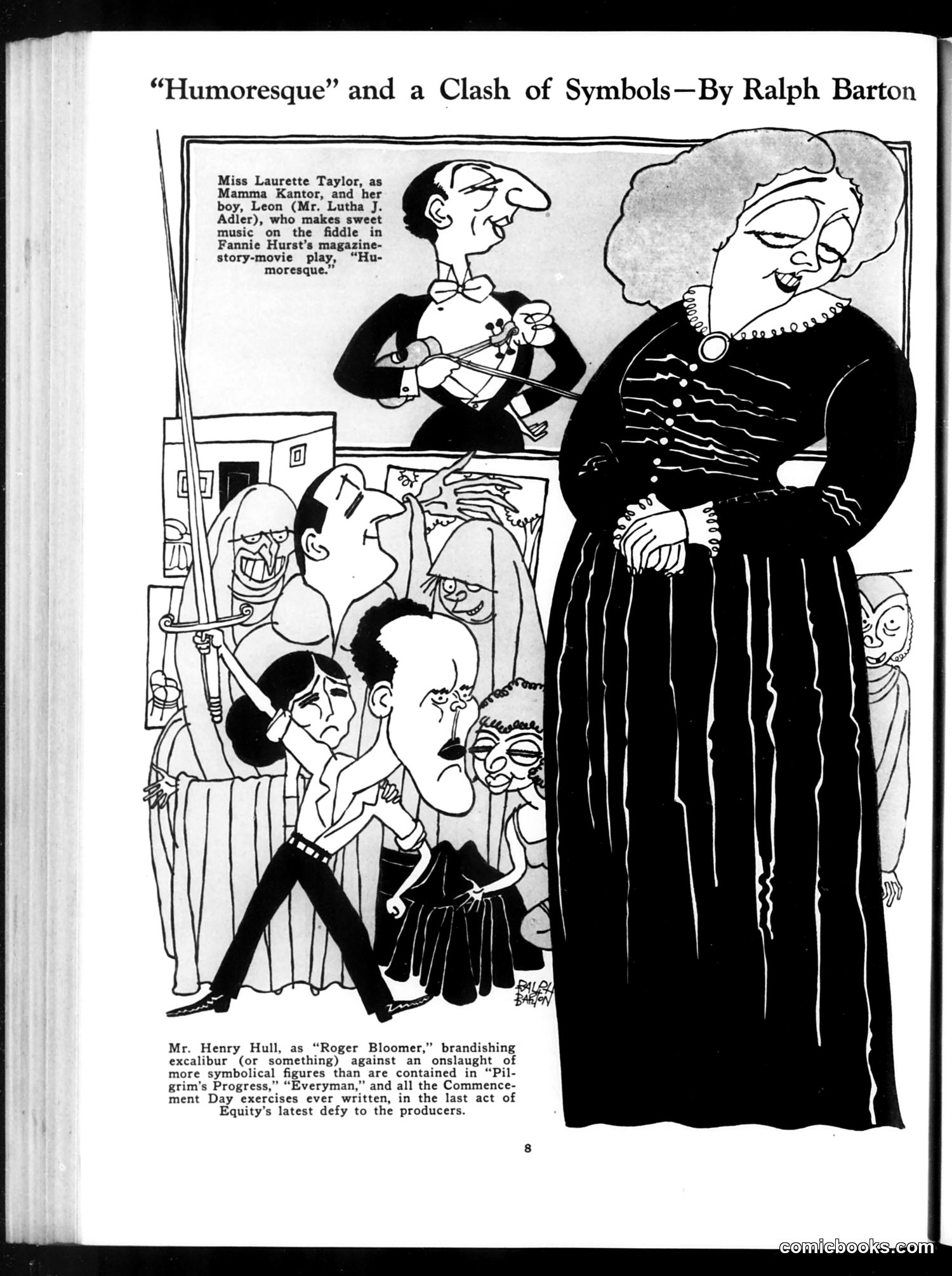
This cartoon satirizes a theatrical production featuring Miss Laurette Taylor and Mr. Henry Hull. The humor concerns a clash between highbrow artistic symbolism and lowbrow entertainment. Taylor plays a character performing fiddle music in "Humoresque," while Hull's character "Roger Bloomer" wields an excalibur-like sword against what the caption describes as excessive symbolic figures—referencing "Pilgrim's Progress," "Everyman," and Commencement Day exercises. The satire mocks the pretentious overuse of allegorical symbols in theater, contrasting refined artistic intent with comedic excess. The exaggerated caricatures of the supporting cast emphasize the clash between serious theatrical ambition and ridiculous visual presentation.
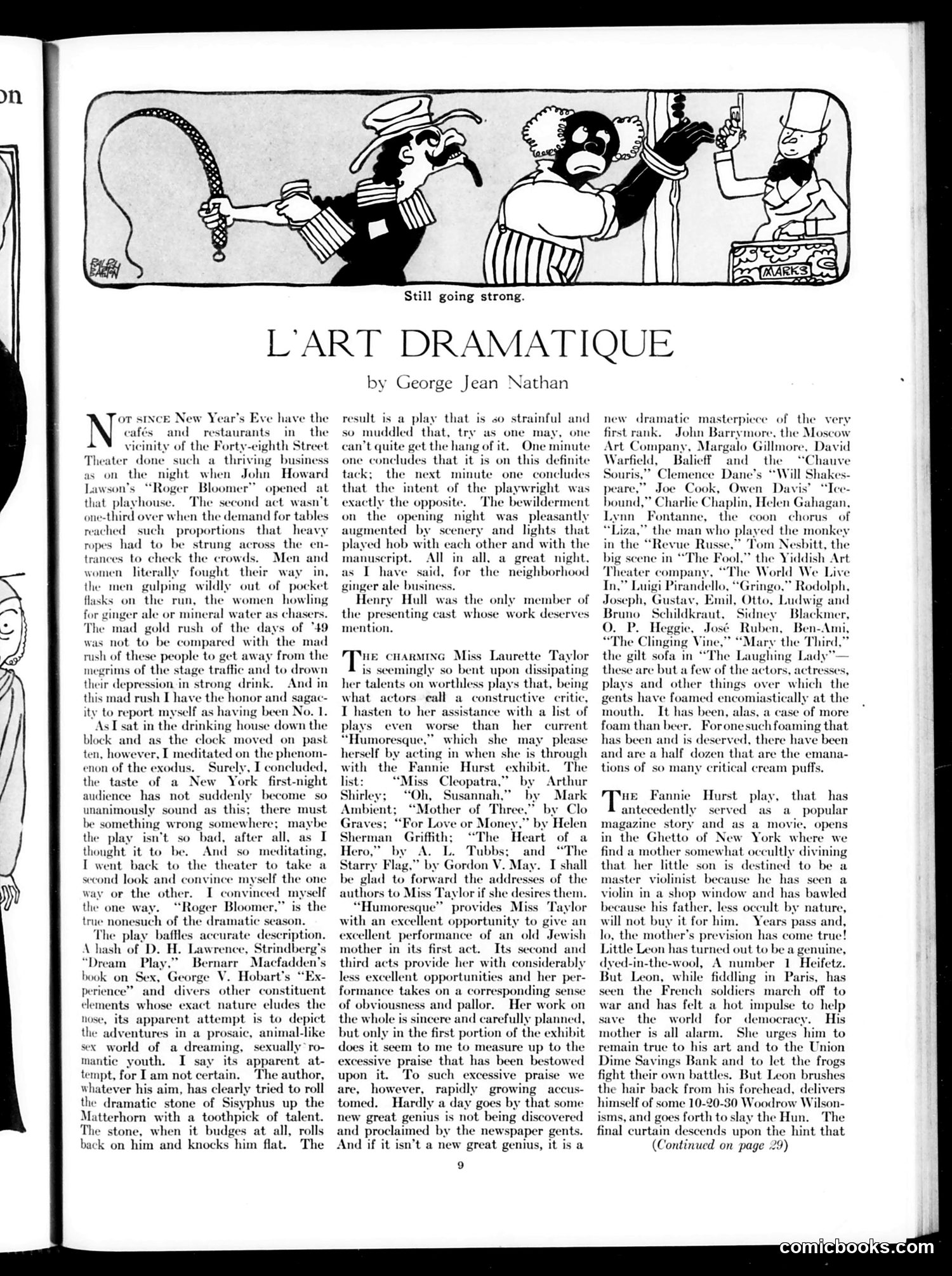
This is George Jean Nathan's scathing review of John Howard Lawson's play "Roger Bloomer," which opened on Forty-eighth Street. The cartoon at top depicts the play's opening night: audiences fleeing the theater in droves to nearby bars and restaurants, desperately drinking to escape the experience. Nathan's satire is brutal. He compares the play to a chaotic amalgam of highbrow references (D.H. Lawrence, Strindberg) mixed with pulp (Bernarr Macfadden's sex manual), calling it utterly confused and muddled. The only bright spot: actor Henry Hull's performance. He also mocks actress Laurette Taylor, suggesting she waste her talents on equally terrible scripts rather than "Humoresque." The implication: her acting skills deserve better material than what contemporary playwrights offer. The joke's dark humor lies in suggesting audiences would literally rather get drunk than sit through modern theater—a cutting indictment of 1920s Broadway's dramatic quality.
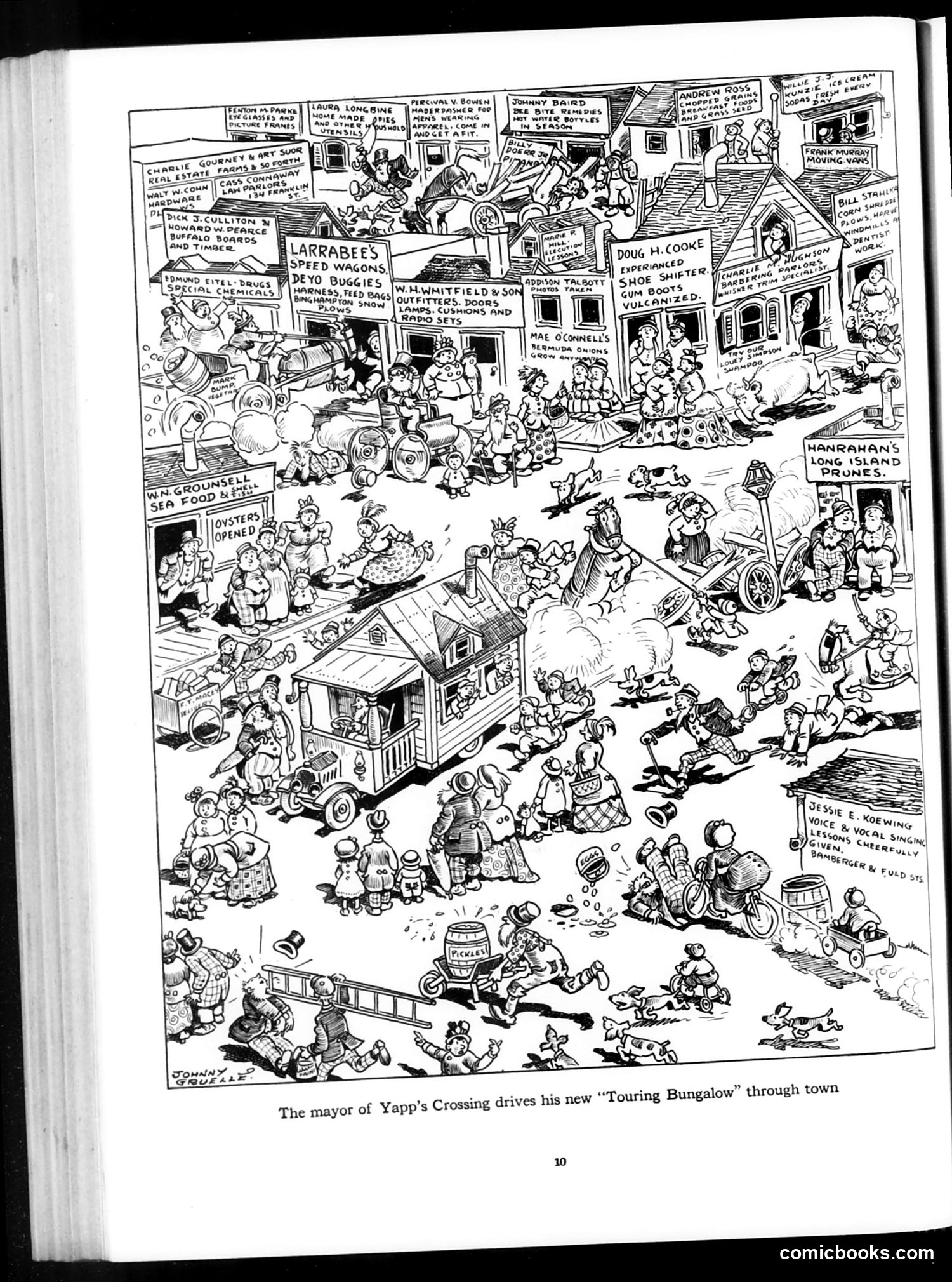
This is a densely-packed satirical illustration depicting a small town celebration as the mayor drives a novelty vehicle called a "Touring Bungalow" through the community. The cartoon mocks small-town life and provincial pride through exaggerated chaos and numerous local business advertisements integrated into the scene. The scattered storefronts and signs reference real local merchants (Larrabee's, Doug Cooke's shop, various proprietors), suggesting this depicts an actual town—likely "Yapp's Crossing" itself. The satire targets the excitement and disruption caused by this ostentatious display, with townspeople and children swarming around in chaotic activity. The "Touring Bungalow" itself—an early automotive novelty designed as a mobile home—represents the era's fascination with new technology and conspicuous consumption. The mayor's prominence suggests commentary on small-town leadership and civic vanity. Overall, the cartoon gently ridicules provincial boosterism and small-town social hierarchies through humorous exaggeration.
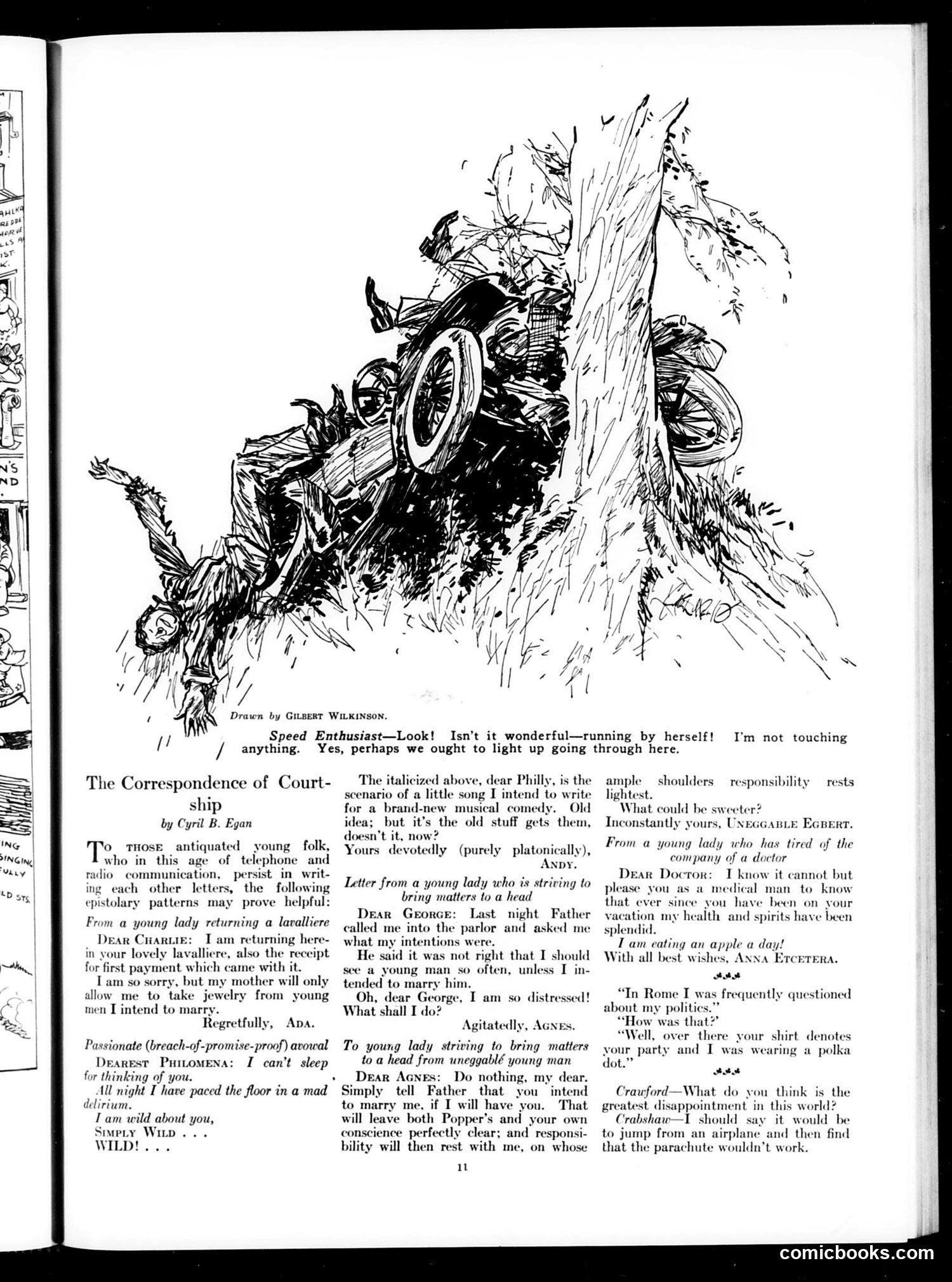
This page from Judge contains two distinct pieces: **The Cartoon (top):** Drawn by Gilbert Wilkinson, it depicts a car accident—a vehicle has crashed into a tree. The caption jokes about a "Speed Enthusiast" driving recklessly, with one occupant remarking the car is "running by herself" and they "ought to light up" (turn on headlights). This satirizes early automobiles and reckless driving culture of the era. **"The Correspondence of Courtship" (main text):** A humor column by Cyril B. Egan presenting mock letters between courting couples. It satirizes the formality and anxieties of courtship customs—including etiquette around gifts (lavalieres), declarations of love, and the delicate question of "intentions." The humor lies in the stilted, overwrought language young people used in letters, and the social pressure on women to secure marriage commitments. References to "breach-of-promise" lawsuits reflect real legal consequences of broken engagements in that era. The page mockingly celebrates outdated romantic conventions readers would recognize from their own experience.
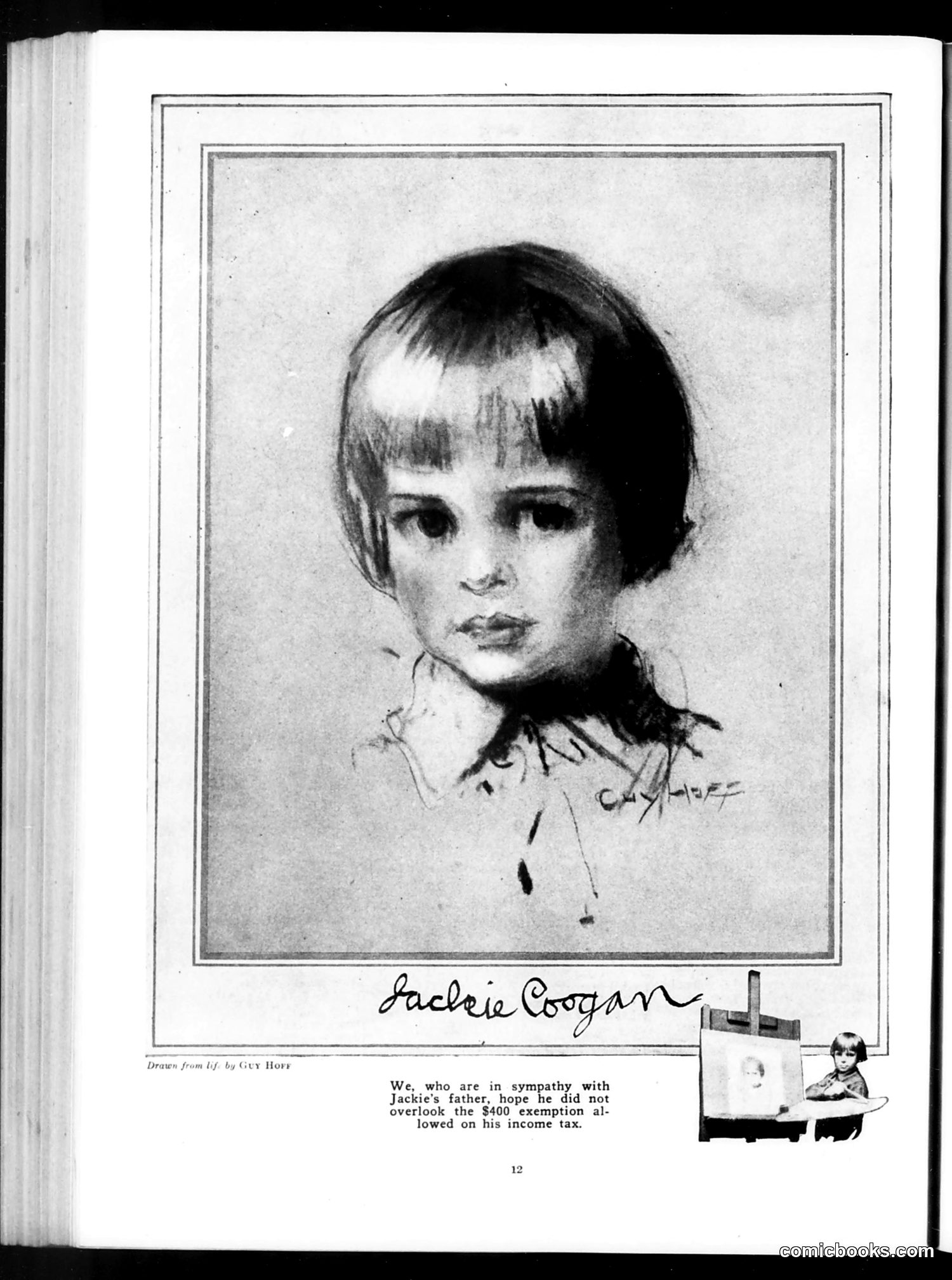
This page features a portrait drawing titled "Jackie Coogan," signed by artist Guy Hoff. The accompanying text is a satirical jab at child star Jackie Coogan's father regarding income taxes. The joke references the $400 personal exemption allowed under income tax law. It sarcastically suggests that Jackie's father—who profited from his child's film earnings—should remember to claim this standard deduction. The implication is that the father may have been enriching himself through Jackie's child labor without properly accounting for taxes, and Judge magazine is ironically "hoping" he at least takes the basic exemption available to all taxpayers. This reflects early 20th-century concerns about child exploitation in entertainment and tax accountability.
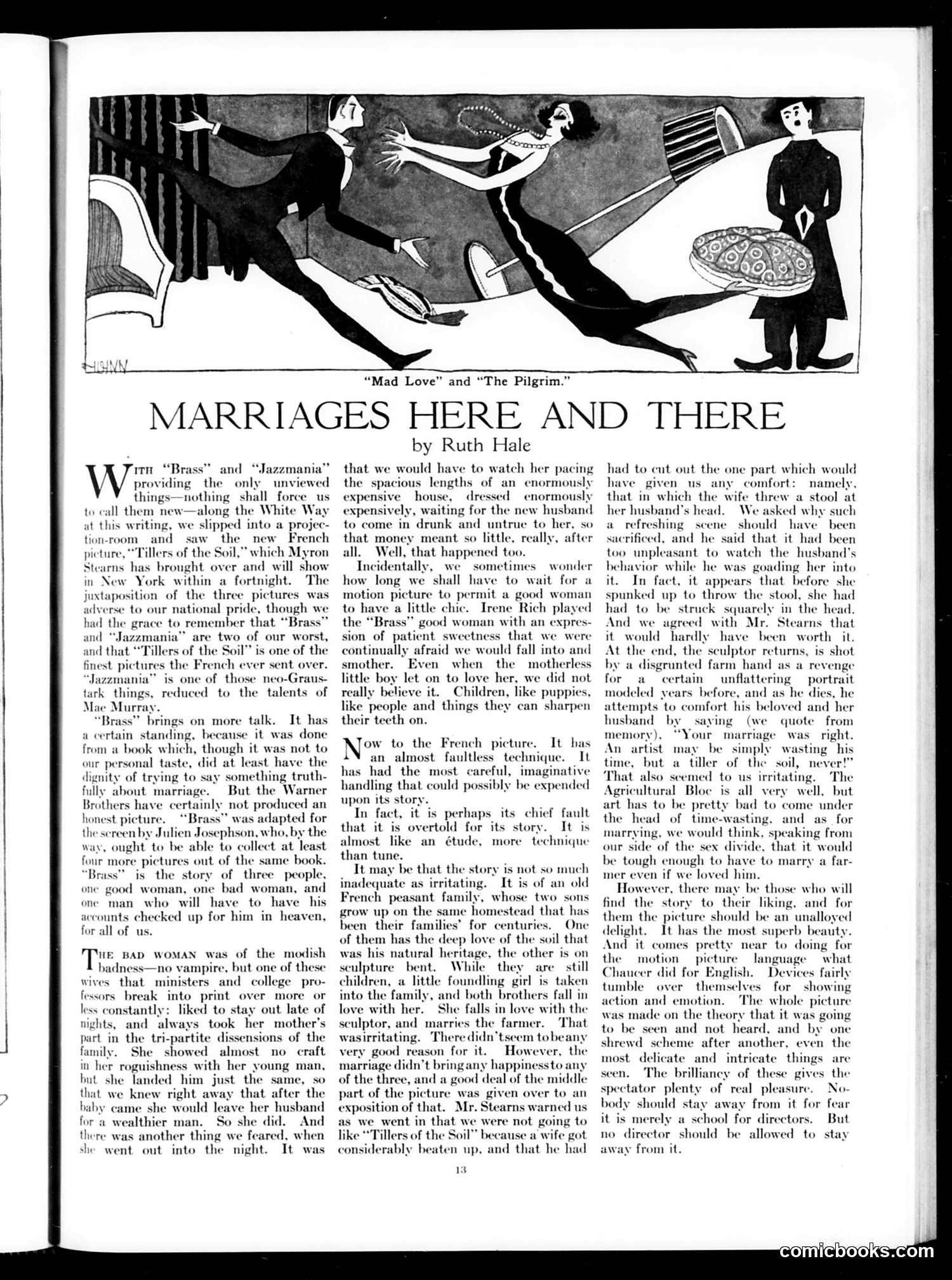
This page reviews three recent films through the lens of marriage depiction. The cartoon at top illustrates scenes from "Mad Love" and "The Pilgrim"—contemporary films being discussed. Ruth Hale critiques American versus French cinema. She reviews "Brass" (a Warner Brothers adaptation), which depicts a morally questionable woman who abandons her husband for wealth. Hale finds the "good woman" character played by Irene Rich unconvincingly saccharine. The French film "Tillers of the Soil" concerns a peasant family where two brothers love the same foundling girl; she marries the farmer (not the sculptor she loves), creating unhappiness. Hale's satire targets American cinema's moralizing sentimentality versus European film's sophisticated storytelling. She mocks Hollywood's inability to portray virtuous women as genuinely interesting or complex—they're merely patient and sweet rather than authentically chic or compelling. The piece reflects 1920s highbrow criticism of popular entertainment's artistic limitations.
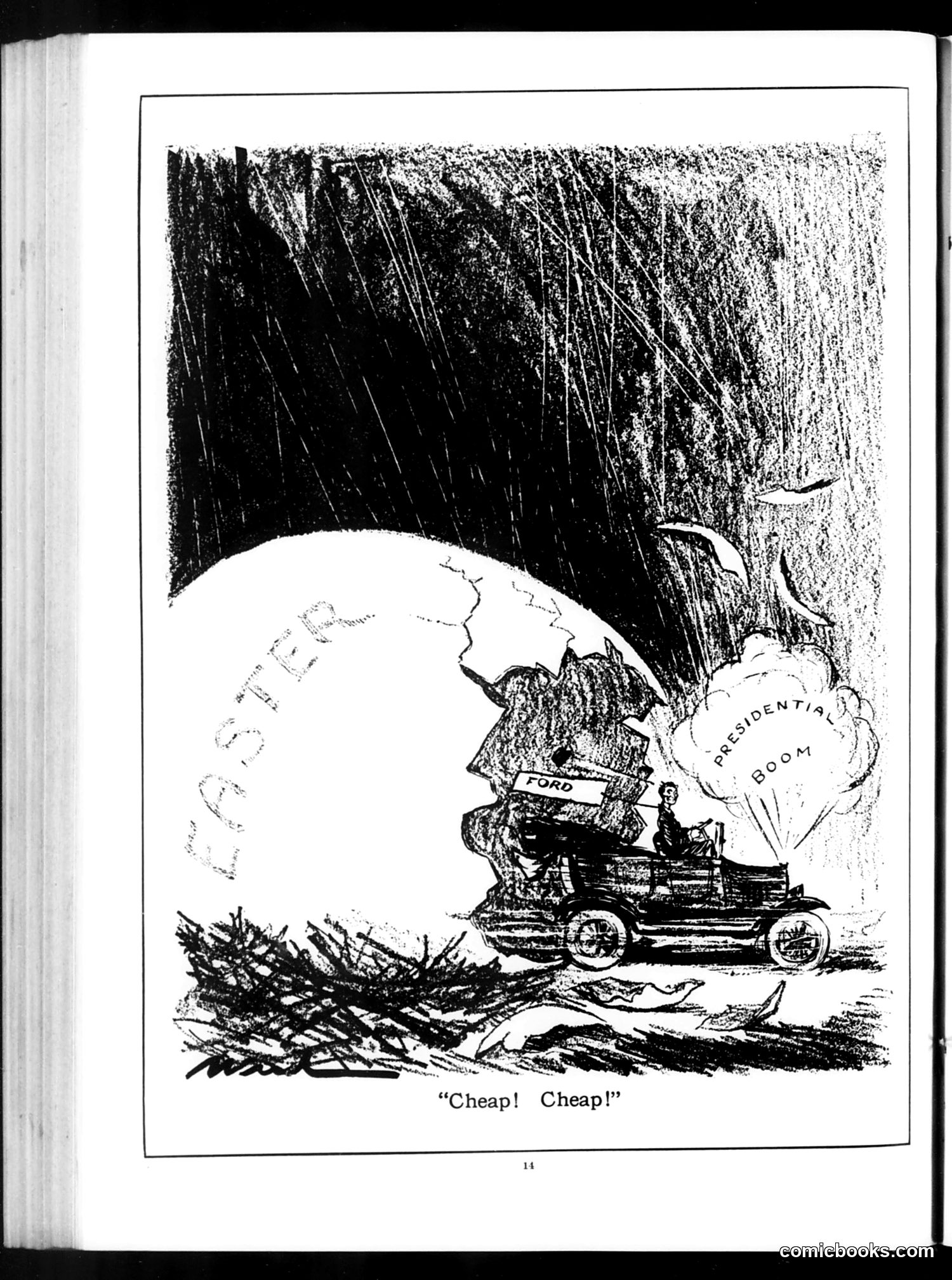
This political cartoon satirizes Henry Ford and his Model T automobile during the early automotive boom. The image shows a Ford car emerging from a giant egg labeled "PRESIDENTIAL BOOM," with the driver exclaiming "Cheap! Cheap!" The satire mocks Ford's famous assertion that he could manufacture affordable automobiles for the masses. The egg imagery suggests Ford's automotive ambitions are newly hatched and emerging. By having the figure cry "Cheap! Cheap!" (mimicking a chick's sound), the cartoonist ridicules Ford's obsessive emphasis on affordability as his primary selling point and political message. This likely references Ford's potential presidential aspirations or his growing political prominence during the 1910s-1920s era.
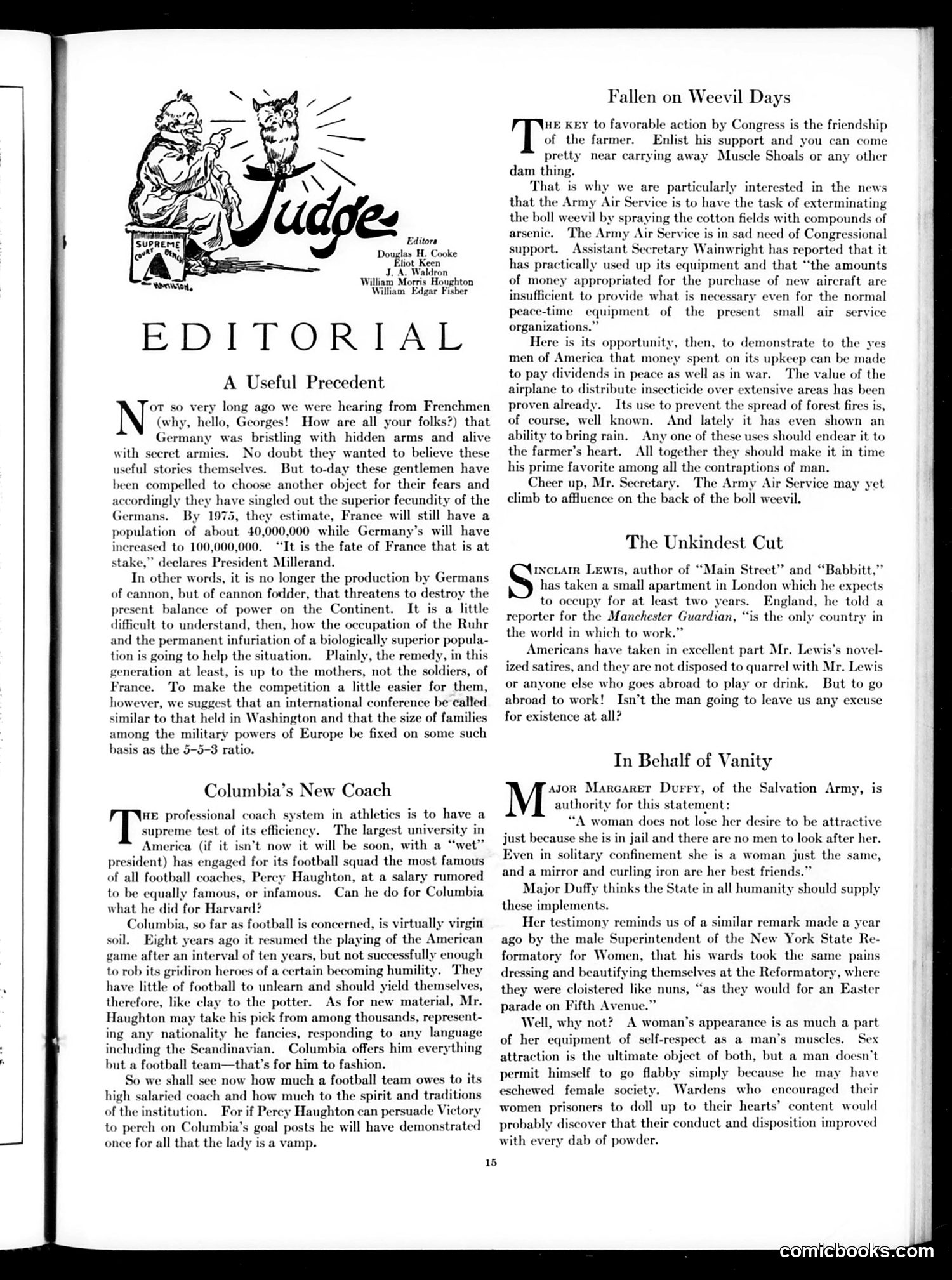
**The cartoons and editorials on this page target several political-social issues:** **"A Useful Precedent"** satirizes French fears of German population growth. France had accused Germany of secret rearmament; now they worry about demographic superiority by 1975 (Germany projected at 100 million vs. France's 40 million). Judge mockingly suggests an international conference to limit European military powers' family sizes—a ridiculous solution parodying the Washington naval treaties. **"Columbia's New Coach"** discusses Columbia University hiring famous coach Percy Haughton. Judge skeptically questions whether his renown (credited with Harvard's success) will matter without genuine football talent, suggesting Haughton must "fashion" a team from scratch—implying Columbia's football program remains weak. **"Fallen on Weevil Days"** advocates for Army Air Service funding through agricultural utility. The service will spray cotton fields with arsenic to eliminate boll weevils, demonstrating practical value to farmers and Congress—a tool for securing appropriations. All pieces employ satirical wit aimed at contemporary political and institutional inefficiencies.
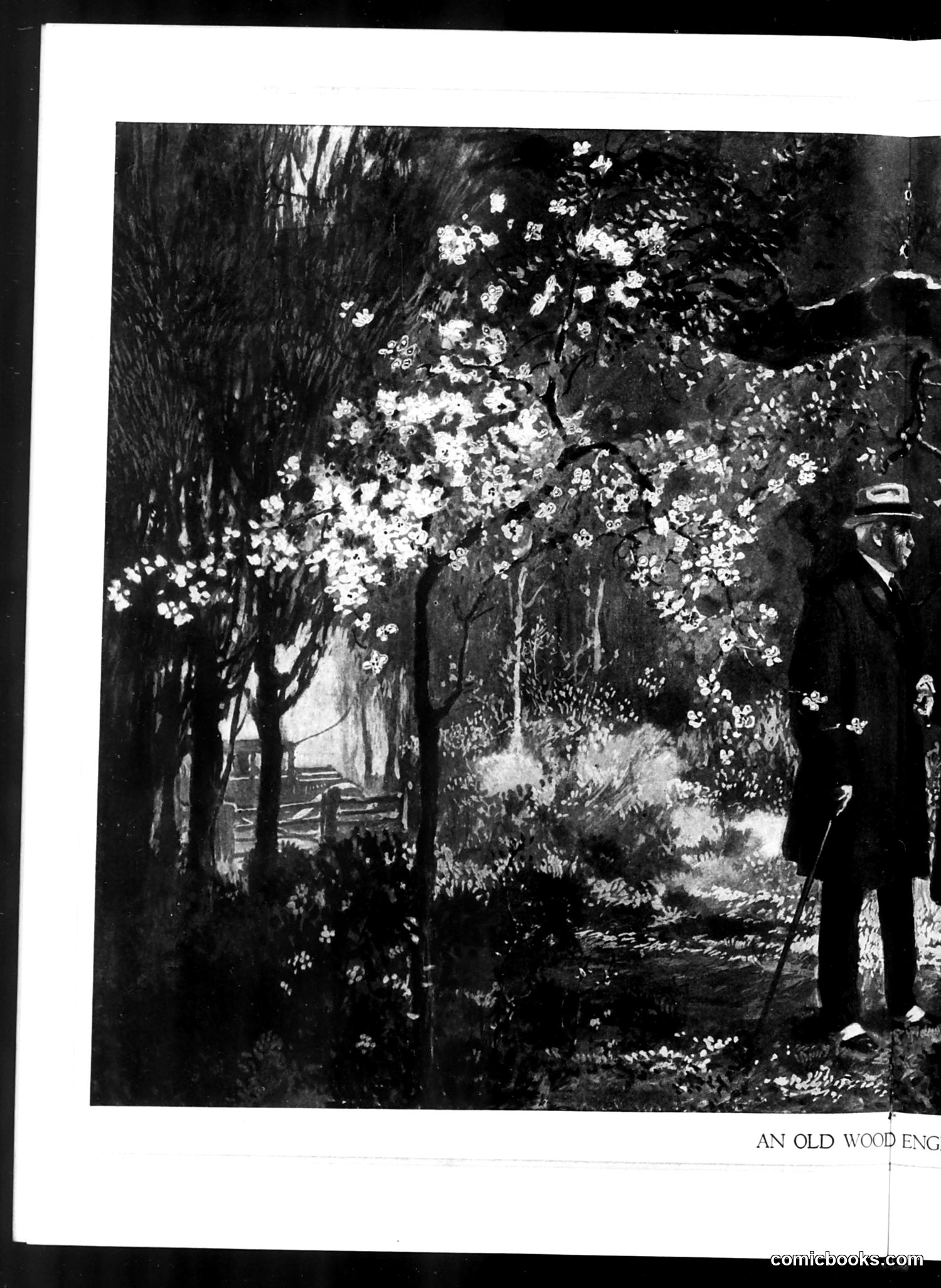
This page appears to be a title or caption for an illustration rather than a complete cartoon. The image shows a black and white landscape scene with flowering vines or blossoms overhead, tall trees framing a pathway, and a figure in formal dress (appearing to wear a hat) standing on the right side. The scene has a romantic, pastoral quality typical of late 19th/early 20th century illustration. The caption "AN OLD WOOD ENG" likely refers to a wood engraving—a traditional printmaking technique. Without additional context or text explaining the satirical intent, the specific political or social commentary this illustration conveys remains unclear. It may simply be an aesthetic piece rather than overt satire.
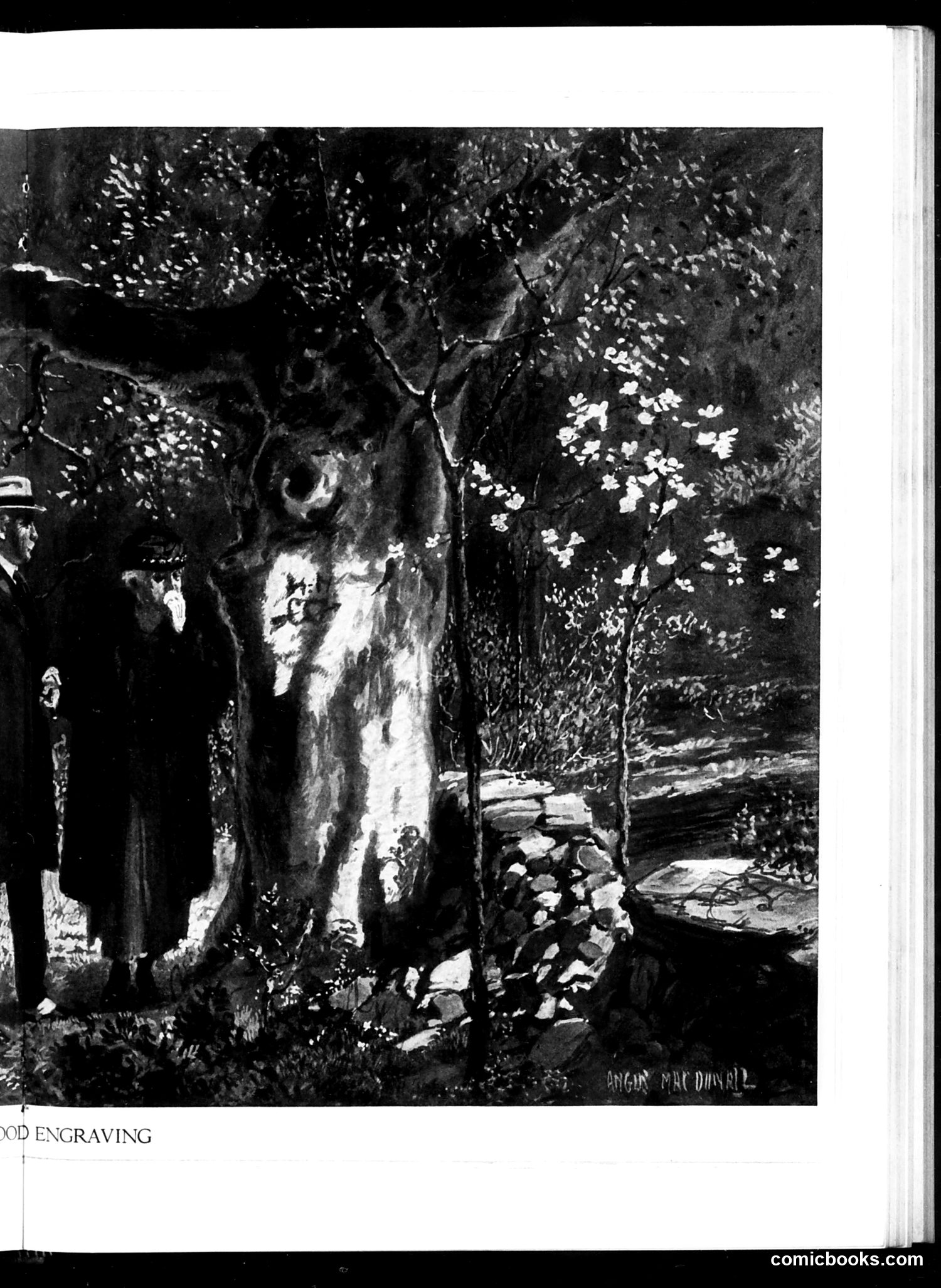
This page appears to be primarily a wood engraving illustration rather than a political cartoon. The black and white image shows a forest or wooded scene with large trees, flowering plants or blossoms visible in the canopy, and what appears to be figures or people among the vegetation below. The style is characteristic of late 19th or early 20th-century wood engraving techniques used in Judge magazine. However, the OCR text is fragmentary and largely illegible, containing only single letters and symbols that don't form coherent words or captions. Without clear text identifying the subject matter, figures, or satirical intent, I cannot definitively explain what political or social commentary this illustration conveys to a modern reader. The caption reads simply "WOOD ENGRAVING," suggesting this may be primarily showcasing the artistic technique rather than making specific satirical commentary.
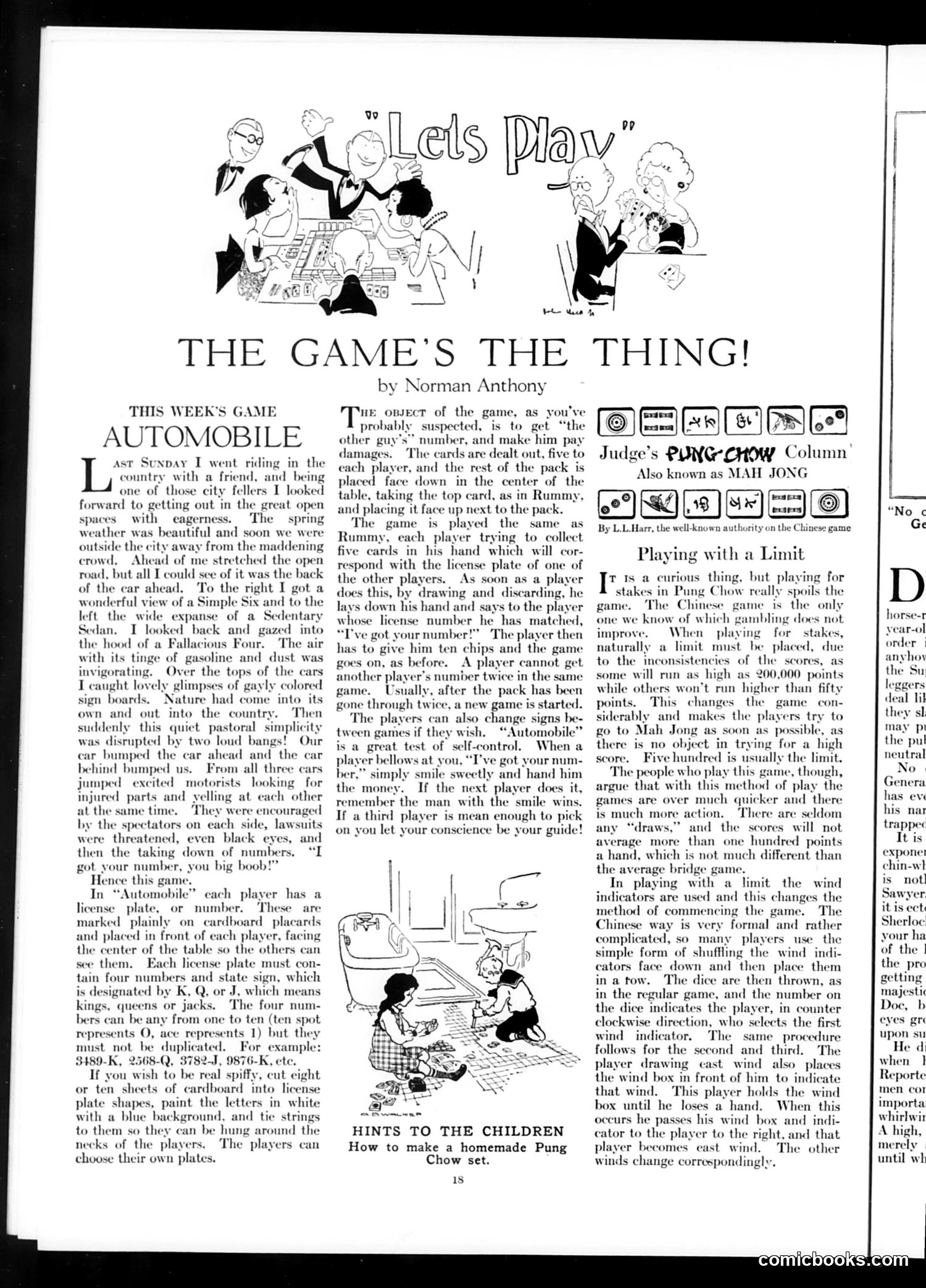
This page presents two unrelated game instructionals by Norman Anthony for Judge magazine readers. **"Automobile" (main feature):** A humorous card game mimicking car accidents. Players receive license plates (numbered cards) and compete to match five cards to opponents' numbers. When successful, they "collect damages"—the loser pays chips. The satire mocks the era's nascent automobile culture: the piece opens with Anthony's anecdote about a country drive ruined by traffic congestion and fender-benders, then transforms this frustration into a parlor game. The joke captures early-20th-century anxiety about automobiles disrupting pastoral life and increasing interpersonal conflict through collisions. **"Pung Chow" (sidebar):** Brief instructions for the Chinese game Mahjong, which was experiencing a craze in America during the 1920s-30s. The column discusses playing with betting limits. The page emphasizes leisure gaming as social commentary on modern American anxieties—automobiles and foreign gaming crazes.
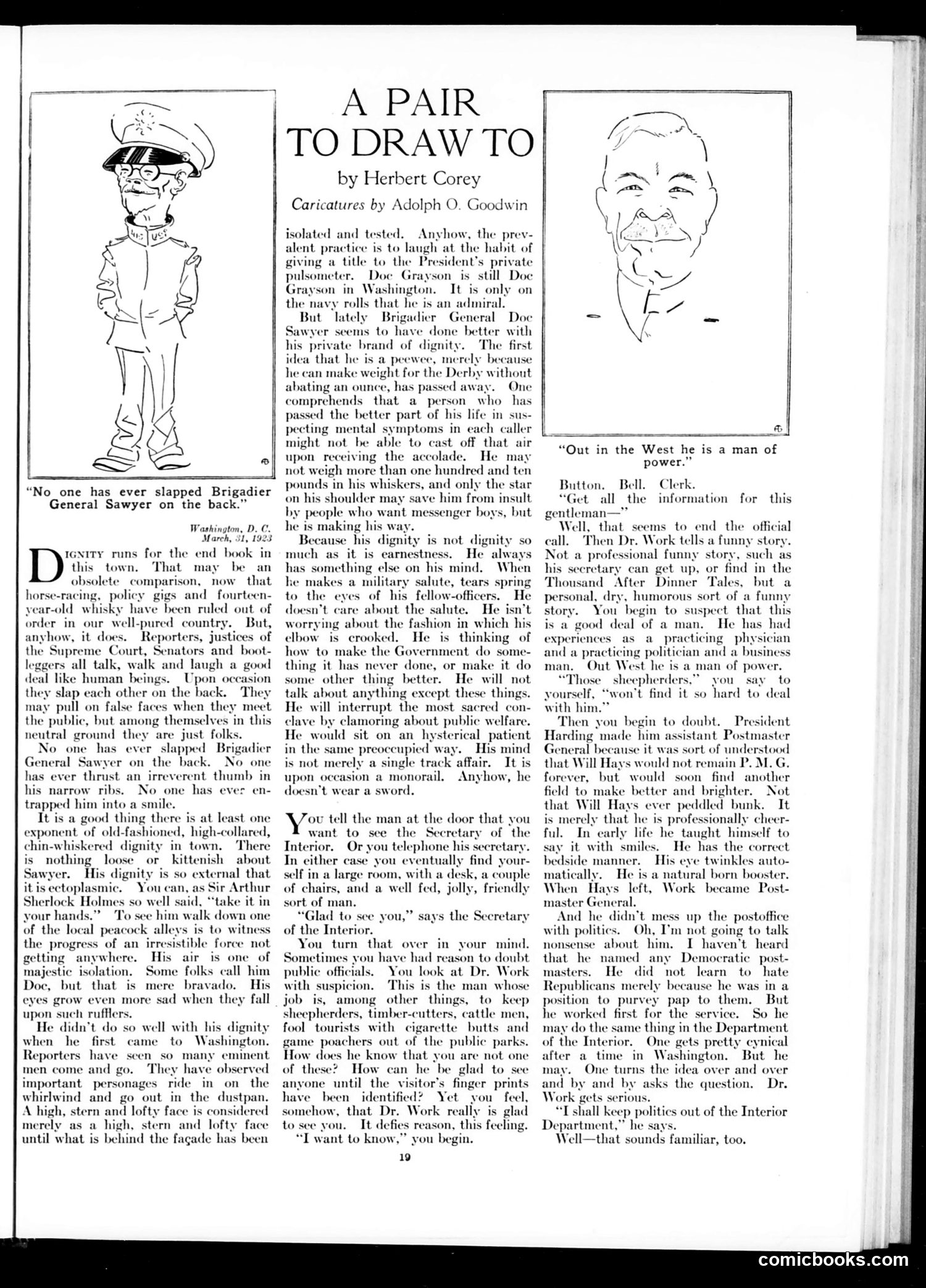
This satirical piece by Herbert Corey profiles **Brigadier General Doc Sawyer**, the President's private physician (appears to be during the Harding administration, circa 1923 based on the date). The satire contrasts Sawyer's exceptional personal dignity—so stern and formal that even seasoned Washington reporters cannot get him to relax or smile—with his genuine earnestness about public welfare. Unlike typical Washington figures who adopt masks for the public, Sawyer maintains rigid formality even in private. The humor lies in the paradox: his dignity isn't mere pretense but stems from his preoccupation with doing good for the government. He interrupts important meetings to argue about public policy, sits with patients in his characteristic distracted manner, and refuses to play Washington's social games. The caricature emphasizes his small stature ("doesn't weigh more than one hundred and ten pounds") and stern expression, making him an anomaly in a capital full of backslapping politicians. The title suggests he's worth drawing—a character type worth capturing.
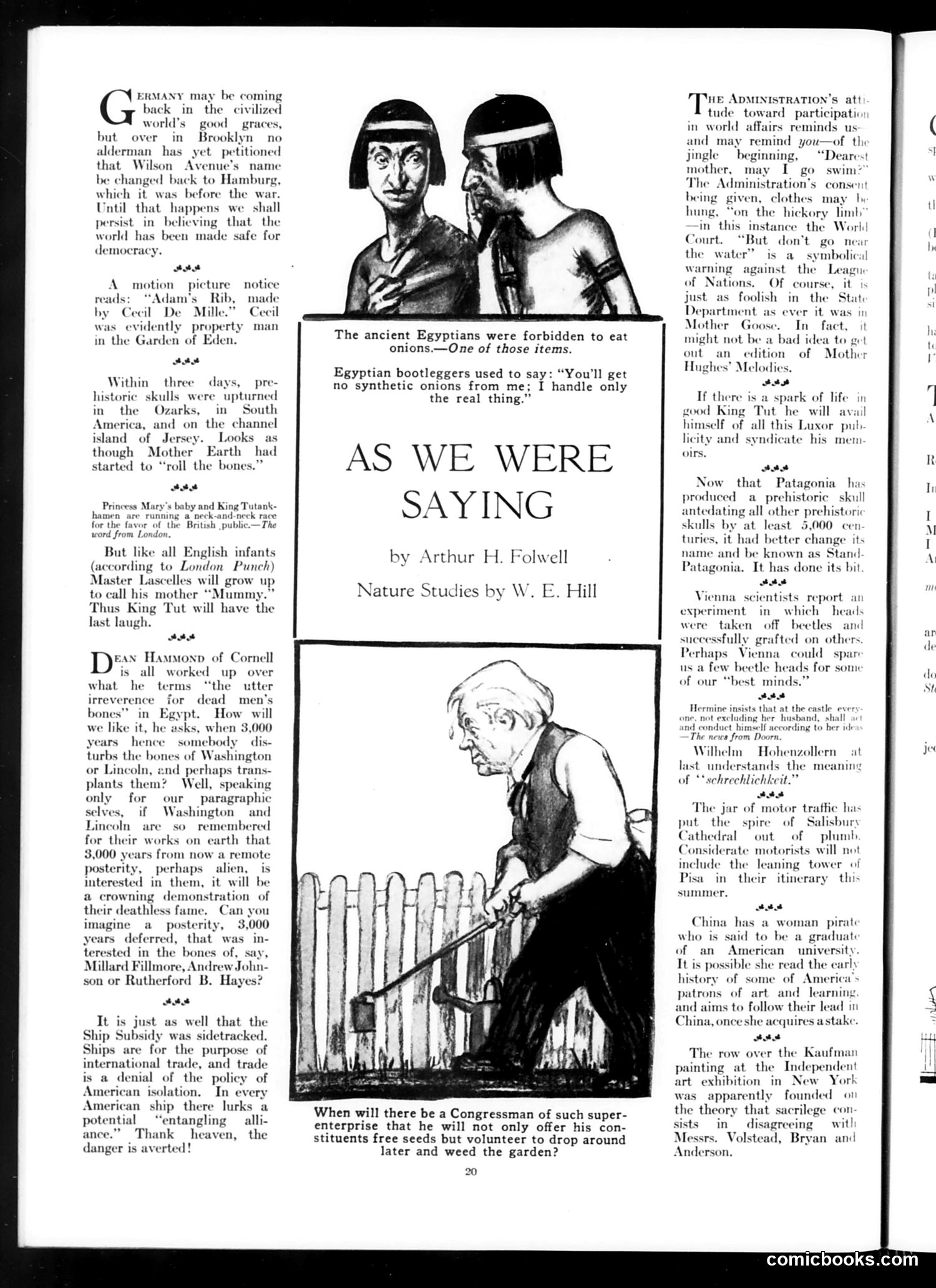
This page from Judge contains several brief satirical commentary pieces and illustrations typical of 1920s American humor: **Main cartoon**: Two Egyptian mummy heads illustrate jokes about Egyptian bootleggers selling "real" onions (referencing Prohibition-era bootlegging) and ancient Egyptian burial customs—commentary on contemporary American lawbreaking dressed in historical costume. **Text satire**: The pieces mock: - Post-WWI reconciliation with Germany (Wilson Avenue's name change from "Hamburg") - American isolationism and reluctance toward the League of Nations - The frenzy over recently-discovered prehistoric skulls - King Tutankhamun's popularity in British culture - Proposed Congressional pork-barrel "seed distribution" programs **W.E. Hill illustration**: Shows an elderly gardener at a fence—likely accompanying the seed/gardening joke. The overall tone satirizes American politics, isolationism, and popular culture obsessions of the early 1920s, using wordplay and historical/current-event references to make contemporary points.
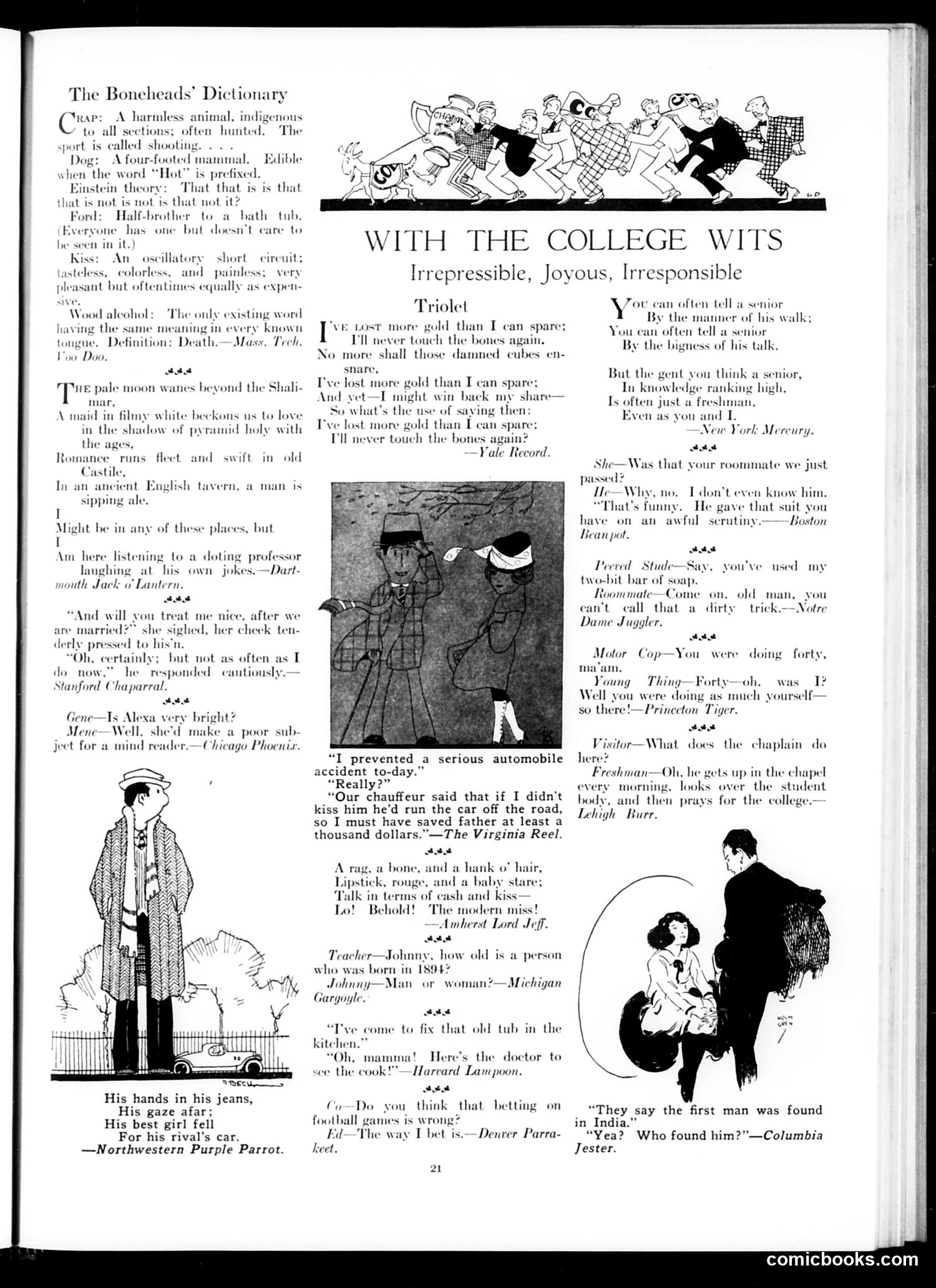
This page from *Judge* magazine contains two main sections: a humorous "dictionary" of slang and a college-humor section titled "With the College Wits." **"The Boneheads' Dictionary"** satirizes contemporary slang and popular concepts. Notable entries include: - **Ford**: A joke about Henry Ford's Model T (the car "half-brother to a bath tub"), mocking its basic design - **Einstein theory**: A nonsensical definition poking fun at Albert Einstein's relativity, which was famously difficult for the public to understand - **Wood alcohol**: Dark humor about Prohibition-era dangers **"With the College Wits"** collects humorous quips from college magazines. The jokes target college stereotypes—gambling ("I've lost more gold"), dating behavior, and student pretension (seniors distinguished only by their swagger). One joke references a chauffeur coercion scenario; another mocks modern women as materialistic ("Talk in terms of cash and kiss"). The cartoons depict typical college and young-adult scenarios: a dapper man, students in romantic situations. The overall tone reflects 1920s-era attitudes toward education, gender, and social class.
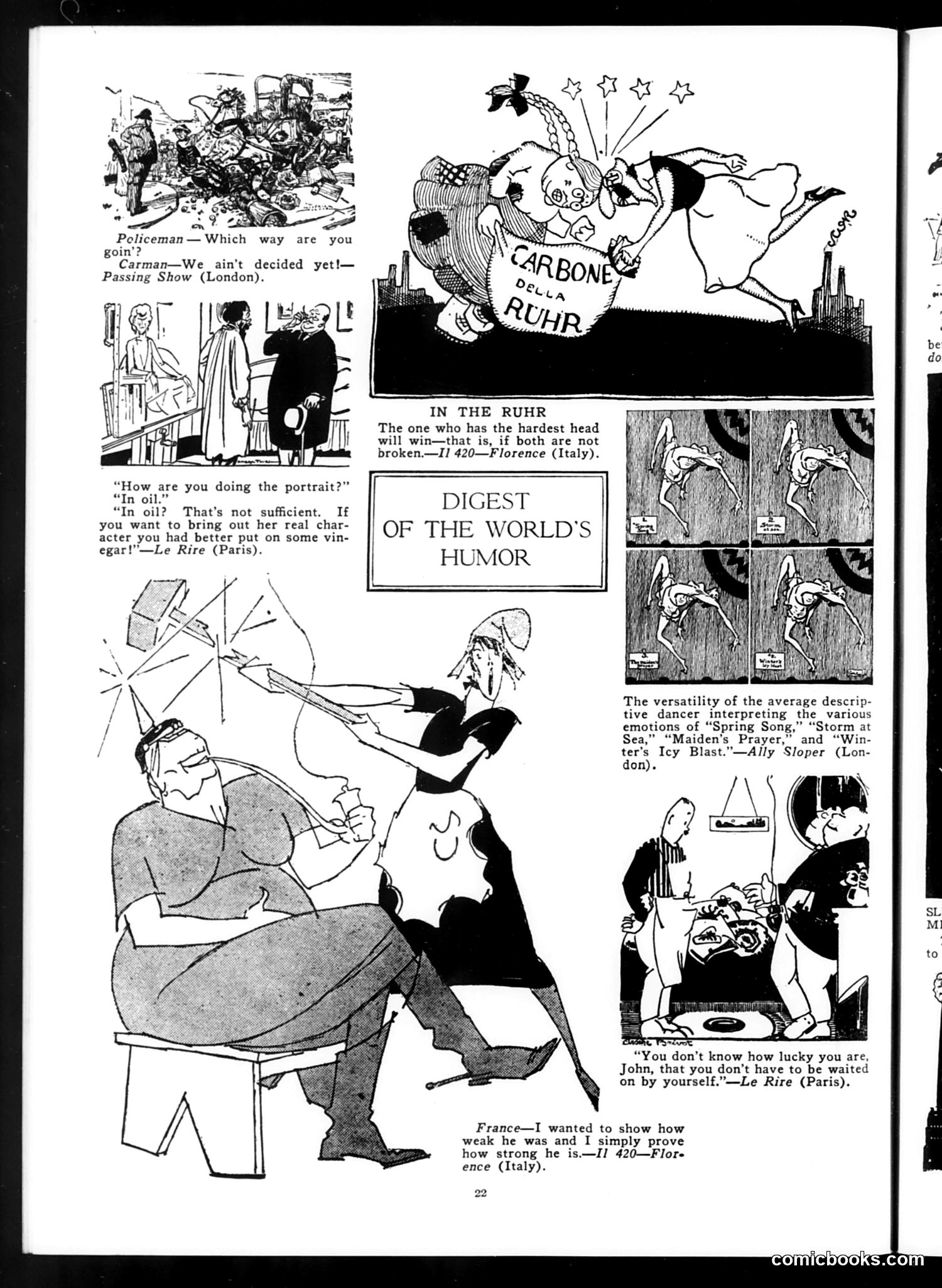
This page collects international satirical cartoons from Judge magazine, presenting humor translated from European sources (London, Paris, Italy). **Key content:** The main cartoon "In the Ruhr" depicts two figures fighting over the industrial Ruhr region—a reference to post-WWI Franco-German tensions over this coal/steel area. The caption's dark joke about "hardest heads" breaking suggests mutual destruction rather than victory. Other jokes target: portrait painting requiring "vinegar" (implying bitterness reveals character), a descriptive dancer's versatility across emotional pieces, and domestic service ironies. **Historical context:** This appears from the 1920s Weimar period, when the Ruhr occupation and Franco-German hostilities dominated European politics. The cartoons reflect anxieties about ongoing conflict and reconstruction. **The satire:** These are straightforward gags relying on wordplay and exaggeration—typical Judge humor meant to mock both social pretension and international tensions through accessible comedy.
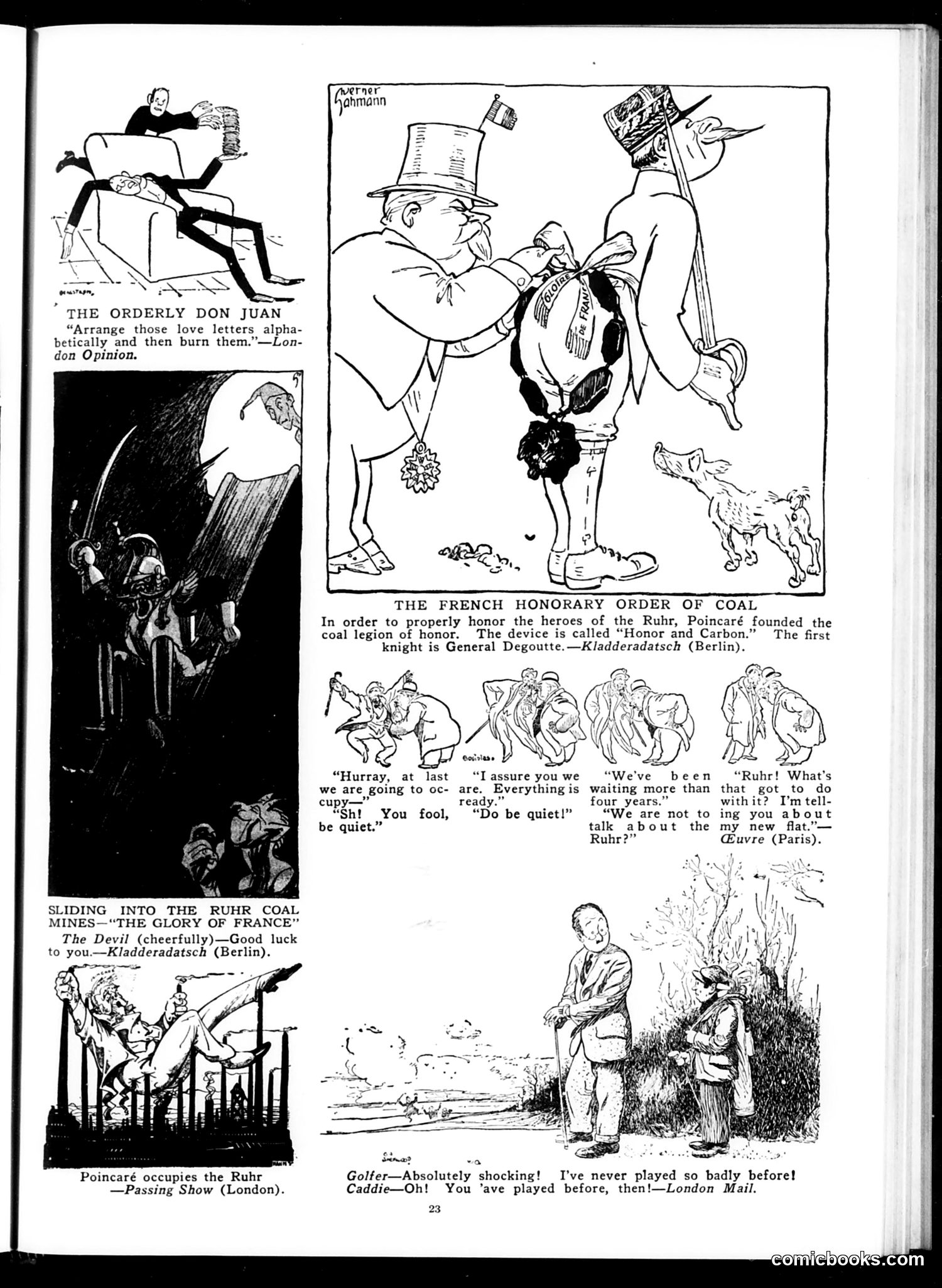
This Judge page satirizes France's military occupation of Germany's Ruhr coal region following World War I. The central cartoon mocks French Premier Poincaré's invasion as a "coal legion of honor"—sarcastically suggesting France dressed up resource theft as heroic military achievement. The surrounding dialogue comics show French soldiers' impatience for occupation to begin, with German commentary ("Kladderadatsch") depicting the venture as damnable folly. One cartoon shows soldiers "sliding into the Ruhr coal mines" as "the glory of France," with the Devil wishing them luck—implying moral corruption. The scattered cartoons use dark humor: a golfer analogy jokes about repetitive failure, while "Don Juan" concerns orderly letter-burning, possibly alluding to destroying evidence of diplomatic maneuvering. **Context**: Germany's Ruhr occupation (1923) was hugely controversial internationally—seen as aggressive French imperialism rather than legitimate war reparations enforcement.
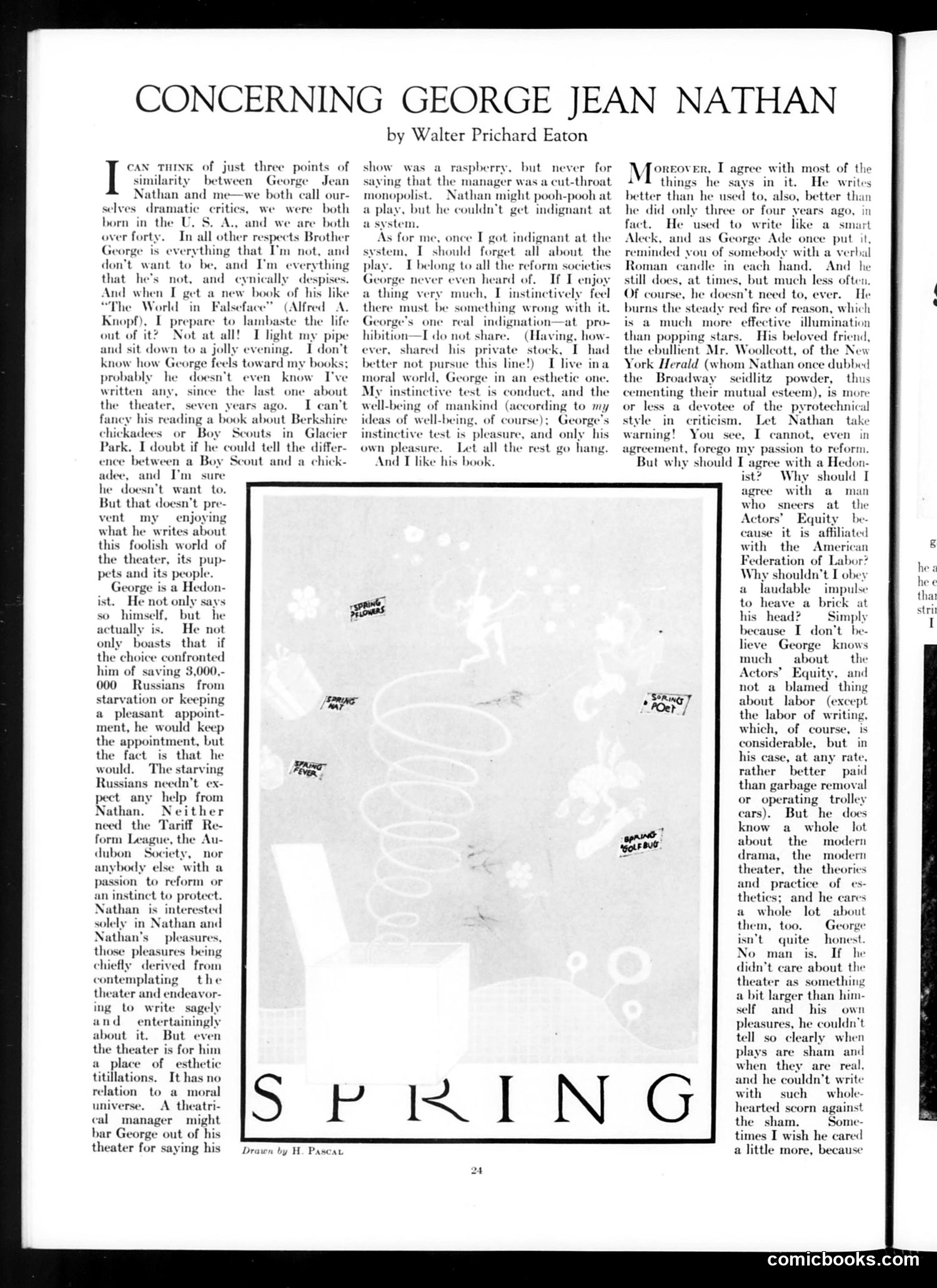
This page features a critical essay by Walter Prichard Eaton about **George Jean Nathan**, a prominent theater critic of the early 20th century. The main cartoon appears to be a simple illustration labeled "SPRING" (drawn by H. Pascal), which seems decorative rather than satirical. Eaton's text contrasts their opposing worldviews: Nathan is a "Hedonist" who values aesthetic pleasure above moral concerns—famously claiming he'd keep a pleasant appointment rather than save millions from starvation. Eaton, by contrast, is a moralist who applies ethical judgment to everything, including theater. The satire is gentle and affectionate. Eaton admits Nathan writes brilliantly about theater despite—or because of—his cynical amorality. He praises Nathan's recent improvement in style, comparing his older writing to "a verbal Roman candle." The piece exemplifies how early-20th-century intellectuals debated whether art criticism should serve moral purposes or exist purely for aesthetic appreciation—a recurring modernist tension.
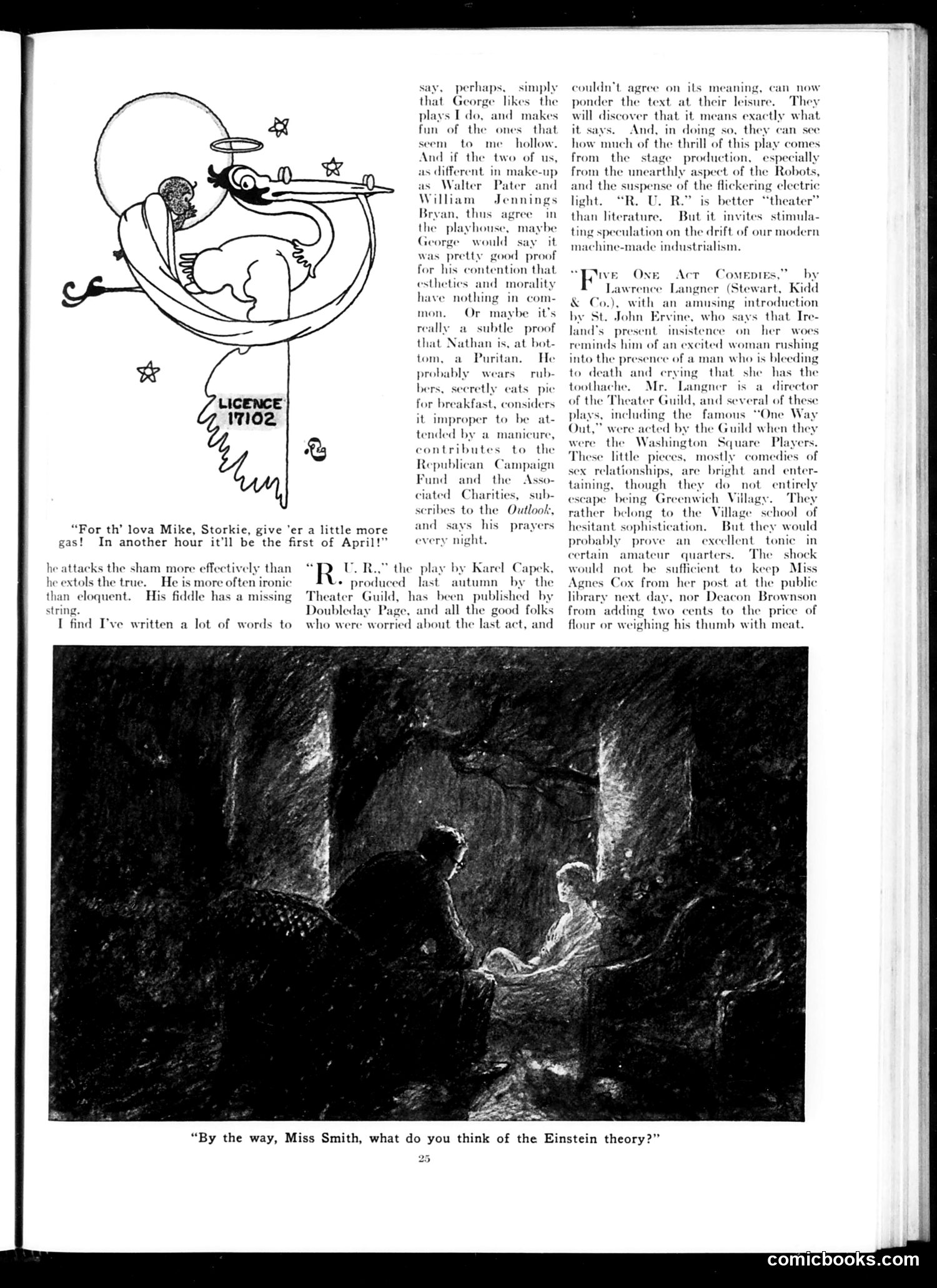
**Upper Cartoon:** A whimsical line drawing shows a figure (likely representing a playwright or critic) suspended in a crescent moon with stars, labeled "Licence 17102." The caption quotes someone urging "Storkie" to give "a little more gas" before April 1st—referencing April Fools' Day. This appears to mock theatrical pretension or overwrought drama criticism. **Lower Photograph & Text:** The page discusses theater reviews, particularly praising Karel Čapek's "R.U.R." (a play about robots) and Lawrence Langner's one-act comedies. The critique notes that "R.U.R." works better as theater than literature due to its visual spectacle. The text also gently satirizes moral prudishness—suggesting even conservative figures like a librarian (Miss Cox) and deacon would remain unmoved by the play's provocative content. **The Point:** Judge is mocking both theatrical grandiosity and audience hypocrisy—the gap between claimed artistic sensitivity and actual provincial morality.
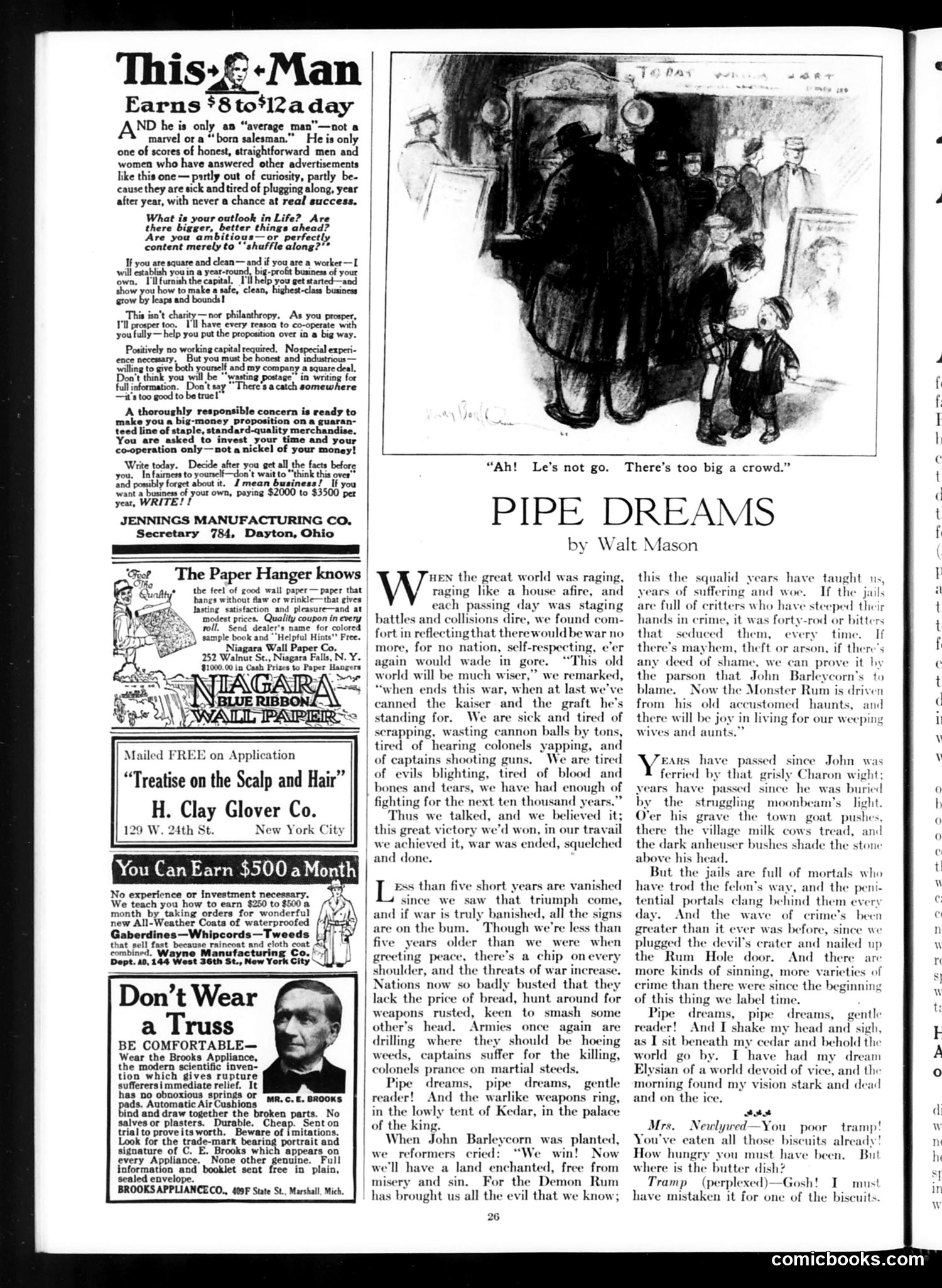
This page is primarily **advertisements**, not political satire. The main content consists of business opportunity ads promising income ($8-12/day, $500/month, etc.) to appeal to working-class readers seeking better employment. The only cartoon appears at top right, illustrating "Pipe Dreams" by Walt Mason—a short story about post-WWI disillusionment. The sketch shows an adult and child viewing a large, menacing figure (possibly representing crime, vice, or urban danger), with the child saying "Ah! Let's not go. There's too big a crowd." This reflects post-war anxiety about urban crime and moral decay. Mason's accompanying text references the recent war's end, expressing weary hope that nations will abandon violence, while acknowledging cynicism about whether real peace will follow. The "pipe dreams" are naive optimistic fantasies contrasted against continuing social problems (crime, poverty, vice). The ads themselves constitute *indirect* social commentary—their proliferation suggests widespread economic anxiety and desperation for advancement among the magazine's working-class readers.
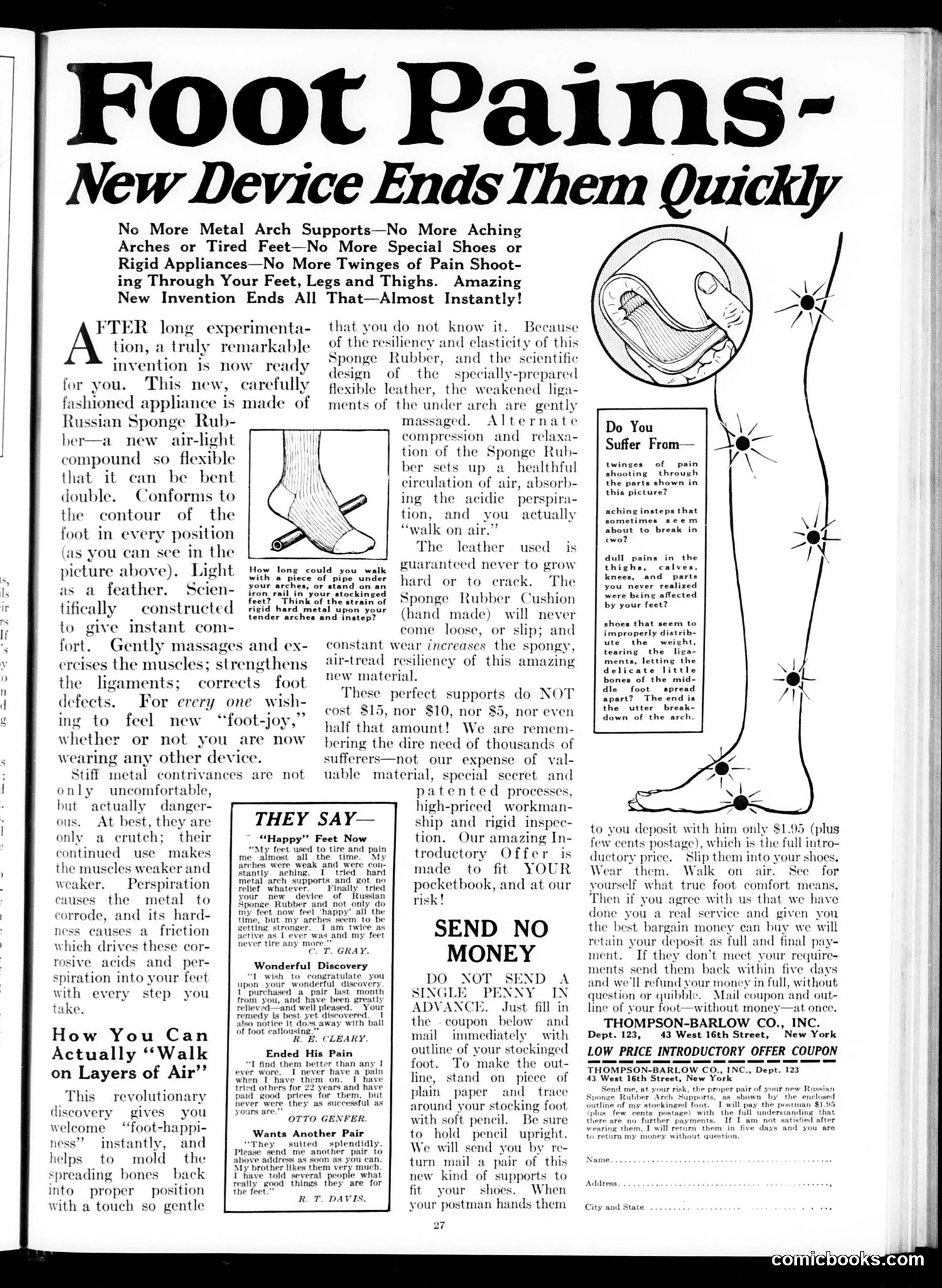
This is primarily a **mail-order advertisement**, not political satire. It promotes a "Russian Sponge Rubber" foot arch support device as a revolutionary alternative to rigid metal supports. The page uses common early 20th-century advertising rhetoric: testimonials ("They Say"), anatomical diagrams showing foot pain points, and appeals to consumer anxiety about foot ailments. The "Send No Money" offer—requiring only a traced footprint—was a typical direct-mail marketing tactic designed to lower purchase barriers. The cartoonish foot illustrations with radiating pain symbols are decorative rather than satirical, meant to visually communicate suffering. The advertisement targets people experiencing genuine foot problems, positioning this new flexible rubber device as superior to existing metal orthotics that supposedly weakened muscles and corroded from perspiration. This reflects early-1900s consumer culture: heavy advertising, mail-order commerce, and medical device marketing in mass-circulation magazines like *Judge*.
This page is primarily **financial advertising and investment advice**, not political satire. It contains multiple stock brokerage and bond advertisements from firms like Clarence Hodson Inc., I.S. Bache & Co., and James M. Leopold & Co., promoting investment opportunities. The substantive editorial content is Theodore Williams's article "Good Things in Oil," which argues optimistically that the petroleum industry faces unlimited growth. Williams contends there's "no known limit" to earth's petroleum reserves and predicts demand from automobiles and industrial use will prevent overproduction. He specifically highlights new discoveries in Smackover, Venezuela, Alaska, and Africa as evidence of continued supply. This reflects early-20th-century American confidence in natural resource abundance and industrial expansion. The article positions oil stocks and petroleum-related securities as sound investments, serving the magazine's dual purpose as satirical commentary *and* financial publication for its affluent readership.
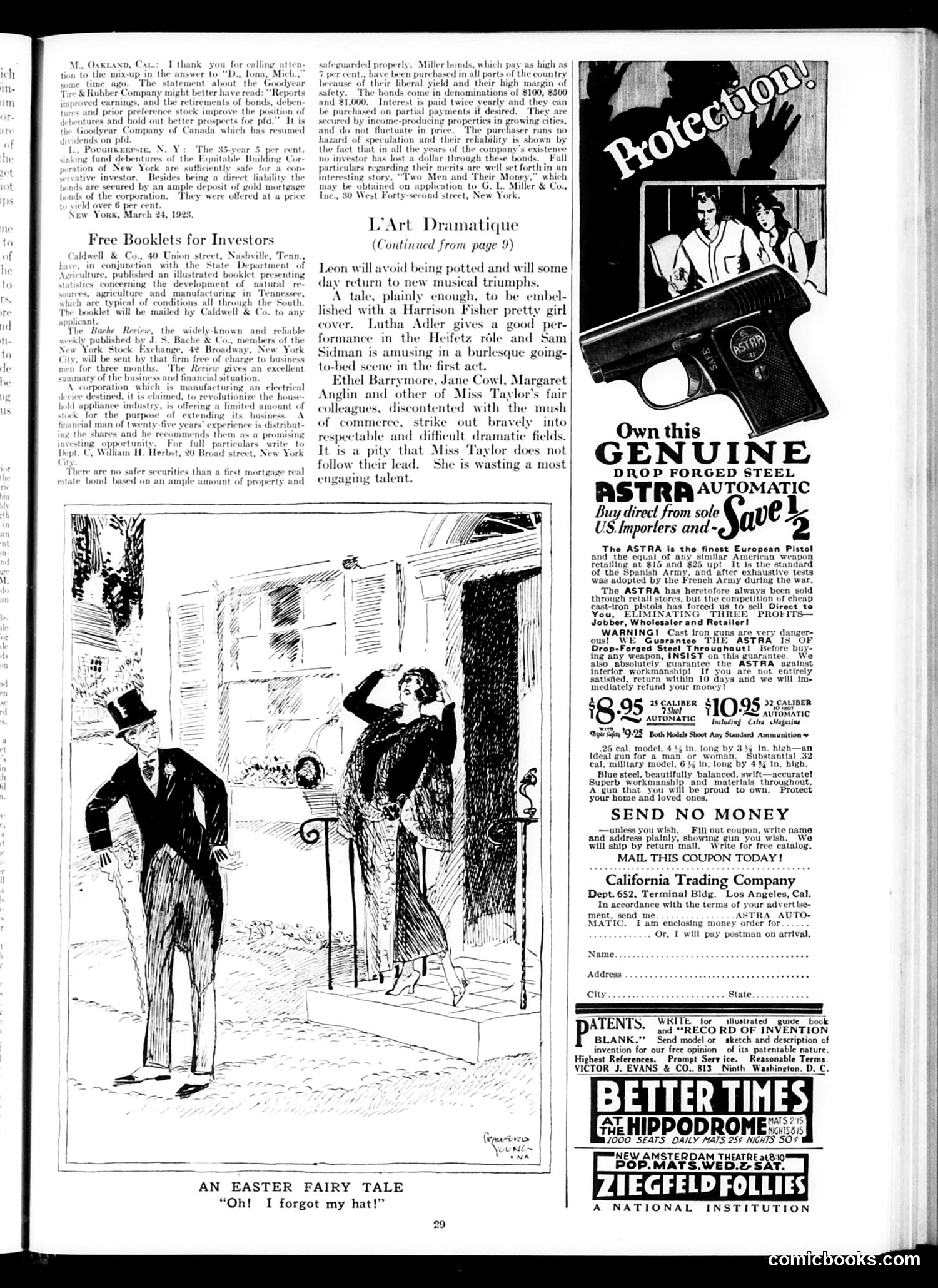
**The Main Cartoon: "An Easter Fairy Tale"** The illustration shows a well-dressed gentleman in a top hat encountering a woman at a doorway, with the caption "Oh! I forgot my hat!" This is a mild Easter-themed social comedy. The joke appears to be about embarrassment or awkwardness—the man has forgotten his hat while visiting (likely in a compromising situation suggested by his disheveled appearance). It's genteel satirical humor typical of Judge's era: poking fun at upper-class social etiquette and romantic entanglements, not crude but suggestive of impropriety. **Context for Modern Readers:** The hat was essential formal attire in the 1920s; forgetting it represented carelessness or haste, implying the gentleman left in a flustered state. The humor relies on readers understanding both the importance of proper dress codes and the social scandal of being caught in an undignified situation. The rest of the page consists primarily of investment advice columns and advertisements for firearms and theatrical productions—typical magazine content of the era.
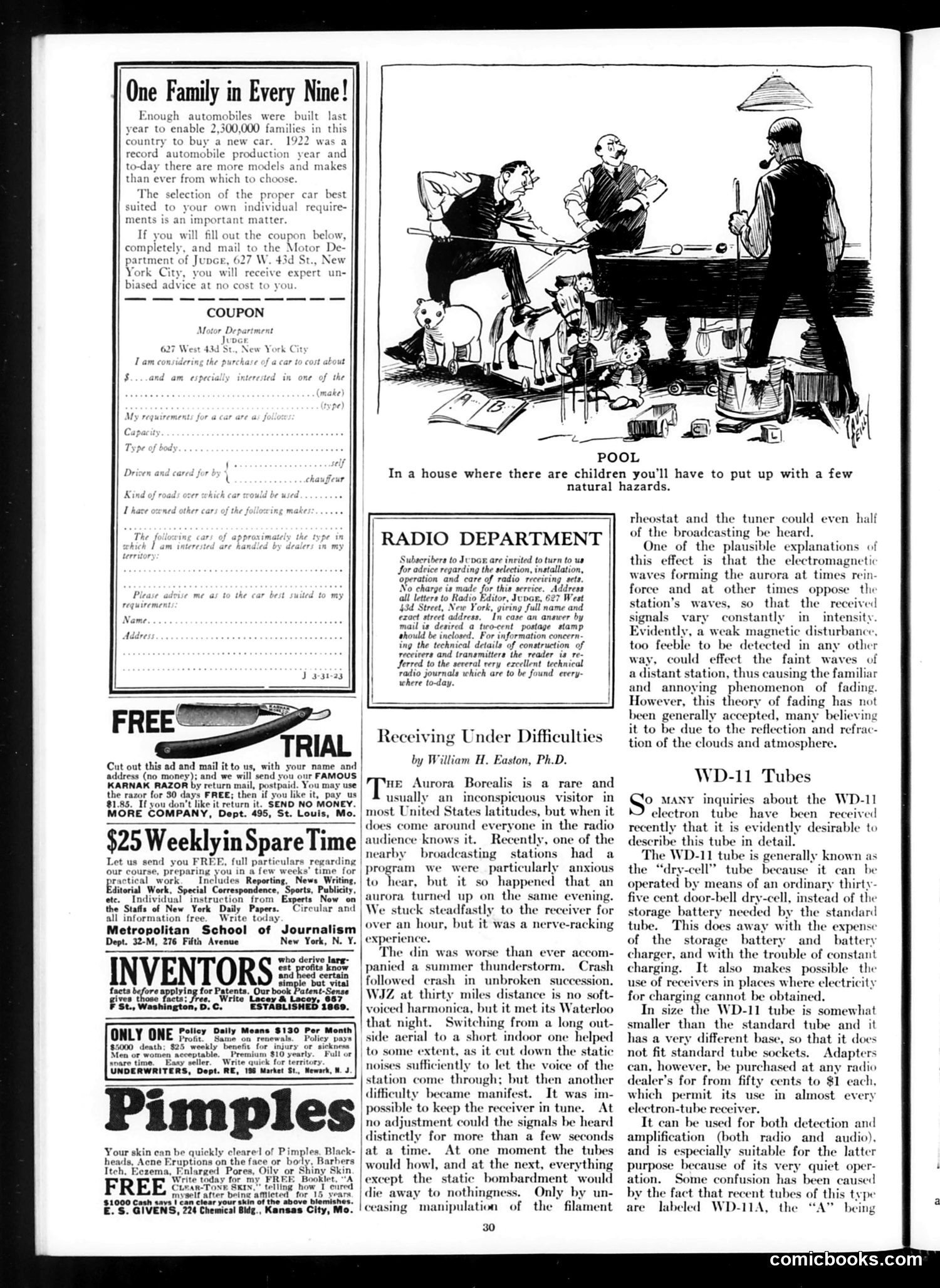
This page contains **automotive and radio-era advertisements mixed with technical content**, reflecting 1920s consumer culture. The main cartoon (top right) satirizes **family life with a new automobile**. It depicts chaos in a home where children play with toys while adults discuss cars—suggesting that owning a car creates "natural hazards" through distraction and domestic disruption. The joke critiques how automobiles were becoming status symbols that dominated middle-class conversation and priorities. The page also features: - A **Motor Department coupon** offering free automobile-buying advice from Judge magazine - A **Radio Department** section addressing the growing obsession with radio technology - An article by William H. Easton on **radio reception difficulties**, specifically how the Aurora Borealis (Northern Lights) interferes with radio signals—a genuine technical problem for 1920s radio enthusiasts The advertisements (razors, journalism courses, pimple treatments) represent typical Judge content. Overall, the page captures the **technological excitement and social disruption** of the 1920s consumer boom.
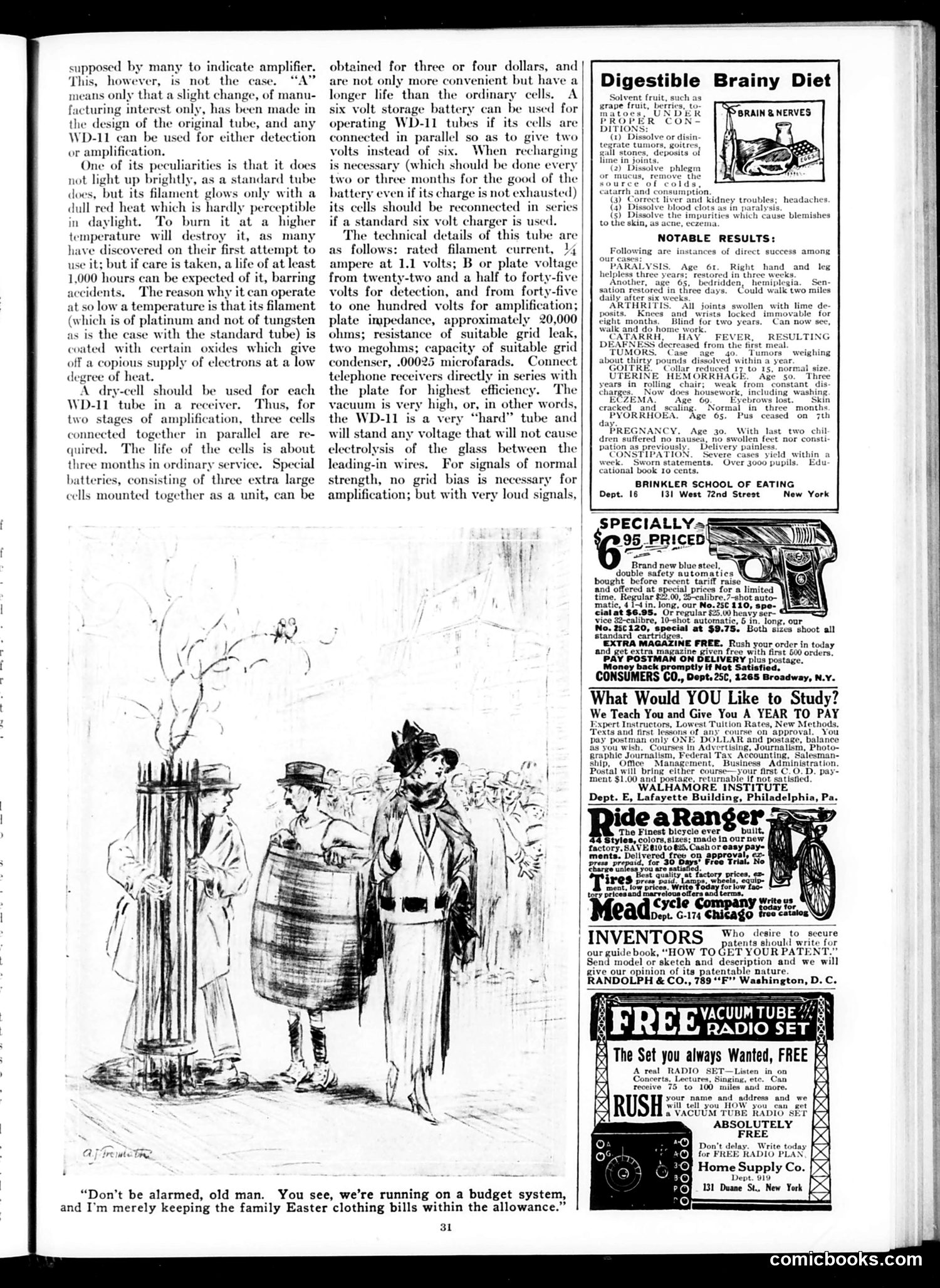
The cartoon depicts a domestic scene featuring a woman with what appears to be an enormous barrel or basket of clothing, confronting a man (likely her husband). The woman is explaining their financial arrangement by saying they operate on a "budget system" where she limits Easter clothing bills to stay within the family allowance. **The Satire:** This is a gentle jab at domestic economy and marriage dynamics. The humor lies in the obvious contradiction: the woman is holding what looks like an enormous quantity of clothing while claiming she's being fiscally responsible. The joke suggests that women's interpretation of "staying within budget" may differ considerably from what husbands believe they've authorized. It satirizes both spouse management of household finances and the gap between stated financial discipline and actual spending behavior—a domestic tension that evidently resonated with Judge magazine's early 20th-century readership. The cartoon reflects social attitudes about women, shopping, and marital economics typical of the era.
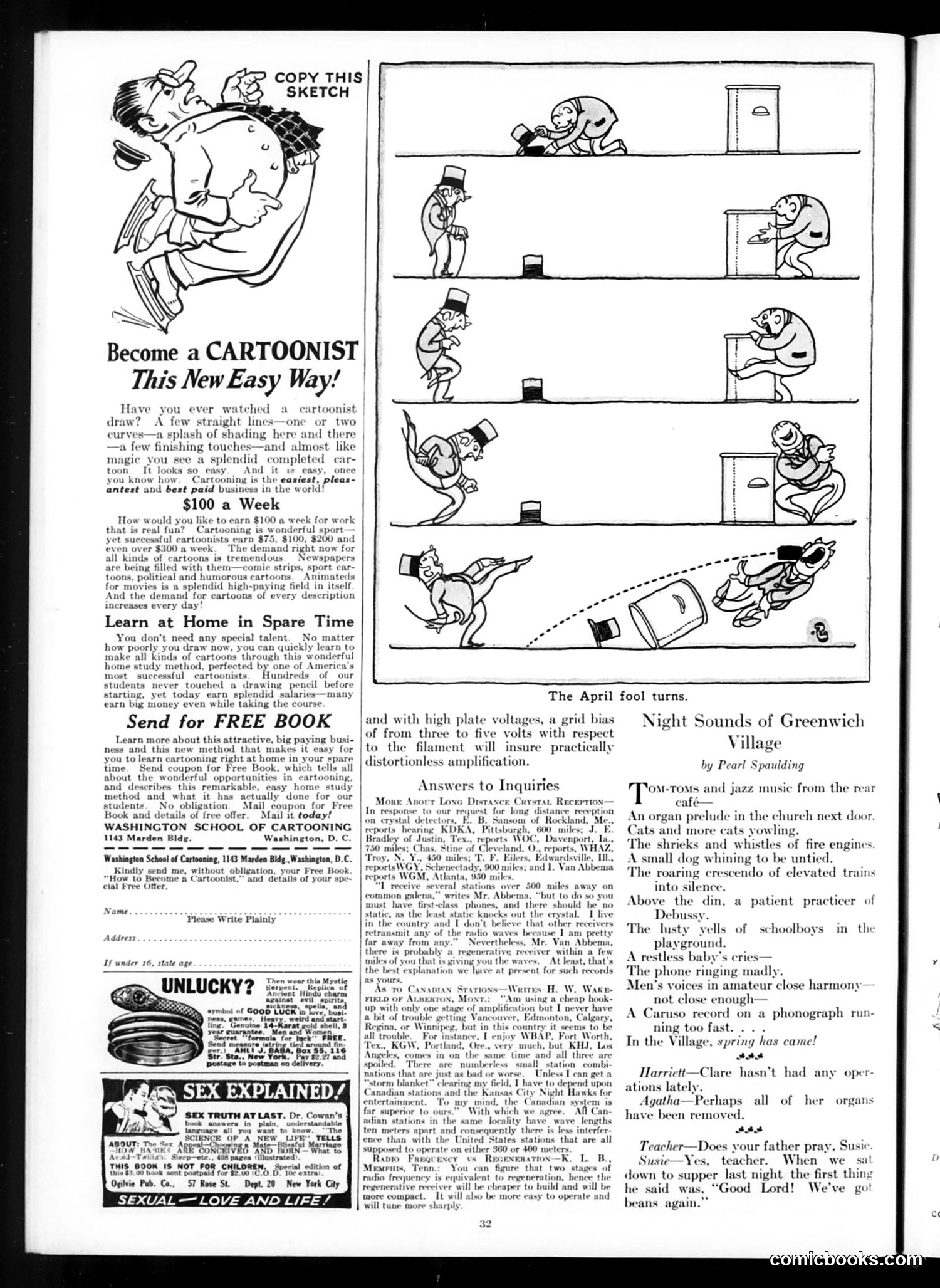
This page contains **primarily advertisements and filler content**, not political satire. The main feature is a **cartooning school advertisement** from the Washington School of Cartooning, promising readers they can earn "$100 a Week" learning to draw cartoons at home. The sequential sketches on the right show a figure progressively launching himself from a cannon—a visual gag illustrating the concept of "becoming a cartoonist." Below are **unrelated classified advertisements**: one hawking a "Mystic Symbol" for good luck, another titled "Sex Explained" promoting a medical pamphlet. The page also contains a **short story excerpt** ("Night Sounds of Greenwich Village" by Pearl Spaulding) and a Q&A column addressing radio enthusiasts' technical questions about crystal receivers and transmission. **No discernible political or social satire appears on this page.** It represents typical magazine filler from the era—a mix of practical instruction advertising, medical/pseudo-scientific promotions, and light literary content designed to fill space between major features.
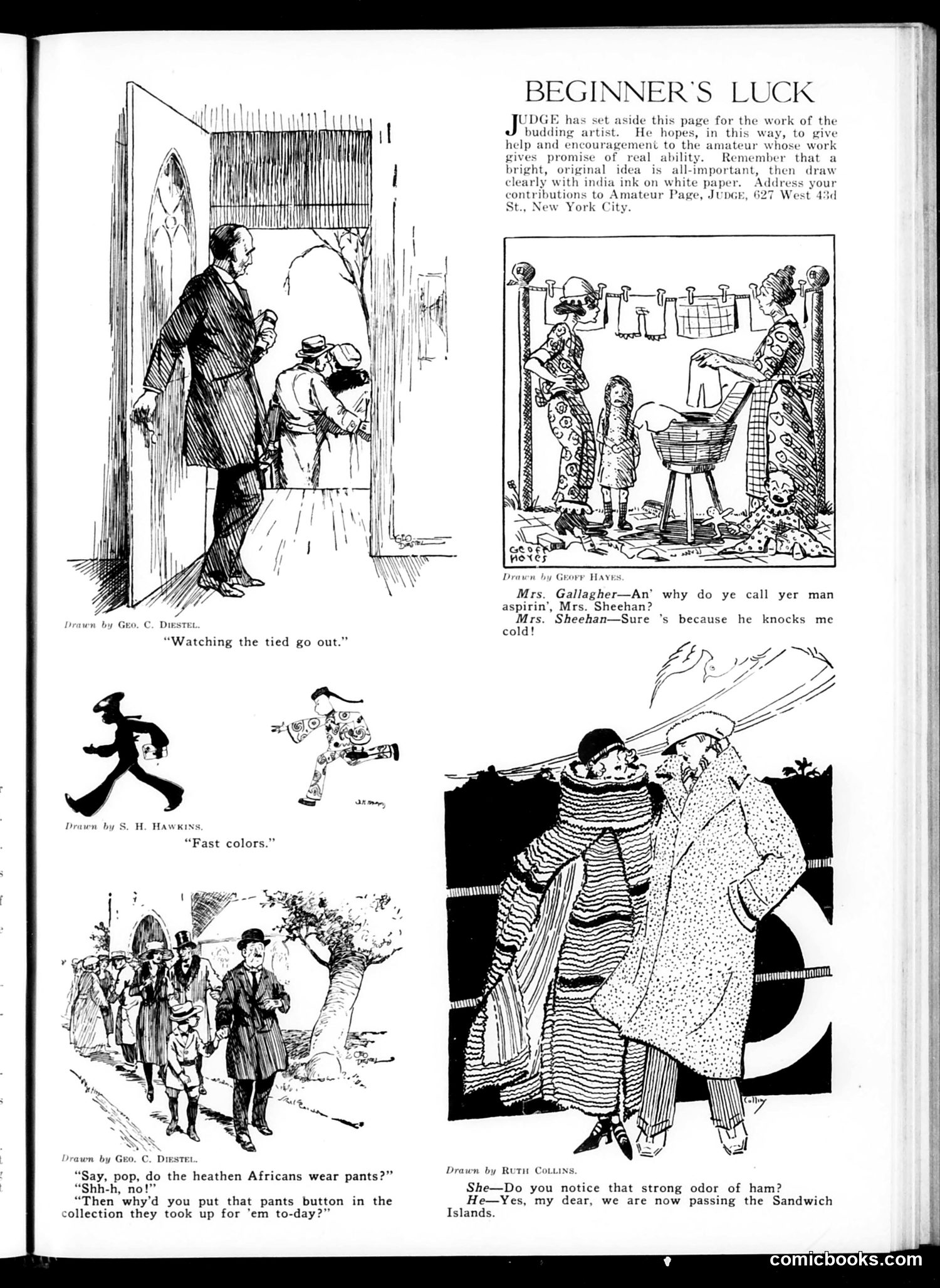
This is an editorial page showcasing amateur cartoonists' work. The header explains Judge is publishing submissions from aspiring artists to encourage talent. The cartoons are short gags typical of early-20th-century humor: - **"Watching the tied go out"**: A man observes someone leaving (possibly a servant or visitor). - **Irish domestic servants joke**: Mrs. Sheehan calls her husband "aspirin" because he "knocks me cold"—a pun on aspirin's effects. - **"Fast colors"**: A figure running; unclear without more context. - **African clothing absurdity**: A child asks why Africans don't wear pants; the father jokingly suggests someone donated a pants button to a collection for Africans, implying the absurdity of the charity. - **"Sandwich Islands" pun**: A couple smells ham while passing the Sandwich Islands (now Hawaii), a simple geographic wordplay. The humor is gentle, domestic, and relies on puns and simple observations rather than sharp satire.
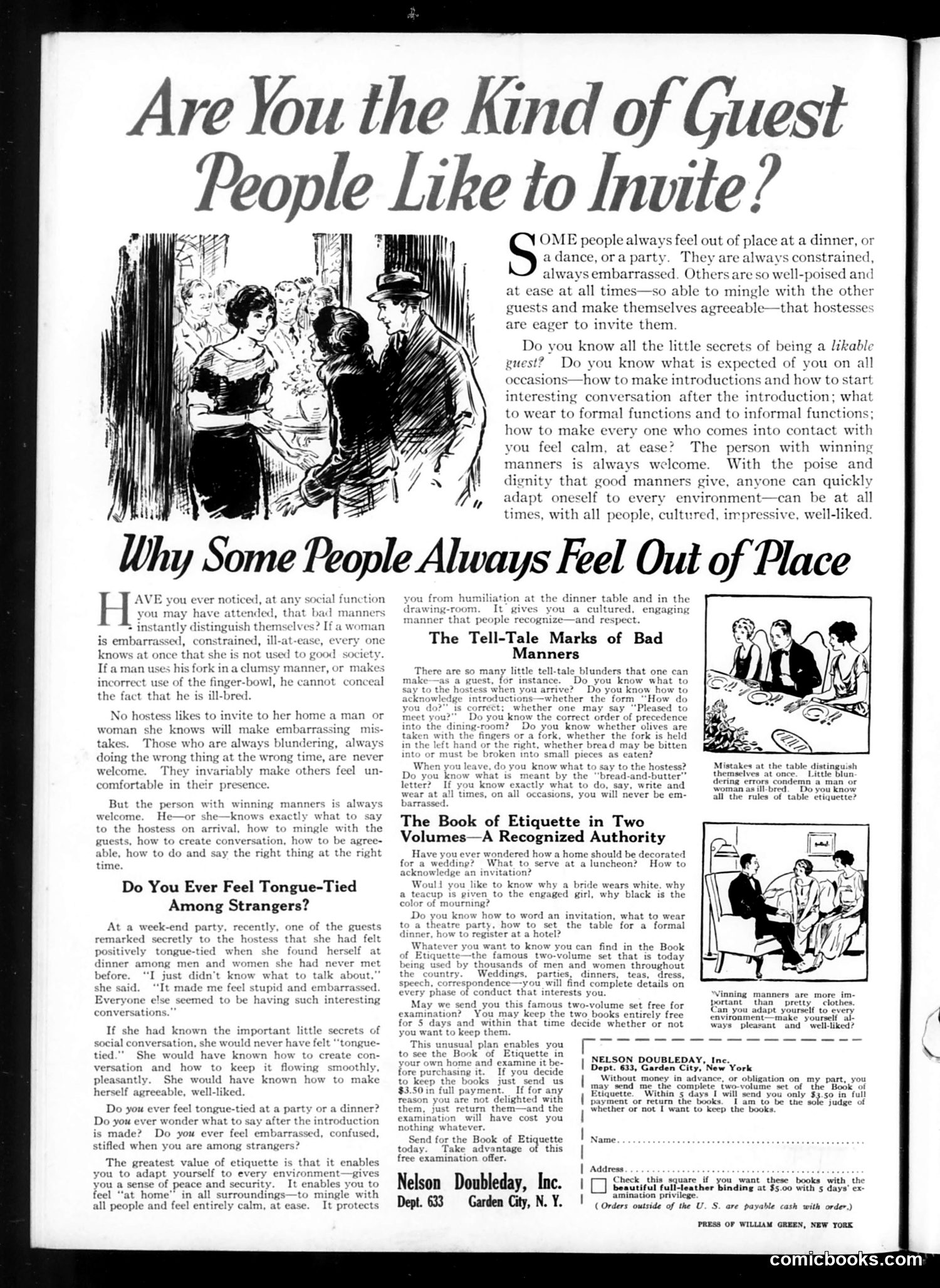
This is primarily **advertising disguised as advice content**—a common early 20th-century magazine format. The page addresses social anxiety about appearing unsophisticated at formal gatherings (dinners, dances, parties). The central message: **bad manners instantly expose lower-class origins**. Examples include improper fork use, finger-bowl mistakes, and not knowing which bread may be bitten versus broken. The satire is gentle—mocking socially awkward guests who feel "tongue-tied" and embarrassed, while praising those with "winning manners" and "poise." The three small cartoons illustrate table-setting blunders and social mistakes that distinguish the cultured from the ill-bred. **The real purpose**: selling Nelson Doubleday's "Book of Etiquette in Two Volumes"—presented as a "recognized authority" that will transform readers into acceptable guests. The framing suggests that etiquette is learnable, yet the anxious tone reinforces that social class distinctions matter deeply. This reflects early 1900s American class consciousness, where displaying proper manners signaled respectability.