
Judge, 1923-03-31 · page 27 of 36
Judge — March 31, 1923 — page 27: what you’re looking at
What you’re looking at
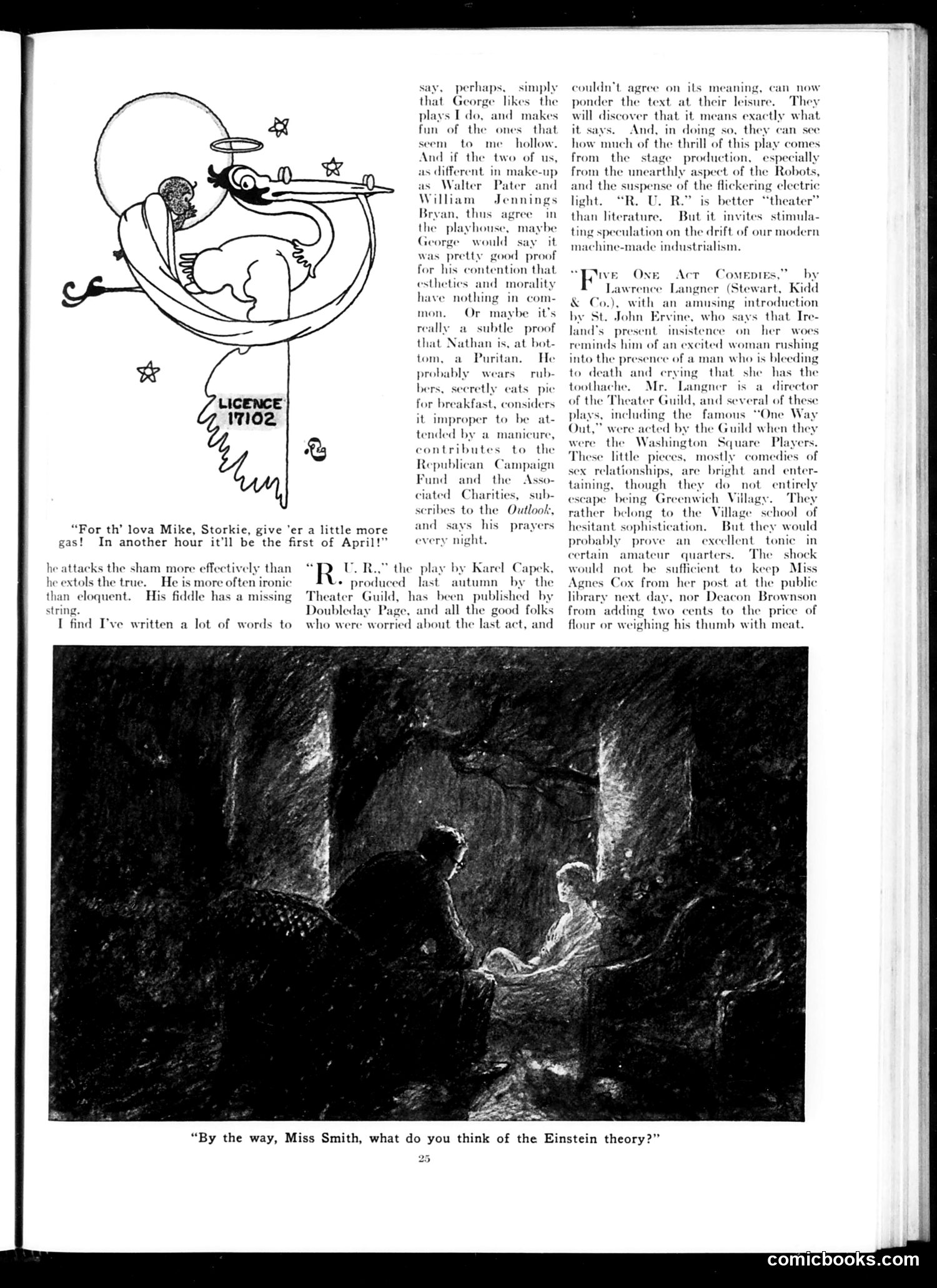
**Upper Cartoon:** A whimsical line drawing shows a figure (likely representing a playwright or critic) suspended in a crescent moon with stars, labeled "Licence 17102." The caption quotes someone urging "Storkie" to give "a little more gas" before April 1st—referencing April Fools' Day. This appears to mock theatrical pretension or overwrought drama criticism. **Lower Photograph & Text:** The page discusses theater reviews, particularly praising Karel Čapek's "R.U.R." (a play about robots) and Lawrence Langner's one-act comedies. The critique notes that "R.U.R." works better as theater than literature due to its visual spectacle. The text also gently satirizes moral prudishness—suggesting even conservative figures like a librarian (Miss Cox) and deacon would remain unmoved by the play's provocative content. **The Point:** Judge is mocking both theatrical grandiosity and audience hypocrisy—the gap between claimed artistic sensitivity and actual provincial morality.
📄 Transcribed text from this page (OCR, searchable)
Machine-transcribed from the original scan — historical spelling and the odd misread are preserved.
“For th’ lova Mike, Storkie, give ‘er a little more In another hour it'll be the first of April!” gas! he attacks the sham more effectively than he extols the true. He is more often ironic than eloquent. His fiddle has a missing string. I find I’ve written a lot of words to the way, Miss Smith, what do you say, perhaps, simply that George likes the plays Ido, and makes fun of the that seem to me hollow. And if the two of us, as different in make-up as Walter Pater and William Jennings Bryan, thus agree in the playhouse, maybe George would. say. it was pretty good proof for his contention that esthetics and morality nothing in com- Or maybe it’s really a subtle proof that Nathan is, at bot- Puritan. He wears rub- have mon. tom, a probably bers, secretly eats pic for breakfast, it improper to be at- considers tended by a manicure, the Republican Campaign Fund and the Asso- ciated Charities, sub- scribes to the Outloc his prayer: contributes to and says every night. “R UR." the play by Karel Capek, + produced last autumn by the Theater Guild, has been published by Doublec Page, and all the good folks who were worried about the last act, and couldn't agree on ils meaning, can now ponder the text at their leisure. They will discover that it means exactly what it says. And, in doing so, they can see how much of the thrill of this play from the stage production, espe \ from the unearthly aspect of the Robots, and the suspense of the flickering electric light. “R. U. R.” is better “theater” than literature. But it invites stimula- ting speculation on the drift of our modern machine-made industrialism. Act Comeptrs,” by “Peve ONE . Lawrence Langner (Stewart, Kidd & Co.), with an amusing introduction hy St. John Ervine, who says that Ire- land's present her woes reminds him of an excited woman rushing into the presence of a man who is bleeding to death and erying that has the toothacl Mr. Langner is a_ director of the Theater Guild, and several of these plays, including the famous “One Way Out,” were acted by the Guild when they were the Washington Square Players. These little pieces, mostly comedies of sex relationships, are bright and enter- taining, though they do not. entirely pe being Greenwich Villagy. They rather belong to the Village school of hesitant sophistication. But they would probably prove an excellent. tonic in certain amateur quarters. The shock would not be sufficient to keep Miss Agnes Cox from her post at the public library next day, nor Deacon Brownson from adding two cents to the price of flour or weighing his thumb with meat. insistence on she think of the Einstein theory?” comicbooks.com