
Judge, 1923-03-31 · page 21 of 36
Judge — March 31, 1923 — page 21: what you’re looking at
What you’re looking at
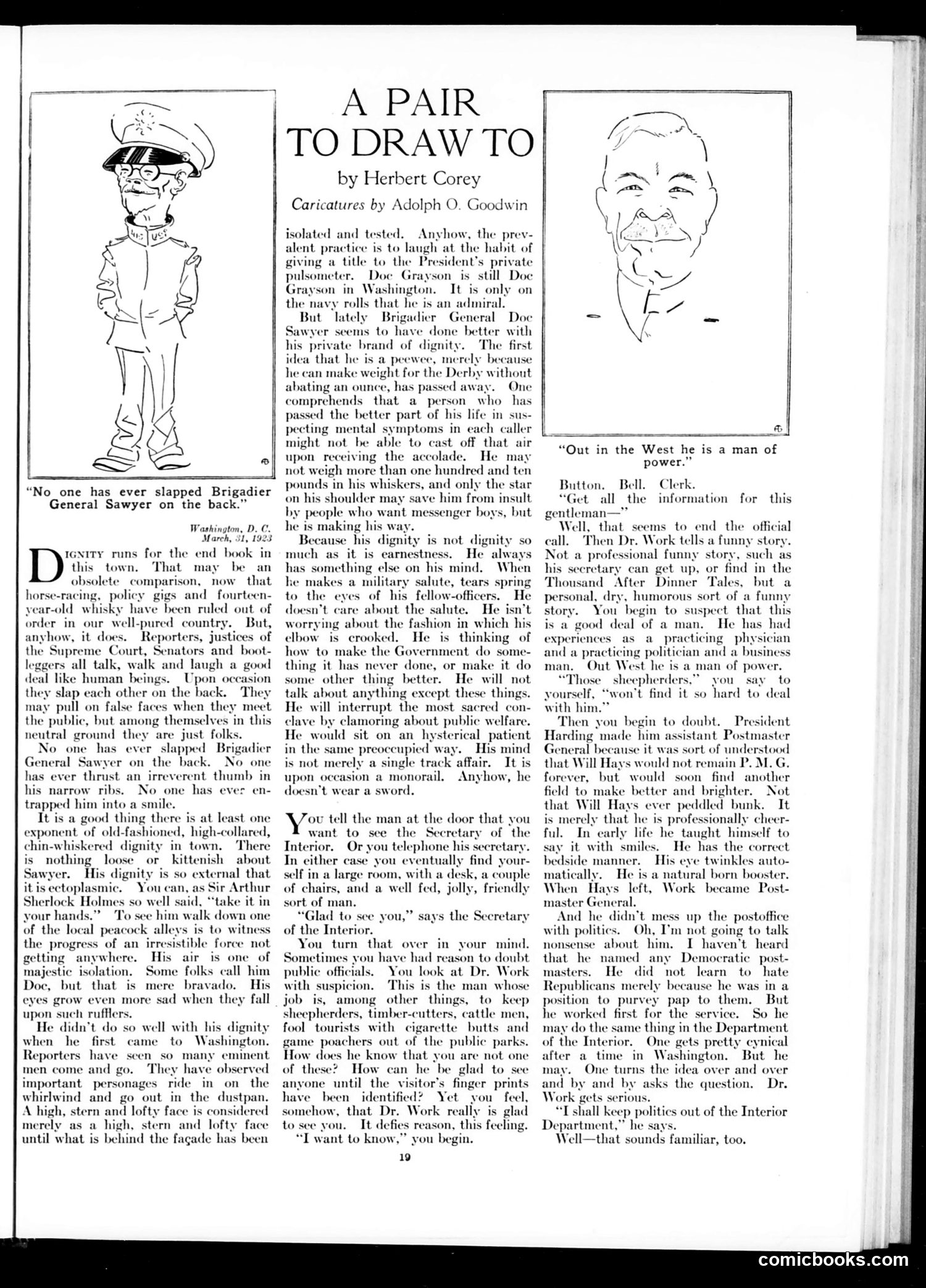
This satirical piece by Herbert Corey profiles **Brigadier General Doc Sawyer**, the President's private physician (appears to be during the Harding administration, circa 1923 based on the date). The satire contrasts Sawyer's exceptional personal dignity—so stern and formal that even seasoned Washington reporters cannot get him to relax or smile—with his genuine earnestness about public welfare. Unlike typical Washington figures who adopt masks for the public, Sawyer maintains rigid formality even in private. The humor lies in the paradox: his dignity isn't mere pretense but stems from his preoccupation with doing good for the government. He interrupts important meetings to argue about public policy, sits with patients in his characteristic distracted manner, and refuses to play Washington's social games. The caricature emphasizes his small stature ("doesn't weigh more than one hundred and ten pounds") and stern expression, making him an anomaly in a capital full of backslapping politicians. The title suggests he's worth drawing—a character type worth capturing.
📄 Transcribed text from this page (OCR, searchable)
Machine-transcribed from the original scan — historical spelling and the odd misread are preserved.
] “No one has ever slapped Brigadier General Sawyer on the back.” Washington, D. C. March, iGNnity runs for the end book in this town, That may be an obsolete comparison, now that horse-racing, policy gigs and fourteen- year-old whisky have been ruled out of order in our well-pured country. But, anyhow, it does. Reporters, justices of the Supreme Court, Senators and boot- leggers all talk, walk and laugh a good sal like human beings. Upon occasion they slap each other on the back. They may pull on false faces when they meet the public, but among themselves in this neutral ground they are just folks. No one has ever ‘lapped Brigadier General Sawyer on the back. No one has ever thrust an irreverent thumb in his narrow ribs. No one has ever en- trapped him into a smile. It is a good thing there is at least one exponent of old-fashioned, high-collared, chin-whiskered dignity in town. There is nothing loose or kittenish about His dignity is so external that it is ectoplasmic. You can, as Sir Arthur Sherlock Holmes so well said, “take it in your hands.” » see him walk down one of the local peacock alleys is to witness the progress of an irresistible force not getting anywhere. His air is one of majestic iso Some folks call him Doe, but that is mere bravado. His eyes grow even more sad when they fall upon such rufflers. He didn’t do so well with his dignity when he first. came to hington. Reporters have seen so m men come and go. They have observed important personages ride in on the whirlwind and go out in the dustpan. A high, stern and lofty face is considered merely as a high, stern and lofty face until what is behind the fagade has been A PAIR TO DRAW TO by Herbert Corey Caricatures by Adolph O. Goodwin isolated and tested. Anyhow, the prev- alent practice is to laugh at the habit of giving a title to the President's private pulsometer. Doe ayson is still, Doe Grayson in Washington. It is only on the navy rolls t he is an admira But lately Brigadier General Doe Sawyer seems to have done better with his private brand of dignity. The first idea that he is a peewee, merely because he can make weight for the Derby without bating an ounce, has passed away. One aprehends that a person who has ed the better part of his life in. sus- pecting mental symptoms in each caller might not be able to cast off that upon receiving the accolade. He m not weigh more than one hundred and te n pounds in his whiskers, and only the star on his shoulder may save him from insult ; people who ger boys, but he is making his Because his dignity is not dignity so much as it is earnestness. He al has something else on his mind. When kes a military salute, tears spring to the s of his fellow-officers. He doesn’t care about the salute. He isn’t worrying about the fashion in which his elbow is crooked. He is thinking of how to make the Government do some- thing it has never done, or make it do some other thing better. He will not talk about anything ot these things. He will interrupt the most sacred con- clave by clamoring about public welfare. He would sit on an hysterical patient in the same preoccupied way. His mind is not merely a single track affair. It is upon occasion a monorail, Anyhow, he doesn’t wear a sword. 7ov tell the man at the door that you want to see the Secretary of the Interior. Or you telephor peretary. In either case you eventually find your- self in a large room, with a « , a couple of chairs, and a well fed, jolly, friendly sort of man. “Glad to see you,” says the Secretary of the Interior. You turn that over in your mind. Sometimes you have had reason to doubt public officials. You look at Dr. Work with suspicion. This is the man whose job is, among other things, to keep sheepherders, timber-cutters, cattle men, fool tourists with cigarette butts and game poachers out of the public parks. How does he know that you are not one of these? How can he be glad to see anyone until the visitor’s finger prints have been identified? Yet you feel, somehow, that Dr. Work really is glad to see you. It de reason, this feeling. “I want to know,” you begin. 19 “Out in the West he is a man of power.” Button, Bell. Clerk. “Get all the information for this gentleman—” Well, that seems to end the official call. Then Dr. Work tells a funny story. Not a professional funny story, such as his secretary can get up, or find in the Thousand After Dinner Tales, but a personal, dry, humorous sort of a funny story. You begin to suspect that this good deal of a man. He has had periences as a_ practicing phy id a practicing politician and a business man. Out West he is a man of power. “Those sheepherders,” you say to yourself, “won't find it so hard to deal with him.” Then you begin to doubt. President Harding made him assistant Postmaster General because it was sort of understood that Will Hays would not remain P.M. G. forever, but would soon find another field to make better and brighter. Not that Will Hays ever peddled bunk. It is merely that he is professionally cheer- ful. In early life he taught himself to say it with smiles. He has the correct bedside manner. His eye twinkles auto- . He is a natural born booster. When Hays left, Work became Post- master General. And he didn’t mess up the postoffice with politics. Oh, I'm not going to talk nonsense about him. I haven't heard that he named any Democratic post- masters. He did not learn to hate Republicans merely because he was in a position to purvey pap to them, But he worked first for the service. So he may do the same thing in the Department of the Interior. One gets pretty cynical after a time in Washington. But he may. One turns the idea over and over and by and by asks the question. Dr. Work gets serious. “I shall keep politics out of the Interior Department,” he s Well—that sounds familiar, too. comicbooks.com