
Judge, 1923-03-31 · page 5 of 36
Judge — March 31, 1923 — page 5: what you’re looking at
What you’re looking at
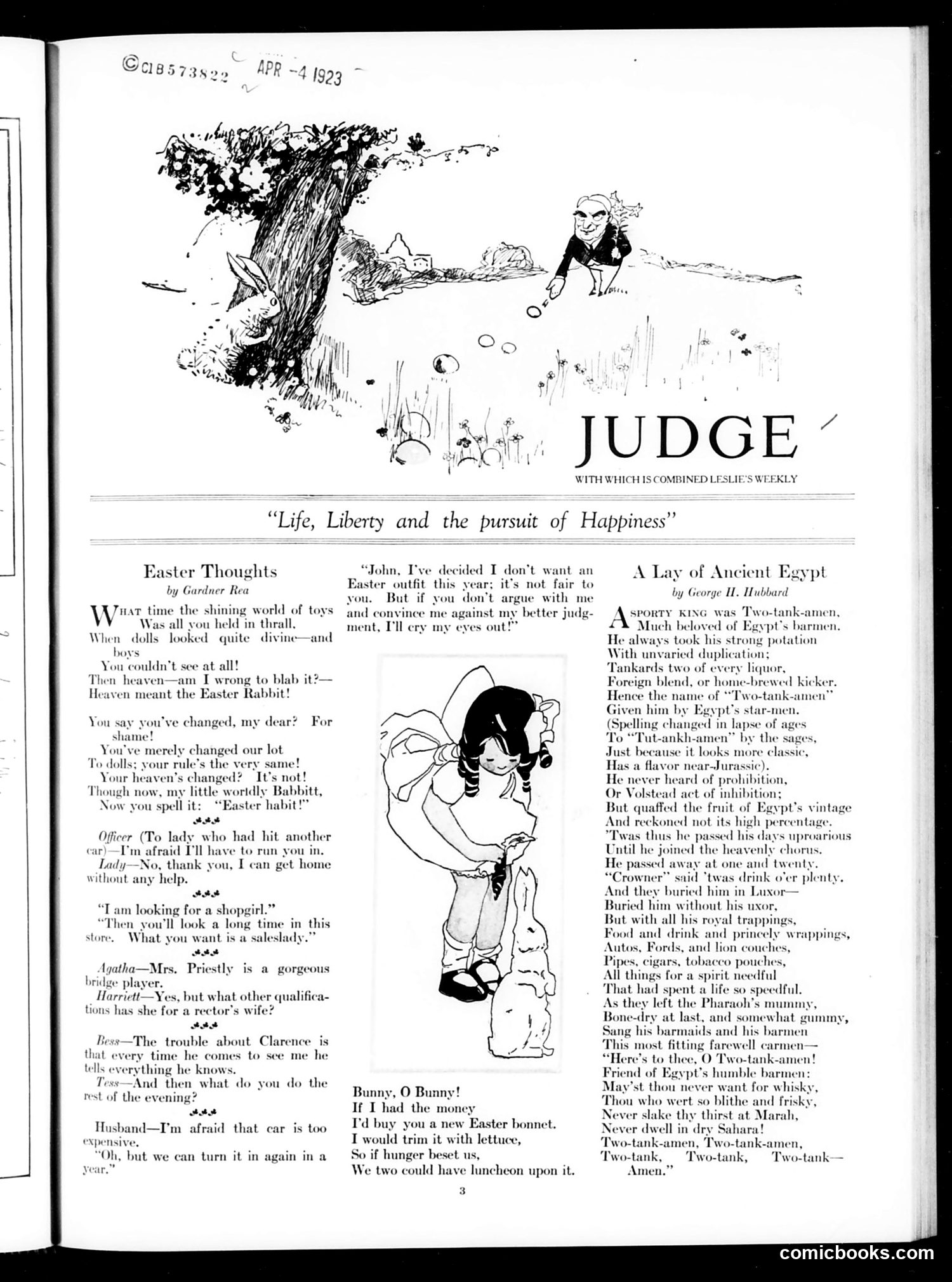
This page combines Easter-themed poetry and satirical humor. The main illustration depicts a child with a rabbit, accompanying "Bunny, O Bunny!"—a poem about purchasing Easter bonnets and rabbits for holiday celebration. The left column, "Easter Thoughts" by Gardner Rea, satirizes how people claim to have "changed" morally while their fundamental nature remains unchanged. References to "Babbitt" (likely Sinclair Lewis's 1922 satirical novel about American conformity) suggest this critiques hollow pretense in modern society. The right column, "A Lay of Ancient Egypt" by George H. Hubbard, is a humorous poem about Egyptian mummification and burial practices—typical Judge content mixing classical references with light comedy. Overall, the page reflects 1920s American cultural commentary through poetry and illustration rather than explicit political cartoons.
📄 Transcribed text from this page (OCR, searchable)
Machine-transcribed from the original scan — historical spelling and the odd misread are preserved.
WITH WHICH IS COMBINED LESLIE'S WEEKLY “Life, Liberty and the pursuit of Happiness” Easter Thoughts by Gardner Rea \ Juat time the shining world of toys Was all you held in thrall, looked When dolls divine—an¢ You couldn't see at all! Then heaven—am I wrong to blab it?— Heaven meant the Easter Rabbit! quite You say you've changed, my dear? For anged our lot To dolls; y the very same! ur heaven’s changed? It’s not! Though now, my litt ridly Babbitt, Now you spell it ster habit!” Officer (To lady who had hit another car)—L'm afraid Pl have to run you in, Iady—No, thank you, I can get home without any help. sae “T am looking for a shopgirl.” hen you'll look a long time in this What you want is a saleslady.” eee store, {gatha—Mrs. bridge player. Harriett—Yes, but what other qualifica- tions has she for a rector’s wife? Pry trouble about Clarence is he comes to see me he Priestly is a gorgeous Bess—The that ¢ time vthing he knows. Tess—And then what do you do the rest of the evening? ery Husband—I'm afraid that car is too expensive. “Oh, but we can turn it in again in a Year.” you. “John, I've decided IT don’t want an Easter outfit this year; it’s not fair to But if you don’t argue with me tinst my better judg- ves out!” and convince me ment, Pll cry my Bunny, O Bur If I had the I'd buy you a new Easter bonnet. I would trim it with lettuce, So if hunger beset us, We two could have luncheon upon it. 3 A Lay of Ancient Egypt by George H. Hubbard SPORTY KING was Two-tank-amen, Much beloved of Egypt's barmen. ays took his strong pot With unvaried duplication; Tankards two of every liquor, Foreign blend, or home-brewed kicker. Hence the name of *Two-tank-amen™ Given him by Egypt's star-men, ing changed in lapse of Tut-ankh-amen” by the si 7 use it looks more classic, of prohibition, Or Volsten: act of inhibitic But quaffed the fruit of And reckoned not its high perce Twas thus he passed his days upre Until he joined the heavenly chorus. He passed away nd twenty. “Crowner™ said “twas drink o'er plenty. And they buried him in Luxor— Buried him without his uxor, But with all his royal trappings, Food and drink and princely wrappings, rds, and lion couches, . tobacco pouches, All ‘ining for a spirit needful ‘That had spent a life so speedful. As they left the Pharaoh’s mummy, Bone-dry at last, and somewhat gummy, Sang his barmaids and his barn aig most fitting farewell « ’s to thee, O Two. -amen! nd of Egypt’s humble barmen: st thou never want for whisky, Thou who wert so blithe and frisky, Never slake thy thirst at Marah, er dwell in dry § Two-tank-amen, ‘Two-tank-1 Two-tank, — Two-tank, Amen.” Two-tank— comicbooks.com