
Judge, 1923-03-31 · page 11 of 36
Judge — March 31, 1923 — page 11: what you’re looking at
What you’re looking at
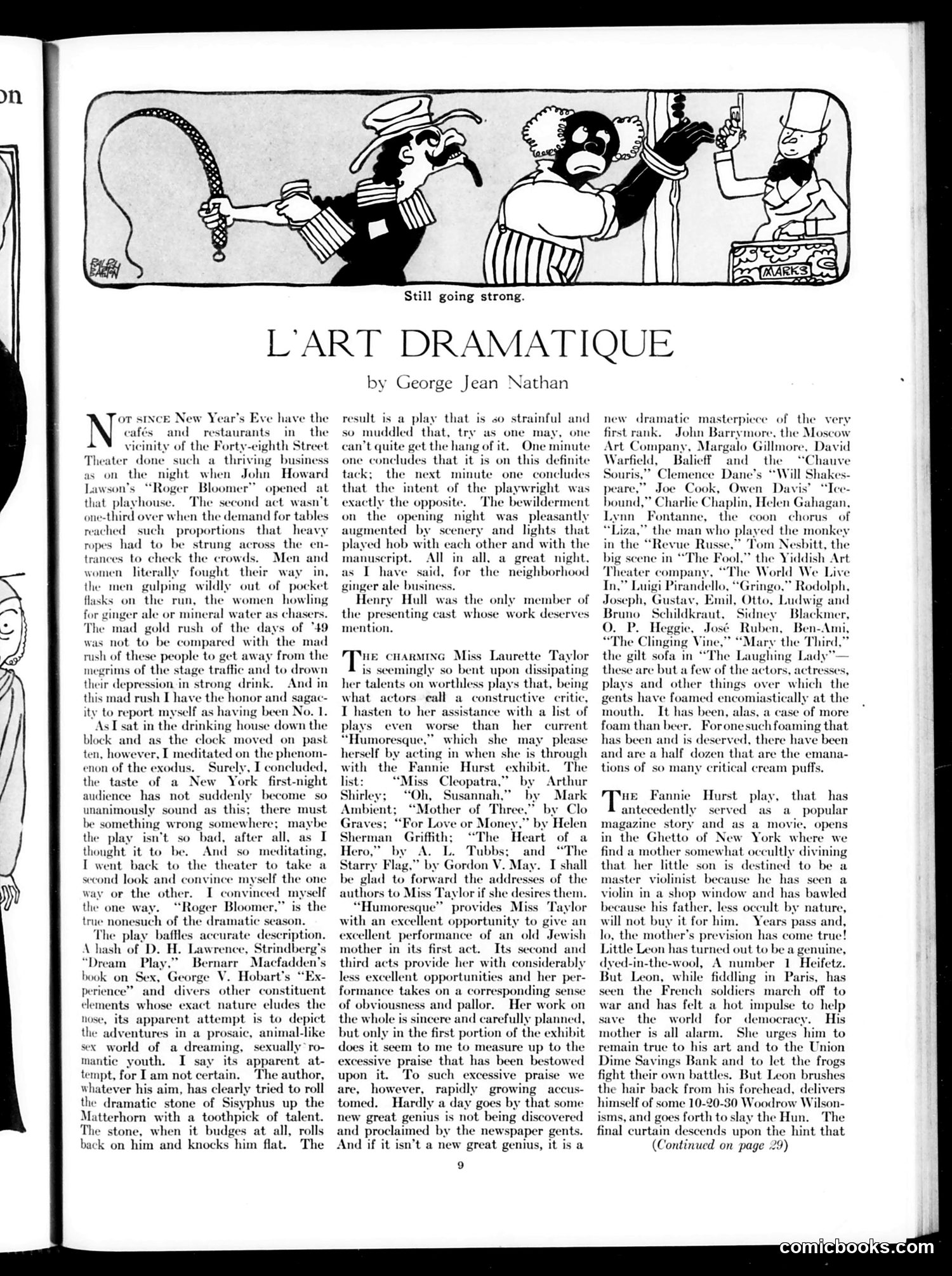
This is George Jean Nathan's scathing review of John Howard Lawson's play "Roger Bloomer," which opened on Forty-eighth Street. The cartoon at top depicts the play's opening night: audiences fleeing the theater in droves to nearby bars and restaurants, desperately drinking to escape the experience. Nathan's satire is brutal. He compares the play to a chaotic amalgam of highbrow references (D.H. Lawrence, Strindberg) mixed with pulp (Bernarr Macfadden's sex manual), calling it utterly confused and muddled. The only bright spot: actor Henry Hull's performance. He also mocks actress Laurette Taylor, suggesting she waste her talents on equally terrible scripts rather than "Humoresque." The implication: her acting skills deserve better material than what contemporary playwrights offer. The joke's dark humor lies in suggesting audiences would literally rather get drunk than sit through modern theater—a cutting indictment of 1920s Broadway's dramatic quality.
📄 Transcribed text from this page (OCR, searchable)
Machine-transcribed from the original scan — historical spelling and the odd misread are preserved.
Still going strong. L'ART DRAMATIQUE or stNcE New Year's Eve have the cafés and restaurants in the vicinity of the Forty-eighth Street Theater done such a thriving business as on the night when John Howard Lawson’s “Roger Bloomer” opened at that playhouse. The second act wasn't one-third over when the demand for tables reached such proportions that heavy ropes had to be strung across the en- traneces to check the crowds. Men and women literally fought their way in, the men gulping wildly out of poe! flasks on the run, the women howling for ginger ale or mineral water as chasers. The mad gold rush of the days of “49 was not to be compared with the mad rush of these people to get away from the megrims of the stage traffic and to drown their depression in strong drink. And in this mad rush I have the honor and ity to report myself as having been 1. AsI sat in the drinking house down the block and as the clock moved on past ten, however, I meditated on the phenom- enon of the exodus. Surely, I concluded, the taste of a New York first-night audience has not suddenly become so unanimously sound as this; there must be something wrong somewhere; maybe the play isn’t so bad, after all, as I thought it to be. And so meditating, I went back to the theater to take a second look and convince myself the one way or the other. I convinced myself the one way. “Roger Bloomer,” is the true nonesuch of the di om. The play baffles accurate description. \ hash of D. H. Lawrence, Strindberg’s “Dream Play.” Bernarr Macfadden’s book on Sex, George V. Hobart’s “Ex- perience” and divers other constituent elements whose exact nature eludes the hose, its apparent attempt is to de the adventures in a prosai i sex world of a dreaming, s mantic youth. I say its app tempt, for Lam not certain, The author, whatever his aim, has clearly tried to roll the dramatic stone of Sisyphus up the Matterhorn with a toothpick of talent. The stone, when it budges at all, rolls back on him and knocks him flat. The by George Jean Nathan result is a play that is so strainful and so muddled that, try as one may, one can’t quite get the hang of it. One minute one concludes that it is on this definite tac the next minute one concludes that the intent of the playwright was exactly the opposite. The bewilderment on the opening night was pleasantly augmented by scenery and lights that played hob with each other and with the manuscript. All in all, a great night. haves for the neighborhood ginger ale business. Henry Hull was the only member of the presenting cast whose work deserves mention. TT! CHARMING Miss Laurette 's seemingly so bent upon diss her talents on worthless pl constructive critic, en to her tance with a list of plays even worse than her current “Humoresque,” which she may please y acting in when she is through annie Hurst it. The “Miss Cleopatra y Arthur ‘Oh, Susannah Mark fother of Thre by Clo ‘or Love or Money,” by Helen i “The Heart of a . Tubbs; and “The Starry Flag,” by Gordon V. May. I shall be glad to forward the addre of the authors to Miss Taylor if she desires them. “Humoresque” provides Miss Taylor with an lent opportunity to give an excellent performance of an old Jewish mother in its first act. Its ond and third acts provide her with considerably less excellent opportunities and her per- formance takes on a corresponding sense of obviousness and pallor. Her work on sincere and carefully planned, in the first portion of the exhibit it seem to me to measure up to the has been bestowed upon it. To such sive praise we are, however, rapidly growing accus- tomed. Hardly a day goes by that some new great genius is not being discovered and proclaimed by the newspaper gents. And if it isn’t a new great genius, it is a what actors call with list: Shirley; 9 new dramatic masterpiece of the very firstrank. John Barrymore, the Moscow Art Company, Ma ; re, David Warfield, — Balieff “hauve Souris,” Clemence Dane's * | Shakes- peare,” Joe Cook, Owen Davis’ “Ice- bound,” Charlie Chaplin, Helen Gahe Lynn Fontanne, the coon chorus of “Liza,” the man who played the monkey in the “Revue Russe,” ‘Tom Nesbitt, the big scene in “The Fool,” the Yiddish Art ‘Theater company, “The World We Live In,” Luigi Pirandello, “Gringo,” Rodolph, Joseph, Gustav, Emil, Otto, Ludwig and Bruno Schildkraut, Sidney Blackmer, O. P. Heggie, José Ruben, Ben-Ami, “The Clinging Vin ry the Third,” the gilt sofa in “T) ing Lady”— ¢ but a few of the nd other things over which the have foamed encomiastical mouth. It has been s se of more foam than bee such foaming that has been and is deserved, there have been and are a half dozen that are the emana- tions of so many critical cream puffs. . actresses, Hurst play, that has served as a popular magazine story and as a movie, opens in the Ghetto of New York where we find a mother somewhat occultly divining that her little son is destined to be a master violinist because he has seen a violin in a shop window and has bawled because his father, less occult by nature, will not buy it for him. Years pass and, lo, the mother's prevision has come true! Little Leon has turned out to be a genuine, dyed-in-the-wool, A number 1 Heife’ But Leon, while fiddling in Paris, | seen the French soldiers march off to war and has felt a hot impulse to help save the world for democracy. His mother is all alarm. She urges him to remain true to his art and to the Union Dime Savings Bank and to let the frogs fight their own battles. But Leon brushes the hair back from his forehead, delivers himself of some 10-20-30 Woodrow Wilson- isms, and goes forth to slay the Hun. The final curtain descends upon the hint that (Continued on page 29) HE Fannie antecedently