
Judge, 1923-03-31 · page 15 of 36
Judge — March 31, 1923 — page 15: what you’re looking at
What you’re looking at
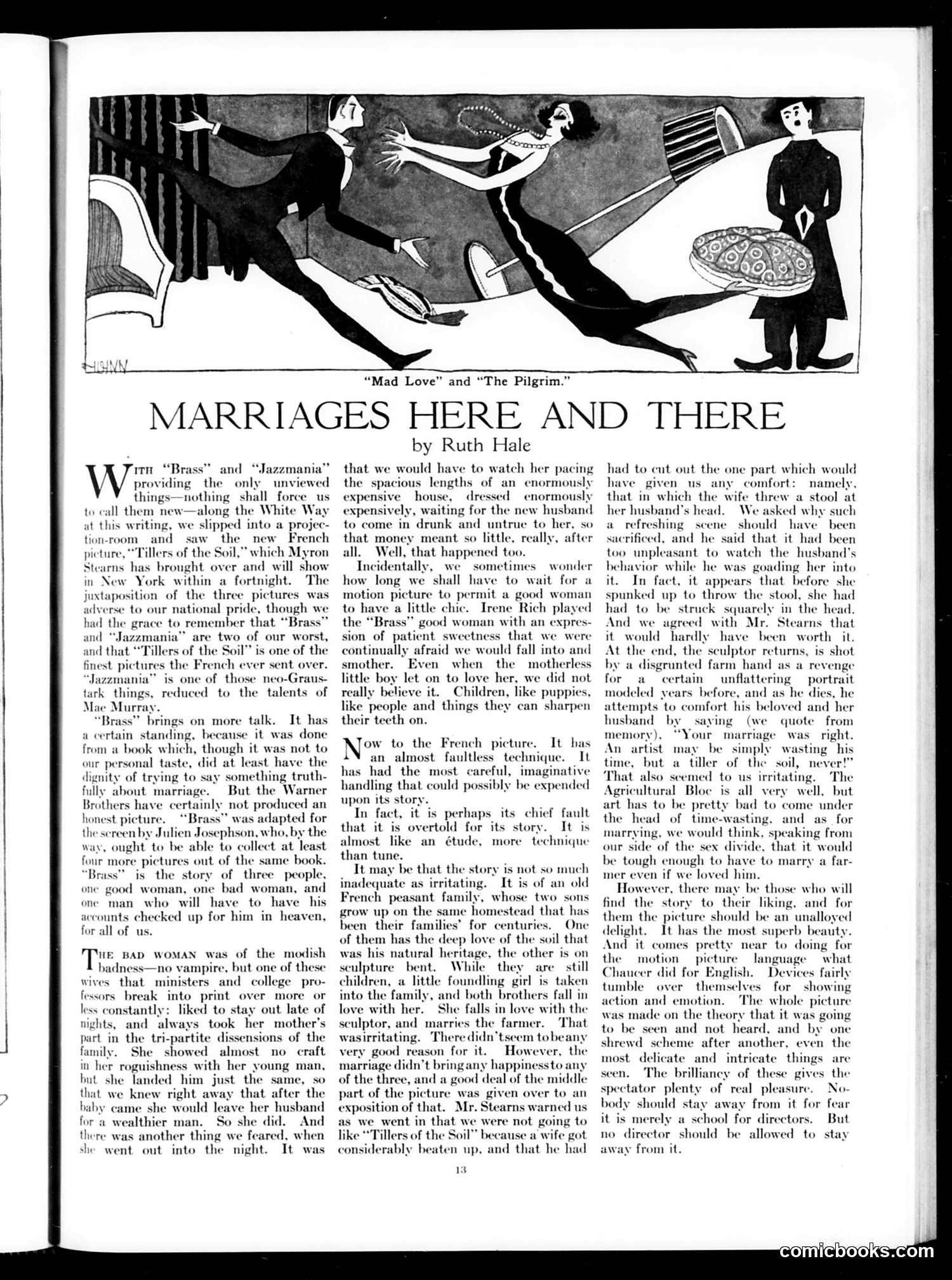
This page reviews three recent films through the lens of marriage depiction. The cartoon at top illustrates scenes from "Mad Love" and "The Pilgrim"—contemporary films being discussed. Ruth Hale critiques American versus French cinema. She reviews "Brass" (a Warner Brothers adaptation), which depicts a morally questionable woman who abandons her husband for wealth. Hale finds the "good woman" character played by Irene Rich unconvincingly saccharine. The French film "Tillers of the Soil" concerns a peasant family where two brothers love the same foundling girl; she marries the farmer (not the sculptor she loves), creating unhappiness. Hale's satire targets American cinema's moralizing sentimentality versus European film's sophisticated storytelling. She mocks Hollywood's inability to portray virtuous women as genuinely interesting or complex—they're merely patient and sweet rather than authentically chic or compelling. The piece reflects 1920s highbrow criticism of popular entertainment's artistic limitations.
📄 Transcribed text from this page (OCR, searchable)
Machine-transcribed from the original scan — historical spelling and the odd misread are preserved.
“Mad Love” and “The Pilgrim. MARRIAGES HERE AND THERE im “Brass” and “Jazzmania” W providing the only unviewed things—nothing shall force us to call them new—along the White Way at this writing, we slipped into a projec- tion-room and saw the new French picture, “Tillers of the Soil,” which Myron Stearns has brought over and will show in New York within a fortnight. The juxtaposition of the three pictures was adverse to our national pride, though we had the grace to remember that “Brass” mania” are two of our worst, Tillers of the Soil” is one of the the French ever sent over. * is one of those neo-Graus- reduced to the talents of and * and that finest. pictur “Jazzmani, tark thing Mae Murray “Brass” brings on more talk. a certain standing, because it v from a book which, though i our personal taste, did at I ve the dignity of trying to say something truth- fully about marriage. But the Warner Brothers have certainly not producec honest picture. Brass” was adapted for the screen by Julien Josephson, wh way, ought to be able to collect at least four more pictures out of the same book. “Brass” is the story of three people: one good woman, one bad woman, and one man who will have to have his accounts checked up for him in heaven, for all of us. It has done not to HE BAD WOMAN was of the modish badness—no vampire, but one of these wives that ministers and college pro- fessors break into print over more or less constantly: liked to stay out late of nights, and always took her mother’s part in the tri-partite dissensions of the family. She showed almost no craft in her roguishness with her young man, but she landed him just the same, so that we knew right away that after the baby came she would leave her husband for a wealthier man. So she did. And there was another thing we feared, when she went out into the night. It by Ruth Hale vould have to watch her pacing sus lengths of an enormously house, dressed enormously y, waiting for the new husband to her, so lly, after that we the 5] expensive expen: to come in drunk and untri that money meant so little, re all. Well, that happened too. Incidentally, we sometimes wonder how long we shall have to wait for a motion picture to permit a good woman to have a little chic. Irene Rich played the “Brass” good woman with an expres- sion of patient sweetness that we were continually afraid we would fall into and smother. Even when the motherless little boy let on to love her, we did not really believe it. Children, like puppies, like people and things they can sharpen their teeth on. No to the French picture. It has LN an almost faultless technique. It has had the most careful, imaginative handling that could possibly be expended upon its story. In fact, it is perhaps its chief fault that it is overtold for its story. It is almost like an étude, more technique than tune. It may be that the story is not so much inadequate as irritating. It is of an old French peasant family, whose two sons grow up on the tead that has been their famili nturies. One of them has the deep love of the soil that ge, the other is on sculpture bent. While th are still children, a little foundling girl is t into the family, and both brothers fall in love with her. She falls in love with the sculptor, and marries the farmer. T! rritating. Theredidn’tseem tobeany -y good reason for it. However, the marriage didn’t bringany happiness to any of the three, and a good deal of the middle part of the picture was given over to an exposition of that. Mr. Stearns warned us as we went in that we were not going to “Tillers of the Soil” because a wife got a like considerably beaten up, and that he had 13 had to cut out the one part which would have given us any comfort: namely, that in which the wife threw a stool at her husband's head. We asked why such a refreshing scene should have’ been sacrificed, and he said that it had been too unpleasant to watch the husband’s behavior while he was goading her into it. In fact, it appears that before she spunked up to throw the stool, she had had to be struck squarely in the head. And we agreed with Mr. Stearns that it would hardly have been worth it. At the end, the sculptor returns, is shot by a disgrunted farm hand as a revenge for a certain unflattering — portrait modeled ye nd as he dies, he attempts to comfort his beloved and her husband by saying (we quote from memory), our marriage was right. An artist may be simply wasting his time. tiller of the soil, never!” That also seemed to us irritating. The Agricultural Bloc is all very well, but art has to be pretty bad to come under the head of time-wasting., and as for marrying, we would think, speaking from our side of the sex divide, that it would be tough enough to have to marry a far- mer even if we loved him. However, there may be those who will find the story to their liking, and for them the picture should be an unalloyed delight. It has the most superb beauty. And it comes pretty near to doing for the motion picture language what Chaucer did for English. Devices fairly tumble over themselves for showing action and emotion. The whole picture was made on the theory that it was going to be seen and not heard, and by one shrewd scheme after another, even the delicate and intricate things are The brilliancy of these gives the pleasure. No- body should stay away from it for fear i school for directors. But allowed to. stay most seen. no director should be away from it.