
Judge, 1923-03-31 · page 7 of 36
Judge — March 31, 1923 — page 7: what you’re looking at
What you’re looking at
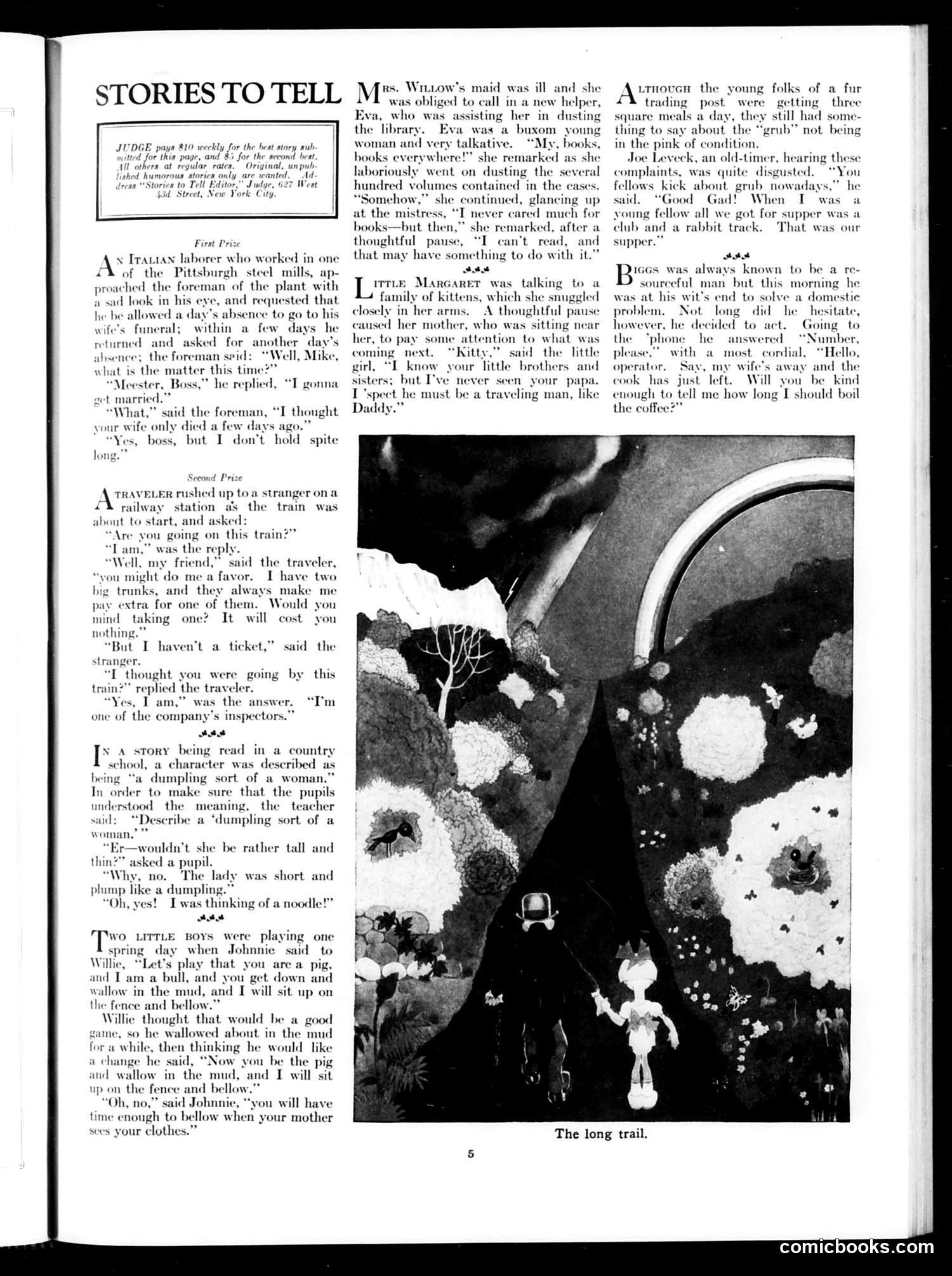
This page from *Judge* magazine presents a humor column featuring reader-submitted short stories competing for cash prizes ($10 for first place). The content reflects turn-of-the-century working-class and domestic humor. The stories employ gentle, situational comedy rather than political satire: an Italian steelworker quickly remarries after his wife's funeral; a train passenger tries to smuggle extra luggage by posing as a company inspector; schoolchildren confuse "dumpling" with "noodle"; a boy avoids wallowing in mud by letting his friend do it first; a young maid dismisses books because she can't read; a child assumes her kitten's father is a traveling salesman; and nostalgic complaints about meal quality. The accompanying illustration "The Long Trail" appears unrelated to the stories—showing a desert or wasteland scene with a figure and covered wagon, likely depicting frontier hardship themes popular in the era. The humor targets working-class life, immigrant accents, and domestic situations rather than politics.
📄 Transcribed text from this page (OCR, searchable)
Machine-transcribed from the original scan — historical spelling and the odd misread are preserved.
STORIES TO TELL pays $10 weekly for the best story aub- this page, and 85 for the accond best rs at regular rates. Original, unpub: shed humorous stories only are wanted “Stories to Tell Editor,” Judge, bid Street, New York City. 27 West First Prize As Trattan laborer who worked in one f% of the Pittsburgh steel mills, ap- proached the foreman of the plant with a sad look in his eye, and requested that he be allowed a day’s absence to go to his wife's funeral; within a few days he returned and asked for another day’s absence; the foreman seid: “Well, Mike, what is the matter this time?” ester, Boss,” he replied, get married. “What,” said the foreman, “I thought your wife only died a few days ago.” “Yes, boss, but I don't hold spite A TeAY PLE rushed up toa stranger on a £% railway station as the train was al rt, and asked: “Are you going on this train?” “Tam,” was the reply. “Well, my friend, “vou might do me a favor. I have two big trunks, and they ys make me pay extra for one of them. Would you mind taking one? It will you nothing.” “But I haven't a stranger. “I thought you were going by this train?” replied the trave es, I am,” was the answer. one of the company’s inspectors.” id the traveler, cost ticket,” said the Ree) I’ a story being read in a country school, a character was described as being “a dumpling sort of a woma In order to make sure that the pupils understood the meaning, the teacher said: scribe a ‘dumpling sort of a r—wouldn’t she be rather tall and * asked a pupil. y, no. The lady was short and plump like a dumpling. “Oh, yes! Iwas thinking of a noodle!” ttt Te LITTLE BOYS were Pp spring day when Johnnie said to Willie, “Let's play that you are a pig, and I'am a bull, and you get down and wallow in the mud, and I will sit up on the fence and bellow. Willie thought that would be a good game, so he wallowed about in the mud for a while, then thinking he would like a change he said, “Now you be the pig and wallow in the mud, and I will sit up on the fence and bellow.” “Oh, no,” said Johnnie, “you will have time enough to bellow when your mother sees your clothes.” M™: Witiow’s maid was ill and she AVI was obliged to call in a new helper, Eva, who was assisting her in dusting the library. Eva was a buxom young woman and very talkative. “My, books, books everywhere!” she remarked as she laboriously went on dusting the severi hundred volumes contained in the « “Somehow,” she continued, glancing up at the mistress, “I never cared much for books—but then,” she remarked, after a thoughtful pause, “I can’t read, and that may have something to do with it ery ImTLE MarGaret was talking to a family of kittens, which she snuggled closely in her arms. A thoughtful pause caused her mother, who was sitting near her, to - some attention to what coming next. “Nitty,” said the little girl, “I know your little brothers and sisters; but I've never seen your papa. I ‘spect he must be a traveling man, like Daddy.” Atmoucs the young folks of a fur trading post were getting three square meals a day, they still had some- thing to say about the “grub” not being in the pink of condition. Joe Leveck, an old-timer, hearing these complaints, quite disgusted. “You fellows kick about grub nowadays,” he said. “Good Gad! When IT was a young fellow all we got for supper was a club and a rabbit track. That was our supper.” aes B“* was always known to be a re- sourceful man but this morning he was at his wit’s end to solve a domestic problem. Not long did he hesitate, however, he decided to act. Going to the ‘phone he answered “Number, please.” with a most cordial, ‘Hello, operator. Say, my wife’s away and the cook has just left. Will you be kind enough to tell me how long I should boil the coffee?” The long trail. comicbooks.com