
Judge, 1923-03-31 · page 26 of 36
Judge — March 31, 1923 — page 26: what you’re looking at
What you’re looking at
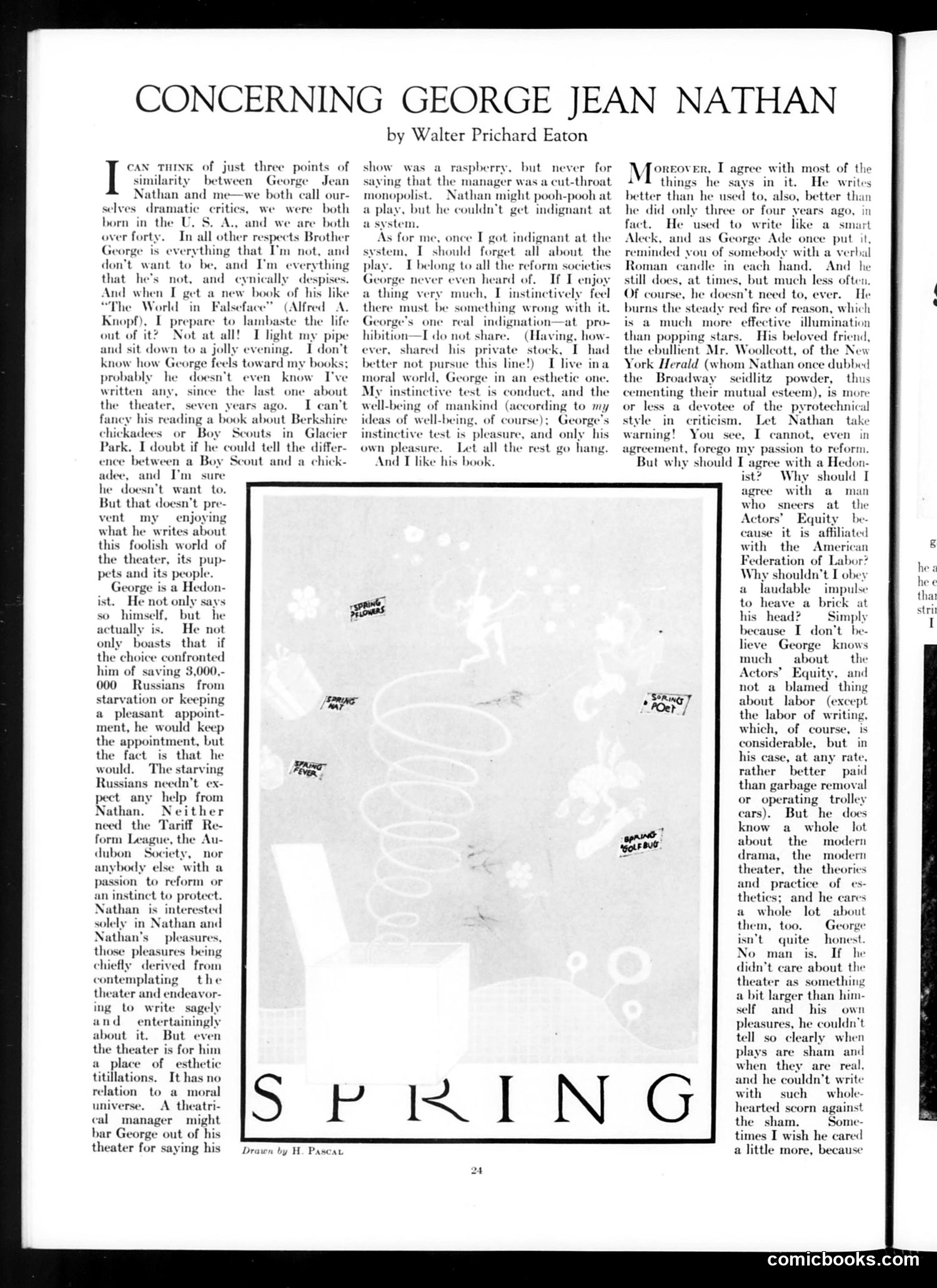
This page features a critical essay by Walter Prichard Eaton about **George Jean Nathan**, a prominent theater critic of the early 20th century. The main cartoon appears to be a simple illustration labeled "SPRING" (drawn by H. Pascal), which seems decorative rather than satirical. Eaton's text contrasts their opposing worldviews: Nathan is a "Hedonist" who values aesthetic pleasure above moral concerns—famously claiming he'd keep a pleasant appointment rather than save millions from starvation. Eaton, by contrast, is a moralist who applies ethical judgment to everything, including theater. The satire is gentle and affectionate. Eaton admits Nathan writes brilliantly about theater despite—or because of—his cynical amorality. He praises Nathan's recent improvement in style, comparing his older writing to "a verbal Roman candle." The piece exemplifies how early-20th-century intellectuals debated whether art criticism should serve moral purposes or exist purely for aesthetic appreciation—a recurring modernist tension.
📄 Transcribed text from this page (OCR, searchable)
Machine-transcribed from the original scan — historical spelling and the odd misread are preserved.
CONCERNING GEORGE JEAN NATHAN by Walter Prichard Eaton similarity between George Jean Nathan and me—we both call our- selves dramatic critics, we were both born in the U. and we are both forty. In all other respects Brother George is everything that I'm not, and don’t want to be, and I'm everything that he’s not, and cynically despises. And when I get a new book of his like “The World in’ Falseface’ (Alfred A. Knopf), I prepare to lambaste the life out of it? Not at all! I light my pipe and sit down to a jolly evening. I don’t know how George feels toward my books: probably he doesn’t even know I've written any, since the last one about the theater, seven. y I can't fancy his reading a book about Berkshire chickadees or Boy Scouts in Glacier Park. I doubt if he could tell the differ- ence between a Boy Scout and a chick- adee, and I’m sure he doesn’t want to. But that doesn’t pre- vent’ my — enjoying what he writes about this foolish world of the theater, its pup- pets and its people. orge is a Hedon- ist. He not only says so himself, but he actually is. He not only boasts that if the choice confronted him of saving 3,000,- 000 Russians from starvation or keeping a pleasant appoint- ment, he would keep the appointment, but the fact is that he would. The starving Russians needn't ex- I CAN THINK of just three points of need the Te form League dubon Society, nor anybody else with a passion to reform or an instinct to protect. Nathan is interested solely in Nathan and Nathan's _ pleasures, those pleasures being chiefly derived from contemplating the theater and endeavor- ing to write sagely and — entertainingly about it. But even the theater is for him a place of esthetic titillations. It has no relation to a moral universe. A theatri- cal manager might bar George out of his theater for saying his Drawn by H. Pascau show was a raspberry, but never for saying that the manager was a cut-throat monopolist. Nathan might pooh-pooh at a play, but he couldn't get indignant at a system. As for me, once T got ind t at the should forget all about the play. I belong to all the reform so George never even heard of. If T enjoy a thing very much, I instinctively feel there must be something wrong with it. G s one real indignation—at_ pro- hibition—I do not share. (Having, how- ever, shared his private stock, I had better not pursue this line!) I live ina moral world, George in an esthetic one. My instinctive test is conduct, and the well-being of mankind (according to my ideas of well-being, of course); George's instinctive test is pleasure, and only his own pleasure. Let all the rest go hang. And T like his book. system, I Monee Er, I agree with most of the 4 things he says in it. He writes better than he used to, also, better than he did only three or four years ago, in fact. He used to write like a smart Aleck, and as George Ade once put it, reminded you of somebody with a verbal Roman candle in each hand. And _ he still does times, but much less often, Of course, he doesn’t need to, ever. He burns the steady red fire of reason, which is a much more effective illumination than popping stars. His beloved friend, the ebullient Mr. Woollcott, of the New York Herald (whom Nathan once dubbed the Broadway seidlitz powder, thus cementing their mutual esteem), is more or less a devotee of the pyrotechnical style in criticism. Let Nathan take warning! You see, I cannot, even in agreement, forego my passion to reform, But why should I agree with a Hedon- ist? Why should I agree with a man who sneers at the Actors’ Equity be- cause it is affilic with the American Federation of Labor? Why shouldn't I obey a laudable impulse to heave a brick at his head? Simply because I don’t be- lieve George knows much about the Actors’ Equity, and not a blamed thing about labor (except the labor of writing, which, of course, is considerable, but in his case, at any rate, rather better paid than garbage removal or operating trolley cars). But he does know a_ whole lot about the modern drama, the modern theater, the theories and practice of es- thetics; and he cares a whole lot about them, too. — George isn’t quite honest No man is. If he didn’t care about the ter as something arger than him- and his own ures, he couldn't tell so clearly when plays are sham and when they are real, and he couldn't write with such — whole- hearted scorn agai the sham. times I wish he cared a little more, because hea he « thar stru comicbooks.com