
A complete issue · 36 pages · 1923
Judge — January 6, 1923
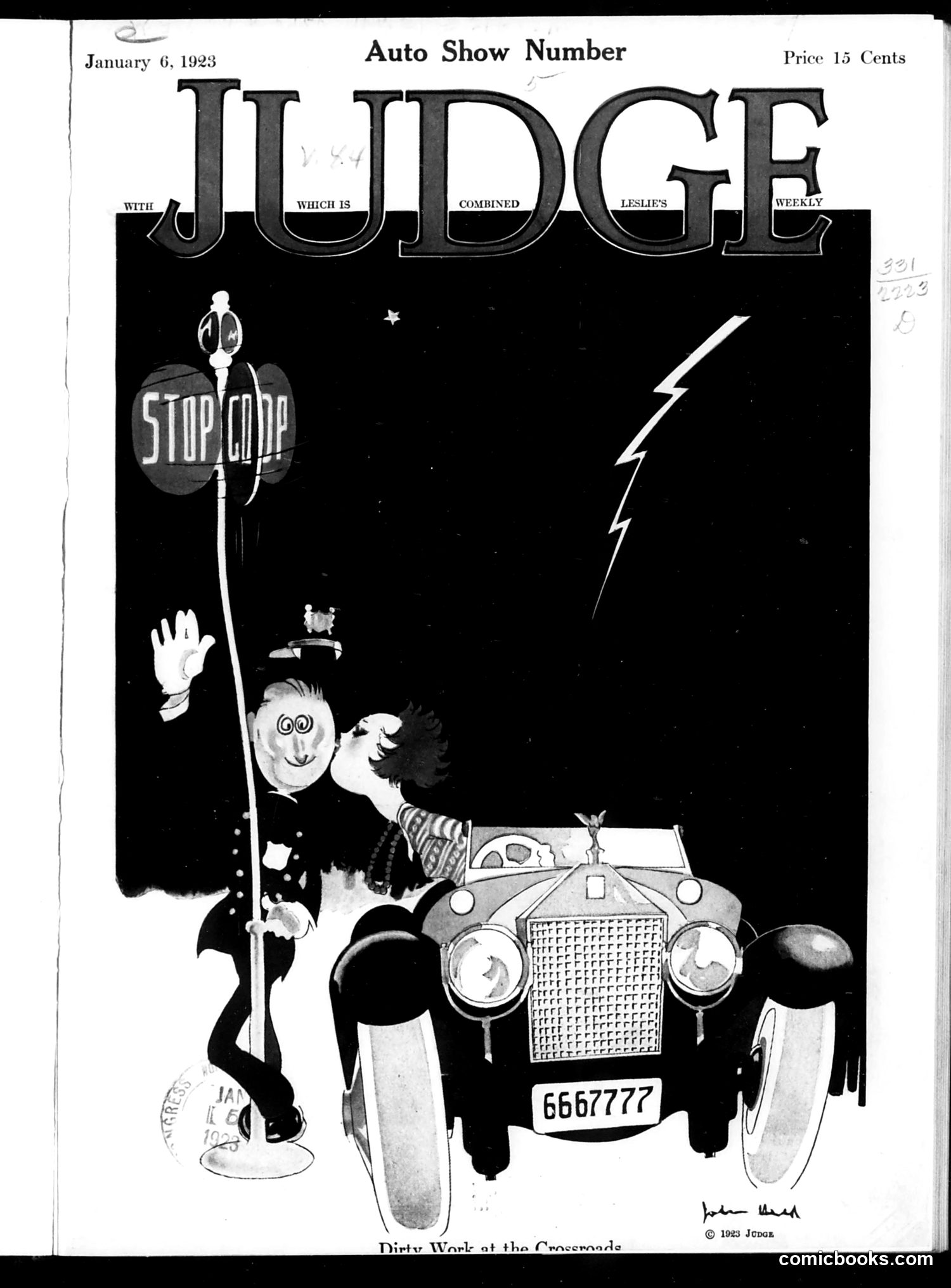
This "Auto Show Number" satirizes traffic safety through cartoon humor. The central figure—a comically wide-eyed driver in a Dodge automobile—ignores a "STOP" sign while reaching toward a traffic signal, suggesting reckless disregard for road rules. The lightning bolt and stop sign emphasize danger. The title "Dirty Work at the Crossroads" (visible at bottom) plays on the period phrase meaning underhanded dealing. This cover critiques dangerous driving behavior emerging in the automobile age, when traffic safety regulations were new and often ignored. The absurdist, exaggerated expressions and style are typical of 1920s satirical illustration, mocking drivers who treated roads recklessly. The Dodge nameplate and license plate provide specific period details reflecting real automobile anxieties of the era.
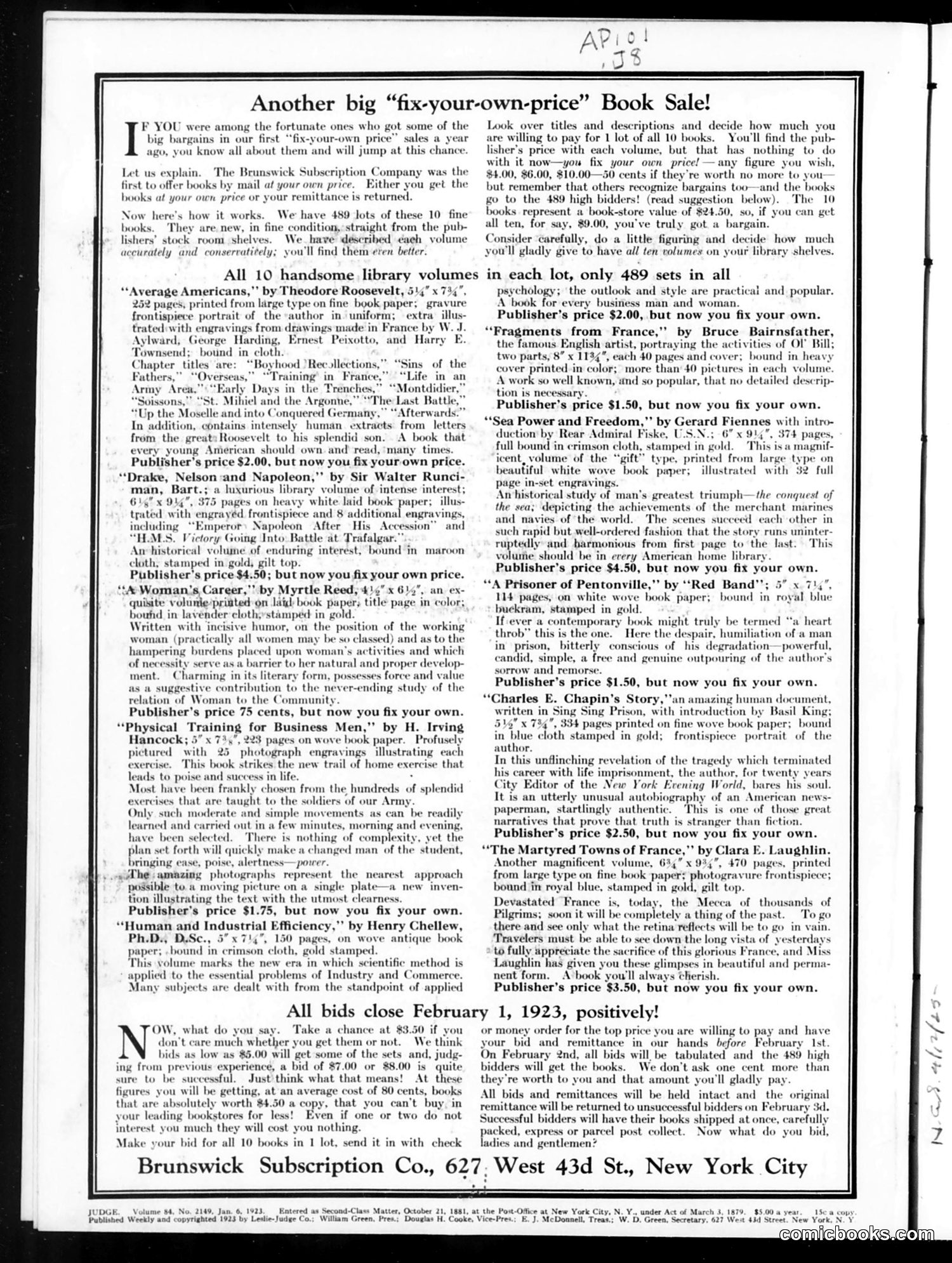
This page is primarily a book auction advertisement for the Brunswick Subscription Company, not a political cartoon. It announces a "fix-your-own-price" book sale closing February 1, 1923, featuring handsome library volumes available at discounted rates. The advertisement lists ten books for auction, including works by Theodore Roosevelt, Sir Walter Runciman, and others. Text emphasizes buyers can set their own prices within reason—typically $1.50 to $4.50 per volume, well below publisher's prices. The page contains no political cartoons or satirical illustrations. It's a straightforward commercial pitch targeting book collectors and libraries, using Judge magazine's space as an advertising vehicle rather than for editorial content or humor.
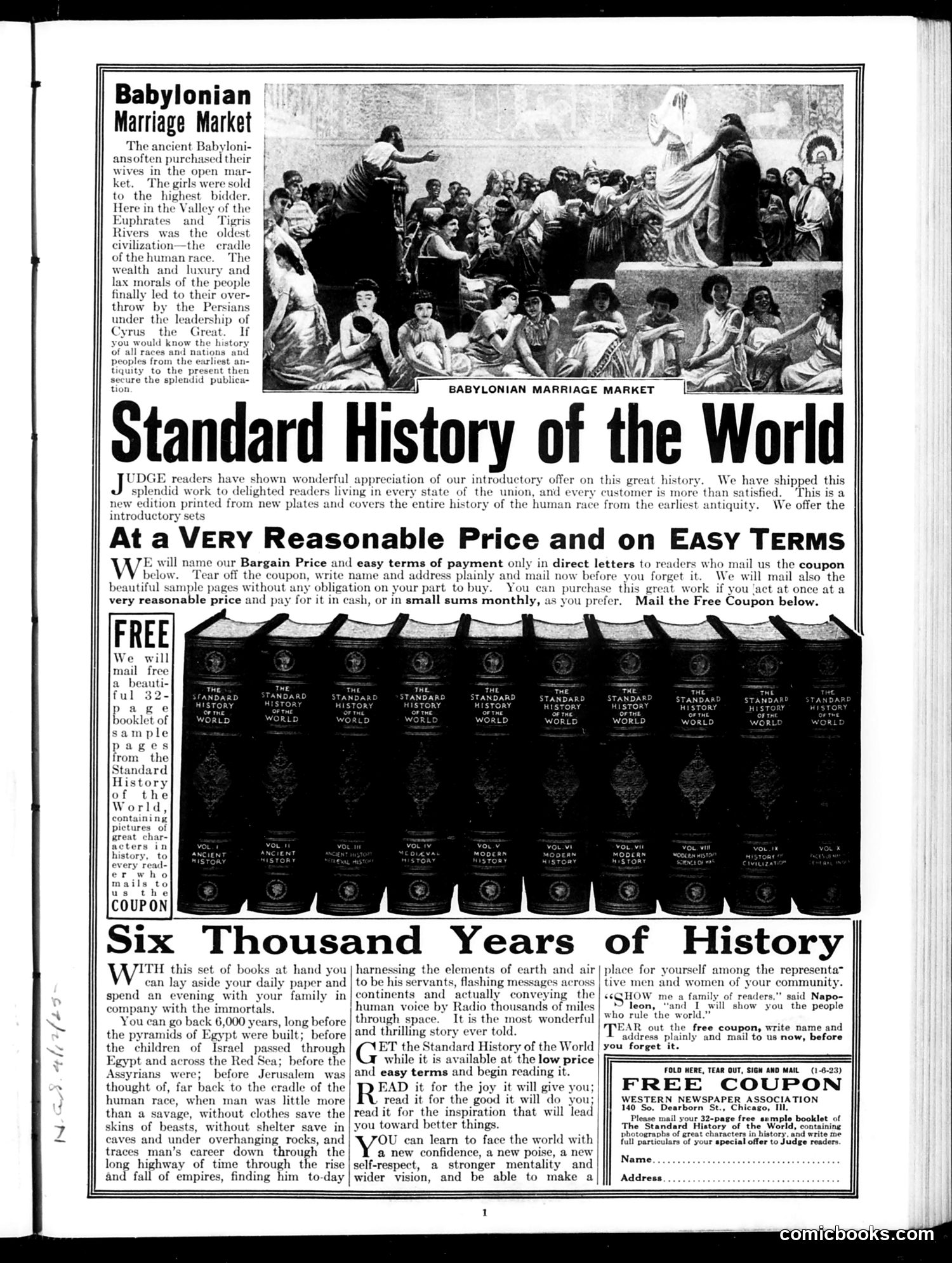
This page is **primarily an advertisement**, not political satire. It promotes the "Standard History of the World," a multi-volume encyclopedic work sold through mail order. The top illustration labeled "Babylonian Marriage Market" depicts an ancient historical scene—women being auctioned in a marketplace—serving as an example of the historical content readers would encounter in the books. The advertisement emphasizes affordability ("Very Reasonable Price and on Easy Terms"), offers free sample pages, and includes images of the ten volumes. The copy promises readers access to "six thousand years of history" covering ancient civilizations like Egypt, Assyria, and Jerusalem. The sole satirical element appears minimal—this is fundamentally a commercial pitch using Judge's platform to sell educational materials to readers interested in world history.
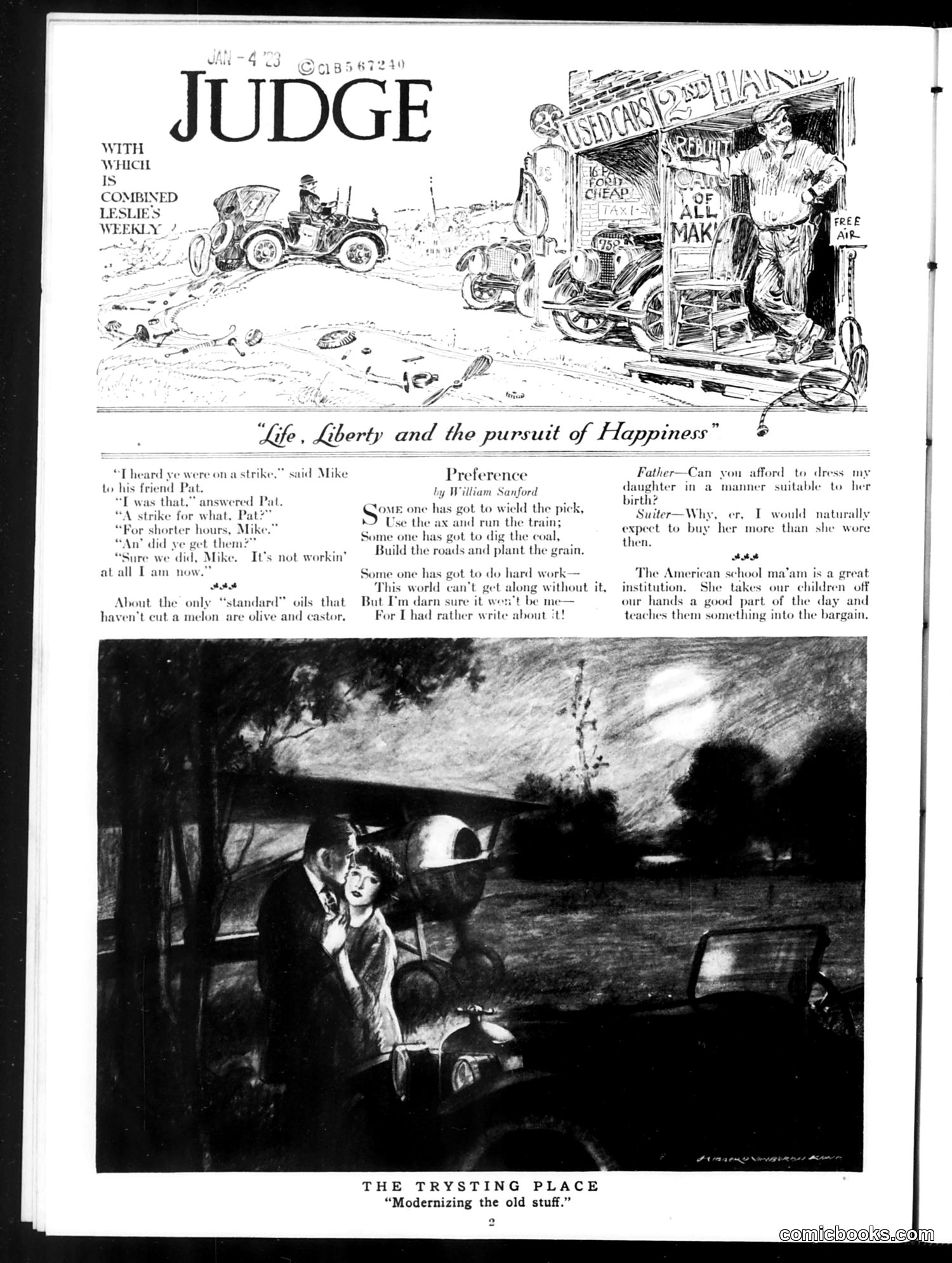
This page contains a cartoon strip and satirical commentary about labor strikes. The dialogue shows "Mike" and a friend debating a workers' strike—Mike argues strikes don't work, while his friend counters that some people must do hard work and that he'd "rather write about it." The satirical point appears to critique armchair intellectuals who romanticize labor struggles while avoiding practical engagement. The lower photograph, titled "The Trying Place: Modernizing the Old Stuff," shows a couple in a car and likely comments on courtship customs in the modern automotive age. The "Preference" poem by William Sanford also satirizes social attitudes about education and gender roles, mocking both working-class aspirations and upper-class pretension. The overall theme: American social and labor tensions of the 1920s era.
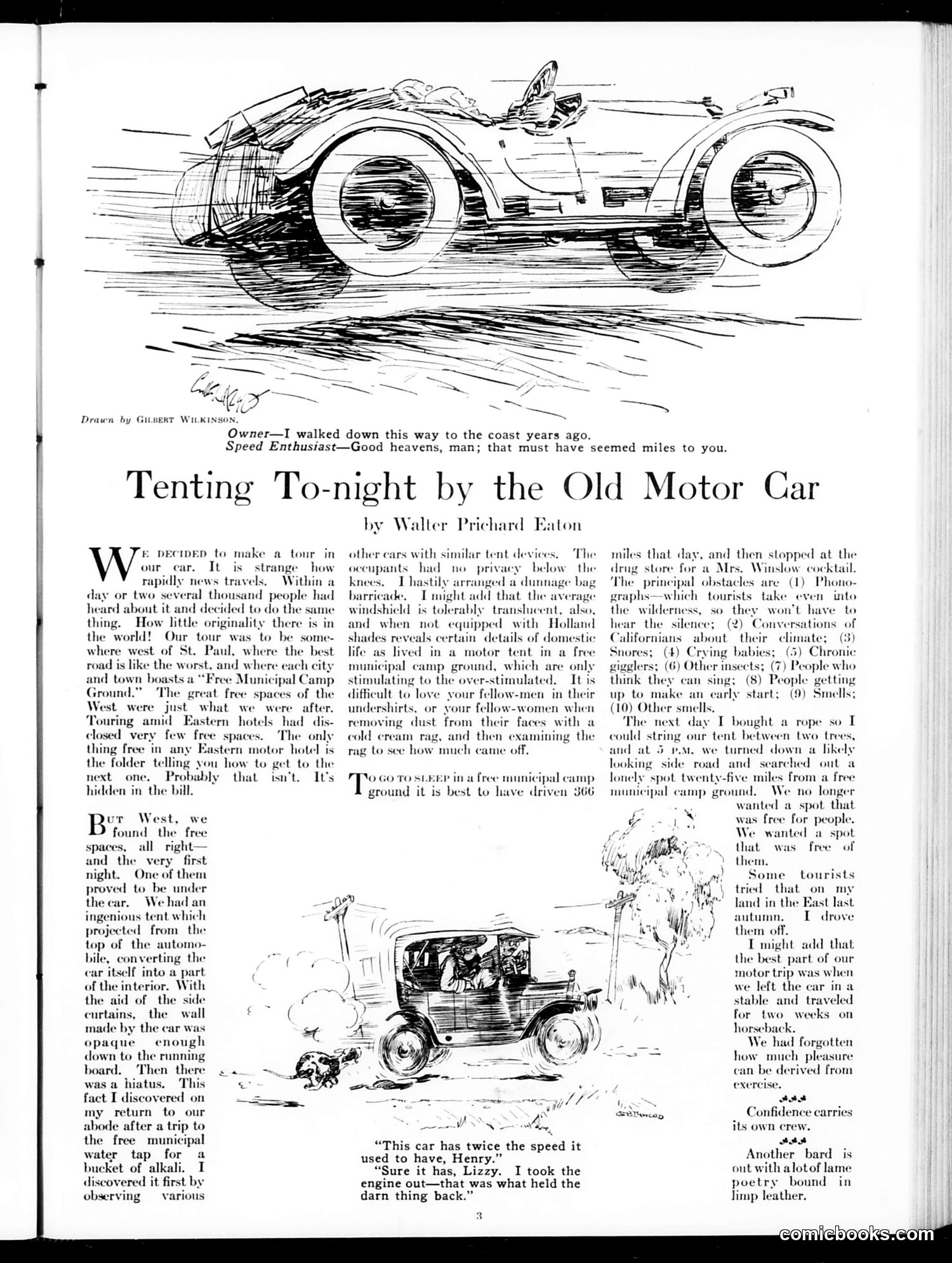
This is a humorous short story by Walter Prichard Eaton, illustrated by Gilbert Wilkinson, about early automobile camping. The narrative describes a family's decision to tour in their car with a tent device—a novel camping method at the time. The satire targets the emerging "motor tourist" phenomenon and the inconveniences of primitive auto-camping. The story pokes fun at overcrowded free municipal campgrounds, the uncomfortable sleeping arrangements, and various tourist behaviors (singing badly, smell issues, etc.). The accompanying sketches show the impractical tent-car contraption and cramped camping conditions. The piece satirizes both the novelty of motorized travel and urban tourists' attempts to experience "roughing it" while actually seeking comfort—a timeless social commentary on leisure culture.
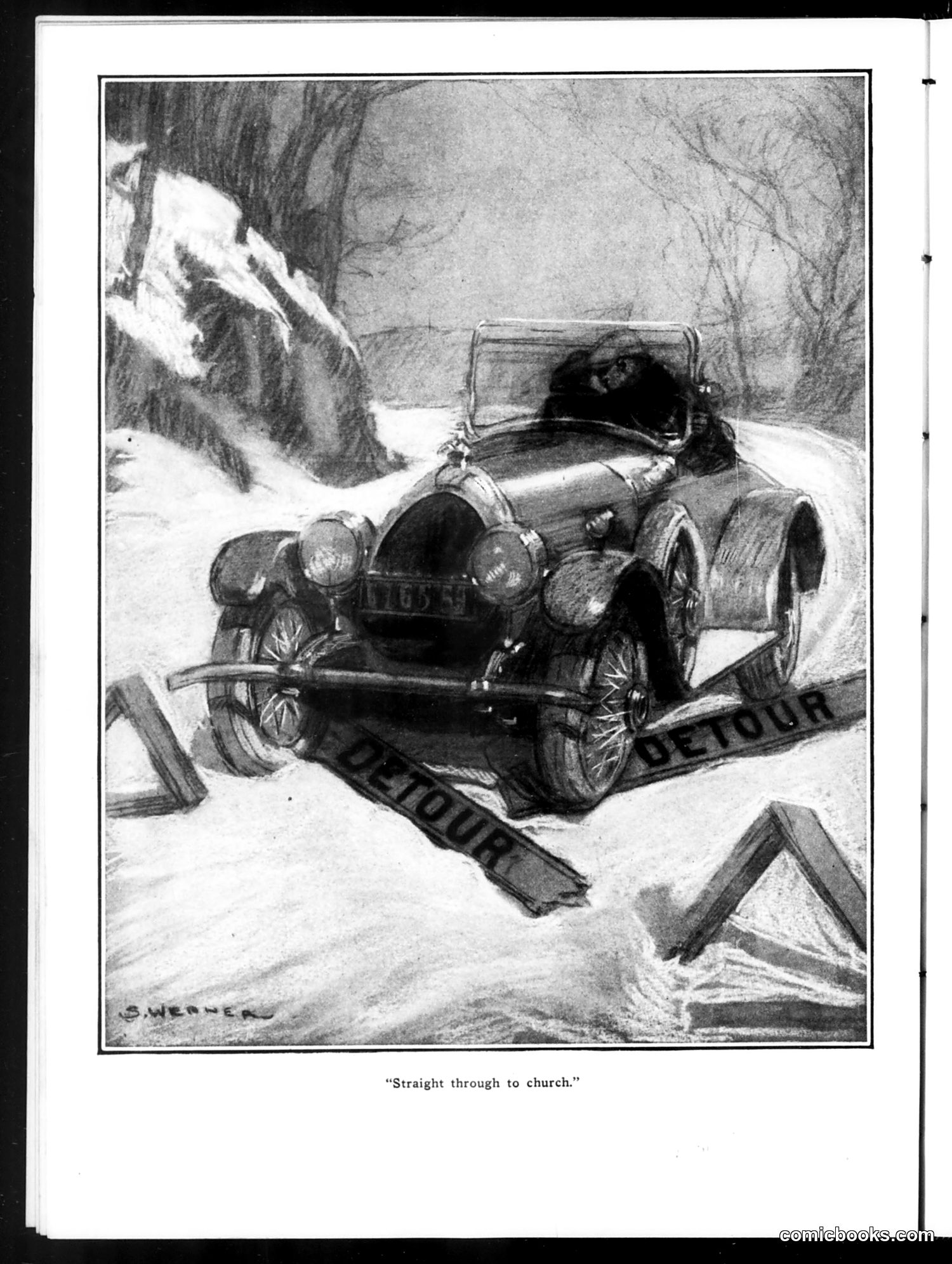
This cartoon depicts an early automobile stuck in snow, with the caption "Straight through to church." The joke appears to satirize the reliability and practicality of early automobiles in winter conditions. The car, labeled "DETROIT" (likely referencing Detroit's automobile manufacturing industry), has skidded off the snowy road and become immobilized. The contrast between the driver's apparent destination—church—and the vehicle's actual predicament suggests the unreliability of these new machines. The humor targets both the nascent automobile industry and owners' overconfidence in the technology's capabilities. Rather than providing dependable winter transportation, the car has stranded its occupant, making the casual phrase "straight through to church" darkly ironic. This reflects early 20th-century skepticism about automobiles as practical alternatives to established transportation methods.
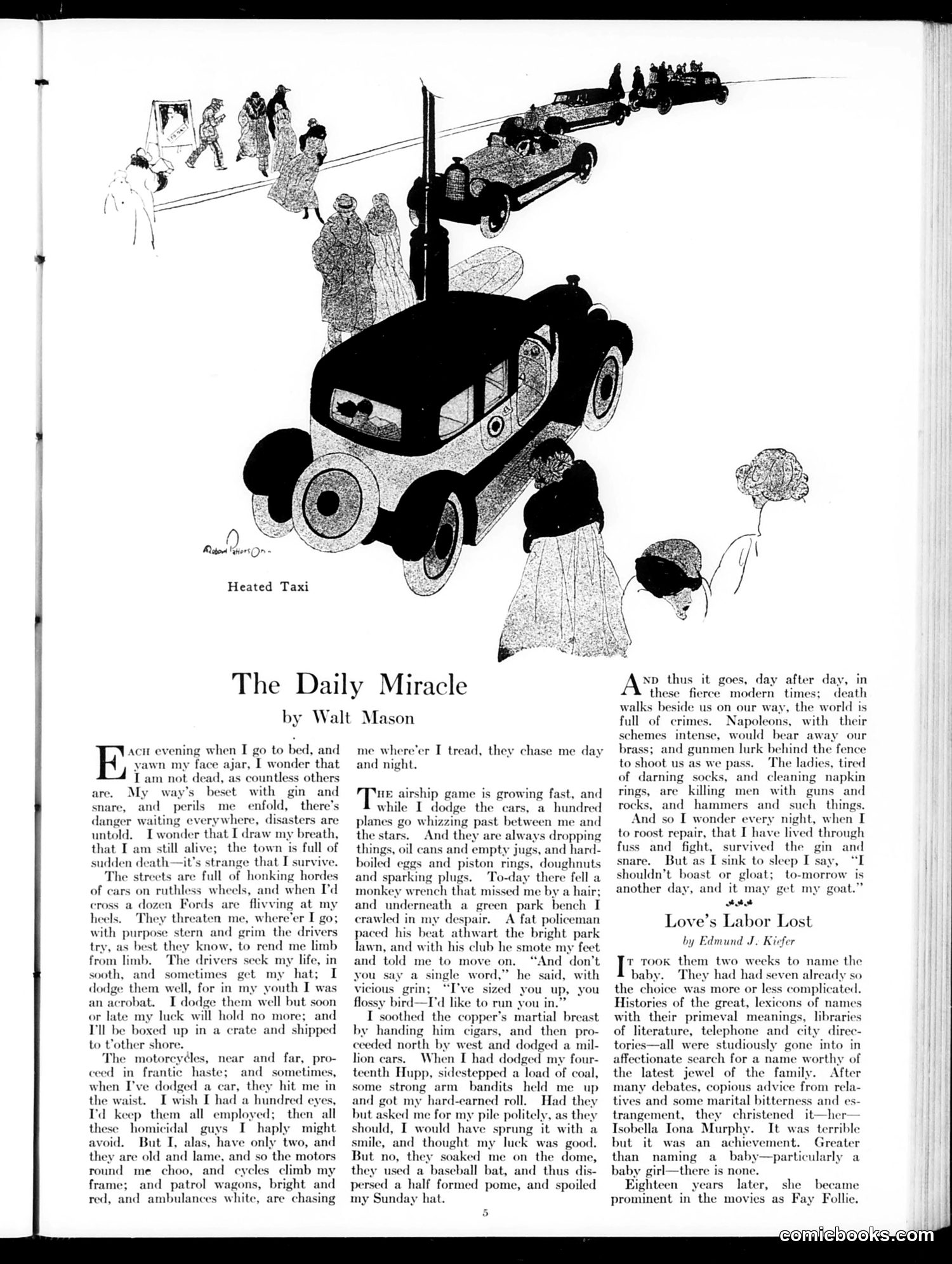
This page satirizes the hazards of modern urban life in the early automotive age. The main cartoon illustrates a "Heated Taxi"—a humorous depiction of a heated cab vehicle surrounded by pedestrians and traffic chaos. Walt Mason's poem complements the illustration, cataloging the dangers a pedestrian faces daily: speeding automobiles and motorcycles, airplanes dropping debris, muggers, and hostile police. The narrator marvels he survives each night given the constant threats—cars, criminals, and armed women ("killing men with guns and rocks"). The satire targets the rapid modernization of American cities, where new technologies (automobiles, aircraft) created unexpected hazards. The poem's tone shifts between anxiety and absurdist resignation: death lurks everywhere, yet people persist. The secondary piece "Love's Labor Lost" appears unrelated. The overall message: modern progress brings chaos and danger that earlier generations never faced.
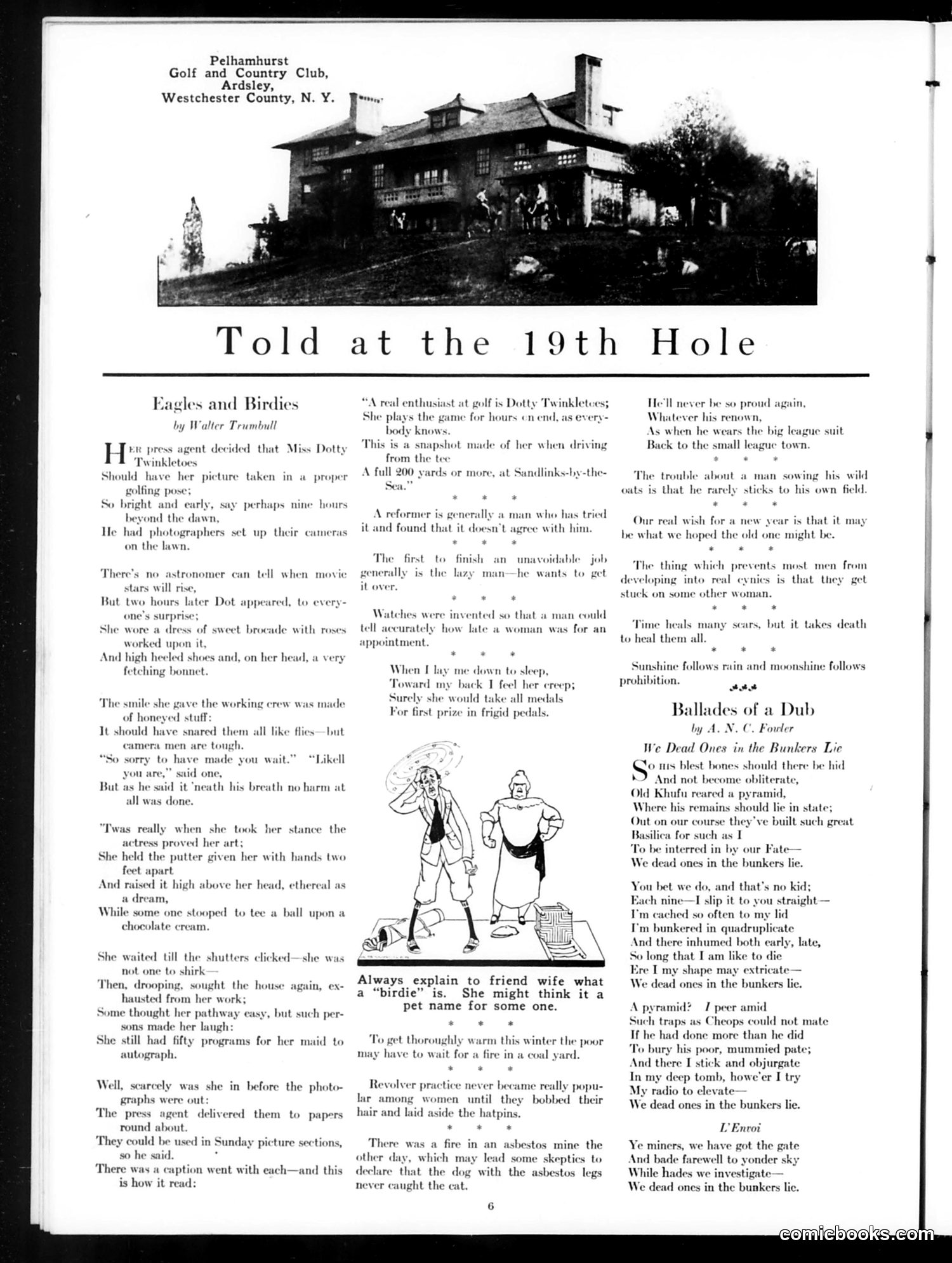
This page contains humorous golf-themed content from an American satirical magazine. The main story, "Eagles and Birdies" by Walter Trumbull, satirizes Hollywood vanity and the artificiality of publicity. It mocks an actress ("Miss Dotty Twinkletoes") who poses for golf photographs despite being entirely unprepared for actual golfing—she wears an ornate brocade dress and high heels rather than appropriate athletic wear. The joke exposes how press agents fabricate glamorous images for public consumption, complete with misleading captions claiming she's an enthusiastic golfer when she's merely a posed subject. The page also contains brief satirical one-liners about reformers, laziness, timekeeping, and other social observations typical of Judge's humor. A separate poem, "Ballades of a Dub," humorously treats golfers trapped in bunkers as if they were pharaohs entombed in pyramids—comic deflation of the golfer's self-importance.
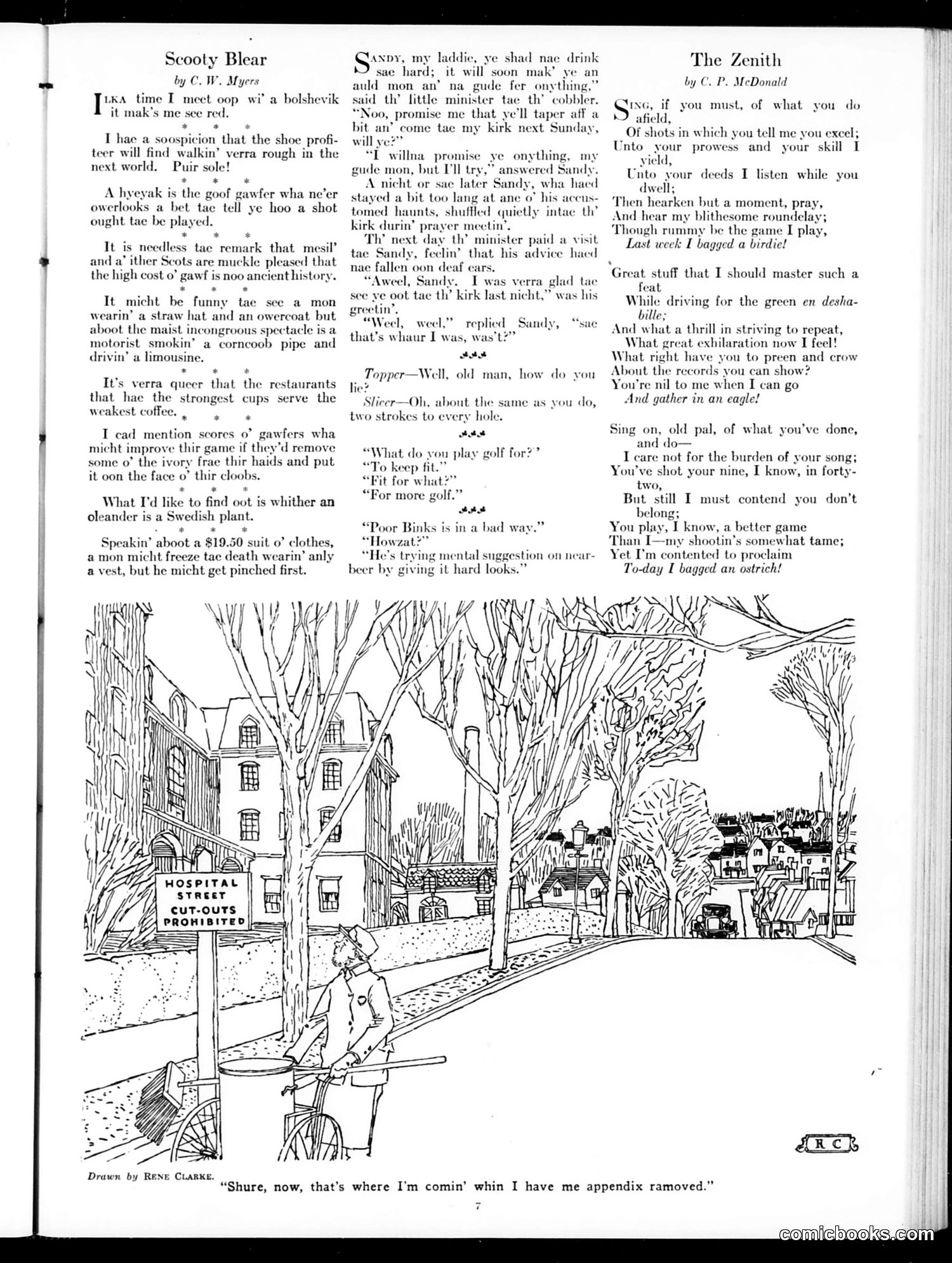
This Judge magazine page contains three distinct humor pieces: **"Scooty Blear"** (left column): Scottish dialect humor about everyday observations—bolsheviks, shoe profiteers, golf, restaurants. The reference to bolsheviks suggests post-WWI anxiety about communism. The humor relies on Scottish brogue and mild social commentary about golf culture and wartime profiteering. **"Topper" (center)**: A brief joke about golf scoring—two golfers discuss their handicaps with wordplay ("two strokes to every hole"). **"The Zenith"** (right): A poem about golf one-upmanship. A golfer boasts about scoring a "birdie," then an "eagle," then absurdly an "ostrich"—escalating claims of accomplishment. The satire mocks competitive bragging and the human impulse to top others' achievements. **The cartoon** (bottom): Shows a cyclist near a hospital sign saying he'll return "when I have me appendix ramoved"—dark humor about inevitable medical procedures, drawn by Rene Clarke. The page's dominant theme is golf culture and one-upmanship in the 1920s leisure class.
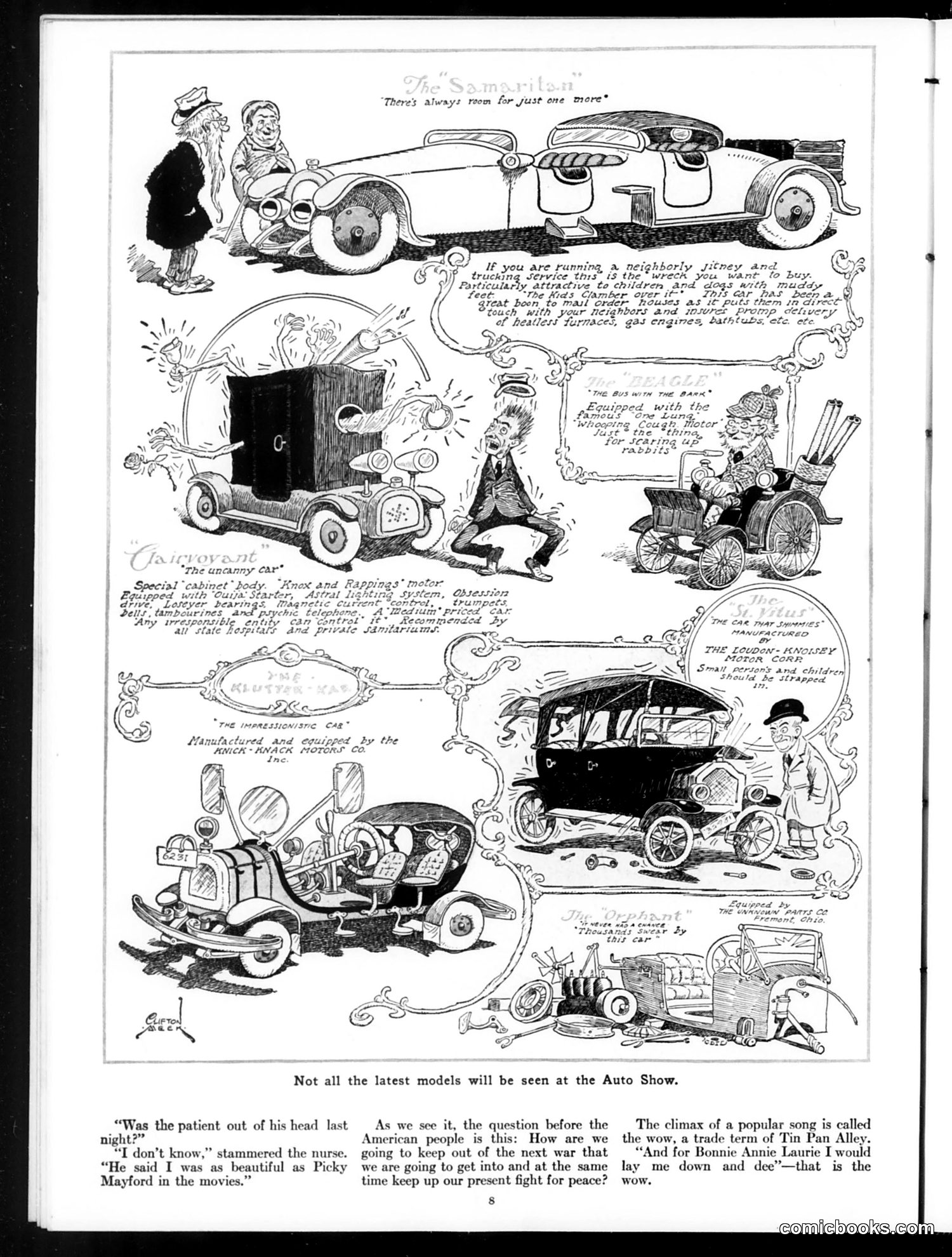
This page satirizes automobiles at an early auto show (likely 1920s-early 1930s). The cartoon showcases various novelty and practical vehicles with humorous descriptions, targeting different buyer demographics—families, delivery services, neighbors with muddy dogs. The satire mocks both: 1. **Vehicle manufacturers** promoting increasingly absurd features and designs as innovations 2. **Consumer culture** where people buy cars for impractical or frivolous reasons References to "mail order houses" and "heatless furnaces" suggest the vehicles are marketed as delivery vehicles during a period when motorized transportation was replacing horses. The bottom text fragments discuss unrelated topics (a patient's lucidity, war pacifism, Tin Pan Alley songs), suggesting this is a magazine page mixing satire, advertisements, and miscellaneous content—typical of Judge's format.
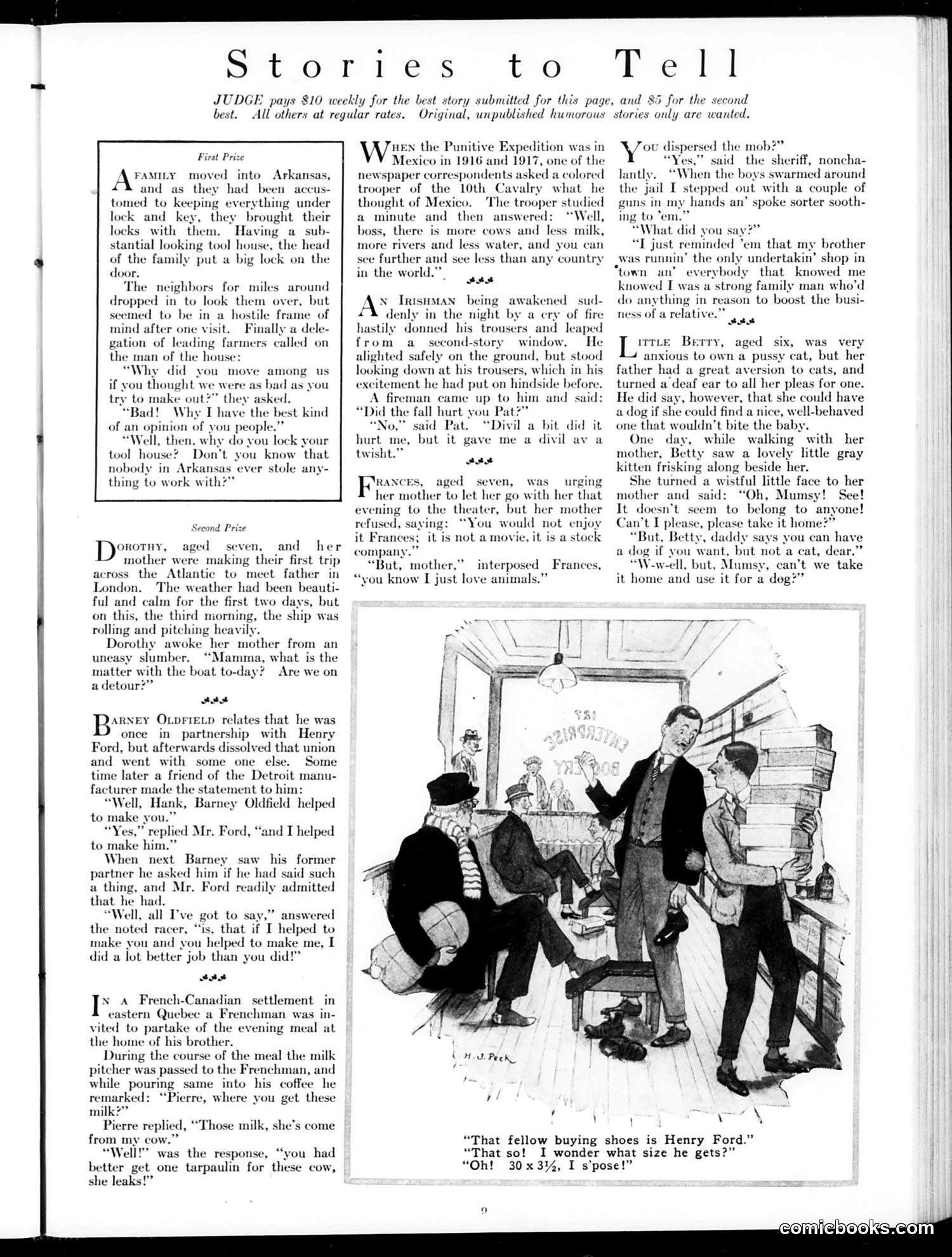
This page from Judge magazine contains five humorous short stories (not political cartoons). The content reflects early 20th-century American regional and ethnic humor: 1. **Arkansas Lock Story**: Satirizes frontier stereotypes—a newcomer locks his toolhouse, insulting locals by implying they're thieves. The punchline subverts expectations: Arkansans pride themselves on honest dealings. 2. **Dorothy's "Detour"**: A child's innocent misunderstanding of seasickness as the ship being off-course. 3. **Barney Oldfield/Henry Ford Story**: References the famous race car driver and automobile magnate, joking about their dissolved partnership and mutual credit-taking. 4. **10th Cavalry Trooper**: Uses a Black soldier's observation of Mexico during the 1916-17 Punitive Expedition to deliver absurdist humor about the country's contradictions. 5. **Irishman's Trousers/French-Canadian Milk**: Ethnic humor playing on stereotypical Irish and French-Canadian accents and supposed foolishness. The page advertises Judge's story-submission contest ($10 first prize).
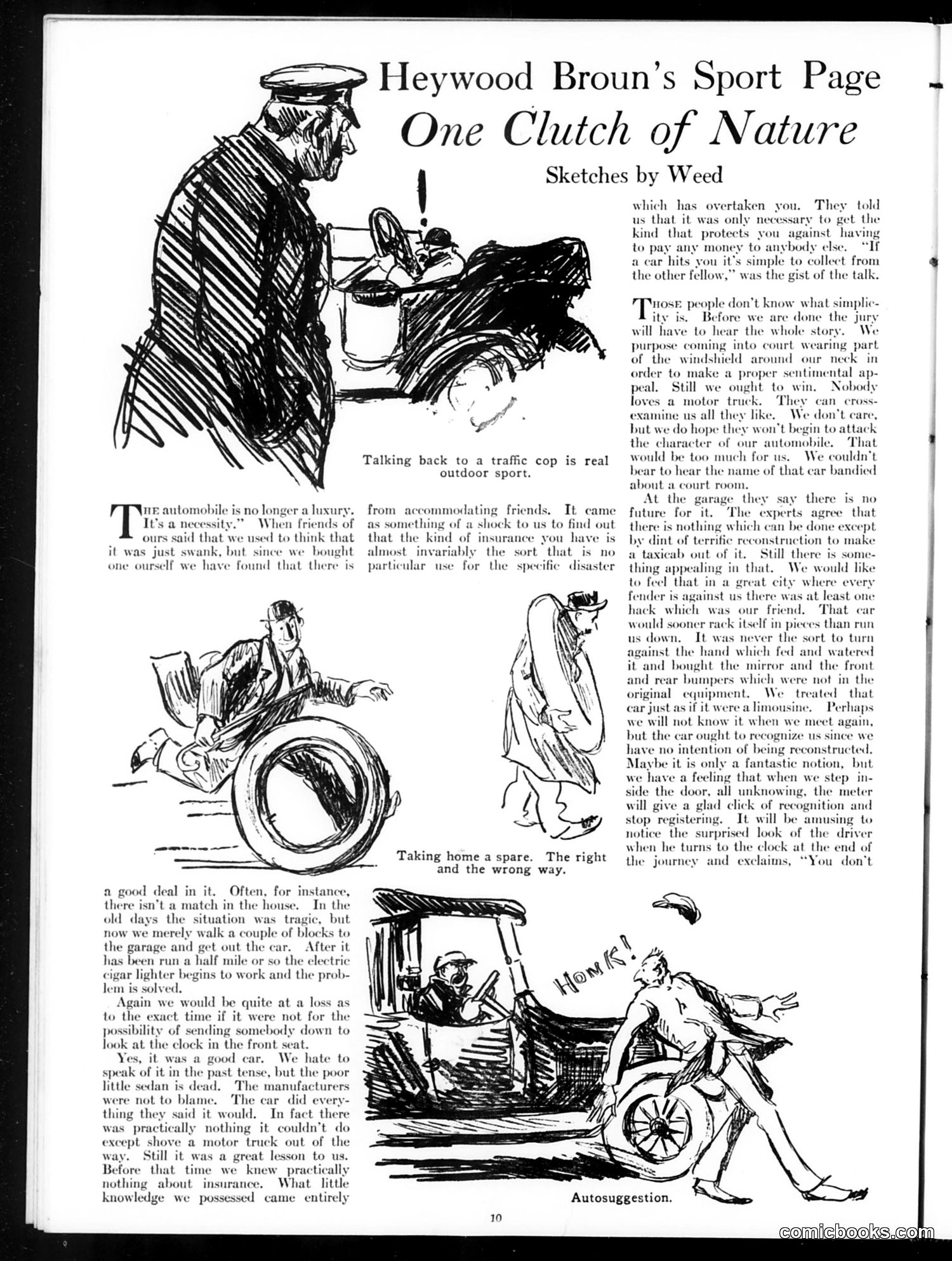
This piece satirizes early 20th-century car ownership and the unforeseen complications of automobile culture. Broun humorously recounts his experience with a modest sedan that encountered a motor truck—likely a collision causing significant damage. The satire targets several aspects: the false economy of car ownership (presented as a "necessity" rather than luxury), inadequate insurance that doesn't actually protect owners, and the absurdity of litigation when accidents occur. The sketches illustrate common automotive indignities—arguing with traffic cops, taking home a spare tire incorrectly, and dealing with a truck collision. Broun's central joke is that despite treating the car well, it ultimately failed catastrophically. The cartoons mock how dependent owners became on vehicles for basic needs (checking the time via the dashboard clock, finding matches), exposing the car's invasion into everyday life. The final illustration suggests a cyclist being hit by a car—an "autosuggestion" that reflects the era's anxieties about automobile danger to pedestrians and other road users.
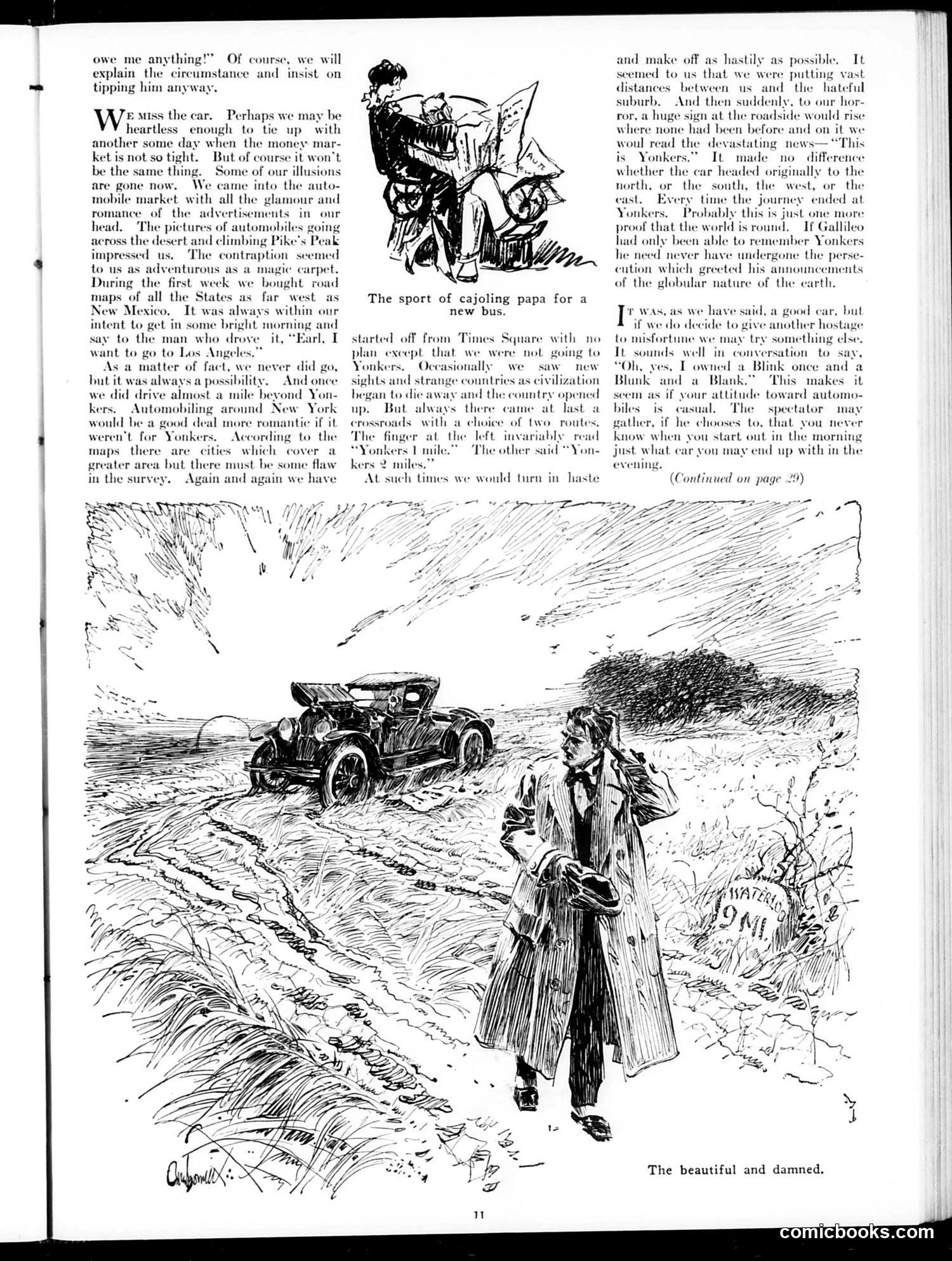
This piece satirizes early automotive enthusiasm and the disappointing reality of car ownership. The text mocks people who bought automobiles seduced by glamorous advertisements showing cars crossing deserts and climbing mountains, imagining romantic cross-country adventures. The reality? They end up trapped in the suburban monotony of Yonkers, New York, unable to escape no matter which direction they drive—a darkly humorous commentary on the gap between consumer fantasy and actual experience. The author notes that even attempting one mile beyond Yonkers felt adventurous. The cartoon shows a stranded motorist and vehicle in desolate terrain, illustrating the mismatch between aspirational auto-travel imagery and mundane reality. The title "The beautiful and damned" references desire corrupted by commercial promises. This satirizes both consumer gullibility and the limitations of early automobiles for actual long-distance travel.
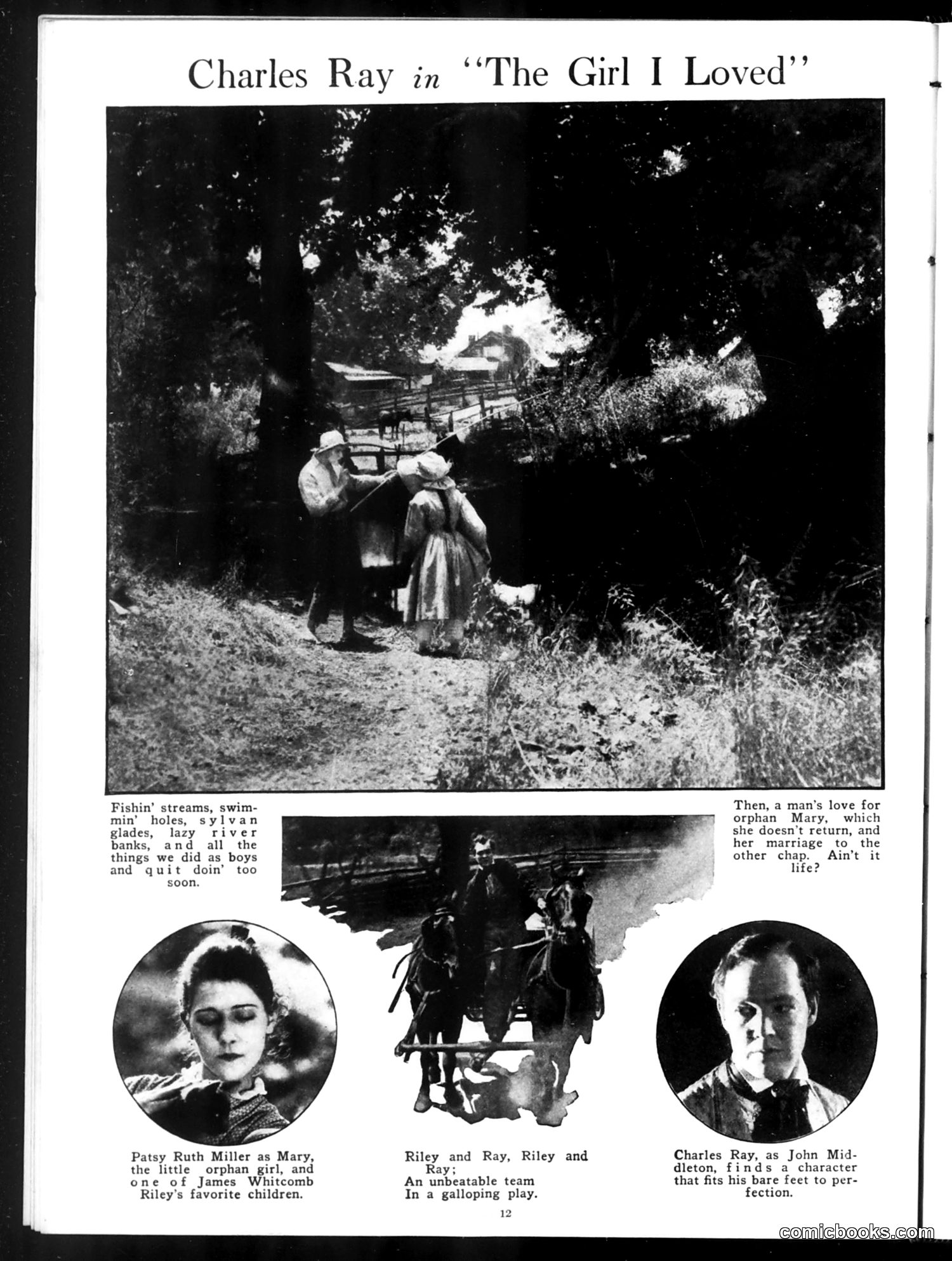
This is a **film review** for a movie adaptation of James Whitcomb Riley's work, not political satire. The page promotes a silent film starring Charles Ray and Patsy Ruth Miller. The plot, as described: a man loves an orphan girl named Mary, but she marries someone else instead—exploring themes of unrequited love and rural American sentiment. Riley was a celebrated Hoosier poet known for sentimental, folksy verses about childhood and small-town life. The page identifies the actors in circular portraits and praises "Riley and Ray" as "an unbeatable team in a galloping play." The accompanying photos show rural scenes (fishing, horseback riding) that evoke Riley's nostalgic, pastoral aesthetic. This appears to be **promotional content** rather than satire—Judge magazine mixed entertainment journalism with humor. The reference to "bare feet to perfection" suggests the film captures authentic rural character authentically.
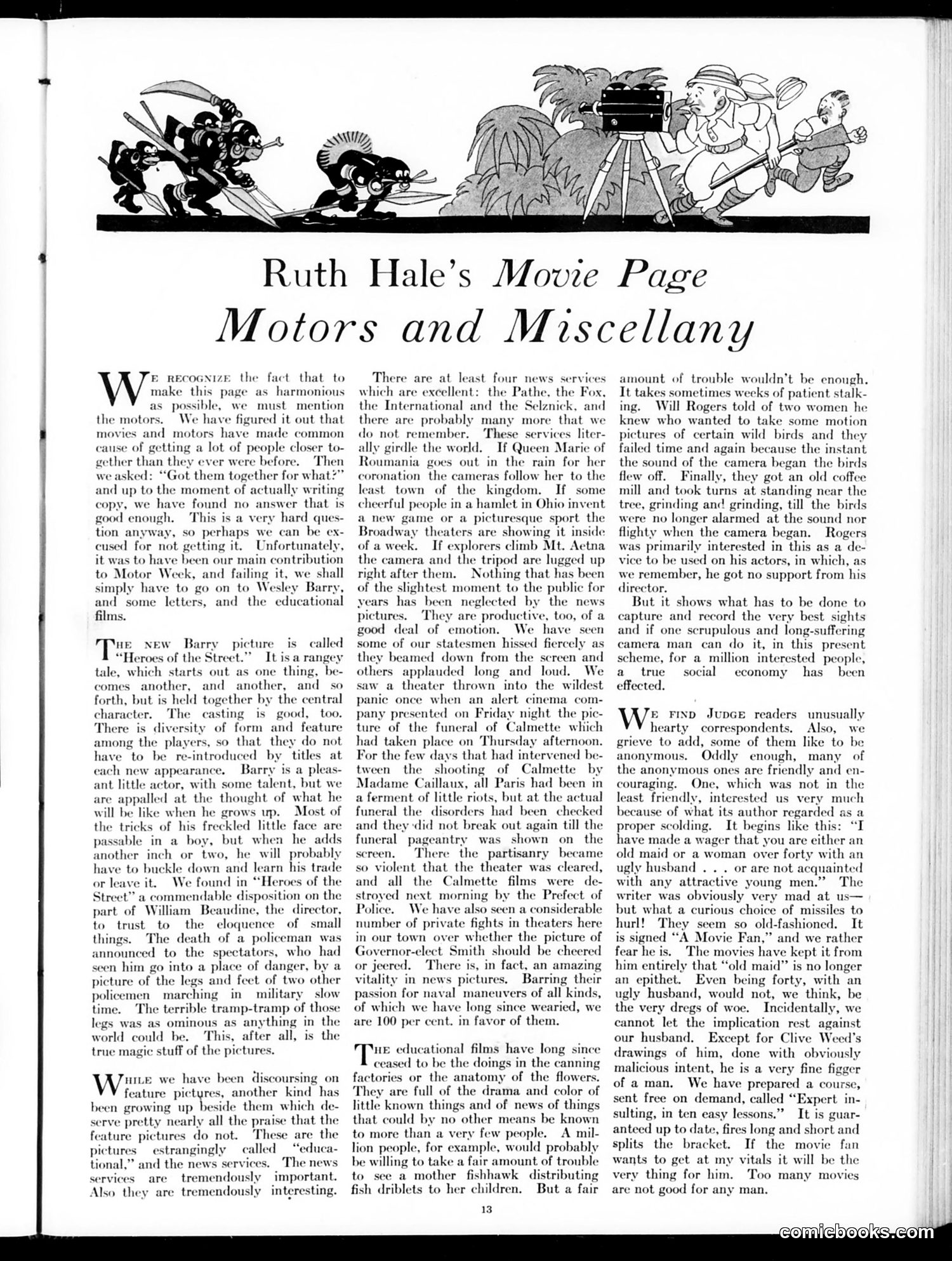
This is a film criticism column by Ruth Hale discussing newsreels and educational cinema. The illustrated header shows figures operating early movie cameras and equipment. The main content praises **newsreel services** (Pathé, Fox, International, Selznick) for their global reach and emotional impact on audiences. Hale cites a specific historical example: the **Calmette assassination funeral** (1914), where Madame Caillaux had killed newspaper editor Gaston Calmette. When theaters screened the funeral footage days later, the partisan violence that had been suppressed at the actual event erupted again—so violently the theater was cleared. The column also reviews a Harry Barry film, "Heroes of the Street," praising its director's subtle storytelling choices. The broader point: newsreels are powerful, affecting documents that capture real events with genuine emotional consequences for viewers—a relatively new phenomenon in early cinema.
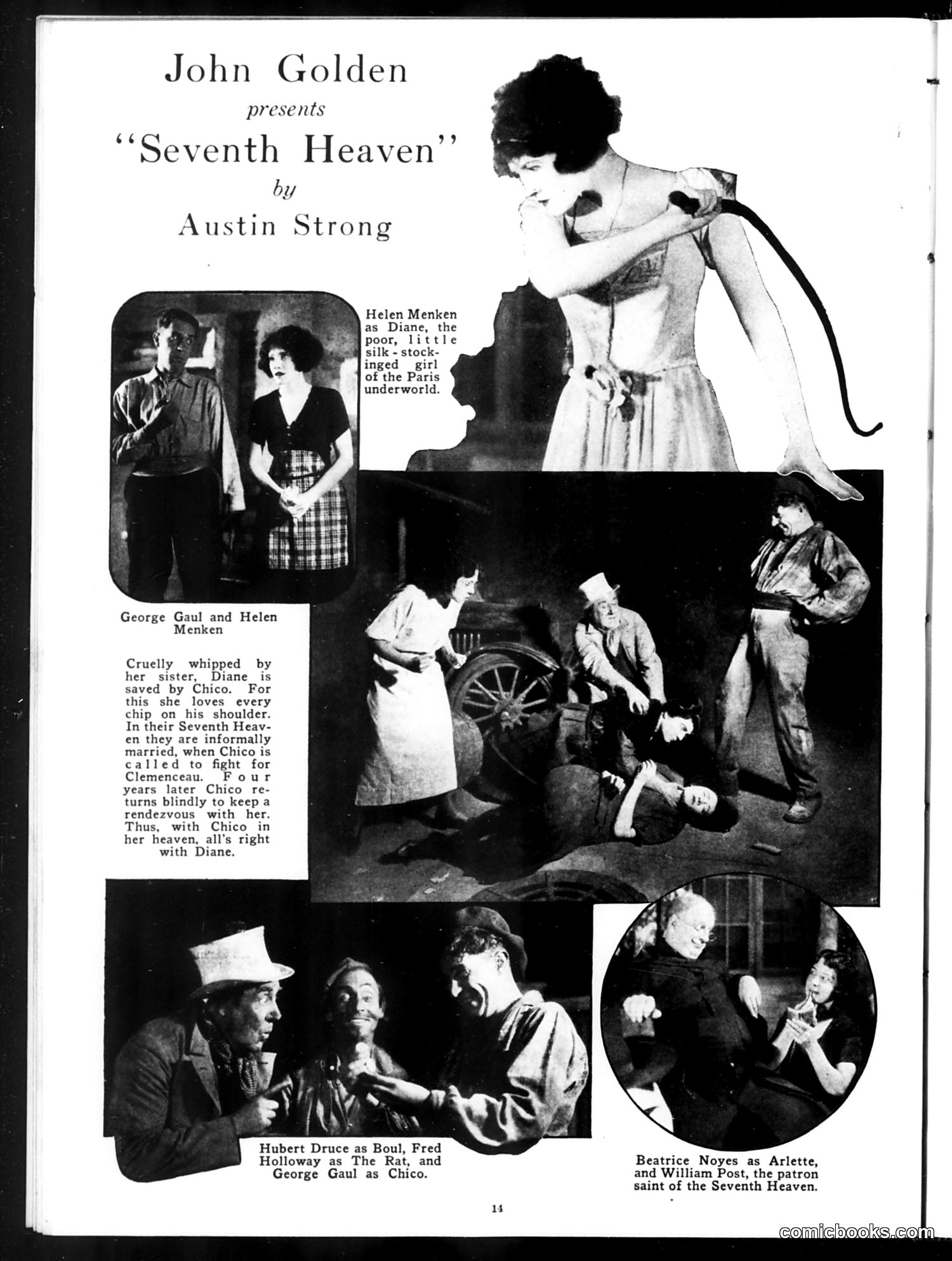
This is a promotional page for the Broadway play "Seventh Heaven" by Austin Strong, presented by producer John Golden. The page showcases scenes and the cast, featuring Helen Menken as Diane, a poor Parisian girl from the underworld. The plot concerns Diane's romance with Chico, a working-class man who rescues her from abuse by her cruel sister. They find happiness together ("Seventh Heaven"), but are separated when Chico is conscripted to fight in World War I under French leader Clemenceau. Four years later, he returns—now blind—to reunite with her. The page identifies supporting actors including George Gaul, Hubert Druce, Fred Holloway, Beatrice Noyes, and William Post. Rather than political satire, this is straightforward theatrical advertising in Judge magazine, promoting a sentimental wartime romance drama popular in the 1920s.
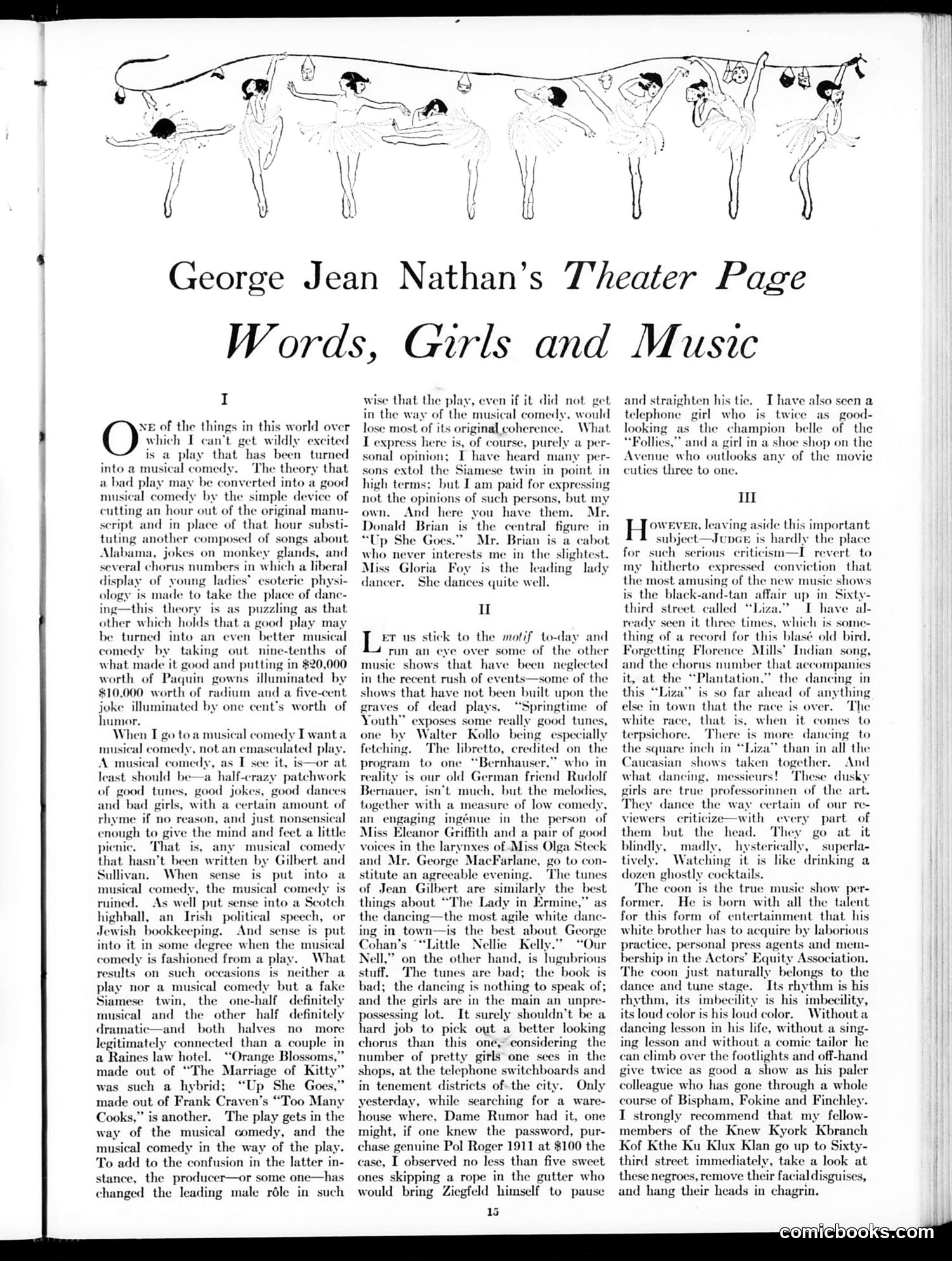
This is George Jean Nathan's theater column, not a political cartoon. Nathan was a prominent drama critic, and this page contains his opinion piece critiquing musical comedies of the era. **Main argument:** Nathan dismisses the trend of converting plays into musicals by cutting the original script and inserting unrelated songs, chorus girls, and expensive costumes. He argues this creates a "fake Siamese twin"—neither good theater nor good music. **Specific targets:** He names productions like "Up She Goes" (starring Donald Brian, whom he finds uninteresting) and criticizes how producers eliminate plot coherence to showcase chorus numbers and expensive gowns illuminated by radium lighting. **The satire:** Nathan sarcastically suggests adding "sense" to musical comedy ruins it—like adding sense to a Scotch highball or Irish political speech. He positions himself as the arbiter of taste against popular opinion. The decorative header shows chorus girls in various poses, visually representing the "display of young ladies' esoteric physiology" he critiques.
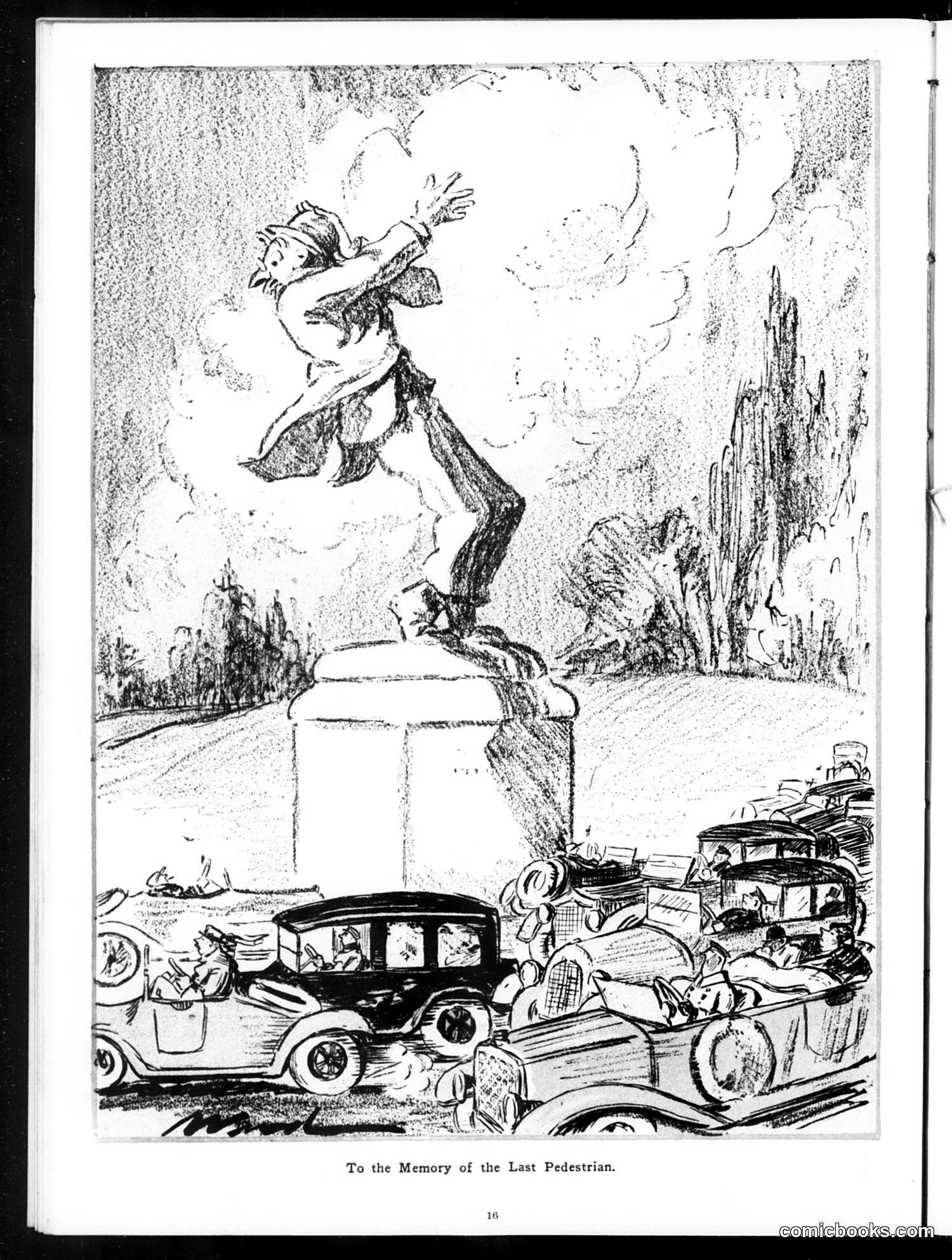
This satirical cartoon depicts an exaggerated monument to a pedestrian, suggesting that pedestrians have become extinct due to automobile traffic. A grotesque figure stands atop a pedestal in a barren landscape, arms raised in distress or surrender. Below, numerous automobiles crowd together chaotically, implied to be the cause of pedestrian demise. The satire addresses early 20th-century anxiety about rapidly increasing motor vehicle traffic and its danger to pedestrians. By framing the pedestrian as a vanished species worthy of memorial, the cartoonist critiques both the dominance of automobiles in public spaces and society's apparent indifference to the safety hazards they created. This reflects genuine concerns about traffic fatalities during the automobile era's explosive growth.
**The Judge Mascot**: The cartoon header features Judge's trademark owl character, a symbol of satirical wisdom used throughout the magazine's run. **Main Editorial Targets**: This page attacks President Harding's failed merchant marine subsidy bill and the absurdities of Prohibition enforcement. **"The Subsidy Subsides"**: Mocks Harding's dogged support for a shipping subsidy despite political defeat. Judge argues the government's isolationist trade policies and anti-alcohol shipping rules (banning liquor from American merchant vessels) made the subsidy request laughably hypocritical—asking taxpayers to fund what the government itself handicapped. **"Laugh This Off"**: Sarcastically highlights Prohibition's enforcement chaos. A town marshal in Cody, Wyoming was shot by a federal prohibition officer, then prosecuted for arresting the drunk officer. Judge's bitter irony: federal agents could drink on duty with impunity while local law enforcement faced consequences for interfering—exposing Prohibition's fundamental absurdity and corruption.
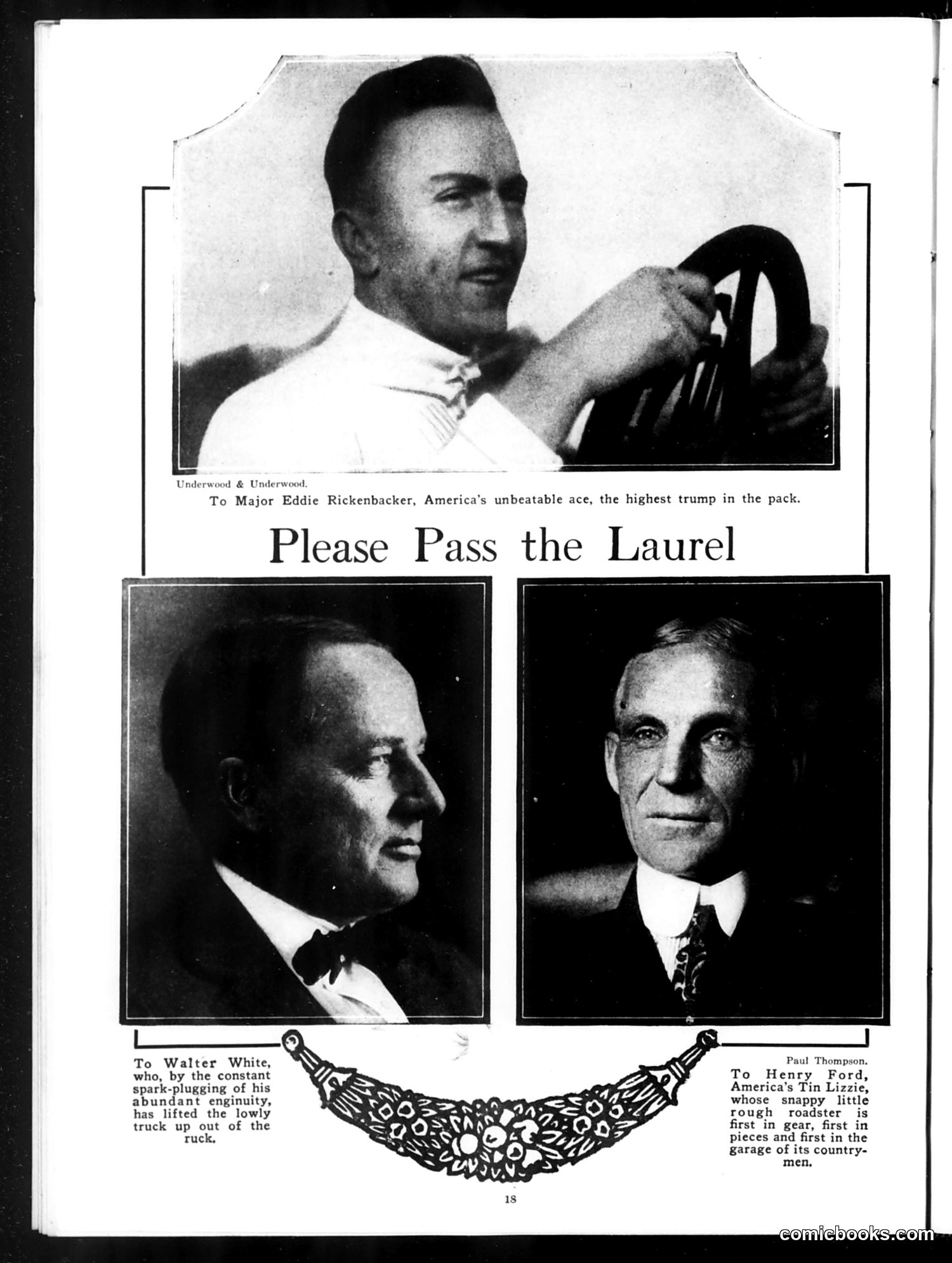
This Judge magazine page satirizes the automotive industry by awarding laurels to three men. The top portrait honors **Eddie Rickenbacker**, a famous WWI fighter pilot, as "America's unbeatable ace." The two lower portraits praise **Walter White** (likely an engineer or industrialist) for improving trucks, and **Henry Ford** for his Model T ("Tin Lizzie")—though Ford's tribute is clearly mocking, sarcastically praising his car for being "first in pieces" and "first in the garage," suggesting chronic mechanical failure and poor reliability. The ornamental laurel wreath divides the honorees, mimicking classical victory imagery. The satire mocks how these industrial figures receive celebrity treatment while the Model T, despite its commercial success, was notoriously unreliable. The joke plays on Ford's fame versus the reality of his product's quality.
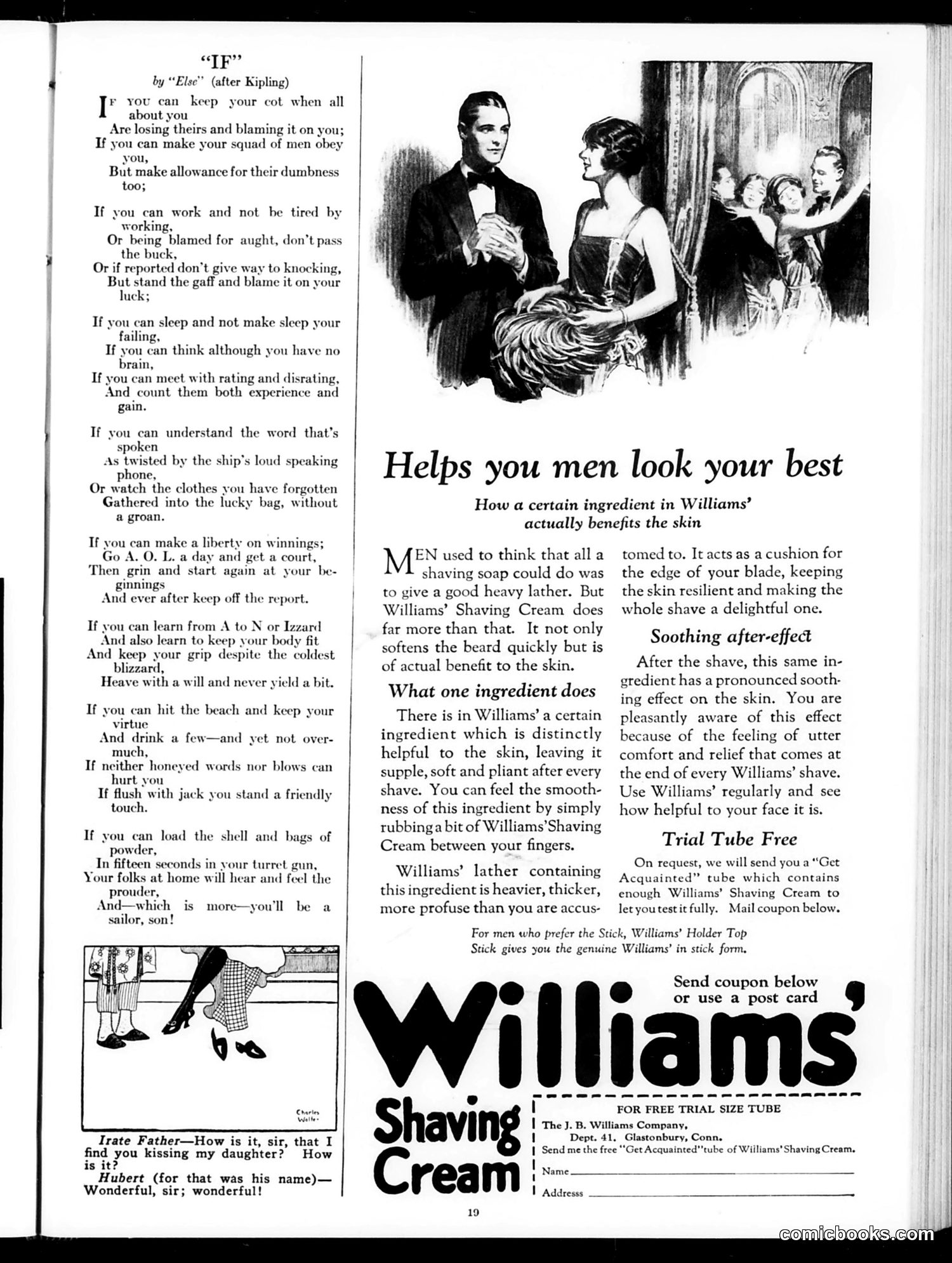
This page contains two distinct elements: **Left side**: A satirical poem titled "IF" (credited to "Else," parodying Kipling's famous poem). It humorously describes the ideal Navy sailor—a man who endures hardships without complaint, keeps discipline, avoids trouble with officers, manages money wisely, and performs duties competently. The humor lies in the exaggerated catalog of naval life's indignities: forgotten laundry in the "lucky bag," shore leave court-martials, confusing ship communications, and the pressure to load ammunition quickly. A small cartoon below shows an "Irate Father" discovering his daughter kissing someone named Hubert, who responds "Wonderful, sir; wonderful!"—a simple joke about male audacity. **Right side**: A full-page advertisement for Williams' Shaving Cream, emphasizing a mysterious beneficial "ingredient" that softens skin. The ad includes an illustration of well-dressed men at a social gathering and offers a free trial tube. The page is primarily **advertising content** with satirical military humor as filler.
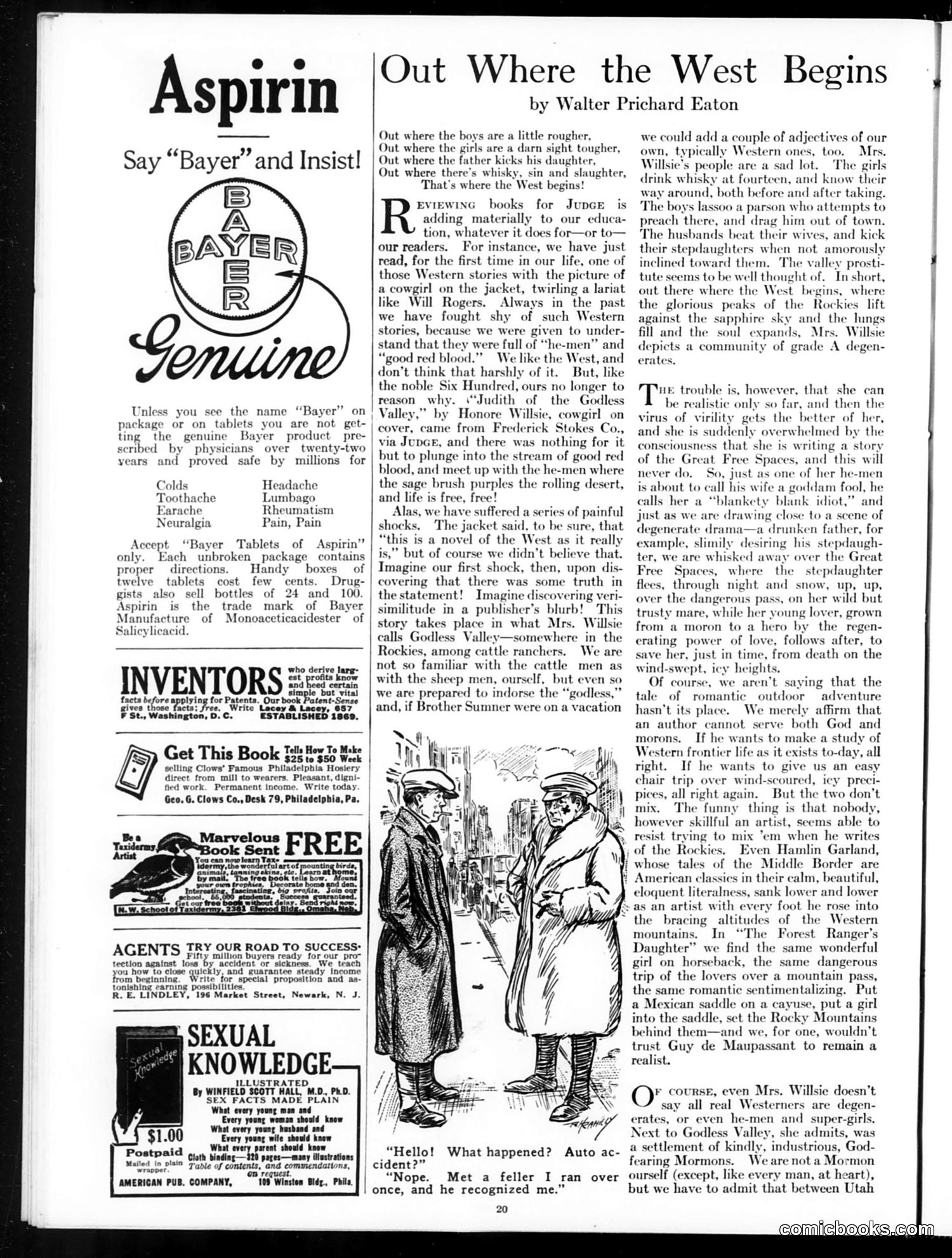
This page contains a literary review by Walter Prichard Eaton of Honore Willsie's novel "Judith of the Godless Valley," a Western story featuring a cowgirl protagonist. **The Satire:** Eaton critiques Willsie's attempt at realistic Western fiction. He notes that while she accurately depicts the brutal, degenerate behavior of frontier society—drinking, wife-beating, prostitution—she cannot maintain this realism when writing romantic scenes. Instead, she retreats into sentimental clichés, replacing "goddam fool" with "blankety blank idiot" and interrupting dramatic moments with melodramatic escapes across snowy mountain passes. **The Point:** Eaton mocks the contradiction between Willsie's gritty ambitions and her Victorian prudishness. She wants literary authenticity but lacks the artistic courage to follow through, collapsing into conventional romanticism. This represents broader criticism of early 20th-century women writers attempting serious Western fiction while constrained by social expectations about propriety. The page also contains unrelated Aspirin and book advertisements typical of period magazines.
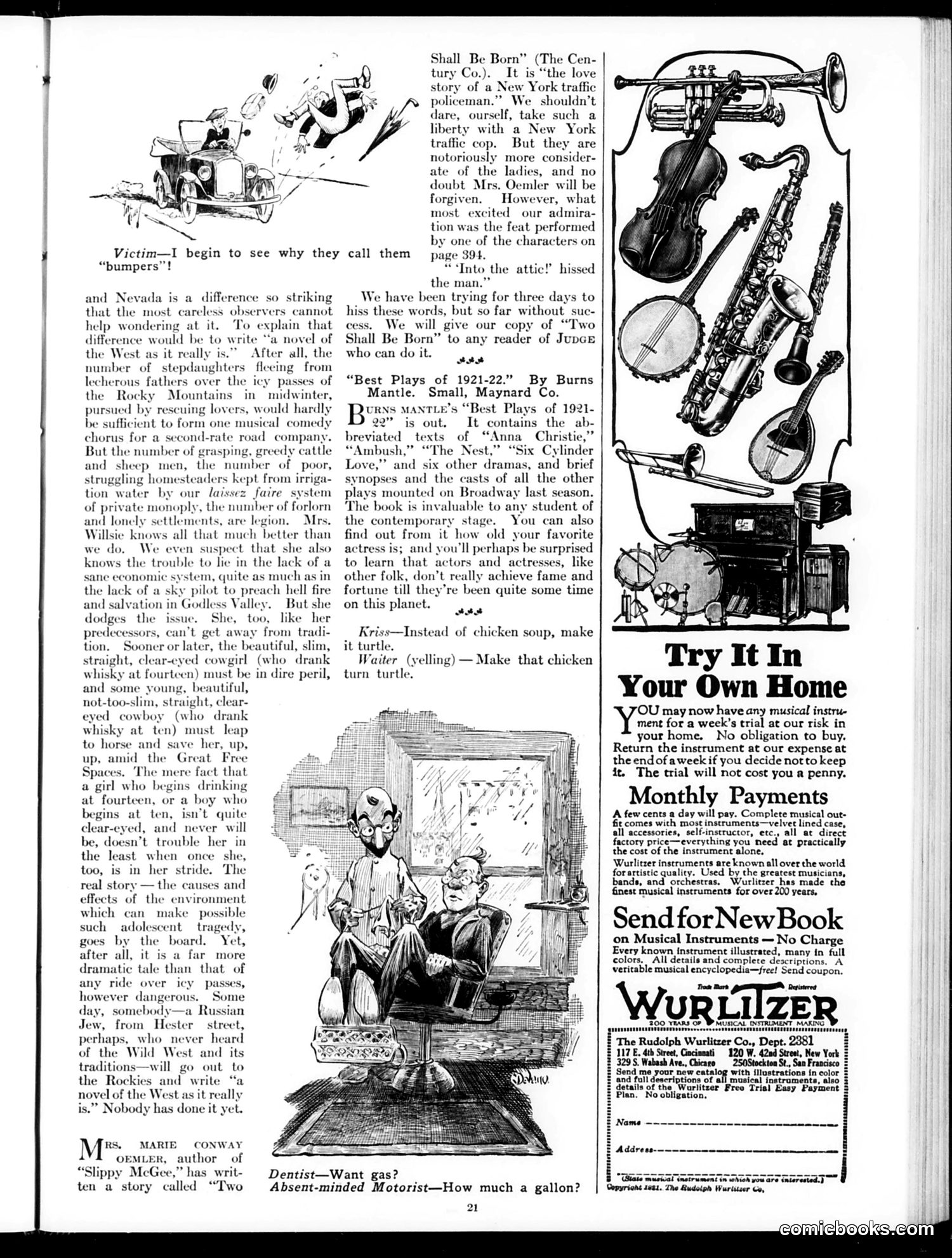
This page contains **book reviews and literary criticism** rather than political cartoons. The main content critiques contemporary Western novels and plays. The lead review discusses a Western novel by Marie Conway Oemler, satirizing how Western fiction romanticizes frontier life with predictable plots—beautiful cowgirls and heroic cowboys—while ignoring the real social issues: economic inequality, irrigation rights disputes, and struggling homesteaders. The reviewer notes the tragic irony that young alcoholics in these stories recover once romance enters. A secondary review praises Burns Mantle's "Best Plays of 1921-22," noting it reveals actors' true ages, debunking the myth that fame comes early. The page also includes **light humor**: jokes about a motorist asking a dentist the price of "gas" (gasoline vs. anesthesia), and wordplay about soup. **The Wurlitzer advertisement** dominates the right side, offering home trial of musical instruments with monthly payments—typical early-20th-century consumer marketing. The satire targets **literary pretension and formulaic storytelling** rather than specific political figures.
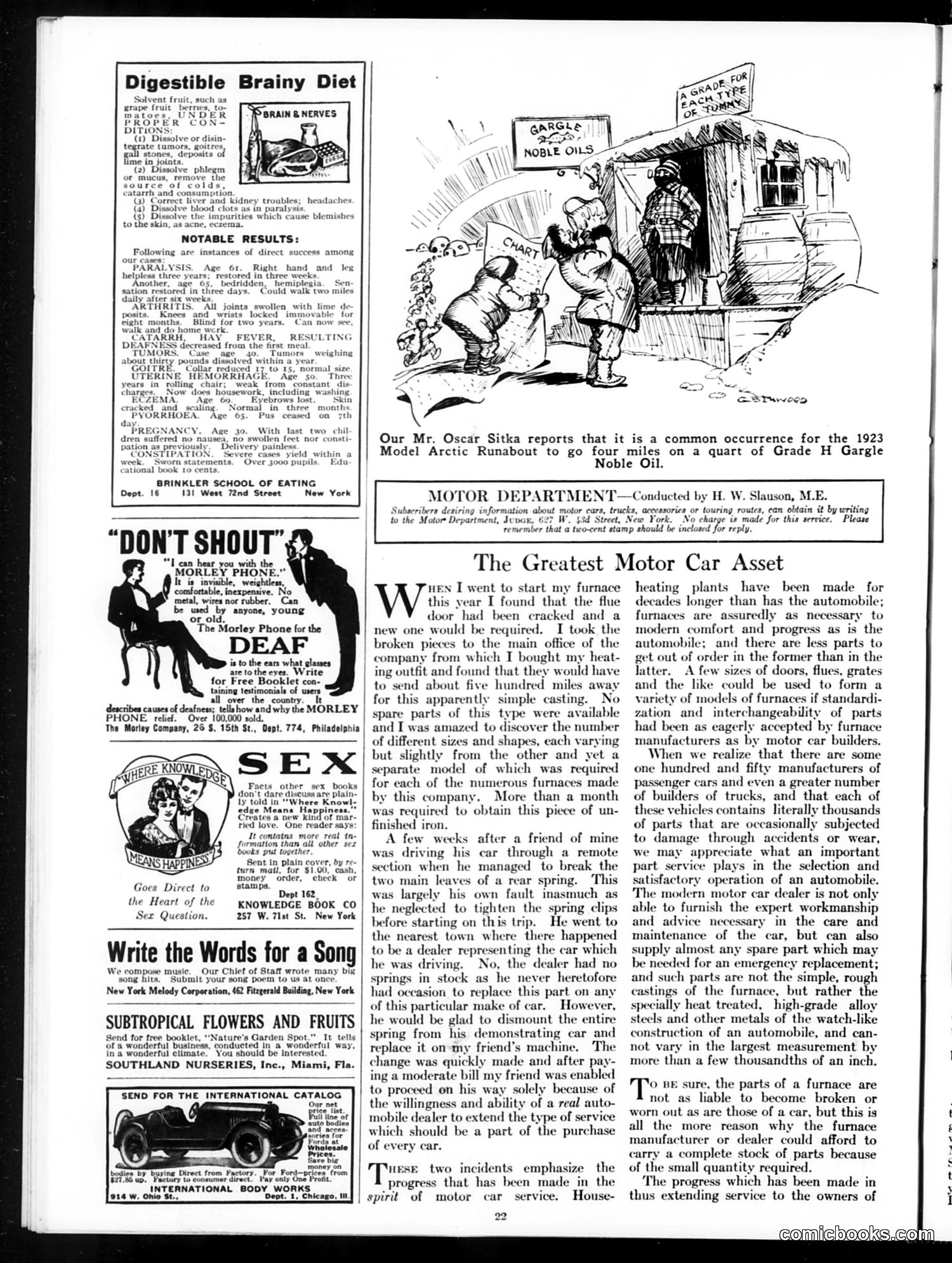
This page is primarily **advertising and articles**, not political satire. The main content includes: **"Digestible Brainy Diet"** advertisement for a health treatment claiming to cure paralysis, arthritis, eczema, and pregnancy issues—typical early 20th-century medical quackery with unverified testimonials. **The cartoon** (top right) shows a figure promoting "Gargle Noble Oils" to customers at a shack, humorously illustrated as snake-oil salesmanship—a common Judge trope mocking dubious patent medicines. **"Don't Shout"** advertises the Morley Phone for deaf people—a legitimate assistive device of the era. **The Motor Department article** discusses furnace and car parts availability, arguing dealerships should stock spare parts—not satire but practical consumer advice. **Other ads** promote the "Knowledge Book" on sex education, a song-writing service, and subtropical nurseries. The page reflects 1920s consumer culture: medical fraud, emerging assistive technology, and automobile standardization concerns. The only satirical element is the crude oil-salesman cartoon mocking health product charlatans.
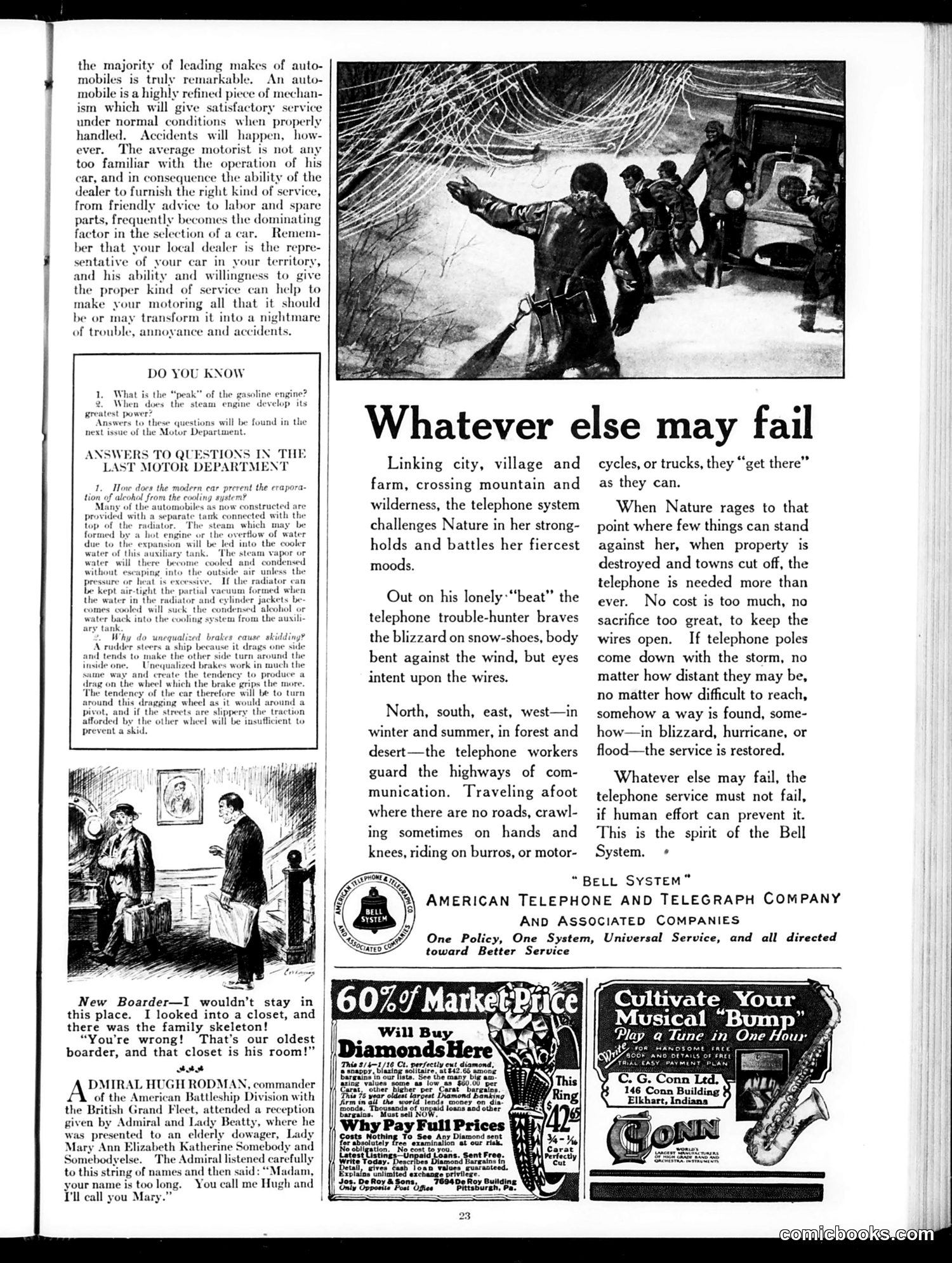
This page contains several distinct elements: **Main Advertisement (Right):** A Bell System telephone company advertisement. The large illustration shows telephone workers braving harsh weather to maintain communication lines. The text emphasizes the telephone company's commitment to service regardless of conditions—workers traverse mountains, deserts, and storms to keep lines operational. This is corporate messaging about reliability and dedication, presented as heroic. **Humor Pieces (Left):** Two brief jokes: one about a new boarder finding a "family skeleton" (a euphemism for shameful secrets), and another about Admiral Hugh Rodman at a reception, where he humorously shortens a noblewoman's lengthy name to "Mary." These are gentle, period-appropriate humor pieces. **Minor Advertisements (Bottom):** Diamond sales and music lessons ads typical of the era. **Context:** This appears to be mid-to-early 20th century content emphasizing corporate virtue during an era when telephone infrastructure was being expanded. The advertising presents infrastructure work as noble and essential.
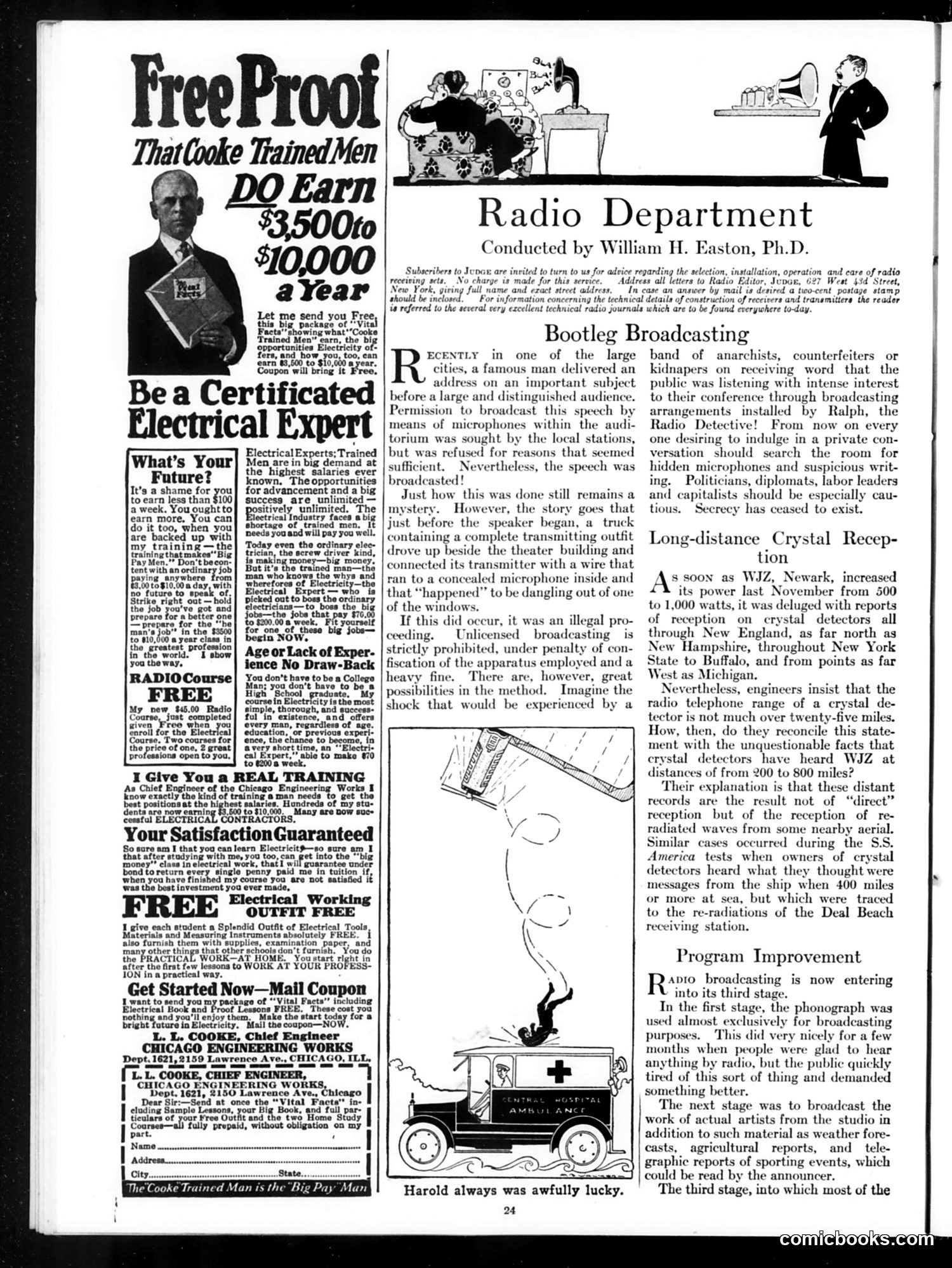
This is primarily an **advertisement-heavy page** from Judge magazine featuring two distinct sections: **Left Side - Vocational Ads:** Multiple ads for the "Cooke Training" electrical engineering correspondence course, promising salaries of $3,500-$10,000 annually. This reflects early-1920s enthusiasm for electricity as a lucrative career field during rapid industrialization. **Right Side - "Radio Department" Editorial Content:** The featured article "Bootleg Broadcasting" describes an unnamed famous speaker whose address was illegally broadcast despite the venue's refusal. A truck with unauthorized transmitting equipment parked outside the theater and secretly captured his speech via concealed microphone. **Historical Context:** This satirizes the chaotic early radio era before FCC regulation (1927). Broadcasting rights and frequencies were unregulated; "bootleg" broadcasting was genuinely common. The cartoon of Harold (the ambulance driver) being "awfully lucky" provides comedic relief unrelated to the main articles. The page captures a transitional moment: electricity and radio technology were still novel, largely unregulated, and sometimes humorously lawless.
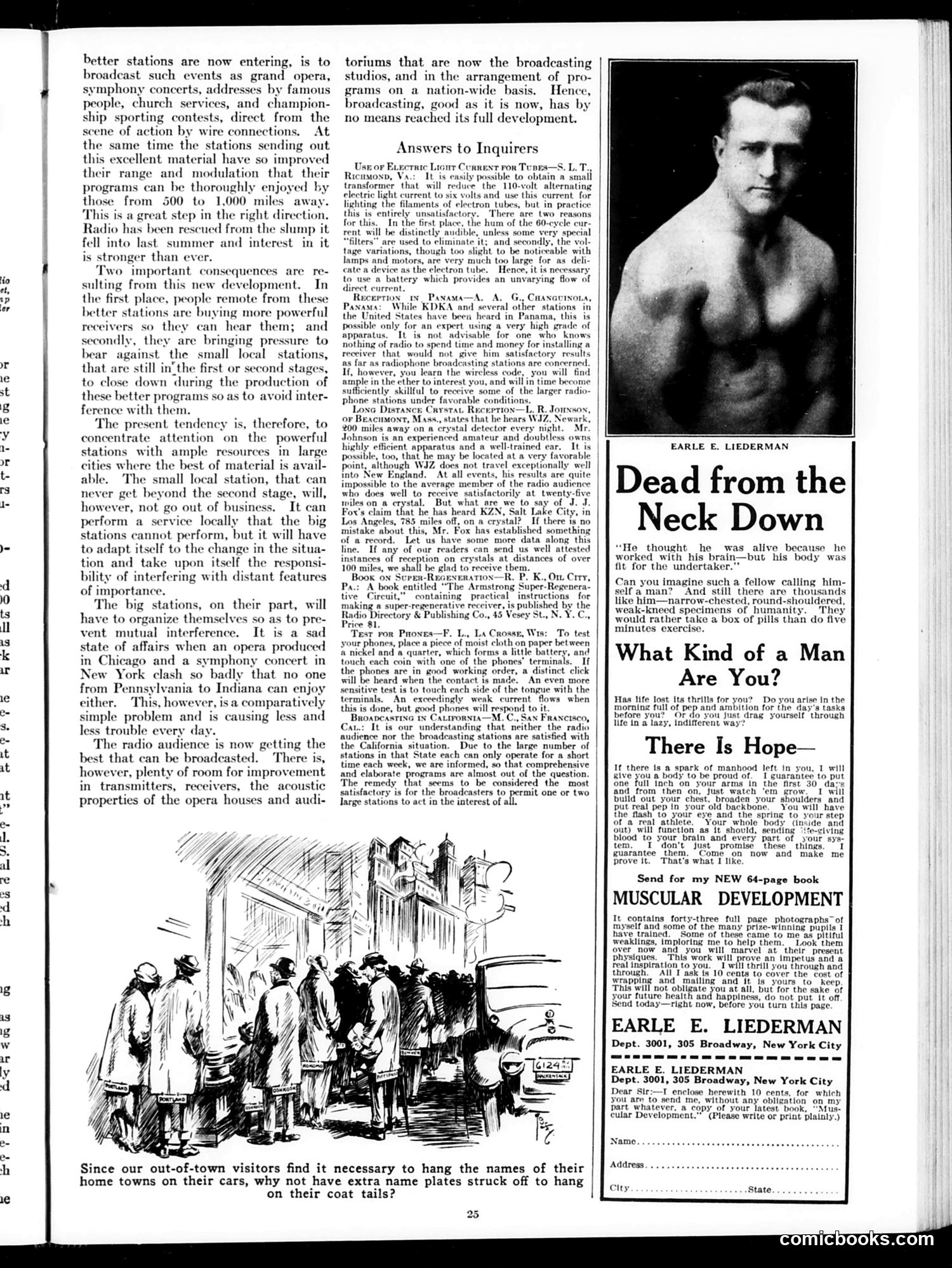
This Judge magazine page from the early radio era (circa 1920s) discusses broadcasting's rapid development. The main article celebrates how powerful radio stations now broadcast grand operas, concerts, and sporting events across 500-1,000 miles, improving receiver technology and national reach. The satire emerges in the tension between big-city stations and struggling local ones. Powerful urban stations are monopolizing attention while small-town broadcasters face pressure to shut down to avoid interference. The cartoon at page bottom (caption visible: "Since our out-of-town visitors find it necessary to hang the names of their home towns on their cars, why not have extra name plates struck off to hang on their coat tails?") satirizes out-of-town visitors' behavior—suggesting they're so eager to broadcast their origins that they should literally wear name plates like car tags. The "Answers to Inquirers" section addresses technical radio questions, typical of early radio's experimental, DIY culture.
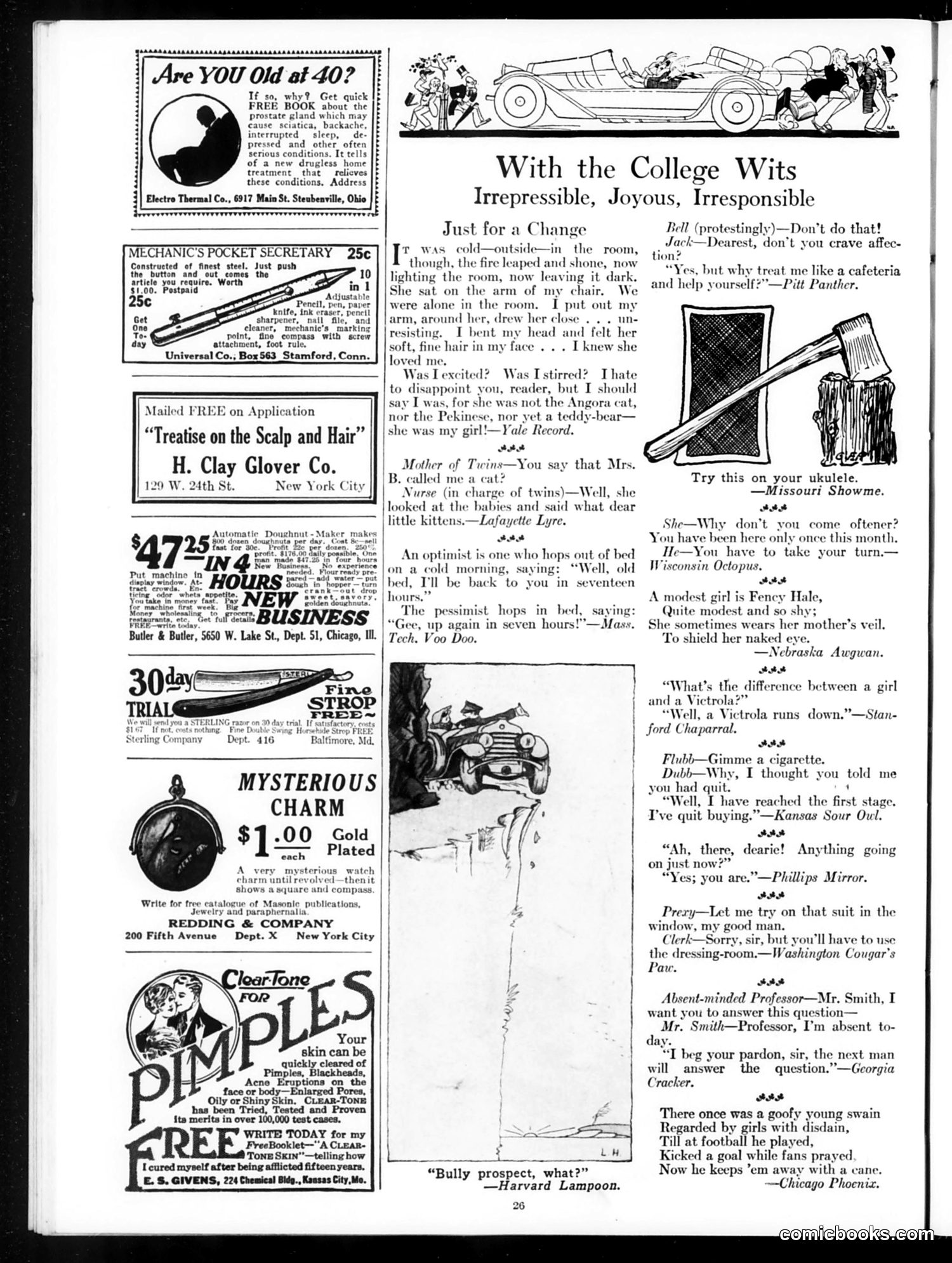
This page presents humorous anecdotes and jokes contributed by college humor magazines (Yale Record, Lafayette Lyre, Michigan's Michigang, etc.). The content reflects early 20th-century collegiate comedy, emphasizing romantic mishaps, domestic absurdities, and mild innuendo acceptable for the era. **Key themes:** - **Romance and physical affection**: Multiple jokes involve young men and women in intimate moments ("she sat on the arm of my chair"), with some coy resistance ("Don't do that!"). - **Courtship anxieties**: Jokes about frequency of visits, reluctance to commit to relationships, and quitting smoking to appear more attractive. - **Gender stereotypes**: Women portrayed as modest, coy, or materialistic; men as bumbling and insincere. - **Mild social satire**: Professors forgetting their duties, cafeteria-style courtship, fashion consciousness. The humor is gentle, college-focused, and designed to appeal to young, educated readers familiar with campus life. The cartoonish illustrations and light tone emphasize entertainment over serious commentary.
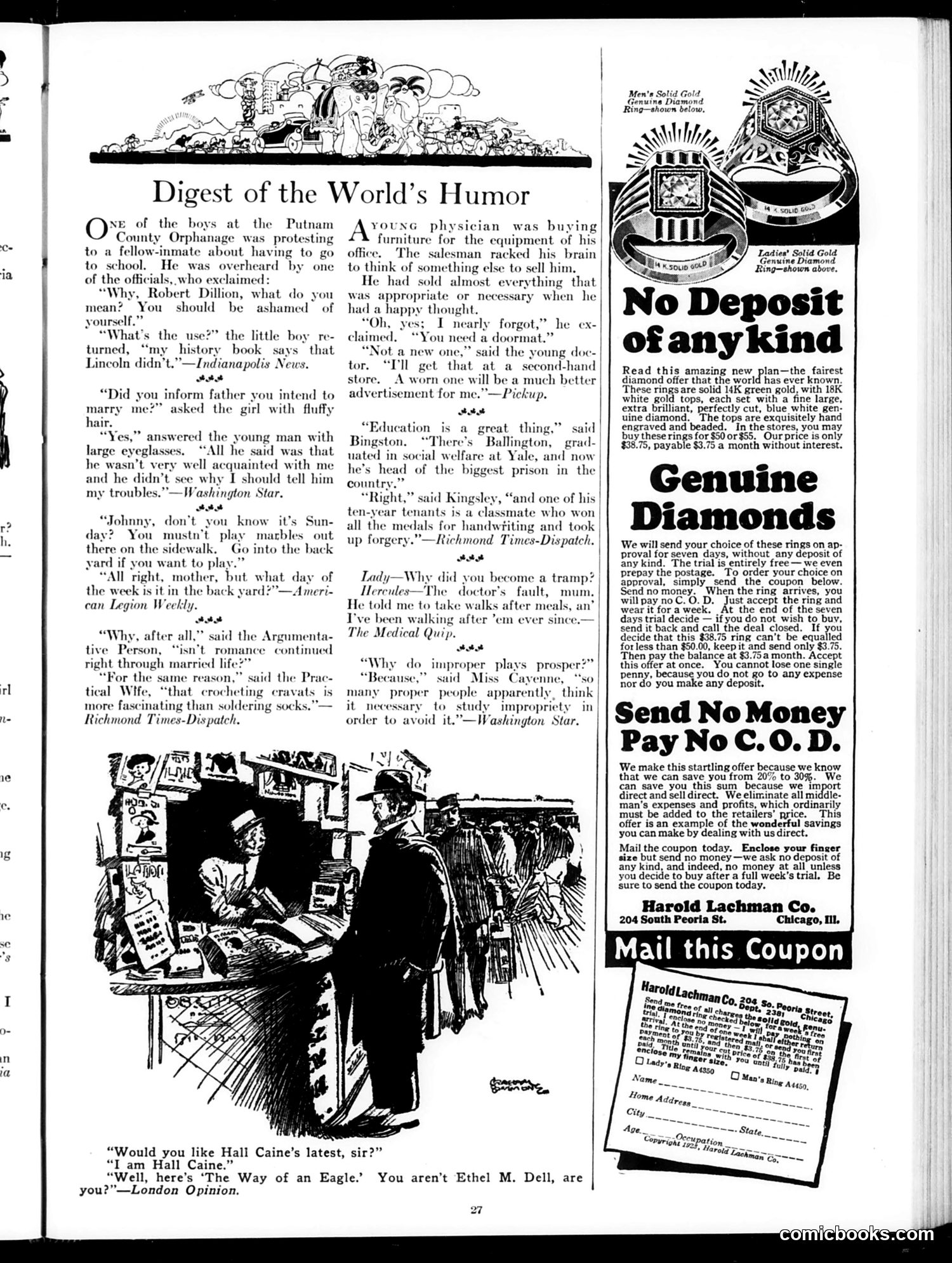
This page contains humorous anecdotes and period advertisements. The "Digest of the World's Humor" section presents short jokes sourced from various newspapers, mostly featuring children or naive characters making logical arguments that undermine authority figures—a common comedic format of the era. The main cartoon depicts a bookstore or shop scene where a customer and clerk interact, illustrating one of the printed jokes about Hall Caine (a popular early-20th-century author). The right side features aggressive advertising for "Genuine Diamonds" from Harold Lachman Co. in Chicago—a mail-order scheme offering rings "without deposit" on approval. This was a common sales tactic of the period, exploiting consumers' desire for luxury goods with payment plans and trial periods. The repeated emphasis on "no deposit" and "no C.O.D." was designed to lower perceived risk for buyers. The overall page reflects Judge magazine's mix of satirical humor and commercial advertising targeting middle-class readers.
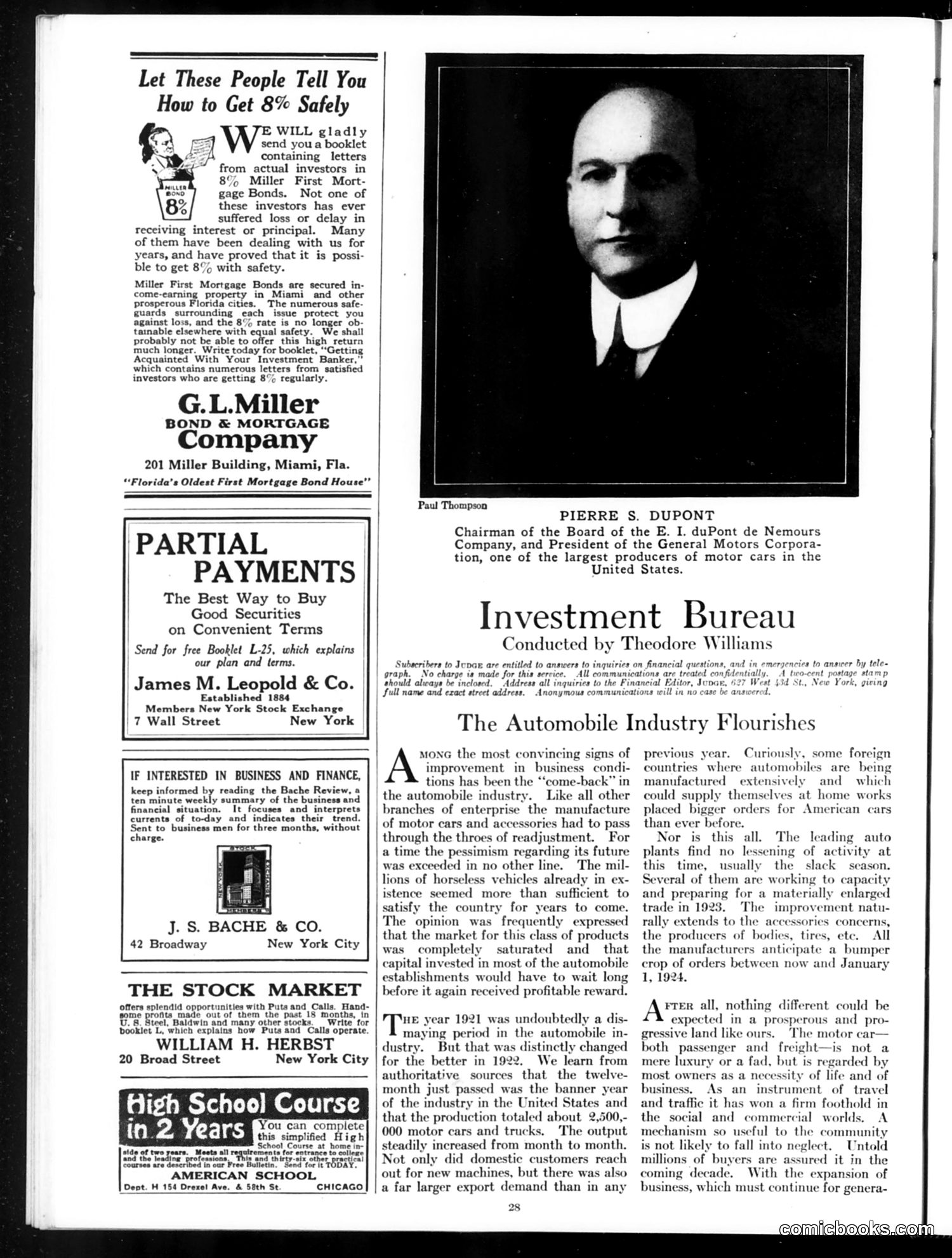
This page is primarily **advertising**, not satirical content. It showcases financial investment opportunities from the 1920s era. **Key figure**: Pierre S. DuPont, Chairman of E.I. DuPont de Nemours Company and General Motors President, is pictured as a prominent businessman endorsing investment services. **Context**: The ads promote various investment products—mortgage bonds, stock options ("Puts and Calls"), and financial advisory services—typical of the pre-1929 stock market boom. The "8% safely" claim from G.L. Miller (a Miami mortgage company) reflects the era's optimistic investment culture before the Great Depression. **The article** discusses automobile industry recovery from 1921-1922 recession, positioning cars as a growth investment. **For modern readers**: This page captures the speculative, confidence-driven investment landscape of the 1920s, before regulatory safeguards (SEC, FDIC) existed. The emphasis on "safety" and "testimonial letters" reveals how investors sought reassurance in an unregulated market prone to fraud.
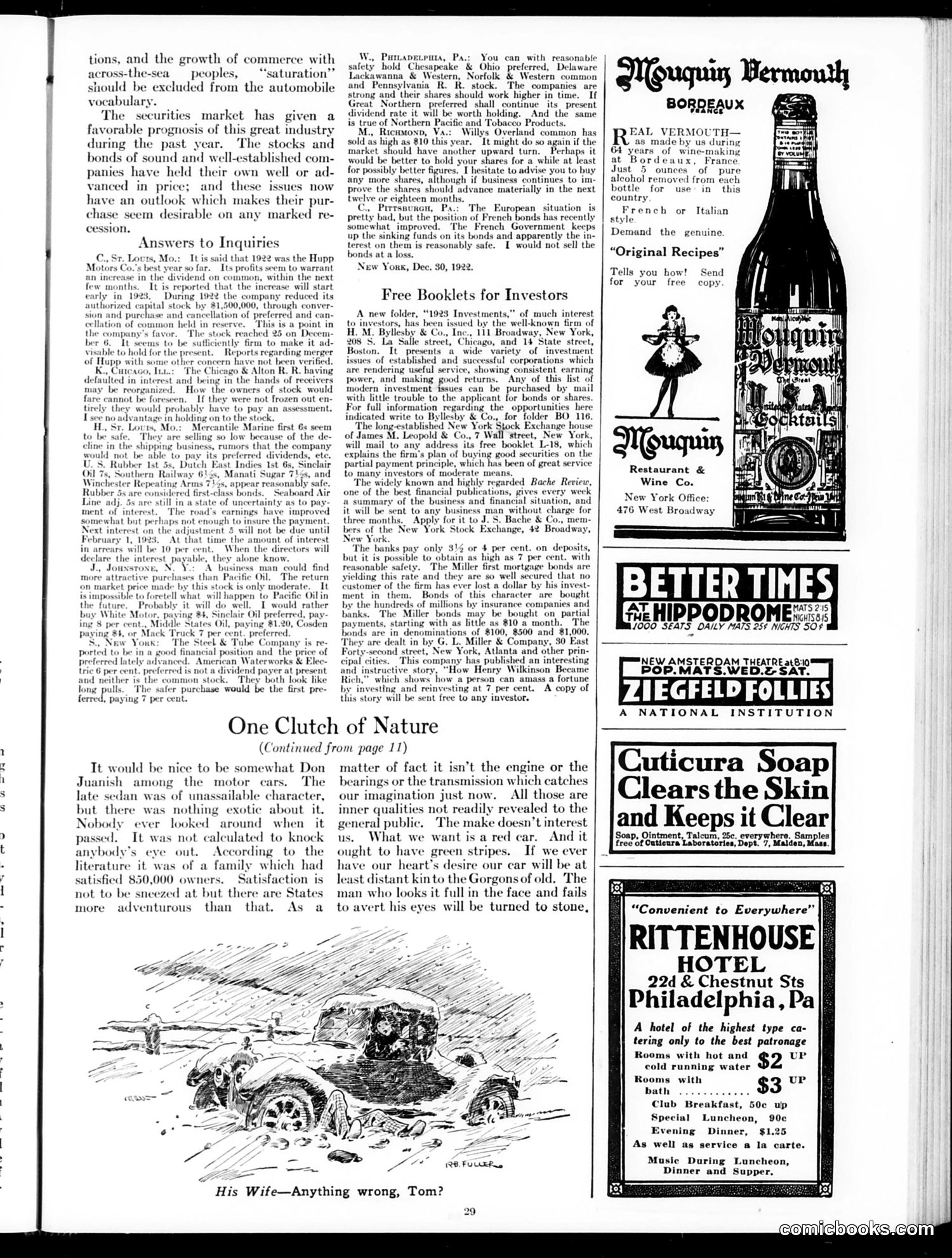
This single-panel cartoon depicts a man standing amid the wreckage of a badly damaged automobile, with debris scattered around. The caption reads, "His Wife—Anything wrong, Tom?" The joke is straightforward physical humor: the car is completely destroyed—essentially obliterated—yet the wife casually asks if something is "wrong," as if minor trouble might explain the catastrophic damage. The satire targets both automotive unreliability in the early 1920s and domestic dynamics, where wives feign ignorance or understate obvious disasters. The illustration accompanies an article titled "One Clutch of Nature" discussing motor cars, suggesting the cartoon exemplifies the era's frustrations with automobile performance and the comedic potential of mechanical failure.
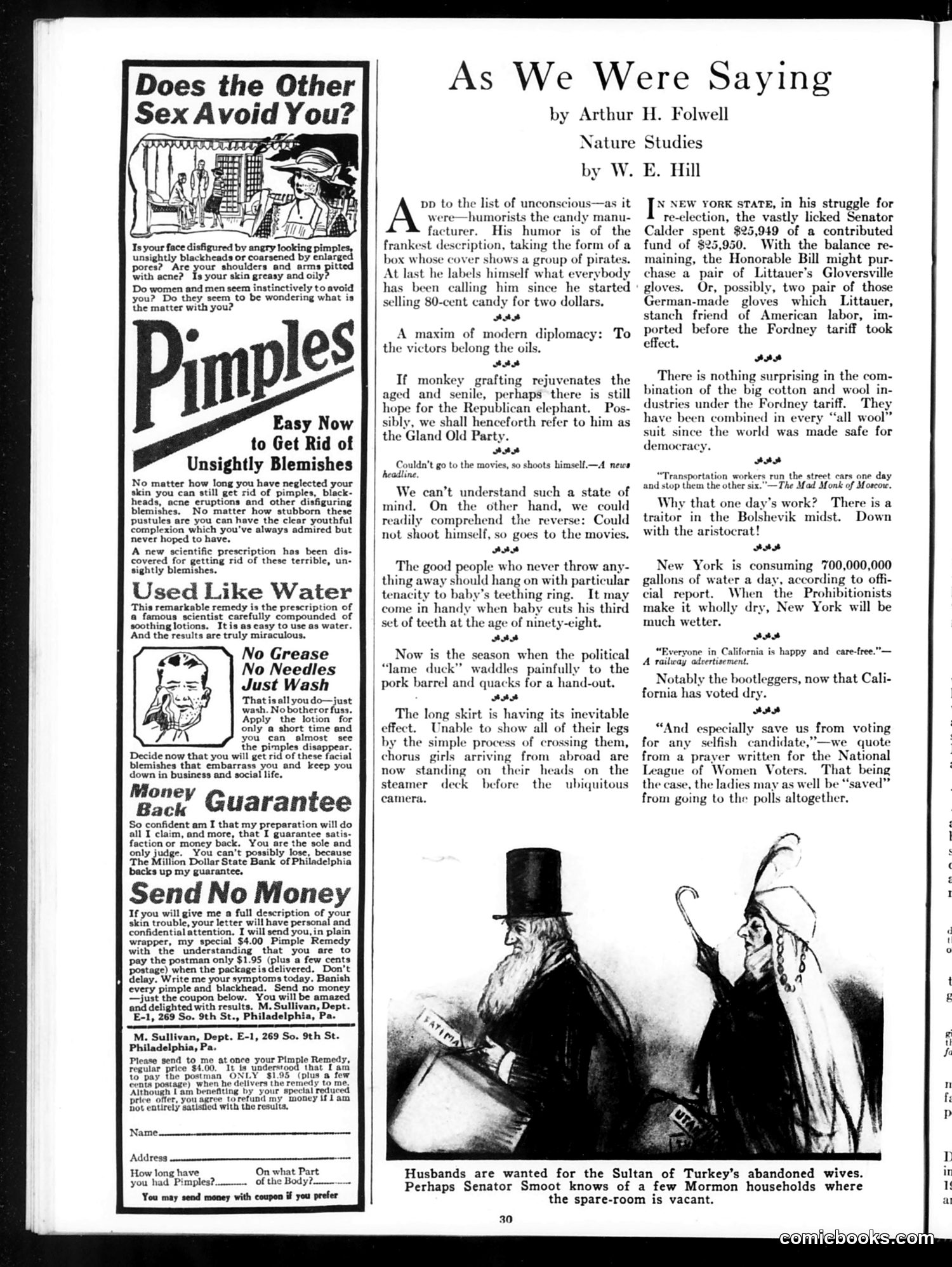
This Judge magazine page primarily contains **advertisements** (notably for "Pimple Remedy") rather than political cartoons. The main editorial content, "As We Were Saying" by Arthur H. Folwell, consists of brief satirical observations: **Key references:** - A candy manufacturer labels his product "Pirates," satirizing inflated pricing (80-cent candy sold for two dollars) - "Gland Old Party" jokes about monkey-gland rejuvenation treatments (a 1920s fad) applied to the Republican elephant—suggesting the GOP needs biological revival - A suicide joke contrasts someone who "couldn't go to the movies" shooting himself versus someone unable to shoot himself going to movies instead The satire targets **consumer fraud** (inflated candy prices), **Republican party vigor**, and absurdist **modern anxieties**. The bottom illustration shows two figures discussing husbands wanted by the Sultan of Turkey—likely a joke about polygamy or emigration, though context is unclear.
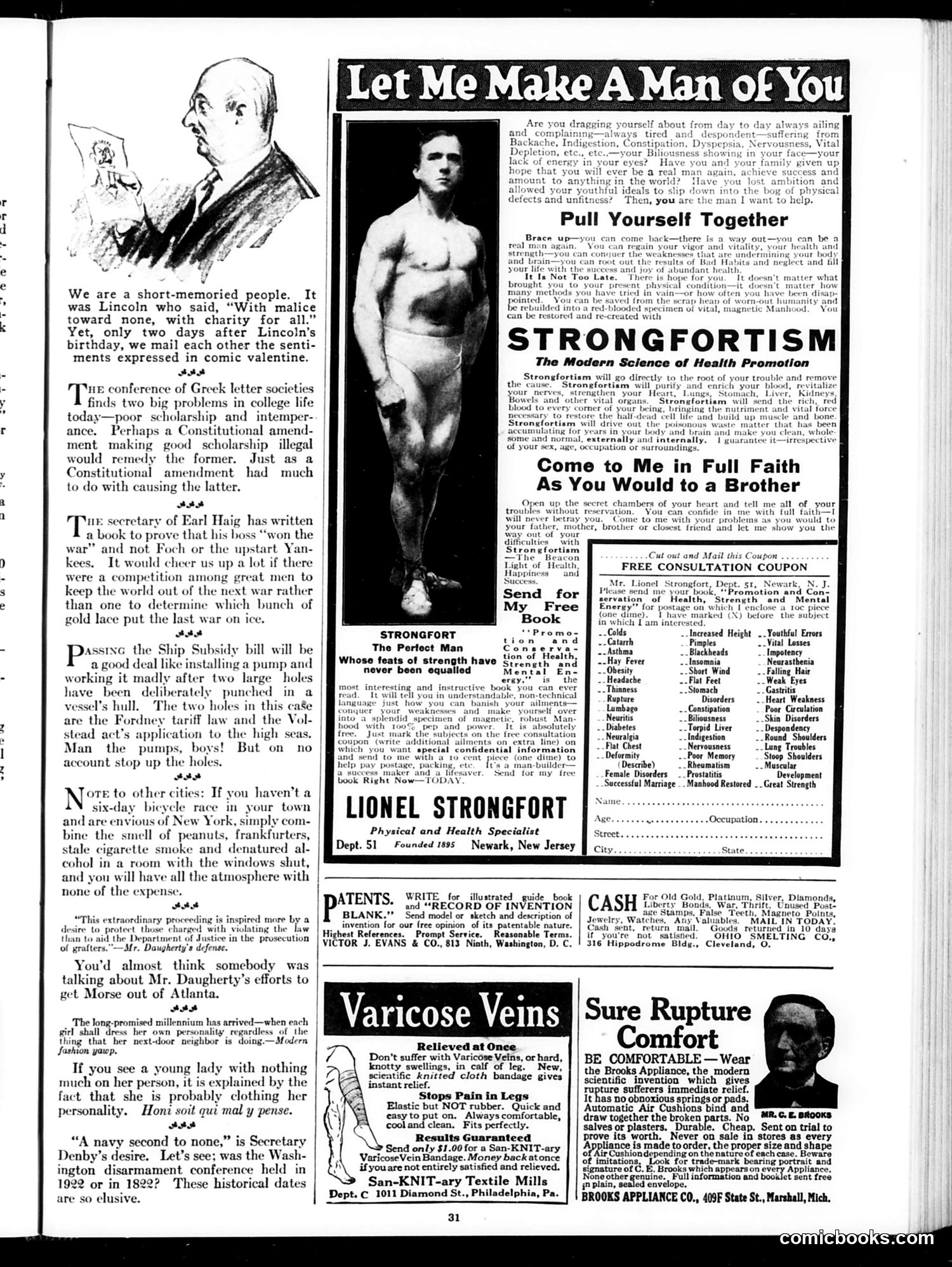
This page primarily consists of **political commentary and advertisements** rather than traditional cartoons. The **editorial section** (left side) contains several brief satirical observations on 1920s American life: - A jab at the **hypocrisy of American sentiment**: celebrating Lincoln's charity two days before mailing cruel comic valentines - **Criticism of Prohibition**: referencing the Volstead Act as a "hole" in policy, alongside the Fordney tariff, that undermines the Ship Subsidy bill - **Mockery of Secretary Denby**: questioning his claim of "a navy second to none" given the 1922 Washington Disarmament Conference - **Veiled criticism of Attorney General Daugherty**: suggesting selective prosecution of certain grafters The **dominant content** is a large advertisement for **"Strongfortism,"** a mail-order physical culture and health promotion system by Lionel Strongfort. This reflects the era's popular pseudo-scientific fitness movements promising bodily transformation through specialized training. The page captures early 1920s concerns: post-war politics, Prohibition's complications, political corruption, and the era's obsession with physical self-improvement marketed through magazines.
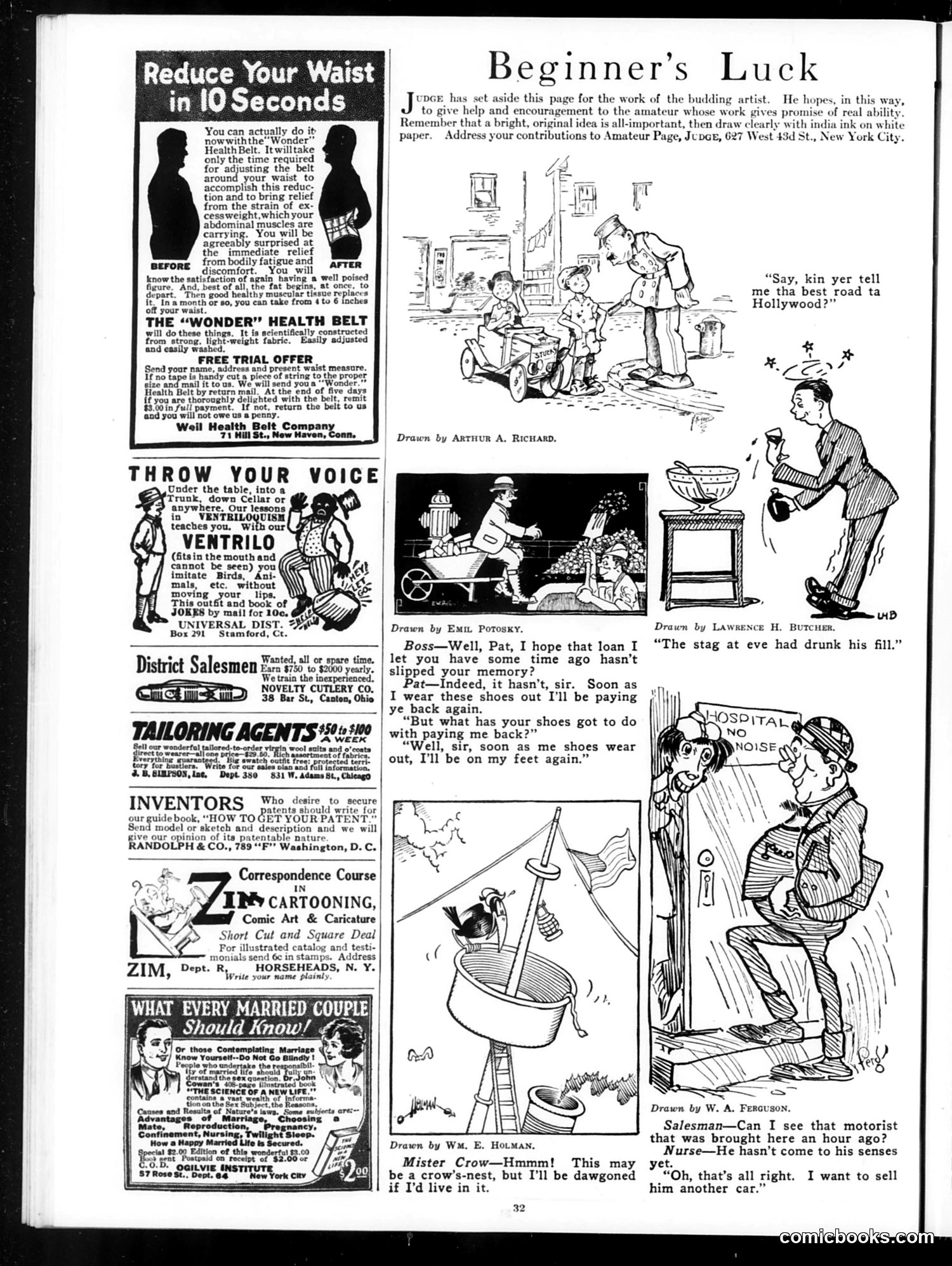
This is a **mixed content page** from Judge magazine featuring amateur cartoons and period advertisements. ## The Cartoons The right side showcases **four humorous cartoon submissions**: 1. **Irish laborer joke** (Pofosky): A boss and worker ("Pat") discuss a loan. The punchline relies on wordplay—Pat promises to repay "soon as me shoes wear out, I'll be on my feet again"—playing on the literal and figurative meanings of "on my feet." 2. **Hollywood aspirant** (Richard): A child asks directions to Hollywood, reflecting early 20th-century fascination with the film industry. 3. **"Stag at eve" joke** (Butcher): References the romantic poem line while showing a drunk stag, making a visual pun. 4. **Hospital salesman** (Ferguson): A car salesman attempts to sell another automobile to an unconscious motorist—absurdist humor about aggressive salesmanship. ## Context The page explicitly states Judge reserves this space for amateur artists, encouraging submissions. The cartoons exemplify popular humor styles: ethnic dialect jokes, wordplay, and satirical commentary on consumer culture and ambition.
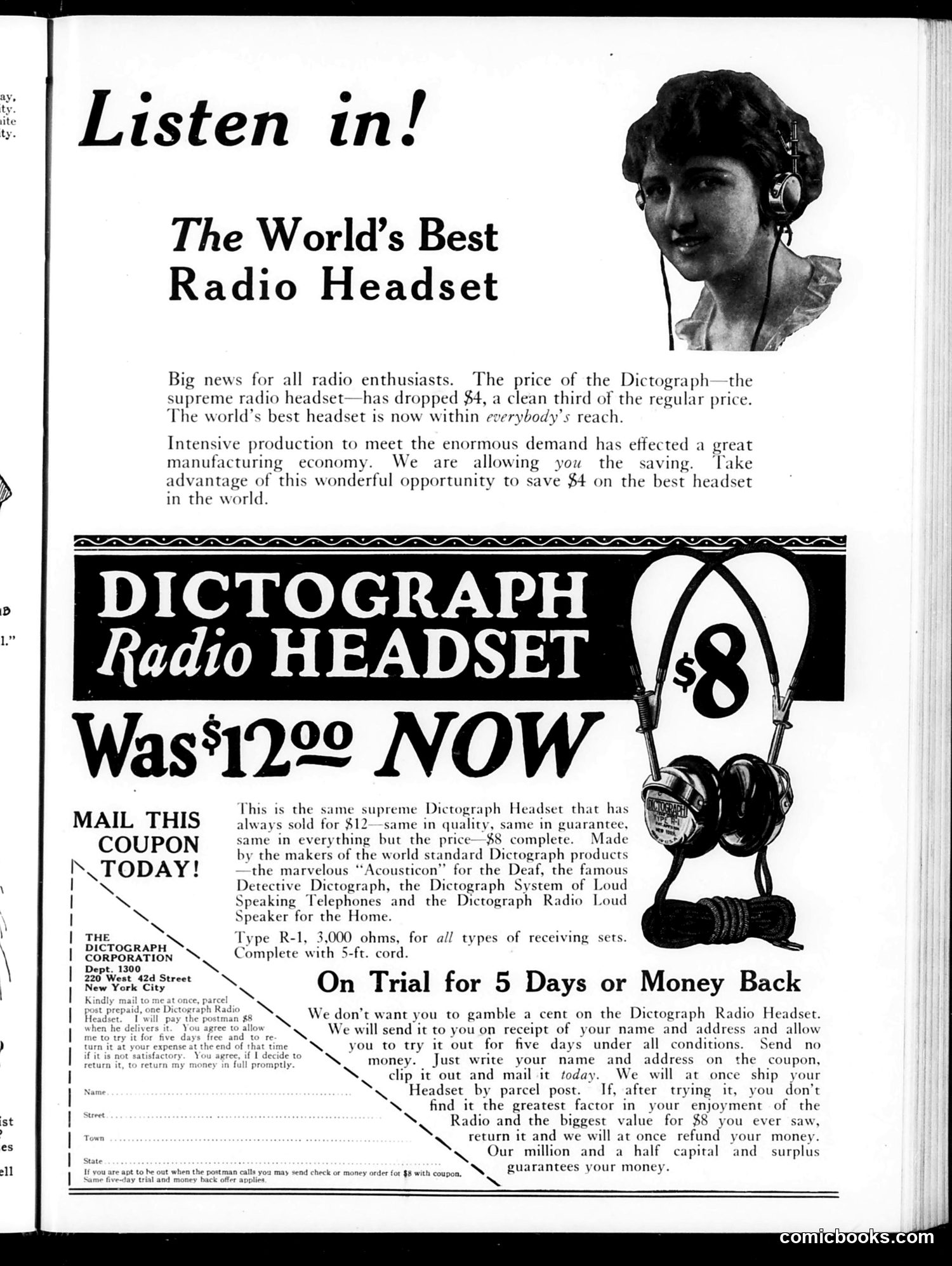
This page is primarily a **product advertisement**, not satire or political commentary. It advertises the Dictograph Radio Headset, marketed as "the world's best," reduced from $12 to $8. The content reflects **early 1920s radio enthusiasm**. "Listen in!" was contemporary slang for tuning a radio receiver. The headset was essential equipment—radios required headphones then, not speakers. The advertisement emphasizes **affordability through mass production**, a common sales pitch during this era of industrial expansion. The money-back guarantee ("On Trial for 5 Days") was also typical marketing of the period. The page includes a **mail-in coupon** with fields for name, address, town, and state—standard direct-mail advertising before digital ordering existed. The accompanying photograph shows a woman wearing the headset, representing the product's appeal to general consumers, not just technical enthusiasts. No political message or satire is present; this is straightforward commercial advertising in a magazine known primarily for humor and commentary on other topics.
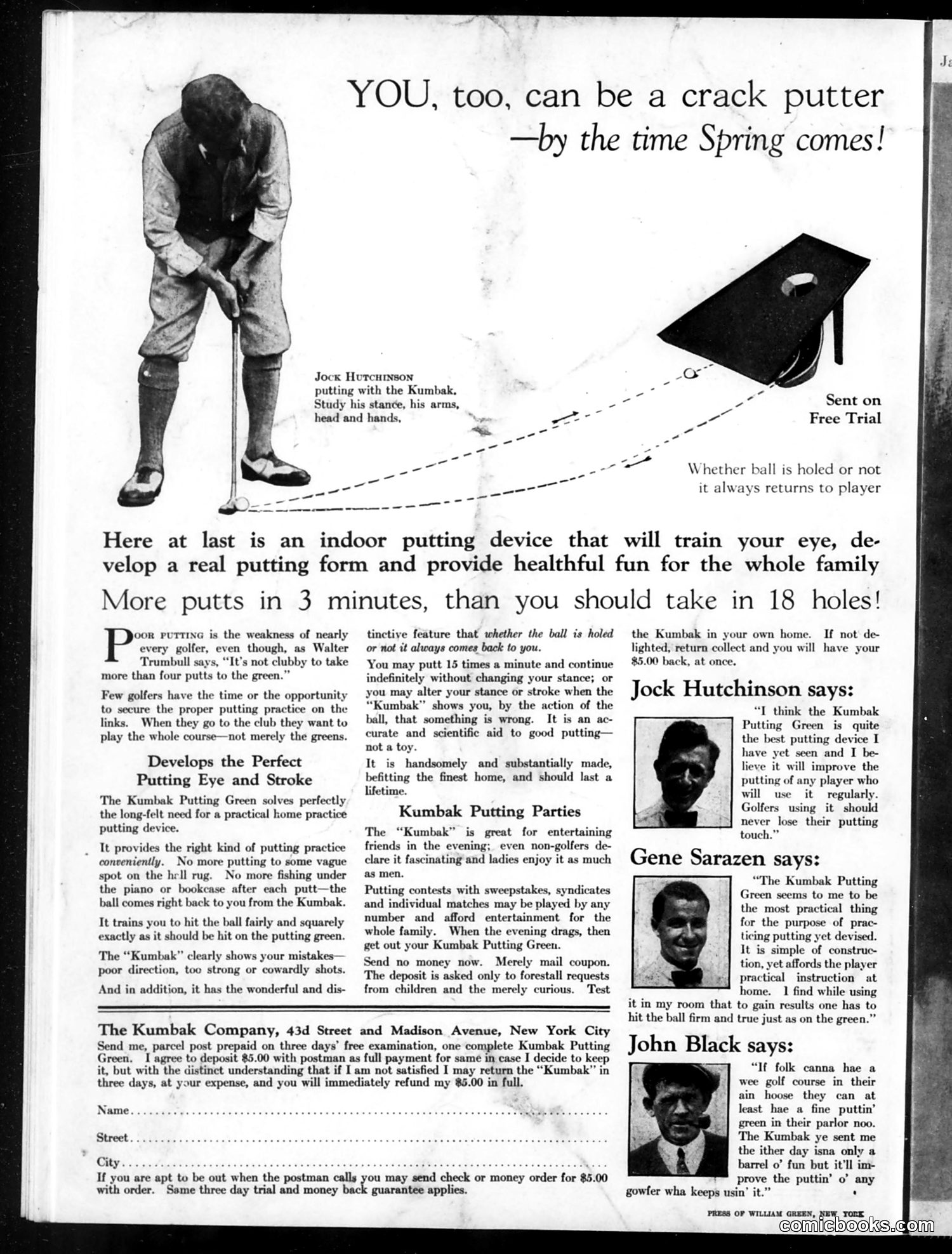
This is primarily a **product advertisement**, not satire. It promotes the "Kumbak Putting Green," an indoor putting device for home golf practice. The page features endorsements from **real professional golfers of the era**: Jock Hutchinson, Gene Sarazen, and John Black (a Scottish golfer, indicated by his dialect "canna hae a wee golf"). These were legitimate celebrities lending credibility to the product. The humor is gentle and self-aware rather than satirical. The headline jokes that users can become "crack putters" by springtime through this device. The advertisement plays on golfers' universal frustration: poor putting skills despite practice, inability to practice greens conveniently, and the inconvenience of retrieving balls. The device's key selling point—the ball automatically returns to the player—solved a practical problem for home use. The coupon offer with a free trial and money-back guarantee was standard early 20th-century mail-order marketing. This represents Judge magazine's advertising content rather than its satirical editorial mission.