
Judge, 1923-01-06 · page 17 of 36
Judge — January 6, 1923 — page 17: what you’re looking at
What you’re looking at
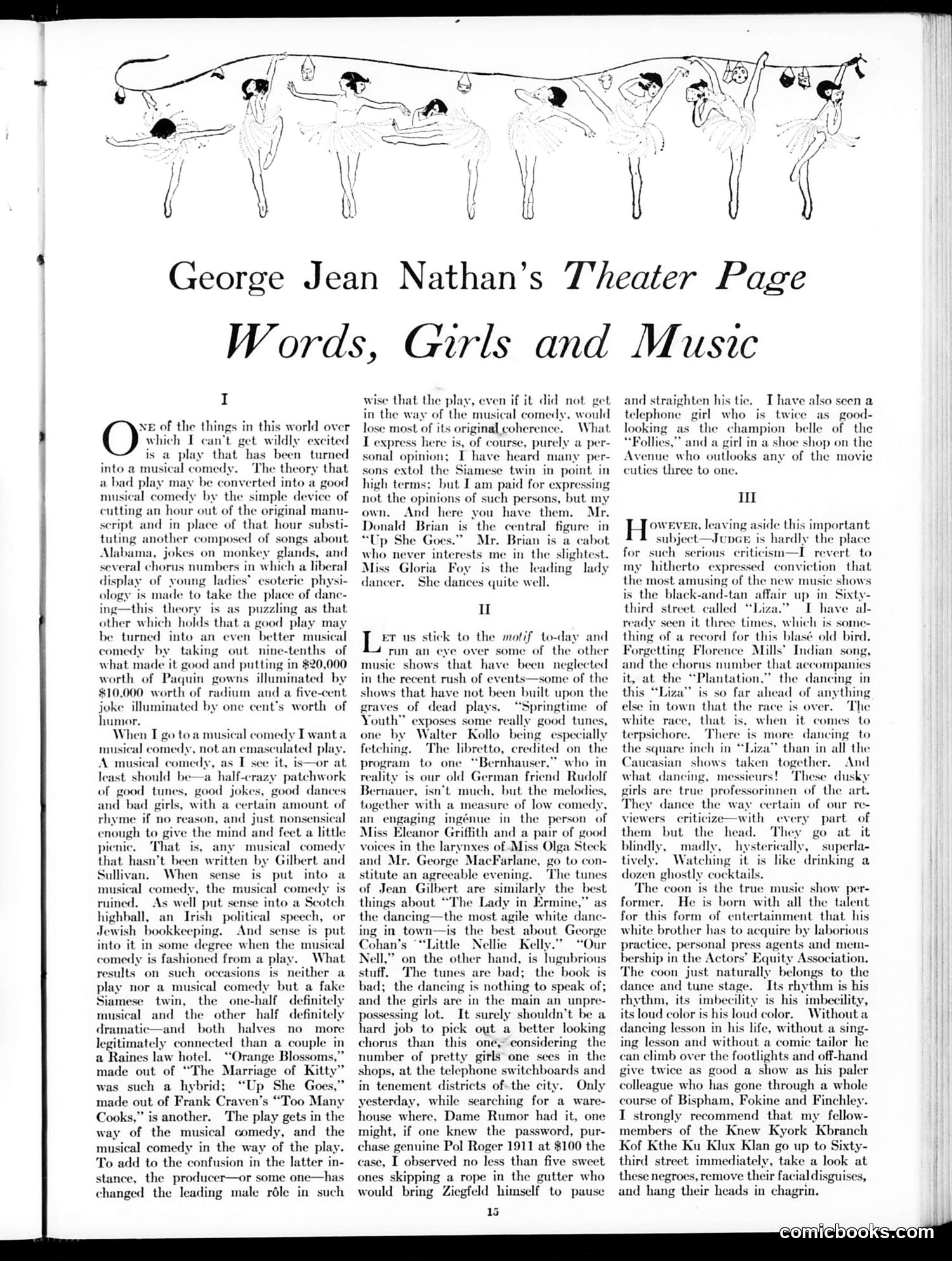
This is George Jean Nathan's theater column, not a political cartoon. Nathan was a prominent drama critic, and this page contains his opinion piece critiquing musical comedies of the era. **Main argument:** Nathan dismisses the trend of converting plays into musicals by cutting the original script and inserting unrelated songs, chorus girls, and expensive costumes. He argues this creates a "fake Siamese twin"—neither good theater nor good music. **Specific targets:** He names productions like "Up She Goes" (starring Donald Brian, whom he finds uninteresting) and criticizes how producers eliminate plot coherence to showcase chorus numbers and expensive gowns illuminated by radium lighting. **The satire:** Nathan sarcastically suggests adding "sense" to musical comedy ruins it—like adding sense to a Scotch highball or Irish political speech. He positions himself as the arbiter of taste against popular opinion. The decorative header shows chorus girls in various poses, visually representing the "display of young ladies' esoteric physiology" he critiques.
📄 Transcribed text from this page (OCR, searchable)
Machine-transcribed from the original scan — historical spelling and the odd misread are preserved.
George Jean Nathan’s Theater Page Words, I NE of the things in this world over which I can’t get wildly excited is a play that has been turned into a musical comedy. The theory that a bad » may be converted into a good musical comedy by the simple device of cutting an hour out of the original manu- script and in place of that hour substi- tuting another composed of songs about Alabama, jokes on monkey glan several chorus numbers in which display of young ladies’ esoteric physi ology is made to take the place of danc- ing—this theory is as puzzling as that other which holds that a good play may be turned into an even better music comedy by taking out nine-tenths of what made it good and putting in $20,000 worth of Paquin gowns illuminated by $10,000 worth of radium and a five-cent joke illuminated by one cent’s worth of humor. When I go toa music: musical comedy, not an er A musical comedy, as I se least should be—a half-crazy patchwork of good tunes, good jokes, good dances and bad girls, with a’ certain amount rhyme if no reason, and just nonsensica’ enough to give the mind and feet a little pienic. That is, any musical comedy that hasn’t been written by Gilbert and Sullivan. When sense is put into a musical comedy, the musical comedy is ned. As well put sense into a Scotch highball, Irish political speech, or Jewish bookkeeping. And sense is put into it in some degree when the comedy is fashioned from a play. results on such occasions is neither a play nor a musical comedy but a fake Siamese twin, the one-half definitely musical and the other half definitely dramatic—and both halves no more legitimately connected than a couple in a Raines law hotel. “Orange Blossoms,” made out of “The Marriage of Kitty was such a hybrid; “Up She Goes made out of Frank Craven’s “Too Many ’ is another. The play gets in the sical comedy, and the ‘al comedy in the way of the p! fo add to the confusion in the latter in- stance, the producer—or some one—has changed the leading male réle in such omedy T want a culated pI it, is—or Girls and wise that the play, even if it did not get in the way of the musical comedy, would lose most of its original coherenc What I express here is, of course, purely a per- sonal opinion; I have heard many per- sons extol the Siamese twin in point, in high terms; but I am paid for expressing not the opinions of such persons, but my own. And here you have them. Mr. Donald Brian is the central figure in “Up She Goes.” Mr. Brian is a cabot who never interests me in the slightest. Miss Gloria Foy is the leading lady dancer, She dances quite well. II L Tus stick to the motif to-day and run ane over some of the other music shows that have been neglected in the recent rush of events—some of the shows that have not been built upon the graves of dead plays. “Springtime of Youth” exposes some really good tunes, one ter Kollo being especially fetching. The libretto, credited on the program to one “Bernhauser,” who in reality is our old German friend Rudolf Bernauer, isn’t much, but the melodies, ether with a measure of low comedy, engaging ingénue in the person of Eleanor Griffith and a pair of good voices in the larynxes of Olga Steck ia Mr. George MacFarlane, go to con- stitute an agreeable evening. The tunes of Jean Gilbert are similarly the be t things about “The Lady in Ermin the dancing—the most agile white d ing in town—is the best about George Cohan’s “Little Nellie Kelly.” “Our Nell,” on the other hand, is lugubrious stuff. The tunes are bad; the book is bad; the dancing is nothing to speak of; and the girls are in the main an unp pe ing lot. It surely shouldn’t be a hard job to pick out a better looking chorus than this one, considering t number of pretty girls one sees in t shops, at the telephone switchboards and in tenement districts of-the city. Only yesterday, while searching for a ware- house where, Dame Rumor had it, 01 might, if one knew the password, pur- chase genuine Pol Roger 1911 at $100 the case, I observed no less than five sweet ones skipping a rope in the gutter who would bring Ziegfeld himself to pause 15 Music and straighten his tie. T have also seen a telephone girl who is twice as good- looking as the champion belle of the “Polli and a girl in a shoe shop on the Avenue who outlooks any of the movie cuties three to one. Il H™ R, leaving aside this important subject—JupGe is hardly the place for such serious criticism—I revert to my hitherto expressed conviction that the most amusing of the new music shows is the black-and-tan affair up in Six third street called “Li I have al- ready seen it three times, which is some- thing of a record for this blasé old bird. Forgetting Florence Mills’ Indian song, and the chorus number that accompanies it, at the “Plantation.” the dancing in this “Liza” is so far ahead of anything else in town that the race is over. The white race, that is, when it comes to terpsichore. There is more dancing to the square inch in “Liza” than in all the shows taken together. And t dancing, messicurs! These dusky re true professorinnen of the art. ice the way certain of our re- criticize—with every part. of head. They go at it blindly, madly, h superla- tively. Watching drinking a dozen ghostly coc The coon is the true, music show per- former. He is born for this form of e white brother has to acquire practice, personal press agents and mem- hership in the Actors’ Equity Associatic The coon just naturally be ‘longs to the dance and tune rhythm, its imbe its loud color is his loud color. dancing lesson in his life, without a sing- ing lesson and without a comic tailor he an climb over the footlights and off-hand give twice as good a show as his paler colleague who has gone through a whole course of Bispham, Fokine and Finchl I strongly recommend that my fellow- members of the Knew Kyork Kbranch Kof Kthe Ku Klux Klan go up to Sixty- third street immediately, take a look at s, remove their facial disguises, heads in chagrin. girls They viewers them but the