
Judge, 1923-01-06 · page 12 of 36
Judge — January 6, 1923 — page 12: what you’re looking at
What you’re looking at
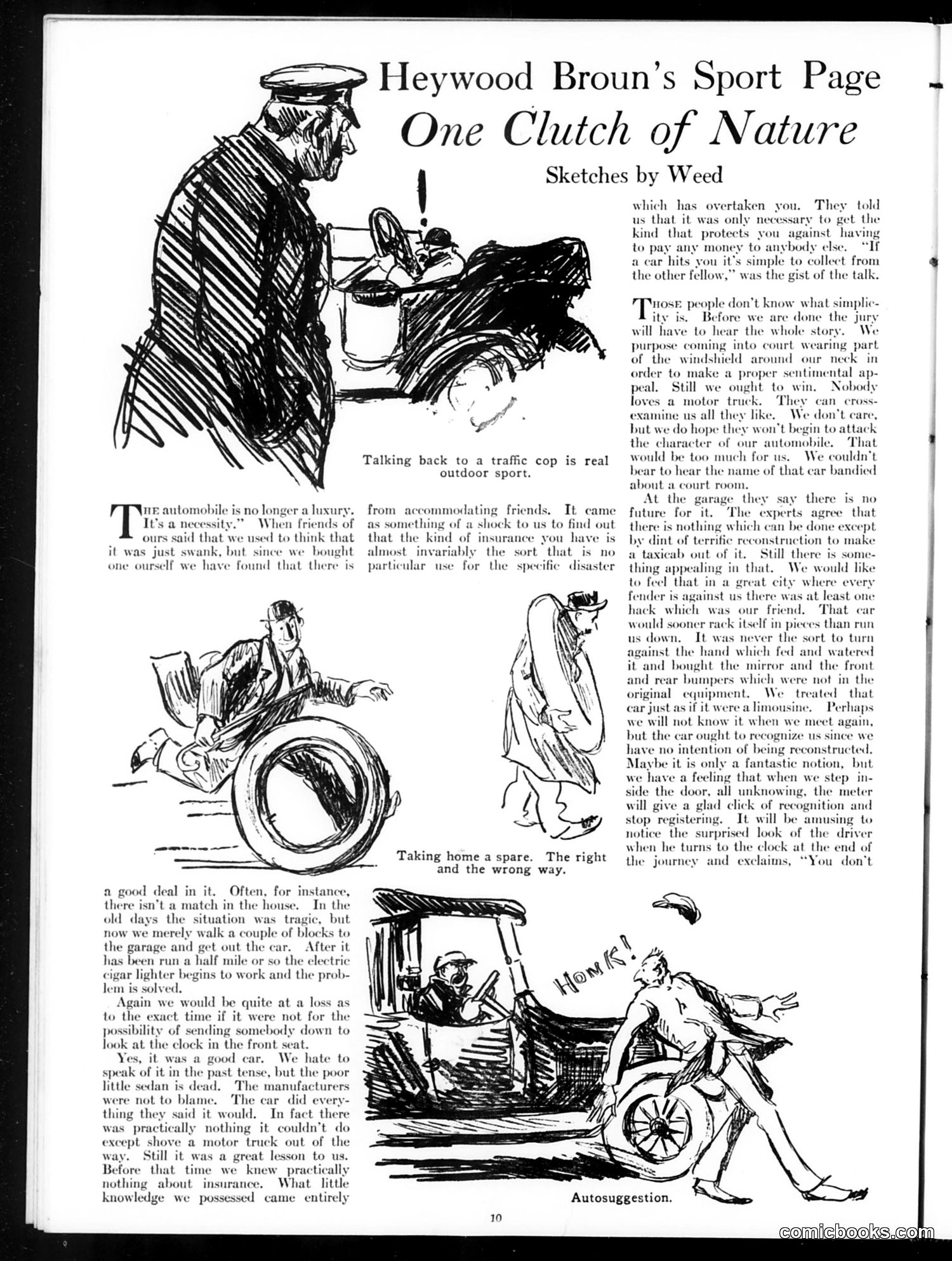
This piece satirizes early 20th-century car ownership and the unforeseen complications of automobile culture. Broun humorously recounts his experience with a modest sedan that encountered a motor truck—likely a collision causing significant damage. The satire targets several aspects: the false economy of car ownership (presented as a "necessity" rather than luxury), inadequate insurance that doesn't actually protect owners, and the absurdity of litigation when accidents occur. The sketches illustrate common automotive indignities—arguing with traffic cops, taking home a spare tire incorrectly, and dealing with a truck collision. Broun's central joke is that despite treating the car well, it ultimately failed catastrophically. The cartoons mock how dependent owners became on vehicles for basic needs (checking the time via the dashboard clock, finding matches), exposing the car's invasion into everyday life. The final illustration suggests a cyclist being hit by a car—an "autosuggestion" that reflects the era's anxieties about automobile danger to pedestrians and other road users.
📄 Transcribed text from this page (OCR, searchable)
Machine-transcribed from the original scan — historical spelling and the odd misread are preserved.
Talking back to a traffic cop is real outdoor sport. NE automobile is no longer aluxury. from accommodating friends. | It’s a necessity.” When friends of | as something of a shock to us to find ours said that we used to think that that the kind of insurance you have is ght almost invariably the sort that is no is particular use for the specific disaster it was just swank, but since we bo one ourself we have found that the: Taking home a spare. The right and the wrong way. Often, for instance, In the ion was tragic, but alk a couple of blocks to the g: and get out the car. After has been run ulf mile or so the electric cigar lighter begins to work and the prob- Jem is solved. Again we would be quite at a loss as to the exact time if it were not for the possibility of sending somebody down to look at the clock in the front seat. Yes, it was a good car, We ha speak of it in the past tense, but the poor little sedan is « The manufacturers were not to blame. The car did every: thing they said it would. In fact thei was practically nothing it couldn't « sept shove a motor truck out of the w Still it was a great lesson to us. Before that time we knew practically nothing about insurance. What little knowledge we possessed came entirely a good deal in it. there isn’t a match in the house. old days the Heywood Broun’s Sport Page One Clutch of Nature Sketches by Weed which has overtaken you. They told us that it was only necessary to get the kind that protects you against having to pay any money to anybody else. “If a car hits you it’s simple to collect from 8 the other fellow,” was the gist of the talk. » we are done the jury he whole story. We purpose coming into court wearing part of the windshield around our neck in order to make a proper sentimental ap- peal. Still we ought to win. Nobody loves a motor truck. They can cross- examine us all they like. We don’t ¢: but we do hope they won't begin to att the character of our automobile. ‘That ' would be too much for us. We couldn't bear to r the name of that car bandied about a court room. At the garag future for it. ‘The exy there is nothing which can be by dint of terrific reconstruction to make icab out of it. ill there is some- ealing in t We would like ty where every Pose people don’t know what simplic- ity f y there is no hack which was our friend. would sooner rack itself in pieces than run us down, It was never the sort to turn against the hand which fed and watered it and bought the mirror and the front and rear bumpers which were not in the equipment. We treated that as if it were a limousine. Per we will not know it when we meet but the car ought to recognize us since we have no intention of being reconstructed. t is only a fantastic notion, but have a feeling that when we step in- side the door, all unknowing, the meter will give a glad click of recognition and stop registering. It will be amusing to notice the surprised look of the driver when he turns to the clock at the end of the journey and exclaims, “You don’t