
Judge, 1923-01-06 · page 13 of 36
Judge — January 6, 1923 — page 13: what you’re looking at
What you’re looking at
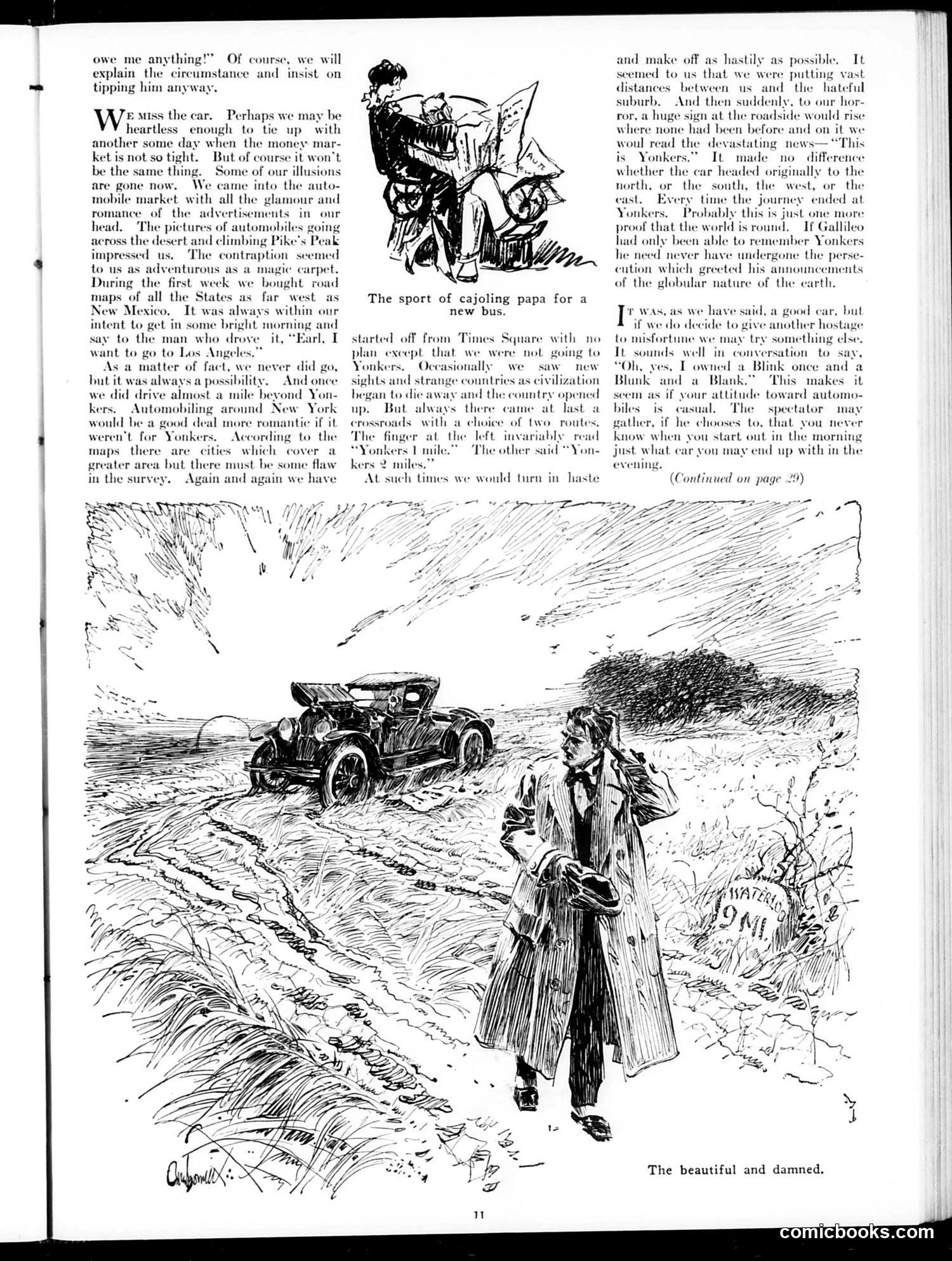
This piece satirizes early automotive enthusiasm and the disappointing reality of car ownership. The text mocks people who bought automobiles seduced by glamorous advertisements showing cars crossing deserts and climbing mountains, imagining romantic cross-country adventures. The reality? They end up trapped in the suburban monotony of Yonkers, New York, unable to escape no matter which direction they drive—a darkly humorous commentary on the gap between consumer fantasy and actual experience. The author notes that even attempting one mile beyond Yonkers felt adventurous. The cartoon shows a stranded motorist and vehicle in desolate terrain, illustrating the mismatch between aspirational auto-travel imagery and mundane reality. The title "The beautiful and damned" references desire corrupted by commercial promises. This satirizes both consumer gullibility and the limitations of early automobiles for actual long-distance travel.
📄 Transcribed text from this page (OCR, searchable)
Machine-transcribed from the original scan — historical spelling and the odd misread are preserved.
owe me anything!” Of course. explain the circumstance and insist on tipping him anyway. E Miss the car. Perhaps we may be heartless enough to tie up with another some day when the money mar- ket is not so tight. But of course it won't be the same thing. Some of our illusions are gone now. We came into the auto- mobile market with all the glamour and romance of the advertisements in’ our ‘The pictures of automobiles going ss the desert and climbing Pike's Peak impressed us. The contraption seemed to us as adventurous as a magic carpet. During the first week we bought road maps of all the St far west as New Mexico, It was always within our intent to get in some bright morning and say to the man who drove it, “E: want to go to Los Angeles.” f we never did go, And once but it was always a possibility. we did drive almost a mile beyond Yon- kers. Automobiling und New York would be a good deal more romantic if it weren't for Yonkers. According to the maps there are cities which cover a greater arca but there must be some flaw in the survey. Again and again we have The sport of cajoling papa for a new bus. started off from Times Square with no plan except that we were not going to Yonkers. Occasionally — we new sights and strange countries as civilization began to die and the country opened always there came at last a up. But crossroads with a choice of two routes. The finger at the left: in ably ad “Yonkers | mile.” The other said *Yon- kers 2 miles.” At such times we would turn in’ haste and make off as hastily as possible. It seemed to us that we were putting vast distances between us and the hateful suburb, And then suddenly, to our hor- ror, a huge sign at the roadside would rise where none had been before and on it we woul read t tating news— ‘This is Yonke It made no difference whether the car headed originally to the north, or the south, the west, or the Svery time the journey ended at Yonkers. Probably this is just one more proof that the world is round. If Gallileo had only been able to remember Yonkers he need never have undergone the perse- cution which greeted his announcements of the globular nature of the earth. ] to misfortune we may try something Tt sounds well in conversation to “Oh, yes, T owned a Blink once and 4 Blunk ¢ a Blank.” This makes it seem as if your attitude toward automo- biles is casual. The spectator may gather, if he chooses to, that you ne know when you start out in the morning just what car you may end up with in the evening. (Continued on page 29) east. r, but The beautiful and damned. comicbooks.com