
Judge, 1923-01-06 · page 7 of 36
Judge — January 6, 1923 — page 7: what you’re looking at
What you’re looking at
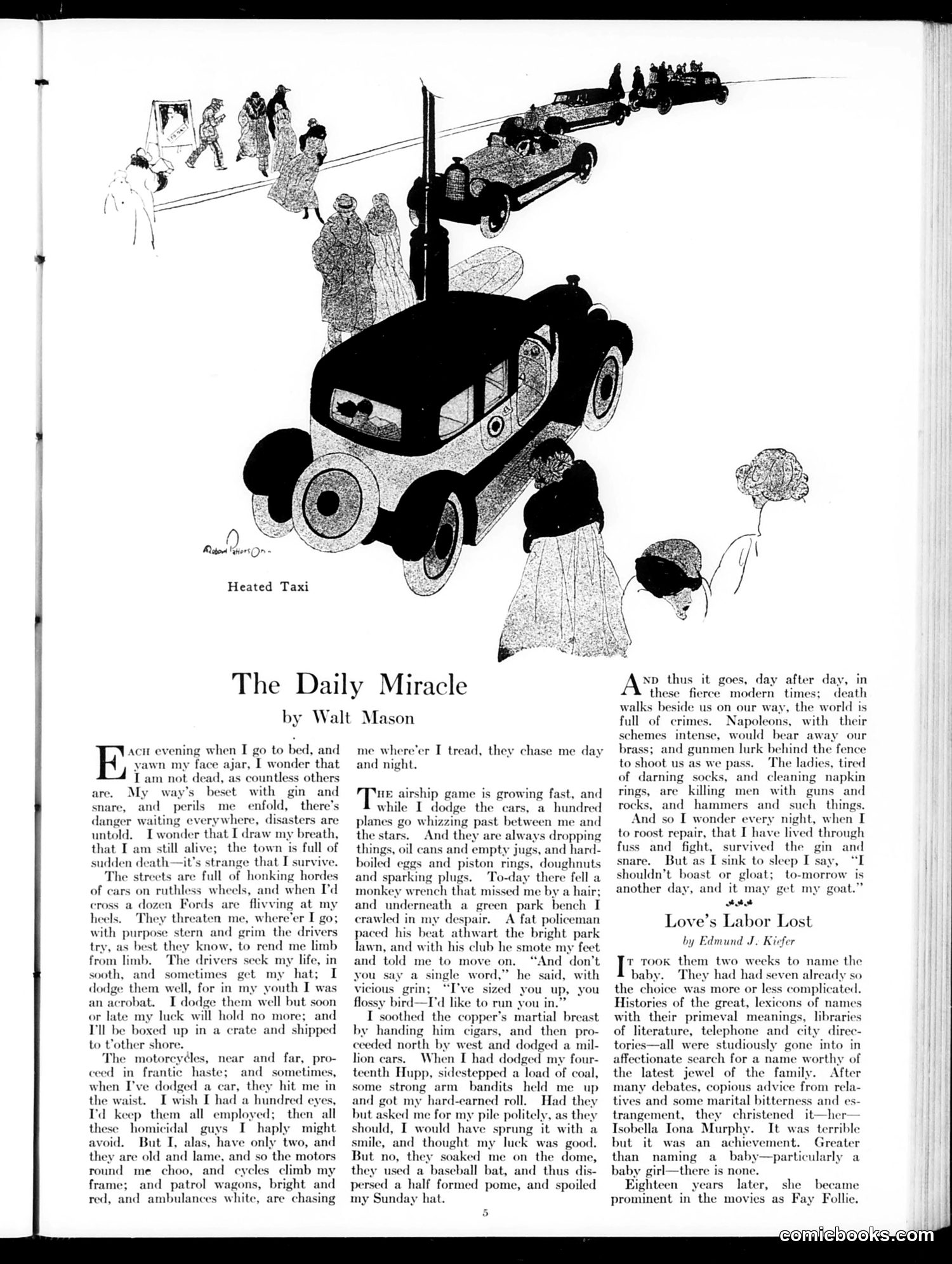
This page satirizes the hazards of modern urban life in the early automotive age. The main cartoon illustrates a "Heated Taxi"—a humorous depiction of a heated cab vehicle surrounded by pedestrians and traffic chaos. Walt Mason's poem complements the illustration, cataloging the dangers a pedestrian faces daily: speeding automobiles and motorcycles, airplanes dropping debris, muggers, and hostile police. The narrator marvels he survives each night given the constant threats—cars, criminals, and armed women ("killing men with guns and rocks"). The satire targets the rapid modernization of American cities, where new technologies (automobiles, aircraft) created unexpected hazards. The poem's tone shifts between anxiety and absurdist resignation: death lurks everywhere, yet people persist. The secondary piece "Love's Labor Lost" appears unrelated. The overall message: modern progress brings chaos and danger that earlier generations never faced.
📄 Transcribed text from this page (OCR, searchable)
Machine-transcribed from the original scan — historical spelling and the odd misread are preserved.
Ere Reto liorsQn = Heated Taxi The Daily Miracle by Walt Mason acu evening when I go to bed, and E yawn my face ajar, I wonder that T am not dead, as countless others My way’s beset with gin and snare, and perils me enfold, there's danger waiting everywhere, disasters are untold. [wonder that I draw my breath, that I am still alive; the town is full of sudden death—it’s strange that I survive. The streets are full of honking hordes of cars on ruthless wheels, and when I'd cross a dozen Fords are flivving at my heels. They threaten me, where’er I go; with purpose stern and grim the drivers try, as best they know, to rend me limb from limb. The drivers seek my life, in sooth, and sometimes get my hat; I dodge them well, for in my youth I was an acrobat. I dodge them well but soon or late my luck will hold no more; and I'll be boxed up in a crate and shipped to t’other shore. The motorcy pro- ceed in frantic and sometime when I've dodged a car, they hit me the waist. I wish I had a hundred eyes, I'd keep them all employed; then all these homicidal guys I y avoid. But I, alas, have only two, and they are old and lame, and so the motors round me choo, and cycles climb my frame; and patrol wagons, bright and red, and ambulances white, are chasing me where’er I tread, they chase me day and night. HE airship game is growing fast, and while I dodge the cars, a hundred planes go whizzing past between me and the stars. And they are always dropping things, oil cans and empty jugs, and hard- boiled eggs and piston rings, doughnuts and sparking plugs. To-day there fell a monkey wrench that missed me by a hair: and underneath a green park bench I crawled in my despair. A fat policeman paced his beat athwart the bright park lawn, and with his club he smote my feet and told me to move on. “And don’t you say a single word,” he said, with vicious grin; “I’ve sized you up, you flossy bird—I'd like to run you in.” I soothed the copper’s martial breast by handing him cigars, and then pro- ceeded north by west and dodged a mil- lion cars. When I had dodged my four- teenth Hupp, sidesteppe load of coal, some strong arm bandits held me up and got my hard-earned roll. Had they but asked me for my pile politely, as they should, I would sprung it with a smile, and thought my luck was good. But no, they soaked me on the dome, y used ball bat, and thus dis- a half formed pome, and spoiled my Sunday hat. A D thus it goes, day after day, in these fierce modern times; death walks beside us on our way, the world is full of crimes. Napoleons, with their schemes intense, would bear away our brass; and gunmen lurk behind the fence to shoot us as we pass. The ladies, tired of darning socks, and cleaning napkin rings, are killing men with guns and rocks, and hammers and such things. And so I wonder every night, when I to roost repair, that I lived through fuss and fight, survived the gin and But as I sink to sleep I say, “ to-morrow is zoat.”” snare. shouldn’t boast or gloat; another day, and it may get my wae Love’s Labor Lost by Edmund J. Kiefer took them two weeks to name the baby. They had had seven already so the choice was more or less complicated. Histories of the great, lexicons of names with their primeval meanings, libraries of literature, telephone and city direc- tories—all were studiously gone into in ionate search for a name worthy of the latest jewel of the family. After many debates, copious advice from rela- tives and some marital bitterness and es- trangement, they christened it—her Isobella Iona Murphy. It was terrible but it w an achievement. Greater than naming baby—particularly a baby girl—there is none. Eighteen years later, she became prominent in the movies as Fay Follie.