
A complete issue · 37 pages · 1922
Judge — December 30, 1922
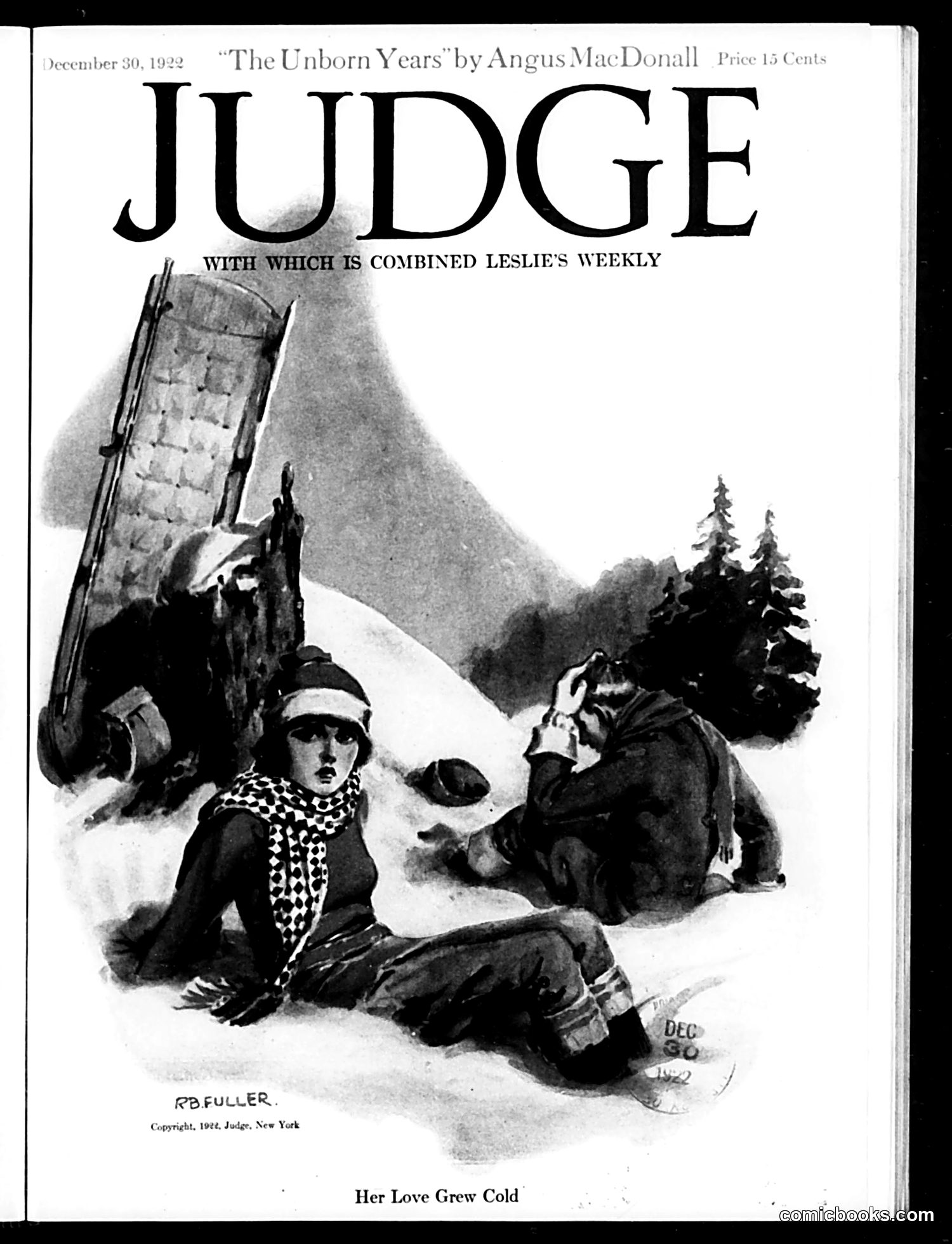
This cover illustrates "Her Love Grew Cold," a story likely exploring romantic disappointment. The illustration by R.B. Fuller depicts two figures in winter clothing sitting in snow, with a snow-covered structure and evergreen trees in a mountain landscape behind them. The caption's title suggests a narrative about failed romance—a common theme in early 1920s popular entertainment. The winter setting and intimate positioning of the figures emphasize emotional coldness mirroring the physical environment. Without additional story content visible, the specific social commentary or satirical point remains unclear, though the juxtaposition of romantic expectation against harsh winter conditions appears central to the narrative's meaning.
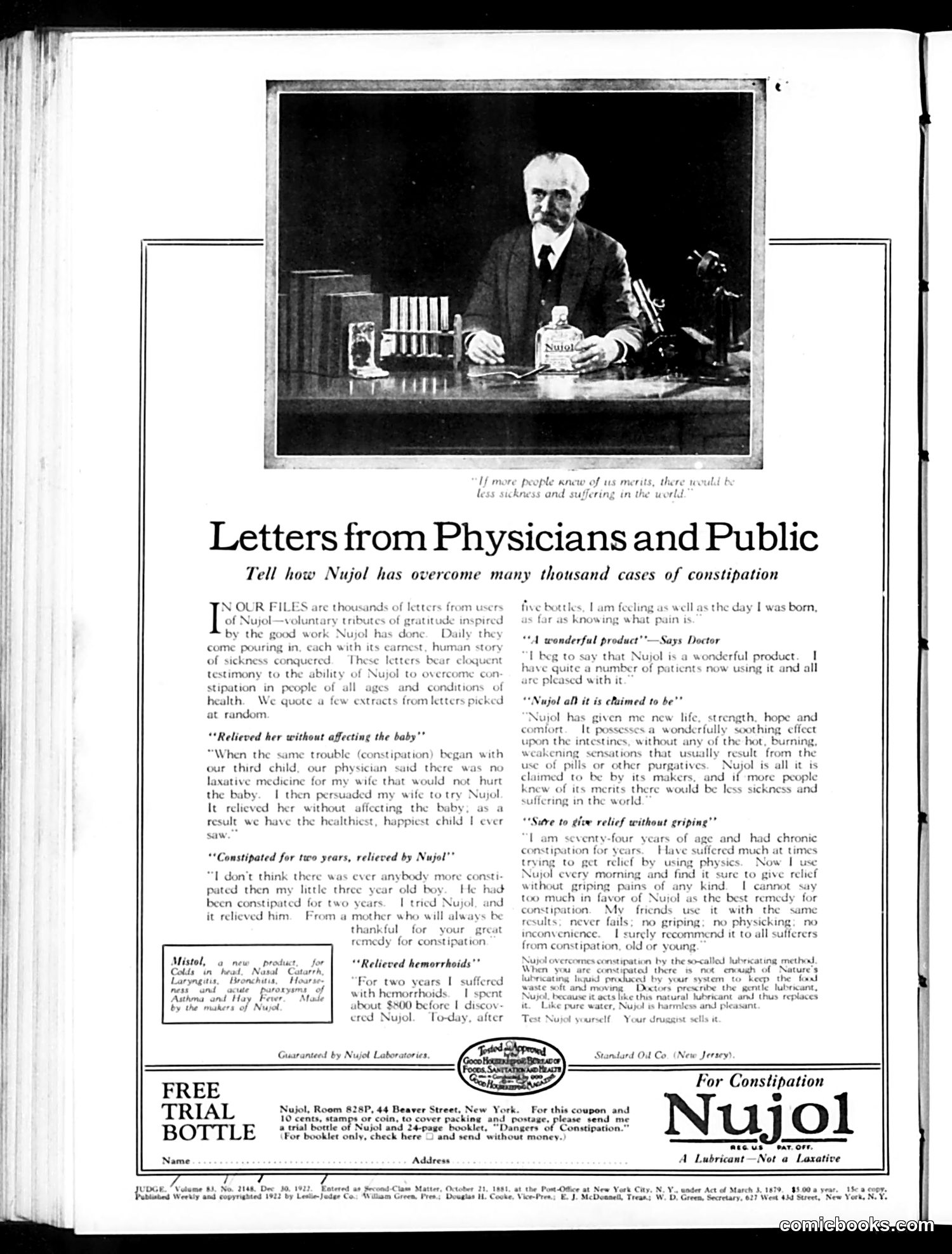
This page is primarily **advertising, not satire**. It promotes "Nujol," a commercial laxative product, using testimonial letters from physicians and patients claiming to have overcome constipation. The photograph shows an unidentified man (likely a doctor or company representative) at a desk with product bottles, positioned to convey medical authority and legitimacy. The testimonials employ common early 20th-century advertising rhetoric—"relieved without affecting the baby," "constipated for two years"—to establish credibility through relatable human stories. **The satire element, if any, is subtle**: Judge magazine may be gently mocking the overwrought medical testimonial format itself, which was (and remains) a fixture of patent medicine advertising. However, the page functions primarily as paid promotion rather than editorial commentary.
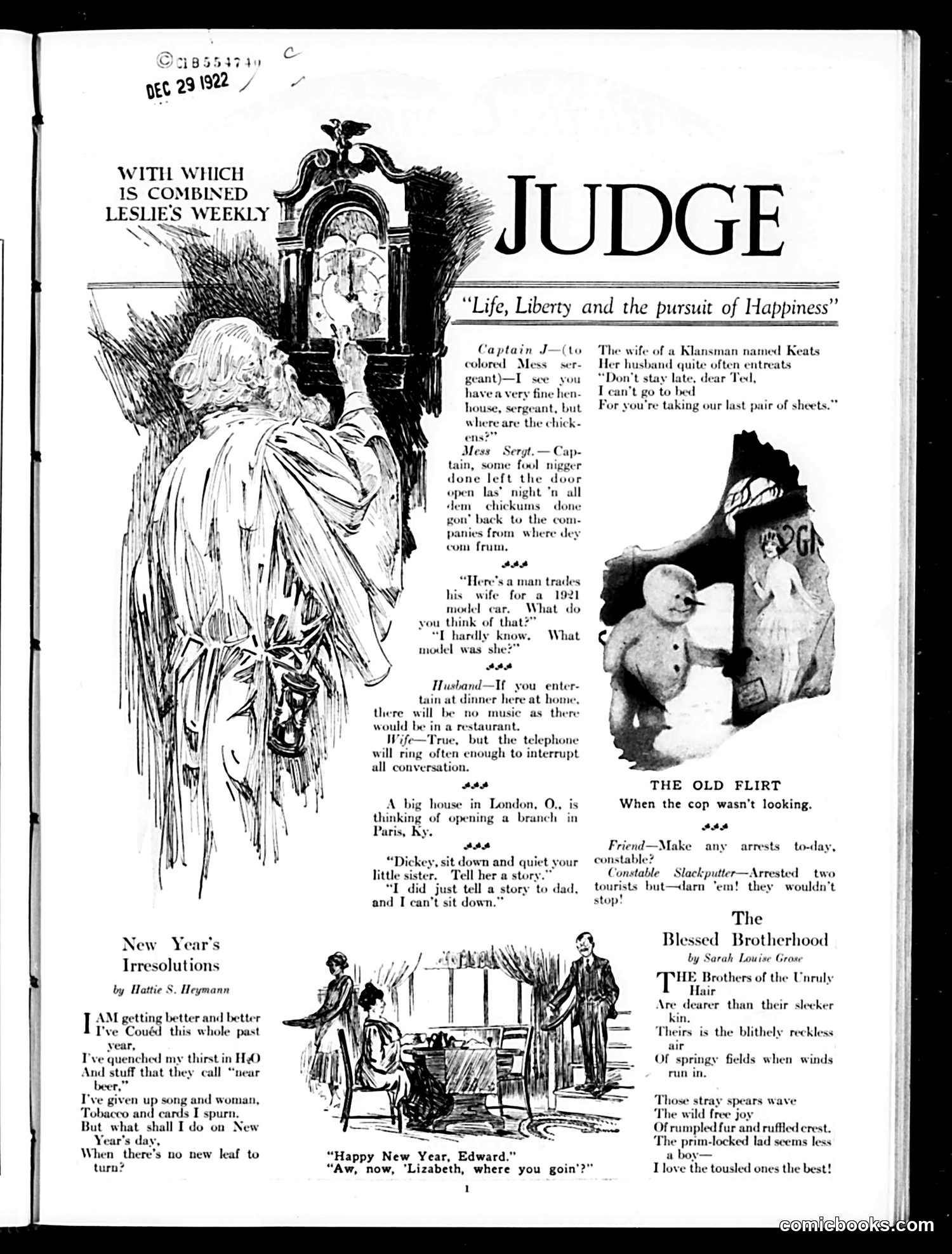
This page contains humor pieces rather than political cartoons. The main illustration depicts a figure in classical robes consulting a large grandfather clock, likely representing "Father Time" or New Year symbolism—a common Judge trope for New Year's issue commentary. The text includes humorous anecdotes about domestic life and marital situations (wives complaining about husbands, etc.), typical of Judge's satirical approach to American middle-class behavior. "New Year's Resolutions" by Hattie S. Hyemann presents self-deprecating reflections on personal improvement—standard satirical material. "The Blessed Brotherhood" poem by Sarah Louise Grose appears to be sentimental or ironic commentary on brotherhood themes. The overall tone mocks contemporary social customs and domestic dynamics rather than targeting specific political figures or events.
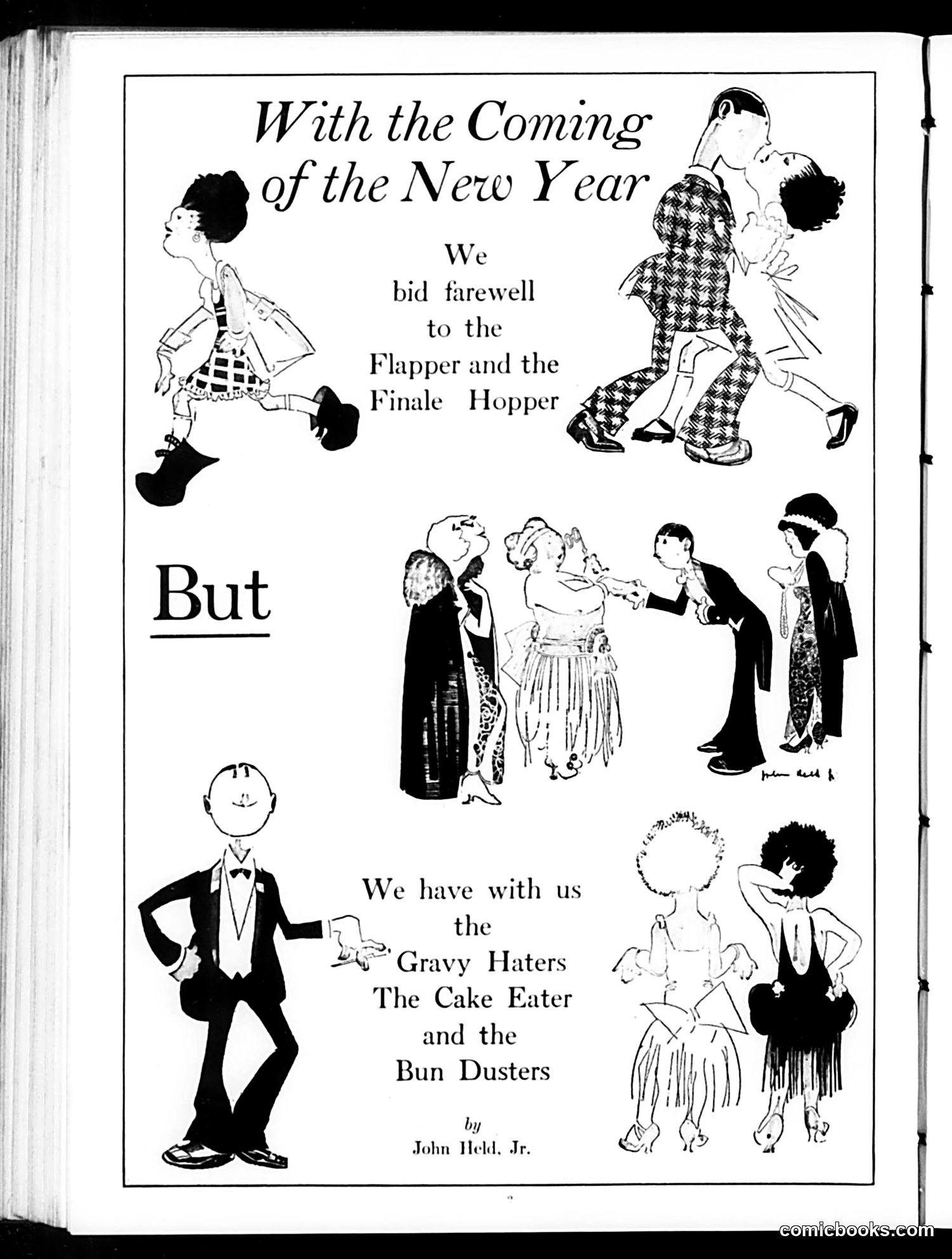
This is a humorous farewell to 1920s dance crazes. The page bids goodbye to the "Flapper and the Finale Hopper"—fashionable dance styles of the era—while welcoming new social types for the coming year. The illustrated characters represent stereotypical 1920s figures: flappers (women in short dresses), a dapper gentleman in formal wear, and various social types. The text references "Gravy Haters," "The Cake Eater" (slang for a ladies' man), and "Bun Dusters"—all period slang terms for recognizable social archetypes of the Jazz Age. The satire mocks the rapid, cyclical nature of 1920s fads and social fashions, suggesting that as one set of trendy behaviors and character types fades, new equally ridiculous ones arrive. The cartoonist humorously catalogs these disposable cultural trends.
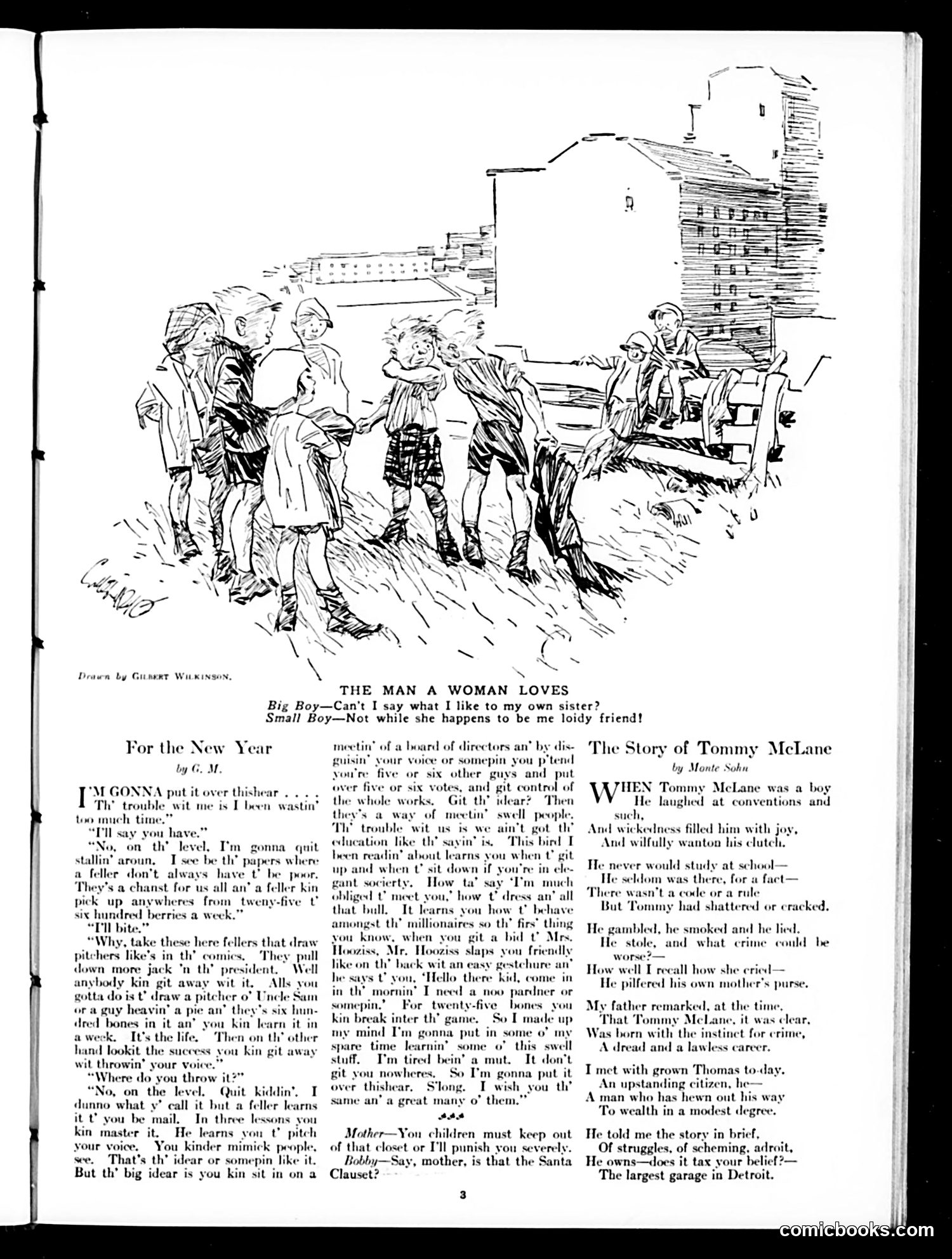
This page contains three distinct pieces: a street scene illustration by Gilbert Wilkinson titled "The Man a Woman Loves," a New Year's humor piece by G.M. about New Year's resolutions, and a story titled "The Story of Tommy McLane" by Monte Sohn. The main cartoon depicts children and adults in an urban setting with tenement buildings. The dialogue between "Big Boy" and "Small Boy" appears to satirize class consciousness and friendship, with the Big Boy asking why he can't discuss personal matters with his "loidy friend" (lower-class speech pattern). The page primarily represents early 1900s domestic and social humor rather than political satire. The content reflects period attitudes toward class distinctions, childhood behavior, and working-class urban life, likely aimed at middle-class magazine readers.
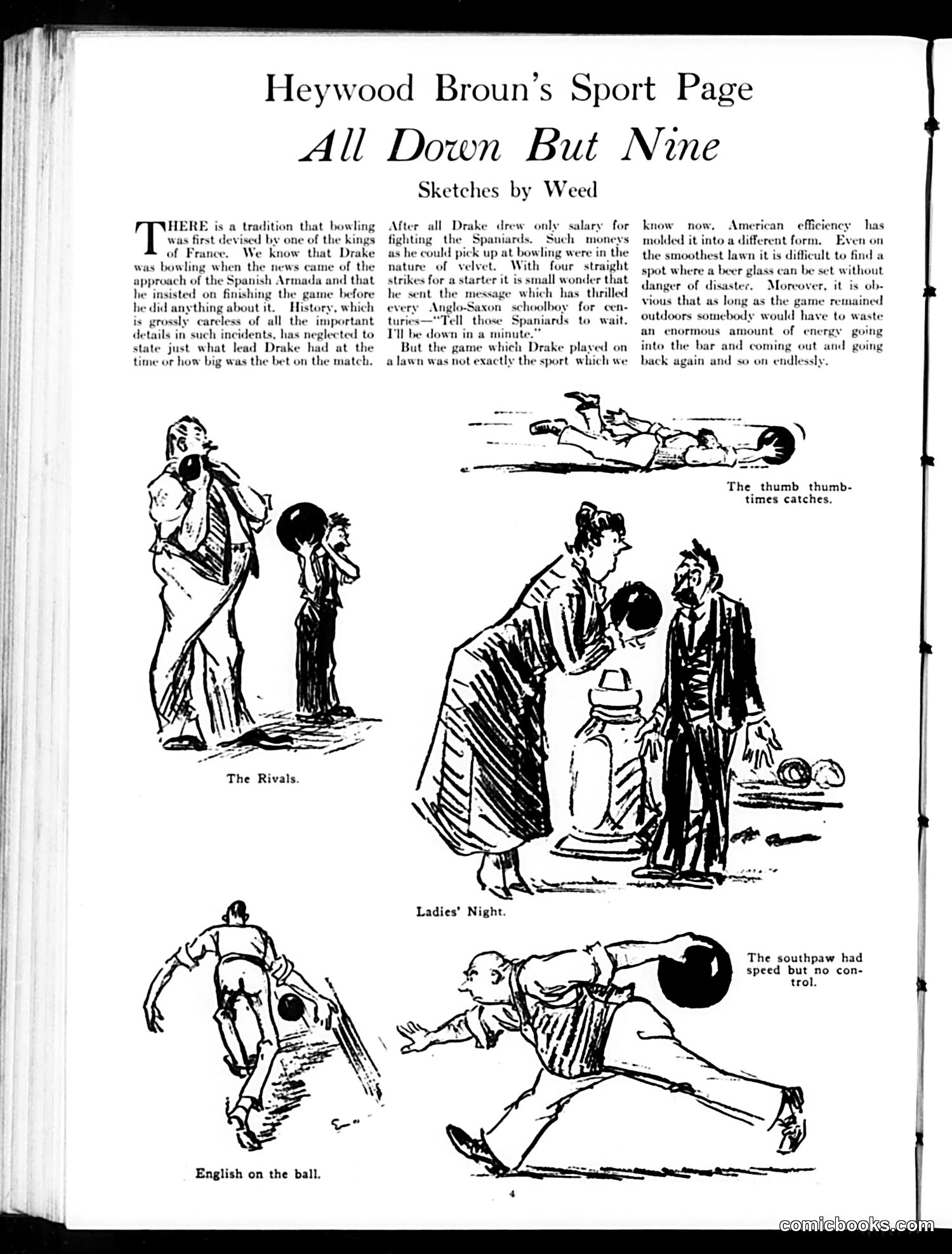
This is Heywood Broun's sports satire column featuring bowling sketches by Weed. The title references bowling's scoring system (pins knocked down). The sketches humorously depict bowling culture of the era: - **"The Rivals"**: Two competitive bowlers, one upset - **"Ladies' Night"**: Women bowling, presented as a novelty event - **"English on the ball"** and **"The southpaw"**: Technical bowling jokes about spin and left-handed players - **"The thumb thumb-times catches"**: A mishap illustration The accompanying text discusses Drake's historical dismissal from the Spanish Armada narrative and ties it to bowling's modern popularity as an American sport requiring efficiency and precision. The satire gently mocks both bowling's growing genteel acceptance (particularly among women) and competitive bowling culture's earnestness.
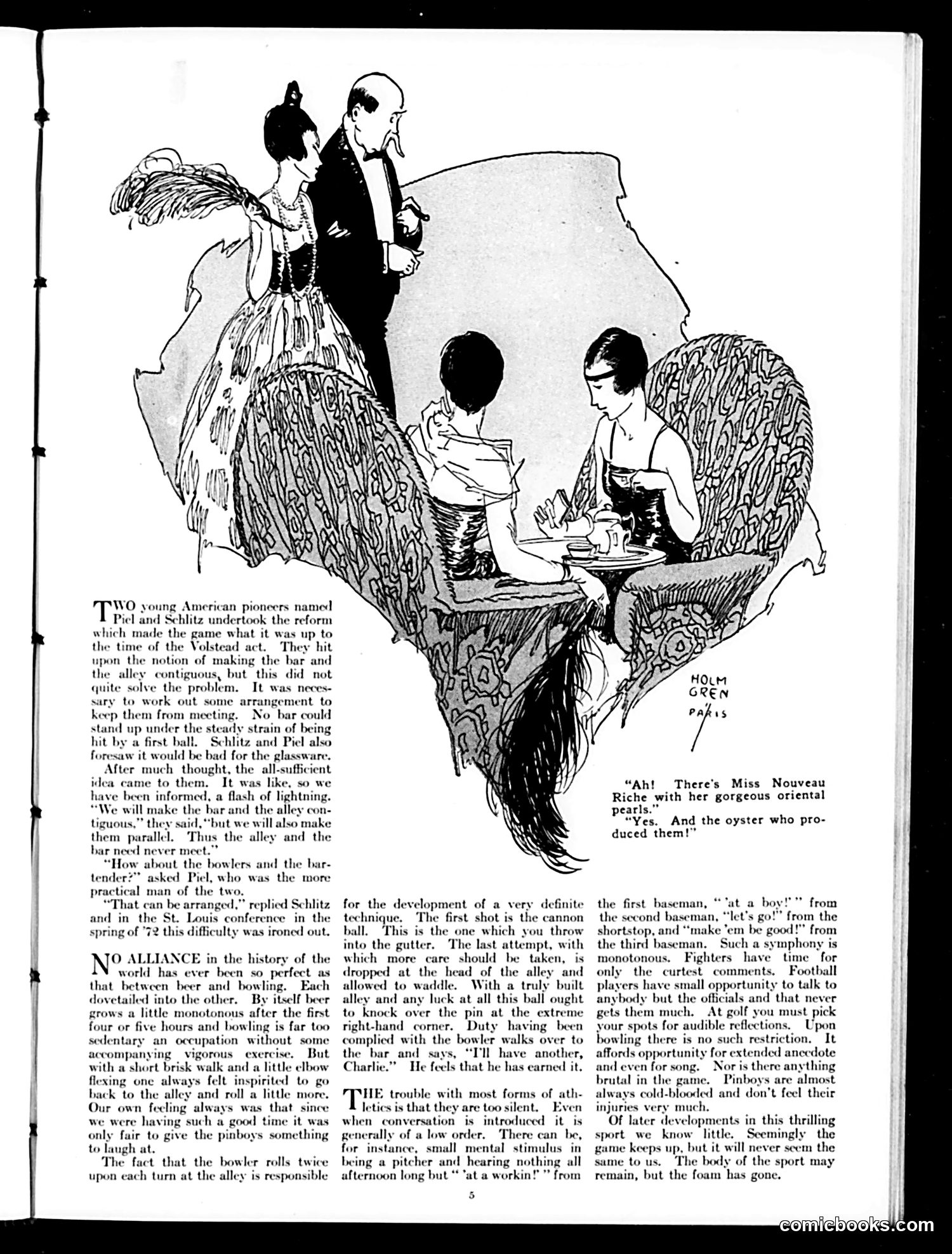
This **Judge** magazine page satirizes the relationship between beer and bowling in early 20th-century American leisure culture. The illustration depicts two elegant figures (representing beer/bar culture) alongside bowlers, visualized as a large profile of a man's head. The text humorously credits fictional "pioneers" Piel and Schlitz (beer brand names) with reforming bowling by separating bars from alleys—solving the practical problem that bowlers would damage glassware if drinking happened near the pins. The satire's point: beer and bowling were so commercially intertwined that they seemed like natural partners in American recreation. The piece celebrates this alliance while gently mocking how bowling required alcohol to be "tolerable," and how bowling alleys depended on bar sales. The final lament—"the foam has gone"—suggests nostalgia for an earlier era of this leisure partnership, implying changes (possibly Prohibition-related) have diminished the experience.
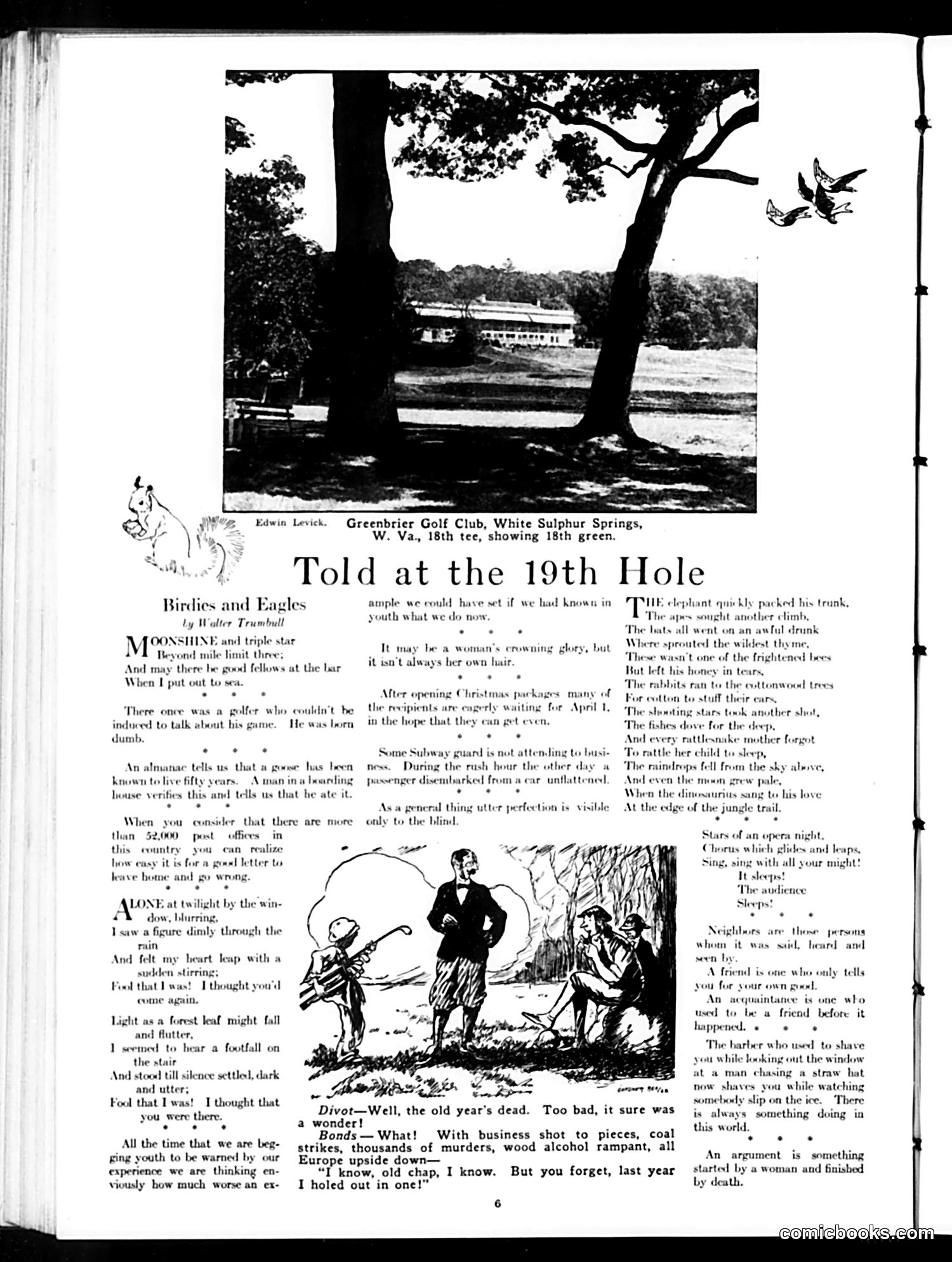
This page from *Judge* magazine presents early 20th-century humor mixing golf anecdotes, romantic poetry, and social commentary. **The Main Cartoon:** Shows two men by a golf course discussing the passing year ("old year's dead"). One brags he "holed out in one"—achieved a hole-in-one—while the other references broader disasters: "business shot to pieces, coal strikes, thousands of murders, wood alcohol rampant, all Europe upside down." The joke contrasts trivial golf accomplishment with catastrophic real-world conditions, likely referencing post-WWI upheaval and Prohibition-era America. **Supporting Content:** Includes sentimental poetry about lost love, golf club observations, and satirical one-liners mocking social conventions (women's hair, post-office efficiency, friendship definitions). The photograph shows Greenbrier Golf Club, a luxury resort. **The Point:** Satirizes upper-class preoccupation with leisure and sport while serious social crises unfold—a common *Judge* critique of wealthy detachment from contemporary turmoil.
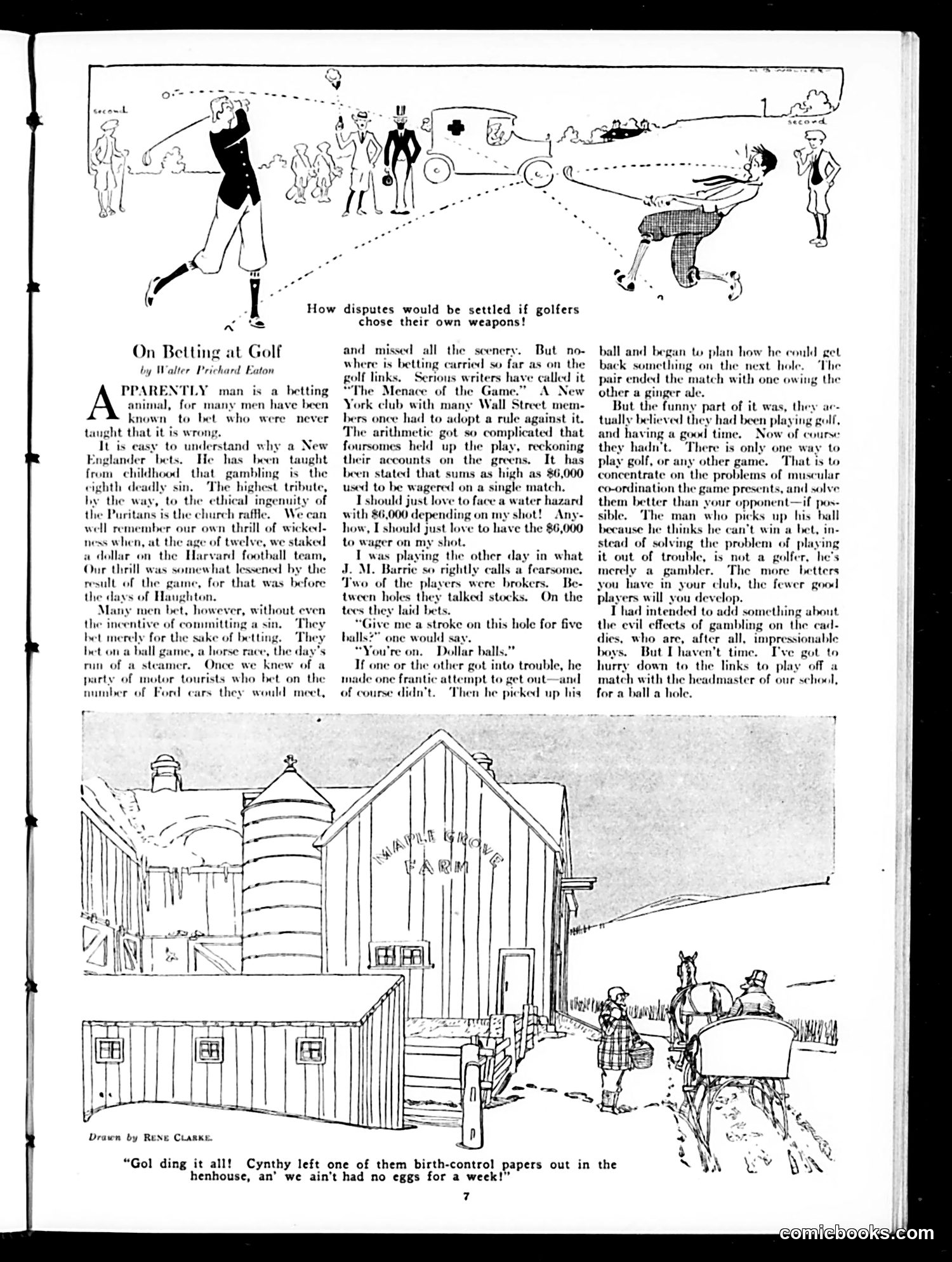
This page contains an essay by Walter Prichard Eaton critiquing excessive gambling among golfers, particularly wealthy New Yorkers and Wall Street types. The article illustrates how betting has corrupted golf from a skill-based sport into pure gambling, with foursomes spending so much time calculating wagers they hold up play. The satirical point: golfers who focus on winning bets rather than improving their game aren't truly playing golf—they're merely gamblers. Eaton argues that concentration on one's actual performance, not financial stakes, develops real players. The anecdote about brokers betting between holes epitomizes the problem. The bottom cartoon, drawn by Rene Clarke, is unrelated farm humor: a rural couple discovers birth-control literature left in their henhouse, blaming it for their sudden egg shortage—a joke about rural ignorance and the unexpected consequences of modern contraception reaching rural areas.
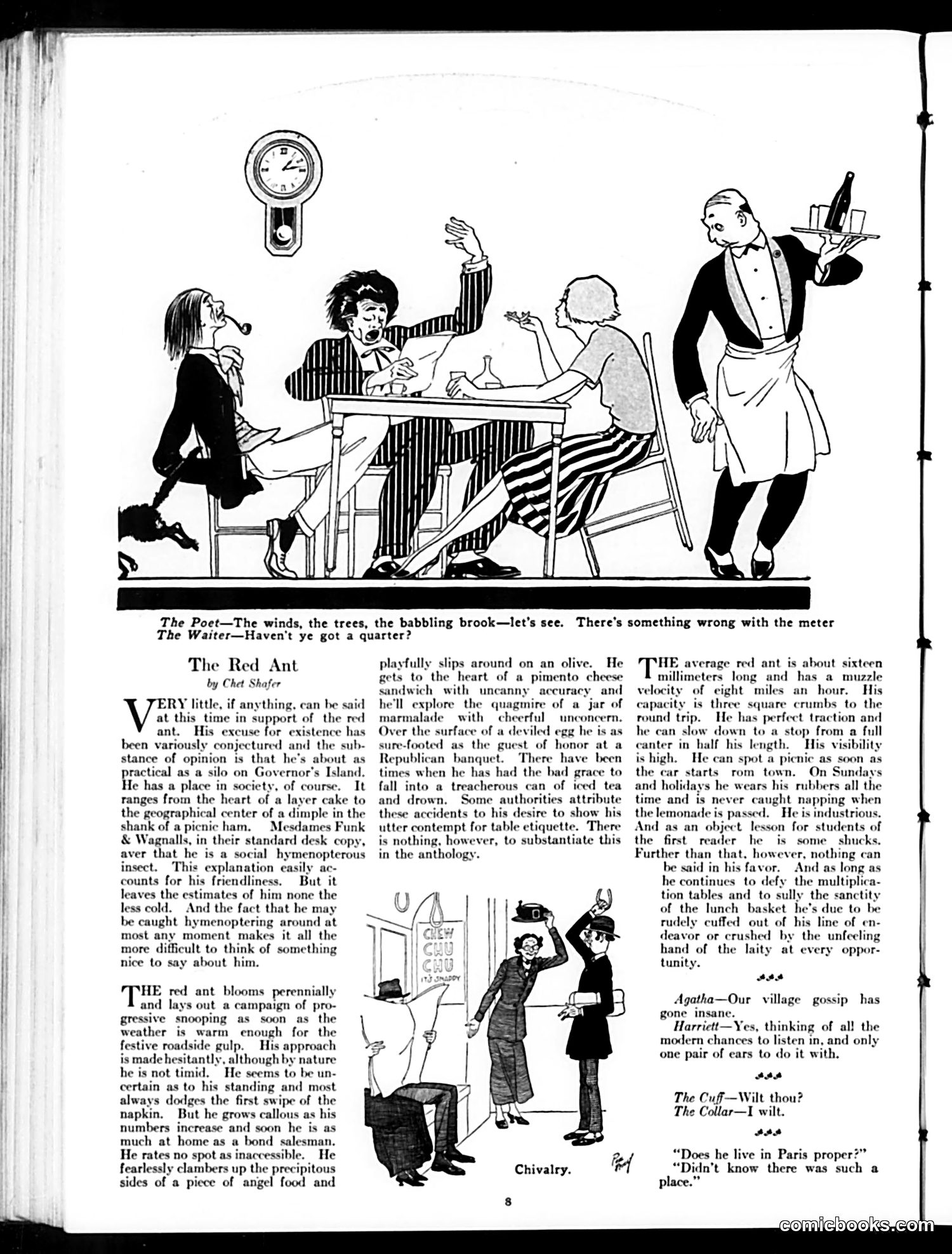
This page contains two distinct pieces of satirical content: **"The Red Ant" (main article):** A humorous essay by Chet Shafer anthropomorphizing red ants as antisocial pests. The satire targets the ant's shameless intrusion into human food and spaces—picnics, desserts, sandwiches—with mechanical precision and utter disregard for social boundaries. The piece mockingly praises the ant's "industrious" nature while condemning its fundamental uselessness and destructiveness, suggesting it deserves extermination. This likely functions as veiled social commentary on unwanted or parasitic elements in society. **The cartoon (top):** A poet struggles to compose verse while a waiter interrupts demanding payment ("Haven't ye got a quarter?"). The satire mocks impoverished bohemian artists—their romantic pretensions about nature contrasted sharply with practical financial desperation. **Minor jokes (bottom):** Brief quips about village gossips lacking time to listen to all modern entertainment, and wordplay about Paris. The page reflects 1920s-era American humor targeting social pretension and minor annoyances of urban/social life.
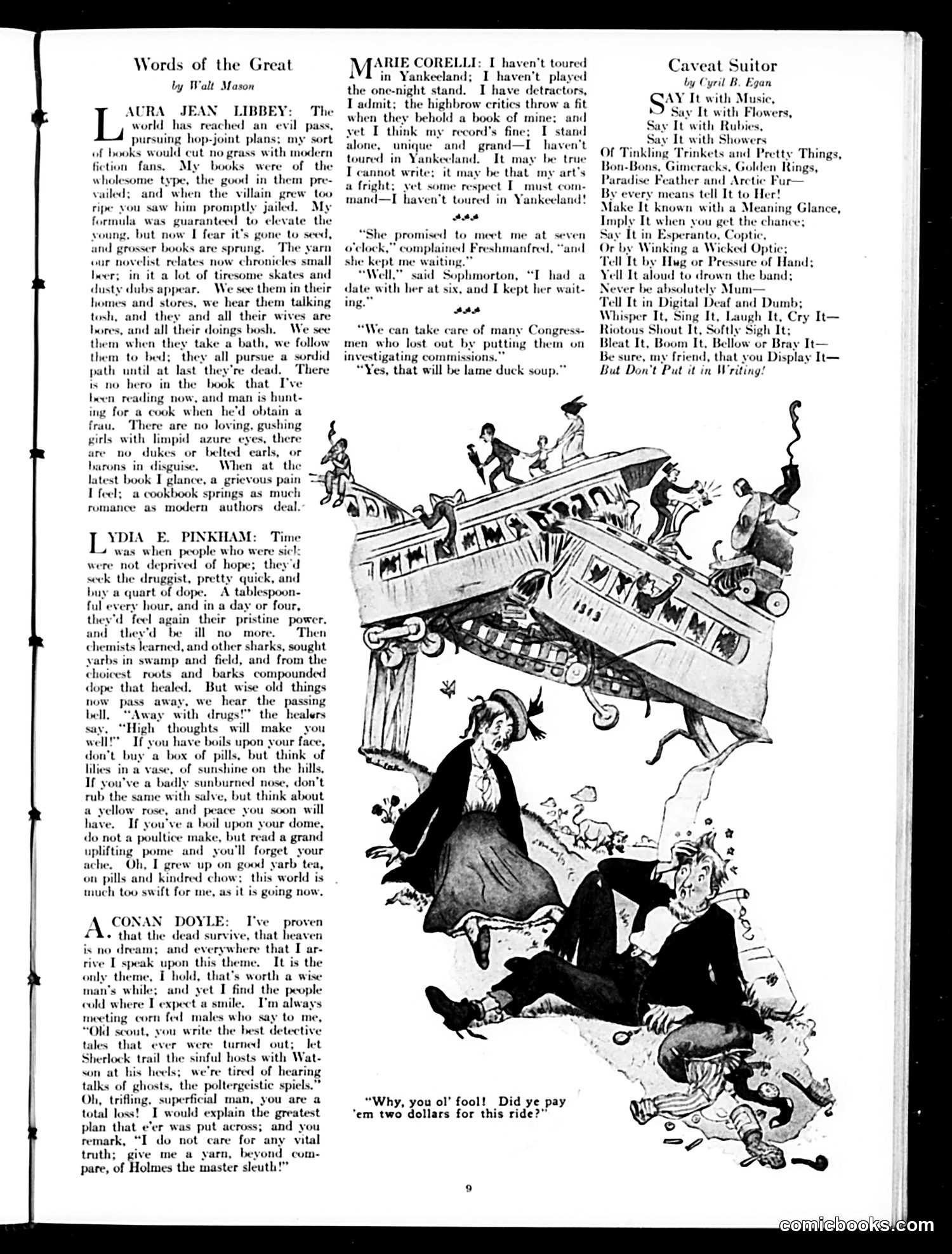
This page from *Judge* satirizes several prominent early-20th-century authors and public figures through Walt Mason's verse commentary. **The main cartoon** depicts a chaotic steamship scene with passengers in disarray, illustrating the satirical critiques below. **The targets:** - **Laura Jean Libbey**: A romance novelist criticized for wholesome, moralistic fiction now deemed outdated compared to grittier modern realism. - **Lydia E. Pinkham**: The patent medicine entrepreneur whose tonics promised cure-alls; the satire mocks modern "New Thought" wellness culture replacing actual medical treatment. - **Conan Doyle**: The creator of Sherlock Holmes, criticized for promoting spiritualism and the afterlife while readers only want detective fiction. - **Marie Corelli**: A popular novelist defending her reputation and artistic integrity despite never touring America. **The satire's point**: These celebrities cling to outdated or eccentric concerns—sentimental fiction, miraculous cures, spiritualism—that modern readers/society have moved beyond. The humor lies in their apparent bewilderment at changing public tastes.
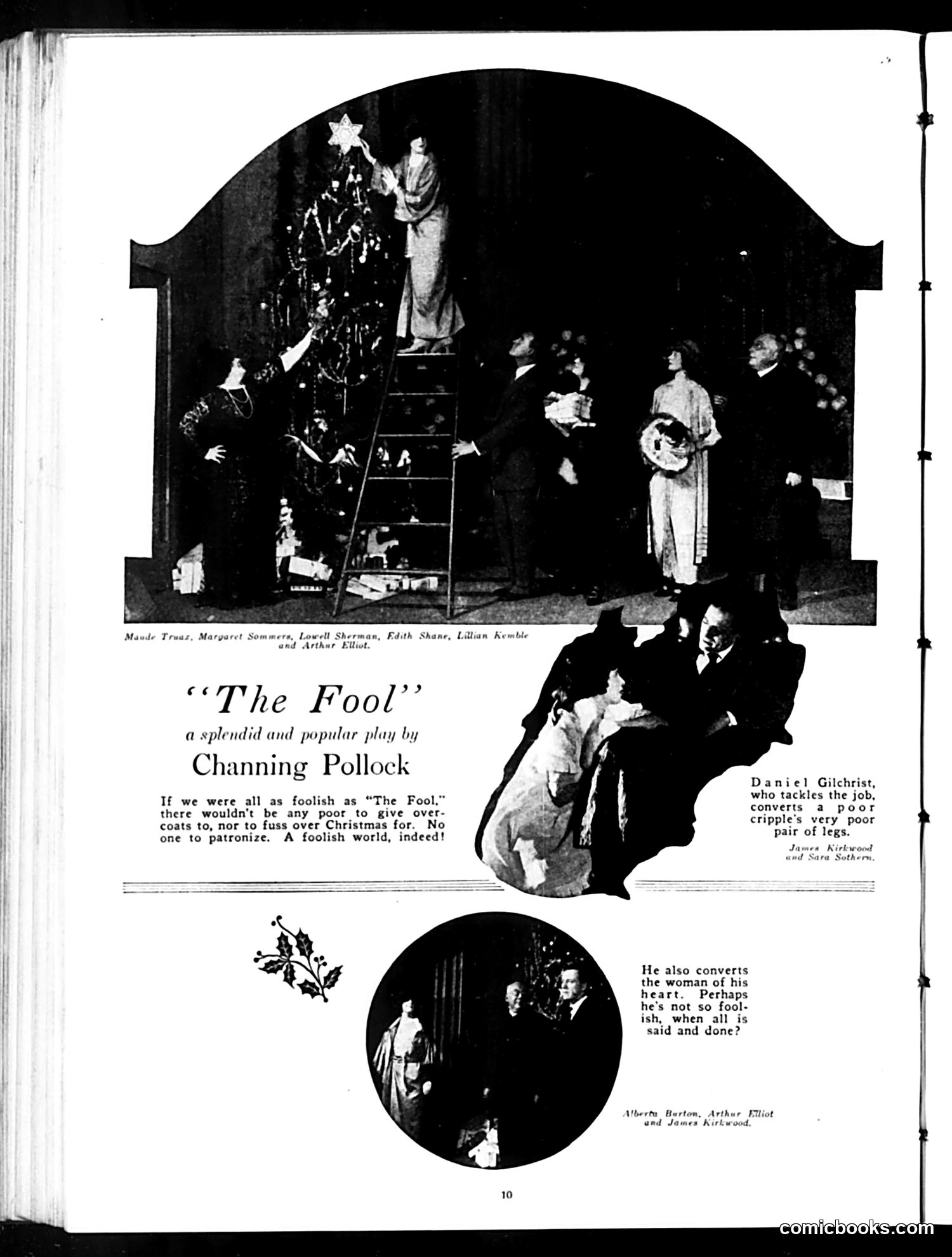
This page promotes Channing Pollock's play "The Fool," featuring photographs from the production with cast members identified. The accompanying text is satirical commentary on the play's moral message. The satire critiques the play's apparent central premise: a foolish character who converts others through moral persuasion—including a crippled man and the "woman of his heart." Judge's editors mock this sentiment, sardonically observing that if everyone were truly virtuous like "The Fool," there would be no poor people to patronize or charity work to perform. The joke cuts two ways: it suggests that society's charitable impulses partly depend on poverty existing, and that the play's naive idealism about human conversion is itself foolish. The final caption adds a tongue-in-cheek twist—perhaps the character isn't foolish after all if he successfully wins the woman's heart through virtue.
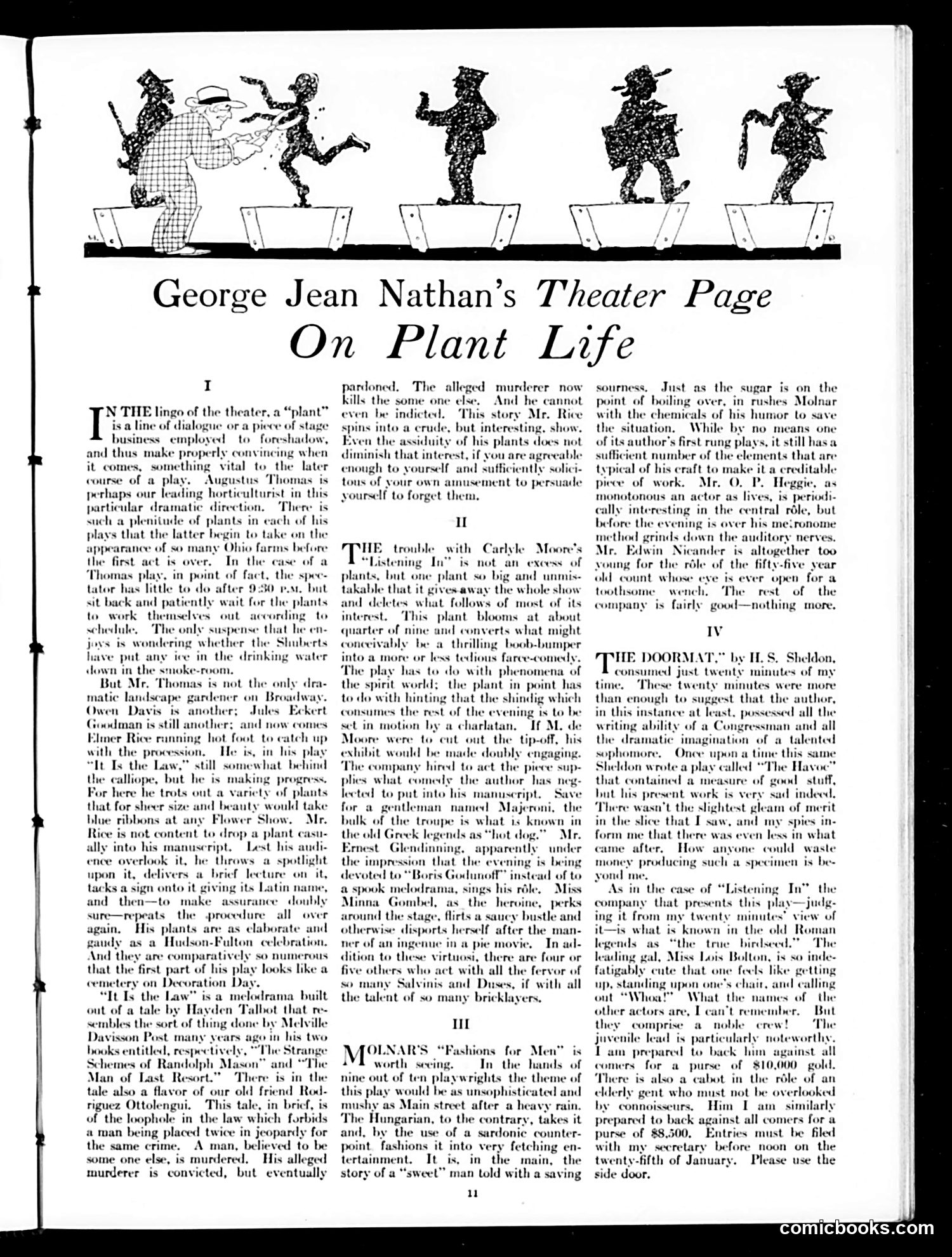
This theater criticism page by George Jean Nathan satirizes contemporary playwrights' overuse of "plants"—dramatic exposition devices that foreshadow plot points. **The Satire:** Nathan mocks playwrights Augustus Thomas, Owen Davis, Jules Eckert Goodman, and Elmer Rice for cluttering their plays with excessive planted clues. He particularly ridicules Rice's "It Is the Law," comparing his plants to an overcrowded flower show—so numerous and obvious that audiences cannot miss them. Nathan suggests Rice even uses spotlights and signs to ensure the audience notices these devices. **The Point:** Competent playwrights should integrate exposition naturally; these writers use such heavy-handed techniques that the theatrical illusions collapse. The satire criticizes their lack of subtlety and craftsmanship, suggesting audiences spend more time noticing dramatic mechanics than enjoying the actual story. The cartoon header shows silhouetted theatrical figures in exaggerated poses, likely representing these overwrought dramatic styles.
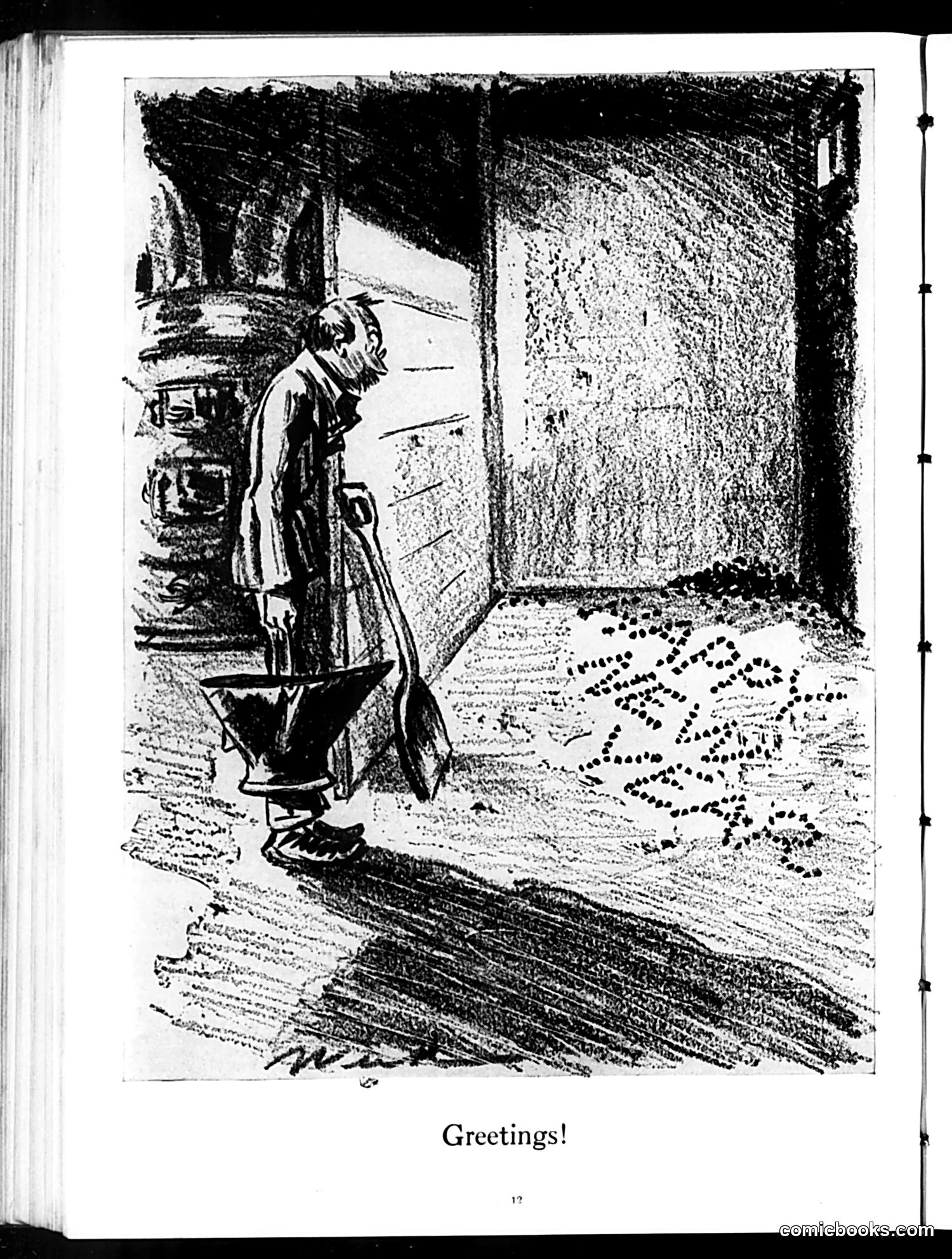
This page from *Judge* magazine shows a single cartoon illustration with the caption "Greetings!" The image depicts a man in formal attire (coat and hat) standing in what appears to be a shabby, run-down interior space with rough walls and a deteriorating floor. He holds a shovel and stands beside a wheelbarrow. Scattered on the ground appear to be coins or small objects arranged in a pattern. The satire likely comments on economic hardship or degradation of circumstances—possibly depicting someone of formerly higher status now reduced to menial labor or poverty. The formal dress contrasts sharply with the manual work and deteriorated surroundings, suggesting a fall in social or economic position. Without additional context or date information visible on the page, the specific historical reference remains unclear, though the overall theme appears to address class decline or economic struggle.
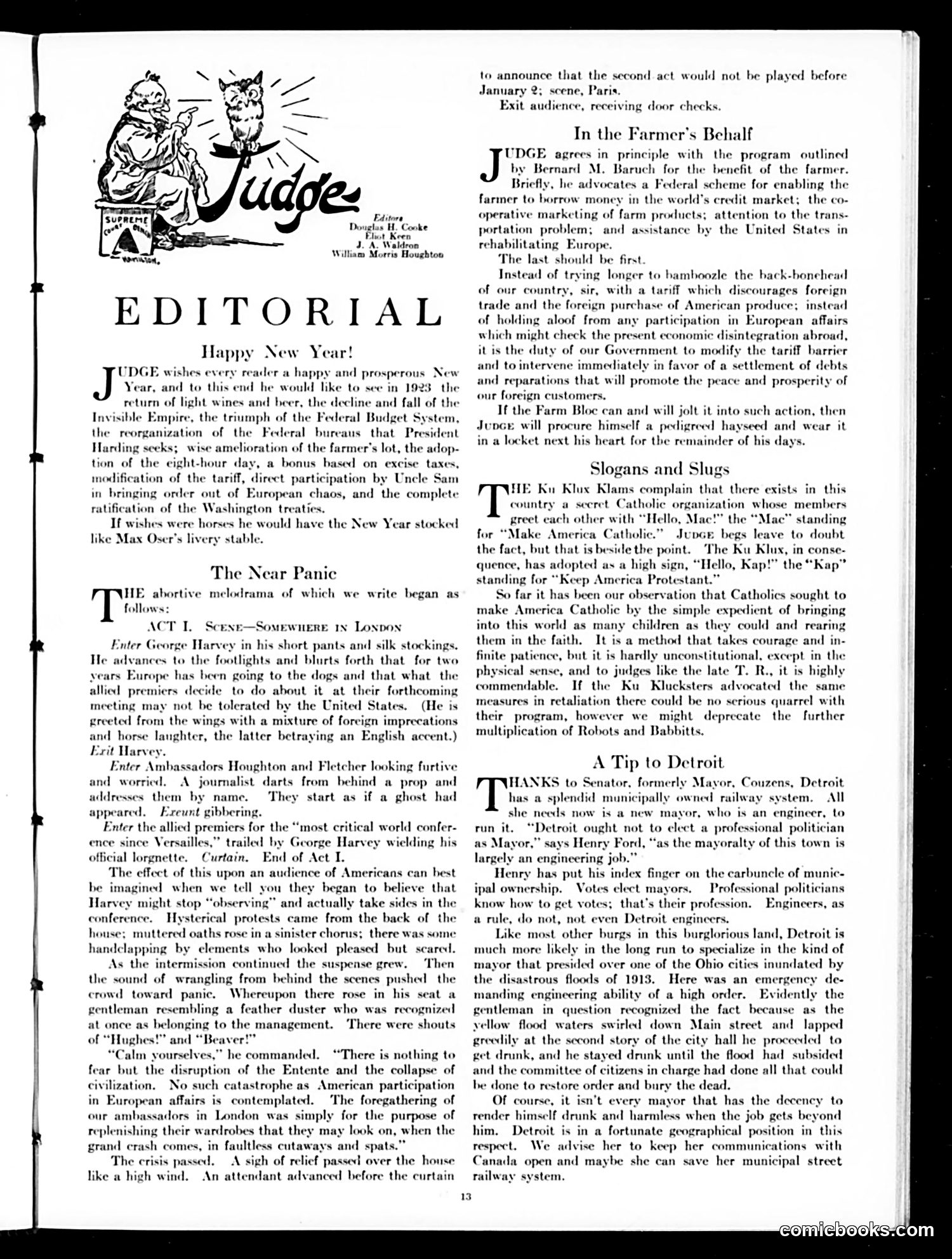
This editorial page from Judge magazine (likely early 1923) contains satirical commentary on American politics and foreign policy. **"The Near Panic"** is a theatrical sketch mocking American anxiety over international diplomacy. It satirizes Ambassador George Harvey's role at post-WWI peace conferences in London, portraying diplomatic negotiations as melodrama. The sketch suggests Americans feared Harvey might actually intervene in European affairs (rather than merely "observe"), triggering panic in the audience. When a figure resembling Secretary of State Hughes (identifiable by the crowd's cries of "Hughes!") reassures the audience that ambassadors are there only for "replenishing their wardrobes," the satire mocks diplomatic pretense and American isolationist sentiment. **The masthead cartoon** shows Judge as a character giving stern advice—the magazine's signature format for political commentary. **"In the Farmer's Behalf"** advocates New Deal-style agricultural support programs and criticizes protective tariffs as harmful to farmers, representing progressive editorial positions on 1920s farm policy. The page reflects post-WWI anxieties about American involvement in European affairs and domestic economic reform debates.
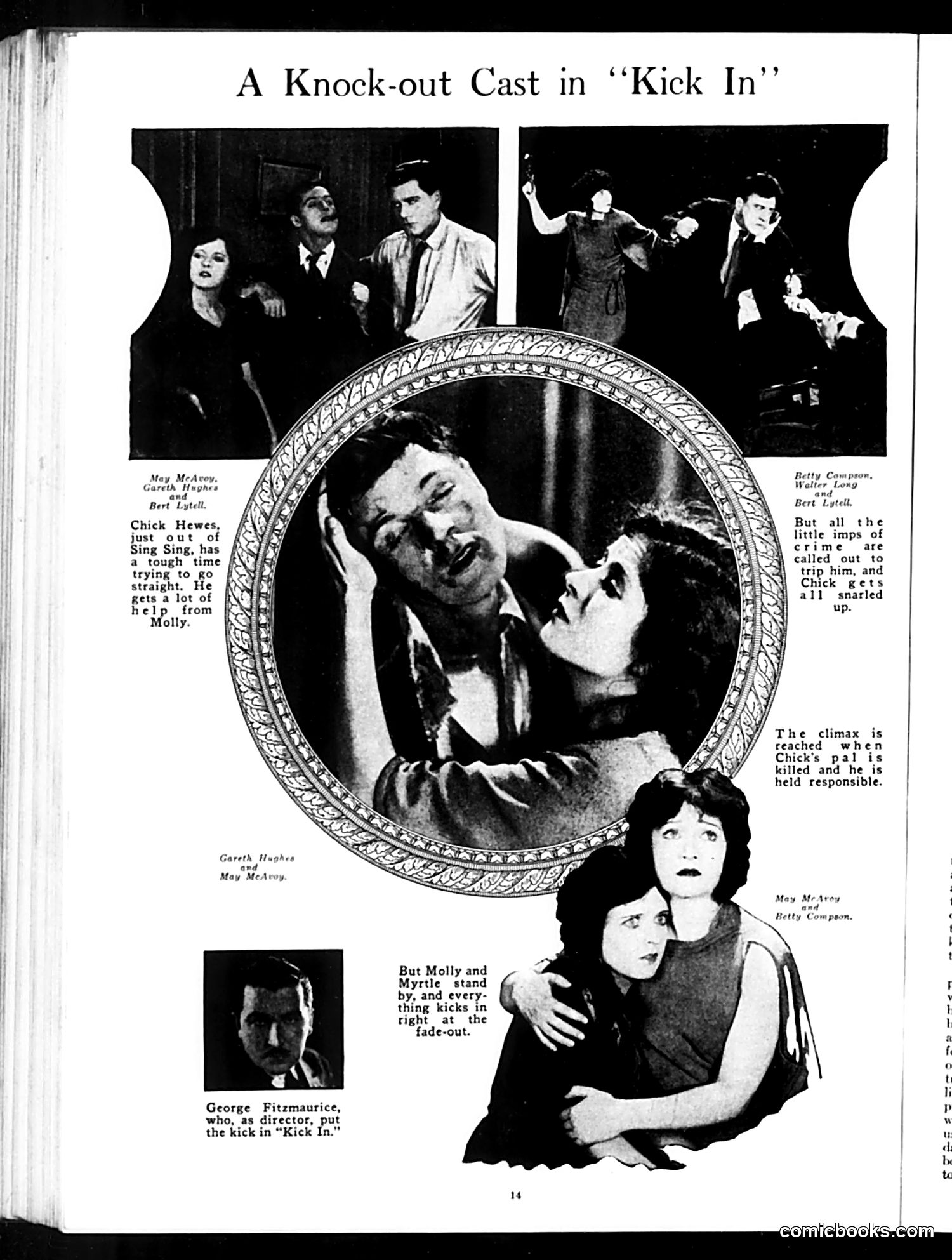
This is a promotional page for the silent film "Kick In," directed by George Fitzmaurice. It's not satire, but rather a cast showcase presenting the plot and actors. The film centers on Chick Hewes (played by Bert Lytell), a man freshly released from Sing Sing prison attempting to go straight. The plot involves criminals attempting to derail his reformation, culminating in his pal's murder, for which Chick is held responsible. Two women—Molly and Myrtle (May McAvoy and Gareth Hughes appear in supporting roles)—ultimately stand by him through the crisis. The page uses photographic stills and plot summaries to advertise this melodramatic crime drama to magazine readers, emphasizing the "knock-out cast" and dramatic tension of the narrative.
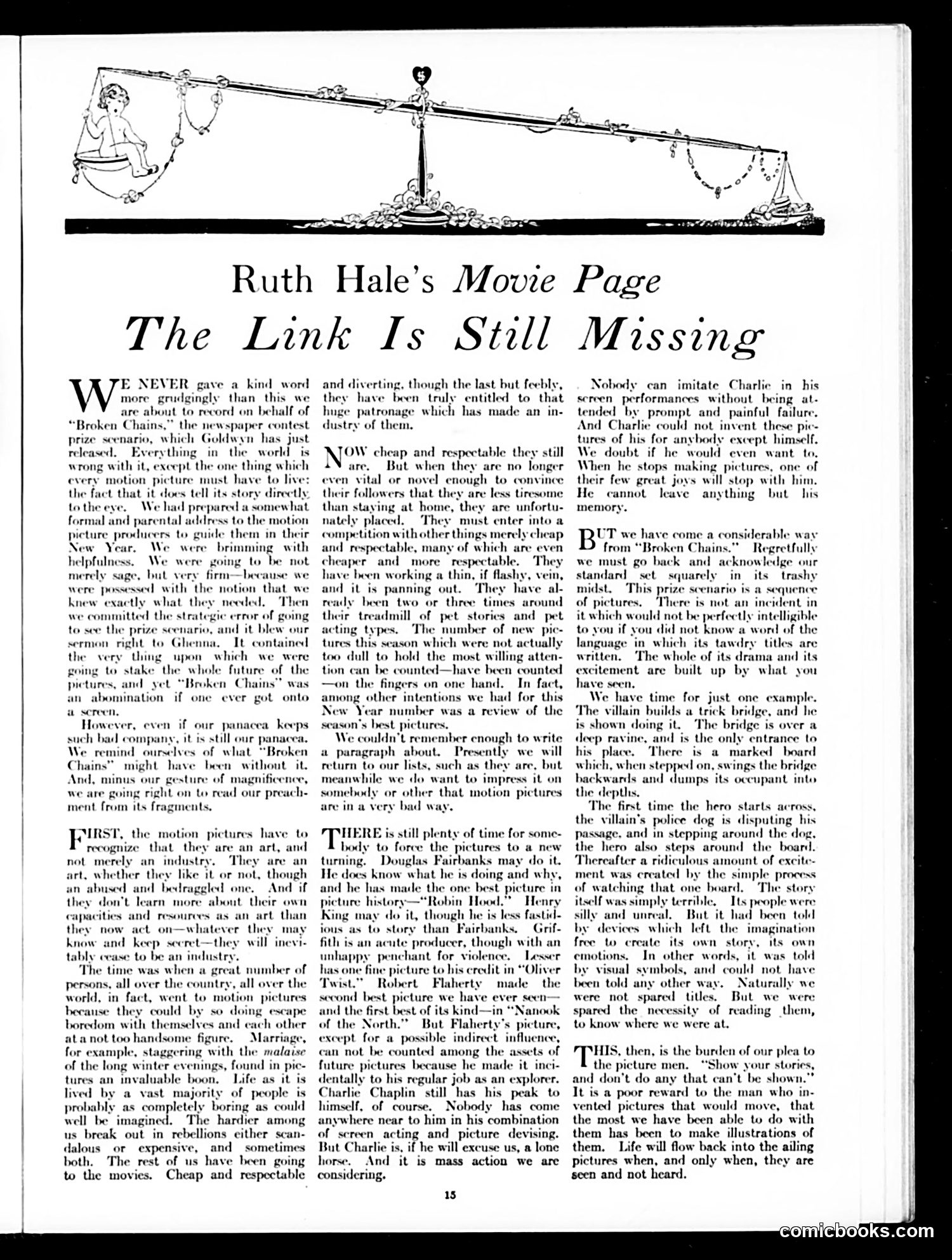
This is film criticism by Ruth Hale, a prominent 1920s journalist and satirist. She reviews *Broken Chains*, a Goldwyn Studio scenario (screenplay) from a newspaper contest. **The Satire's Point:** Hale praises the film's visual storytelling while condemning its narrative quality. She argues motion pictures have become creatively exhausted—recycling the same plot formulas and star types repeatedly. The "link" of originality is missing. **Key References:** She mentions Douglas Fairbanks's *Robin Hood* as an example of superior filmmaking, and criticizes directors like D.W. Griffith (for violence) while acknowledging his talent. She notes that films once offered escape from mundane life, but now compete unsuccessfully against cheaper entertainment. **Context:** This reflects 1920s concerns about Hollywood's artistic legitimacy—whether movies were genuine art or mere commercial product. Hale's critique targets industry complacency and formulaic storytelling.
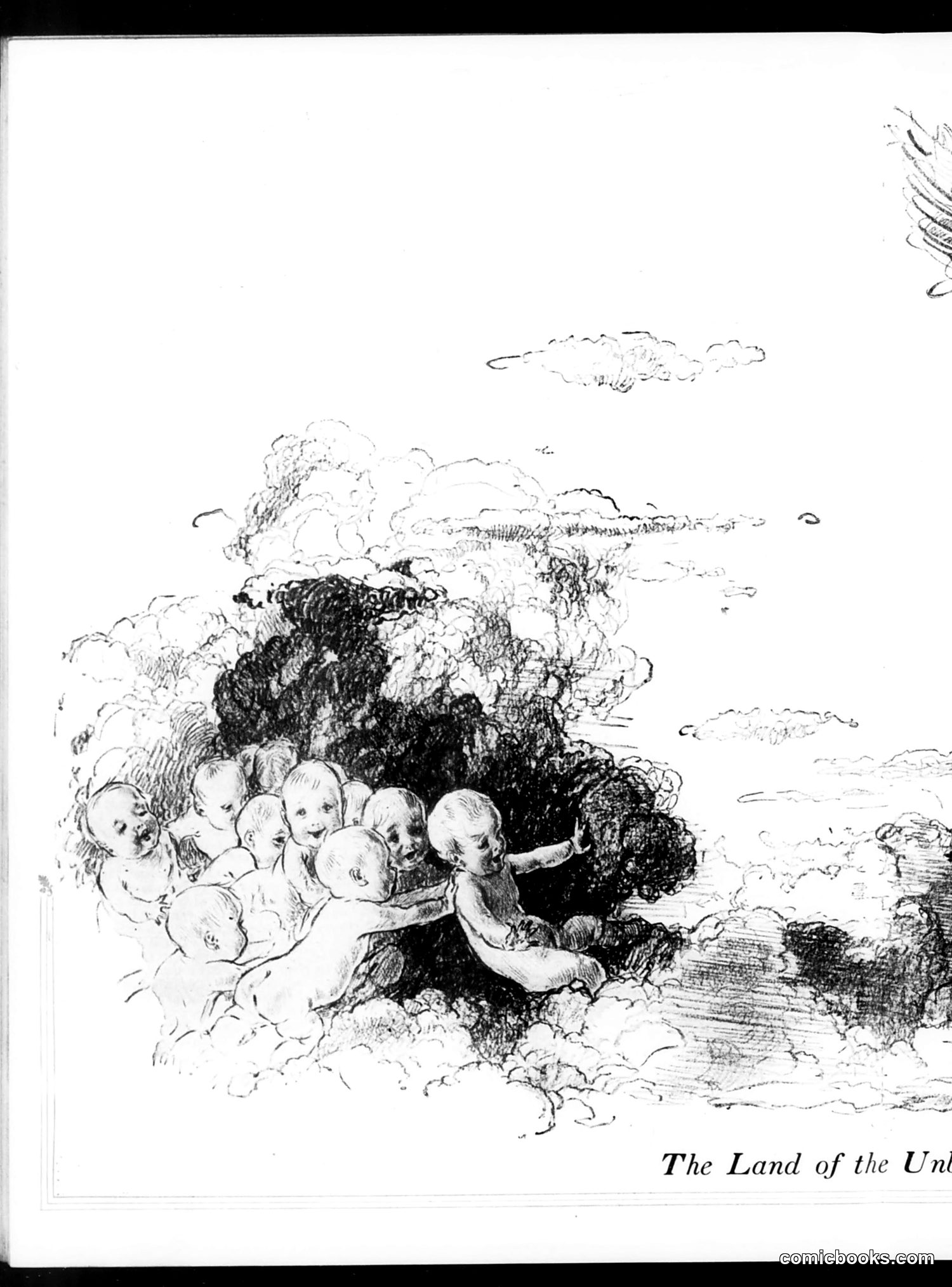
This illustration depicts a group of cherubic infants or putti gathered around what appears to be a dark, shadowy figure or mass in clouds. The title "The Land of the Uni[verse]" (text cut off) suggests a fantastical or allegorical scene. The exact satirical meaning is unclear without the complete text and additional context. The image could reference: - An imaginary realm or utopian fantasy - A commentary on innocence versus corruption (light cherubs versus dark center) - A mythological or literary allusion popular with Judge's readers The style and cherub imagery suggest this is likely from Judge's more whimsical or fairy-tale inspired satirical content, but without seeing the full caption and surrounding material, I cannot definitively identify the specific political or social target of the satire.
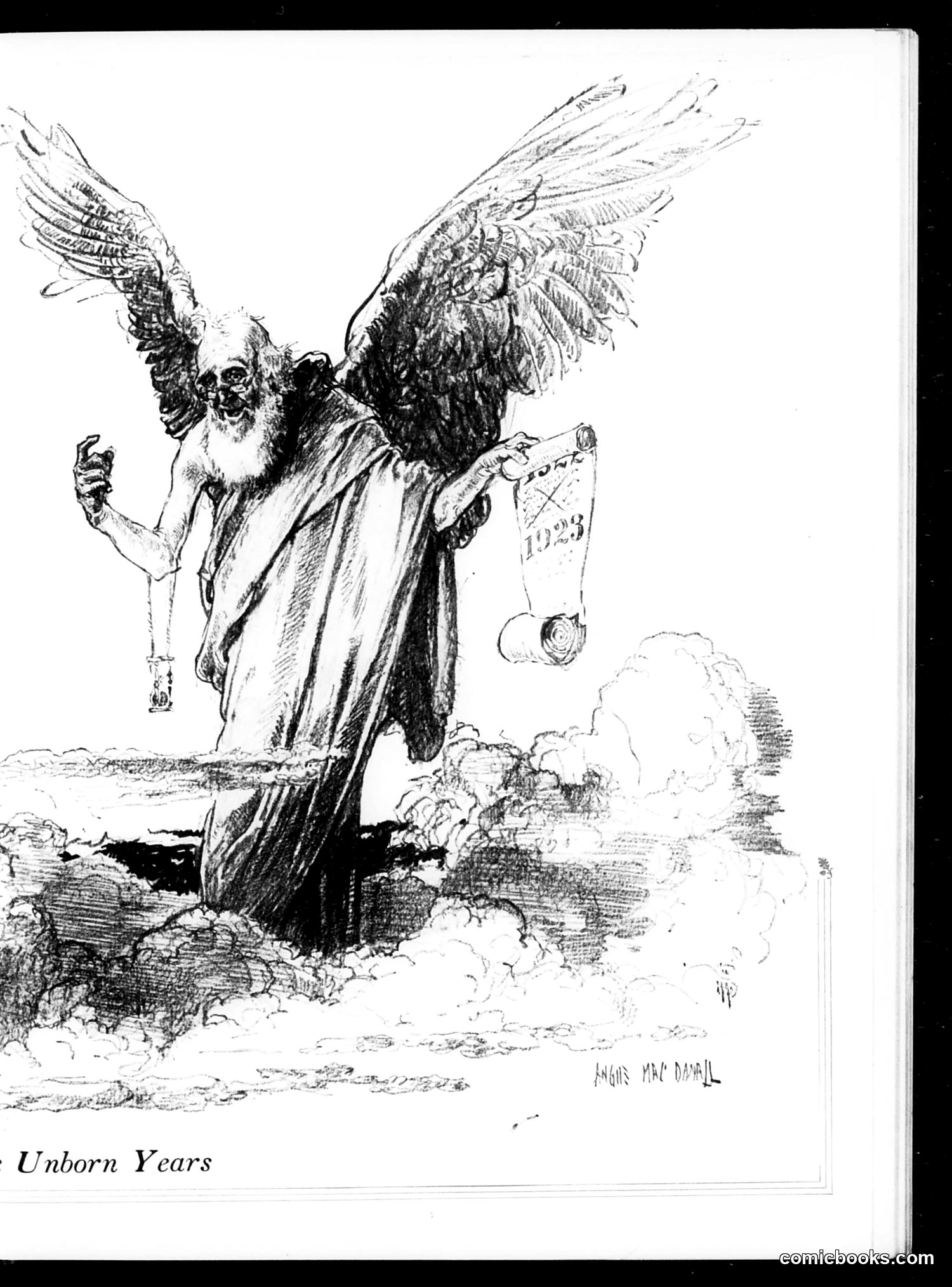
This is a satirical illustration titled "Unborn Years" depicting an angelic or allegorical figure with large wings, wearing flowing robes and holding what appears to be a calendar or document marked "1923." The figure stands among clouds and rocky terrain, suggesting a heavenly or otherworldly setting. The satire likely comments on anticipation or anxiety about the future—specifically the year 1923 and what it might bring. The winged messenger figure traditionally represents fate, hope, or destiny in political cartooning. Without additional context about Judge magazine's 1922 publication date and contemporary events, the specific political or social critique remains unclear, though it appears to express uncertainty or foreboding about the coming year.
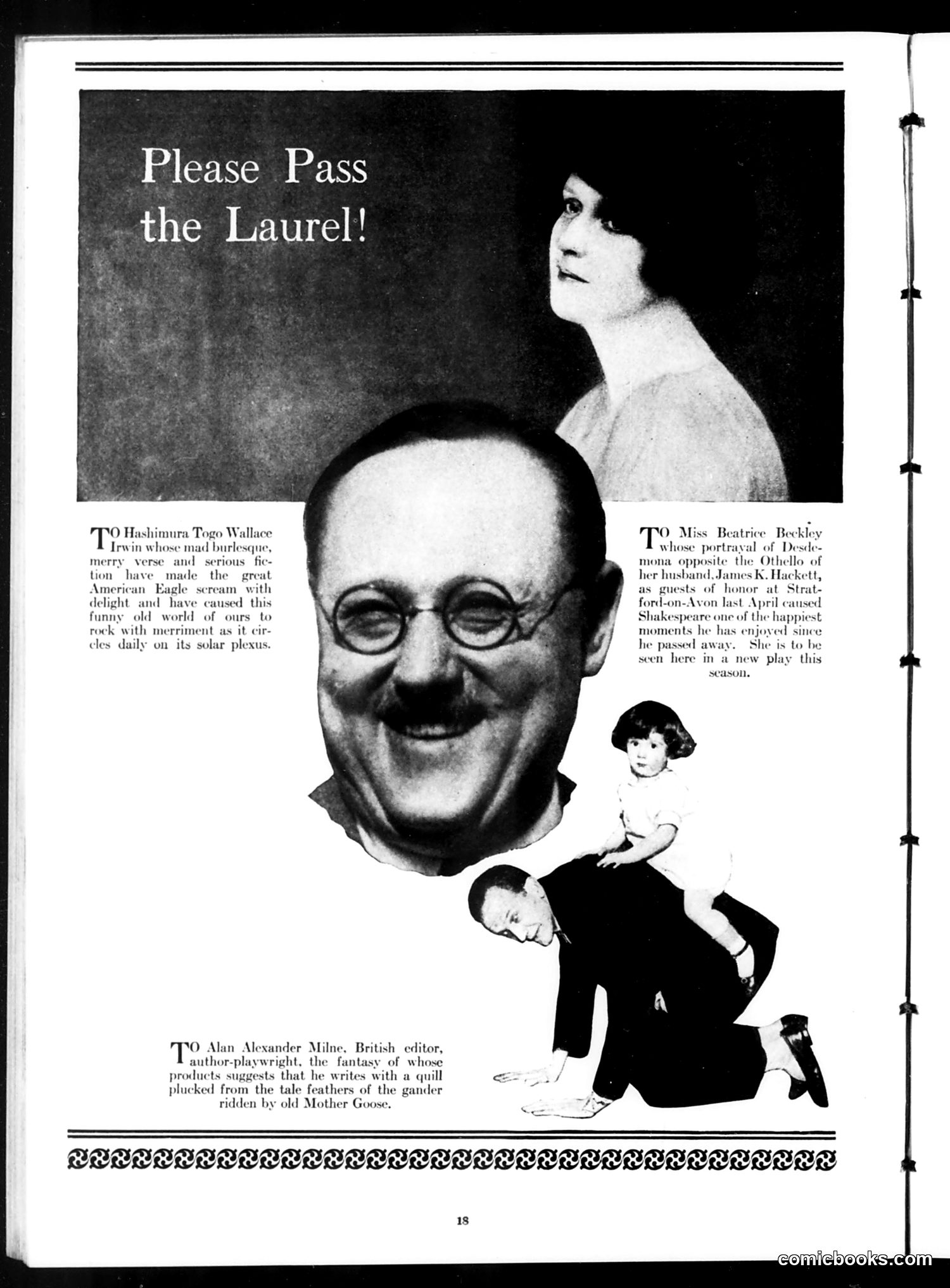
This page humorously awards "laurels" (honors) to three figures in theater and literature: **Hashimura Togo Wallace Irwin**: A writer whose comedic verse and fiction made "the great American Eagle scream with delight"—satire praising his humor's widespread appeal. **Miss Beatrice Beckley**: An actress praised for playing Desdemona opposite her husband James K. Hackett's Othello at Stratford-on-Avon, with the joke that Shakespeare himself would be delighted by her performance if he were alive. **Alan Alexander Milne**: A British editor and playwright mocked for writing whimsical fantasy—the satire suggests his imaginative work is so fanciful it's as if written with a feather from the goose ridden by Mother Goose. The page's framing device—"Please Pass the Laurel!"—treats theatrical and literary achievement with playful mock-seriousness, awarding prestige while gently ribbing each honoree's particular style or pretensions. The central caricatured head suggests a dignified judge overseeing these accolades.
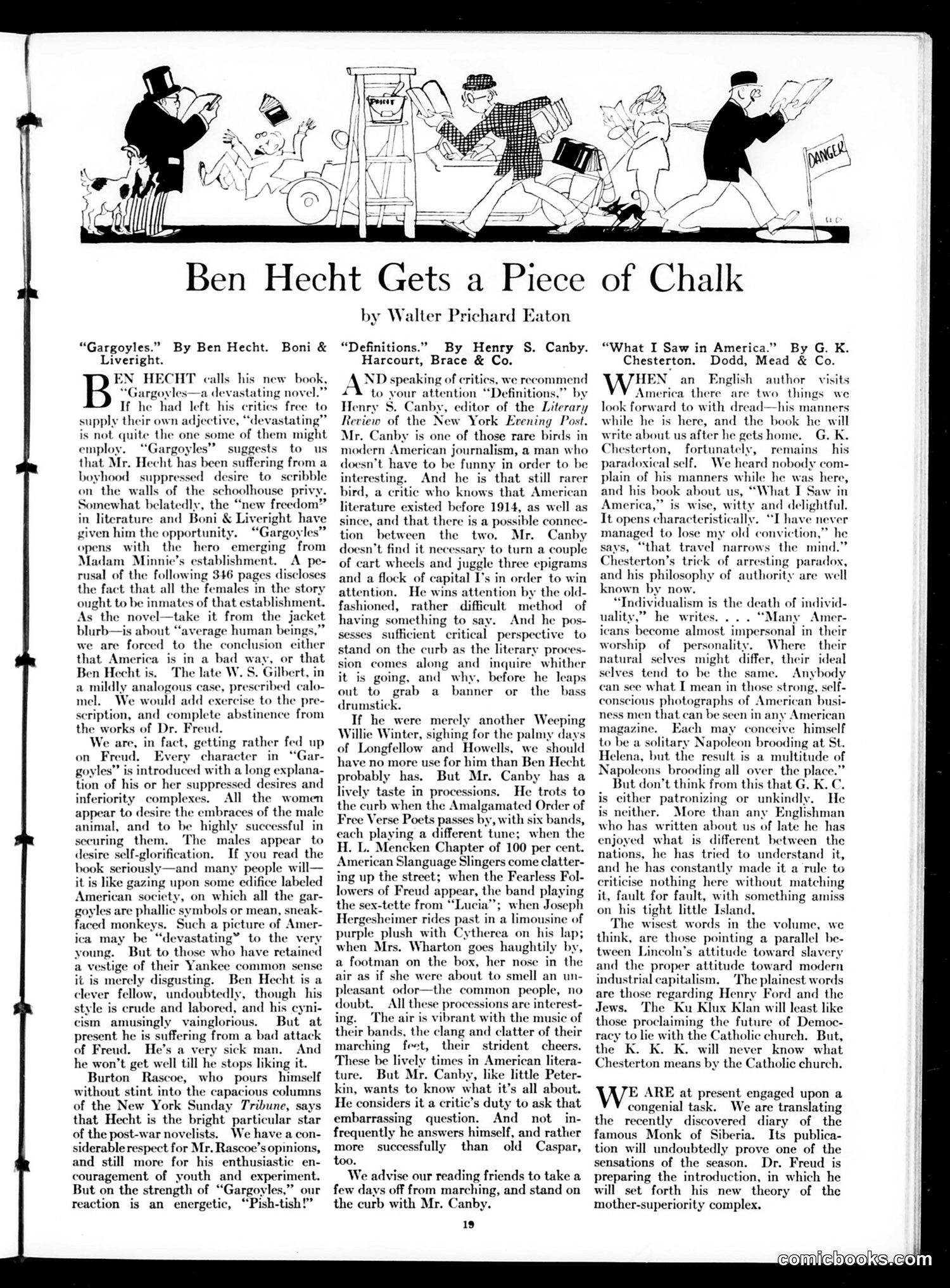
This page reviews two books by literary critic Walter Prichard Eaton. The cartoon header depicts various literary figures engaged in chaotic activity. **Main Content:** The reviewer savagely critiques Ben Hecht's novel *Gargoyles*, claiming it's obsessed with Freudian psychology and sexual content. Eaton suggests Hecht is immature—comparing him to someone scribbling in schoolhouse bathrooms—and that the book is essentially populated by prostitutes. He dismisses Hecht's work as "devastatingly" bad (sarcastically using critics' own praise against him) and attributes the novel's problems to excessive influence from Freud. Notably, he praises Burton Rascoe for encouraging young writers, but rejects Rascoe's championing of Hecht. By contrast, Eaton praises Henry S. Canby's *Definitions*, celebrating Canby as a rare thoughtful critic who doesn't rely on cheap tricks or nostalgia, and who appreciates literary innovation while understanding pre-1914 American literature. **Context:** This reflects 1920s literary debates about modernism, Freudianism, and whether new experimental writing represented progress or adolescent indulgence.
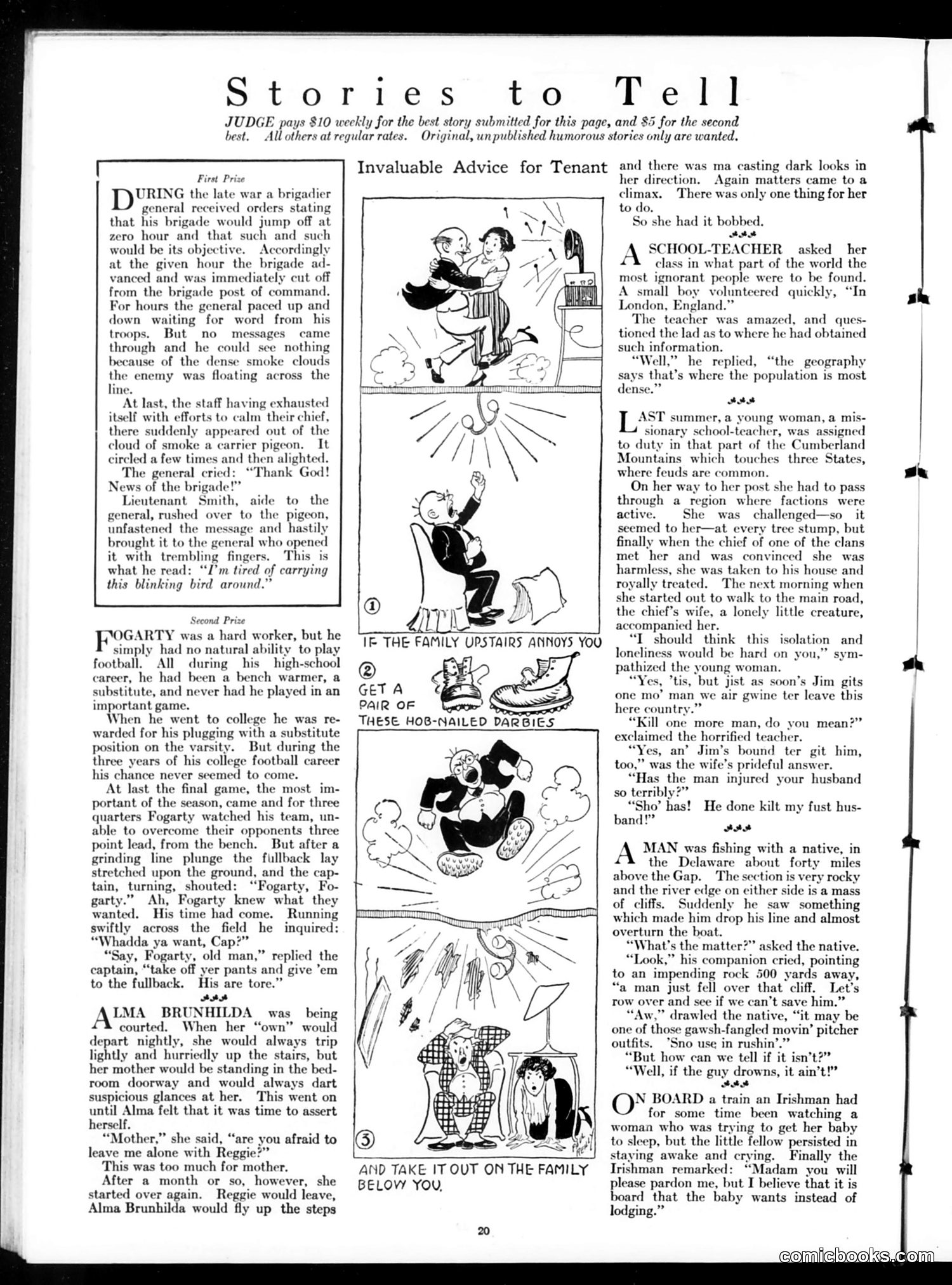
This page from Judge magazine features a **humor story competition** offering $10 for the best submission. The content consists of five short comedic anecdotes: 1. **WWI General's Pigeon**: A soldier delivers a message from a carrier pigeon complaining about being transported—satirizing the chaos and absurdity of wartime communication. 2. **Fogarty's Football Glory**: A substitute player finally gets field time, only to be asked to donate his pants to replace a fullback's torn ones—mocking athletic team culture and misplaced expectations. 3. **Alma Brunhilda's Courtship**: A girl's suspicious mother monitors her suitor visits until Alma dramatically solves the problem by cutting her hair short (bobbing was a rebellious 1920s trend)—poking fun at generational conflict over courtship propriety. 4. **Geography Lesson**: A student defines "most ignorant people" as Londoners because of "dense population"—simple wordplay humor. 5. **Missionary in the Mountains**: A brief tale of a teacher navigating feuding Appalachian clans—appears incomplete. The illustrations are simple line drawings accompanying each story. This represents typical early-20th-century Judge content: light, domestic satire targeting social conventions and everyday mishaps.
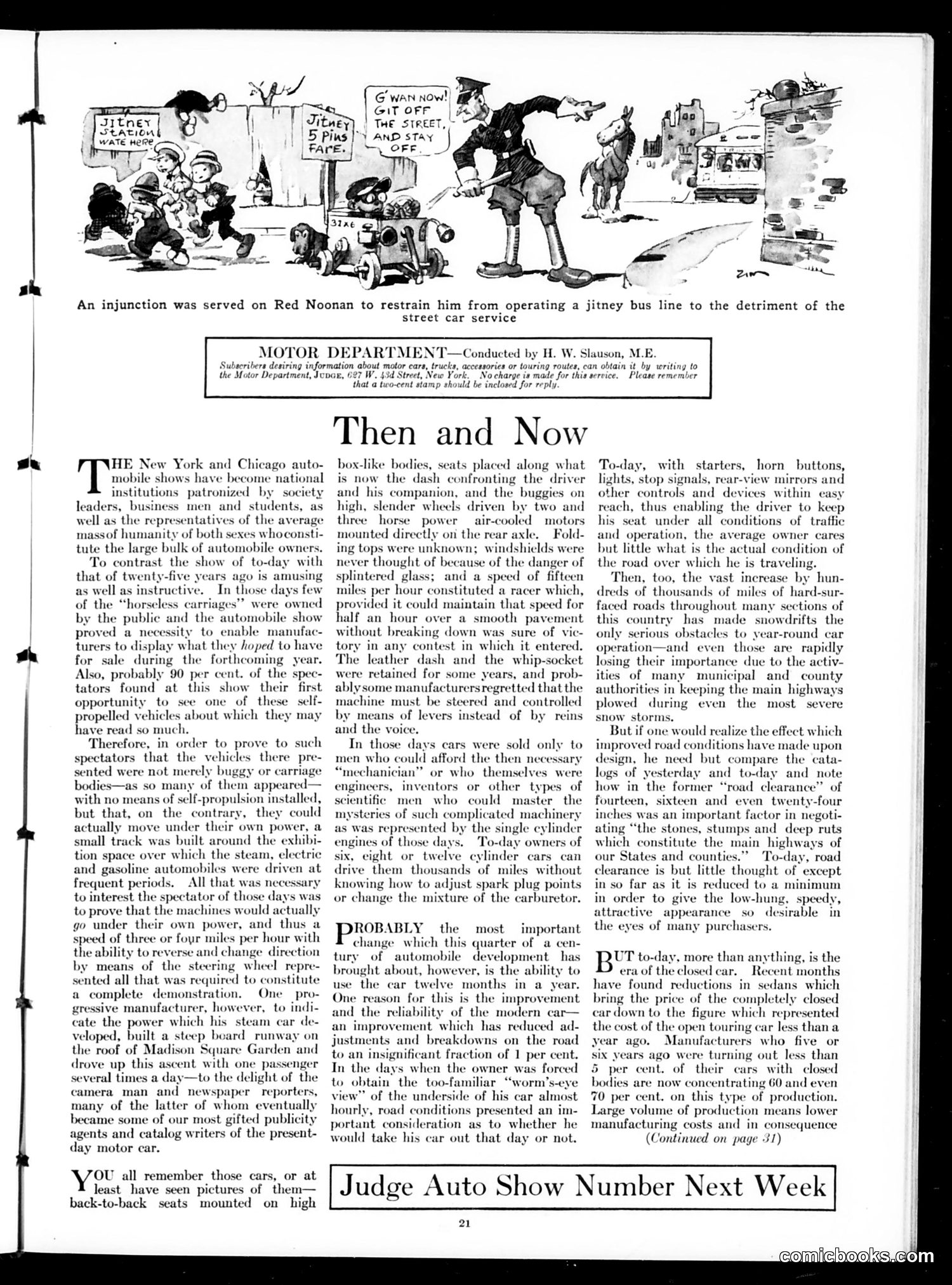
The top cartoon satirizes **Red Noonan**, who operated a "jitney bus" line—an early informal transit service using small vehicles. An injunction (court order) was served against him because his cheaper service undercut the established street car monopoly. The cartoon mocks this legal action, showing Noonan being chased off the street while passengers and operators of traditional street cars celebrate protecting their business interests. The accompanying article contrasts early automobiles (circa 1900s) with modern cars (1920s). Early cars were: - Box-like, high-wheeled contraptions requiring mechanical expertise - Capable of only 15 mph - Operated by wealthy engineers and inventors - Displayed at shows with demonstration tracks Modern cars feature: - Starters, mirrors, controls - Reliable performance - Mass production making them affordable - Easy operation for ordinary drivers The satire celebrates automotive progress while the cartoon critiques how established industries use legal means to suppress competition.
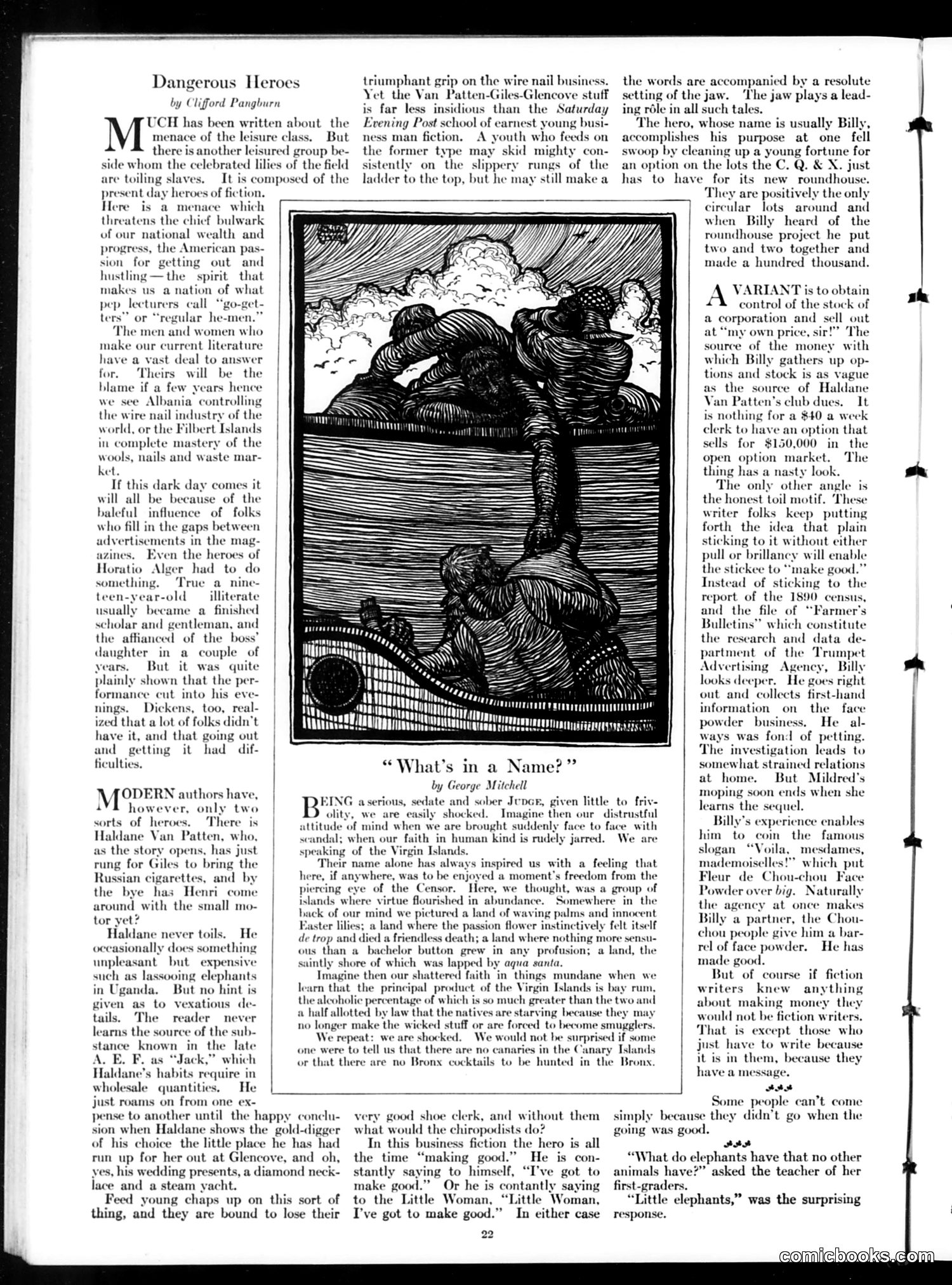
This article satirizes popular business fiction in magazines like the *Saturday Evening Post*, particularly stories featuring young protagonists named "Billy" who achieve sudden wealth through minimal effort—acquiring stock options or corporate control and selling at profit. The author, Clifford Pangburn, critiques these narratives as dangerous because they glorify get-rich-quick schemes rather than honest work, contrasting them with older literature (Horatio Alger, Dickens) that showed success required actual effort. He worries such fiction promotes laziness among readers and threatens American competitiveness, sarcastically warning that if Americans stop hustling, nations like Albania will dominate industries like wire nails. The accompanying illustration depicts what appears to be a heroic businessman figure, likely mocking the idealized "he-man" protagonist of such fiction. The satire targets both lazy fiction-writing and the unrealistic fantasies sold to impressionable readers.
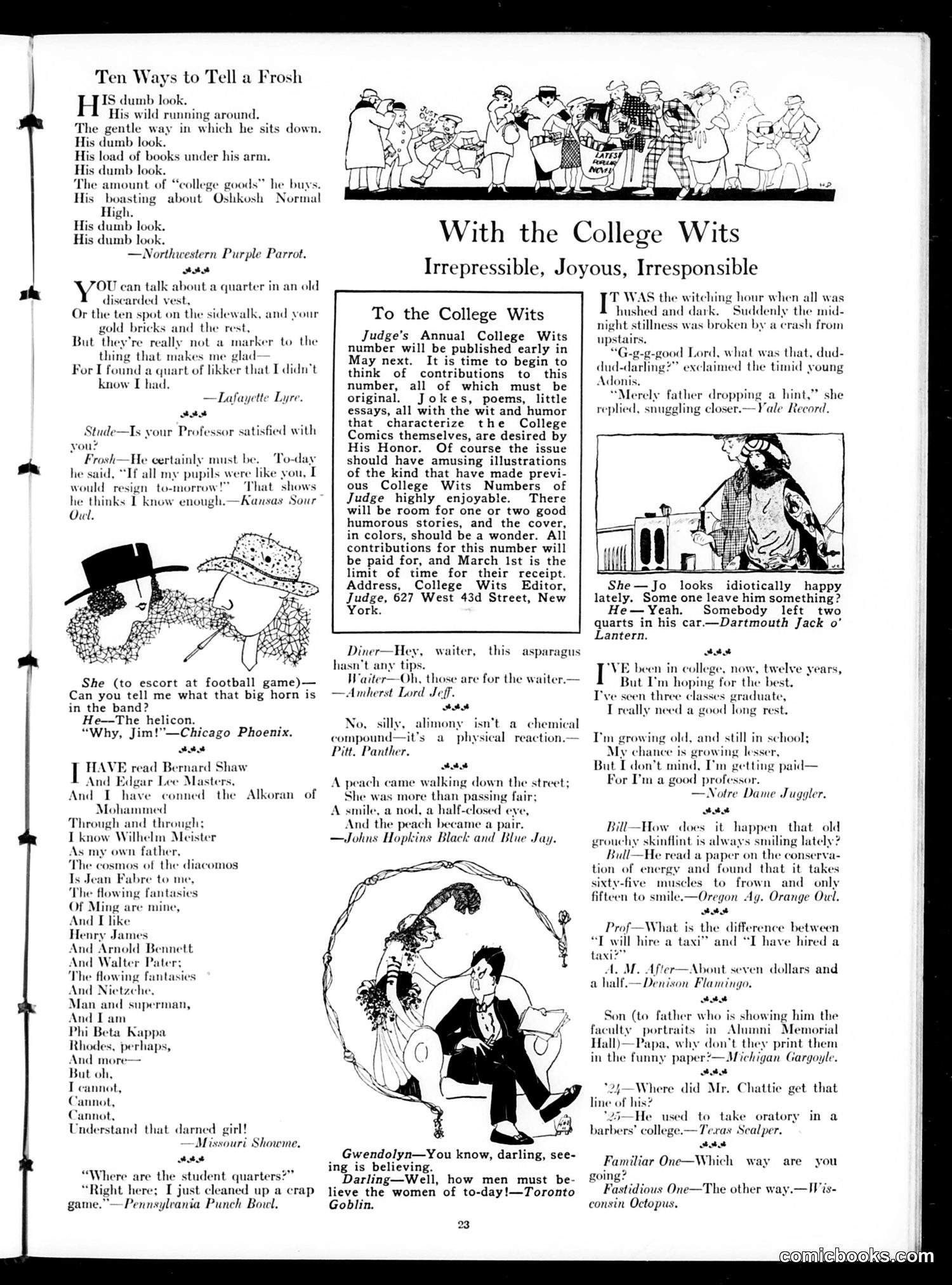
This page from *Judge* satirizes college life, particularly targeting freshmen ("frosh"). The left column repeatedly mocks freshman stereotypes—their "dumb look," wild behavior, and naïveté—through quips sourced from college newspapers like *Northwestern Purple Parrot* and *Lafayette Lyre*. The right side features the "College Wits" section, showcasing brief jokes and witticisms from various colleges. These include campus humor about prohibition-era drinking ("quarts in his car"), romantic encounters, and academic absurdities. One recurring joke plays on a student's inability to understand women despite mastering complex philosophy—a dig at male pretentiousness. The illustrations depict typical college scenarios: formal social gatherings and a couple in a romantic moment. Overall, the page mocks freshman foolishness and collegiate pretension through lighthearted banter that would have resonated with contemporary college readers and their families.
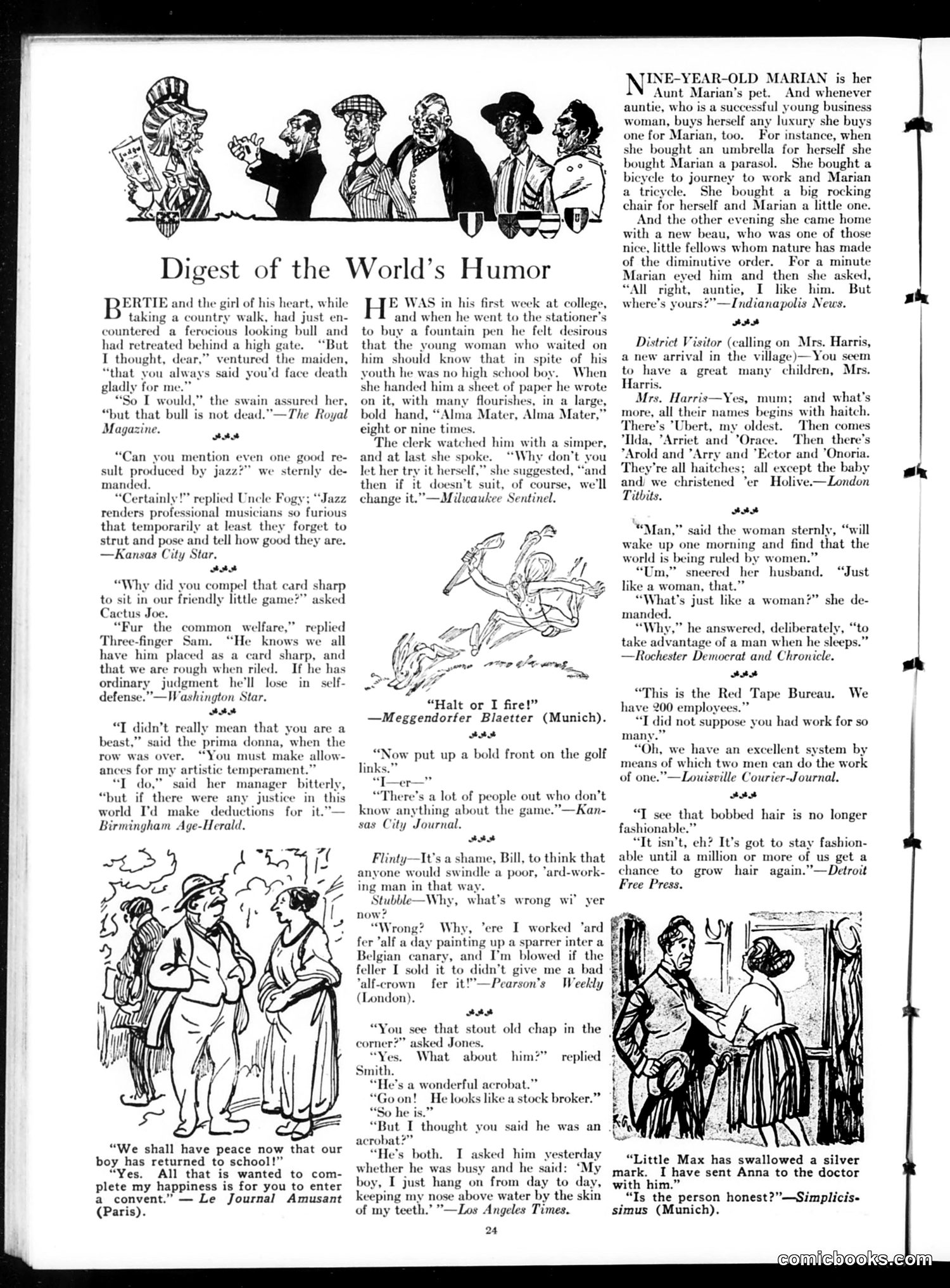
This page collects short humorous anecdotes and jokes from various international publications, typical of Judge's "Digest of the World's Humor" feature. **Key jokes include:** - A cowardly suitor claims he'd face death, then hides behind a gate from a bull - Jazz music's only benefit is making professional musicians too angry to brag - A card sharp is invited to a poker game so his known cheating will cause him to lose through self-defense - A nine-year-old girl expects her aunt to provide a matching "beau" for herself, mirroring how her aunt buys her duplicate luxury items - A college boy shows off penmanship to impress a stationer's clerk - A woman warns her husband that women will soon rule the world; he dismissively agrees, calling it "just like a woman" The cartoons satirize human vanity, social pretension, and gender dynamics. The humor relies on ironic reversals and observations of everyday behavior—typical of early 20th-century periodical satire. No specific political figures or events are referenced.
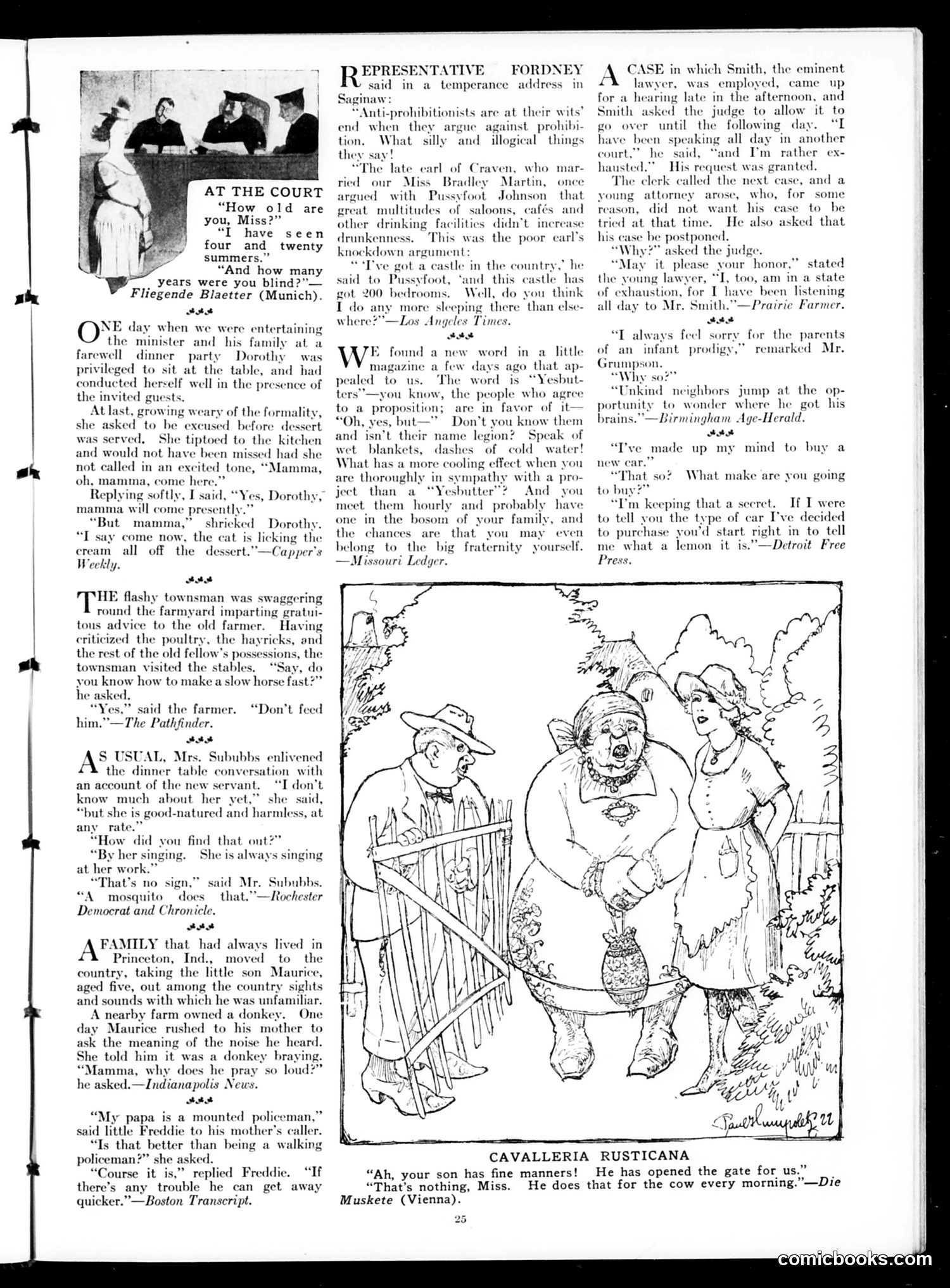
This page contains several brief humorous anecdotes typical of early 20th-century American satirical magazines, plus one political reference and a cartoon. **Political Content:** Representative Fordney delivers a temperance speech in Saginaw, mocking anti-prohibition arguments as "silly and illogical." The anecdote about the Earl of Craven (a real historical figure) suggests that even aristocrats with abundant resources can't escape social problems—here, the implication that multiple bedrooms don't reduce drunkenness, undercutting anti-prohibition logic. **The Cartoon (bottom):** Titled "Cavalleria Rusticana," it depicts a portly man at a gate with two women, illustrating a joke about fine manners and cow-tending—likely a reference to the famous opera. **Other Content:** Domestic humor anecdotes about children, servants, and rural life—typical filler material mocking middle-class pretension and miscommunication. The page reflects early Prohibition-era debates and genteel American humor conventions of the period.
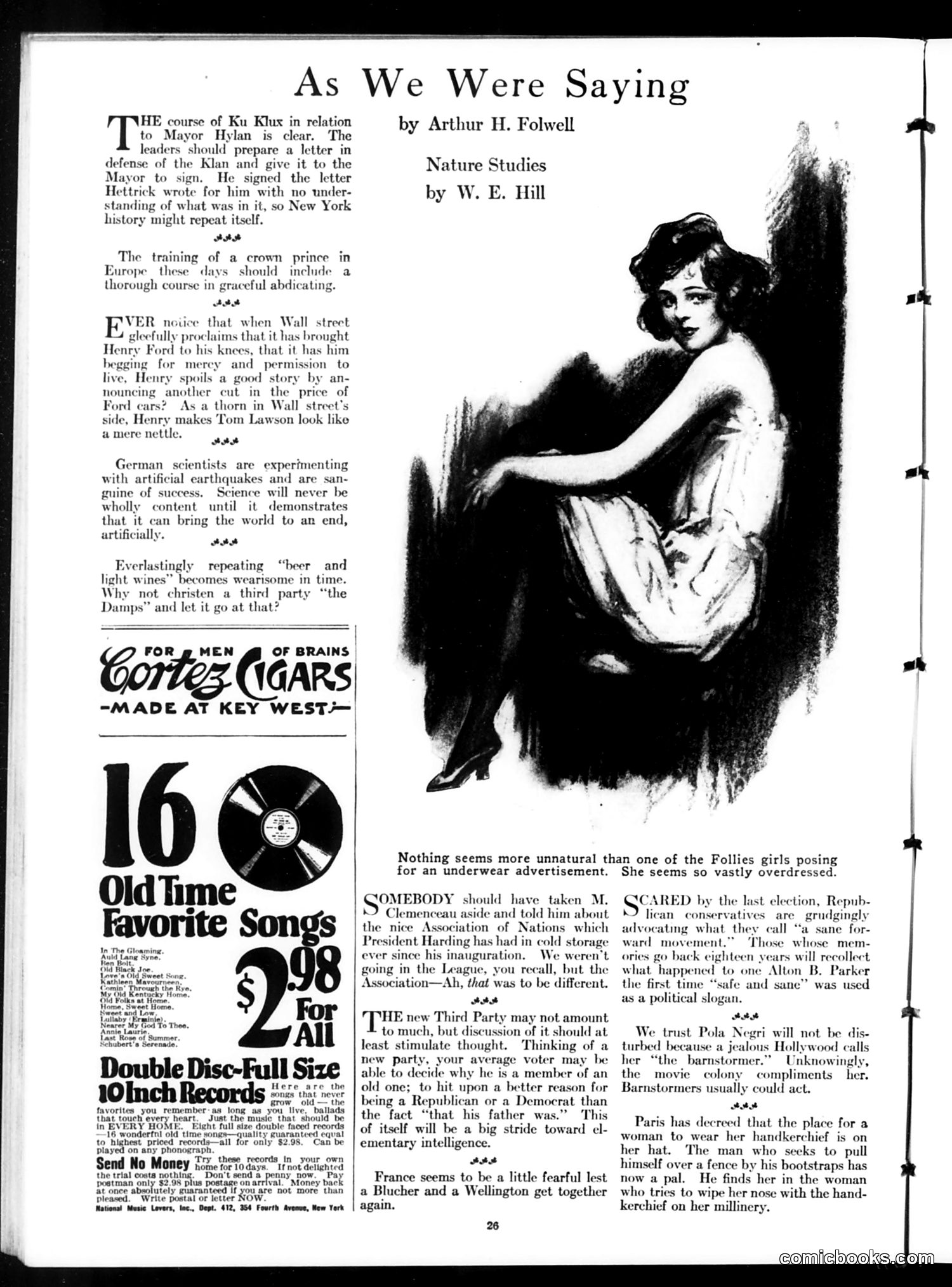
This page from Judge contains political and social commentary typical of the 1920s. Key observations: **Political References:** - **Ku Klux Klan**: The opening condemns Mayor Hylan for signing a letter defending the KKK without understanding its contents—satirizing political corruption. - **Henry Ford**: Commentary on Ford's price cuts despite Wall Street's claims of bringing him to heel, positioning him as a thorn in Wall Street's side. - **Third Party politics**: Discusses a new political party's potential to make voters reconsider party loyalty beyond inheriting their parents' affiliation. - **Republican "Safe and Sane" movement**: References conservatives' post-election rebranding, comparing it unfavorably to Alton B. Parker's failed 1904 presidential campaign. **Social Commentary:** The W.E. Hill illustration satirizes Follies showgirls posing for underwear ads while appearing overdressed—the irony being their theatrical costume contradicts the advertisement's purpose. Additional items mock Clemenceau's League of Nations alternative, French anxiety about revanchist powers, and absurd fashion trends.
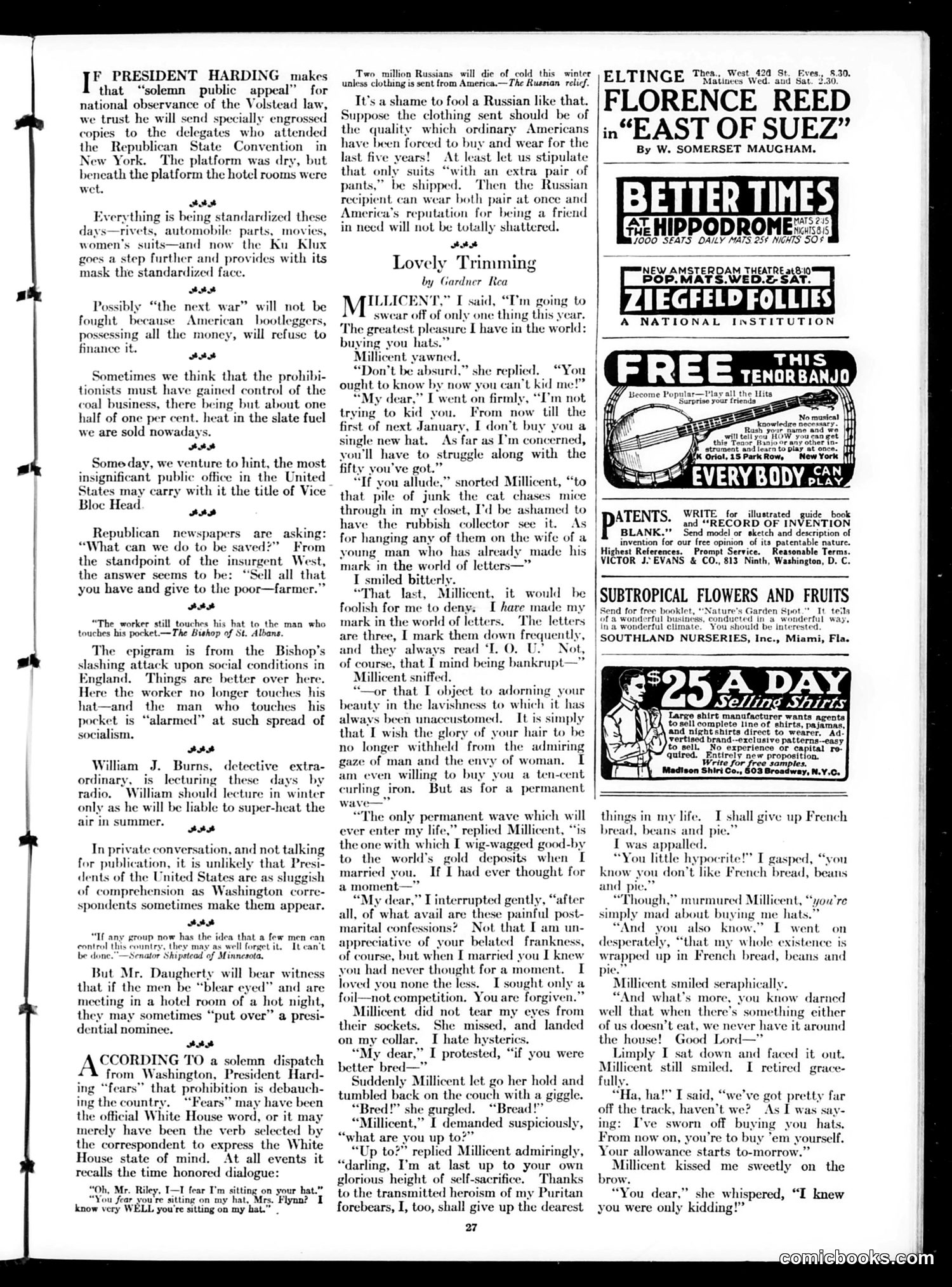
This page from Judge magazine contains political satire targeting President Harding's administration circa the early 1920s. The main editorial attacks focus on **Prohibition hypocrisy**: Harding publicly urged observance of the Volstead Act (Prohibition law), yet Republican Party delegates at New York's convention drank openly in hotel rooms—mocking the administration's dry platform while remaining wet in practice. Other satirical jabs include: - **The KKK**: criticizing the organization's standardization of ideology and appearance - **Bootleggers**: joking that wealthy American liquor smugglers might refuse to finance the next war - **Coal quality**: sarcastically suggesting prohibitionists control the coal industry, given how little heat poor-quality slate fuel provides - **Class dynamics**: contrasting worker deference to the wealthy with wealthy alarm at "socialism" A final editorial criticizes Attorney General Daugherty's ability to manipulate conventions behind closed doors ("put over" a presidential nominee) despite official rhetoric about democratic process. The page is primarily editorial commentary with accompanying advertisements, not comic strips.
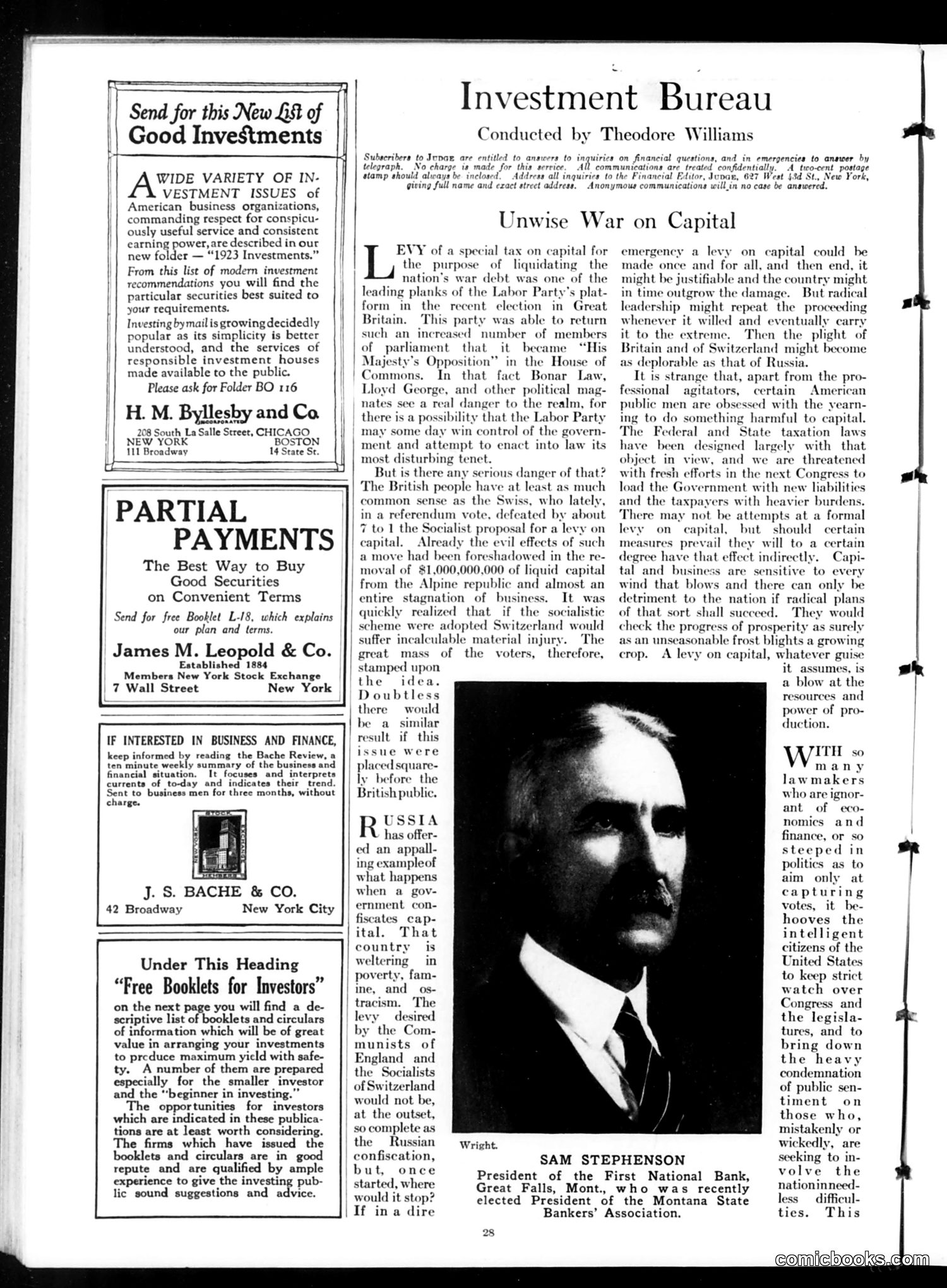
This page is primarily **financial advertising** for investment firms (Byllesby, Leopold, Bache), not political satire. However, the main editorial article addresses a genuine 1920s political controversy. **The Content:** "Unwise War on Capital" warns against the British Labour Party's proposal for a capital tax to pay war debts. The author argues such a tax would be economically destructive, citing Switzerland's recent rejection of a similar socialist proposal (by 7-to-1 vote). The article features a portrait of **Sam Stephenson**, president of First National Bank in Great Falls, Montana, representing the conservative business establishment opposing the tax. **The Political Context:** Post-WWI Britain saw Labour's electoral gains in 1923, alarming business interests who feared radical wealth redistribution. The Swiss referendum comparison emphasizes that even democratic voters rejected such measures. **The Satire/Point:** This isn't satirical—it's straightforward ideological argument: capital taxes threaten prosperity and will be rejected by sensible voters. The juxtaposition of investment ads with anti-tax advocacy reflects *Judge* magazine's pro-business stance during the 1920s.
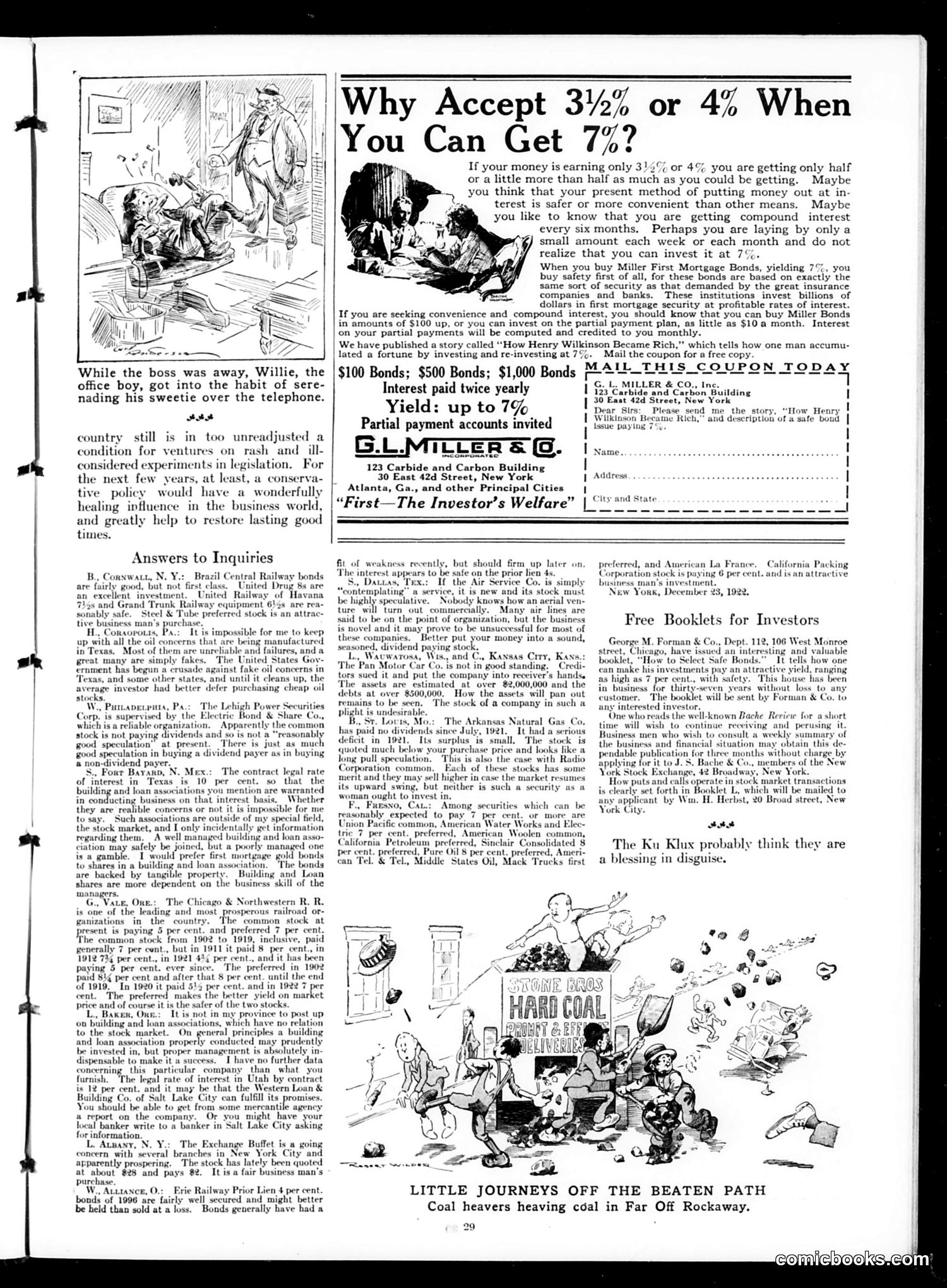
This page contains investment advertising mixed with financial advice columns. The main cartoon shows "Willie," an office boy, using the telephone to serenade his girlfriend while the boss is away—a satirical jab at workplace time-wasting and employee dishonesty during the early 20th century. The dominant content is a S.L. Miller & Co. advertisement promoting first mortgage bonds yielding 7%, positioned against conventional savings accounts earning 3-4%. This reflects the 1920s investment boom when aggressive marketing pushed higher-yield securities. The ad's rhetoric about "safety" and "security" likely seems naive to modern readers aware of the financial crashes that followed in 1929. The bottom cartoon, "Little Journeys Off the Beaten Path," depicts coal "heavers" (laborers) in "Far Off Rockaway"—a satirical commentary on poor working conditions and economic hardship, contrasting sharply with the optimistic investment pitch above. The page represents the era's unbridled financial speculation and class inequality.
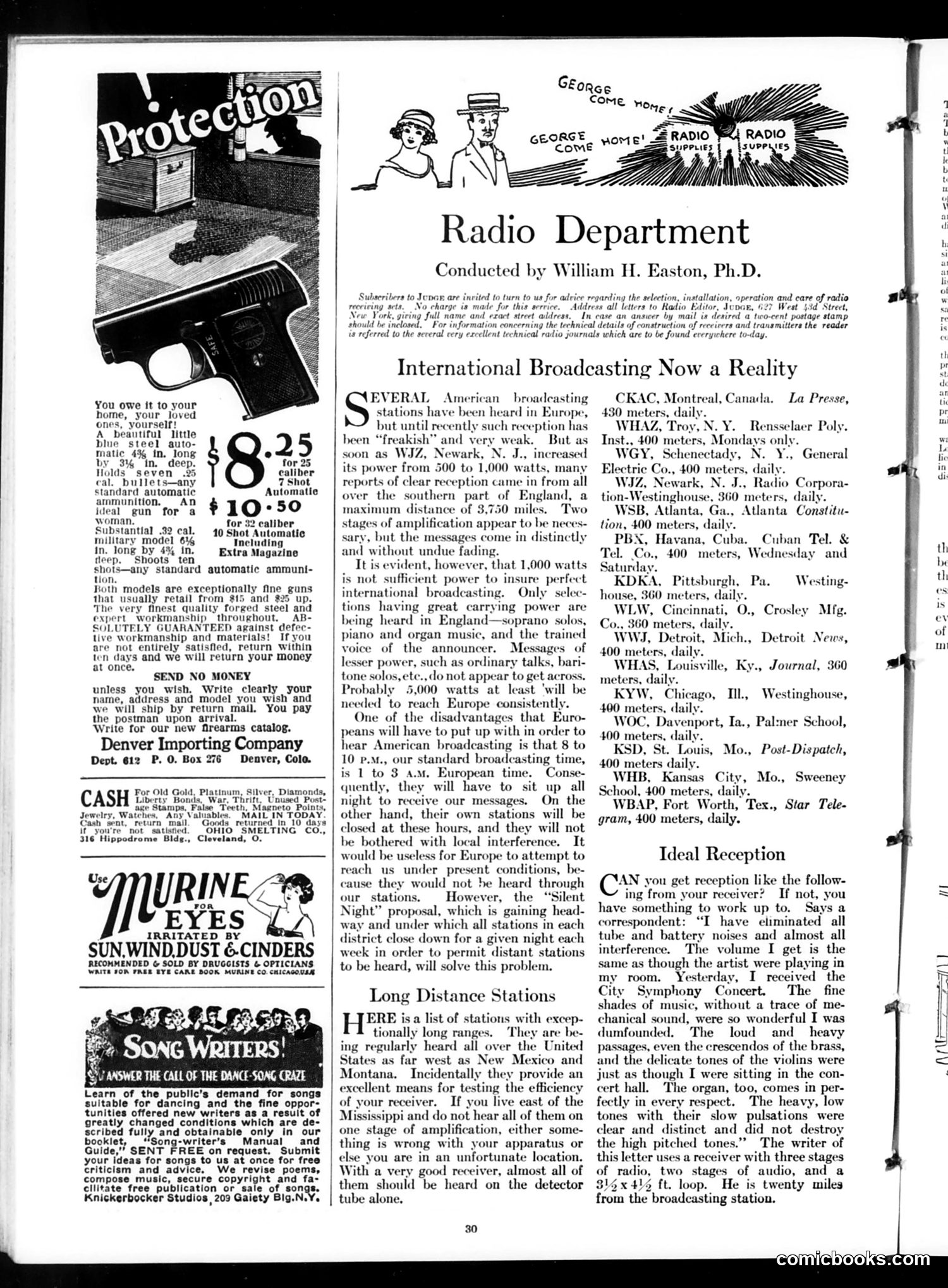
This is primarily a **radio department** column and advertisement page, not a political cartoon. The main content discusses early international radio broadcasting—a cutting-edge technology of the 1920s. The substantive article, "International Broadcasting Now a Reality," explains that American radio stations (like WJZ in Newark) have successfully broadcast across the Atlantic to England at distances up to 3,750 miles. However, the author notes that 1,000 watts is insufficient; 5,000 watts would be needed for consistent reception. Only powerful signals—soprano solos, organ music, trained announcers—carry across; ordinary speech doesn't. The practical challenge mentioned: American broadcasts at 8-10 p.m. (prime time) air at 1-5 a.m. European time, requiring European listeners to stay up all night. The page also contains typical period **advertisements** for firearms, eyeglasses, jewelry, and song-writing services—standard commercial filler in magazines of this era.
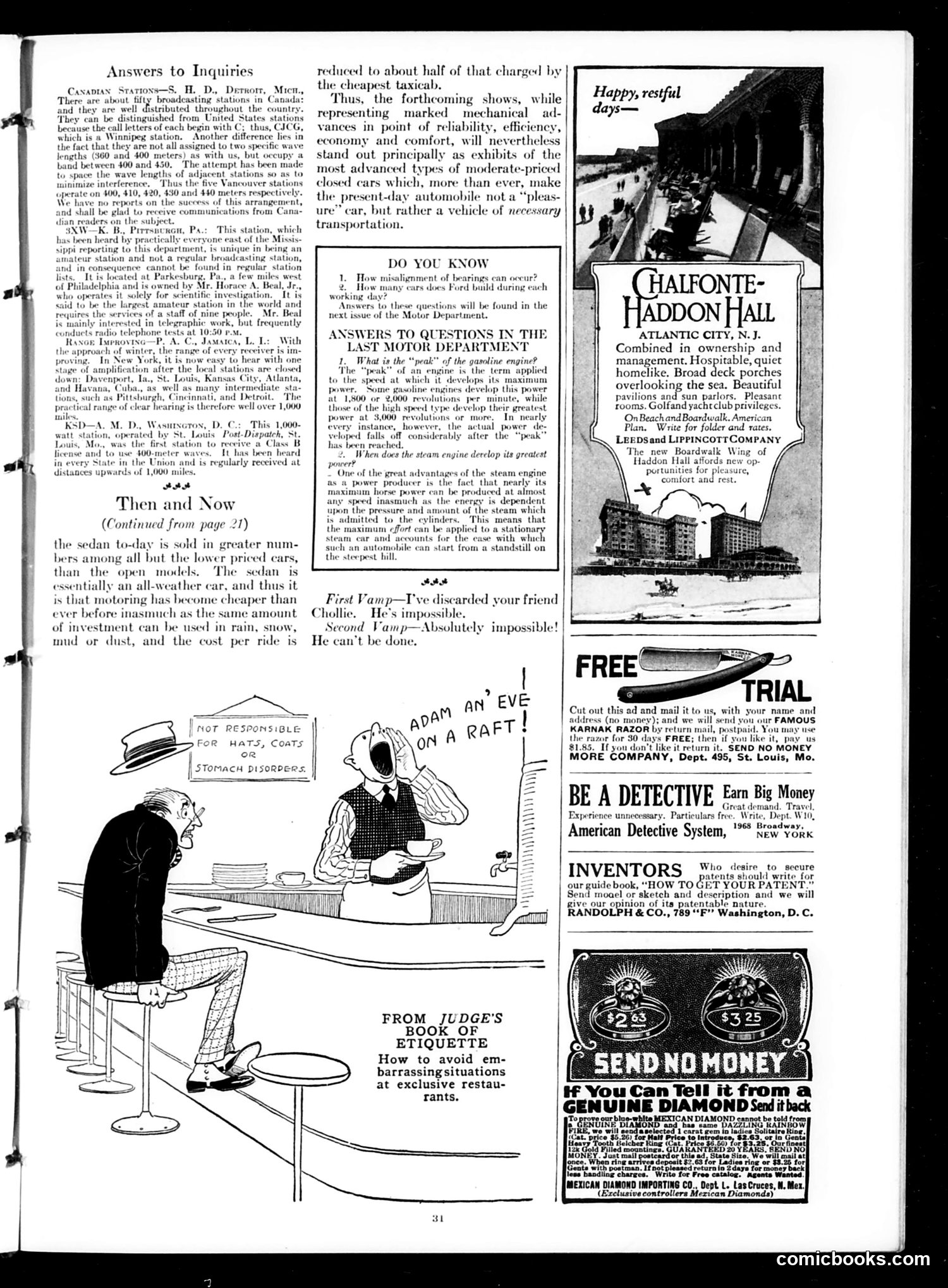
This page from Judge contains **mostly automotive and technical content** rather than political satire. The main cartoon depicts a dining etiquette situation: a man sits at a restaurant table while a waiter presents a large plate. The man appears uncomfortable or embarrassed. The caption references "Judge's Book of Etiquette" and addresses "How to avoid embarrassing situations at exclusive restaurants"—the humor likely concerns social awkwardness among diners unfamiliar with fine dining protocols. The page's bulk comprises an article titled "Then and Now," discussing how the automobile—specifically the sedan—has made personal transportation cheaper and more practical than taxis. It emphasizes reliability and affordability of modern closed cars. The remaining content is technical Q&A about automobile engines and radio broadcasting stations, plus various advertisements for products like razor trials, detective work opportunities, and diamond rings. **This is primarily an informational/advertising page rather than political commentary.** The cartoon's humor is purely social—mocking dinner etiquette confusion—rather than satirizing politics or public figures.
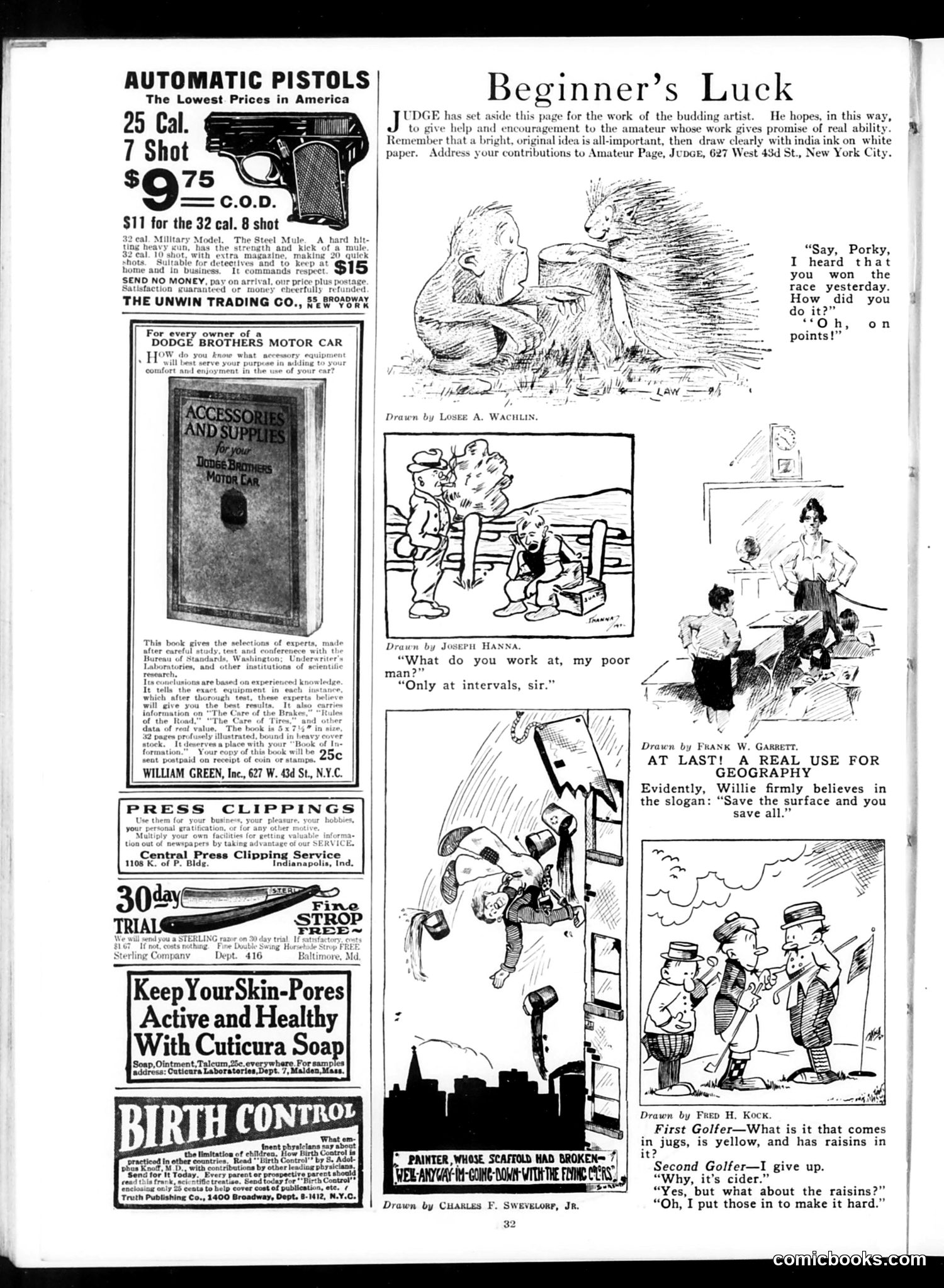
This page features several humorous cartoons typical of Judge's satirical humor: **Top cartoon (Wacklin):** A man explains his racing success to a friend named Porky, claiming it was pure luck—a play on beginner's fortune. **Hanna cartoon:** A wealthy man asks a poor laborer what he does for work; the man replies "only at intervals, sir"—satirizing unemployment or sporadic employment during economically uncertain times. **Garrett cartoon:** A boy named Willie uses a globe as a surface to save—a visual pun on the conservation slogan "save the surface and you save all," mocking children's literal interpretation of adult sayings. **Kock cartoon (bottom):** Two golfers discuss a riddle about cider with raisins. The punchline plays on "hard cider" (fermented/alcoholic cider)—the second golfer adds raisins to increase alcohol content, suggesting Prohibition-era drinking practices. The page also contains period advertisements (pistols, automobiles, birth control) reflecting early 20th-century consumer culture.
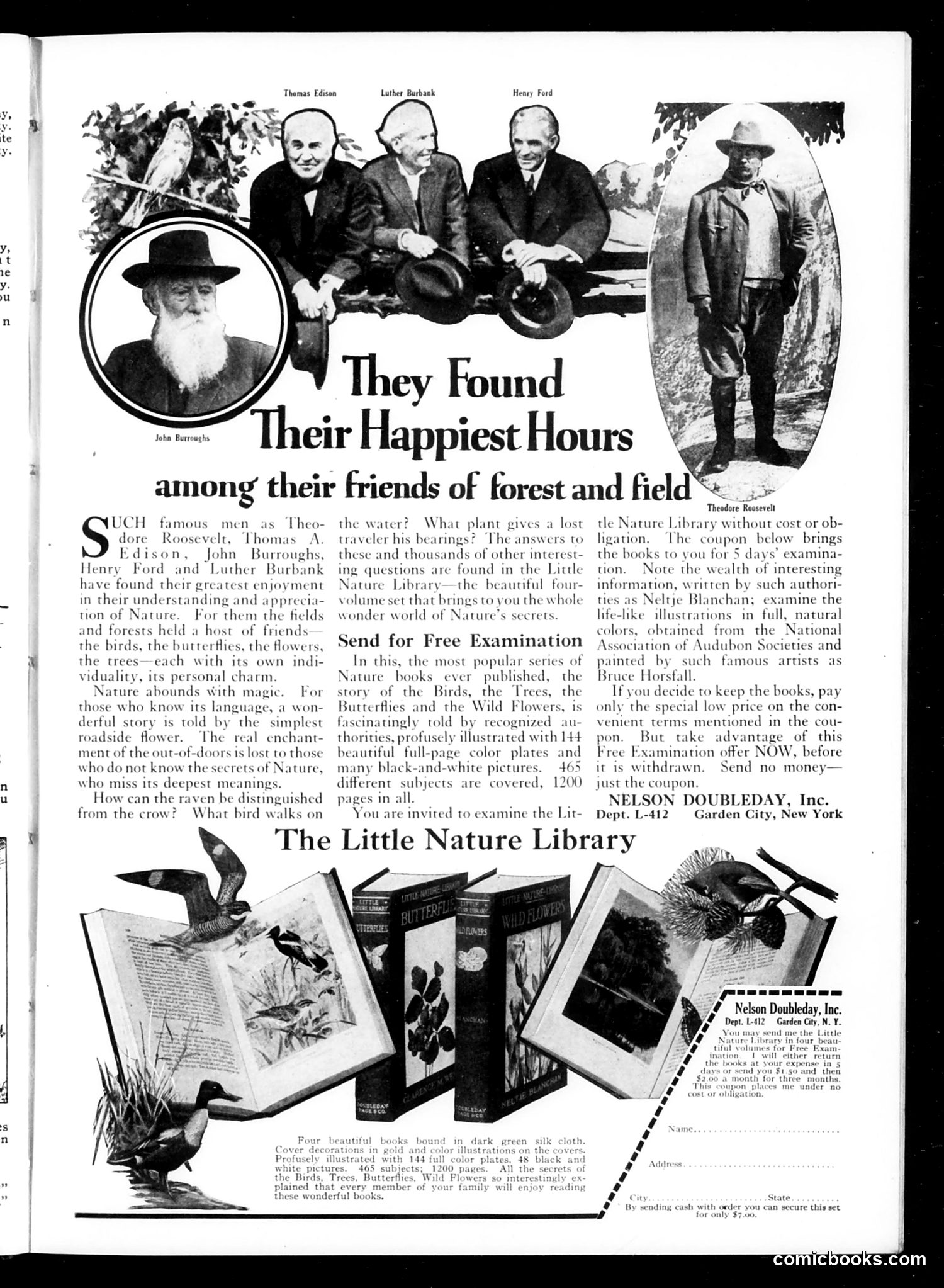
This is primarily an **advertisement** for "The Little Nature Library," a four-volume nature book set published by Nelson Doubleday. The marketing strategy uses celebrity endorsement: it features photographs of five famous men—Theodore Roosevelt, Thomas Edison, John Burroughs, Henry Ford, and Luther Burbank—claiming they found "their greatest enjoyment" in nature study. The appeal is aspirational: by purchasing these books, ordinary readers could supposedly achieve the same intellectual enrichment and happiness as these celebrated figures. The advertisement emphasizes the books' educational value (144 color plates, 465 subjects, 1,200 pages) and offers a free examination period with no money required upfront—a common mail-order tactic of the era. This reflects early 20th-century American enthusiasm for nature study as both education and leisure activity.
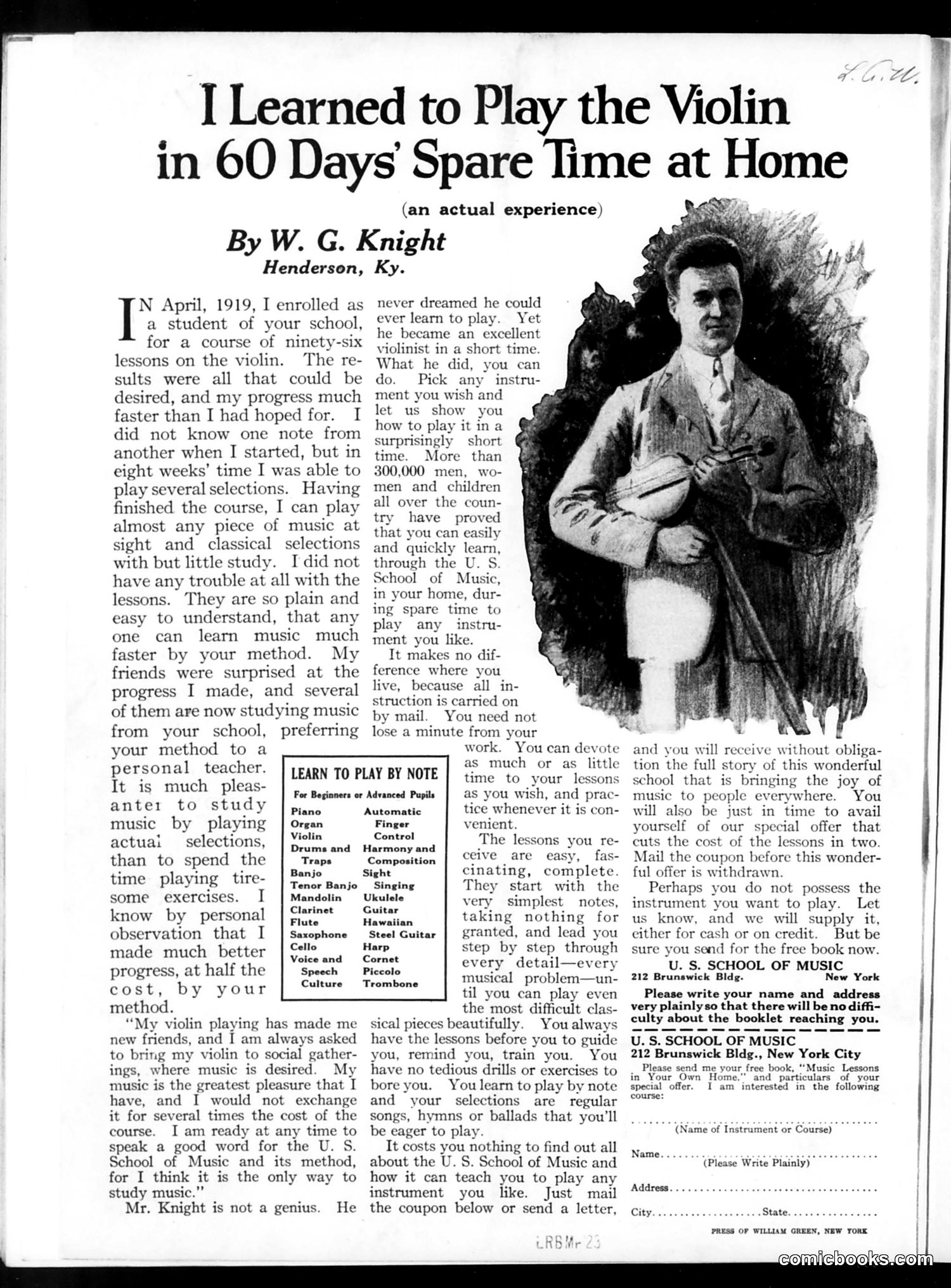
This page is primarily **advertising**, not satire. It features a testimonial advertisement for the U.S. School of Music's mail-order violin instruction course. The "cartoon" element is modest: a sketch of W.G. Knight from Henderson, Kentucky, holding a violin, accompanying his written testimonial about learning violin in 60 days through spare-time home study (April 1919). **What's being sold:** The appeal targets ordinary Americans wanting self-improvement and cultural refinement. The pitch emphasizes accessibility—no previous musical knowledge required, flexible scheduling, affordable pricing, and proven results (claiming "300,000 men, women and children" have succeeded). **Historical context:** This reflects early 20th-century optimism about correspondence education and the democratization of cultural knowledge. The advertisement promises that anyone, even someone like Mr. Knight (explicitly "not a genius"), can master music through systematic mail-based instruction. There is no political satire here—Judge magazine included advertisements among editorial content.

This page appears to be mostly blank or contains minimal visible content in the image provided. The OCR text returned no readable material, and the photograph shows what looks like a blank or nearly blank page from a publication, with only binding visible on the left edge and some markings in the upper left corner that are too faint to decipher clearly. Without legible text or visible cartoon imagery, I cannot identify figures, political references, or satirical content. To provide historical context and analysis of this Judge magazine page, a clearer or higher-resolution image would be needed showing actual cartoon artwork or readable article text.