
Judge, 1922-12-30 · page 23 of 37
Judge — December 30, 1922 — page 23: what you’re looking at
What you’re looking at
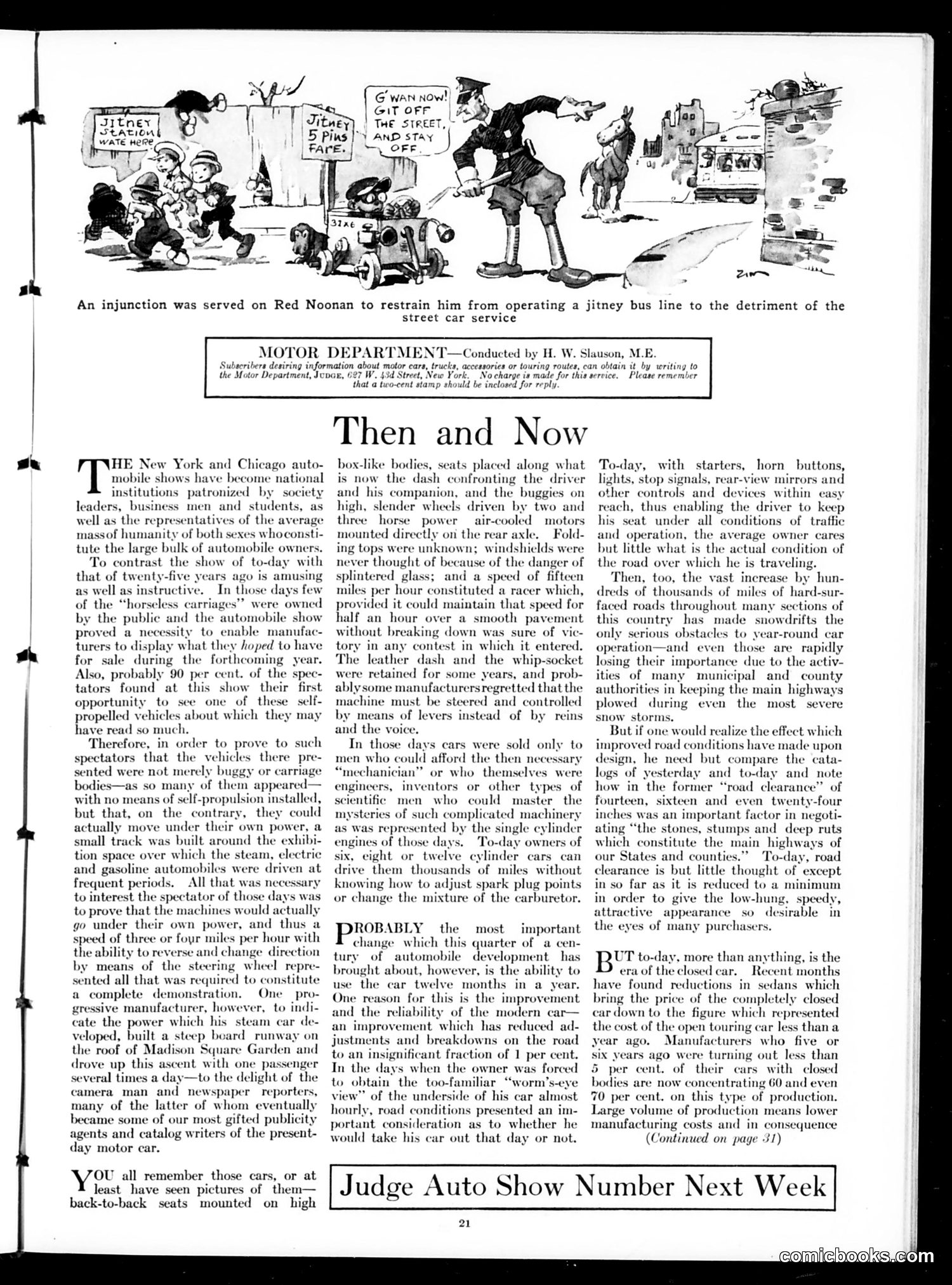
The top cartoon satirizes **Red Noonan**, who operated a "jitney bus" line—an early informal transit service using small vehicles. An injunction (court order) was served against him because his cheaper service undercut the established street car monopoly. The cartoon mocks this legal action, showing Noonan being chased off the street while passengers and operators of traditional street cars celebrate protecting their business interests. The accompanying article contrasts early automobiles (circa 1900s) with modern cars (1920s). Early cars were: - Box-like, high-wheeled contraptions requiring mechanical expertise - Capable of only 15 mph - Operated by wealthy engineers and inventors - Displayed at shows with demonstration tracks Modern cars feature: - Starters, mirrors, controls - Reliable performance - Mass production making them affordable - Easy operation for ordinary drivers The satire celebrates automotive progress while the cartoon critiques how established industries use legal means to suppress competition.
📄 Transcribed text from this page (OCR, searchable)
Machine-transcribed from the original scan — historical spelling and the odd misread are preserved.
se JItner STATION An injunction was served on Red Noonan to restrain him from operating a jitney bus line to the street car service detriment of the MOTOR DEPARTMENT—Conducted by H. W. Slauson, M.E. Subscribers desiring information about motor cara, trucks, accessories or touring routes, can obtain it by writing to the Motor Department, Jovar, 627 W. $3d Street, New York that @ two-cent stamp should be inclosed for reply. No charge is made for this service. Please remember HE New York and Chicago auto- mobile shows have become national institutions patronized by. society ders, business men and students, as ge 1 well as the representatives of the ave massof humanity of both sexes whoconsti- tute the large bulk of automobile owners. To contrast the show of to-d y with rs ago is amusing In those days few norseless carriages” were owned by the public and the automobile show proved a ne y to enable manufac- turers to display what they hoped to have for sale during the forthcoming Also, probably 90 per cent. of the spe tators found at this show their first opportunity to see one of these self- propelled vehicles about which they may have read so much. Therefore, in order to prove to such spectators that the vehicles there pre- sented were not merely buggy or carriage bodies—as so many of them appeared— with no means of self-propulsion installed, but that, on the contrary, they could actually move under their own power, a small track was built around the exhibi- tion space over which the st and gasoline automobiles were driven at frequent periods. All that was necessary to interest the spec to prove that the m go under their own power, and thus a speed of three or foyr miles per hour with the ability to reverse and change direction by means of the steering wheel repre- sented all that was required to constitute a complete demonstration. One _pro- e manufacturer, however, to indi- instructiv gre cate the power which his steam car de- veloped, built a steep beard) runway on the roof of Madison Square Garden’ and drove up this ascent with one passenger several times a day—to the delight of the camera man and newspaper reporters, many of the latter of whom eventually became some of our most gifted publicity agents and catalog writers of the present- y motor car. OU all remember those cars, or at least have seen pictures of them— mounted on high Then and Now box-like bodies, seats placed along what is now the dash confronting the driver and his companion, and the buggies on high, slender wheels driven by two and three horse power — air-cooled motors mounted directly on the rear axle. Fold- ing tops were unknown; windshields were never thought of because of the danger of splintered glass; and a speed of fifteen miles per hour constituted a racer which, provided it could maintain that speed for half an hour over a smooth pavement without breaking down was sure of vic- tory in any contest in which it entered. The leather dash and the whip-socket were retained for some years, and prob- ablysome manufacturersregretted that the machine must be steered and controlled by means of levers instead of by reins and the voice. In those days cars were sold only to men who could afford the then ne ry “mechanician” or who themselves were engincers, inventors or other types of scientific men who could master the mysteries of such complicated machinery as was represented by the single cylinder engines of those days. To-day owners of six, eight or twelve cylinder cars can drive them thousands of miles without knowing how to adjust spark plug points or change the mixture of the carburetor. ROBABLY the most important change which this quarter of a cen- tury of automobile development has brought about, however, is the ability to use the car twelve months in a year, One reason for this is the improvement and the reliability of the modern car— an improvement which has reduced ad- justments and breakdowns on the road to an insignificant fraction of 1 per cent. In the days when the owner was forced to obtain the too-familiar “worm’s-eye view” of the underside of his car almost hourly, road conditions presented an im- portant consideration as to whether he would take his car out that day or not. To-day, with starters, horn buttons, lights, stop signals, rear-view mirrore.and other controls and devices within easy reach, thus enabling the driver to keep his seat under all conditions of traffic and operation, the ge owner cares but little what is the actual condition of the road over which he is traveling. Then, too, the vast increase by hun- dreds of thousands of miles of hard-sur- faced roads throughout many sections of this country has made snowdrifts the only serious obstacles to year-round car operation—and even those are rapidly losing their importance due to the activ- ities of many municipal and county authorities in keeping the main highw: plowed during even the most severe snow storms. But if one would realize the effect which improved road conditions have made upon design, he need but compare the cata- logs of yesterday and to-day and note how in the former “road clearance” of fourteen, sixteen and even twenty-four inches was an important factor in negoti- ating “the stones, stumps, and deep ruts which constitute the main highw of our States and counties.” To-day, road clearance is but little thought of except in so far as it is reduced to a minimum in order to give the low-hung, speedy, attractive appearance so desirable in the eyes of many purchasers, UT to-day, more than anything, is the era of the closed Recent months have found reductions in sedans which bring the price of the completely closed car down to the figure which represented the cost of the open touring car less than a year ago. Manufacturers who five or six years ago were turning out less than 5 per cent. of their cars with closed bodies are now concentrating 60 and even 70 per cent. on this type of production. Large volume of production means lower manufacturing costs and in consequence (Continued on page 31) Judge Auto Show Number Next Week