
Judge, 1922-12-30 · page 21 of 37
Judge — December 30, 1922 — page 21: what you’re looking at
What you’re looking at
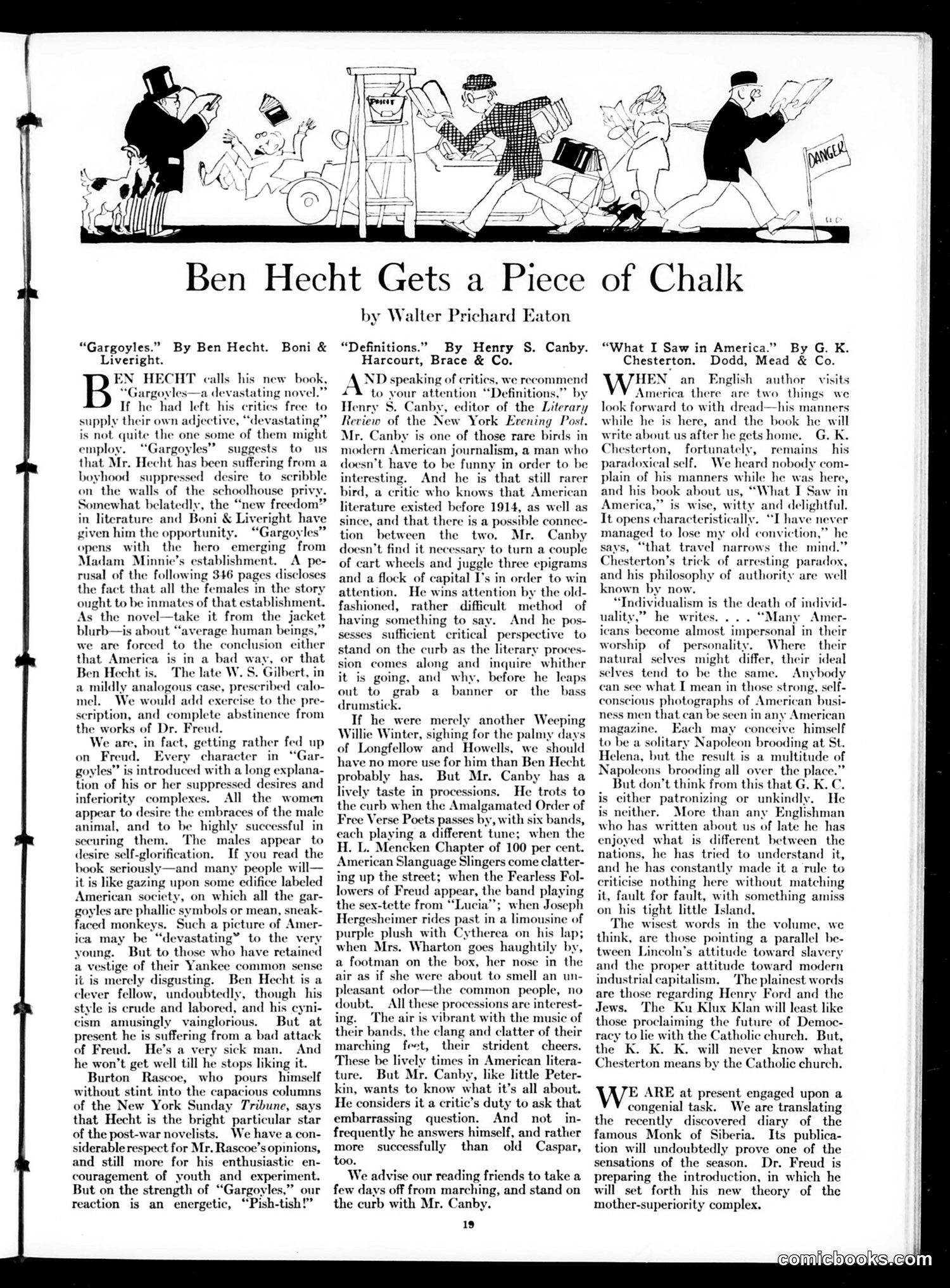
This page reviews two books by literary critic Walter Prichard Eaton. The cartoon header depicts various literary figures engaged in chaotic activity. **Main Content:** The reviewer savagely critiques Ben Hecht's novel *Gargoyles*, claiming it's obsessed with Freudian psychology and sexual content. Eaton suggests Hecht is immature—comparing him to someone scribbling in schoolhouse bathrooms—and that the book is essentially populated by prostitutes. He dismisses Hecht's work as "devastatingly" bad (sarcastically using critics' own praise against him) and attributes the novel's problems to excessive influence from Freud. Notably, he praises Burton Rascoe for encouraging young writers, but rejects Rascoe's championing of Hecht. By contrast, Eaton praises Henry S. Canby's *Definitions*, celebrating Canby as a rare thoughtful critic who doesn't rely on cheap tricks or nostalgia, and who appreciates literary innovation while understanding pre-1914 American literature. **Context:** This reflects 1920s literary debates about modernism, Freudianism, and whether new experimental writing represented progress or adolescent indulgence.
📄 Transcribed text from this page (OCR, searchable)
Machine-transcribed from the original scan — historical spelling and the odd misread are preserved.
Ben Hecht Gets a Piece “Gargoyles.” By Ben Hecht. Boni & Liveright. EN HECHT calls his new book, B les—a devastating novel.” If ad left his critics fres supply their own adjective, “devastatin, is not quite the one some of them might employ. argoyles” suggests to us that Mr. Hecht has been suffering from a boyhood suppressed desire. to scribble on the walls of the schoolhouse privy. Somewhat belatedly, the “new freedom” in literature and Boni & Liveright have given him the opportunity. “Gargoyles” opens with the hero emerging from am Minnie’s establishment. A pe- rusal of the follov ng 346 pages discloses the fact that all the females in the story ought to be inmates of that establishment. As the novel—take it from the jacket blurb—is about “average human beings,” we are forced to the conclusion either that_ Americ: . or that Ben Hecht is. The bert, in a mildly analogous case, prescribed ¢ mel. We would add exercise to the pre- scription, and complete abstinence from the works of Dr. Freud. We are, in fact, getting rather fed up on Freud. Every character in “Gar- goyles” is introduced with a long explana- tion of his or her suppressed desires and inferiority compl All the women appear to desire the embraces of the male and to be highly successful in securing them. The males appear to self-glorifi ation. If you read the it is like gai ring upon some edifice labeled American s on which all the gar- goyles are phallic symbols or mean, sneak- . Such-a picture of Amer- devastating’ to the very But to those who have retained nkee common s merely disgusting. Ben Hecht fellow, undoubtedly, though h style is crude and labored, and his cyni- cism amusingly vainglorious. But at present he is suffering from a bad attack of Freud. He’s a very sick man. And he won’t get well till he stops liking it. Burton Rascoe, who pours himself without stint into the capacious columns of the New York Sunday Tribune, says that Hecht is the bright particular star of the post-war novelists. We have a con- siderable respect for Mr. Rascoe’s opinions, and still more for his enthusiastic en- couragement of youth and experiment. But on the strength of “Gargoyles,” our reaction is an energetic, “Pish-tish!” young. by Walter Prichard Eaton “Definitions.” By Henry S. Canby. Harcourt, Brace & Co. ND speaking of critics, we recommend to your attention “Definitions.” by », editor of the Literary view of the New York Evening Post. Mr. Canby is one of those rare birds in modern American jour m, a man who doesn’t have to be funny in order to be interesting. And he is that still rarer bird, a critic who knows that American literature existed before 1914, as well a: since, and that there is a possible connec- tion between the two. Mr. Canby doesn’t find it necessary to turn a couple of cart wheels and juggle three epigrams and a flock of capital I's in order to win attention. He wins attention by the old- ned, rather difficult, method of having something to say. And he pos- sesses sufficient critical perspective to stand on the curb as the literary proces- sion comes along and inquire. whither it is going, and why, before he | ps out to grab a banner or the drumstick. If he were merely another Weeping Willie Winter, sighing for the palmy days. of Longfellow and Howells, we should have no more use for him than Ben Hecht probably has. But Mr. Canby has a lively taste in processions. He trots to the curb when the Amalgamated Order of Free Verse Poets passes by, with six bands, each playing a different tune; when the H. L. Mencken Chapter of 100 per cent. American Slanguage Slingers come clatter- ing up the street; when the Fearless Fol- lowers of Freud appear, the band playing the sex-tette from “Luc when Joseph Hergesheimer rides past in a limousine of purple plush with Cytherea on his lap; when Mrs. Wharton goes haughtily b: a footman on the box, her nose in the air as if she were about to smell an un- pleasant odor—the common people, no doubt. All these processions are interest- ing. The air is vibrant with the music of their bands, the clang and clatter of their marching feet, their strident cheers. These be lively times in American litera- ture. But Mr. Canby, like little Peter- kin, wants to know what it’s all about. He considers it a critic’s duty to ask that embarrassing question. And not in- frequently he answers himself, and rather more successfully than old Caspar, too. We advise our reading friends to take a few days off from marching, and stand on the curb with Mr. Canby. 19 of Chalk “What I Saw in America.” By G. K. Chesterton. Dodd, Mead & Co. HEN an English author visits America there are two things we look forward to with dread—his manners while he is here, and the book he will write about us after he gets home. G. kK. Chesterton, fortunately, remains — his paradoxical self. We heard nobody com- plain of his manners whi he was here, about us, “What T Saw in s wise, witty and delightful. “Thave never ged to lose my old conviction,” he “that travel narrows the mind.” Chesterton's trick of arresting pé and his philosophy of authority a known by now. “Individualism is the death of individ- uality,” he writes... . icans become almost. imperse in their worship of personality. Where their natural selves might differ, their ideal selves tend to be the same. Anybody can see what I mean in those strong, self- conscious photographs of American busi- men that can be seen in any American ch may conceive himself solitary Napoleon brooding at St. but the result is a multitude of Napoleons brooding all over the place.” But don’t think from this that G. K. C. ither patronizing or unkindly, He is neither. More than any Englishman s written about us of late he has enjoyed what is different between the nations, he has tried to understand it, and he has constantly made it a rule to criticise nothing here without: matching it, fault for fault, with something amiss on his tight little Island, The wisest words in the volume, we think, are those pointing a parallel be- tween Lincoln’s attitude toward slavery and the proper attitude toward modern industrial capitalism. _The plainest words are those regarding Henry Ford and the Jews. The Ku Klux Klan will least like those proclaiming the future of Democ- racy to lie with the Catholic church. But, the K. K. K. will never know what Chesterton means by the Catholic church. WE ARE at present engaged upon a congenial ta: We are translating the recently discovered diary of the famous Monk of Siberia. Its publica- tion will undoubtedly prove one of the sensations of the season. Dr. Freud is preparing the introduction, in which he will set forth his new theory of the mother-superiority complex.