
Judge, 1922-12-30 · page 13 of 37
Judge — December 30, 1922 — page 13: what you’re looking at
What you’re looking at
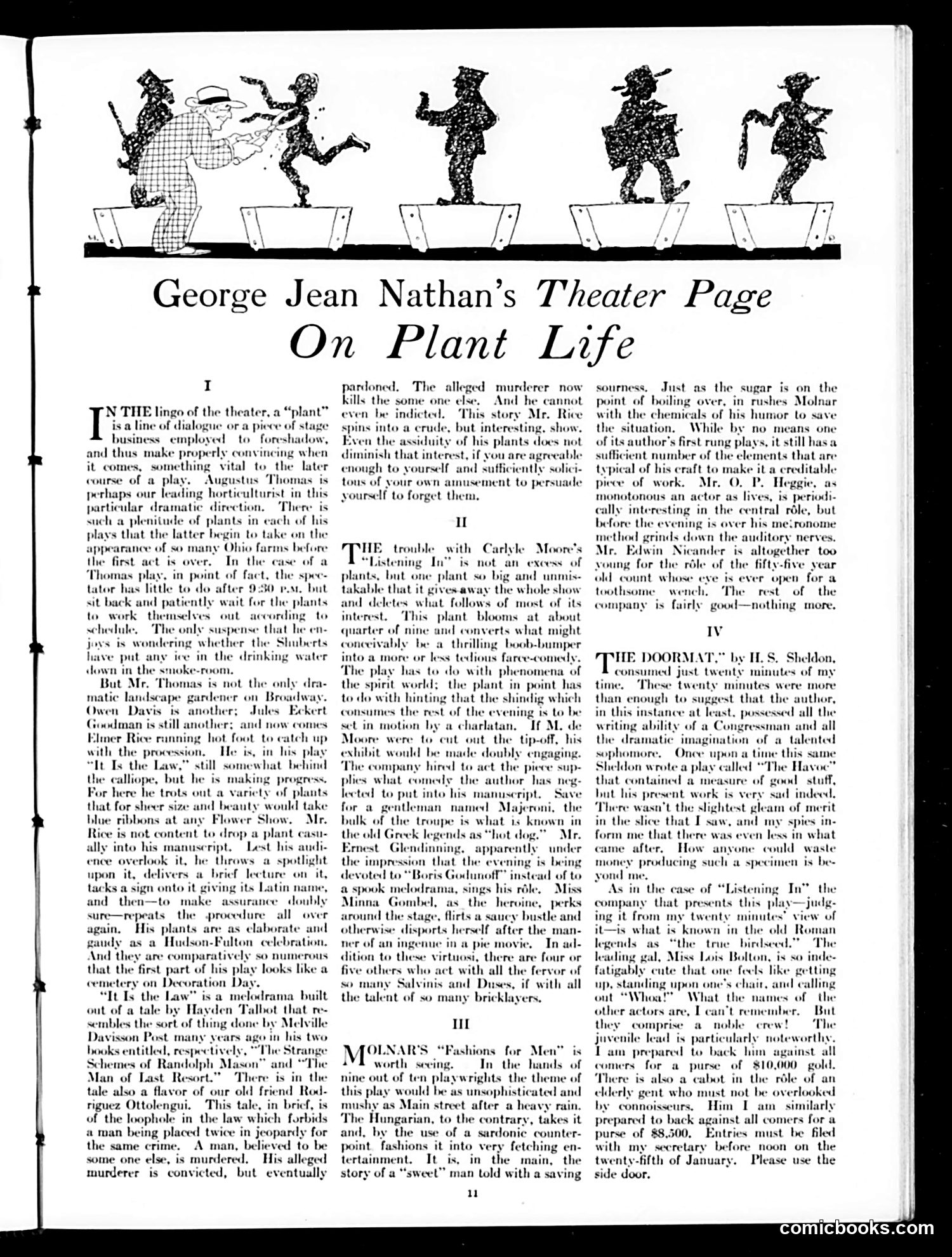
This theater criticism page by George Jean Nathan satirizes contemporary playwrights' overuse of "plants"—dramatic exposition devices that foreshadow plot points. **The Satire:** Nathan mocks playwrights Augustus Thomas, Owen Davis, Jules Eckert Goodman, and Elmer Rice for cluttering their plays with excessive planted clues. He particularly ridicules Rice's "It Is the Law," comparing his plants to an overcrowded flower show—so numerous and obvious that audiences cannot miss them. Nathan suggests Rice even uses spotlights and signs to ensure the audience notices these devices. **The Point:** Competent playwrights should integrate exposition naturally; these writers use such heavy-handed techniques that the theatrical illusions collapse. The satire criticizes their lack of subtlety and craftsmanship, suggesting audiences spend more time noticing dramatic mechanics than enjoying the actual story. The cartoon header shows silhouetted theatrical figures in exaggerated poses, likely representing these overwrought dramatic styles.
📄 Transcribed text from this page (OCR, searchable)
Machine-transcribed from the original scan — historical spelling and the odd misread are preserved.
George Jean Nathan’s Theater Page On I THE lingo of the theater, a “plant” I is a line of dialogue f si business employed to. foreshadow, and thus make properly convincing when it comes, something vital to the later course of a play. Augustus Thomas is perhaps our fing horticulturist in this particular dramatic direction, There is such a plenitude of plants in each of his plays that the latter begin to take on the appearance of so many Ohio farms before the first act is over. In the case of a Thomas play, in point of fact, the spec- tator has little to do after 9:30 p but sit back and patiently wait for the plants to work themsel out according to schedule, ‘The only suspense that he en- joys is wonder whether the Shuberts have put any ice in the drinking water down in the smoke-room, But Mr. Thomas is not the only dra- matic landscape gardener on Broadway. Owen Davis is another; Jules Eckert Goodman is still another; and now comes Eliner Rice running hot foot to catch up with the procession. He is, in his play “Lt Is the Law,” still somewhat behind the calliope, but he is making progress, For here he trots out a variety of plants that for sheer size and beauty would take Hue ribbons at any Flower Show. Rice is not content to drop a plant casu- ally into his manuscript. Lest his audi- erlook it, he ws a spotlight upon it, delivers a brief lecture on it, tacks a sign on ving its Latin name, and i—to make assurance doubly sure—repeats the procedure all over His plants are as clabc and as a Hud ulton celebration. atively so numerous the first part of his play looks like a -y on Decorati “It Is the Law” out of a tale by Hay sort of thing dk {many years age in ie two hooks entitled, respectively ange Schemes of Randolph M ‘The Man of Last Resort. There is in the tale also a r of our old friend Rod- riguez Ottolengui. This tale, in bricf, is of the loophole in the law which forbids a man being placed twice in jeopardy for the same crime. A man, believed to be some one else, is murdered. His alleged murderer is convicted, but eventually odrama built pardoned. The alleged murderer now kills the some one else, And he cannot even be indicted. This story Mr. Rice spins into a crude, but interesting, show. Even the assiduity of his plants does 1 diminish that interest, if y enough to yourself and sufficiently solici- tous of your own amusement to persuade yourself to forget them. II pie trouble with Carlyle Moore's istening In” is not an excess of plants, but one plant so big and unmis- takable that it givesaway the whole show and deletes what follows of most of its interest. This plant blooms at about ter of nine and converts what might thrilling boob-bumper a more or less tedious farce-comedy. The play has to do with phenomena of the spirit world; the plant in point has to do with hinting that the shindig which consumes the rest of the evening is to be set in motion by a charlatan, If M. de Moore were to cut out the tip-off, his exhibit would be made doubly engaging. The company hired to act the piece sup- plies what comedy the author has lected to put into his manuseript. Save for a gentleman named Majeroni, the bulk of the troupe is what is known in the old Greek legends as “hot dog.” Mr. Emest Glendinning, apparently under the impression that the evening is being devoted to “Boris G instead of to a spook melodram: his role. Miss Minna, Gombel, . perks bustle and sings the” iue in a pie dition to these virtuosi, there are four or five others w so many Salvinis and Duses, if with all the talent of so many bricklayers. Ht M OLNAR’S “Fashions for Men” is 4 worth seving. In the hands of nine out of ten playwrights the theme of this play would be as unsophisticated and mushy as Main street after a heavy rain. ‘The Hungarian, to the contrary, takes it and, by the use of a sardonic counter- point fashions it into very fetching en- tertainment. It is, in the main, the story of a “sweet” man told with a saving u Plant Life sourness, Just as the sugar is on the point of boiling over, in rushes Molnar with the chemicals of his humor to save the situation. While by no means one of its author's first rung plays, it still has a sufficient number of the nents that are typical of his craft tom creditable piece of work. Mr. O. Hegg monotonous an actor as lives, is periodi- cally interesting in the central réle, but before the evening is over his metronome method grinds down the auditory nerves. Mr. Edwin Nicander is altogether too young for the role of the fifty-five year Old count: whose ey open fora toothsome — we rest. of the company is fairly good—nothing more. IV HE DOORMAT,” by ILS. Sheldon, consumed just twenty minutes of my ‘These twenty minutes were more rhough to suggest that the author, in this instance at least, possessed all the writing ability of a Congressman and all the drams agination of a talented sophom: Once upon a time this same don wrote a play called “The Havoc” contained a measure of good stuff, this present work is v indeed. wasn't the slightest gleam of merit in the slice that I saw, and my spies in- form me that there was even less in what came after. How anyone could waste money producing such a specimen is be- yond me, As in the case of “Listening In” the company that presents this play—judg- ing it from my twenty minutes’ view of it what is known in the old Roman “the true birdseed.” The ding gal, Miss Lois Bolton, is so inde- fatigably cute that one feels like getting up, standing upon one’s chair, and calling out What the names of the Tean’t remember. But noble crew! ‘The ticularly noteworthy. ack him against a purse of $10,000 re is also a cabot in the réle elderly gent who must not be overlooked by connoisseurs. Him IT am_ similarly prepared to back against all comers for a purse of $8,500, tries must be filed with my secretary before noon on the twenty-fifth of January. Please use the side door. comicbooks.com