
Judge, 1922-12-30 · page 24 of 37
Judge — December 30, 1922 — page 24: what you’re looking at
What you’re looking at
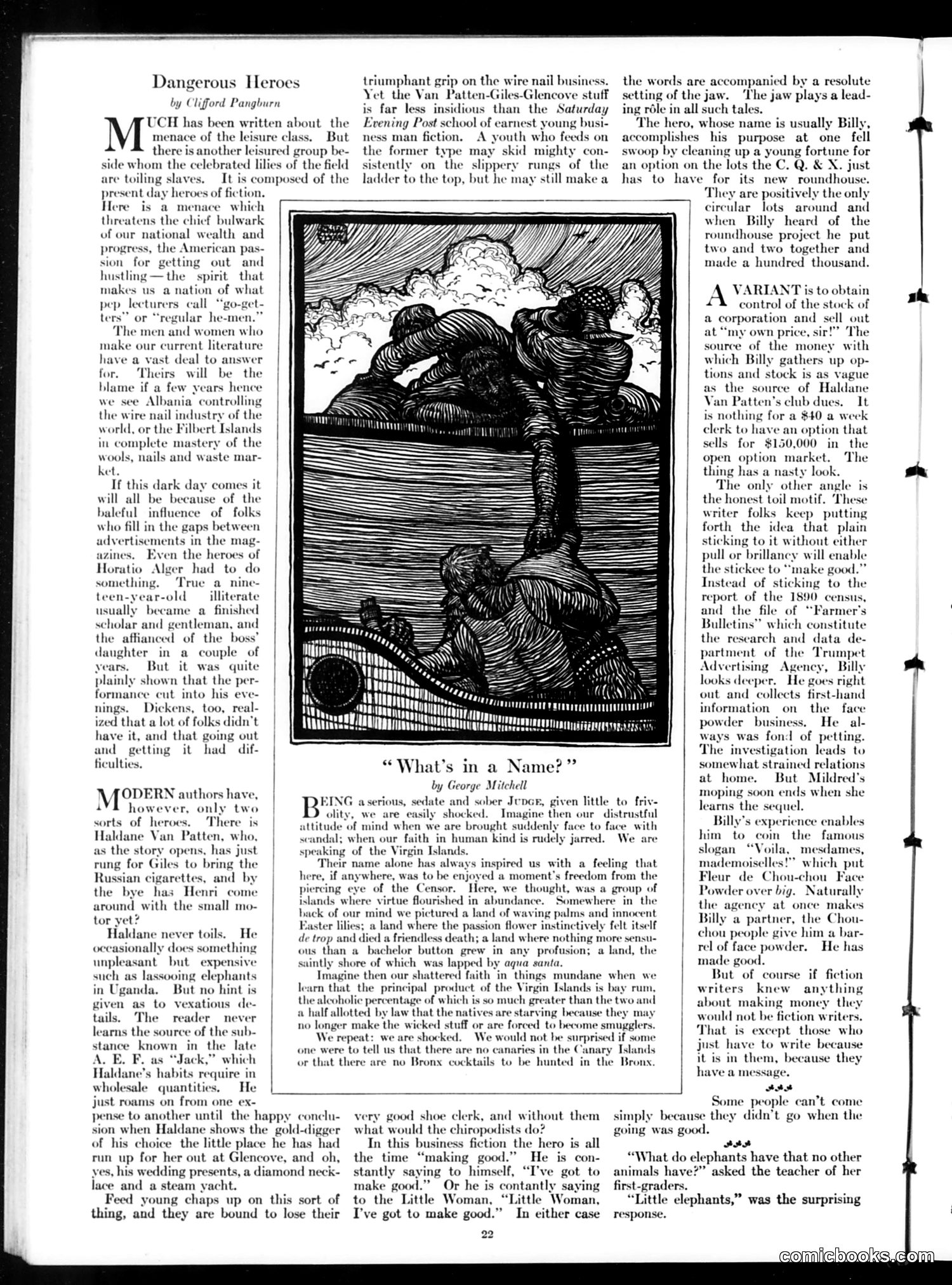
This article satirizes popular business fiction in magazines like the *Saturday Evening Post*, particularly stories featuring young protagonists named "Billy" who achieve sudden wealth through minimal effort—acquiring stock options or corporate control and selling at profit. The author, Clifford Pangburn, critiques these narratives as dangerous because they glorify get-rich-quick schemes rather than honest work, contrasting them with older literature (Horatio Alger, Dickens) that showed success required actual effort. He worries such fiction promotes laziness among readers and threatens American competitiveness, sarcastically warning that if Americans stop hustling, nations like Albania will dominate industries like wire nails. The accompanying illustration depicts what appears to be a heroic businessman figure, likely mocking the idealized "he-man" protagonist of such fiction. The satire targets both lazy fiction-writing and the unrealistic fantasies sold to impressionable readers.
📄 Transcribed text from this page (OCR, searchable)
Machine-transcribed from the original scan — historical spelling and the odd misread are preserved.
Dangerous Heroes by Clifford Panghurn UCH has been written about the menace of the leisure class. But there is another leisured group be- side whom the celebrated lilies of the field are toiling slaves. It is composed of the triumphant grip on the wire nail business. Yet the V: ten. ‘s lencove stuff is far less insidious than the Saturday Evening Post school of earnest young busi- ness man fiction. A youth who feeds on the former type may skid mighty con- sistently on the slippery rungs of the ladder to the top, but he may still make a the words are accompanied by a resolute setting of the jaw. ‘The jaw plays a lead- ing rdle in all such tales. The hero, whose name is usually Billy, accomplishes his purpose at one fell swoop by cleaning up a young fortune for an option on the lots the C. Q. & X. just has to have for its new roundhouse. They are positively the only present day heroes of fiction. Here is a me which threatens the chief bulwark of our national wealth and progress, the American pas- sion for getting out and hustling —the spirit that makes us a nation of what | pep lecturers call “go-get- ters” or “regular he-men. The men and women who | make our current literature | have a vast deal to answer for. Theirs will be the blame if a few years hence we Albania controlling the wire nail industry of the | = world, or the Filbert Islands in complete mastery of the wools, nails and waste mar- ket. If this dark day comes it will all be because of the baleful influence of folks who fill in the gaps between advertisements in the mag- azine Even the heroes of Horatio Alger had to do something. True a nine- | r-old __ illiterate ; me a finished scholar and gentleman, and the affianced of the boss’ daughter in a couple of | years. But it was quite plainly shown that the per- formance cut into his eve- nings. Dickens, too, ized that a lot of folks didn’t | have it, and that going out and getting it had dif- ficulties. authors have, MODER 4 however, only two | I sorts of heroes. There is | Haldane Van Patten, who, as the story opens, has just EING aseriou olity, we are easily of mind when we are brought suddenly f. 1; when our faith in human kind is rudely Fat Wy te BU LLURE LULU LLELaas “What's in a Name?” by George Mitchell yer JUDGE late and s shocked. given little to friv- Imagine then our distrustful to face with rred. circular lots around and when Billy heard of the | roundhouse project he put two and two together and made a hundred thousand. VARIANT is to obtain + control of the stock of a corporation and sell out at “my own price, sir!” The source of the money with which Billy gathers up op- tions and stock is as as the source of Ha Van Patten’s club dues. It is nothing for a $40 a week clerk to have an option that | sells for $150,000 in’ the open option market. The thing has a nasty look. The only other angle is the honest toil motif. These writer folks keep putting forth the idea that plain sticking to it without either pull or brillancy will enable the stickee to “make good.” Instead of sticking to the report of the 1890 census, and the file of ‘armer’s Bulletins” which constitute the research and data de- partment of the Trumpet Advertising Agency, Billy looks deeper. He goes right out and collects first-hand information on the face powder business. He al- ways was fond of petting. The investigation leads to somewhat strained relations at home But Mildred’s moping soon ends when she learns the sequel. Billy’s experience enables him to coin the famous slogan “Voila, mesdames, We are | rung for Giles to bring the Russian cigarettes, and by the bye has Henri come around with the small mo- tor yet? Haldane never toils. He occasionally does something unpleasant’ but expensive such as lassooing elephants in Uganda. But no hint is given as to vexatious de- tails. The reader never earns the source of the sub- stance known in the late ys inspired us with a feeling that ved a moment's freedom from the Censor. Here, we thought, was a group of Somewhere in the rcing eye jands where virtue flourished in abundance. back of our mind we pictured a land of waving palms and innocent Easter lilies; a land where the passion flower instinctively felt itself de trop and died a friendless death; a land where nothing more sensu- ous than a bachelor button grew in any profusion; a land, the saintly shore of which was lapped by agua santa. agine then our shattered faith in things mundane when we product of the Virgin I i f which is so much greater at the nati ) stuff or smugglers. We would not be surprised if some ny ries in the Canary Islands t the princ coholic percentag Hotted by law t no longer make the wicked We repeat: we are shocked. one were to tell us that there mademoiselles!” which put Fleur de Chou-chou Fac Powder over big. Natur: the agency at once makes Billy a partner, the Cho chou people give him a bar- rel of face powder. He has made good. But of course if fiction writers knew anything ing money they tion writers. That is except those who just have to write because ALE. FB, as “Jack,” which | Haldane’s habits require in or that there are no Bronx cocktails to be hunted in the Bronx: it is in them, because they wholesale quantities. He | just roams on from one ex- pense to another until the happy conclu- sion when Haldane shows the gold-digger of his choice the little place he has had run up for her out at Glencove, and oh, yes, his wedding presents, a diamond neck- ed young chaps up on this sort of thing, and they are bound to lose their very good shoe clerk, and without them what would the chiropodists do: In this business fiction the hero is all the time “making good.” He is con- antly saying to himself, “I've got to make good.” Or he is contantly saying to the Little Woman, “Little Woman, I've got to make good.” In either case Some people can’t come simply because they didn’t go when the going was good. Bad “What do elephants have that no other animals have?” asked the teacher of her first-graders. “Little elephants,” was the surprising response. he ty