
Judge, 1922-12-30 · page 7 of 37
Judge — December 30, 1922 — page 7: what you’re looking at
What you’re looking at
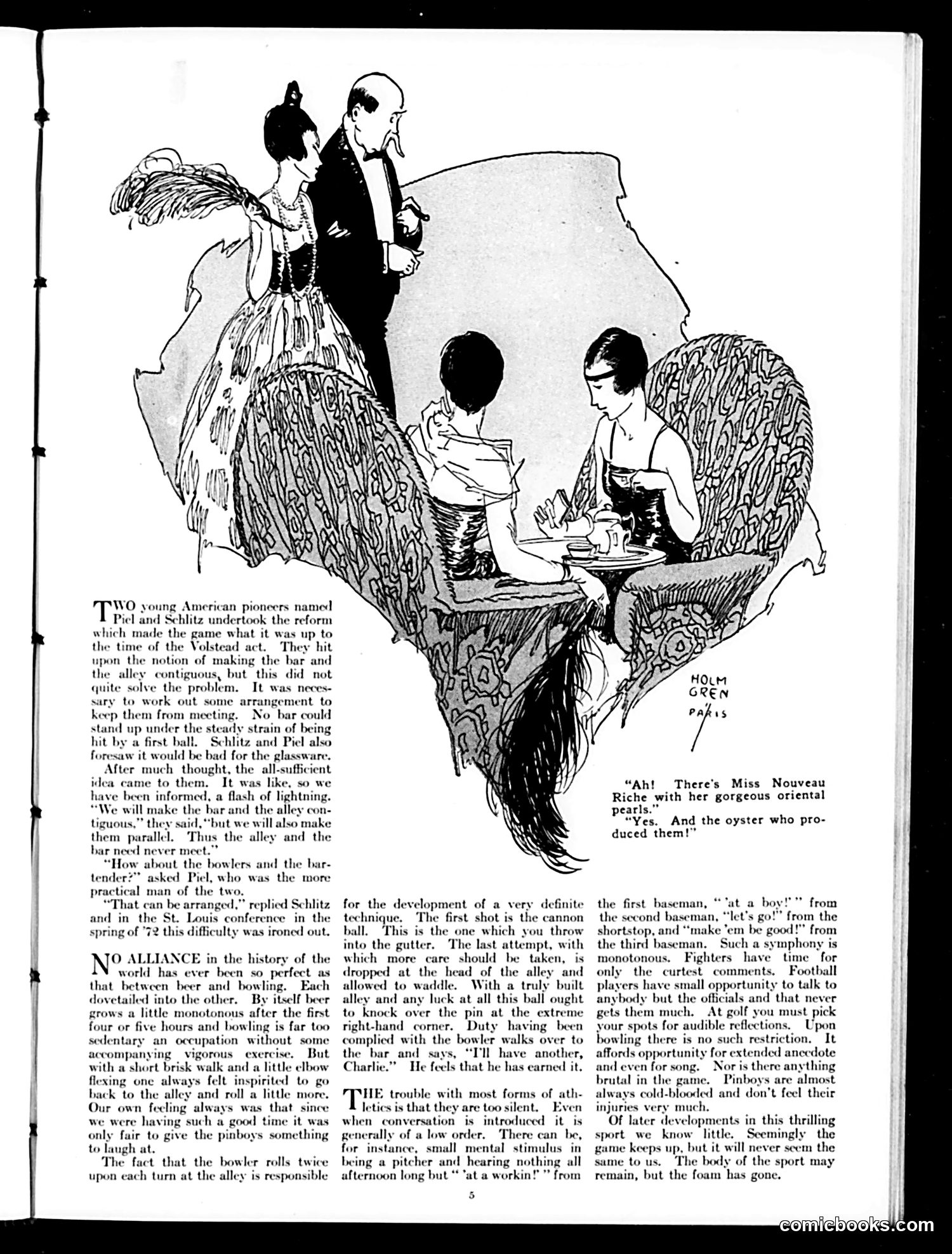
This **Judge** magazine page satirizes the relationship between beer and bowling in early 20th-century American leisure culture. The illustration depicts two elegant figures (representing beer/bar culture) alongside bowlers, visualized as a large profile of a man's head. The text humorously credits fictional "pioneers" Piel and Schlitz (beer brand names) with reforming bowling by separating bars from alleys—solving the practical problem that bowlers would damage glassware if drinking happened near the pins. The satire's point: beer and bowling were so commercially intertwined that they seemed like natural partners in American recreation. The piece celebrates this alliance while gently mocking how bowling required alcohol to be "tolerable," and how bowling alleys depended on bar sales. The final lament—"the foam has gone"—suggests nostalgia for an earlier era of this leisure partnership, implying changes (possibly Prohibition-related) have diminished the experience.
📄 Transcribed text from this page (OCR, searchable)
Machine-transcribed from the original scan — historical spelling and the odd misread are preserved.
Two young American pioneers named Piel and Schlitz undertook the reform which made the game what it was up to the time of the Volstead act. They hit upon the notion of making the bar and the alley ntiguous, but this did not quite solve the problem. It was neces- sary to work out some arrangement to keep them from meeting. No bar could stand up under the steady strain of being ya first ball. Schlitz and Piel also foresaw it would be bad for the glassware. Mfter much thought, the all-sufficient to them. It was like, so we informed, a flash of lightning. arand the alley con- Thus the alley and the bar need never mect.” “How about the bowlers and the bar- asked Piel, who was the more al man of the two. t can be arranged,” replied Schlitz them parallel. and in the St. Louis conference in the spring of '72 this difficulty was ironed out. O ALLIANCE in the history of the IN world has ever been so perfect as that between beer and bowling. Each dovetailed into the other. By itself beer grows a little monotonous after the first four or five hours and bowling is far too an occupation without some accompanying vigorous exercise. But with a short brisk walk and a little elbow back to the alley and roll a little more. Our own feeling always was that since having such a good time it was ly fair to give the pinboys something to laugh at. The fact that the bowler rolls twice upon each turn at the alley is responsible for the development of a very definite techniq: The first shot is the cannon ball. This is the one which you throw into the gutter. The last attempt, with which more care should be taken, is dropped at the head of the alley and allowed to waddle. With a truly built alley and any luck at all this ball ought to knock over the pin at the extreme right-hand corner. Duty having been complied with the bowler walks over to the bar and says, “I'll have another, Charlie.” He feels that he has earned it. HE trouble with most forms of ath- tics is that they are too silent. Even conversation is introduc i ly of a low order. There for instance, small mental stimulus in being a pitcher and hearing nothing all afternoon long but “ ‘at a workin!’ " from 5 “Ah! There's Miss Nouveau Riche with her gorgeous oriental pearls.” “Yes. And the oyster who pro- duced them!” !" from from the ood!" from Such a symphony is monotonous. Fighters have time for only the curtest- comments. Football ¢ small opportunity to talk to a ly but the officials and that never gets them much. At golf you must pick your spots for audible reflections. Upon bowling there is no such restriction. It affords opportunity for extended anecdote and even for song. Nor is there anything brutal in the game. Pinboys are almost always cold-blooded and don't feel their injuries very much. Of later developments in this thrilling sport we know little. ingly the game keeps up, but it will never seem the same to us. The body of the sport may remain, but the foam has gone. the first basems the second base shortstop, and * the third baseman.