
Judge, 1922-12-30 · page 10 of 37
Judge — December 30, 1922 — page 10: what you’re looking at
What you’re looking at
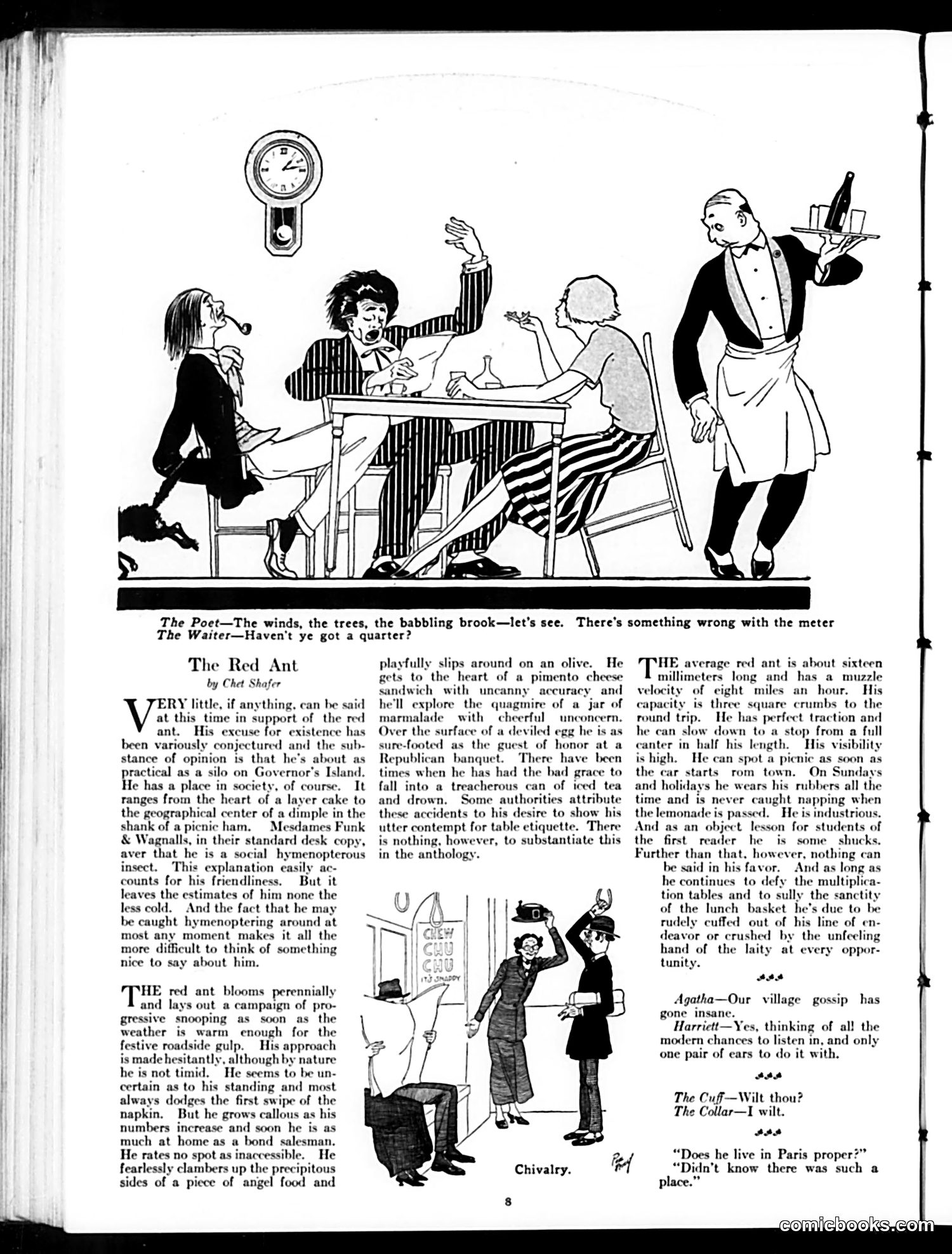
This page contains two distinct pieces of satirical content: **"The Red Ant" (main article):** A humorous essay by Chet Shafer anthropomorphizing red ants as antisocial pests. The satire targets the ant's shameless intrusion into human food and spaces—picnics, desserts, sandwiches—with mechanical precision and utter disregard for social boundaries. The piece mockingly praises the ant's "industrious" nature while condemning its fundamental uselessness and destructiveness, suggesting it deserves extermination. This likely functions as veiled social commentary on unwanted or parasitic elements in society. **The cartoon (top):** A poet struggles to compose verse while a waiter interrupts demanding payment ("Haven't ye got a quarter?"). The satire mocks impoverished bohemian artists—their romantic pretensions about nature contrasted sharply with practical financial desperation. **Minor jokes (bottom):** Brief quips about village gossips lacking time to listen to all modern entertainment, and wordplay about Paris. The page reflects 1920s-era American humor targeting social pretension and minor annoyances of urban/social life.
📄 Transcribed text from this page (OCR, searchable)
Machine-transcribed from the original scan — historical spelling and the odd misread are preserved.
The Poet—The winds, the trees, the babbling brook—let’s see. The Waiter—Haven't ye got a quarter? The Red Ant by Chet Shafer ERY little, if anything, can be said at this time in support of the red ant. His excuse for existence has been variously conjectured and the sub- stance of opinion is that he’s about as practical as a silo on Governor's Island. He has a place in society, of course. It ranges from the heart of a layer cake to the geographical center of a dimple in the shank of a picnic ham. | Mesdames Funk & Wagnalls, in their standard desk copy, aver that he is a social hymenopterous insect. This explanation easily ac- counts for his friendliness. But it leaves the estimates of him none the less cold. And the fact that he may be caught hymenoptering around at most any moment makes it all the more difficult to think of something nice to say about him. HE red ant blooms perennially and lays out a campaign of pro- gressive snooping as soon as the weather is warm enough for the festive roadside gulp. His approach is made hesitantly, although by nature he is not timid. He seems to be un- certain as to his standing and most always dodges the first swipe of the napkin. But he grows callous as his numbers increase and soon he is as much at home as a bond sal He rates no spot as inaccessible fearlessly clambers up the precipitous sides of a piece of angel food and playfully slips around on an olive. He gets to the heart of a pimento cheese sandwich with uncanny accuracy and he'll explore the qu re of a jar of marmalade with — cheerful em. Over the surface of a deviled egg he is as sure-footed as the guest of honor at a Republican banquet. There have been times when he has had the bad grace to fall into a treacherous of iced tea and drown. Some authorities attribute these accidents to his desire to show his utter contempt for table etiquette. There is nothing, however, to substantiate this in the anthology. There's something wrong with the meter THE average red ant is about sixteen millimeters long and has a muzzle velocity of eight miles an hour. His capacity is three square crumbs to the round trip. He has perfect tracti he can slow down to a stop from a canter in half his length. His visibility is high. He can spot a picnic as soon as the car starts rom town. On Sundays and holidays he wears his rubbers all the time and is never caught napping when the lemonade is passed. He is industrious. And as an object lesson for students of the first reader he is some shucks, Further than that, however, nothing can be said in his favor. And as long as he continues to defy the multiplica- tion tables and to sully the sanctity of the lunch basket he’s due to rudely cuffed out of his line of ¢ deavor or crushed by the unfeeling hand of the laity at every oppor- tunity. sae Agatha—Our village gossip has gone insane. Harriett—Yes, thinking of al! the modern chances to listen in, and only one pair of ears to do it with. sae The Cuff—Wilt thou? The Collar—I wilt. sae “Does he live in Paris proper?” “Didn't know there was such a place.”