
Judge, 1922-12-30 · page 11 of 37
Judge — December 30, 1922 — page 11: what you’re looking at
What you’re looking at
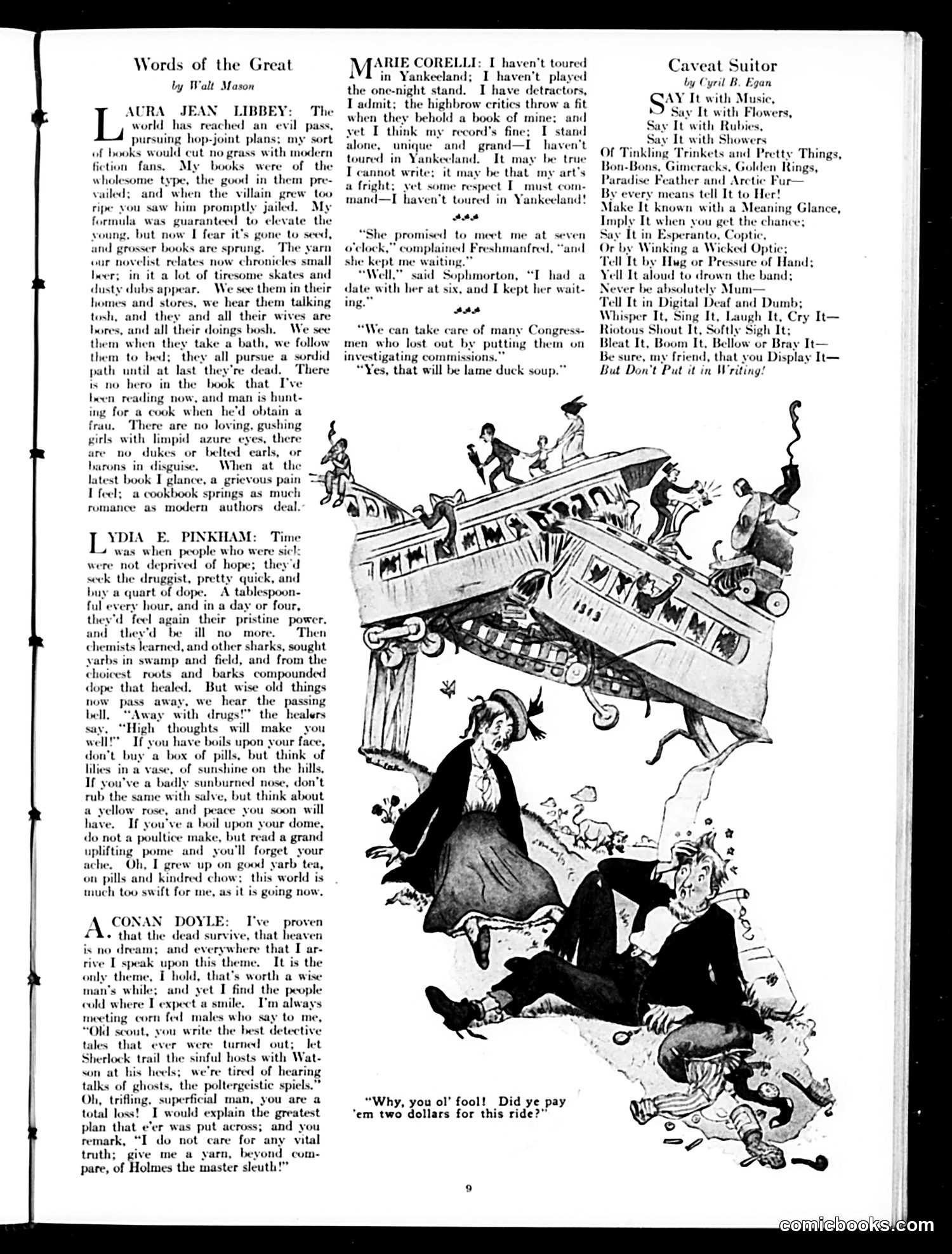
This page from *Judge* satirizes several prominent early-20th-century authors and public figures through Walt Mason's verse commentary. **The main cartoon** depicts a chaotic steamship scene with passengers in disarray, illustrating the satirical critiques below. **The targets:** - **Laura Jean Libbey**: A romance novelist criticized for wholesome, moralistic fiction now deemed outdated compared to grittier modern realism. - **Lydia E. Pinkham**: The patent medicine entrepreneur whose tonics promised cure-alls; the satire mocks modern "New Thought" wellness culture replacing actual medical treatment. - **Conan Doyle**: The creator of Sherlock Holmes, criticized for promoting spiritualism and the afterlife while readers only want detective fiction. - **Marie Corelli**: A popular novelist defending her reputation and artistic integrity despite never touring America. **The satire's point**: These celebrities cling to outdated or eccentric concerns—sentimental fiction, miraculous cures, spiritualism—that modern readers/society have moved beyond. The humor lies in their apparent bewilderment at changing public tastes.
📄 Transcribed text from this page (OCR, searchable)
Machine-transcribed from the original scan — historical spelling and the odd misread are preserved.
Words of the Great ly Walt Mason AURA JEAN LIBBEY: The I world has reached an evil pass, pursuing hop-joint plans; my sort of books would cut no grass with modern fiction fans. My books were of the wholesome type, the good in them pre- vailed; and when the villain grew too ripe you saw him promptly jailed. My formula was guaranteed to elevate the young, but now I fear it’s gone to seed, and grosser books are sprung. The yarn our novelist relates now chronicles small leer; in it a lot of tiresome skates and dusty dubs appear. We see them in their homes and stores, we hear them talking tosh, and they and all their wives are bores, and all their doings bosh. We see them when they take a bath, we follow them to bed; they all pursue a sordid path until at last they're dead. There is no hero in the book t I've been reading now, and man is hunt- ing for a cook when he'd obtain a frau. There are no loving, gushing girls with limpid azure eyes, there are no dukes or belted earls, or harons in disguise. When at the latest book I glance, a grievous pain I feel; a cookbook springs as much romance as modern authors deal. Time » sick: YDIA FE. PINKHAM: 4 was when people who we were not deprived of hope; they'd seck the druggist, pretty quick, and buy a quart of dope. A tablespoon- ful every hour, and in a day or four, again their pristine power, and th be ill no more. — Then chemists learned, and other sharks, sought yarbs in swamp and field, and from the choicest roots and barks compounded dope that healed. But wise old things we hear the passing they'd Te ll “Away say. “High thoughts will mal If you have boils upon your face, ‘t buy a box of pills, but think of lilies in a va of sunshine on the hills, If you've a badly sunburned nose, don’t rub the same with salve, but think about a yellow rose, and peace you soon will ve. If you've a boil upon your dome, do not a poultice make, but read a grand uplifting pore and you'll forget. your ache. Oh, [ grew up on good yarb tea, on pills and kindred chow; this world is much too swift for me, as it is going now. CONAN DOYLE: fA. that the dead surv is no dream; and everywhere that I ar- rive I speak upon this theme. It is the only theme, T hold, that’s worth a wise man’s while; and yet I find the people cold where T expect a smile. I'm always meeting corn fed males who say to “Old scout, you write the best detective tales that ever were turned out; let Sherlock trail the sinful hosts with Wat- son at his heels; we're tired of hearin talks of ghosts, the poltergeistic spiels.”” Oh, trifling, superficial man, you are a total loss! I would explain the greatest plan that e’er was put across; and you remark, “I do not care for any vital truth; give me a yarn, beyond com- pare, of Holmes the master sleuth!” I've proven that heaven ARIE CORELLI: I haven't toured i in Yankeeland; I haven't played the one-night stand. I have detractors, I admit; the highbrow critics throw a fit when they behold a book ef mine; and yet I think my record’s fine; I stand alone, unique and grand—I_ haven't toured in Yankeeland. It may be true T cannot write; it may be that’ my art's a fright; yet some respect [> must com- mand—I haven't toured in Yankeeland! “She promised to meet me at seven o'clock,” complained Freshmanfred, “and she ke we waiting.” “Well.” said Sophmorton, “I had a date with her at six, and I kept her wait- ing.” sae “We can take care of many Congress- men who lost out by putting them on investigating commissions.” “Yes, that will be lame duck soup.” “Why, you ol’ fool! Did ye pay ‘em two dollars for this ride?” Caveat Suitor by Cyril B. Egan AY It with Music, Say It with Flowers, It with Rubies, ay It with Showers Of Tinkling Trinkets and Pretty Things, Bon-Bons, Gimeracks, Golden Rings, Paradise Feather and Arctic Fur— By every means tell It to Her! Make It known with a Meaning Glance, Imply It when you get the chance; Say It in Esperanto, Coptic, Or by Winking a Wicked Optic; ‘Tell It by Hug or Pressure of Hand; Yell It aloud to drown the band; er be absolutely Mum— Tell It in Digital Deaf and Dumb; Whisper It, Sing It, Laugh It, Cry It— Riotous Shout It, Softly Sigh It; Bleat It, Boom It, Bellow or Bray It— Be sure, my friend, that you Display It— But Don't Put it in Writing!