
A complete issue · 36 pages · 1922
Judge — August 26, 1922
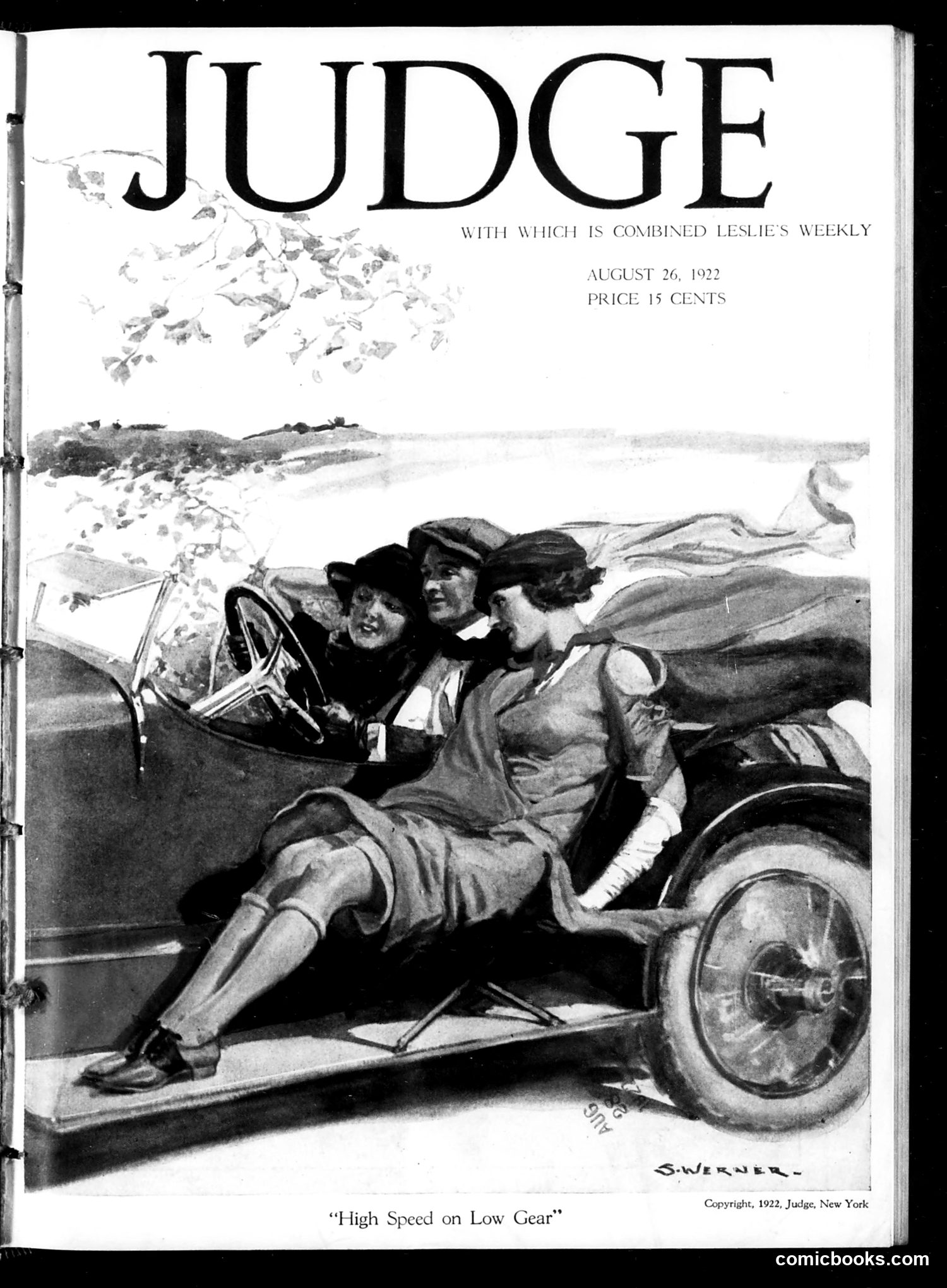
This 1922 Judge magazine cover satirizes reckless driving and unsafe automobile behavior. The illustration shows three people in an open-air car in apparent danger—one woman's leg dangles precariously outside the vehicle while the occupants appear to be joyride driving at excessive speed along a coastal road. The title "High Speed on Low Gear" is a mechanical pun suggesting inefficiency and impropriety. The satire likely targets the popular 1920s car culture and young people's dangerous driving habits during the Jazz Age. The illustration criticizes both the thrill-seeking mentality and the physical recklessness of modern motoring, particularly among the youth of that era. The scenic backdrop contrasts sharply with the chaotic, unsafe behavior depicted.
This page contains an editorial statement titled **"Life, Liberty and the pursuit of Happiness"** signed by "JUDGE," the magazine's editor or editorial voice. The text is a **manifesto of the publication's values and approach**, not a political cartoon. It explains Judge's editorial philosophy: championing individual freedoms (religious, speech, press), optimism balanced with realism, political independence (Republican but acknowledging Democratic merits), and **humor as the primary tool** for social commentary. Key to understanding Judge's purpose: the editor positions **laughter and satire as vehicles for addressing serious issues**—using wit rather than solemnity to critique "big problems of the day." This reflects late 19th/early 20th-century American satirical journalism's ethos of informed, humorous social criticism serving the "pursuit of Happiness."
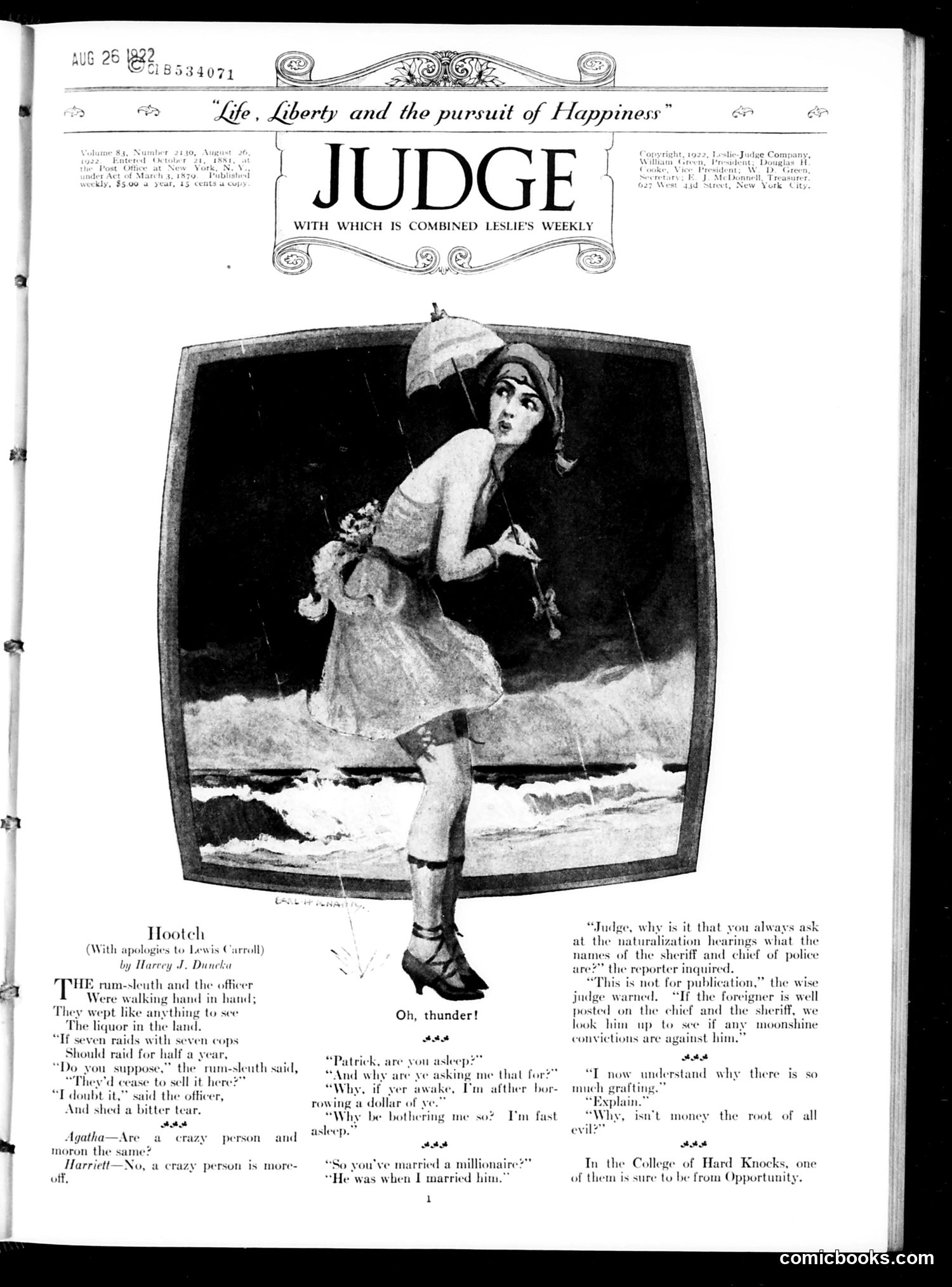
This satirical cartoon depicts Prohibition-era humor. A woman in a beach setting holds an umbrella and appears distressed, exclaiming "Oh, thunder!" The accompanying dialogue references "seven raids with seven cops" and discusses contraband liquor ("the liquor in the hand"). The humor centers on Prohibition enforcement (1920-1933) and the black market it created. The "rum-sleuth and the officer" mentioned in the poem were federal agents tasked with stopping alcohol distribution. The jokes reference: - Difficulty obtaining alcohol despite laws - Corruption among law enforcement - The absurdity of Prohibition The woman's seaside setting with an umbrella may suggest she's "weathering" the challenges of the dry era. The cartoon mocks both Prohibition's ineffectiveness and contemporary social anxieties about crime and enforcement during this unpopular federal experiment.
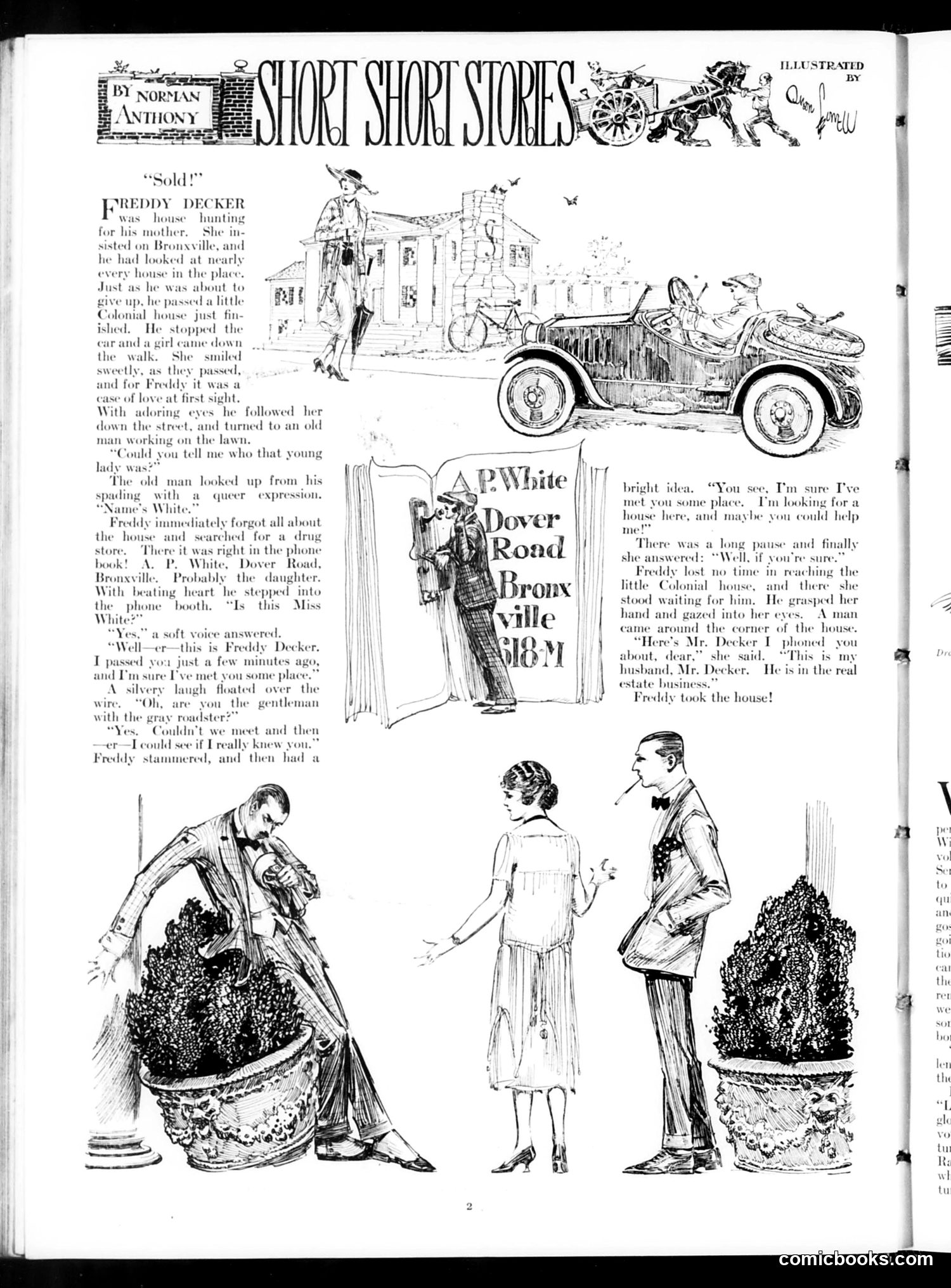
This is a short story, not political satire. Freddy Decker searches for a house to buy for his mother in Bronxville. He encounters an old man working on a lawn who claims to represent "A. P. White, Dover Road, Bronxville" real estate. The man directs Freddy to a Colonial house, where a woman greets him—but she turns out to be the old man's daughter. The "joke" relies on a romantic setup: Freddy falls for the girl at first sight, and the story implies he'll "buy" not just the house but win the girl as well. This reflects 1920s-era romantic comedy tropes where courtship and consumer transactions overlap humorously.
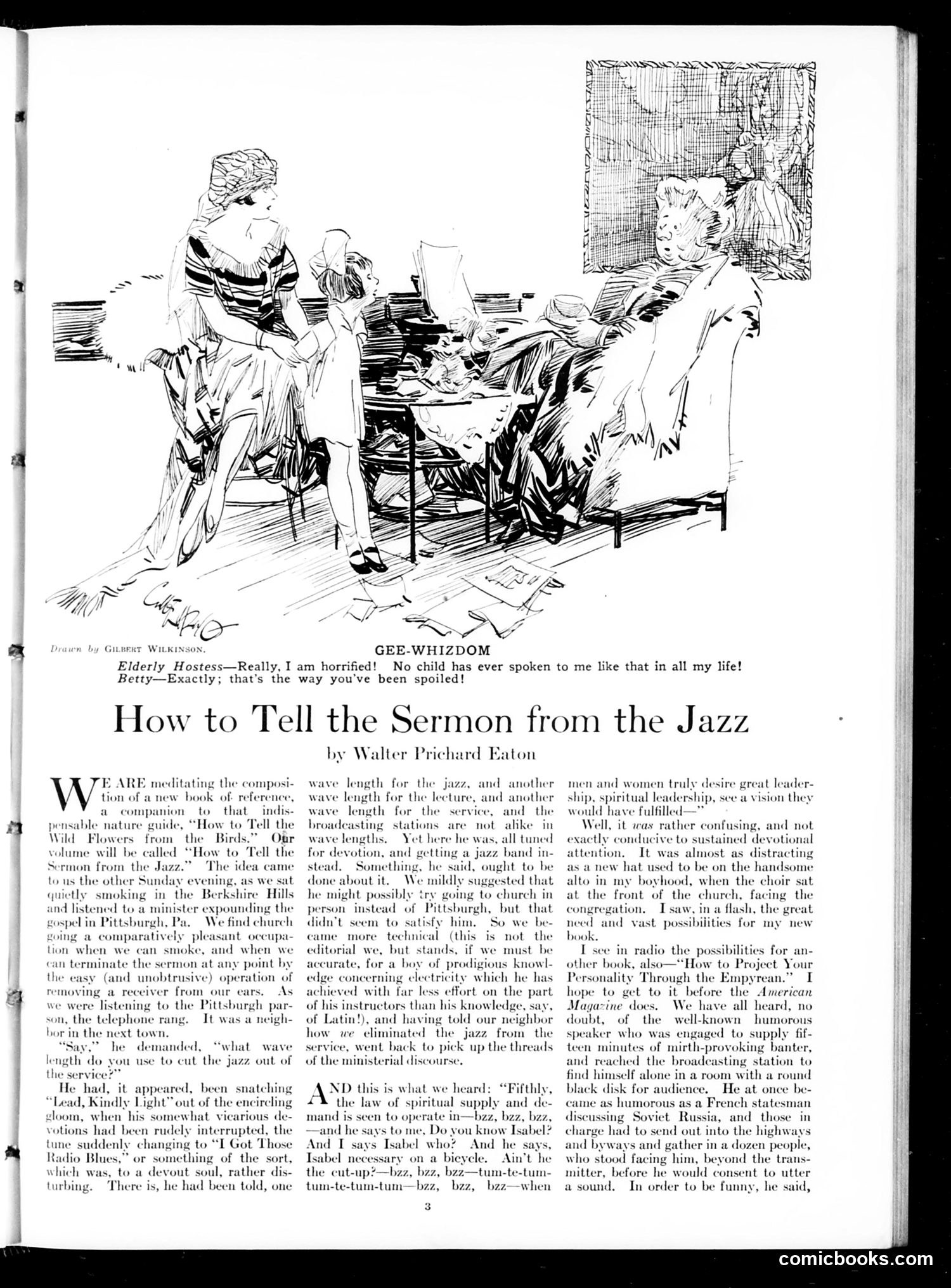
The page contains two distinct elements: **Top cartoon ("Gee-Whizdom"):** An illustration by Gluyas Wilkinson showing an elderly hostess horrified by a child's blunt comment. The joke plays on generational differences in manners—the child's honest observation ("you've been spoiled") violates social convention. This reflects 1920s anxieties about changing parent-child dynamics and the perceived decline of Victorian propriety among younger generations. **Main article:** "How to Tell the Sermon from the Jazz" by Walter Prichard Eaton. This satirical piece addresses early 20th-century cultural anxiety about jazz music's growing influence. The author humorously compares jazz's "wave lengths" to church sermons, suggesting jazz was becoming as culturally dominant and spiritually compelling as religious instruction—a concern held by cultural conservatives who viewed jazz as morally corrupting.
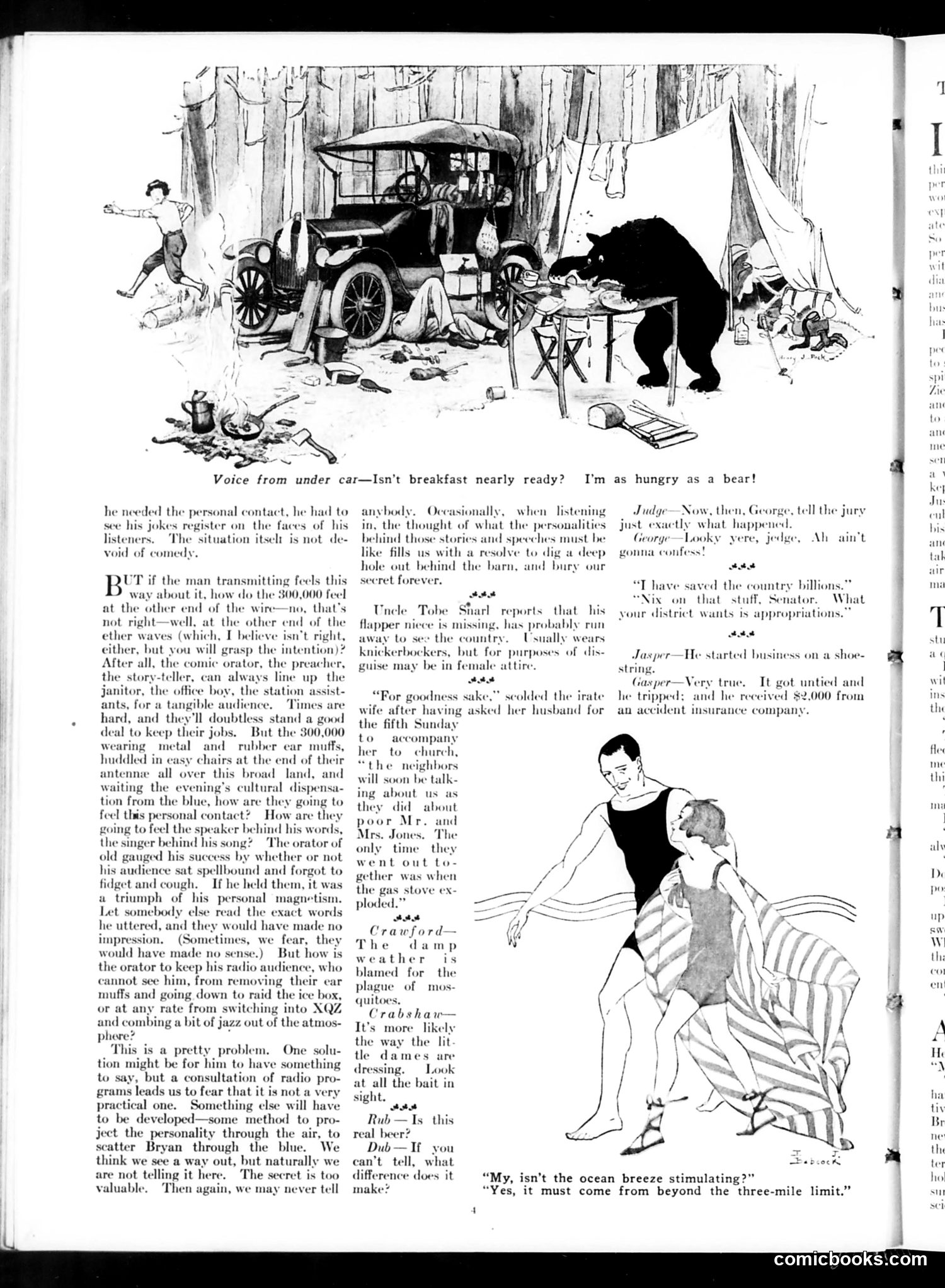
This page contains two cartoons and editorial commentary about early radio broadcasting. **Top cartoon:** Shows a bear under a camping automobile, interrupting breakfast with "Isn't breakfast nearly ready? I'm as hungry as a bear!" The satire concerns radio's technical limitations—how broadcasts transmit voices across distances but lack the "personal contact" needed for genuine audience engagement. The bear represents an uninvited listener, illustrating the problem of reaching uncontrolled audiences. **Bottom cartoon:** Depicts a man and child, with dialogue about ocean breezes coming "beyond the three-mile limit." This appears to mock radio's inability to confine broadcasts within geographic boundaries, satirizing regulatory confusion about controlling transmission. The editorial text discusses challenges radio broadcasters faced in maintaining audience attention without visual elements, a significant concern in early broadcasting's development during the 1920s.
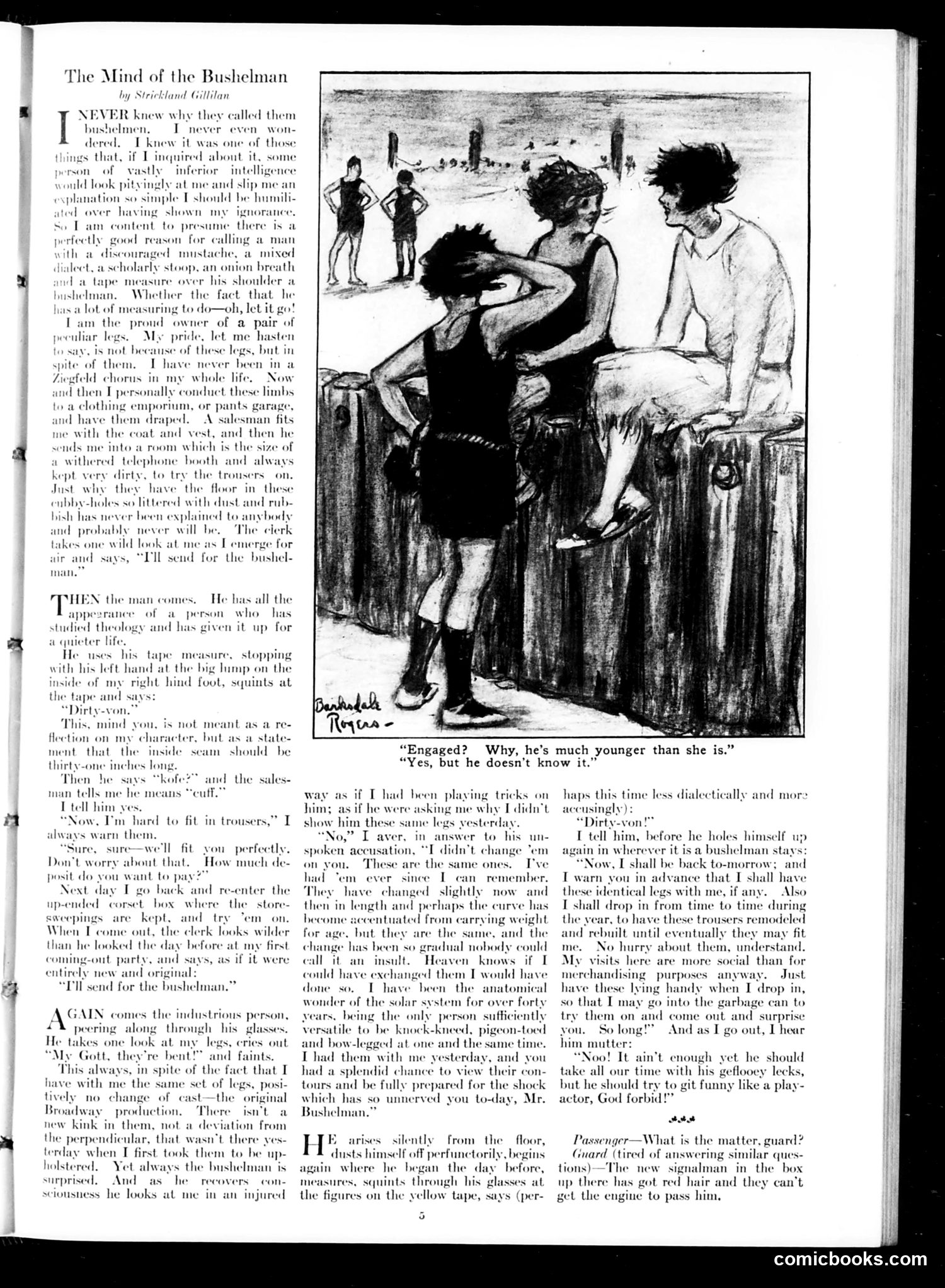
This page contains a humorous essay ("The Mind of the Bushelman") by Strickland Gillilan about the peculiar trade of a "bushelman"—a tailor's specialist who alters and repairs men's clothing, particularly trousers. The narrator satirizes the bushelman's theatrical dramatics: despite measuring the same customer's legs repeatedly over time and finding them unchanged, the bushelman feigns shock and injury, as if the customer deliberately altered his own anatomy between fittings. The joke targets the bushelman's performative incompetence—he's surprised each visit, blames the customer, yet delivers no real solutions. The accompanying cartoon (captioned "Engaged? Why, he's much younger than she is"/ "Yes, but he doesn't know it") is unrelated social satire about a woman engaged to a younger man who's unaware of the age gap. The piece mocks both working-class tailoring trades and masculine vanity about clothing fit through deadpan exaggeration of the narrator's "peculiar legs."
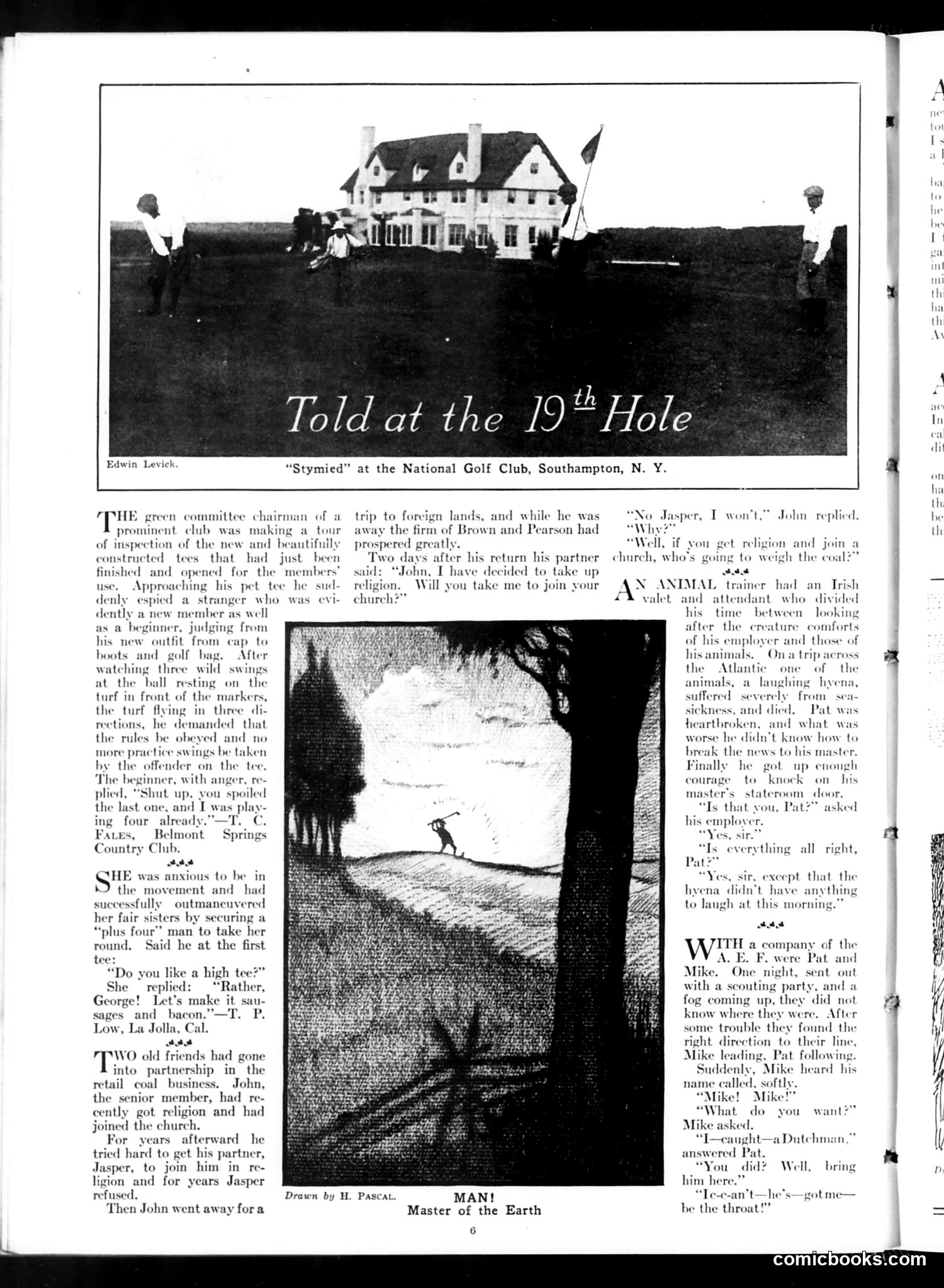
This page contains three separate humorous anecdotes told in golf club settings, typical of Judge's satirical humor. **Top image**: Shows a golf clubhouse at the National Golf Club, Southampton, NY—the setting for the stories below. **Main stories**: 1. A golf club committee chairman scolds a new member for practicing swings improperly, insisting rules be followed. The humor lies in the chairman's pompous enforcement of etiquette. 2. A woman secures a "plus four" man (a skilled golfer) for a round and asks if he likes "high fees"—an apparent pun on golf handicaps that he misinterprets as a question about church donations and morality. 3. Two business partners—John (newly religious) and Jasper—where John repeatedly pressures Jasper to join his church. The irony suggests John's newfound piety doesn't overcome his annoying persistence. The illustration labeled "MAN! Master of the Earth" (by H. Pascal) appears unrelated to the text stories. These represent typical early-20th-century Judge humor: genteel social satire mocking clubmen, religious hypocrisy, and romantic misunderstandings.
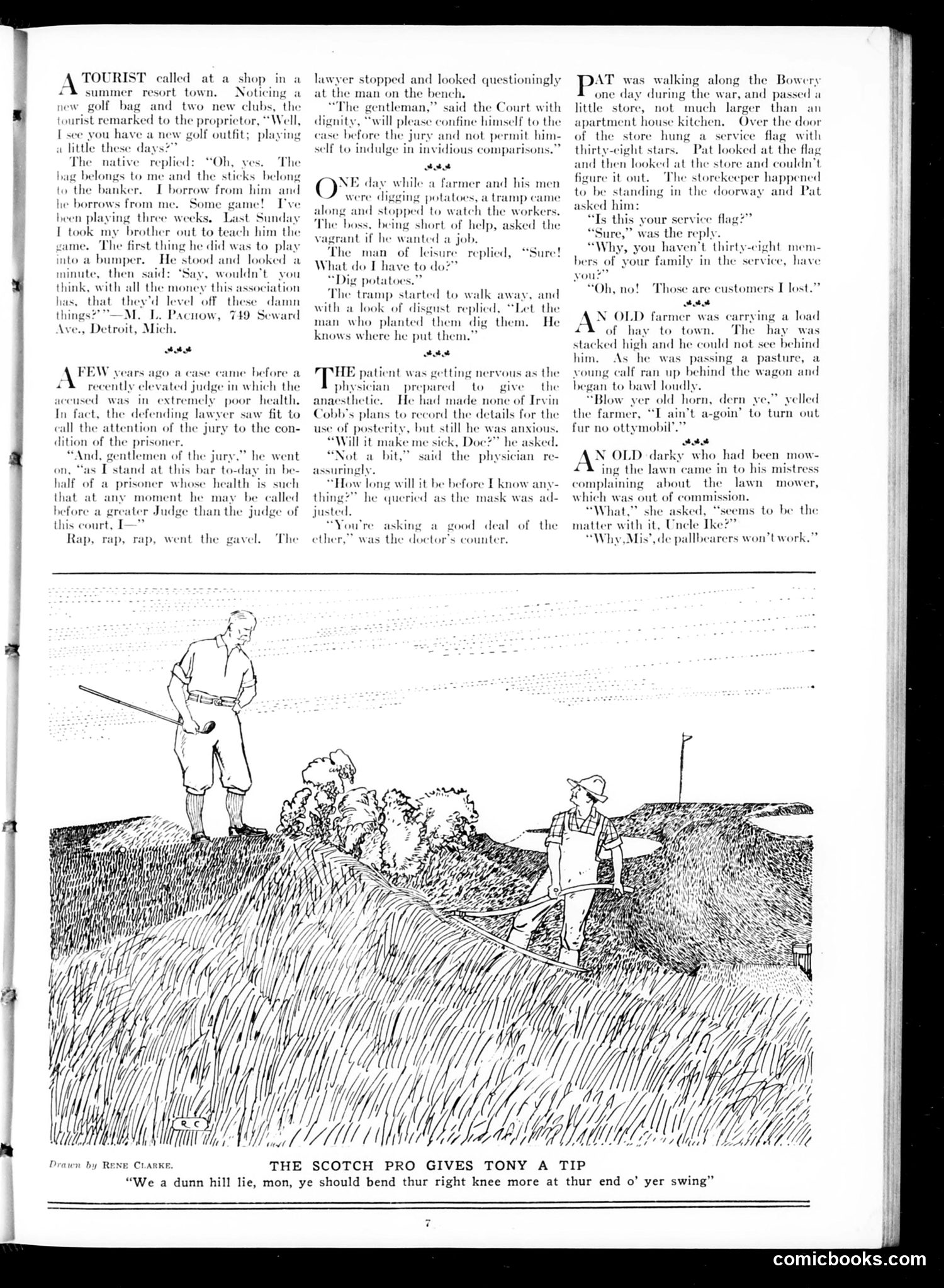
This page contains five separate humorous anecdotes typical of Judge's satirical style: 1. **The Golf Outfit Story**: A tourist notices new golf clubs at a resort shop. The proprietor explains they're shared through a chain of borrowing—he borrows from a banker, who borrows from him—satirizing the interconnected debts and financial dependencies of the era. 2. **The Court Dignity Joke**: A judge instructs a gentleman not to make "invidious comparisons," poking fun at judicial pomposity. 3. **The Service Flag Confusion**: A storekeeper displays a service flag (indicating family members in WWI), but when asked if 38 members of his family serve, admits they're actually "customers I lost"—dark wartime humor about business losses. 4. **The Automobile vs. Farmer**: An old farmer refuses to move his wagon for an automobile, humorously resisting modern technology. 5. **The Lawn Mower and Domestic Help**: An African American worker reports the lawn mower won't work, reflecting period racial dynamics and domestic service relationships. The bottom illustration by René Clarke shows a Scottish golf pro instructing someone named Tony on proper swing technique—a visual joke about Scottish golf expertise.
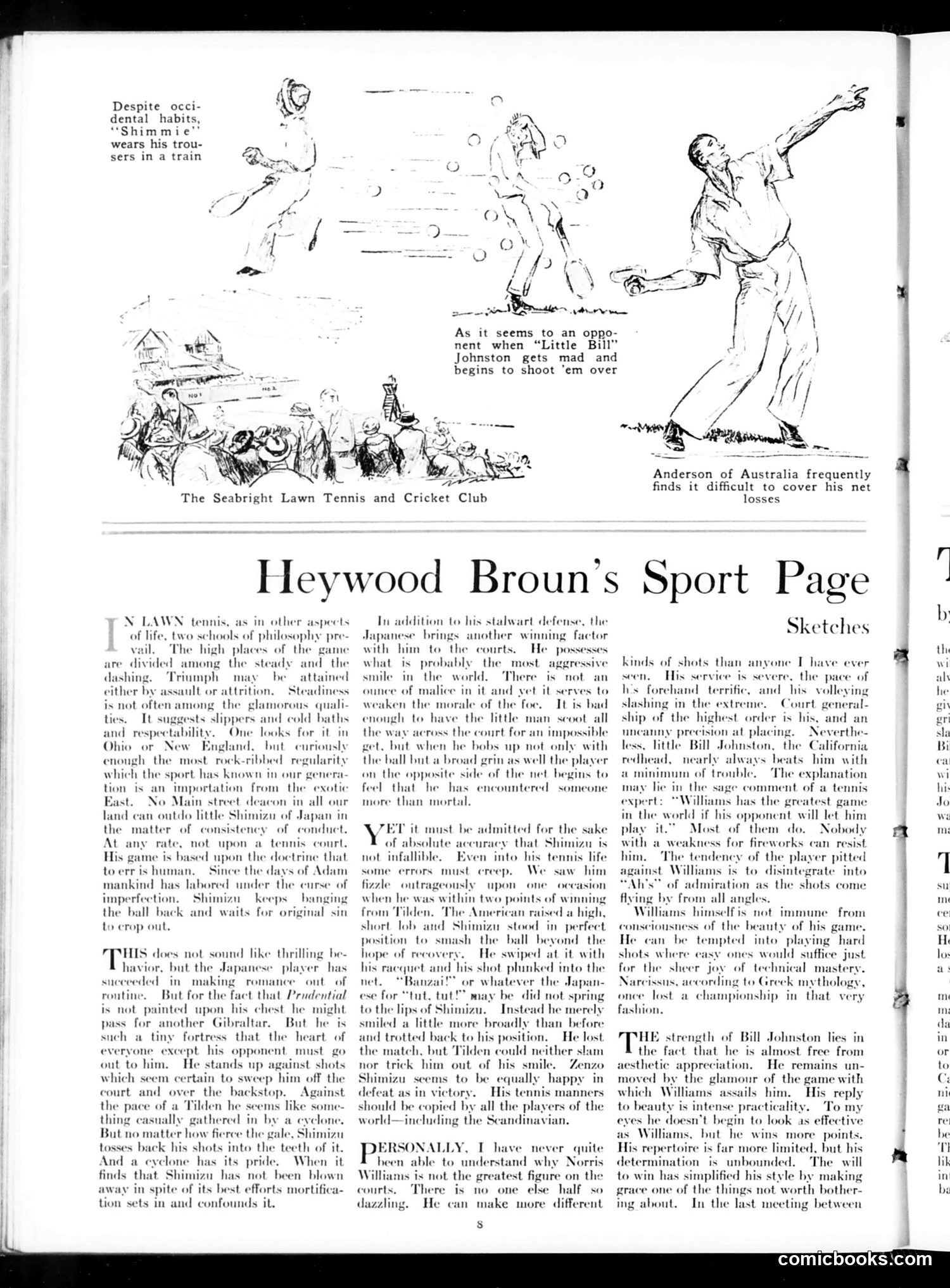
This is a sports commentary page featuring sketches of tennis players. The cartoons mock specific athletes: **"Shimmie"** (top left) appears to reference a player known for the "shimmy" dance—a popular 1920s fad—suggesting he wears trousers in a train despite Western habits, likely poking fun at cultural differences. **"Little Bill" Johnston** (center) is depicted shooting tennis balls wildly when angered, capturing his reputation for aggressive, emotional play. **Anderson of Australia** (right) struggles comically to cover his net—a visual pun on his "net losses" in matches. The main article by Heywood Broun discusses Japanese player **Shimizu**, praising his consistent, defensive style and cheerful demeanor as philosophically superior to Western aggression. Broun contrasts him with American stars like **Tilden**, **Williams**, and **Johnston**, critiquing American players' emotional volatility and unsportsmanlike conduct. The piece advocates for Shimizu's grace-under-pressure approach as a model for international tennis etiquette—a backhanded compliment wrapped in sports criticism.
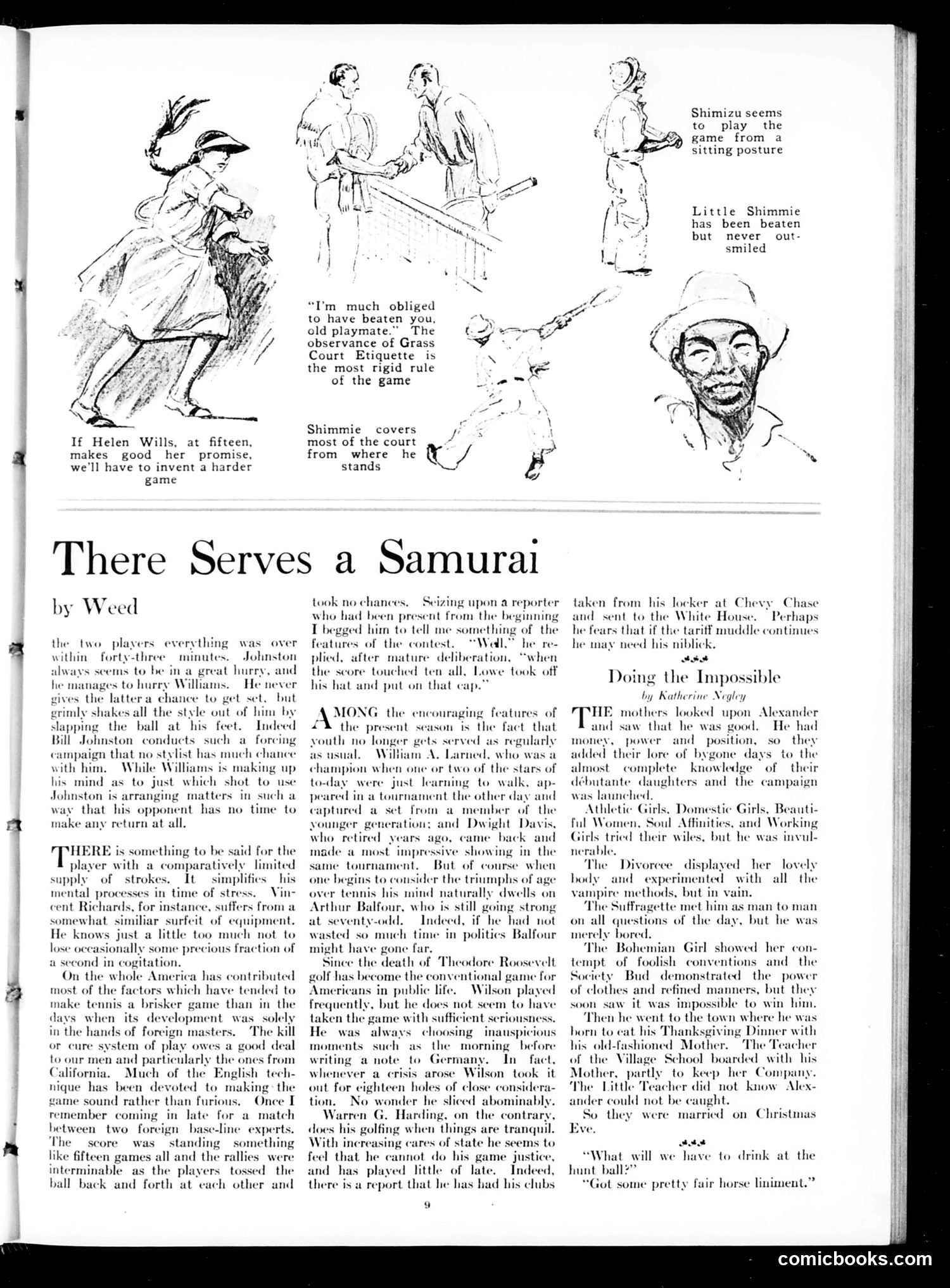
This page satirizes tennis players and American political figures through a sports column by Weed. The top cartoons mock **Seiichiro Kashio** ("Shimizu"), a Japanese tennis player, depicting him in exaggerated caricatured poses with racist stereotyping. The text emphasizes his unusual "sitting posture" and constant smiling—playing into period xenophobic tropes about Japanese people. The main article discusses American tennis champions like **Bill Johnston** and **Helen Wills**, praising American aggressive playing style versus European baseline techniques. The final section compares how U.S. Presidents engaged with golf: **Theodore Roosevelt** played seriously; **Woodrow Wilson** played infrequently and poorly (the text mocks his "sliced abominably"); and **Warren G. Harding** plays less due to state burdens. The satire's point: American vigor and efficiency—in tennis and governance—surpasses foreign (European and Asian) approaches, while also subtly critiquing presidential distractions during serious times.
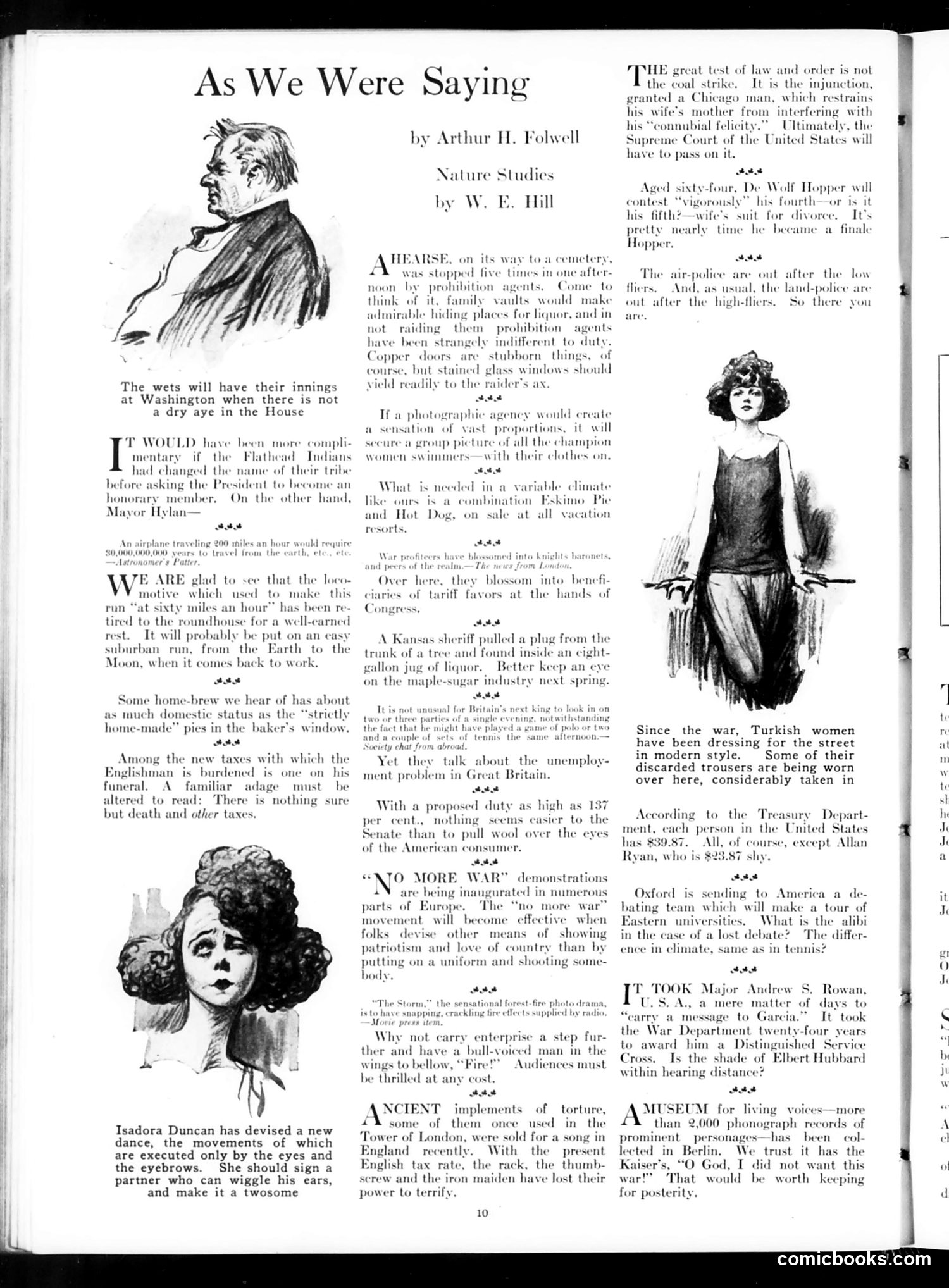
This page collects brief satirical commentary on contemporary issues, circa early 1920s (Prohibition era). The sketches by W.E. Hill and text by Arthur H. Folwell target: **Prohibition enforcement**: Jokes mock agents' ineffectiveness at stopping liquor—family vaults and stained-glass church windows are suggested hiding spots they overlook. **Tariffs & economics**: References a proposed 137% duty, mocking the Senate's ease in deceiving consumers economically. **Celebrity culture**: Isadora Duncan's avant-garde eye-movement dance is ridiculed; aging performer De Wolf Hopper's repeated divorces are joked about. **International politics**: "No More War" European peace movements are dismissed as ineffectual without substance beyond uniforms and rhetoric. **British taxation**: Torture implements lose their power under heavy English tax rates—a dark joke about financial burden. The tone is cynical, worldly commentary on contemporary absurdities—typical Judge magazine fare mocking politicians, celebrities, and social hypocrisy.
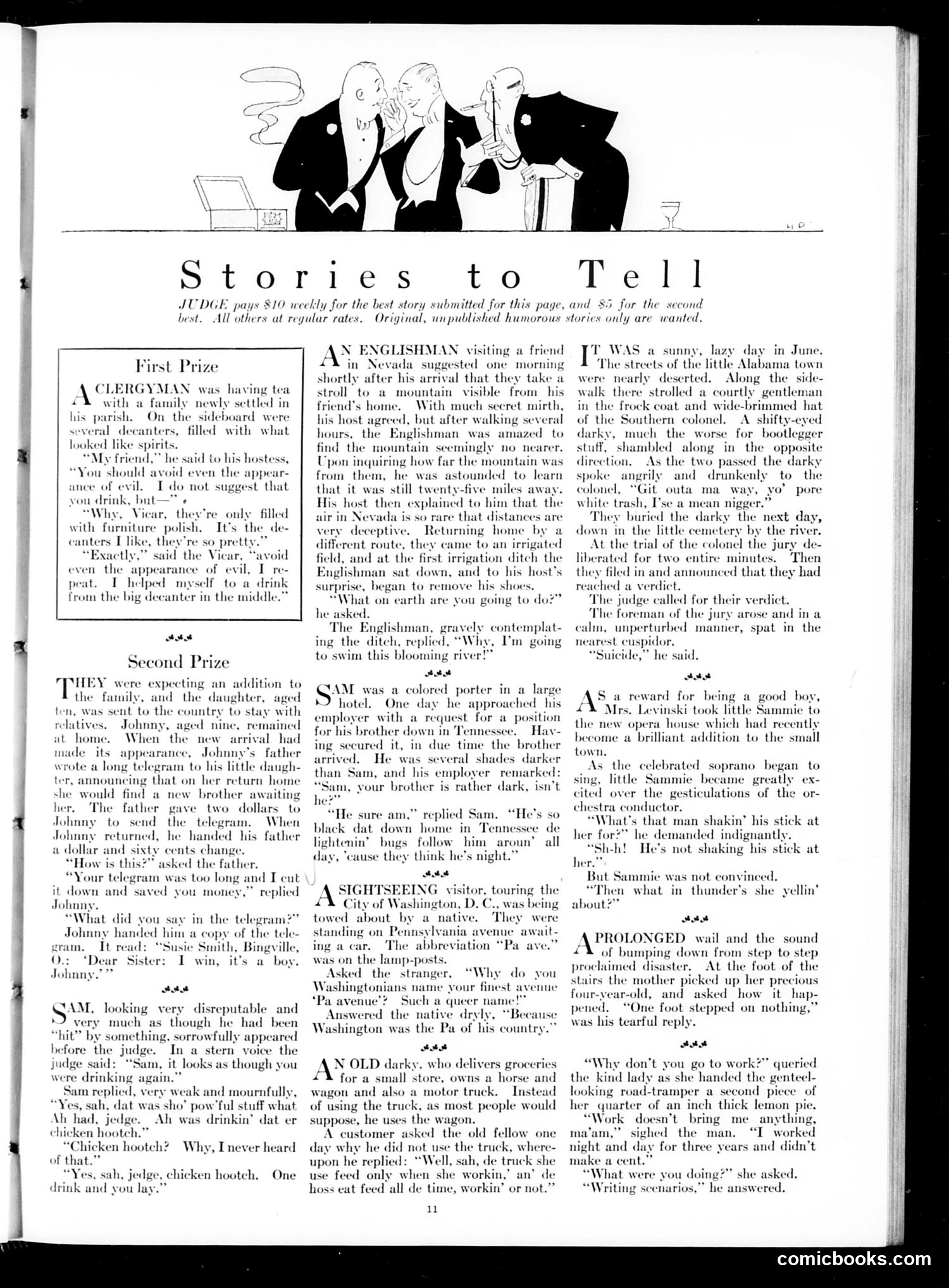
This page from *Judge* magazine contains humorous short stories rather than political cartoons. The content reflects early 20th-century American social attitudes and humor: **Key Stories:** 1. **"A Clergyman"** — A vicar lectures about avoiding evil appearances while secretly drinking furniture polish, satirizing hypocrisy among religious figures. 2. **"Johnny's Telegram"** — A child economizes on a telegram announcing a sibling's birth by abbreviating it to "It's a boy," poking fun at penny-pinching. 3. **"Sam and the Mountain"** — An Englishman is fooled by Nevada's clear air creating optical illusions about distance, mocking gullibility and regional differences. 4. **Racial Humor** — Multiple stories feature stereotypical depictions of Black Americans using exaggerated dialect ("sah," "jedge"), reflecting the casual racism endemic to 1920s American publishing. The magazine's humor targets hypocrisy, regional stereotypes, and class differences, though the racial content today appears offensive and represents historical prejudices normalized in that era.
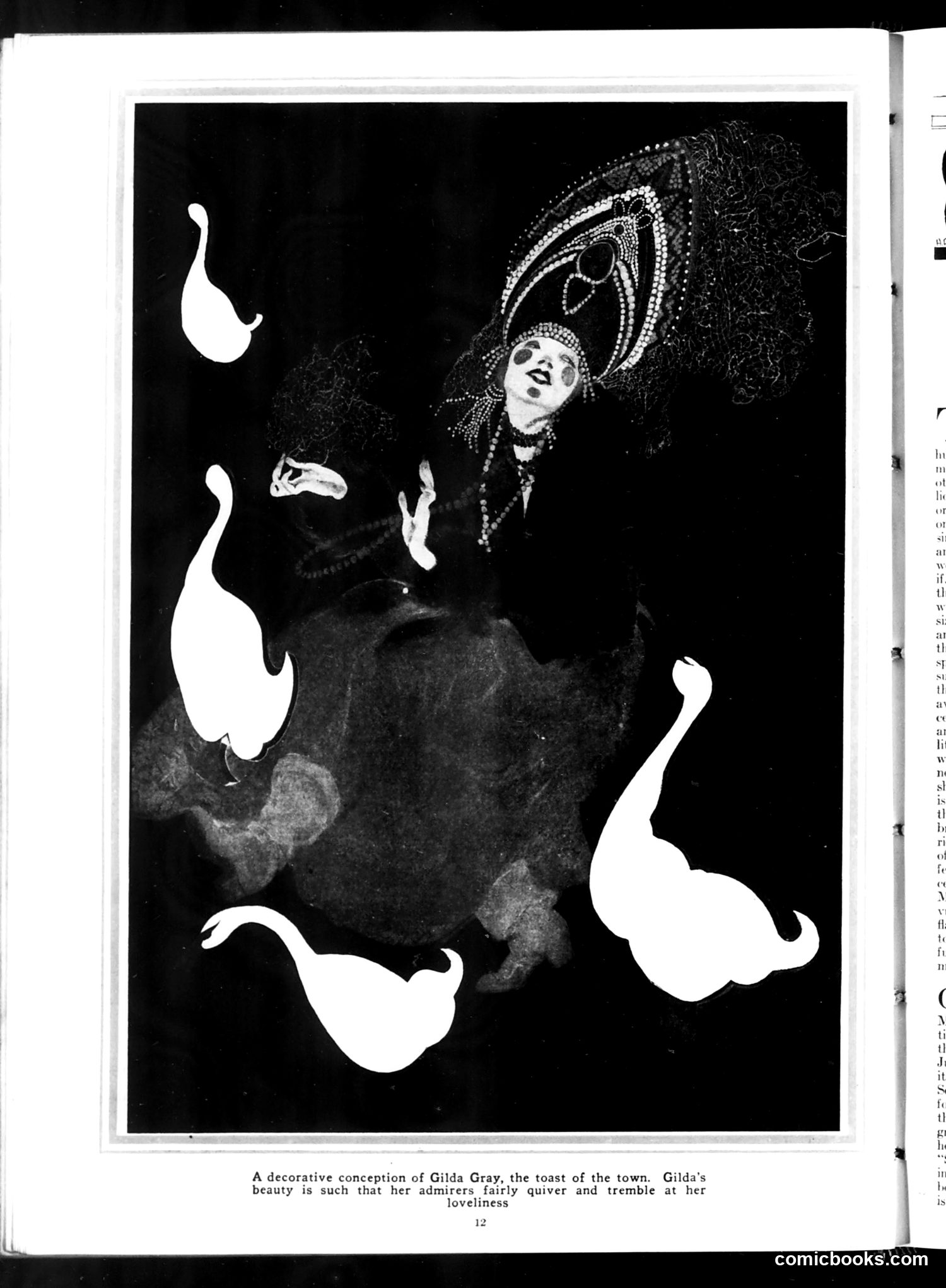
This is a stylized portrait of **Gilda Gray**, a performer who was popular during the Jazz Age (likely 1920s based on the Art Deco styling and "toast of the town" phrasing). The image depicts her wearing an ornate, elaborate headdress with geometric patterns and jeweled details—typical of flapper-era fashion. The satirical point is expressed in the caption: her beauty supposedly causes admirers to "quiver and tremble." The accompanying white bird or swan figures surrounding her appear to represent this exaggerated emotional response—they're depicted as trembling or swooning figures. This is gentle satire of celebrity worship and the breathless admiration directed at glamorous entertainers of the period. The "decorative conception" suggests an idealized, almost surreal portrayal rather than realistic representation, poking fun at how fans and media elevated and aestheticized popular performers.
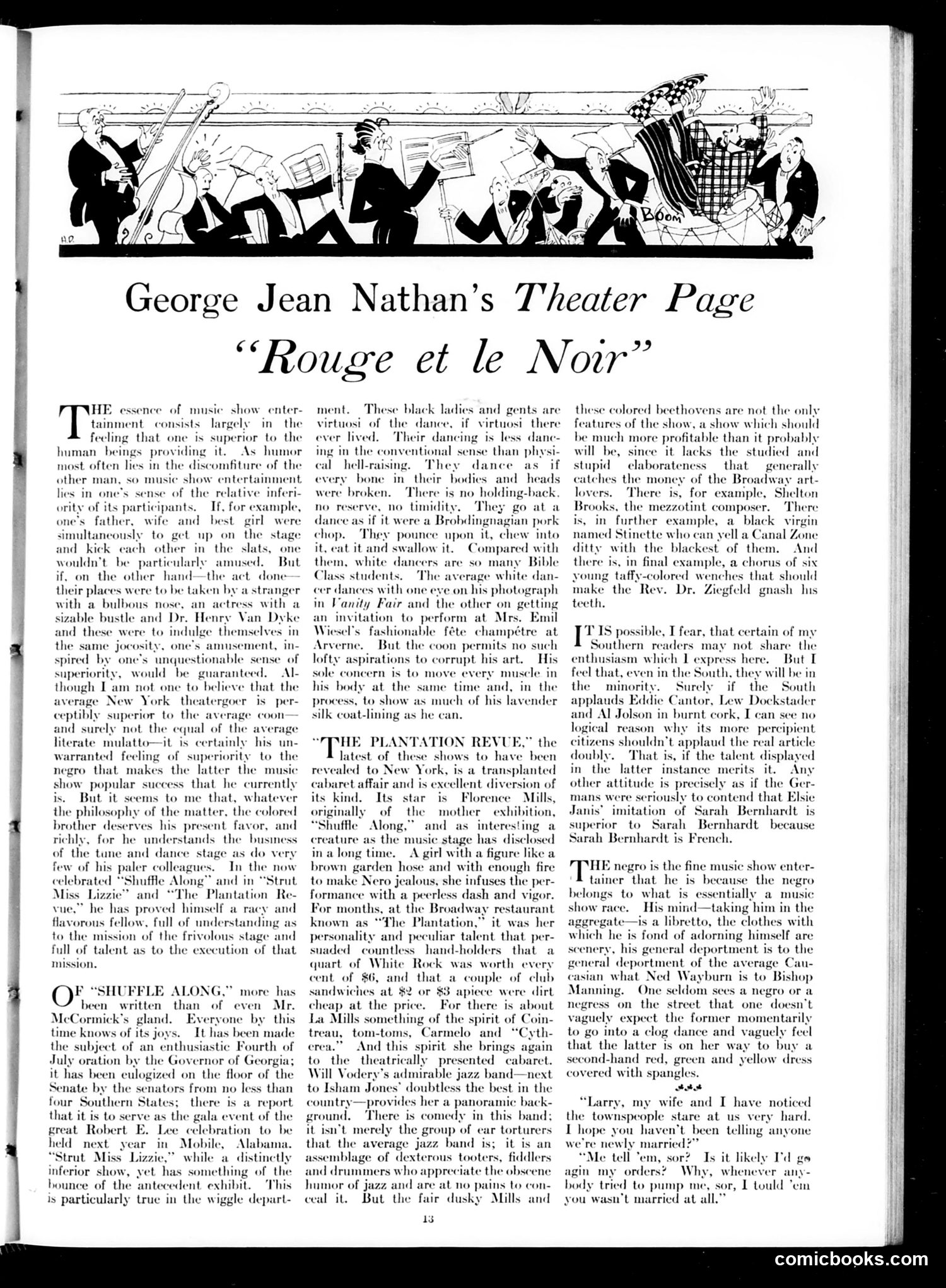
This is theater criticism by George Jean Nathan, a prominent drama critic, reviewing Black musical shows including "Shuffle Along," "Strut Miss Lizzie," and "The Plantation Revue." Nathan argues that music show entertainment depends on audiences feeling superior to performers. He then makes an explicitly racist claim: white theatergoers enjoy Black performers partly due to racial prejudice, though he acknowledges Black performers possess genuine talent and superior understanding of "the tune and dance stage." He praises Black dancers' uninhibited physicality—describing their movement as "hell-raising" and comparing them favorably to restrained white dancers. He celebrates Florence Mills and other performers. The page reflects 1920s critical attitudes: praising Black artistic achievement while simultaneously embedding it within a framework of racial hierarchy and condescension typical of that era's "sophisticated" commentary.
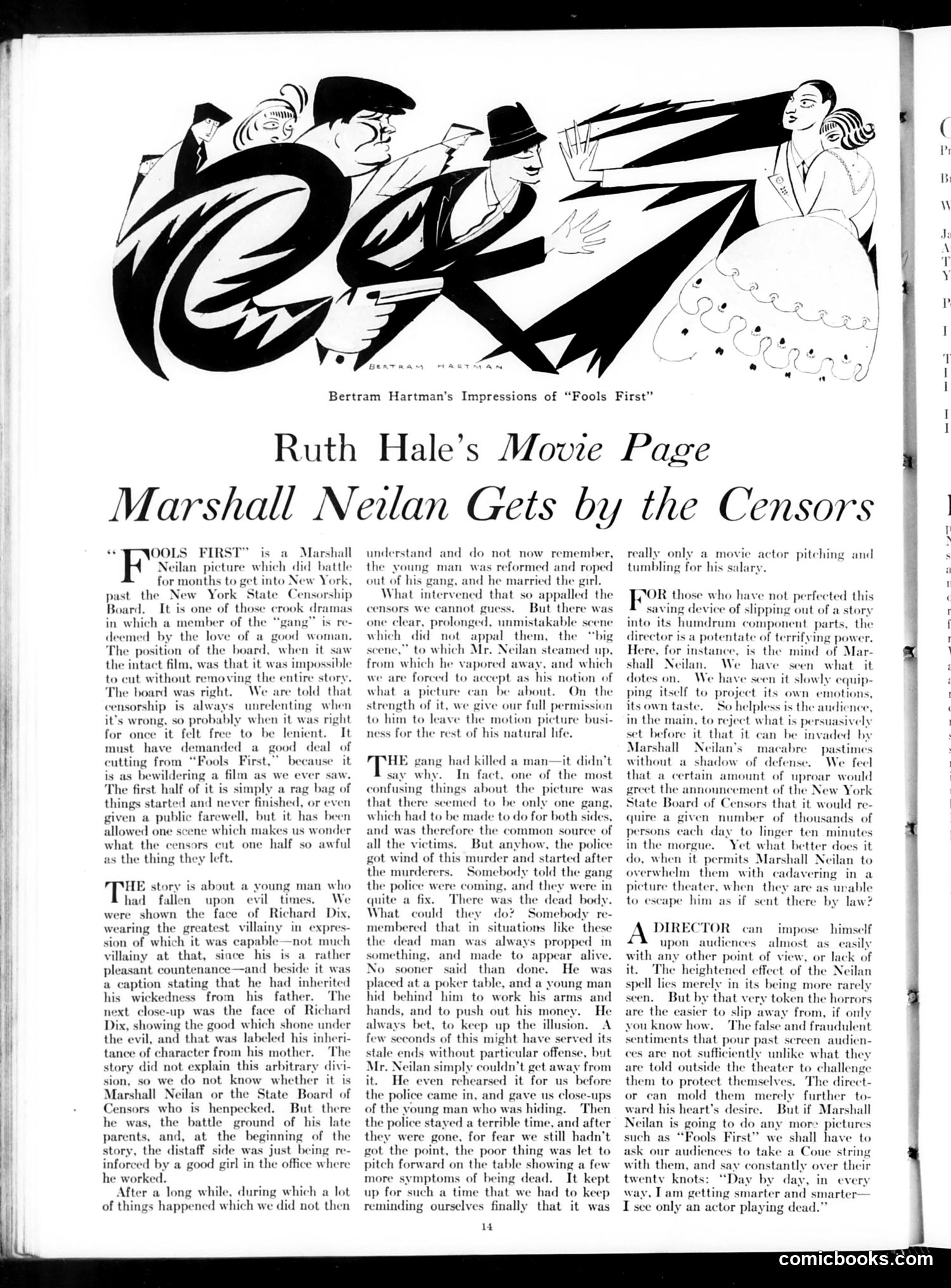
This is a film review by Ruth Hale critiquing director Marshall Neilan's movie "Fools First" (1922), which stars Richard Dix. The cartoon at top, by Bertram Hartman, satirically depicts the film's chaotic plot through dynamic, tangled lettering—visual shorthand for narrative confusion. Hale's review mocks the film's incoherence: a crime drama about a reformed gangster that she finds bewildering and poorly constructed. She particularly ridicules an extended scene where the gang props up a murdered corpse at a poker table to deceive arriving police—a sequence so prolonged and repeatedly shown that it becomes absurd rather than dramatic. The satire targets both Neilan's directorial choices (obsessing over one grotesque gag) and the New York State Censorship Board, which struggled to cut the film without destroying it entirely. Hale sarcastically "permits" Neilan to leave filmmaking, suggesting his artistic judgment is fundamentally flawed. The piece exemplifies 1920s film criticism's blunt, comedic style.
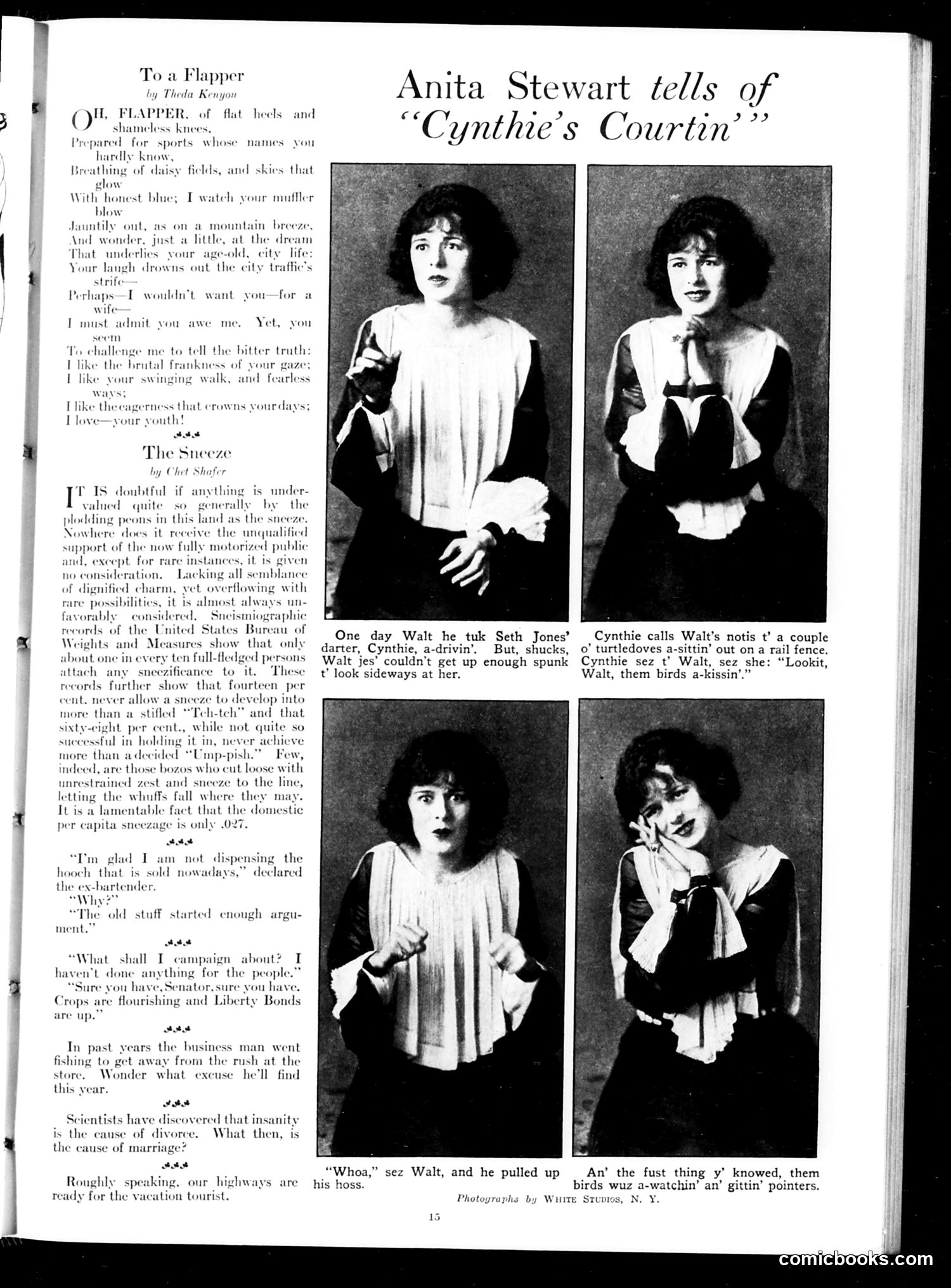
This page features a serialized photo-story starring actress Anita Stewart. The narrative depicts a rural courtship: Walt drives Seth Jones's daughter Cynthie but is too shy to show interest. When Cynthie points out two turtledoves kissing on a fence rail, the hint works—Walt finally reciprocates her affection. The humor relies on rustic dialect ("tuk," "jes'," "sez") and the comedic premise that Walt needed nature's example to overcome his bashfulness. The accompanying photographs show Cynthie's expressive reactions as she tries—successfully—to prompt Walt's romantic attention. For modern readers: this reflects 1920s entertainment that presented rural courtship as quaint and humorous to urban audiences. The "flapper" poetry on the left page provides cultural contrast—celebrating modern young women's boldness—while "Cynthie's Courtin'" shows traditional courtship dynamics in an idealized countryside setting.
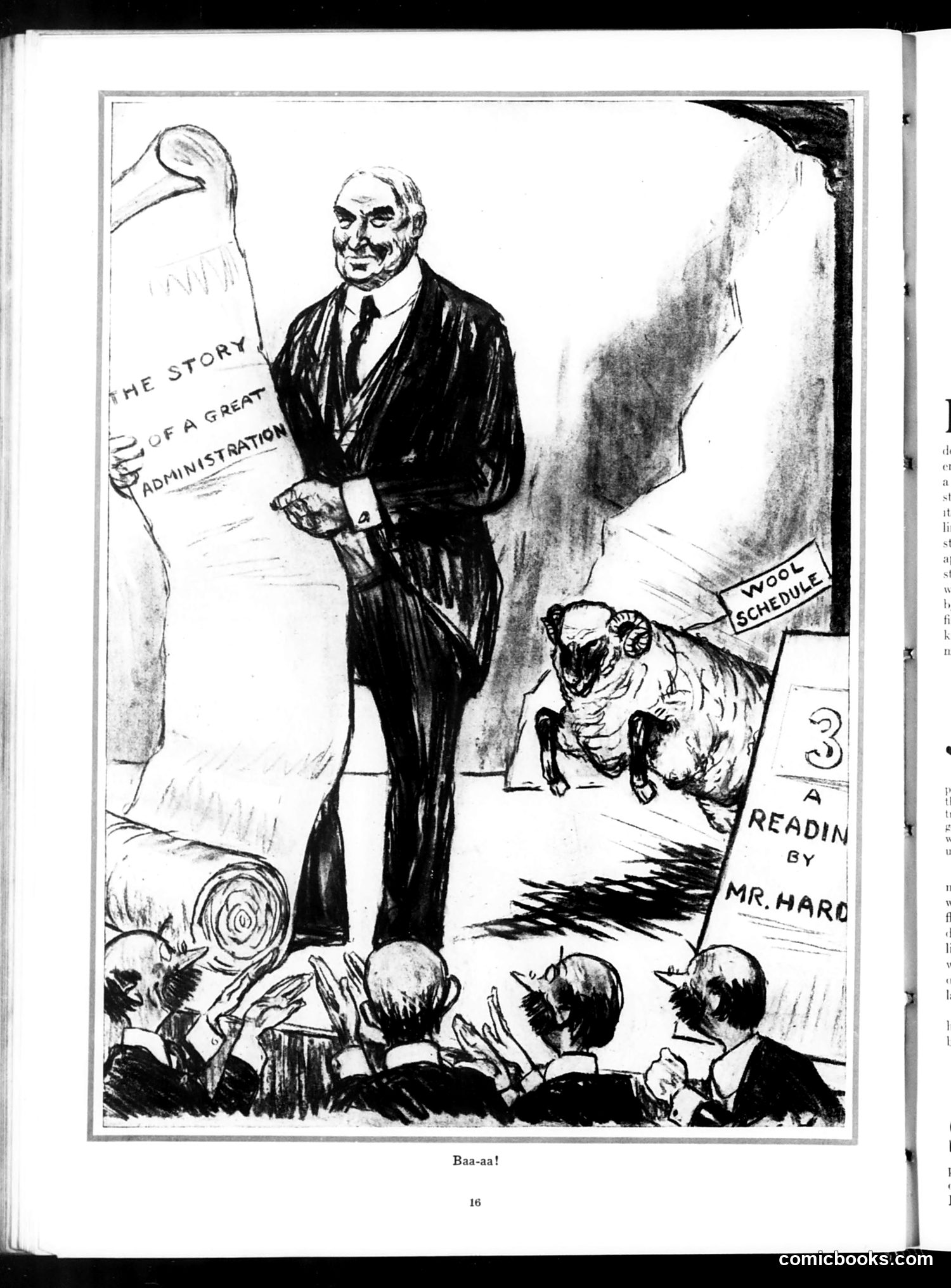
This satirical cartoon depicts a well-dressed man presenting "The Story of a Great Administration" to an audience of schoolchildren. The man appears to be a political figure or administrator defending his record. The humor lies in the visual metaphor: the audience consists of sheep (depicted as childlike figures with sheep characteristics), and a goat wearing a "School Schedule" label sits prominently. The title "Baa-aa!" mimics sheep bleating, suggesting the audience is being treated like mindless animals who will uncritically accept whatever narrative they're told. The satire criticizes how political administrations present their records to the public—implying the citizenry are gullible "sheep" who simply accept official propaganda without critical thinking. The school setting adds another layer: children (and by extension, an uninformed public) are being fed a sanitized version of events.
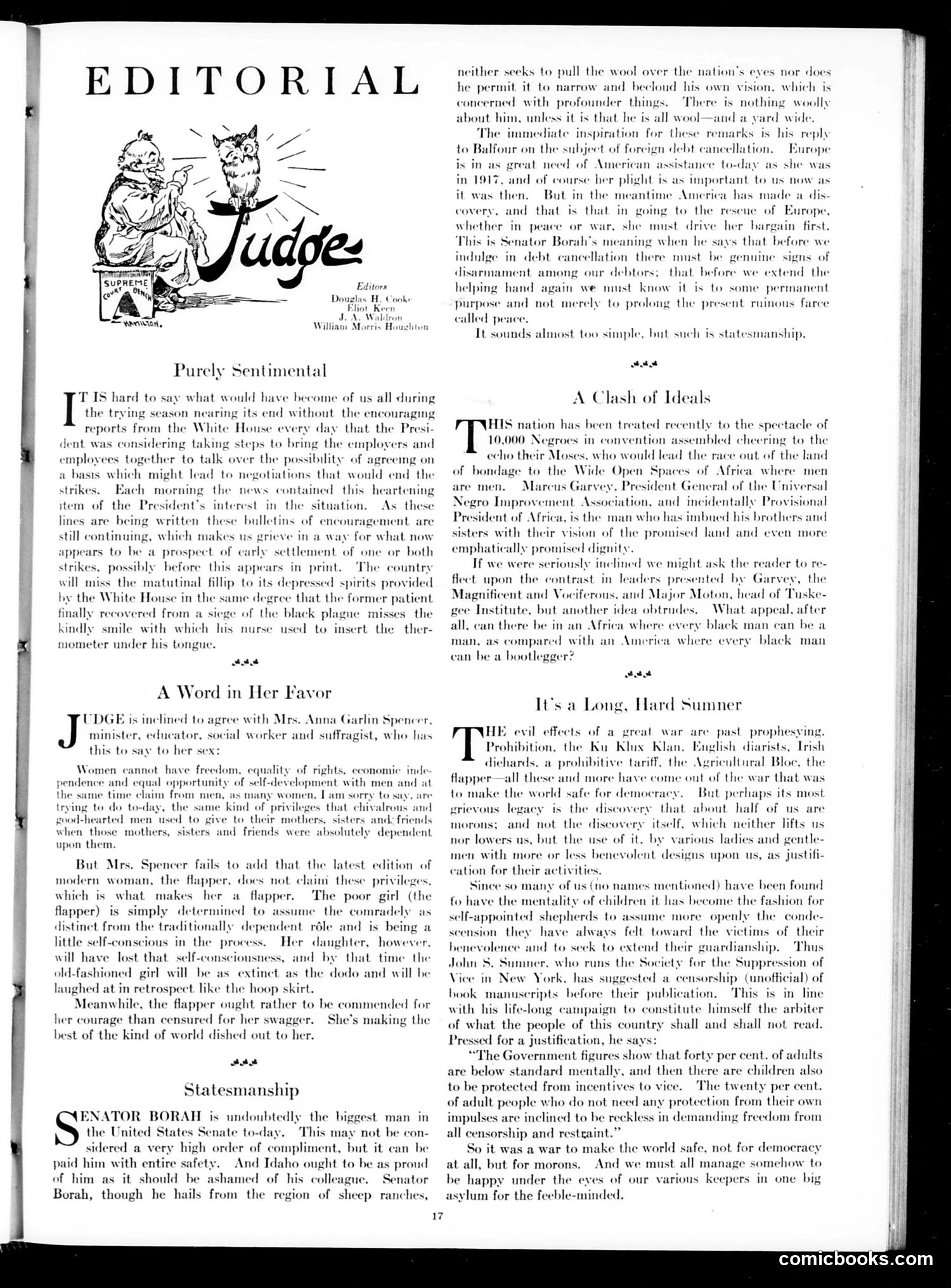
This Judge editorial page from the 1920s addresses post-WWI American politics through four satirical pieces: **"Purely Sentimental"** mocks President Wilson's strike negotiations as performative—comparing them to a plague patient missing his nurse's thermometer after recovery. **"A Word in Her Favor"** defends the "flapper" (modern independent woman) against critics like Anna Garlin Spencer, arguing young women deserve credit for claiming equality rather than blame for their "swagger." **"A Clash of Ideals"** ridicules a proposed Pan-African conference, sarcastically questioning whether an Africa could exist where "every black man can be a man" versus America where "every black man can be a bootlegger"—a caustic commentary on American racial inequality. **"Statesmanship"** praises Senator William Borah of Idaho for opposing debt forgiveness to Allied nations without first seeing genuine European disarmament—framing sound fiscal policy as principled leadership. The cartoon shows the "Judge" mascot figure, the magazine's satirical voice.
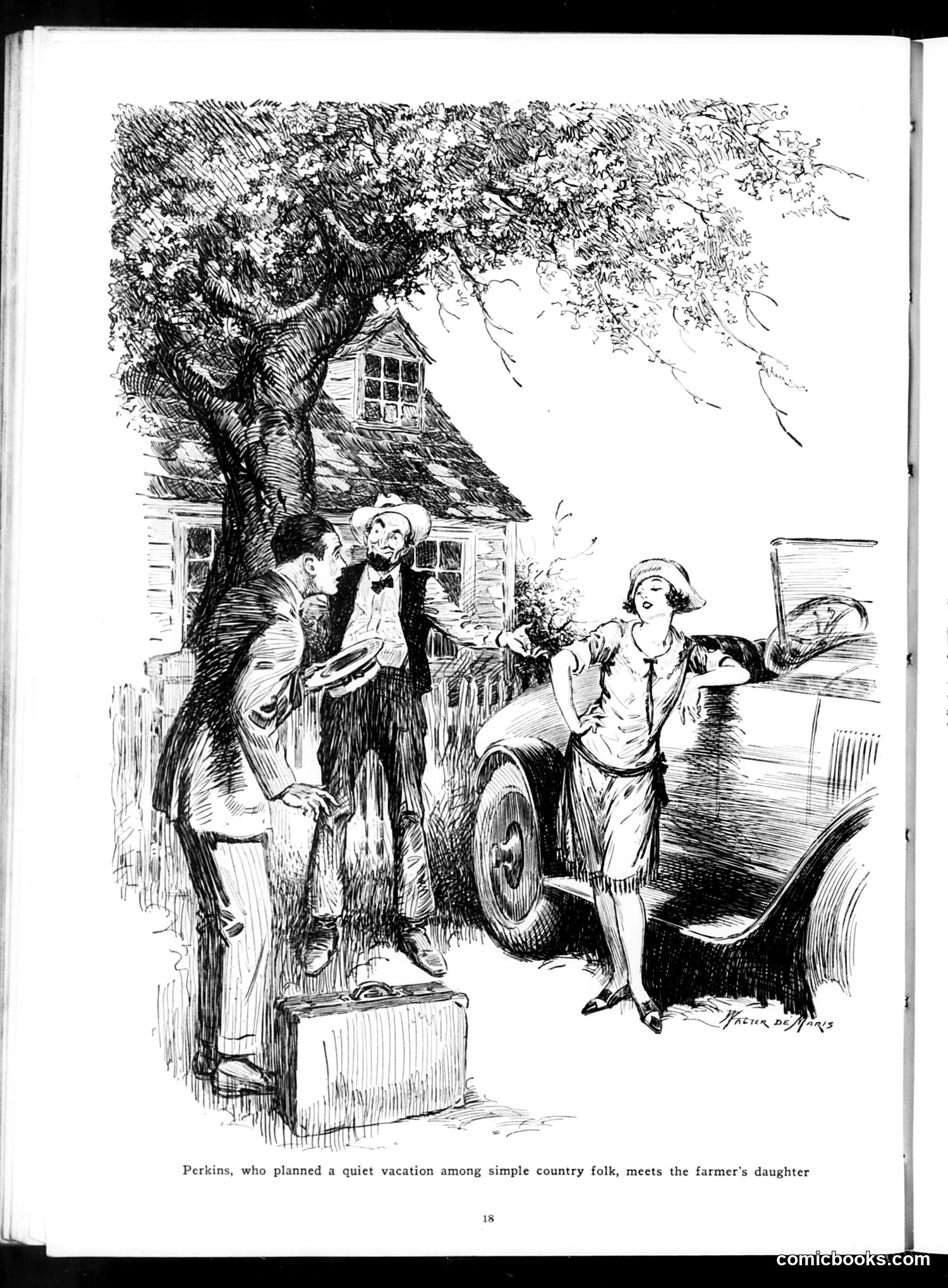
This is a humorous illustration depicting a social clash. A well-dressed urban man named Perkins (carrying a suitcase, suggesting travel) sought a peaceful country vacation among "simple folk." Instead, he encounters the farmer's daughter—depicted as a fashionable, modern woman in stylish 1920s dress, complete with a cloche hat and makeup. The satire mocks the romantic stereotype of rural simplicity. Rather than finding unsophisticated country people, Perkins meets someone equally or more urban and fashionable than himself. The joke plays on the era's tension between idealized rural life and actual modernity spreading everywhere, even to farms. Two men (likely a farmer and another local) observe the encounter with apparent amusement at Perkins's evident surprise. The cartoon reflects 1920s anxieties about changing social hierarchies and the inescapability of modern culture.
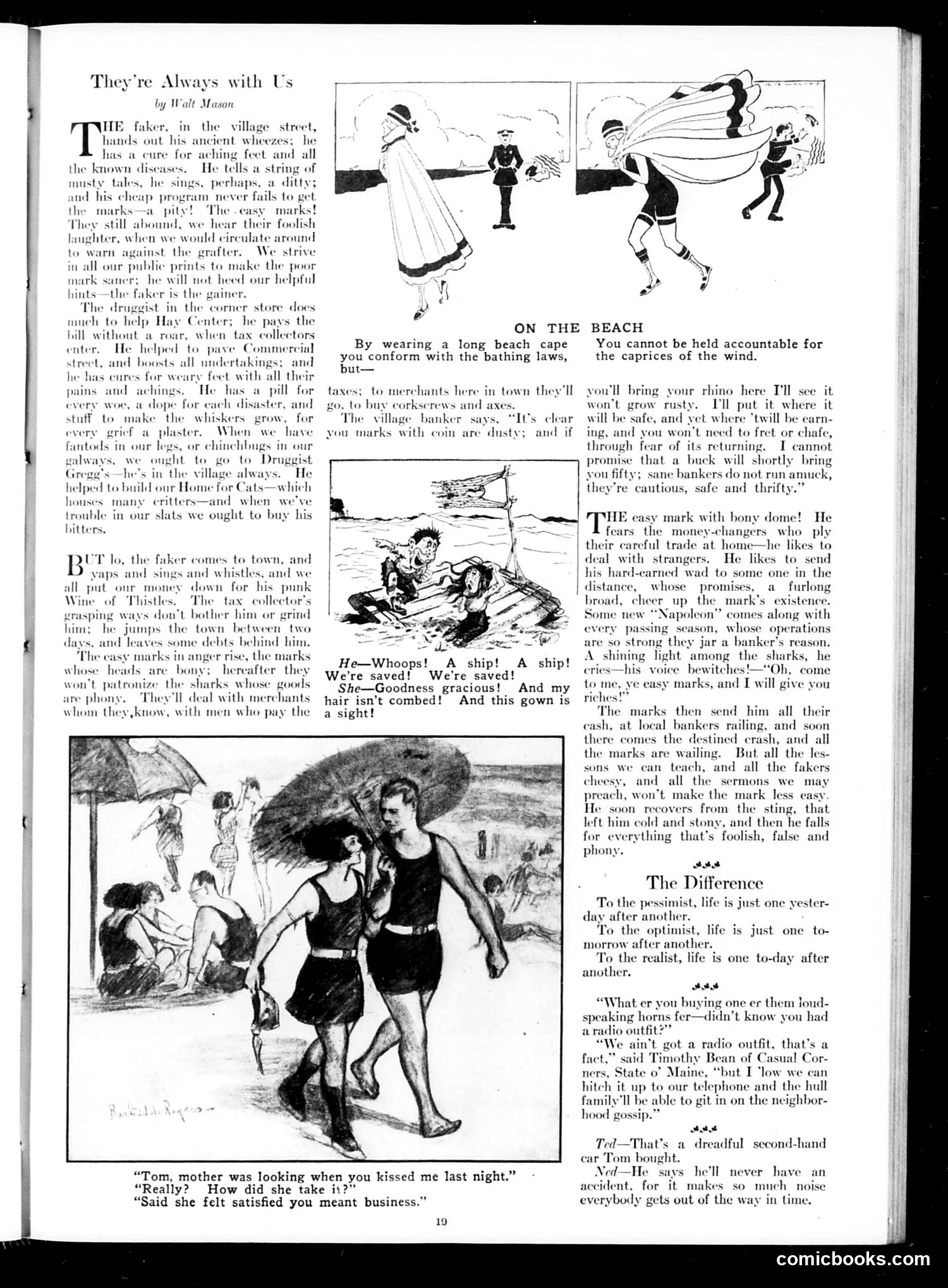
This page satirizes various con artists and fraudsters who prey on gullible people ("marks"). The main targets are: - **The faker/street vendor** peddling dubious cures and schemes, who skips town avoiding taxes - **Con men and swindlers** who lure victims with promises of riches - **The gullible public** who repeatedly fall for obvious scams despite warnings The satire's point: society's "easy marks"—ordinary people—keep losing money to transparent fraudsters because greed and desperation override common sense. Even the trustworthy druggist and honest merchants cannot compete with con artists' flashy appeals. The beach scene and the romantic exchange at bottom appear unrelated filler content, typical of Judge's miscellaneous humor format. The "Difference" poem at page's end—contrasting pessimist, optimist, and realist views—is standard philosophical humor of the era. This reflects Progressive Era anxieties (1910s-1920s) about urban con games and financial fraud targeting working-class Americans.
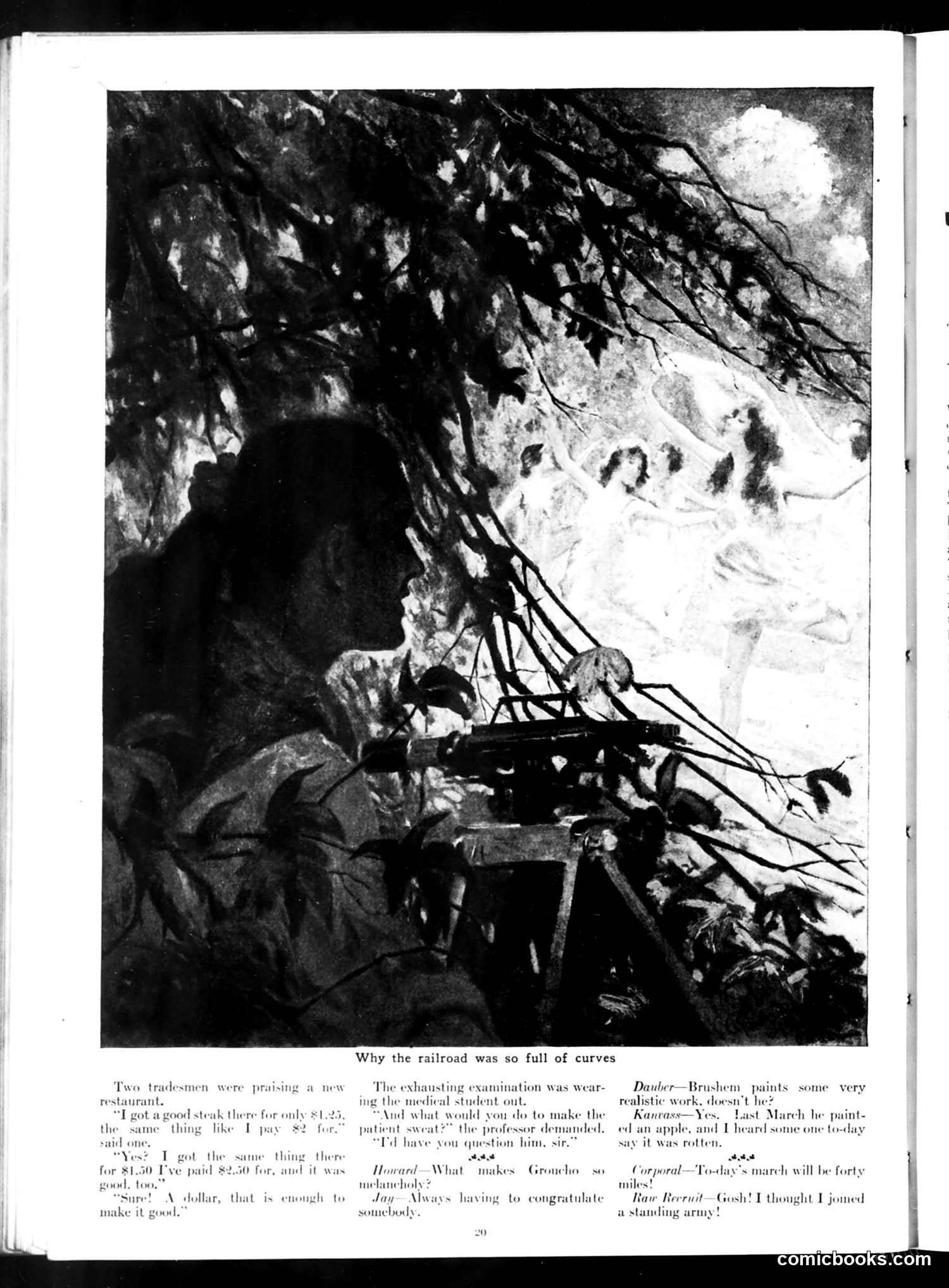
This page contains several brief jokes and a political cartoon titled "Why the railroad was so full of curves." **The main cartoon** depicts a railroad scene with a surveyor or engineer examining terrain under a tree, with a clear landscape visible. The caption sarcastically explains the railroad's winding path: the implication is that the railroad was built with unnecessary curves—likely a reference to corruption or incompetence in railroad construction, where engineers might deliberately create longer routes to inflate costs or contracts. **The smaller jokes** are workplace/professional humor: - Two tradesmen comparing restaurant prices and value - A medical professor testing a student on treating sweating patients - Banter about someone named Groucho being melancholy from congratulating people - An artist named Brushem being praised, then having his work called "rotten" - A recruit complaining about marching forty miles when he signed up for a "standing army" These appear to be generic satirical observations about everyday professional life, money, military service, and human nature rather than references to specific political events or figures.
This is a book review essay by Walter Prichard Eaton discussing Hamlin Garland's collected fiction. The decorative header shows two Egyptian-style scribes flanking an open book. The satire targets contemporary literary criticism and the "new generation" of critics who dismiss older work. Eaton contrasts Sherwood Anderson (praised as "brilliant promise" despite being nearly fifty years old) unfavorably with Garland, whose 1890s prairie fiction—particularly "Rose of Dutcher's Coolly"—remains superior to modern novels. The critique argues Garland's strength lies in authentic Midwestern realism: truthful depiction of rural life, genuine characters, and emotional depth. His later Rocky Mountain stories failed because he descended into "he-man" clichés and artificial nobility rather than honest portrayal. Eaton's point: solid literary achievement from the "antediluvian '90's" outweighs fashionable contemporary work lacking substance—a defense of older American literature against dismissive modernist criticism.
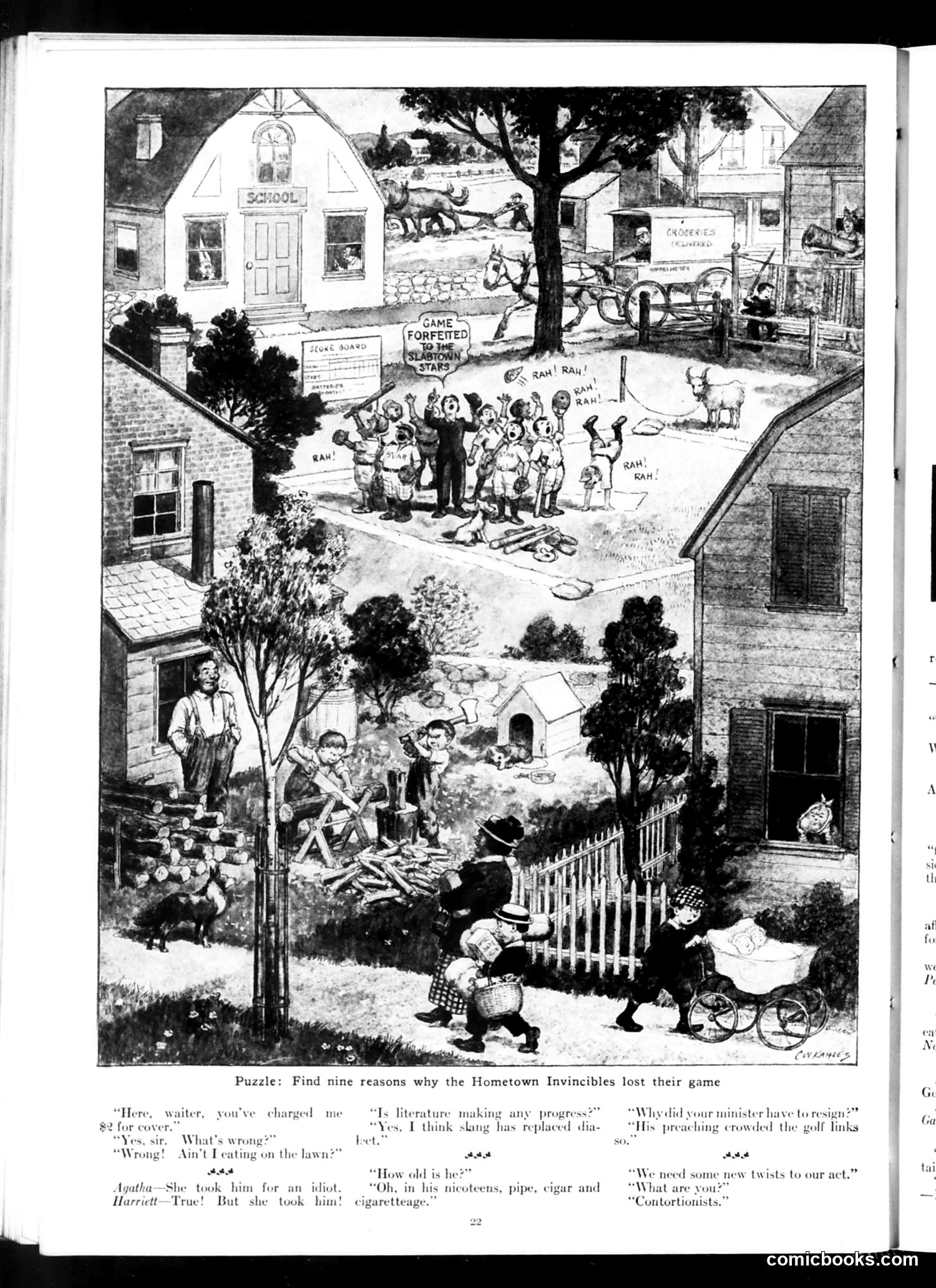
This page from *Judge* magazine features a satirical puzzle illustration depicting a small-town American scene where a baseball team called the "Hometown Invincibles" has lost their game. The cartoon critiques various social disruptions and moral failures affecting the community. The visual puzzle challenges readers to identify nine reasons for the team's defeat, which are illustrated throughout the scene: adults neglecting supervision, eating violations, ministerial scandal (the preacher resigned because his sermons competed with golf for attendance), literature concerns, circus/entertainment distractions, and other social disorders. The accompanying dialogue snippets mock contemporary social anxieties—overcharging at restaurants, improper dining etiquette, clergy moral lapses, and changing entertainment tastes. The satire suggests that early 20th-century American small-town life was fragmenting due to competing leisure activities, commercialism, and shifting values, all symbolized through the baseball team's failure. The tone is gently mocking rather than harshly political.
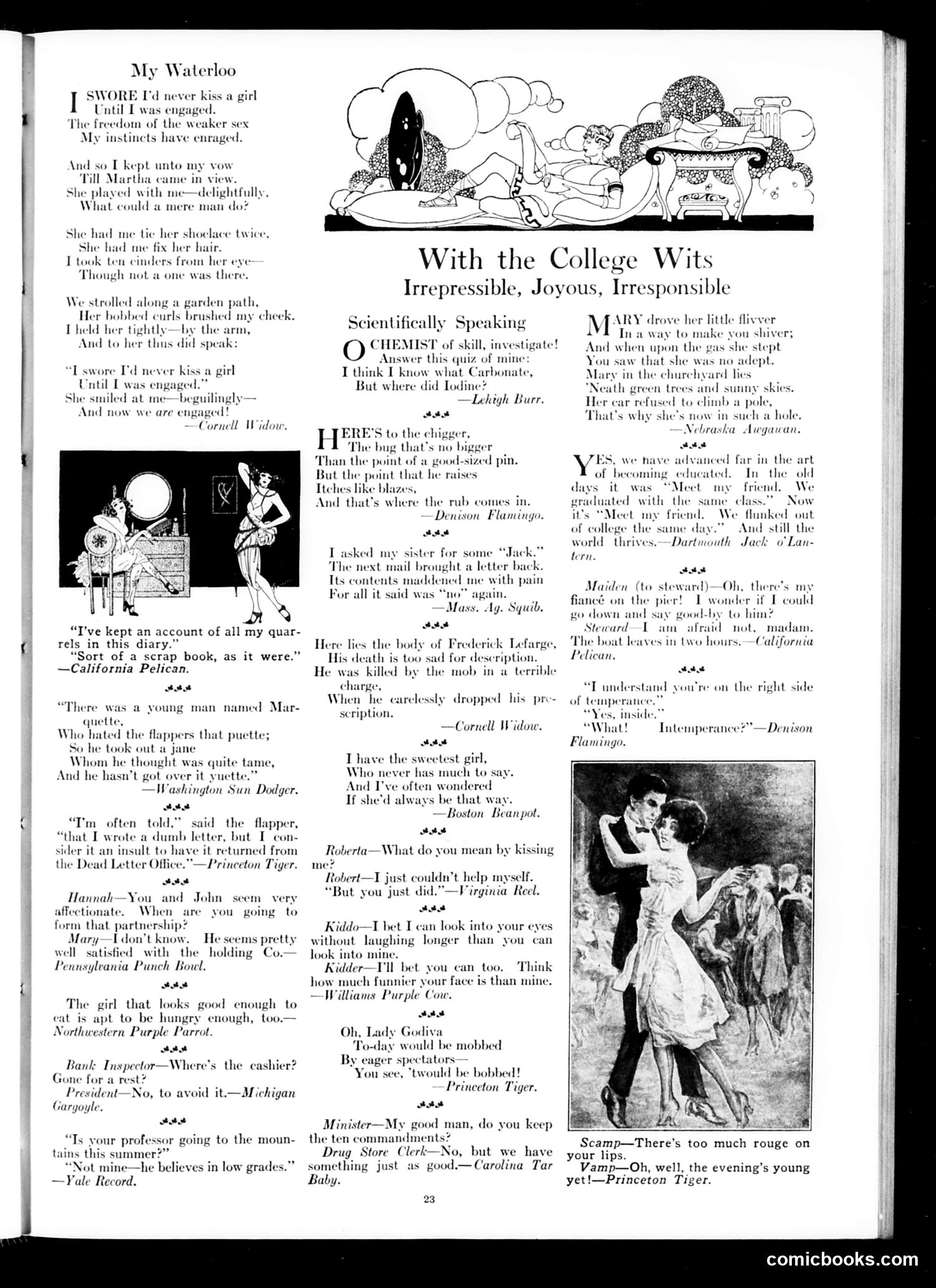
This page collects humorous verses and jokes from college publications, primarily centered on dating, courtship, and the "modern girl" of the Jazz Age. **Main themes:** The title poem "My Waterloo" satirizes a young man who swore never to kiss a girl before engagement, but succumbs to flirtation from "Martha"—a commentary on how the "weaker sex" (women gaining new social freedom) subverts male intentions through charm. **Social context:** References to "flappers" (modern, independent young women), "bobbed" hair, "flivvers" (Model T cars), and casual dating reflect anxieties about changing gender roles and female independence in the 1920s. Multiple jokes play on the tension between traditional courtship rules and new female assertiveness. **The humor:** Mostly puns and wordplay targeting college students, professors avoiding work, and the perceived foolishness of both genders in romantic situations. The cartoons and typography suggest this appeals to college-age readers from elite universities (Yale, Princeton, Michigan referenced).
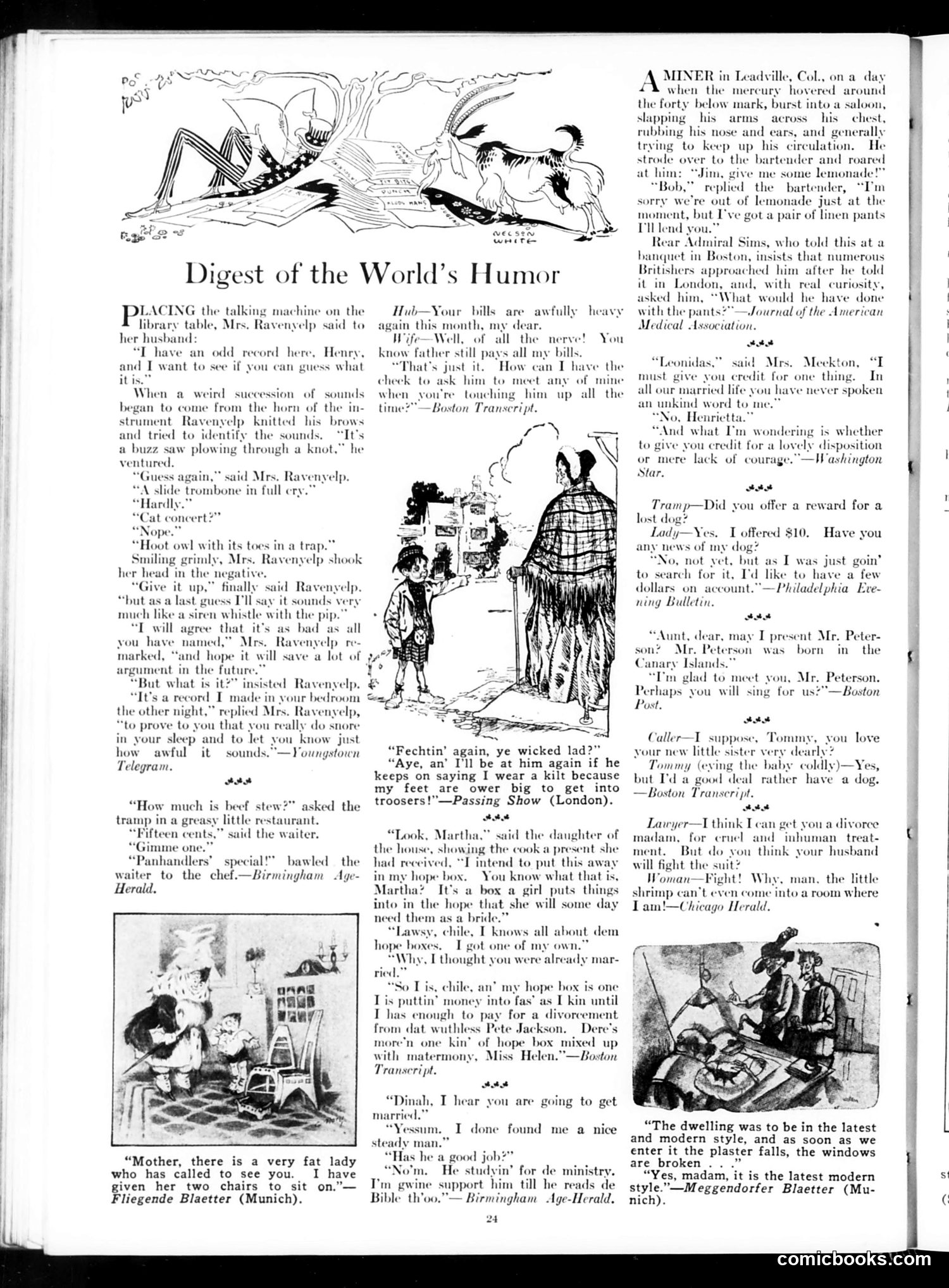
This page collects brief humorous anecdotes from various international sources, typical of Judge's "Digest" feature. The jokes reflect early 20th-century social attitudes: **Key themes:** - **Marital discord**: Husbands' financial dependence on fathers-in-law; wives' complaints about snoring and bill-paying - **Class/servant humor**: A Black domestic worker's humorous account of saving money for divorce (presented in dialect stereotypes common to the era) - **Gender roles**: A bride's "hope box" for future domesticity - **Regional dialect comedy**: Scottish and African-American characters portrayed phonetically for laughs - **Practical absurdism**: A bartender offering pants instead of lemonade to a freezing miner The cartoons show domestic scenes illustrating these jokes. The humor relies heavily on stereotypes, marital tension, and social hierarchies typical of early 20th-century American periodicals. These anecdotes were collected from international sources (Boston, London, Munich, Birmingham) to demonstrate cosmopolitan sophistication.
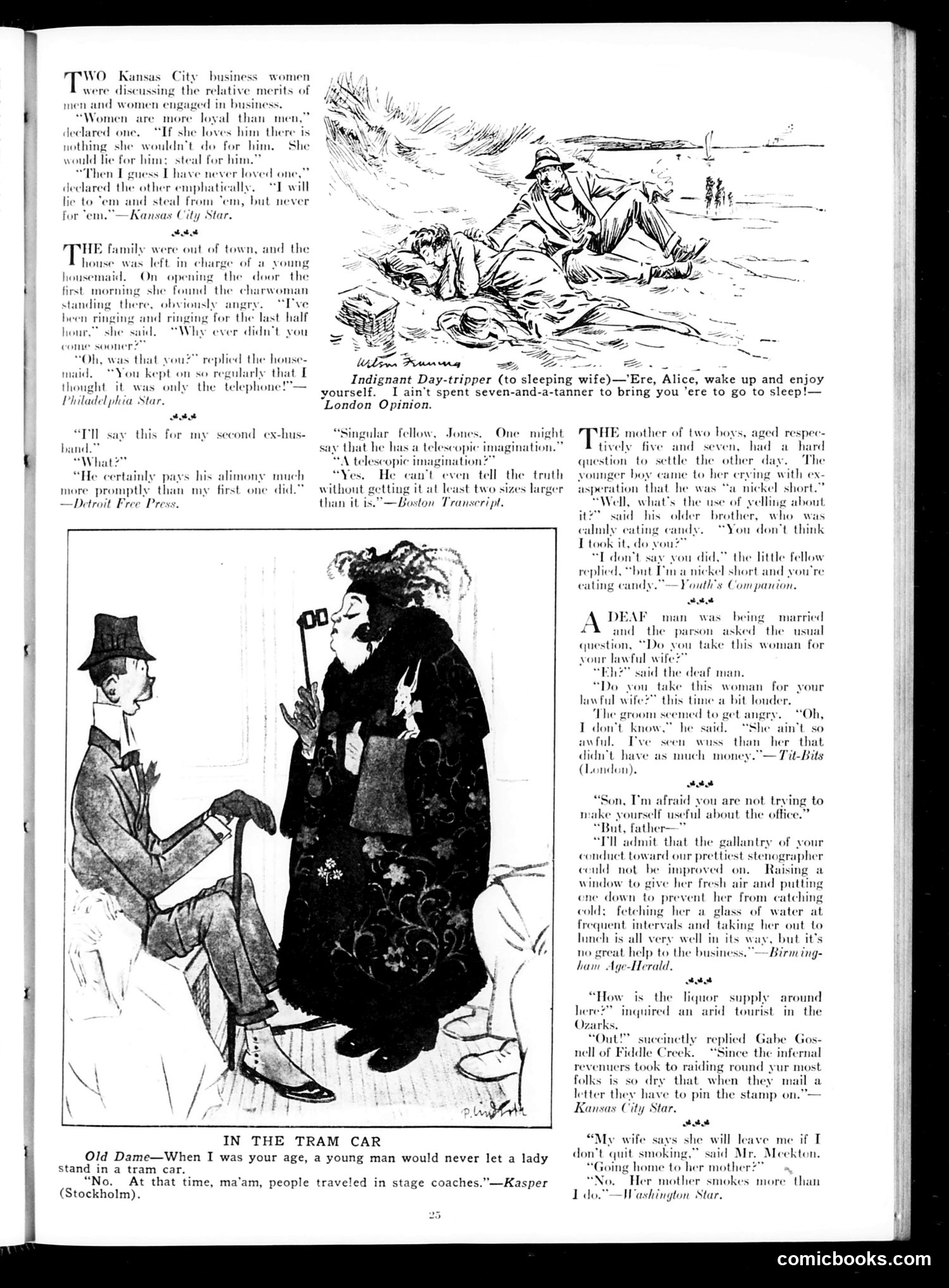
This page contains multiple brief humorous anecdotes typical of early 20th-century satirical magazines, touching on gender relations, marriage, and social propriety. **Key content:** The opening joke contrasts male and female loyalty in business—a woman declares she'd commit crimes for a man she loves, while a man admits he'd steal *from* men but never *for* them, subverting expectations about female devotion. Other jokes mock: a deaf groom mishearing marriage vows; a husband complaining that courting the stenographer (offering fresh air, water, lunch) helps the business less than it appears; a tourist asking about liquor in Prohibition-era Ozarks; and marital discord over smoking. **The tram car cartoon** depicts an elderly woman chiding a young man for not offering his seat—he responds that in her youth people used stage coaches, implying social progress has changed such courtesies. **Overall tone:** Mild, domestic humor reflecting anxieties about changing gender roles, modern conveniences, and social conventions in the early 1900s.
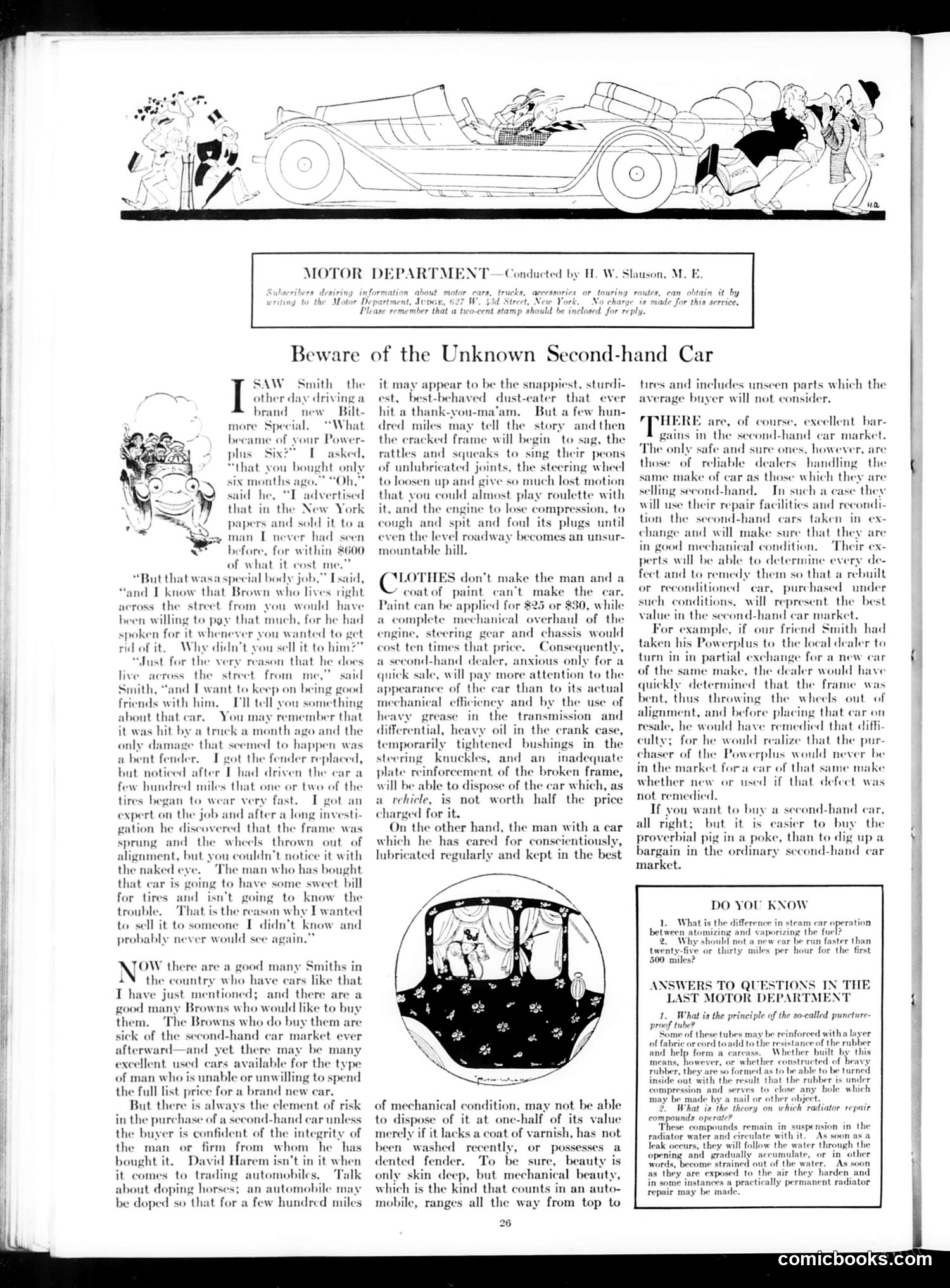
This Judge article warns readers about dishonest used-car dealing through a dialogue between Smith (who sold a damaged car) and an unnamed friend. Smith admits he deliberately sold a vehicle with hidden frame damage—discovered only after a truck accident—to a stranger rather than to his neighbor Brown, precisely because he wanted to avoid future confrontation. The satire targets unscrupulous dealers who cosmetically repair damaged cars with cheap paint, heavy grease, and temporary fixes to mask mechanical problems. A cracked frame might run smoothly for a few hundred miles before deteriorating dangerously. The article contrasts this with honest sellers who maintain their vehicles properly but struggle to get fair prices. The underlying joke: buyer beware in an unregulated market where personal integrity determines whether you're cheated—and some sellers deliberately exploit strangers to protect friendships.
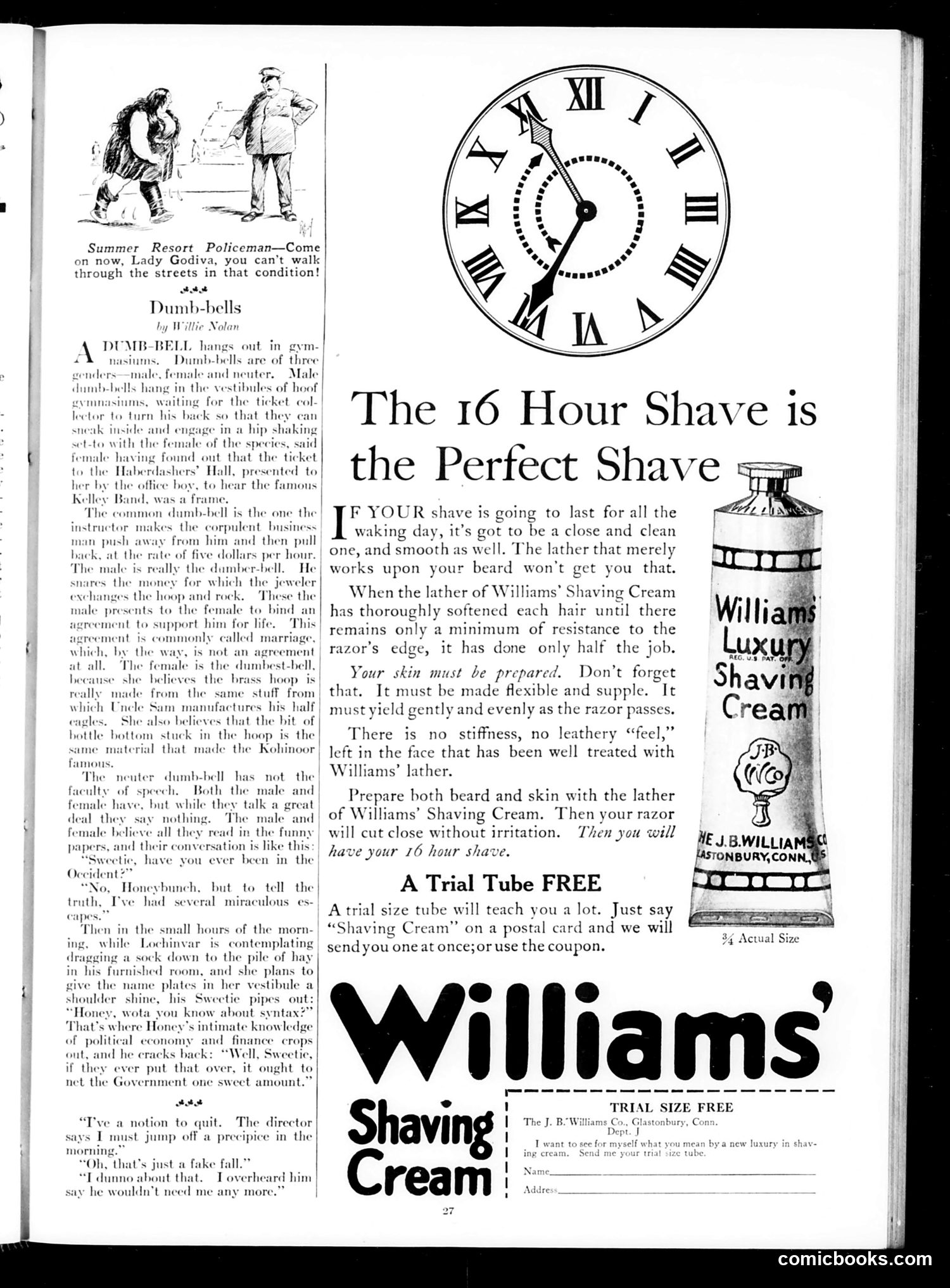
This page contains two distinct pieces: **The "Dumb-bells" cartoon** (left): A satirical article by Willie Nolan about three types of "dumb-bells"—people who frequent gymnasiums. The humor relies on period slang: "male dumb-bells" are men who pursue women at the gym; "female dumb-bells" are women fooled by engagement rings; and "neuter dumb-bells" are people who talk but say nothing. The social commentary mocks courtship rituals, materialism (women deceived by cheap jewelry), and empty conversation. The opening cartoon shows a policeman stopping "Lady Godiva" (likely a woman in insufficient clothing), referencing the medieval legend to joke about indecent public behavior. **The Williams Shaving Cream advertisement** (right): A full-page product ad claiming the cream produces a "16 hour shave"—meaning smoothness lasting the entire working day. It emphasizes skin preparation alongside beard softening. The ad includes a coupon offering a free trial tube, typical of early-20th-century marketing. The page is primarily advertising with satirical content as filler material.
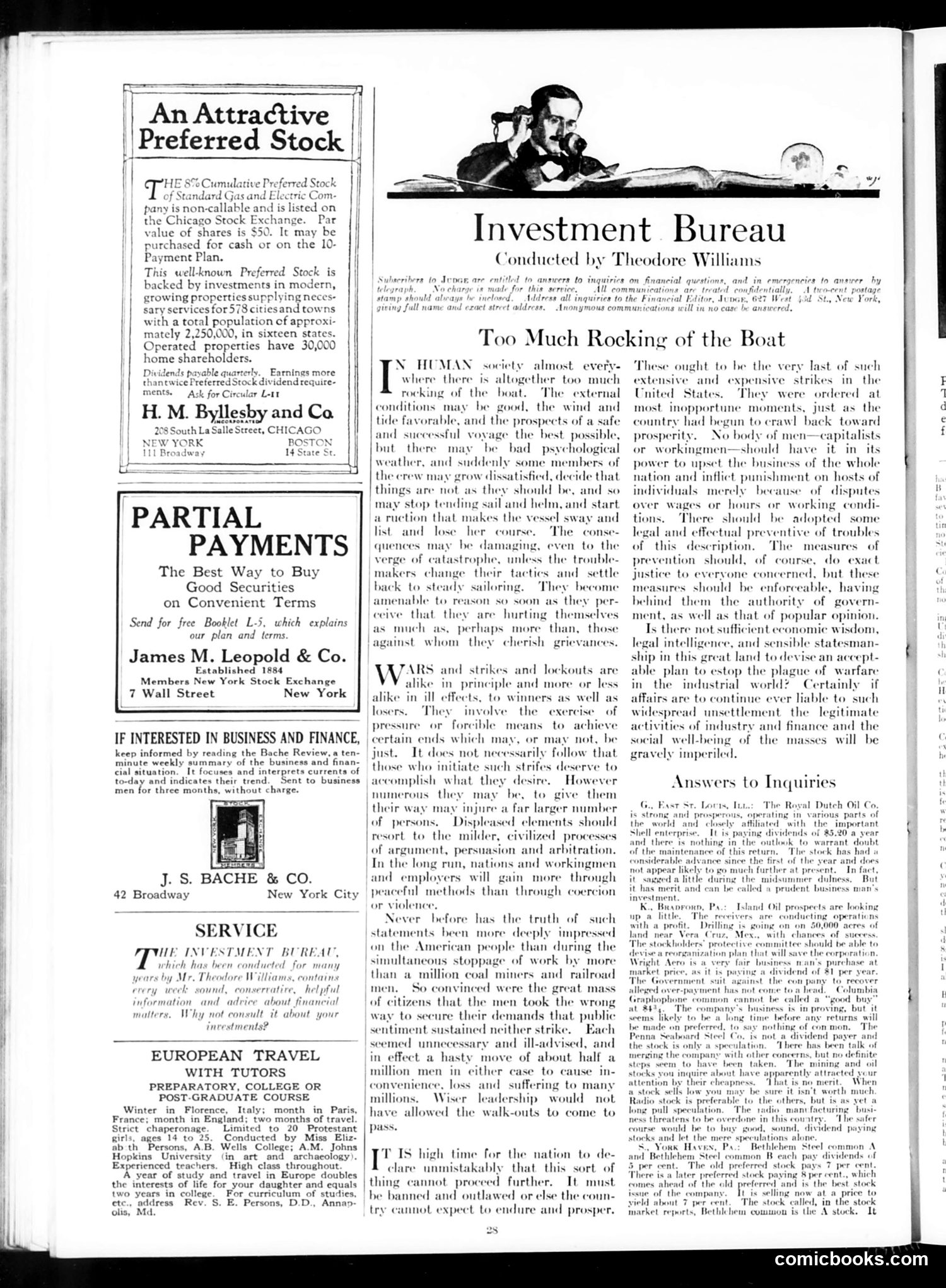
This page is primarily **advertising and financial editorial content**, not political satire. The central illustration shows a man at a telescope labeled "Investment Bureau," conducted by Theodore Williams—a financial advice column. The main article, "Too Much Rocking of the Boat," uses maritime metaphor to argue against labor strikes. It compares workers and employers to crew members on a ship: when dissatisfied workers "rock the boat" through strikes and work stoppages, they damage the entire national economy ("vessel") for everyone. The piece advocates legal restrictions on strikes, arguing that while workers deserve justice, strikes during economic recovery are reckless and harm innocent parties. This reflects **post-WWI labor tensions** (likely 1920s era). The argument—framing strikes as selfish disruption rather than legitimate protest—represents the anti-labor perspective common in business-oriented publications of this period. The surrounding ads promote investment opportunities and financial services, targeting affluent readers.
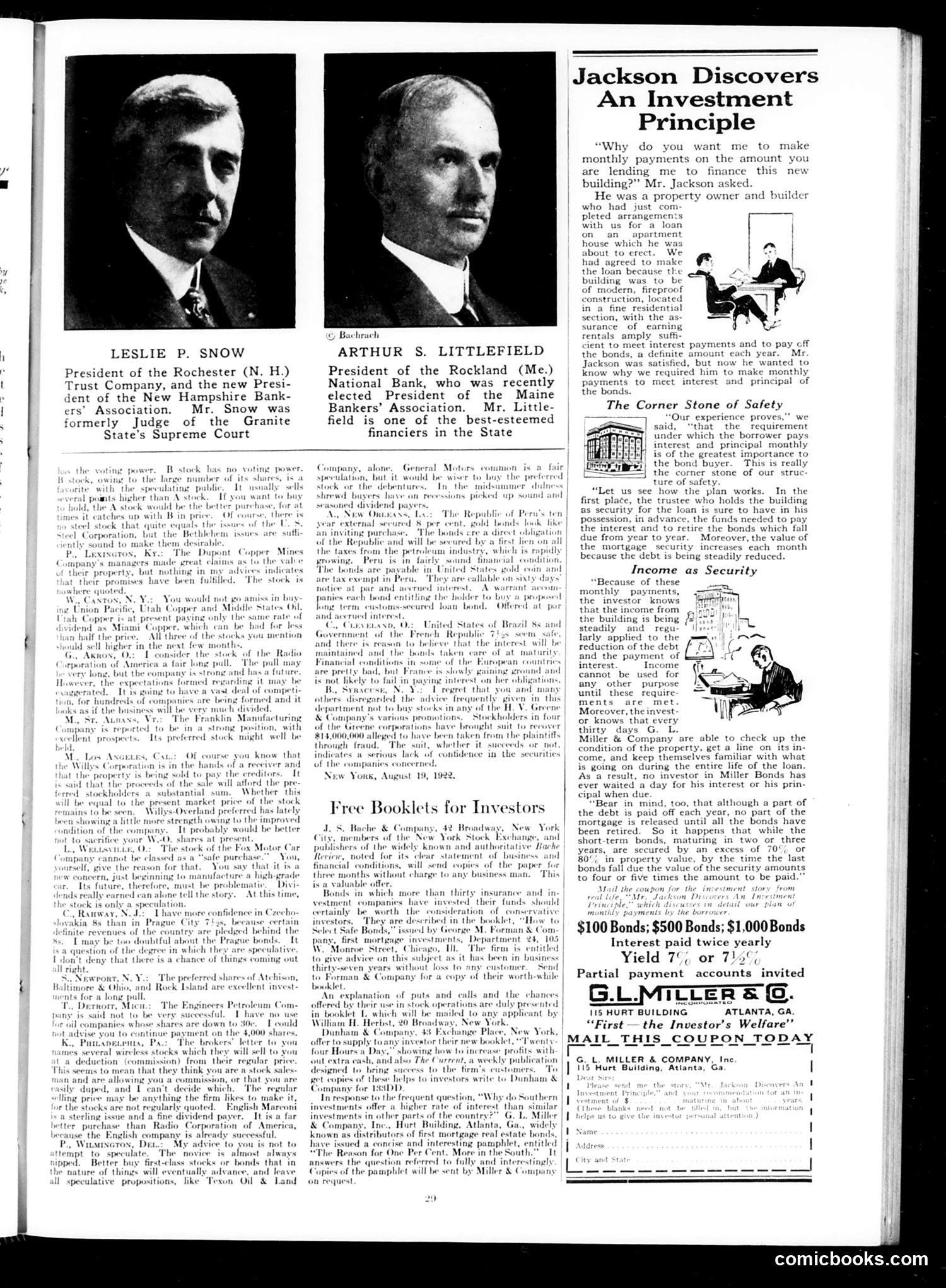
This page from *Judge* magazine is primarily **financial/investment advertising and advice**, not satirical editorial content. The top features **portraits of two New England bankers**: Leslie P. Snow (Rochester Trust Company president) and Arthur S. Littlefield (Rockland National Bank president), newly elected to lead their respective state bankers' associations. This appears to be professional recognition rather than satire. The bulk of the page comprises a financial advice column answering reader questions about stocks and bonds—including Radio Corporation, Willys-Overland, Fox Motor Car, and various foreign bonds. The column warns against speculation and promotes safer investments. The right side contains advertisement coupons for investment booklets and G. L. Miller & Co.'s bond offerings. **Context for modern readers**: This reflects the 1920s investment boom when magazines mixed editorial credibility with financial promotion—blurring lines between journalism and advertising in ways now considered ethically problematic.
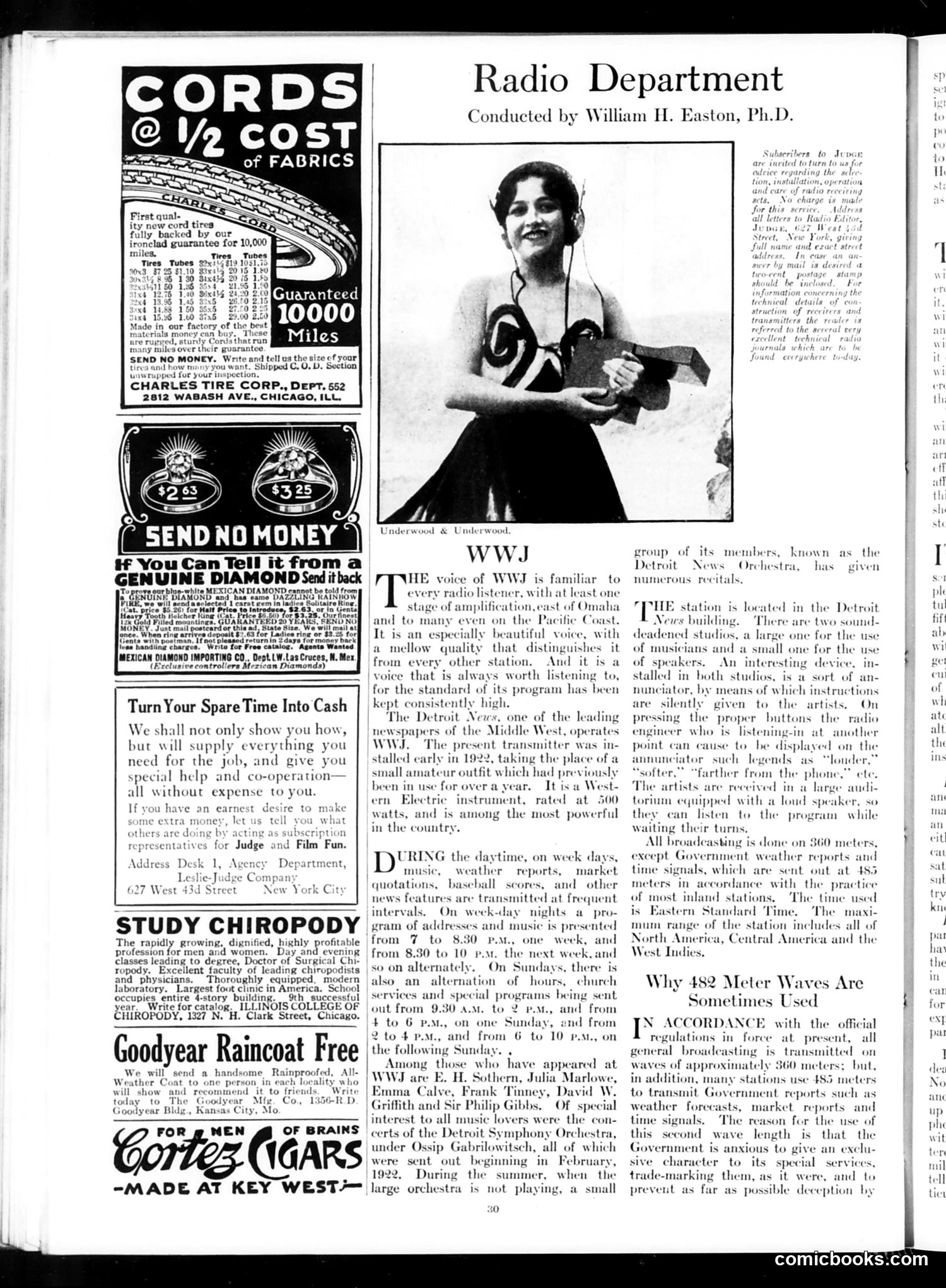
This page is primarily **advertising and editorial content**, not a political cartoon. The main feature is a "Radio Department" column by William H. Easton discussing WWJ, an early Detroit radio station. The editorial praises WWJ's "especially beautiful voice" and "mellow quality," noting its powerful 500-watt Western Electric transmitter installed in 1922. It describes programming: daytime music and news, evening lectures and music (7-8:30 PM alternating weeks), and Sunday religious services and concerts by the Detroit Symphony Orchestra under conductor Ossip Gabrilowitsch. **Context for modern readers:** This represents early radio's prestige era—stations promoted themselves through celebrity appearances and classical music. The technical detail and pride in broadcasting infrastructure reflects how new and remarkable radio technology was in the early 1920s. The page's **advertisements** hawk tire guarantees, correspondence courses (chiropody), and various products—typical Judge magazine monetization of that era.
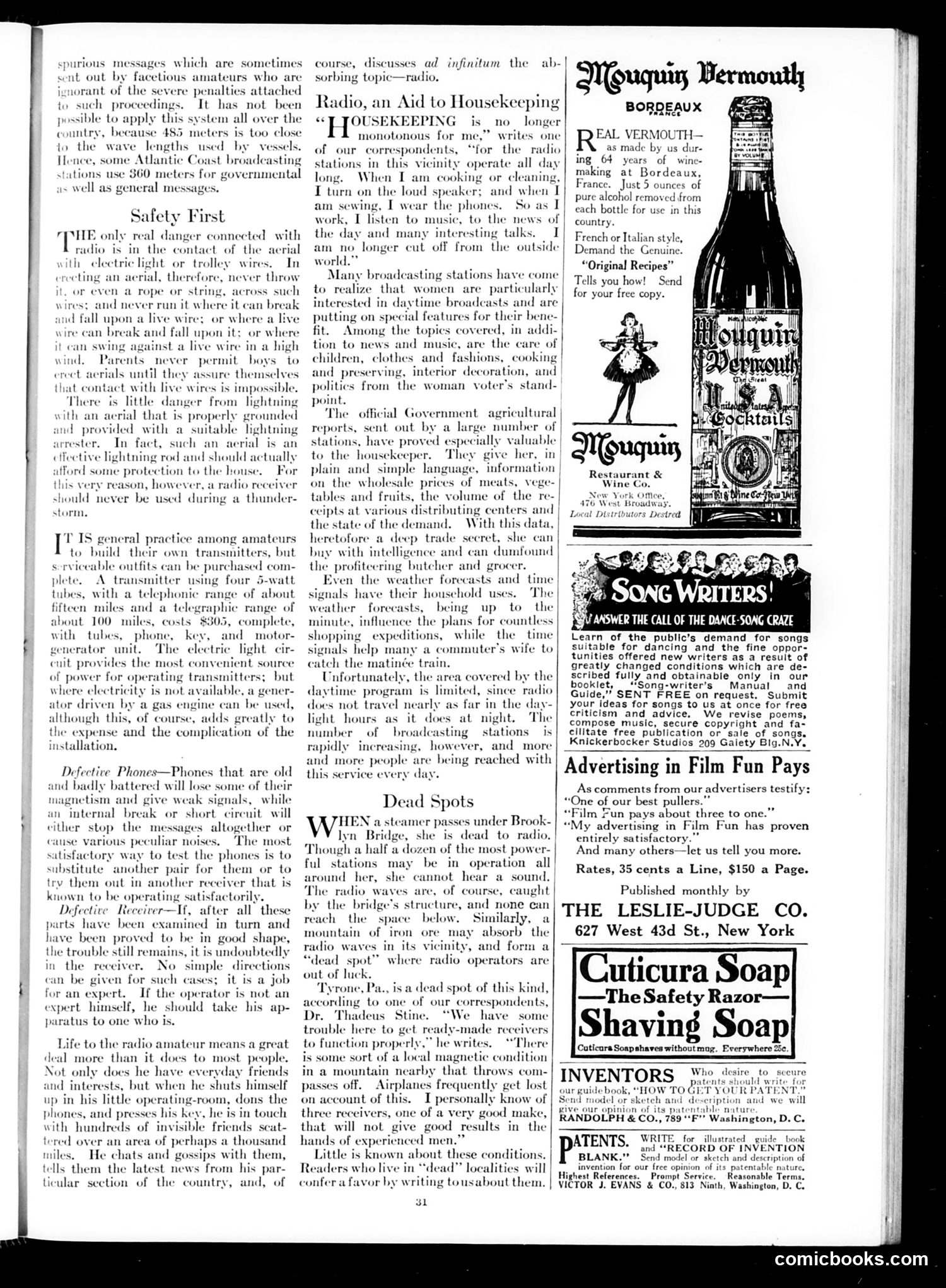
This page from *Judge* magazine combines educational radio content with period advertising. The main article discusses amateur radio operation—a significant hobby in the early 20th century—covering safety precautions, equipment costs (~$305 for transmitters), and troubleshooting defective phones and receivers. A noteworthy section quotes a female correspondent praising radio as liberating for housewives: listening to music, news, and talks while cooking, cleaning, or sewing breaks the "monotony" of domestic work and connects her to the outside world. This reflects how broadcasting stations recognized women as an audience and how radio promised to modernize and enliven household labor. The ads (Mouquin Vermouth, Cuticura Soap, patent services) are typical period marketing. The "Song Writers!" ad solicits amateur songwriting submissions.
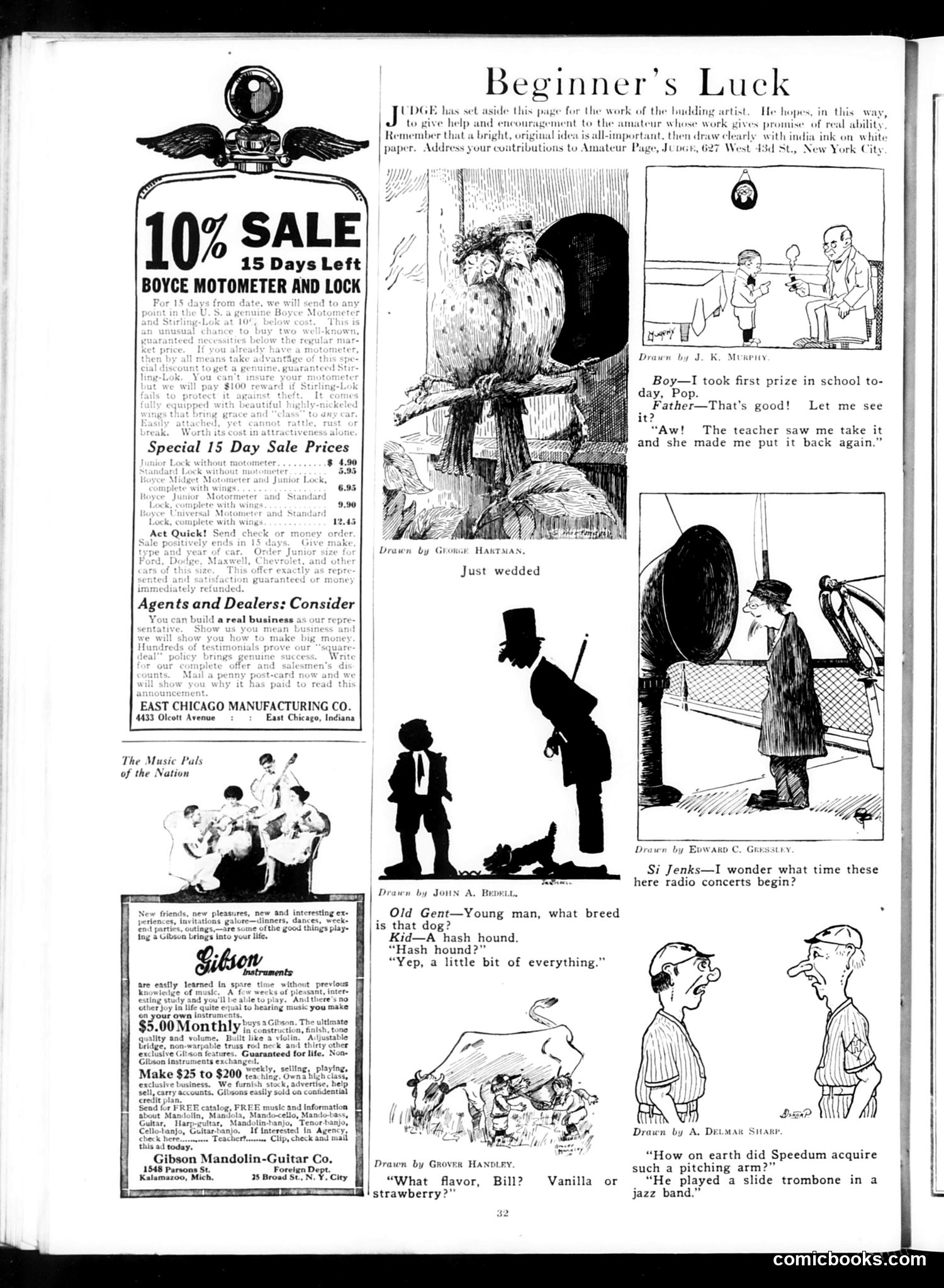
This page is primarily **advertising and humor content** rather than political satire. The layout mixes commercial ads (Boyce Motometer, Gibson instruments) with the "Beginner's Luck" column—Judge's submission space for amateur cartoonists. The cartoons are **lighthearted domestic and social humor**, typical of the era: - A boy admits his teacher forced him to return a school prize he'd taken - A newlywed couple with oversized heads (exaggerated for comic effect) - A man asking about a dog breed; the response "hash hound" (mixed breed) was period slang for mongrels - A radio concert timing joke - A baseball pitcher's arm strength traced to playing trombone in a jazz band—likely poking fun at jazz's then-unconventional status **No political figures or specific contemporary events** are referenced. These are generic social comedies reflecting 1920s American life: school authority, marriage, pets, and the novelty of radio and jazz culture. The humor relies on wordplay and situation comedy rather than satire.
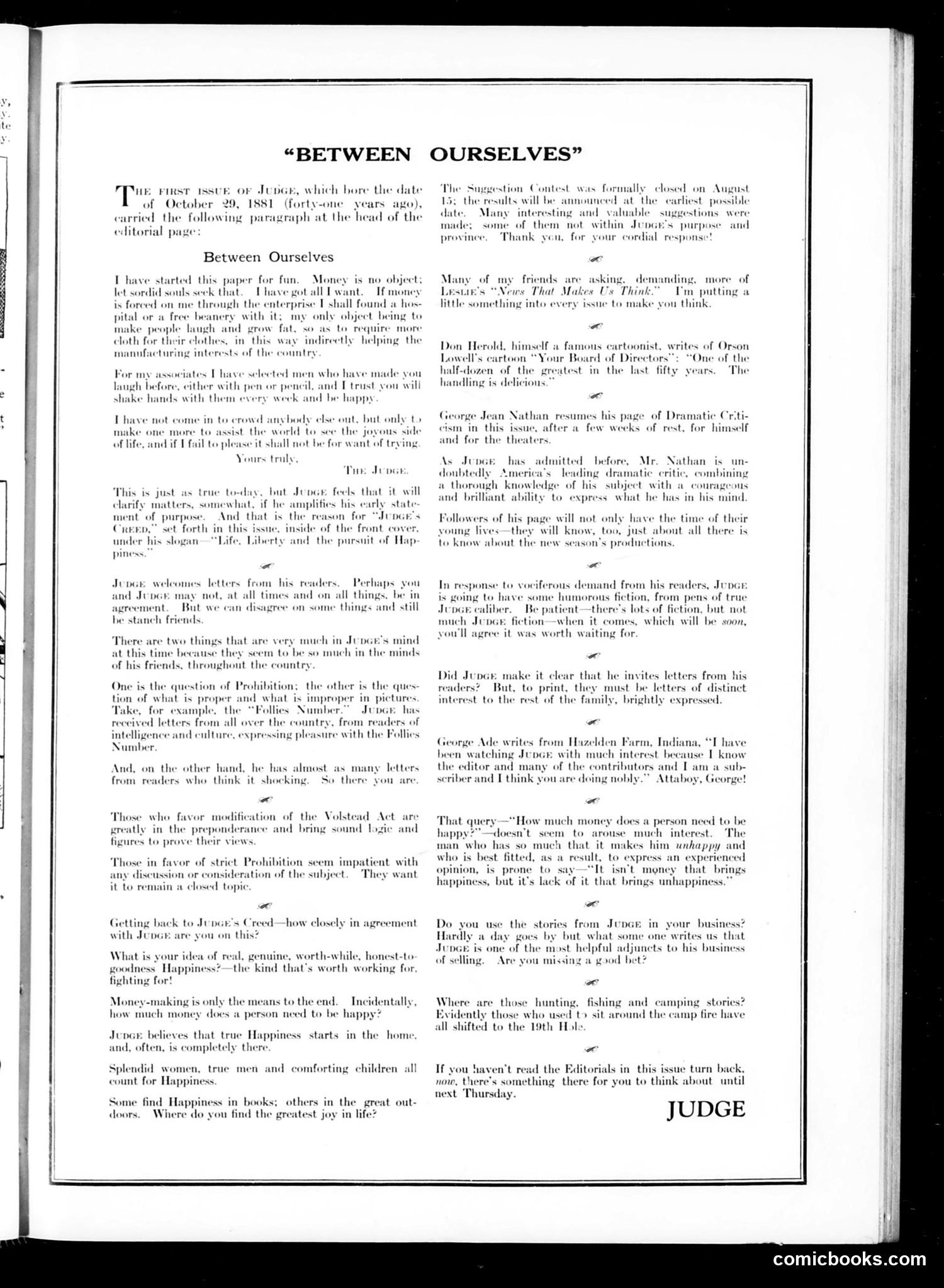
This is the editorial/masthead page from Judge magazine, republishing its founding statement from 1881 (forty-one years prior). The editor reaffirms Judge's original mission: to entertain readers through humor and satire while promoting "Happiness" through home, family, and honest living—not money-seeking. The page solicits reader responses to philosophical questions about what constitutes "real, genuine, worth-while, honest-to-goodness Happiness," touching on contemporary debates like Prohibition. It announces upcoming features including work by cartoonist Don Herold and drama critic George Jean Nathan. Rather than political satire, this is a self-promotional editorial establishing Judge's moral framework: that true happiness derives from domestic virtue and cultural enrichment, not wealth. The "Between Ourselves" title suggests intimate conversation between editor and readers about shared values during the post-WWI era.
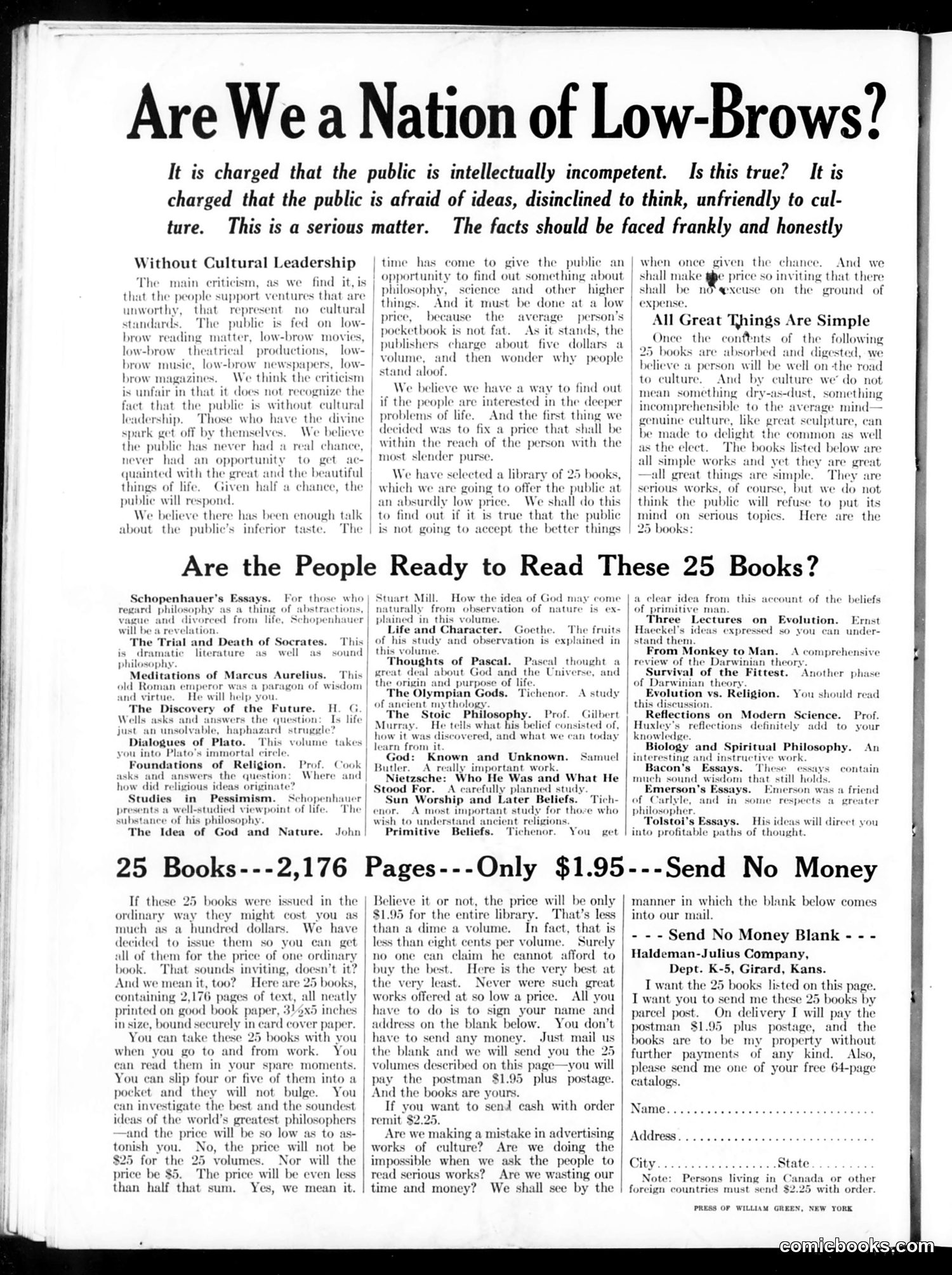
This is primarily a **book advertisement**, not a political cartoon. The Haldeman-Julius Company is promoting a collection of 25 classic philosophical and literary works—including essays by Schopenhauer, Emerson, and Tolstoy, plus works on evolution and religion. The **"low-brows" satire** in the headline criticizes American intellectual standards. The advertiser argues the public lacks cultural leadership and accepts inferior entertainment (low-brow movies, newspapers, music). However, they claim these 25 great books prove people *can* appreciate serious ideas when given affordable access—only $1.95 for 2,176 pages. The pitch exploits class anxieties about intelligence and taste while democratizing high culture through cheap reprinting—a common early 20th-century marketing strategy.