
Judge, 1922-08-26 · page 16 of 36
Judge — August 26, 1922 — page 16: what you’re looking at
What you’re looking at
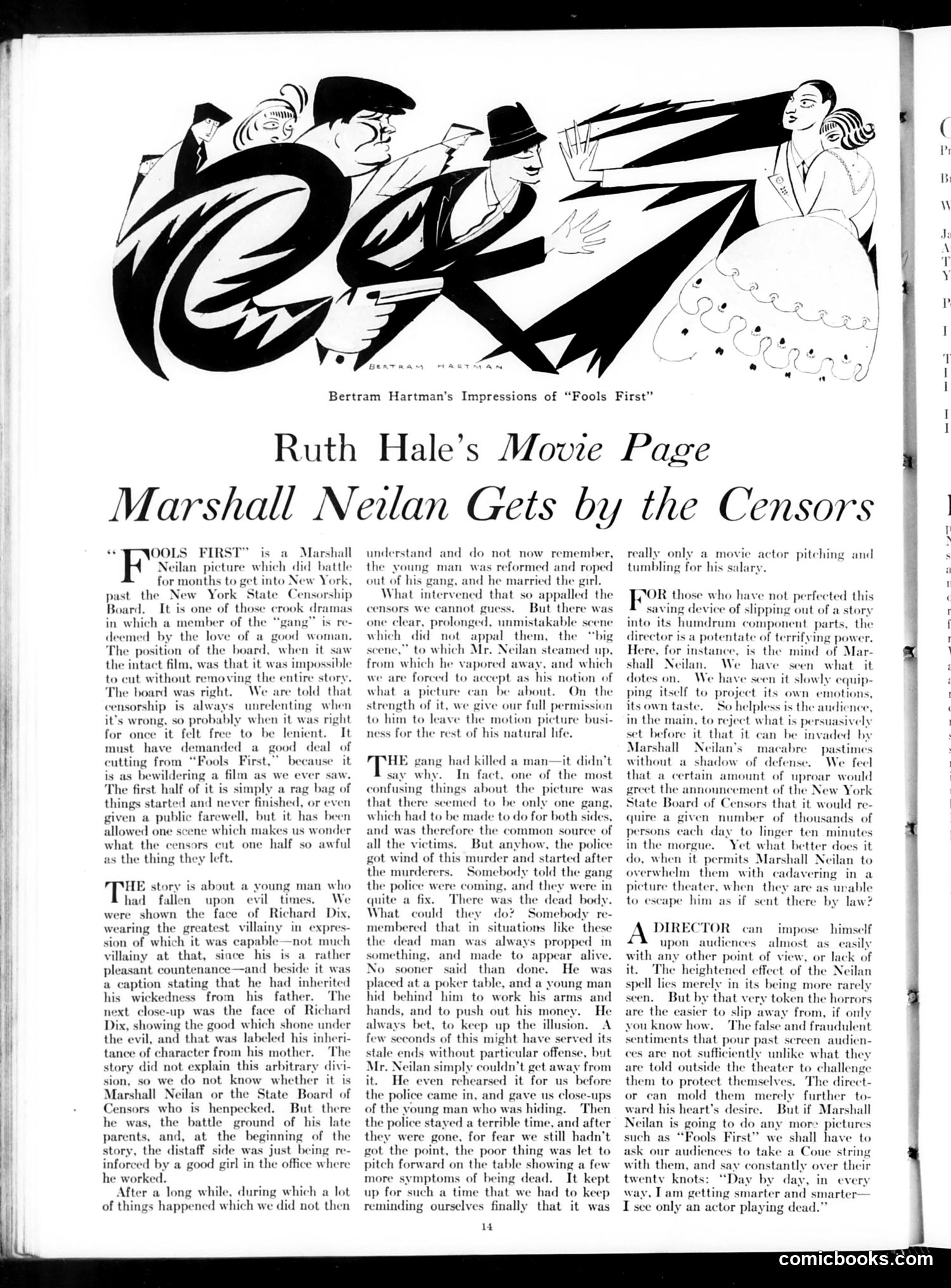
This is a film review by Ruth Hale critiquing director Marshall Neilan's movie "Fools First" (1922), which stars Richard Dix. The cartoon at top, by Bertram Hartman, satirically depicts the film's chaotic plot through dynamic, tangled lettering—visual shorthand for narrative confusion. Hale's review mocks the film's incoherence: a crime drama about a reformed gangster that she finds bewildering and poorly constructed. She particularly ridicules an extended scene where the gang props up a murdered corpse at a poker table to deceive arriving police—a sequence so prolonged and repeatedly shown that it becomes absurd rather than dramatic. The satire targets both Neilan's directorial choices (obsessing over one grotesque gag) and the New York State Censorship Board, which struggled to cut the film without destroying it entirely. Hale sarcastically "permits" Neilan to leave filmmaking, suggesting his artistic judgment is fundamentally flawed. The piece exemplifies 1920s film criticism's blunt, comedic style.
📄 Transcribed text from this page (OCR, searchable)
Machine-transcribed from the original scan — historical spelling and the odd misread are preserved.
Bertram Hartman's Impressions of “Fools First” Ruth Hale’s Movie Page Marshall Neilan Gets by the Censors “ OOLS FIRST” is a Marshall EF Neilan picture which did battle for months to get into New York, past the New York State Censorship Board. It is one of those crook dramas in which a member of the “gang” is re- deemed by the love of a good woman. The position of the board, when it saw the intact film, was that it was impossible to cut without removing the entire story. The board was right. We are told that censorship is always unrelenting when it’s wrong, so probably when it was rig for once it felt free to be lenient. It must have demanded a good deal of cutting from “Fools First,” because it is as bewildering a film a The first half of it is simply a things started and never finished, given a public farewell, but it has been allowed one scene which makes us wonder what the censors cut one half so awful as the thing they left. HE story is about a young man who had fallen upon evil times. We were shown the face of Richard Dix, wearing the greatest vil y in expres- sion of which it was « not much villainy at that, since his is a rather pleasant countenance—and beside it was a caption stating that he had inherited his wickedness from his father. The next close-up was the face of Richard Dix, showing the good which shone under the evil, and that was labeled his inheri- tance of character from his mother. The story did not explain this arbitrary divi- so we do not know whether it is shall Neilan or the State Board of nsors who is henpecked. But there he was, the battle ground of his late parents, and, at the beginning of the story, the distaff side was just being re- inforced by a good girl in the office where he worked. After a long while, during which a lot of things happened which we did not then understand and do not now remember, the young man was reformed and roped out of his gang, and he married the girl. What intervened that so appalled the censors we cannot guess. But there was one clear, prolonged, unmistakable scene which did not appal them, the “big scene,” to which Mr. Neilan steamed up, from which he vapored away, and which we are forced to accept as his notion of what a picture can be about. On the strength of it, we give our full permission to him to leave the motion picture busi- ness for the rest of his natural life. HE gang had killed a man—it didn’t say why. In fact, one of the most confusing things about the picture was that there seemed to be only one gang, which had to be made to do for both sides, and was therefore the common source of all the victims. But anyhow, the police got wind of this murder and started after the murderers. Somebody told the the police were coming, and they were quite a fix. There was the dead body. What could they do? Somebody. re- membered that in situations like these the dead man was always propped im something, and made to appear alive. No sooner said than done. He was placed at a poker table, and a young man hid behind him to work his arms and hands, and to push out his mor He always bet, to keep up the illusion. A few seconds of this might have served its stale ends without particular offense, but Mr. Neilan simply couldn't get away from it. He even rehearsed it for us before the police came in, and gave us close-ups ing man who was hiding. stayed a terrible time, and they were gone, for fear we still hadn't got the point, the poor thing was let to pitch forward on the table showing a few more symptoms of being dead. It kept up for such a time that we had to keep reminding ourselves finally that it was M4 really only a movie actor pitching and tumbling for his salary. por those who have not perfected this ving device of slipping out of a story into its humdrum component parts, the director is a potentate of terrifying power. Here, for instance, is the mind of Mar- shall Neilan. We have seen what it dotes on. We have seen it slowly equip- ping itself to project its own emotions, its own taste. So helpless is the audience, in the main, to reject what is persuasively set before it that it can be invaded by Marshall Neilan’s macabre pastimes without a shadow of defense. We feel that a certain amount of uproar would greet the announcement of the New York State Board of Censors that it would re- quire a given number of thousands of persons cach day to linger ten minutes in the morgue. Yet what better does it do, when it permits Marshall Neilan to overwhelm them with cadavering in a picture theater, when they are as urable to escape him as if sent’ there by law? DIRECTOR can impose himself upon audiences almost as easily with any other point of view, or lack of it. The heightened effect of the Neilan spell lies merely in its being more t seen. But by that very token the are the easier to slip away from, you know how. ‘The false and fraudulent sentiments that pour past sereen audien- ces are not sufficiently unlike what they are told outside the theater to challenge them to protect themselves. The direct- or can mold them merely further to- ‘d his heart's desire. But if Marshall n is going to do any more pictures such as “Fools First’ we shall have to ask our audiences to take a Coue string with them, and say constantly over their twenty knots: “Day by day, in’ every Tam getting smart only an actor playin, comicbooks.com