
Judge, 1922-08-26 · page 23 of 36
Judge — August 26, 1922 — page 23: what you’re looking at
What you’re looking at
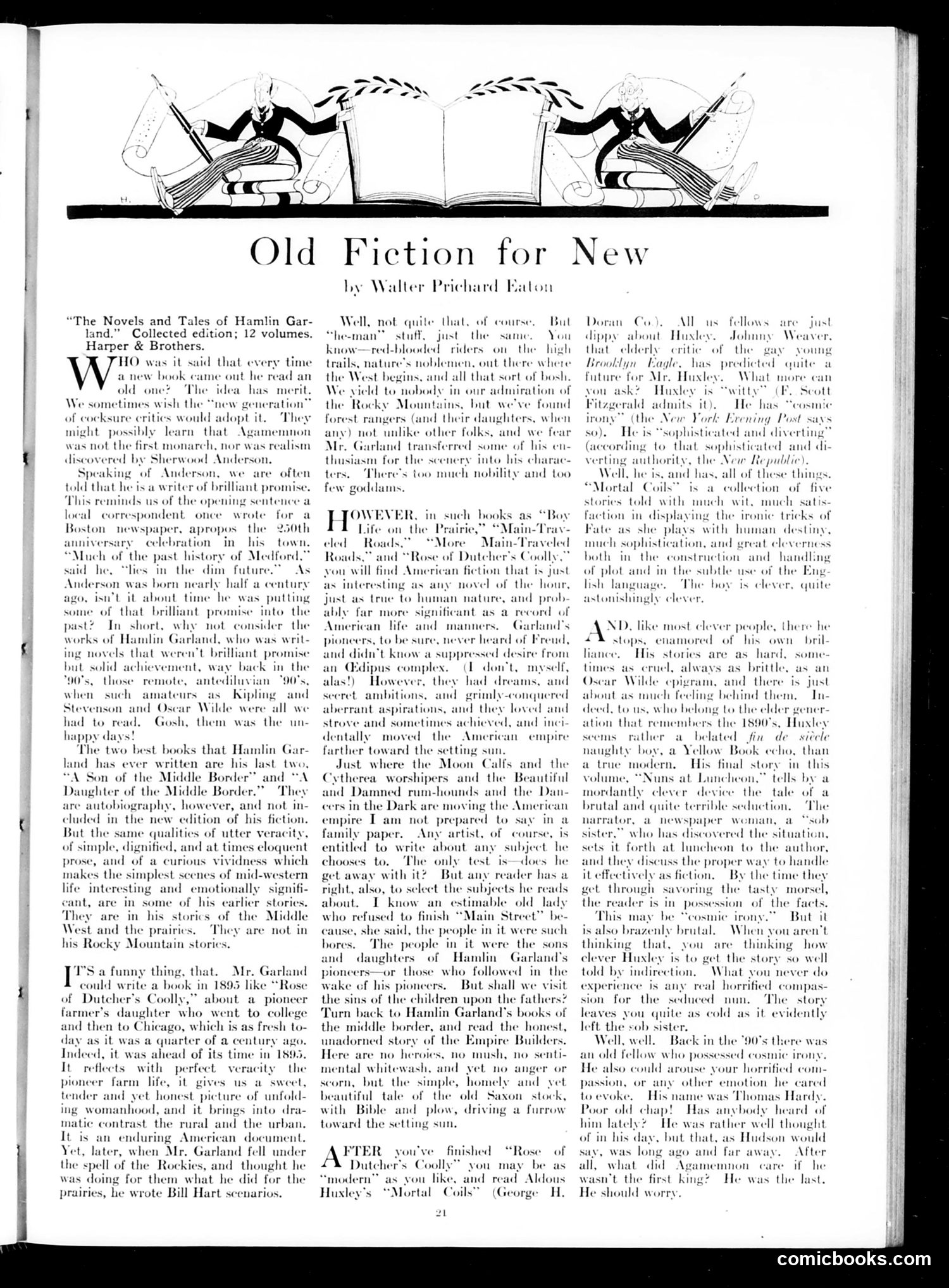
This is a book review essay by Walter Prichard Eaton discussing Hamlin Garland's collected fiction. The decorative header shows two Egyptian-style scribes flanking an open book. The satire targets contemporary literary criticism and the "new generation" of critics who dismiss older work. Eaton contrasts Sherwood Anderson (praised as "brilliant promise" despite being nearly fifty years old) unfavorably with Garland, whose 1890s prairie fiction—particularly "Rose of Dutcher's Coolly"—remains superior to modern novels. The critique argues Garland's strength lies in authentic Midwestern realism: truthful depiction of rural life, genuine characters, and emotional depth. His later Rocky Mountain stories failed because he descended into "he-man" clichés and artificial nobility rather than honest portrayal. Eaton's point: solid literary achievement from the "antediluvian '90's" outweighs fashionable contemporary work lacking substance—a defense of older American literature against dismissive modernist criticism.
📄 Transcribed text from this page (OCR, searchable)
Machine-transcribed from the original scan — historical spelling and the odd misread are preserved.
Old Fiction for New “The Novels and Tales of Hamlin Gar- land.” Collected edition; 12 volumes. Harper & Brothers HO was it said that every time a new book came out he read an 1 one? The idea has merit. We sometimes wish the “new generation” of cocksure critics would adopt it. They might possibly learn that) Agamemnon urch, nor was realism was not the first m discovered by Sherwood Anderson. Speaking of Anderson, we are often told that he is a writer of brilliant promise. This reminds us of the opening sentence a local correspondent. once wrote for a Boston newspay apropos the 250th anniversary celebration in his town. “Much of the past history of Medfc “lies in’ the dim futur As Anderson was born nearly half a century ago, isn’t it about time he was putting said he, of that brilliant promise into. the past? In short, why not consider the works of Hamlin Garland, who was writ- ing novels that weren't brilliant: promise achievement, way back in’ the some but solid “90's, those remote, antediluvian "90's, when such amateurs as Kipling and Stevenson and Oscar Wilde were all we had to read. Gosh, them was the un- happy days! The two best books that Hamlin Gar- land has ever written are his last two, “A Son of the Middle Border” and “A Daughter of the Middle Border.” They are autobiography, however, and not in- cluded in the new edition of his fiction. But the same qualities of utter veracity, of simple, dignified, and at times eloquent sand a curious vividness which implest scenes of mid-western interesting and emotionally. signifi- cant, are in some of his earlier stories. They are in his storics of the Middle West and the prairies. They are not in his Rocky Mountain stories. I a funny thing, that. Mr. Garland could write a book in 1895 like “Rose of Dutcher’s Coolly,” about a pioneer farmer’s daughter who went to college and then to Chicago, which i: fresh to- day as it was a quarter of a century ago. Indeed, it was ahead of its time in 1895. It reflects with perfect veracity the pioneer farm life, it’ gives us a sweet, tender and yet honest picture of unfold- ing womanhood, and it brings into dra- matic contrast the rural and the urban. It is an enduring American document. Yet, later, when Mr. Garland fell under the spell of the Rockies, and thought he was doing for them what he did for the prairies, he wrote Bill Hart scenarios. by Walter Prichard Mat« Well, not quite that, of course. But “he-man™ stuff. just) the You know—red-blooded riders on the high trails, nature's noblemen, out there where the West begins, and all that sort of 1 We yield to nobody in our admiration of the Rocky Mountains, but we've found forest rang (and their daughters, when any) not unlike other folks, and we fear Mr. Garland transferr Af his ene thusiasm for the scenery into his charac- There oo much nobility and too ddams. sume some ters. few g I OWEVER, in such books as “Boy Life on the Pr: “Main-Tray- - n-Traveled Road ids.” and “Rose of Dutcher’s Coolly.” will find American fiction that is just teresting as any novel of the hour, just as true to human nature, and prob ably far more significant as a record of ud manners, ¢ urland’s American. life pioncers, to be sure, never heard of Freud, and didn’t know a suppressed desire from an (Edipus complex. (L don't, myself, alas!) However, they had dreams, and ct ambitions, and. grimly-conquered they loved and ud inci nh empire ‘ant aspiration and sometimes achieve Hy moved the Ameri ward the setting sun. - Just where the Moon Calfs and the Cytherea worshipers and the Beautiful and Damned rum-hounds and the Dan- in the Dark are moving the American ce empire Tam not prepared to say in a family paper. Any artist, of course, is to write about any subject: he chooses The only test is get away with it? But any re: ht, also, to select the subjects he reads about. I know an estimable old lady who refused to finish “Main Street” be- cause, she said, the people in it were such bores. ‘The people in it were the sons and daughters of Hamlin Garland’s pioncers—or those who followed in the wake ef his pioneers. But shall we visit the sins of the children upon the fathers? Turn back to Hamlin Garland’s books of the middle border, and read the honest, unadorned story of the Empire Builders. Here are no heroics, no mush, no senti- entitled does he ader has a mental whitewash, and yet no anger or scorn, but the simple, homely and_ yet beautiful tale of the old) Saxon. stock, with Bible and plow, driving a furrow toward the setting sun. TER you've finished “Rose of Dutcher’s Coolly” you may be as modern” as you like, and read Aldous Huxley's “Mortal Coils” (George H. 2L Doran Co All us fellows are just dippy about Huxley. Johnny Weaver. that elderly critic of the y young Brooklyn Eagle, Nas predicted quite a future for Mr. Huxley. What more can you ask? Huxley is witty"? (F. Scott Fitzgerald admits it), Tle has irony” (the New York Evening Post so). He is “sophisticated and divertin to that sophisticated and di verting au rity, the Vew Well, he is, and has, all of these things. “Mortal Coils” is a collection of five stories told with much wit, much satis- faction in displaying the tricks of Fate as she plays with human destiny, much sophistication, and great cleverness both in the construction and handling of plot and in the subtle use of the lish language. ‘The boy is clever, quite “cosmic (accordin, ublic ironic there he ND. like most clever people, enamored of his own bril as hard brittl stops, His stories ar times as cruel, always Osear Wilde epigram, and the about as much fecli ind them, In- deed, tous, who belong to the elder gener- ation that remembers the 1890's, Huxley rather a belated fin de liance, some us an is just he siecle seems naughty boy, a Yellow Book echo, than a true modern, His final story in’ this volume, “Nuns at Luncheon,” tells by a mordantly clever device the tale of a brutal and quite terrible seduction, The narrator, a newspaper woman, a “sob sister.” who has discovered the situation, sets it forth at luncheon to the author, and they discuss the proper way to handle it effectively as fiction. By the time they through savoring the tasty morsel, the reader is in possession of the facts. “cosmic irony.” But it is also brazenly brutal. When you aren't thinking that, you are thinking how clever Huxley is to get the story so well told by ind What you never do experience is any real horrified compas- sion for the seduced nun. The leaves you quite as cold as it evidently left the P. Well, well. ‘k in the *90°s there was: an old fellow who possessed cosmic irony. This may be story also could arouse your horrified com- other emotion he cared ke. His name was Thomas Hardy. Poor old chap! Has anybody heard of him lately? He was rather well thought of in his day, but that, as Hudson would wnd far away. After Agamemnon care if he He was the last. or any say, was long all, what did wasn't the first ki He should worry. comicbooks.com