
Judge, 1922-08-26 · page 15 of 36
Judge — August 26, 1922 — page 15: what you’re looking at
What you’re looking at
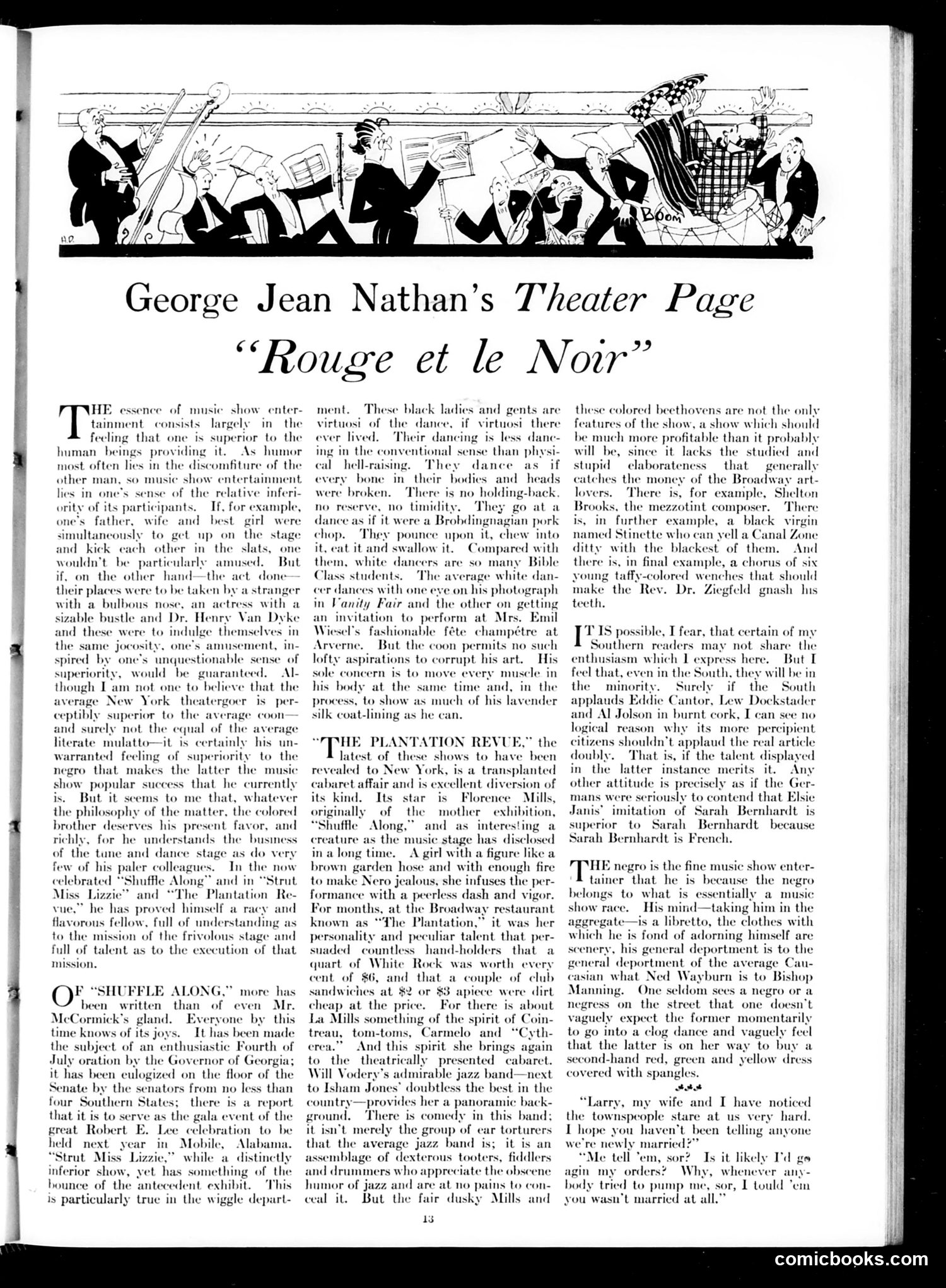
This is theater criticism by George Jean Nathan, a prominent drama critic, reviewing Black musical shows including "Shuffle Along," "Strut Miss Lizzie," and "The Plantation Revue." Nathan argues that music show entertainment depends on audiences feeling superior to performers. He then makes an explicitly racist claim: white theatergoers enjoy Black performers partly due to racial prejudice, though he acknowledges Black performers possess genuine talent and superior understanding of "the tune and dance stage." He praises Black dancers' uninhibited physicality—describing their movement as "hell-raising" and comparing them favorably to restrained white dancers. He celebrates Florence Mills and other performers. The page reflects 1920s critical attitudes: praising Black artistic achievement while simultaneously embedding it within a framework of racial hierarchy and condescension typical of that era's "sophisticated" commentary.
📄 Transcribed text from this page (OCR, searchable)
Machine-transcribed from the original scan — historical spelling and the odd misread are preserved.
——— — D seemeieiael George Jean Nathan’s Theater Page “Rouge et le Novr” HE essence of music show enter- tainment consists largely in the ling that one is superior to the human beings providing it. As humor most. often lies in the discomfiture of the other man, so musie show entertainment lies in one’s sense of the relative inferi- ority of its participants. If, for example, one’s father, wife and best girl were simultaneously to get up on the stag and kick each other in’ the slats, one wouldn't be particularly amused. But if, on the other hand—the act done their places were to be taken by a stranger with a bulbous no: tress with a sizable bustle and Dr. Henry Van Dyke and these were to indulge themselves in the same jocosity, one’s amusement, in- spired by one’s unquestionable sense of superiority, would be guaranteed. AL though Iam not one to believe that the average New York theatergoer is per- ceptibly superior to the average coon and surely not the equal of the average literate mulatto—it is certainly his un- warranted feeling of superiority. to. the negro that: makes the latter the music show popular success that he currently is. But it seems to me that, whatever the philosophy of the matter, the colored brother deserves his present favor, and richly, for he understands the busmess of the tune and dance stage as do very few of his paler colleagues. Tn the now celebrated “Shuffle Along” and in “Strut Miss Lizzie” and “The Plantation Re- vue,” he has proved himself a racy and flavorous fellow, full of understanding as to the mission of the frivolous stage and full of talent as to the execution of that mission, F “SHUFFLE ALONG,” more has been written than of even Mr. McCormick's gland. Everyone by. this time knows of its joys. It has been made the subject of an enthusiastic Fourth of July oration by the Governor of Georgia; it has been culogized on the floor of the Senate by the senators from no less than four Southern States; there is a report that it is to serve as the gala event of the great Robert E. Lee celebration to be held next) year in Mobile, Alabama. “Strut: Miss Lizzie,” while a distinctly inferior show, yet has something of the bounce of the antecedent exhibit. This is particularly true in the wiggle depart- ment. These black ladies and gents are virtuosi of the dance, if virtuosi there ever lived. Their dancing is less dan ing in the conventional sense than physi- cal hell-raising. They dance as if every bone in their bodies and heads were broken. There is no holding-back no reserve, no timidity. They go at a dance as if it were a Brobdingnagian pork chop. They pounce upon it, chew into it, eat it and swallow it. Compared with them, white dancers are so many Bible Class students. The average white dan- cer dances with one eve on his photograph in Vanity Fair and the other on getting an iny nto perform at Mrs. Emil Wiese ashionable féte champétre Arverne. But the coon permits no such lofty aspirations to corrupt his art. His sole concern is to move every muscle in his body at the same time and, in the process, to show as much of his lavender silk coat-lining as he can. AHE PLANTATION REVUE,” the latest of these shows to have been 1 to New York, is a transplanted and is excellent diversion of its kind. Its star is Florence Mills, originally of the mother exhibition, “Shuffle Along,” and as_ inter creature as the music stage has disclosed ina long time. A girl with a figure like a brown garden hose and with enough fire to make Nero jealous; she infuses the per- formance with a peerless dash and vigor. For months, at the Broadway restaurant known as “The Plantation,” it was her personality and peculiar talent that. per- suaded countless hand-holders that a quart. of White Rock was worth every cent of $6, and that a couple of club ndwiches at piece were dirt cheap at the price. For there is about La Mills something of the spirit of Coin- cabaret affair treau, tom-toms, Carmelo and “Cyth- crea.” And this spirit she brings again to the ly presented Will Vodery’s admirable jazz band—next to Isham Jones’ doubtless the best in the country—provides her a panoramic back- ground, There is comedy in this band: it isn’t merely the group of ear torturers that the zz band it is an assemblage of dexterous tooters, fiddlers and drummers who appreciate the obscene humor of jazz and are at no pains to con- ceal it. But the fair dusky Mills and 43 red beethovens are not the only features of the show, a show which should be much more profitable than it probably will be, since it lacks the studied and stupid claborateness — that generally catches the money of the Broadway lovers. There is, for example, Brooks, the mezzotint compose is, in further example, a black virgin named Stinette who can yell a Canal Zone ditty with the blackest of them. And there is, in final example, a chorus of six young taffy-colored wenches that should make the Rev. Dr. Ziegfeld gnash lis teeth. these ¢ T fear, that certain of my lers may not share the But I TIS possible. Southern enthusiasm which 1 express he feel that, even in the South, they will be in the minority. Surely if the South applauds Eddie Cantor, Lew Dockstader and Al Jolson in burnt cork, I can see no logical reason why its more percipient citizens shouldn't applaud the real artic doubly. That is, if the talent displaye in the latter instance merits it. other attitude is precisely as if the ( mans were seriously to contend that Elsie Janis’ imitation of Sarah Bernhardt is superior to Sarah Bernhardt because Sarah Bernhardt is French. THe negro is the fine music show enter- tainer that he is because the negro belongs to what is essentially a music show ra His mind— ig him in the aggregate—is a libretto, the clothes with which he is fond of adorning himself are . his general deportment is to the general deportment of the average Cau- casian what Ned Wayburn is to Bishop Manning. One seldom sees a negro or a negress on the street that one doesn’t vaguely expect the former momentarily to go into a clog dance and vaguely feel that the latter is on her way to buy a second-hand red, green and yellow dress covered with spangles. stot scene! “Larry, my wife and I have noticed the townspeople stare at us very hard. I hope you haven't been telling ‘anyone we're newly married?” “Me tell ‘em, sor? Is it likely Vd go agin my orders? Why, whenever any- body tried to pump me, sor, L tould *em you wasn’t married at all.” comicbooks.com