
A complete issue · 36 pages · 1922
Judge — August 19, 1922
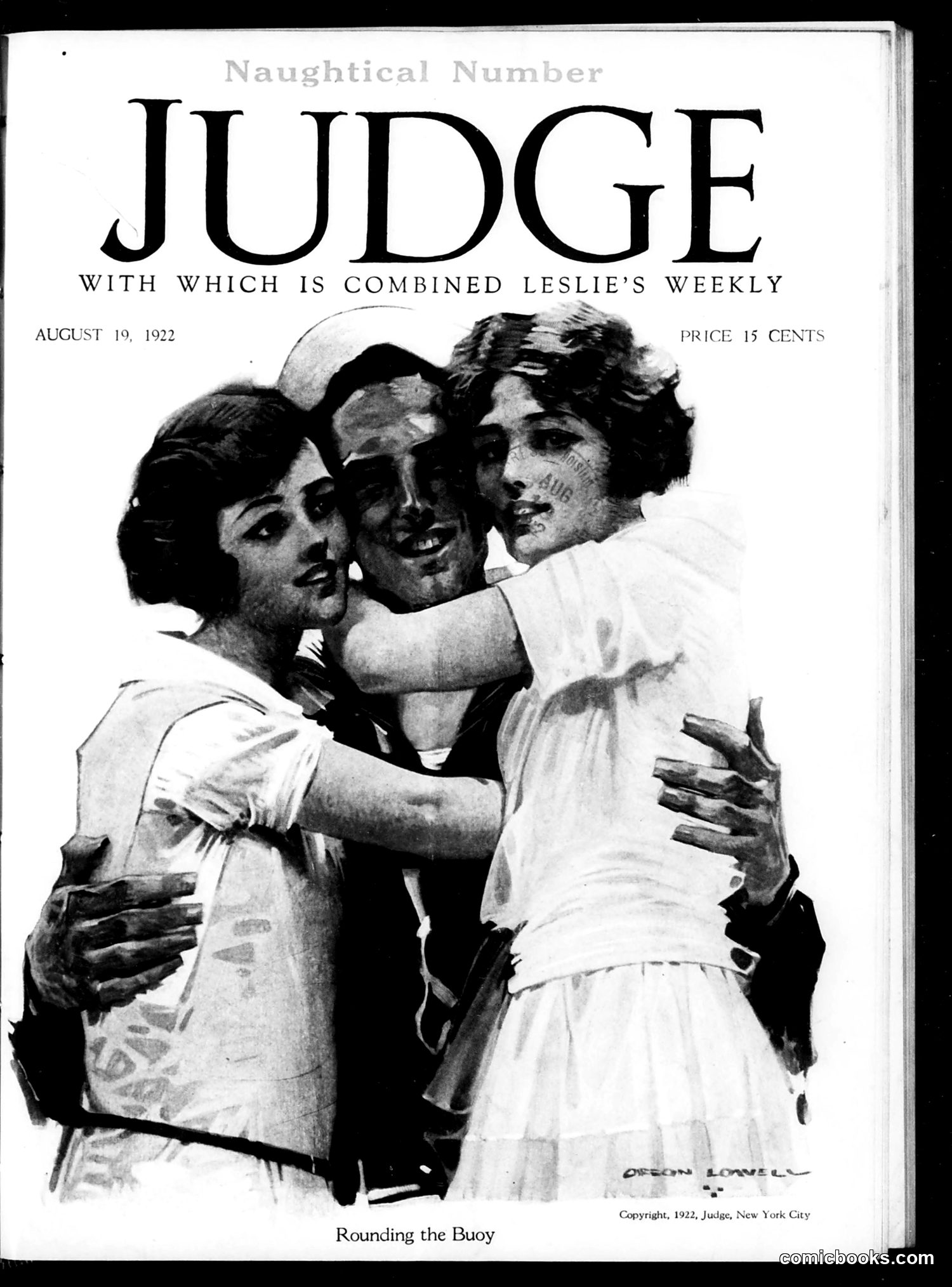
This Judge magazine cover from August 19, 1922 shows three figures in an intimate embrace, titled "Rounding the Buoy." The nautical metaphor suggests navigating around an obstacle or waypoint—here, the "buoy" likely refers to some social or legal boundary. The image appears to satirize romantic or moral entanglements, possibly referencing dating customs or relationship complications of the 1920s Jazz Age. The styled clothing and close physical contact reflect post-WWI attitudes toward courtship that many considered scandalous for the era. Without additional context identifying the specific figures or referencing a particular news event or scandal from summer 1922, the precise satirical target remains unclear, though it comments on contemporary social behavior and romantic conventions.
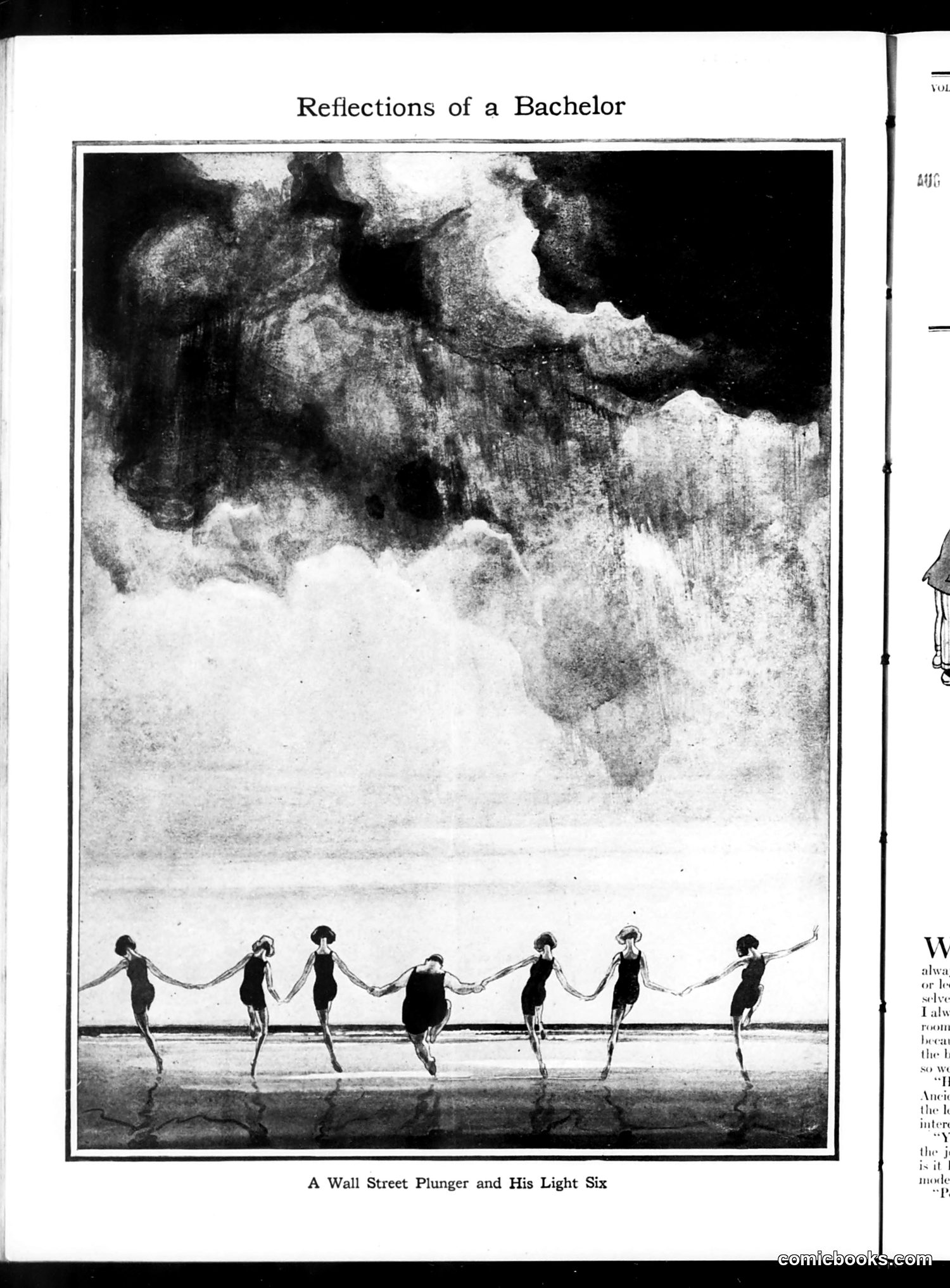
This satirical cartoon depicts "A Wall Street Plunger and His Light Six" - a mockery of a wealthy stock market speculator and his six female companions. The image shows seven figures in swimwear holding a rope chain while appearing to jump or dance together at a beach. The satire targets the excesses of 1920s Wall Street wealth and the lifestyle of speculators who made rapid fortunes during the era's bull market. The "light six" likely references both the women accompanying him and possibly a car model of the period. The cartoon criticizes how such wealth enabled frivolous, ostentatious leisure activities and romantic escapades, suggesting the moral questionability of fortune-making through stock speculation during this era of economic excess.
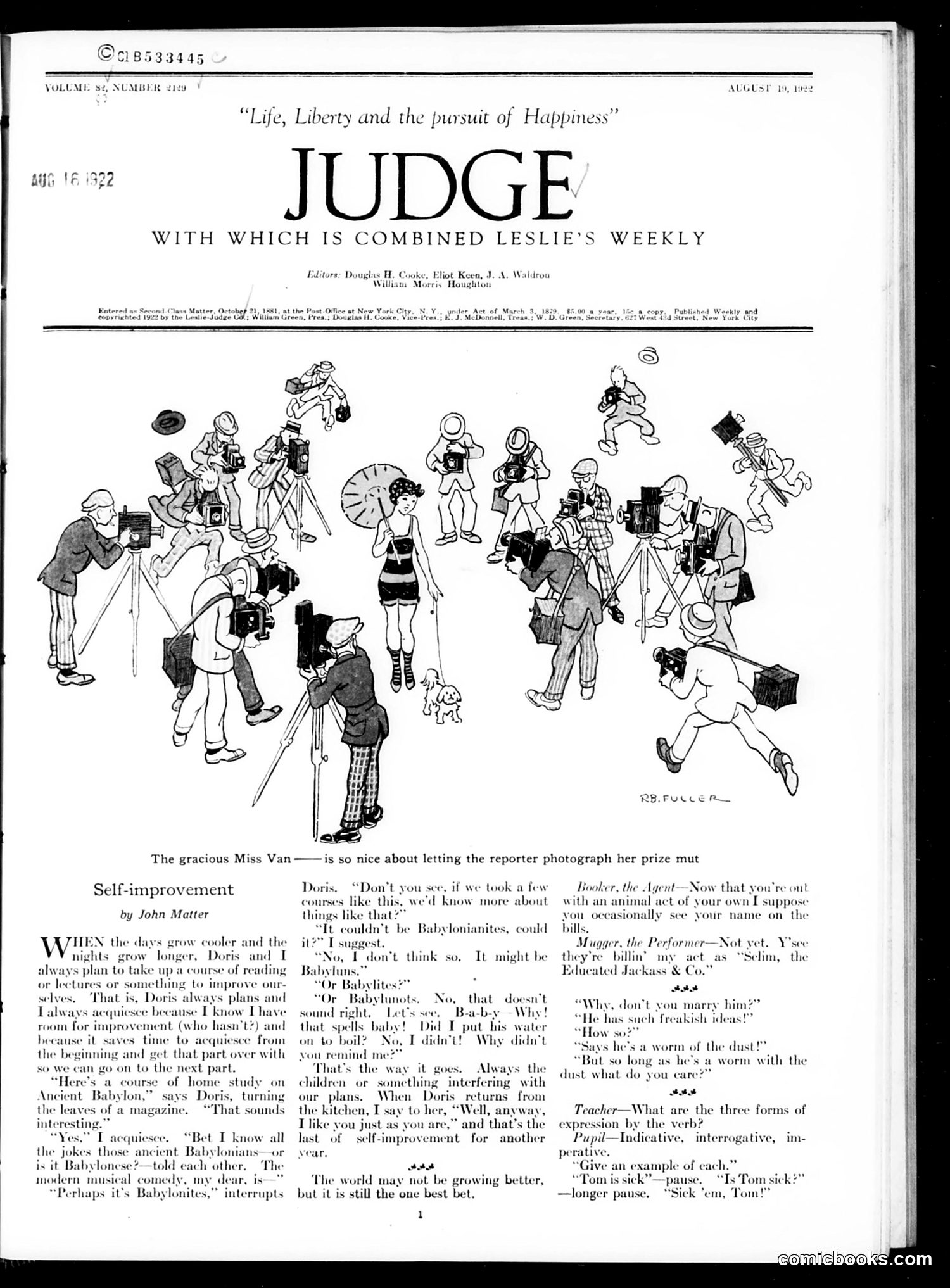
The main cartoon depicts a woman ("Miss Van") being photographed by numerous cameramen and reporters—a satire on celebrity culture and press obsession with prominent women. The accompanying article "Self-improvement" by John Matter humorously discusses "ancient Babylonites" as a comedic device, suggesting self-improvement through studying history. The sidebar jokes reference vaudeville performers and theatrical acts, including references to "Schim, the Educated Jackass & Co."—likely a real or fictional novelty act of the era. The "Teacher" question about verb conjugations appears to be a standard educational humor feature. Overall, this page satirizes 1920s celebrity worship, particularly of women in entertainment, and pokes fun at contemporary theatrical and variety show culture. The Babylonites references remain unclear without additional context.
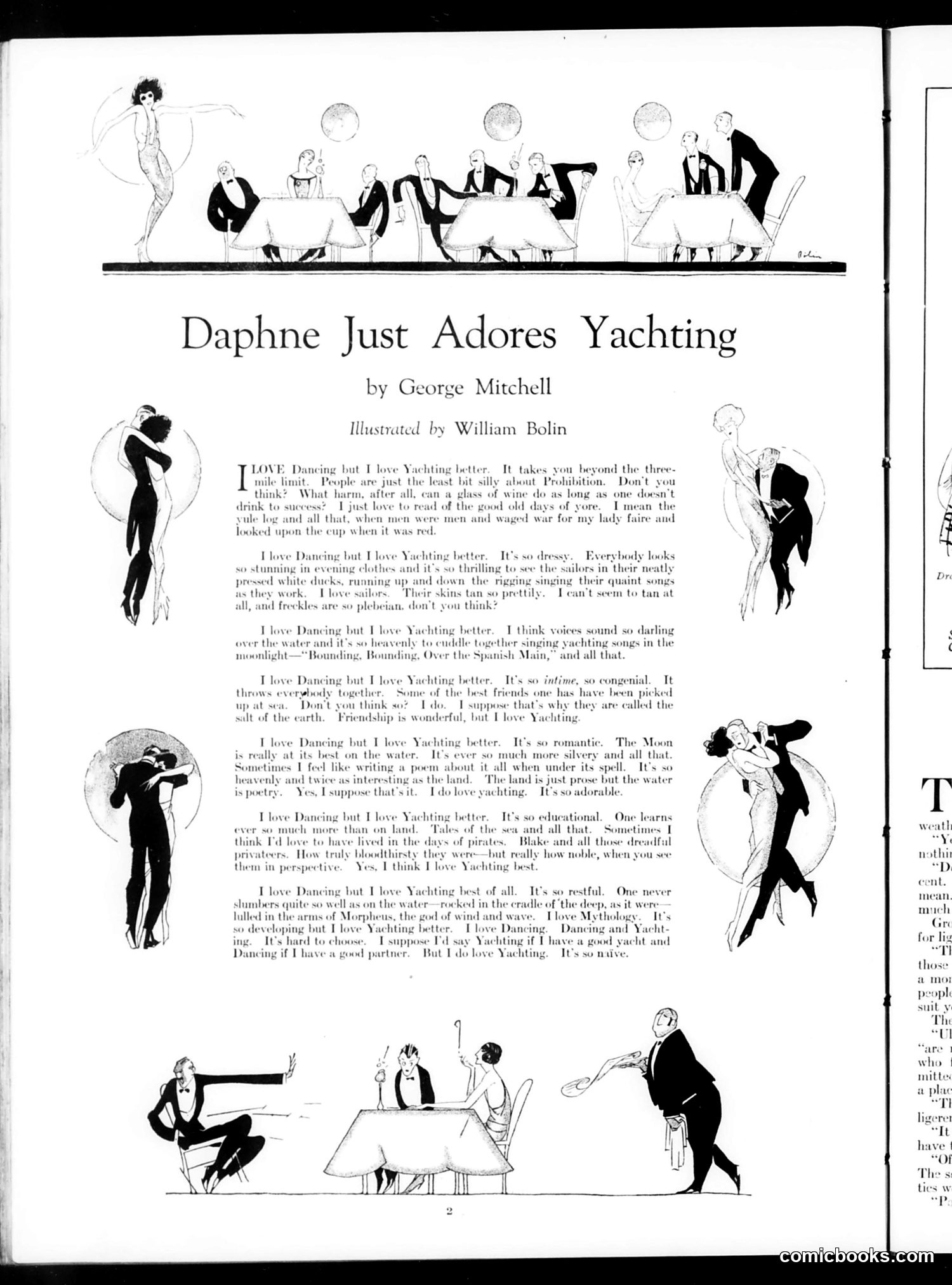
This article by George Mitchell, illustrated by William Bolin, is a humorous essay comparing a woman's love of yachting to her love of dancing. The repeated refrain "I love Dancing but I love Yachting better" frames the piece as satire on upper-class leisure pursuits. The illustrations show fashionable people in evening dress at formal dinners and social gatherings, contrasted with yachting scenes. The joke appears to target wealthy society women who enthusiastically adopt fashionable activities. The illustrations emphasize elegance and sophistication while Mitchell's text suggests the narrator's somewhat superficial enjoyment of yachting as a prestigious pastime. This reflects 1920s-era satire of Jazz Age social climbing and conspicuous consumption among the wealthy.
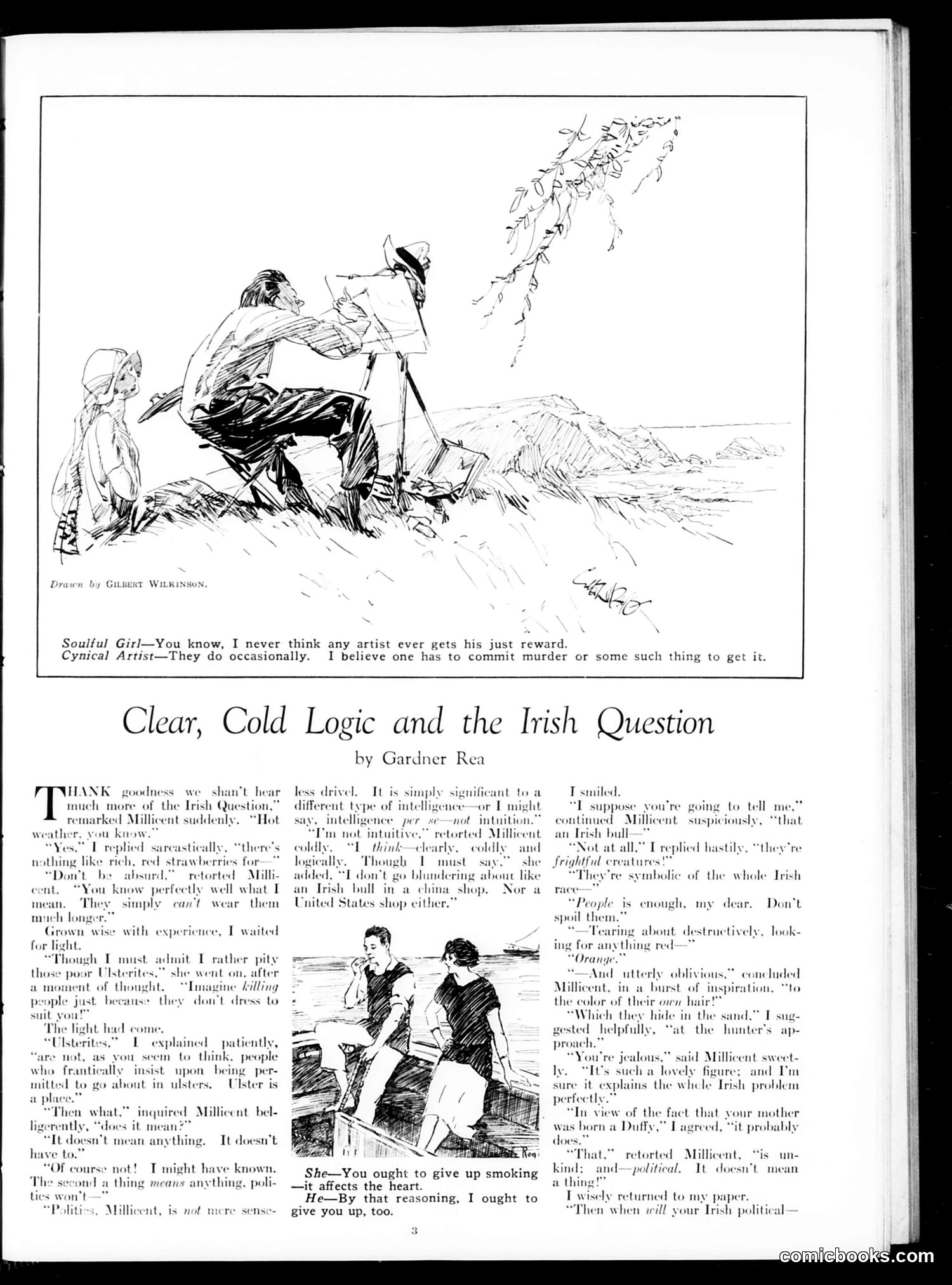
**The Cartoon (top):** Drawn by Gilbert Wilkinson, this sketch shows two figures in an artist's studio. The dialogue satirizes the struggle for artistic recognition: a "Soulful Girl" complains that artists never receive fair reward, while a "Cynical Artist" cynically responds that success requires committing "murder or some such thing." **The Article (below):** "Clear, Cold Logic and the Irish Question" by Gardner Rea presents a dialogue between characters named Millivent and an Irish person (not clearly identified). The conversation appears to mock Irish stereotypes and political positions on Irish independence, using the characters' exchange to satirize both Irish politics and American attitudes toward the "Irish Question"—a major political issue of the early 20th century. The satire targets both artistic pretension and Irish political discourse.
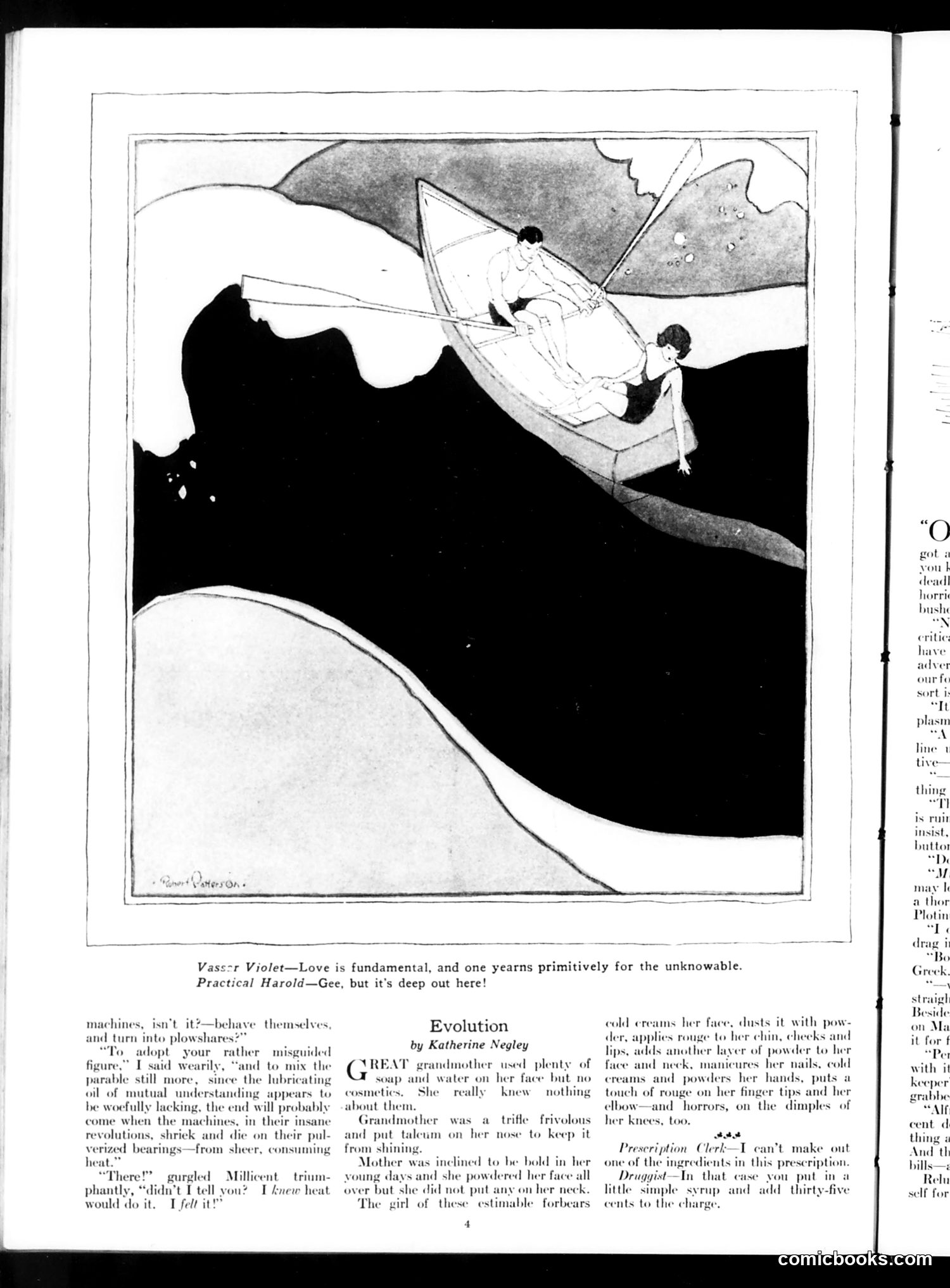
The top illustration appears to be a decorative art piece rather than political satire, showing two figures in a boat amid stylized waves. The dialogue below—attributed to "Vasect Violet" and "Practical Harold"—is humorous domestic banter about deep water, but contains no identifiable political or social commentary. The bottom section presents "Evolution" by Katherine Negley, a satirical short story about cosmetics and beauty standards. The text mocks women's elaborate grooming routines, describing how "Great grandmother" used minimal cosmetics while modern women engage in excessive makeup application—powdering, rouging, applying rouge to fingertips and heels. This satirizes early 20th-century beauty culture and the growing cosmetics industry's influence on women's self-presentation practices.
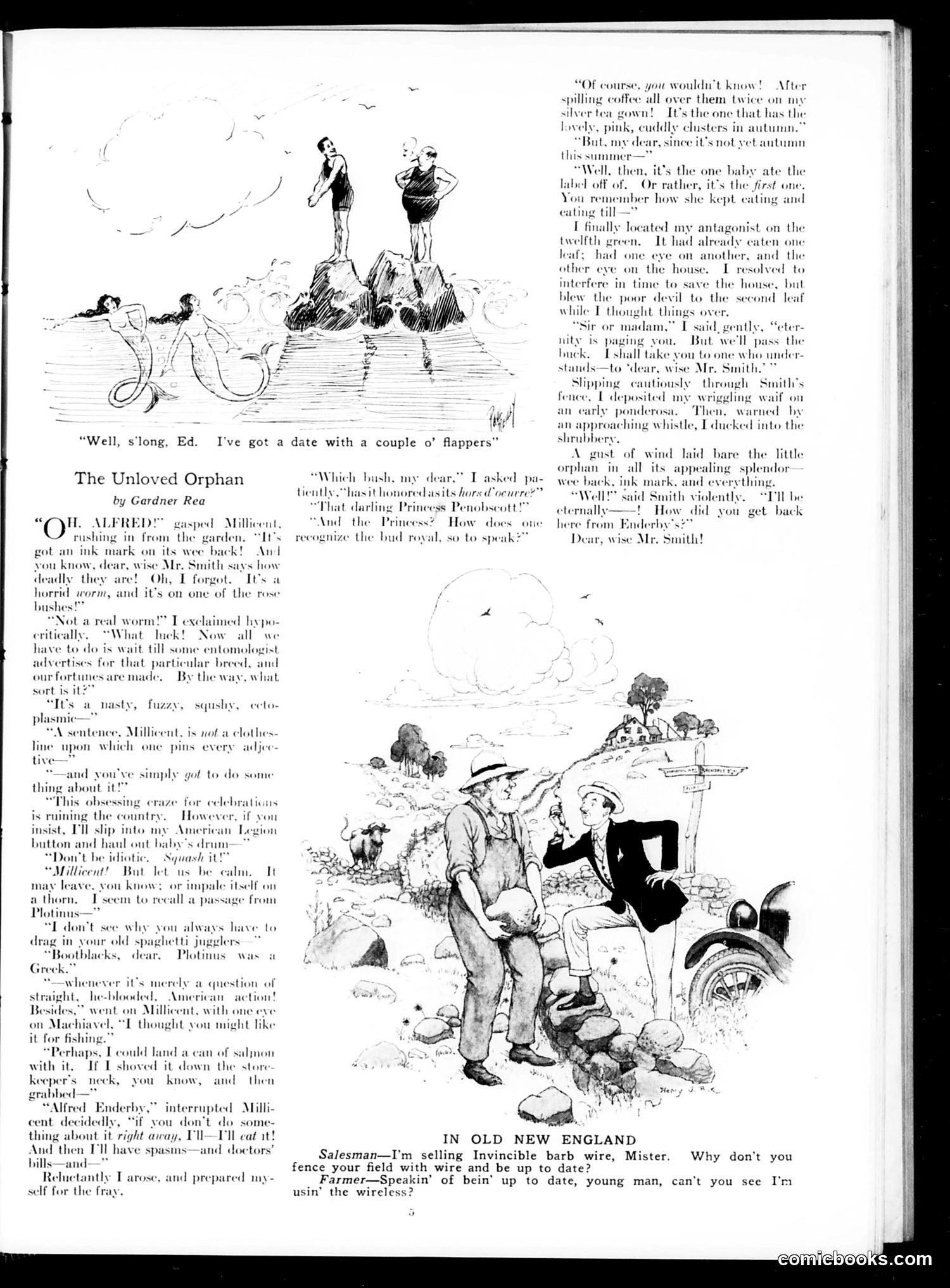
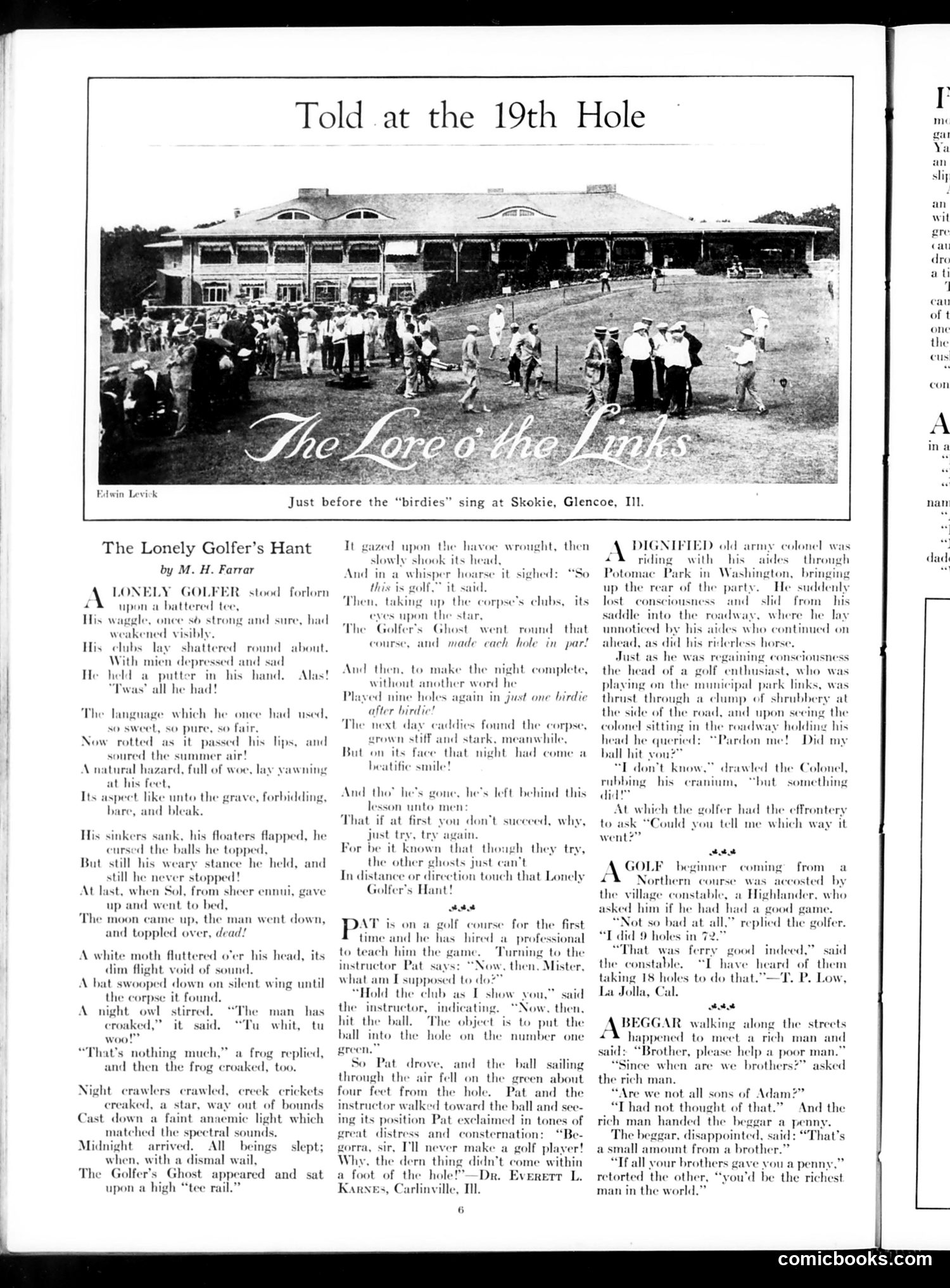
This page presents three humorous golf stories, a popular leisure activity for affluent readers of early 20th-century Judge magazine. **"The Lonely Golfer's Hant"** uses gothic supernatural imagery as extended comedy: a frustrated golfer dies on the course, then his ghost returns to play perfectly—the joke being that only death grants golf mastery. The moral ("try, try again") mockingly suggests persistence is useless. **Pat's story** satirizes Irish immigrants' unfamiliarity with upper-class leisure. Pat, hiring a professional instructor, demonstrates comic incompetence: he can't understand basic golf mechanics, with the punchline that he'll "never make a golf player." **The Colonel's story** contrasts military dignity with golf's indignity—a dignified officer falls from his horse unnoticed, then is struck by a golf ball and cannot identify which direction it came from. All three stories mock golfers (whether dead, immigrant, or military) and highlight golf as a source of humiliation, frustration, and class-based comedy for Judge's affluent readership.
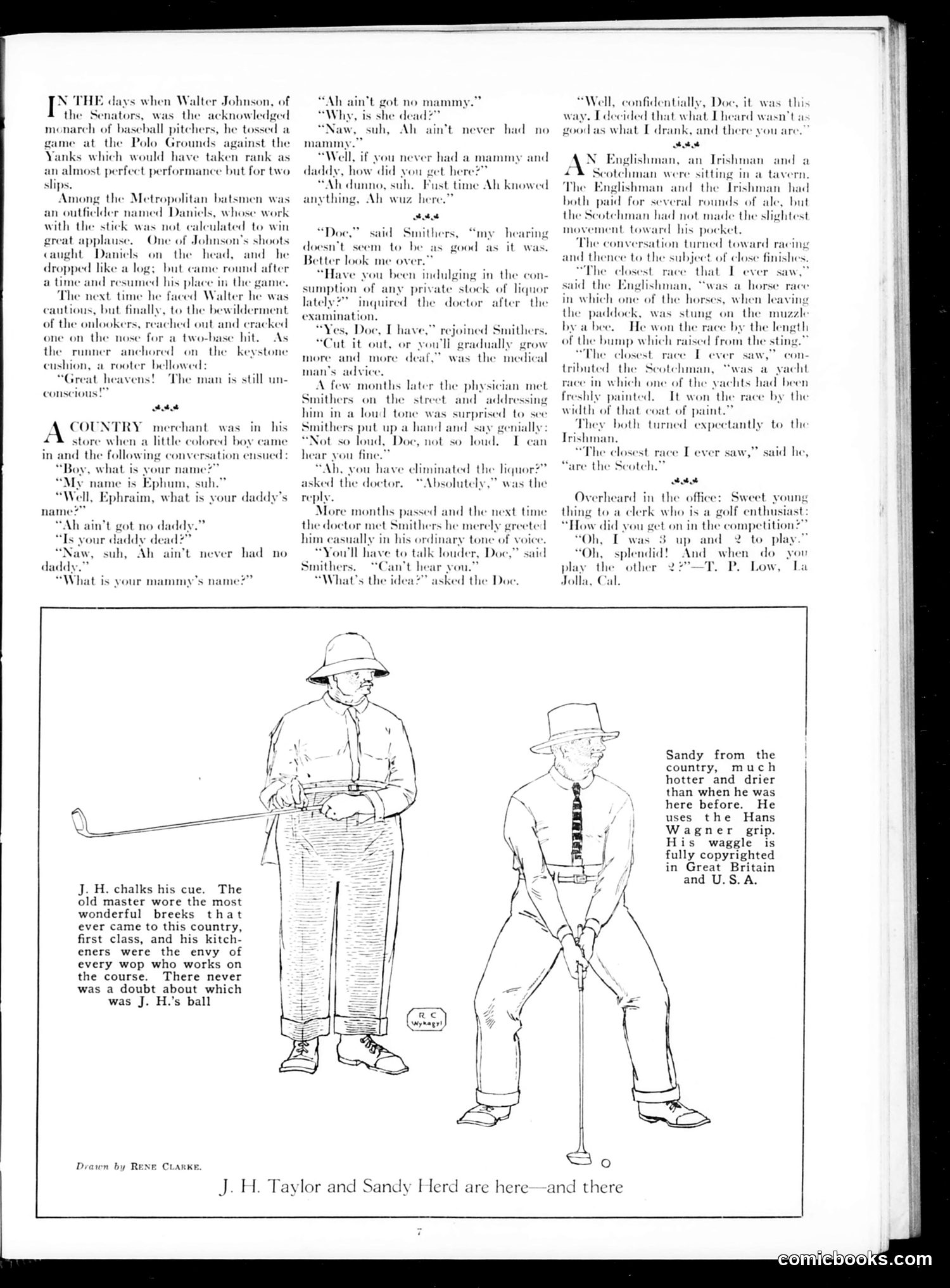
This Judge magazine page contains several brief humorous stories and a golf illustration: **Main cartoon**: Shows J. H. Taylor (a famous golfer) and "Sandy" Herd in their distinctive golf attire. The caption notes Taylor's famous "wonderful breeks" (trousers) and equipment were so recognizable that spectators could identify his ball by sight alone. This celebrates early 20th-century professional golf celebrity. **The stories** are period humor anecdotes about: - A colored boy with no parents (problematic racial humor typical of the era) - A man who drinks, goes deaf, then recovers his hearing by quitting alcohol, but then becomes deaf again (ironic twist ending) - Three men (English, Irish, Scottish) competing in boasting about close races—the Irishman jokes that "the Scotch" are the closest races (implying Scots are stingy/miserly) - A golf enthusiast's competition joke The page reflects early 20th-century American satirical magazine humor: focused on sports celebrities, ethnic stereotyping, and wordplay. The golf content suggests affluent readership interested in the sport.
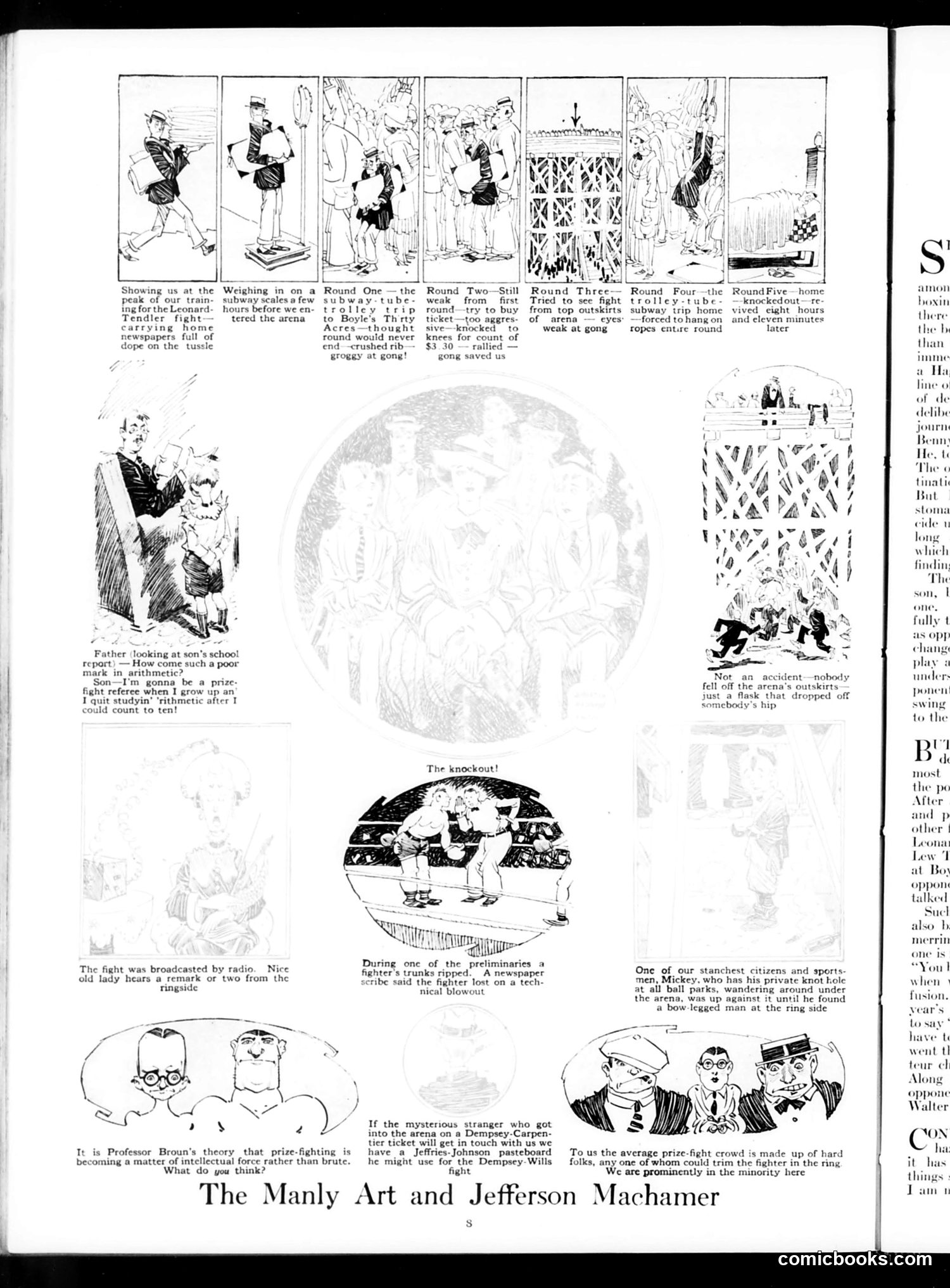
This page satirizes the Leonard-Tendler boxing match and contemporary prize-fighting culture. The top strip follows a fan's exhausting journey to and from the fight via subway, depicting the physical ordeal of attending. The humor targets: - **Boxing spectators**: depicted as rowdy, drunk ("flask"), and socially crude - **The radio broadcast**: a new technology criticized for enabling commentary from "ringside" commentary that intrudes on the experience - **Intellectual pretension**: Professor Broun's claim that boxing represents "intellectual force rather than brute" is mocked as absurd - **Boxing culture generally**: presented as lowbrow entertainment attracting unsophisticated crowds The cartoon critiques both the sport itself and the fans who attend, suggesting boxing draws hard-drinking, crude individuals. The repeated emphasis on counting ("ten"), tickets, and technical rules underscores the satirist's view of boxing as a somewhat disreputable spectacle despite its growing popularity in the 1920s.
This sports column compares prize fighter **Benny Leonard** to golfers like Walter Hagen and Hutchinson, arguing that boxing is intellectually superior to golf—contrary to common assumptions that boxing is "low-brow." Broun's central argument: both sports require precise targeting, but Leonard's task is infinitely more complex. A golfer can study the green calmly; a boxer must calculate his punch's trajectory while his target moves and tries to hit him back. The piece humorously suggests that if golfers were allowed to shout at opponents (as boxers endure), the sport would become as strategically sophisticated as boxing. The column celebrates Leonard's mental discipline, noting his ability to learn and adapt even under disadvantageous conditions (fighting southpaw Lew Tendler). For Broun, boxing exemplifies how sport reveals character—intelligence, judgment, and personality matter as much as physical ability. The thrust: boxing deserves respect as a "highly-intellectualized" sport, challenging prevailing class-based prejudices about the sport.
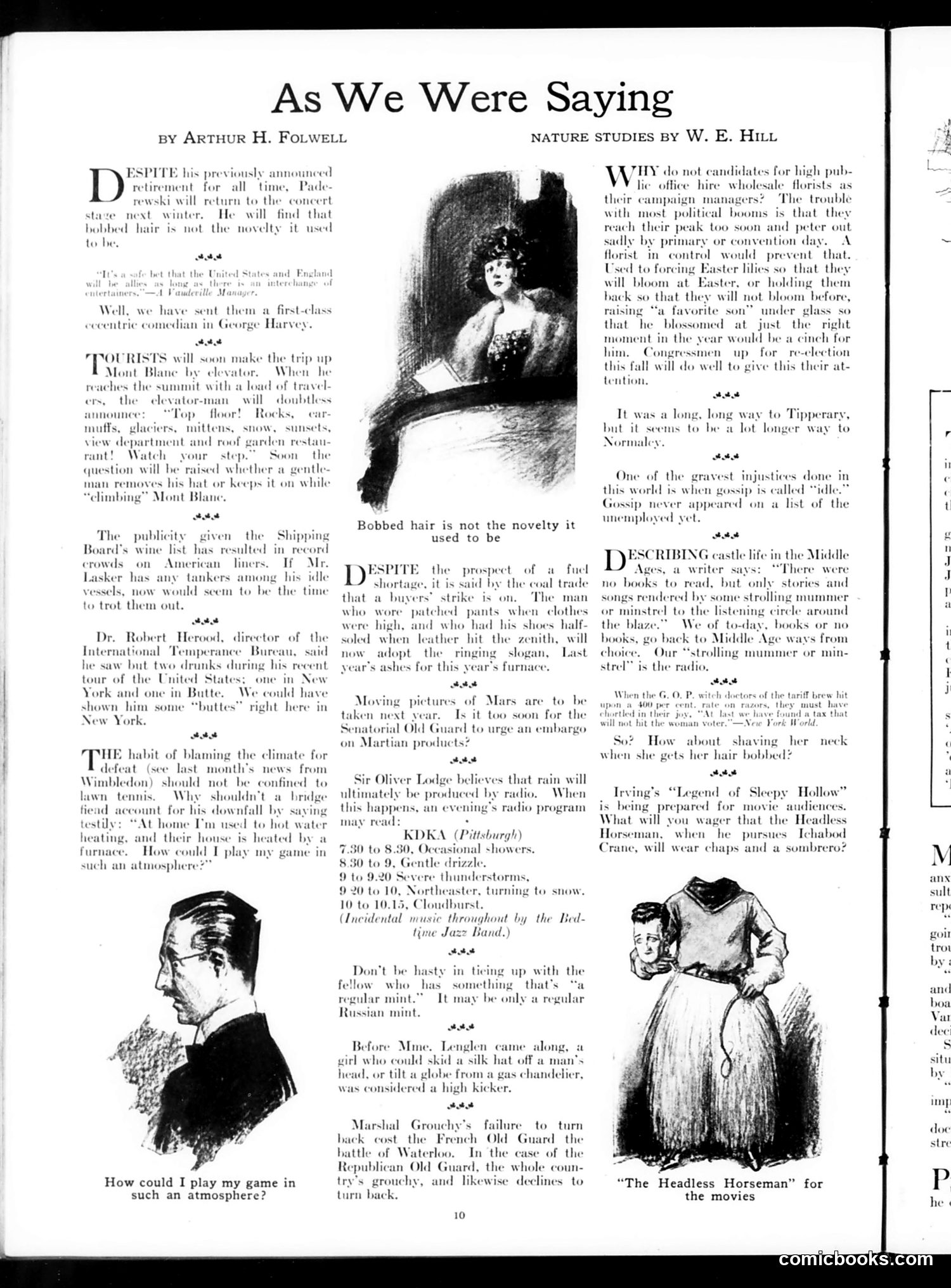
This is a satirical commentary page mixing political humor with social observation, typical of Judge magazine's style. **Key references:** - **Paderewski's return**: Polish pianist/statesman announces comeback; joke is "bobbed hair" (1920s women's fashion) is now commonplace, not novel - **George Harvey**: American diplomat/politician sent abroad as "eccentric comedian" - **Shipping Board wine list**: References a scandal where the U.S. Shipping Board's expensive wine cellar became public knowledge, embarrassingly attracting crowds to liners - **Republican Old Guard/Marshal Grouchy**: Compares GOP leadership to Napoleon's general who failed to support him at Waterloo—suggesting Republicans likewise refuse to "turn back" (support their base) - **"Normalcy"**: Reference to Harding's 1920 campaign promise of "return to normalcy" The page mocks government inefficiency, political hypocrisy, and changing social mores with quick, biting quips rather than elaborate cartoons.
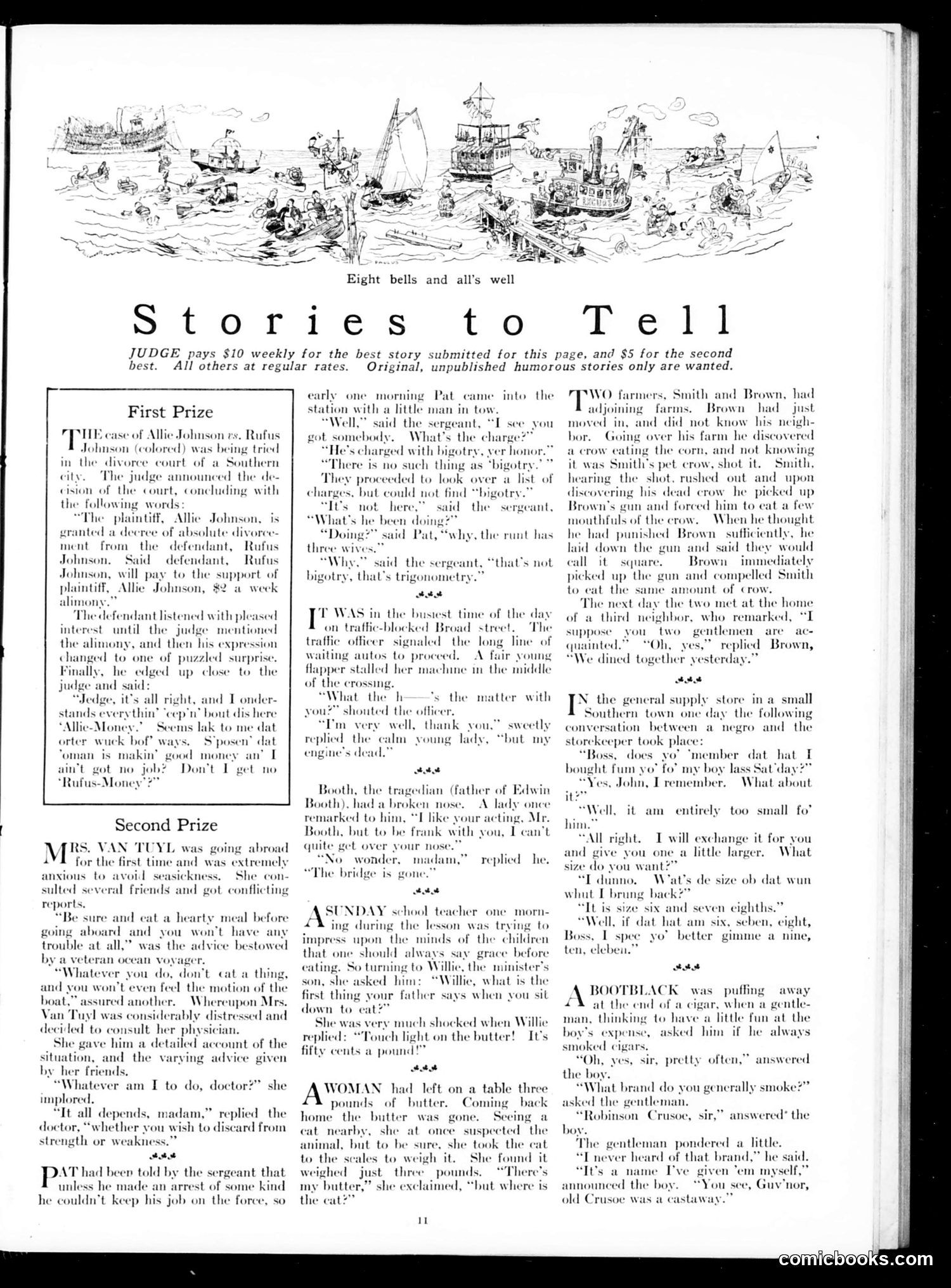
This is a humor page featuring five short joke stories competing for prizes ($10 for first place, $5 for second). The content reflects early 20th-century American stereotypes and social attitudes: **Notable stories:** - A divorce case where a Black man (shown in dialect) is shocked at paying only $2/week alimony, thinking $2 is substantial money - A Mrs. Van Tuyl seeking seasickness advice, receiving contradictory guidance - A police officer (Pat, depicted with Irish stereotyping) arresting a man for "bigotry," confusing it with "trigonometry" - A "flapper" stalling her car in traffic, responding sweetly to an officer's demands - A woman weighing her cat to prove it ate her butter **The satire targets:** dialect humor, Irish policemen, modern young women ("flappers"), and everyday absurdities. The humor relies heavily on period racial and ethnic stereotyping now considered offensive. The page illustrates what Judge considered amusing: character-based comedy, wordplay, and social observation typical of 1920s popular humor magazines.
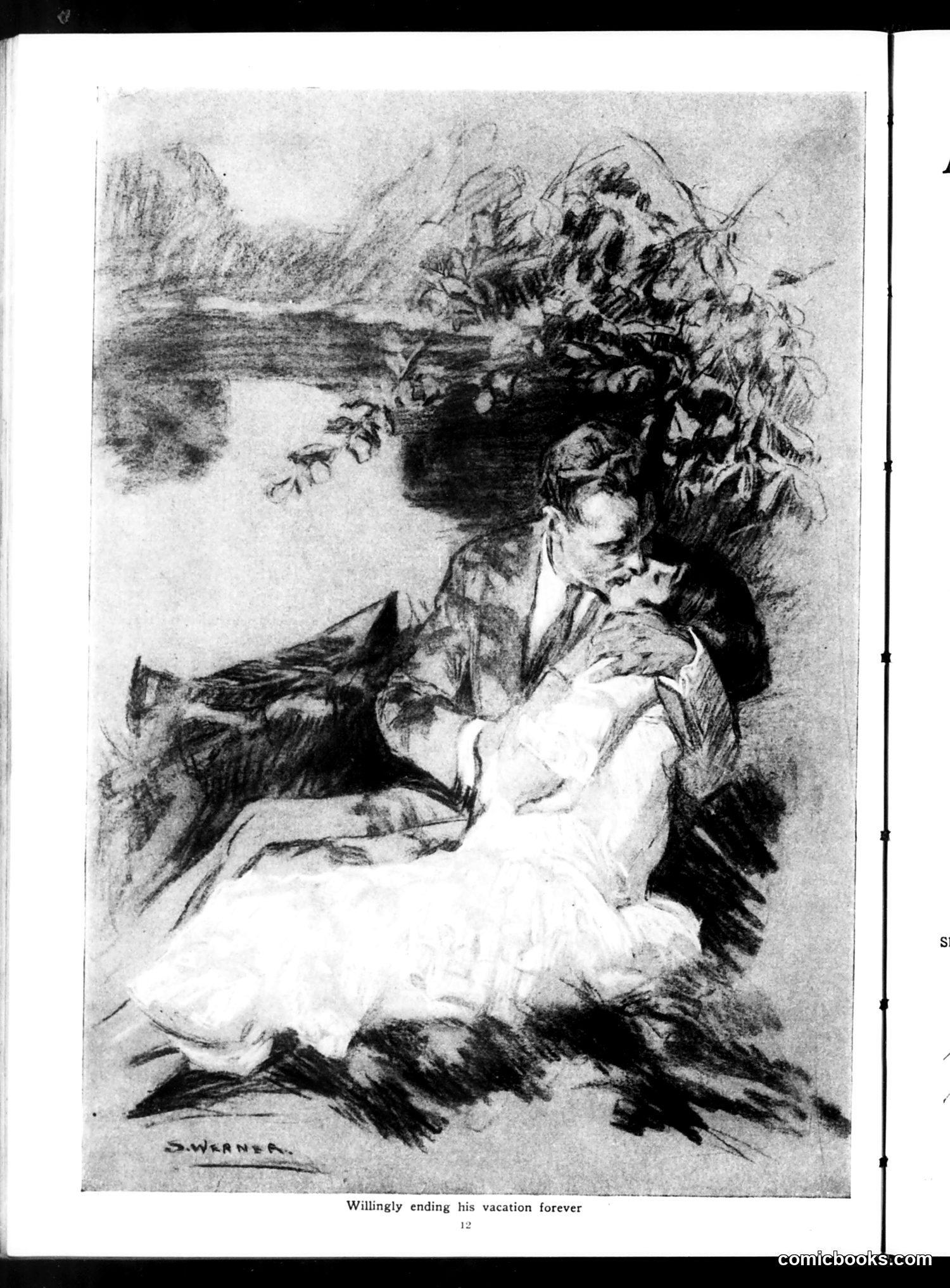
This cartoon depicts a man in formal attire (jacket and vest) reclining outdoors near vegetation and water, apparently deceased or dying. The caption "Willingly ending his vacation forever" creates dark satire—suggesting the figure has chosen permanent death rather than return to his regular life. The cartoon appears to satirize the reluctance many experience when vacations end and ordinary responsibilities resume. By depicting literal death as preferable to returning from vacation, the artist exaggerates this common sentiment for comedic effect. The signature reads "S. WERNSE" (or similar). Without additional context from Judge magazine's publication date, the specific identity of the subject remains unclear, though the satire targets the universal human experience of vacation-ending dread.
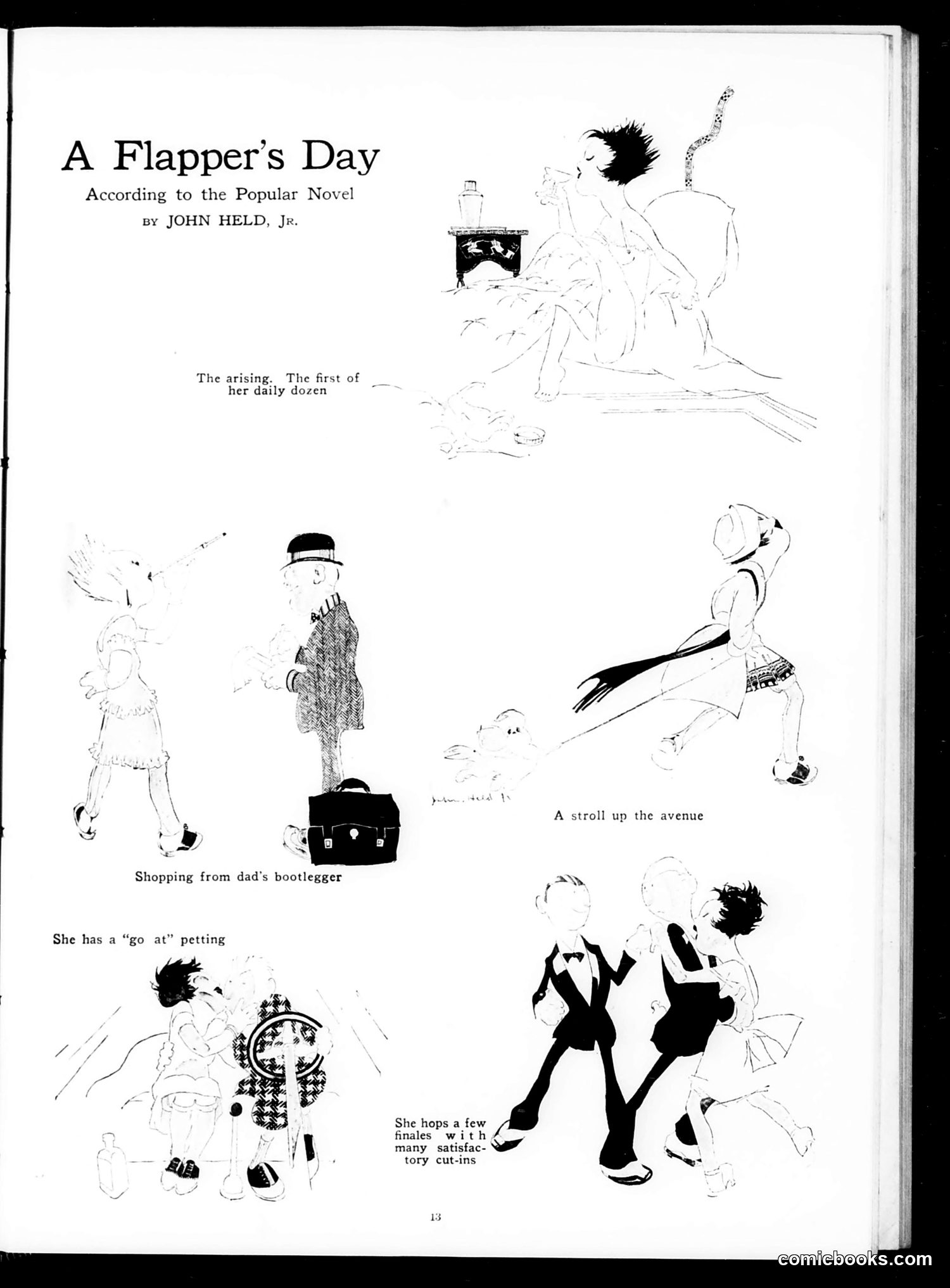
This satirical illustration by John Held Jr. mocks the stereotypical lifestyle of 1920s "flappers"—young women who challenged social conventions. The cartoon depicts a day's activities including: - Morning exercise routines ("daily dozen") - Fashion-conscious strolling - Shopping from her father's bootlegger (referencing Prohibition-era illegal alcohol) - "Petting" (kissing/intimate behavior considered scandalous) - Dancing with multiple partners ("cut-ins") The satire targets both the flapper lifestyle itself and popular novels romanticizing it. By presenting these activities as a typical day—shopping for illegal liquor, casual physical intimacy, and promiscuous dancing—Held critiques both the young women and the media sensationalizing their behavior. The exaggerated, energetic drawings emphasize the perceived recklessness of flapper culture that shocked conservative Americans.
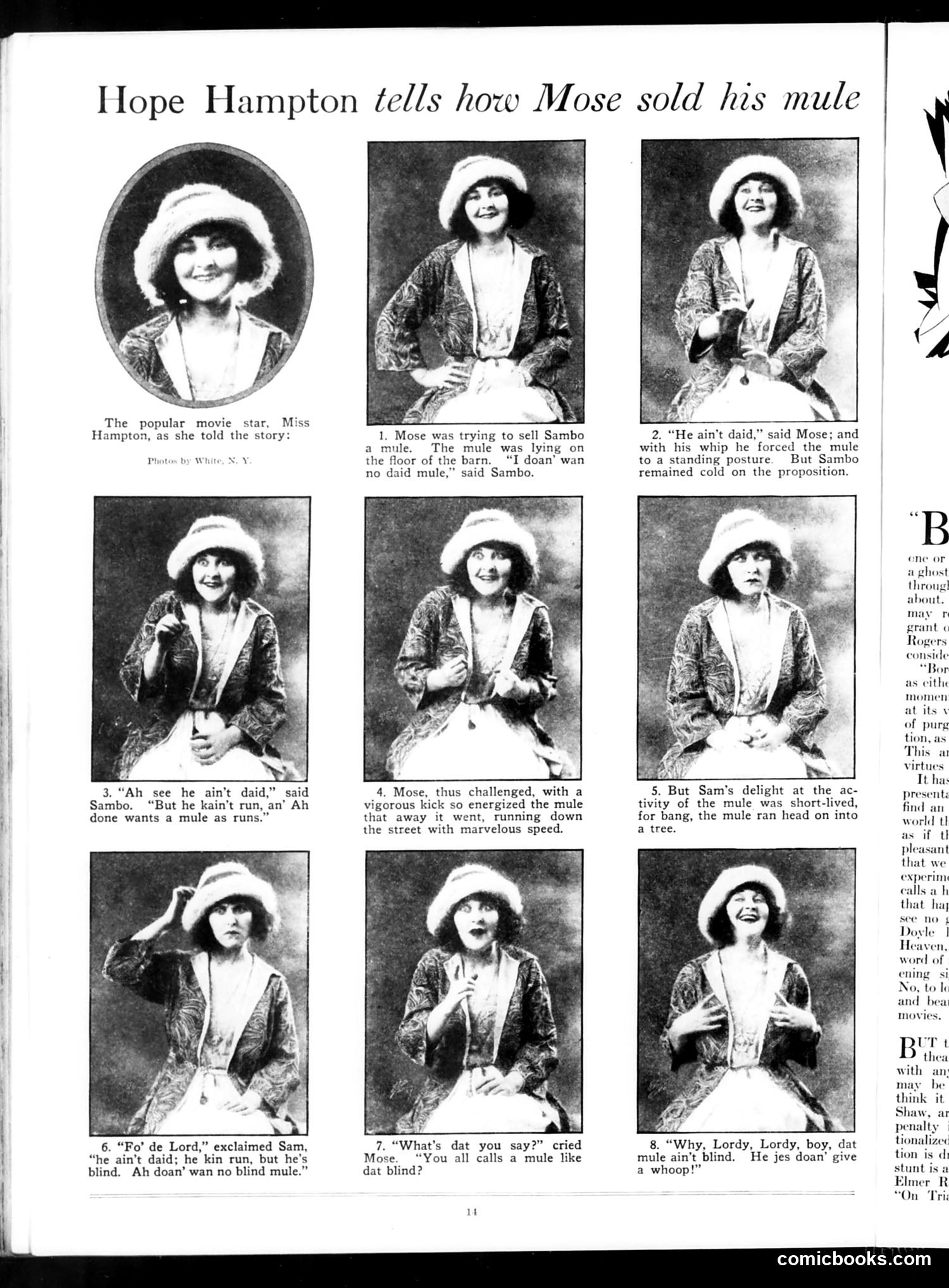
This is a satirical comic strip featuring racist stereotypes typical of early 20th-century American humor. It depicts a dialogue between two African American characters, "Mose" and "Sambo," attempting to sell a defective mule through increasingly absurd justifications. The humor relies on dialect humor and portrayal of African Americans as foolish or dishonest. The "joke" progresses through the mule being dead, then unable to run, then blind—with each objection met by Mose's creative reframing. The punchline (frame 8) suggests the mule simply doesn't care, using dehumanizing language. The strip frames this as a story told by actress Hope Hampton, lending celebrity endorsement to the material. This represents the casual racism embedded in mainstream American entertainment and magazines of this era, where such stereotypical portrayals were considered acceptable public humor.
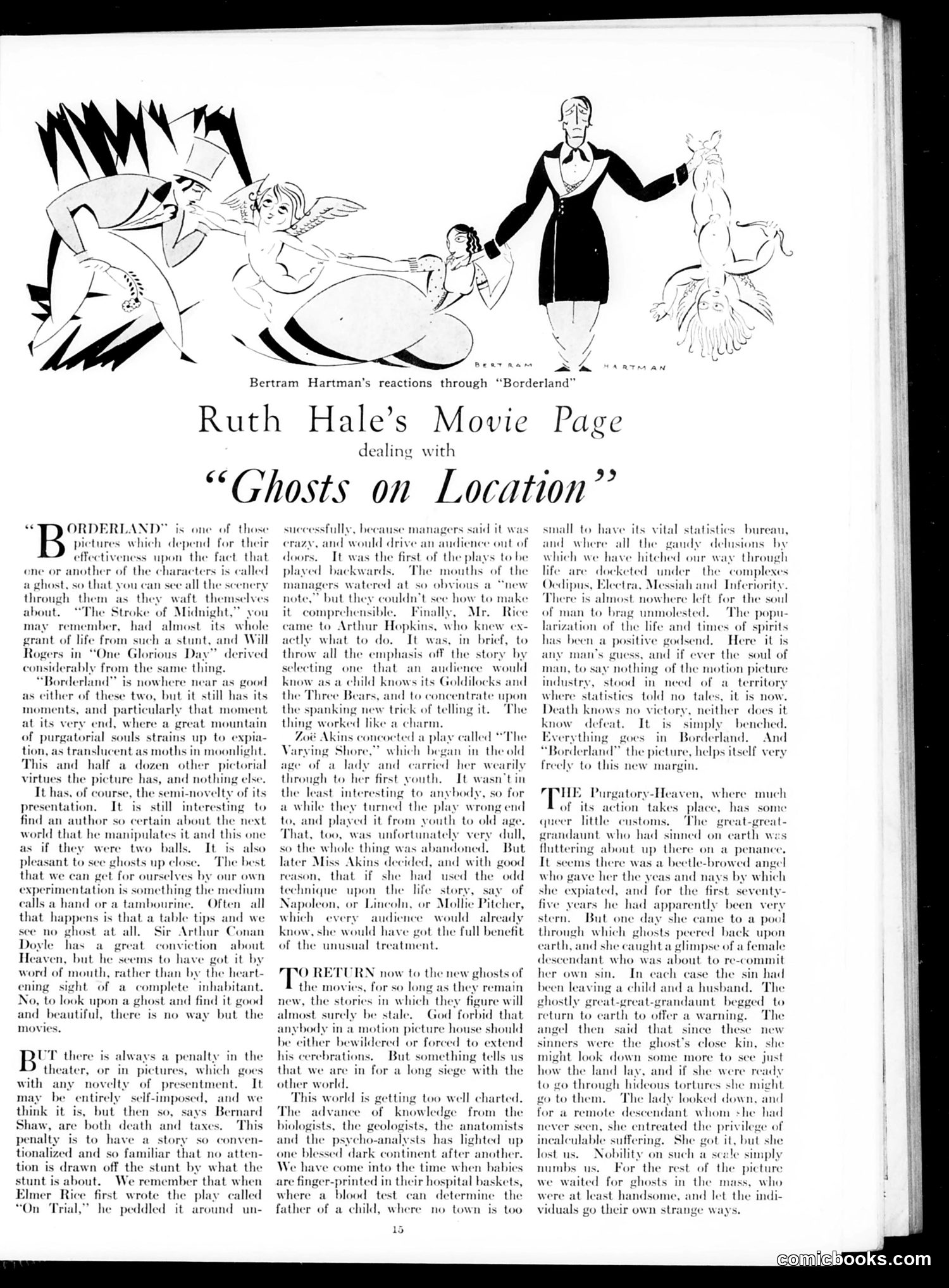
This is Ruth Hale's review of the film *Borderland*, illustrated by Bertram Hartman's cartoon reactions. The page critiques a movie featuring ghosts as visual novelty—characters appearing transparent so viewers see scenery "through them." Hale argues that while the ghost-visualization trick is cinematically interesting, the film suffers from a familiar problem: novelty of *presentation* requires novelty of *story* to succeed. She references successful precedents (*The Stroke of Midnight*, *One Glorious Day*) where filmmakers solved this by using widely-known plots (like "Goldilocks and the Three Bears") so audiences focus on the innovative technique rather than following an unfamiliar narrative. The review concludes that *Borderland*'s ghost imagery, though visually appealing, cannot compensate for its stale storyline—a common penalty in early cinema when directors prioritized technical gimmicks over substantive storytelling.
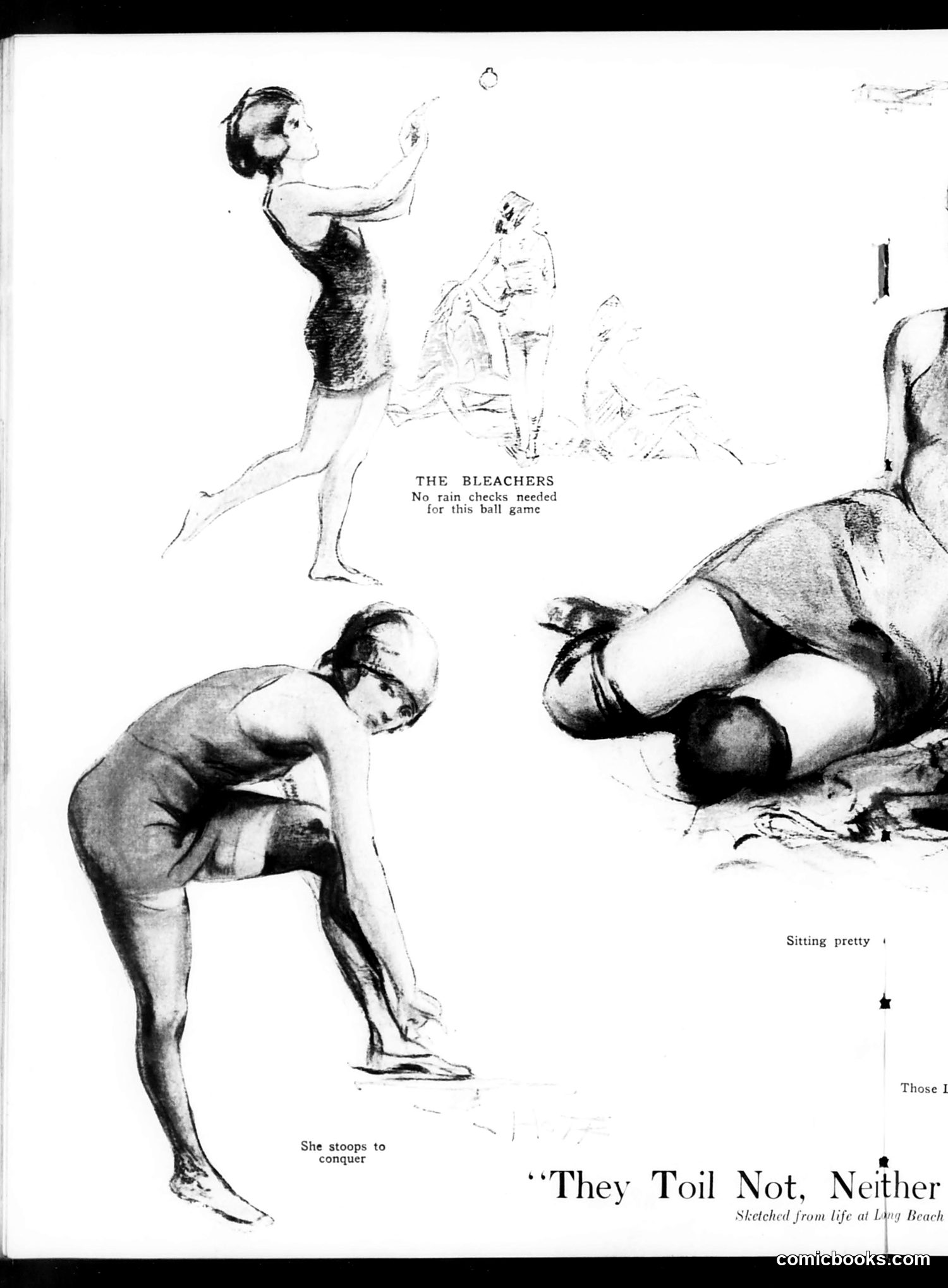
This page from *Judge* magazine features satirical sketches of women at a beach, titled "They Toil Not, Neither" (referencing the biblical phrase about lilies of the field). The cartoon mocks leisured women lounging at "Long Beach," contrasting idle recreation with labor. "The Bleachers" joke suggests these women need no "rain checks"—they're permanently fixture-like observers. "She stoops to conquer" references feminine wiles and social manipulation. The satire targets upper-class female leisure culture and potentially critiques women's perceived idleness during an era when labor and productivity were culturally valorized. The sketches emphasize female bodies in relaxed, recreational poses, suggesting both admiration and social criticism of women unburdened by work—a commentary on class privilege and gender roles in early-to-mid 20th century America.
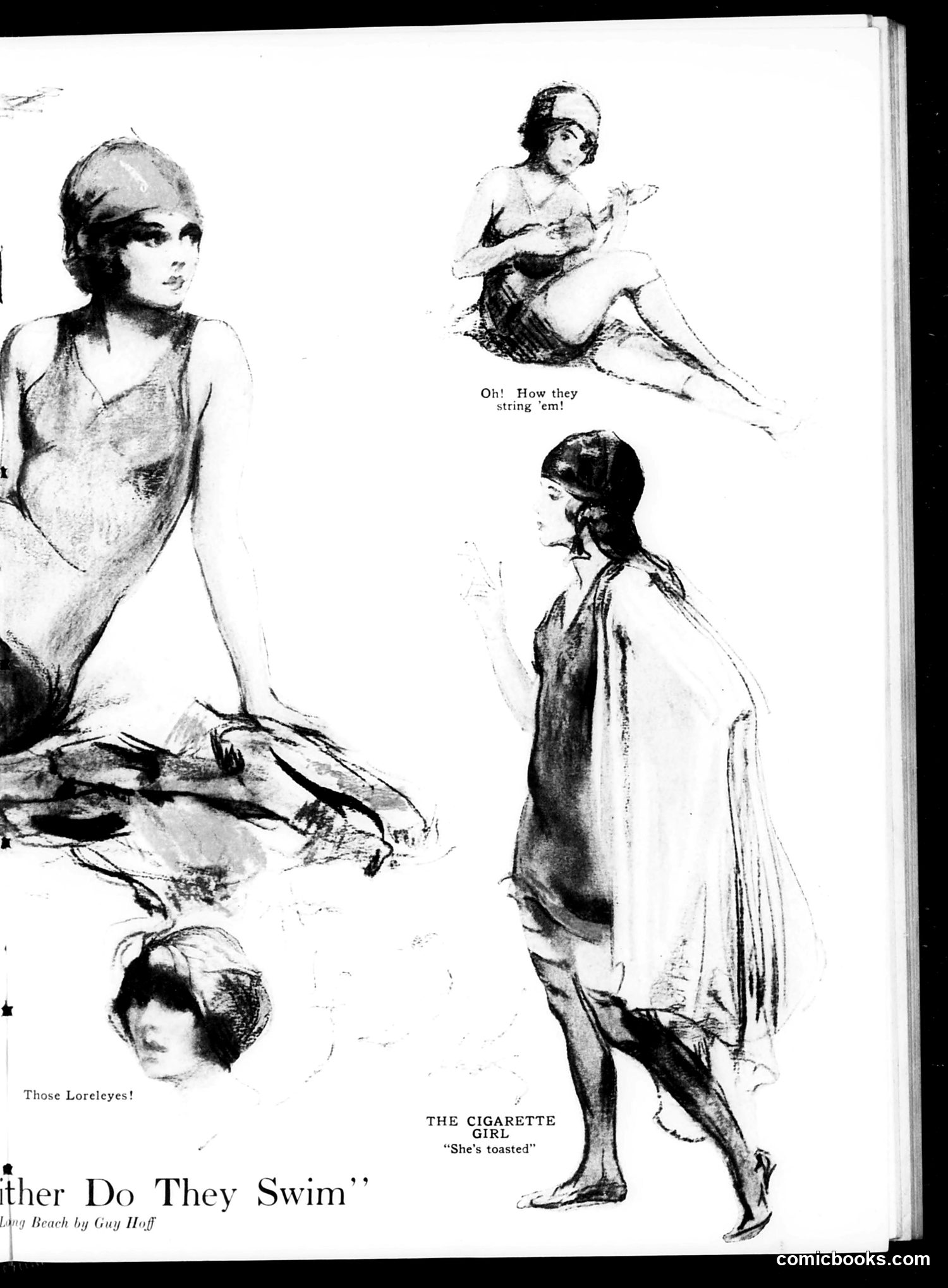
This page satirizes the "cigarette girl"—a stock figure in 1920s entertainment and advertising. The sketches by Guy Hoff show an attractive young woman in various poses, captioned with suggestive language: "Oh! How they string 'em!" and references to "Loreleyes" (the mythological siren who lures men to their doom). The satire targets both the cigarette industry's use of sexualized female imagery in marketing and the stereotype of the attractive woman who manipulates men. "She's toasted" appears to be a cigarette brand reference (likely Lucky Strike's famous slogan), repurposed as double entendre. The cartoon mocks how the advertising industry exploited femininity to sell cigarettes, while simultaneously satirizing the femme fatale archetype popular in Jazz Age culture.
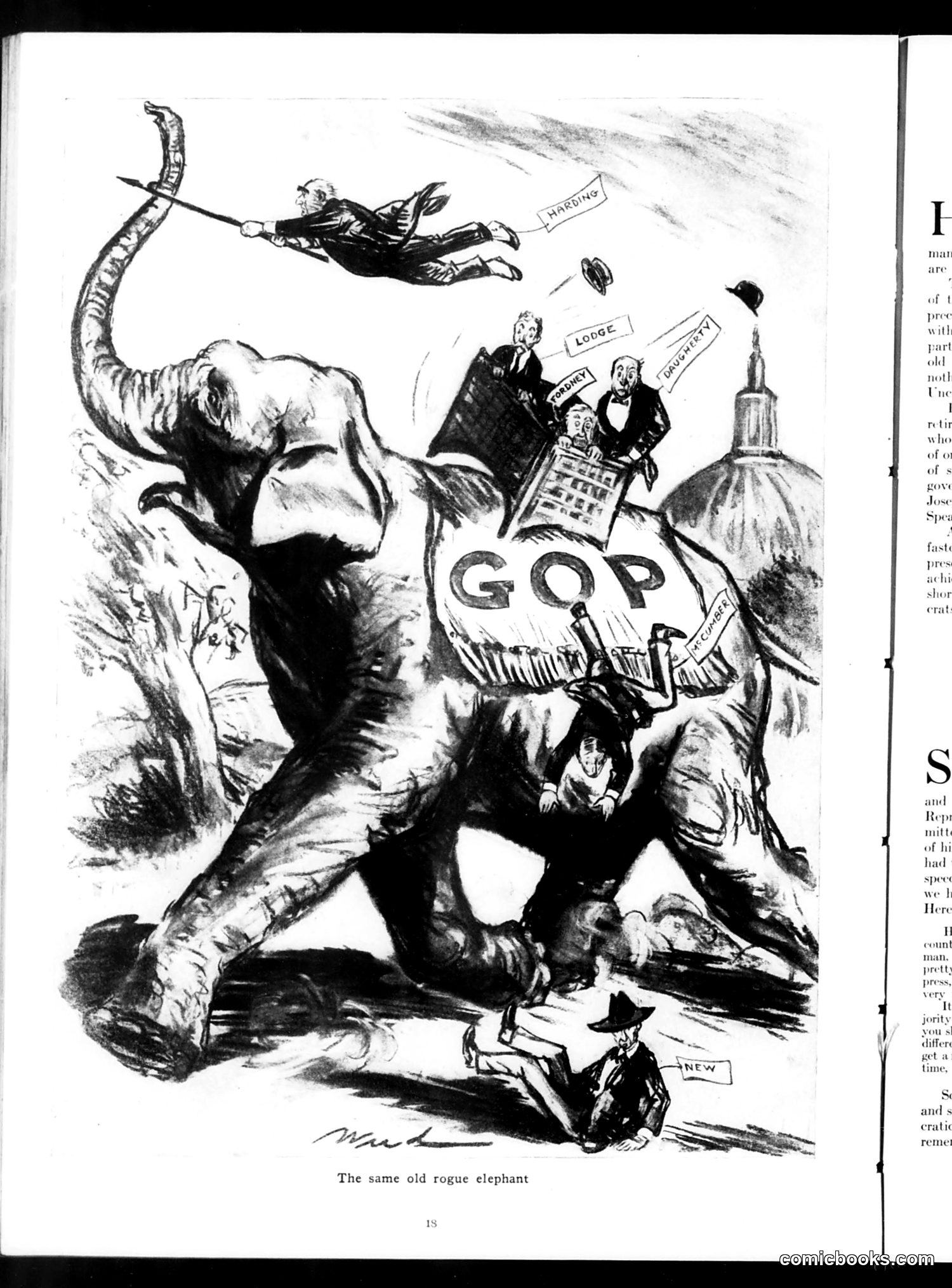
This satirical cartoon depicts the Republican Party (symbolized by an elephant, the GOP's traditional mascot) as a rogue, uncontrollable beast causing chaos. Various Republican political figures cling to or are thrown about by the elephant, labeled with tags reading "HARDING," "LODGE," "DAUGHERTY," and others—likely referencing scandals or unpopular policies from the Harding administration (1921-1923). One man flies through the air holding a "HARMONY" flag, suggesting Republicans' failed attempt to present party unity. Another figure at bottom is labeled "NEW," possibly representing new or reformist Republican voices being trampled. The cartoon's message: the Republican Party, despite its leaders' efforts to control it, remains a destructive, unpredictable force driven by corruption and internal discord. The "same old rogue elephant" caption suggests this is characteristic, recurring Republican behavior rather than aberration.
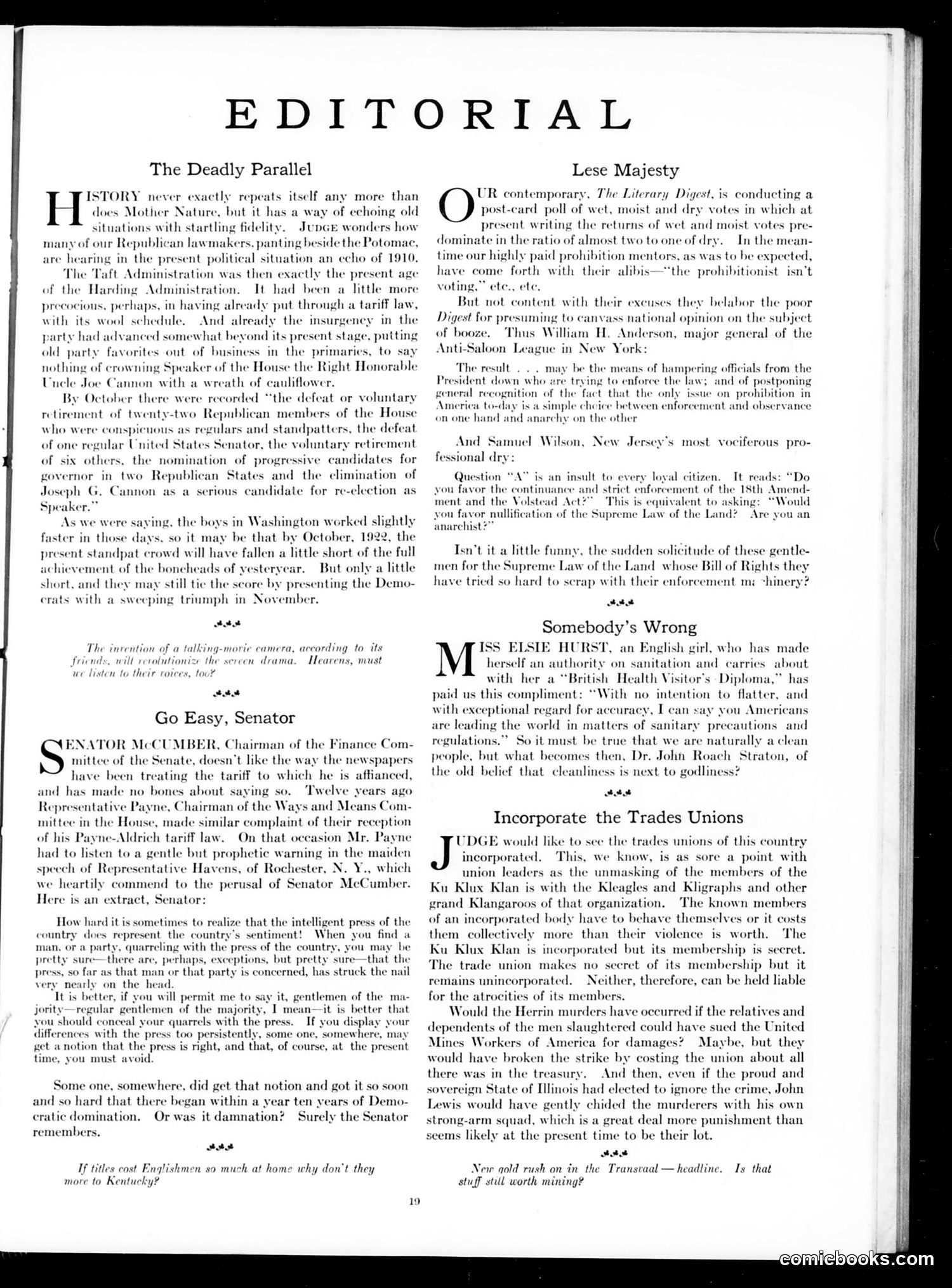
This editorial page critiques Republican political leadership through historical parallels and contemporary commentary: **"The Deadly Parallel"** compares the Harding Administration (circa 1922) to Taft's era (1910), noting both faced insurgent movements within the Republican party. Judge suggests Republican "standpatters" may face similar defeats by October 1922 as they did a decade earlier. **"Go Easy, Senator"** mocks Senator McCumber's complaints about press criticism of his tariff bill. Judge quotes a 1910 speech warning that politicians attacking the press appear defensive—implying McCumber's complaints validate press criticism rather than refuting it. **"Lese Majesty"** attacks the *Literary Digest*'s poll methodology on Prohibition, suggesting prohibitionists are defensive about public opinion on alcohol regulation. **"Somebody's Wrong"** and **"Incorporate the Trades Unions"** appear to address labor and sanitation issues, though details are unclear from the visible text. The page's overall tone: Republican leadership appears vulnerable and unconvincing.
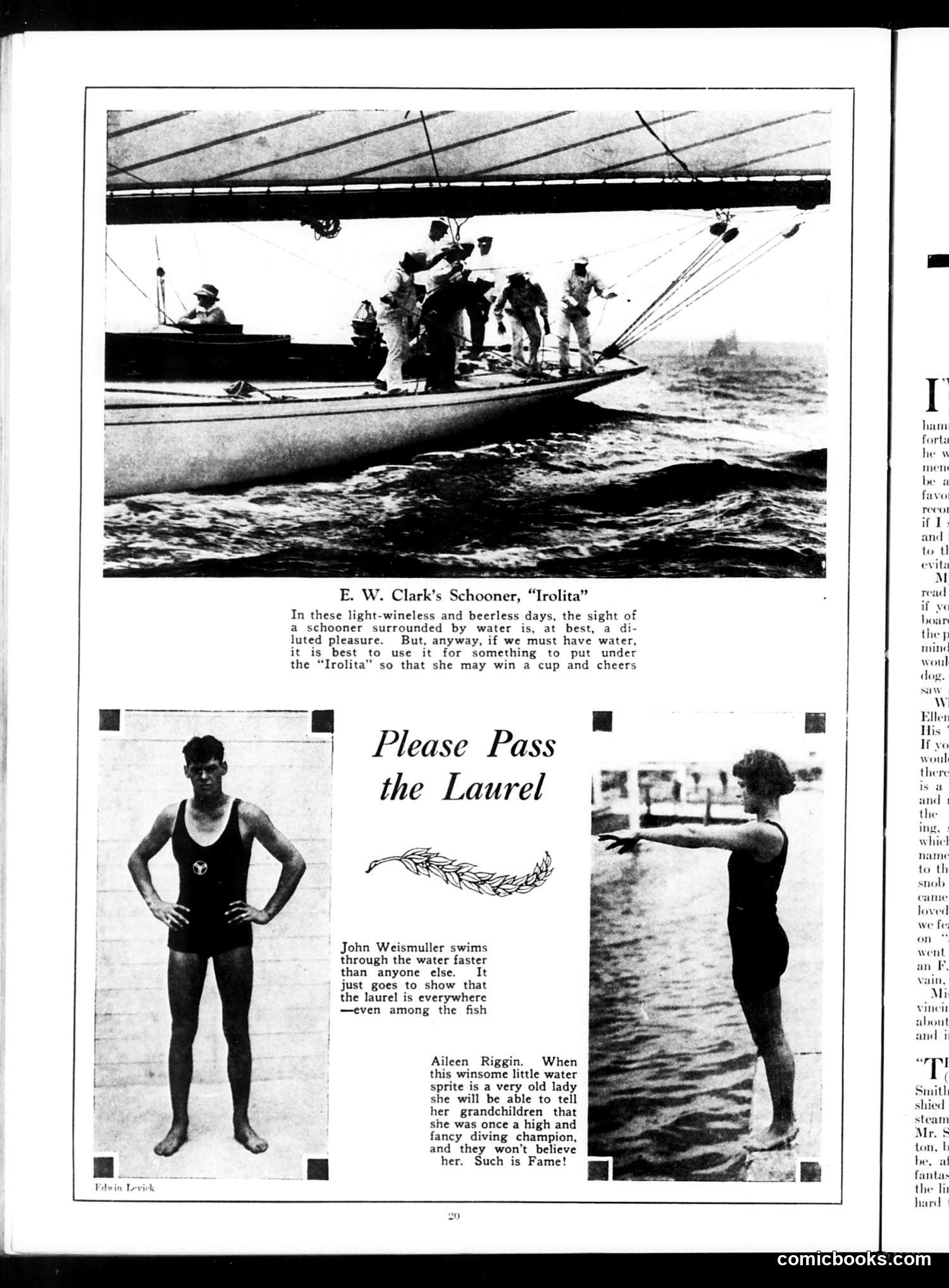
This page satirizes Prohibition-era America (the "light-wineless and beerless days" reference). The top section jokes about E.W. Clark's schooner "Irolita"—using a ship designed for sailing as merely a water platform for a cup competition, since actual recreational boating has lost its appeal without alcohol. The lower section celebrates Olympic athletes John Weismuller (swimmer) and Aileen Riggin (diver). The satire is gentle: it suggests their athletic fame will be fleeting and forgotten—when Riggin is old, her grandchildren won't even believe she was a diving champion. The joke about the laurel being "everywhere—even among the fish" plays on the absurdity of competitive glory in a society stripped of its traditional pleasures. Overall, the page reflects public frustration with Prohibition's constraints on leisure and entertainment.
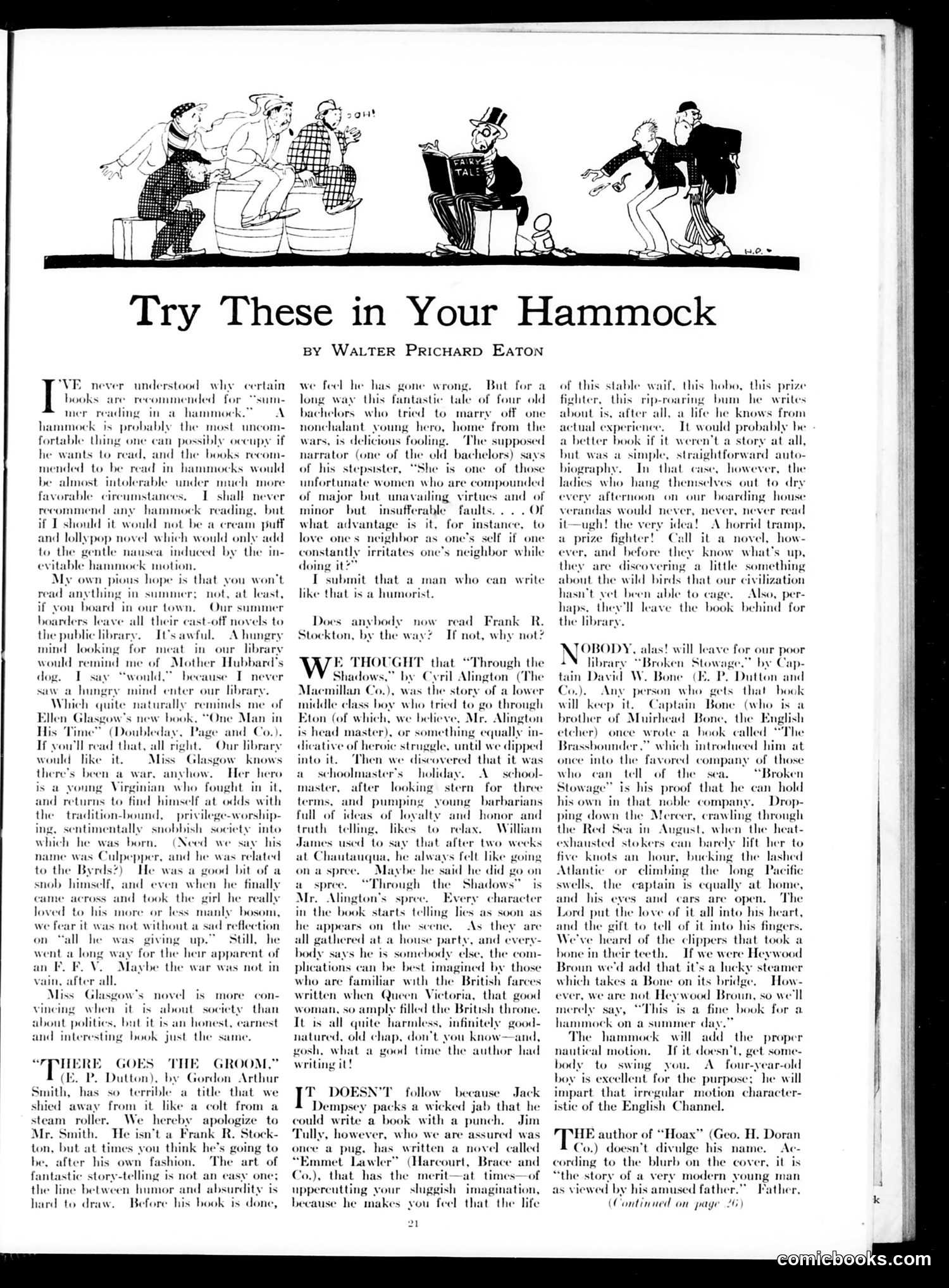
This is a book review column by Walter Prichard Eaton recommending summer reading. The cartoons at the top humorously illustrate people attempting to read in hammocks—showing the physical awkwardness and discomfort of the activity. Eaton reviews three novels: Ellen Glasgow's *One Man in His Time* (about a post-WWI Virginian struggling with tradition-bound society); Gordon Arthur Smith's *There Goes the Groom* (a comedic tale of bachelors trying to marry off a war veteran); and Cyril Alington's *Through the Shadows* (about a schoolmaster's holiday escape). The column's running joke mocks the literary convention of recommending books for "hammock reading"—Eaton argues hammocks are inherently uncomfortable and unfit for serious literature. He also gently satirizes his town's library as receiving summer donations of discarded novels from vacationing residents, creating a collection nobody actually reads.
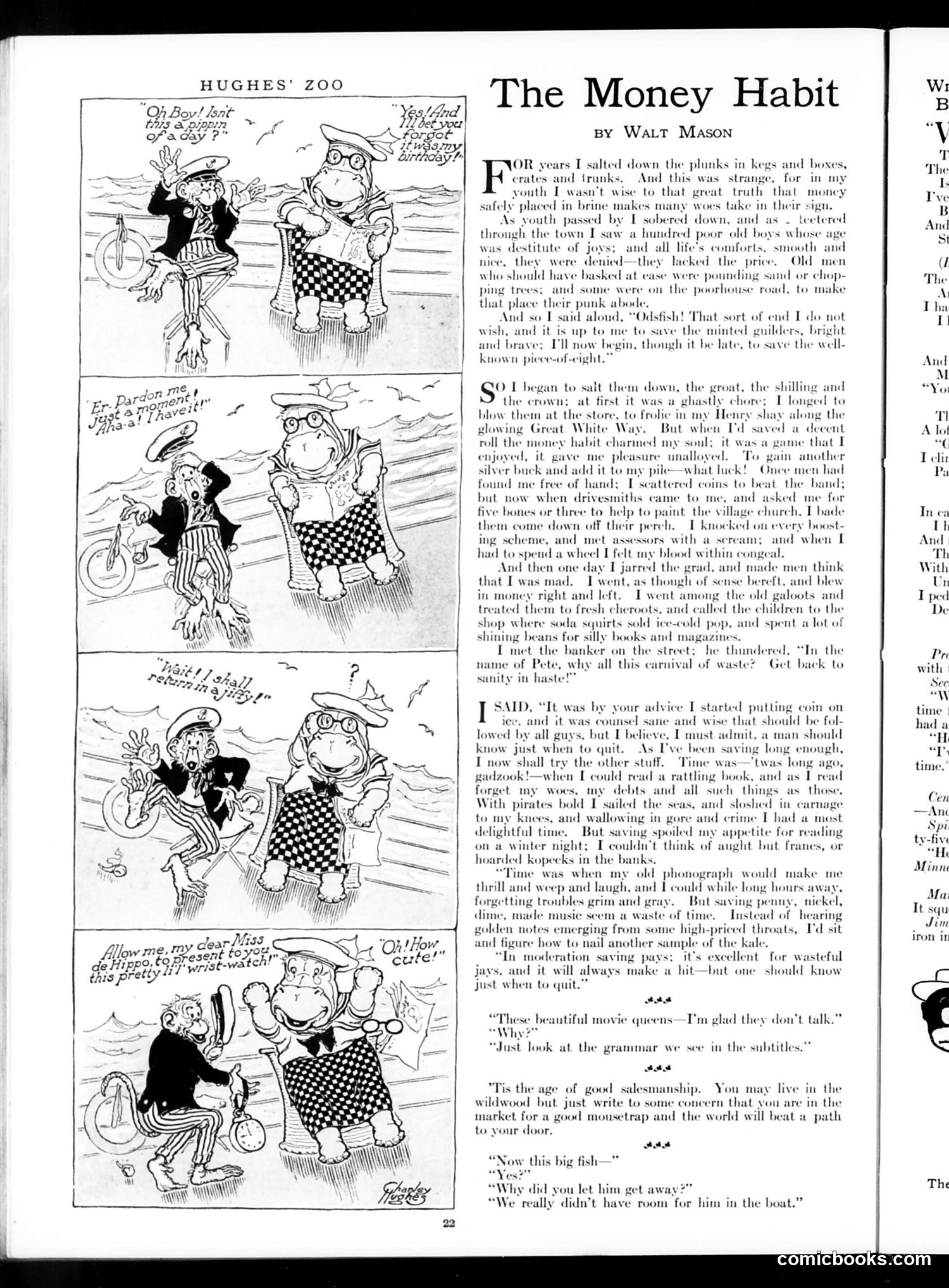
This is a moral fable in comic-strip form about excessive thrift. The narrative follows a man who, witnessing poverty in his town, resolves to save money by "salting down" coins. His miserly habits initially bring satisfaction, but he gradually becomes so obsessed with accumulation that he loses all pleasure in life—forgetting to read, enjoy music, or spend time with friends. The turning point comes when he "jars the grad" (likely "grades" or his conscience) and swings to reckless spending, eventually finding moderation. A banker confronts him about the waste. The message is clear: **extreme parsimony is as destructive as profligacy**. The comic argues for balanced spending—saving is good, but not at the cost of human enjoyment and relationships. This reflects early-20th-century anxiety about both poverty and the emerging culture of accumulation, suggesting virtue lies in the middle path.
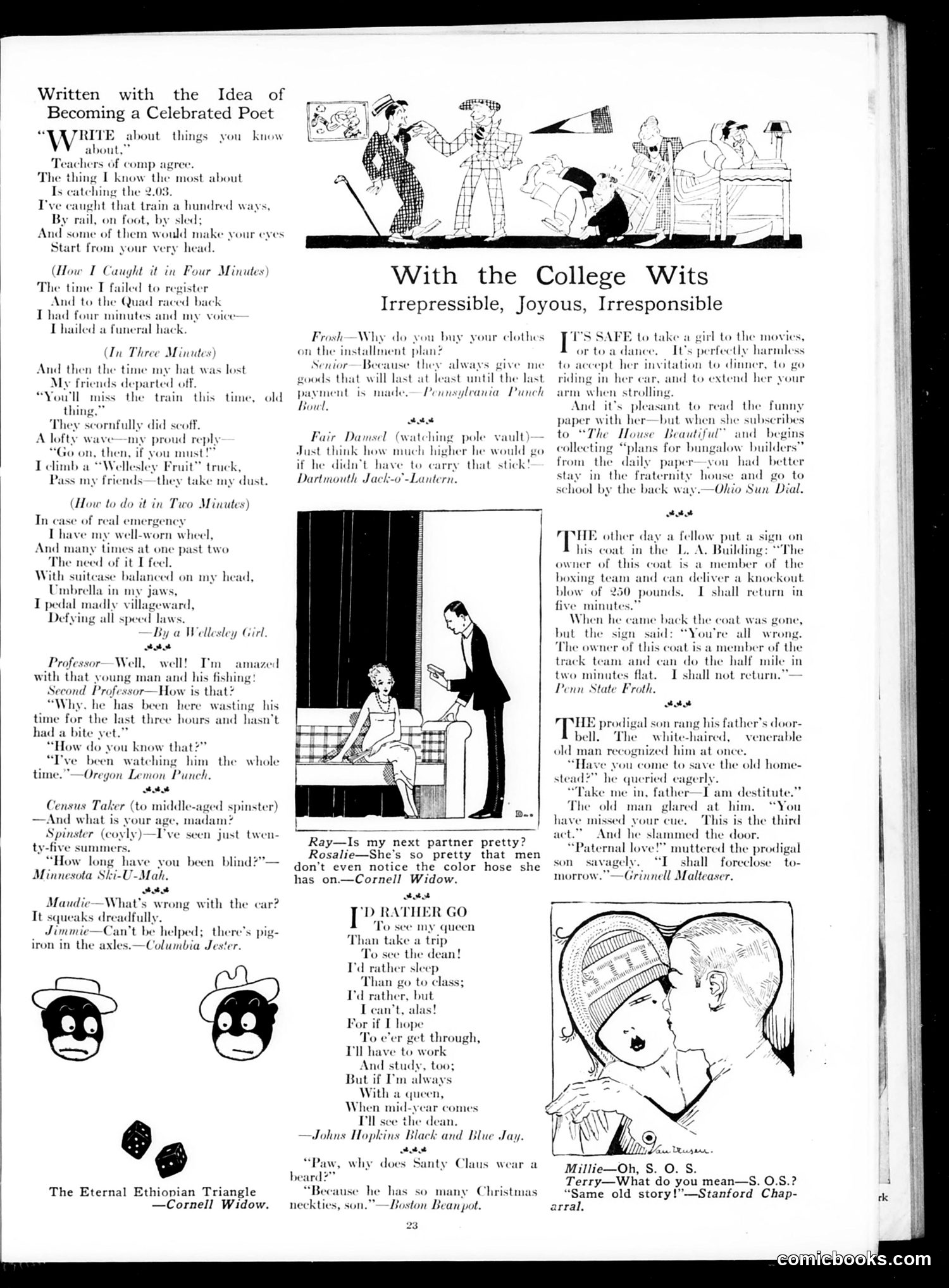
This page collects humorous anecdotes and jokes from college publications, targeting student life circa early 20th century. **Key themes:** The "College Wits" section satirizes undergraduate stereotypes: freshmen naively buying clothes on installment plans, seniors giving cynical advice, and students prioritizing romance over academics (the "I'd Rather Go" poem mocks a student choosing courtship over studying for exams). **Social commentary:** One joke warns against women's emerging independence—a young woman reading "House Beautiful" and collecting bungalow plans is deemed more dangerous than casual dating. This reflects anxiety about women's expanding domestic autonomy. Another anecdote mocks aggressive masculinity: college athletes threatening violence over a coat, suggesting mockery of brutish "tough guy" posturing. **Overall tone:** Affectionate ribbing of collegiate excess, romantic entanglements, and academic negligence—typical Judge magazine fare targeting educated, middle-class readers familiar with college culture.
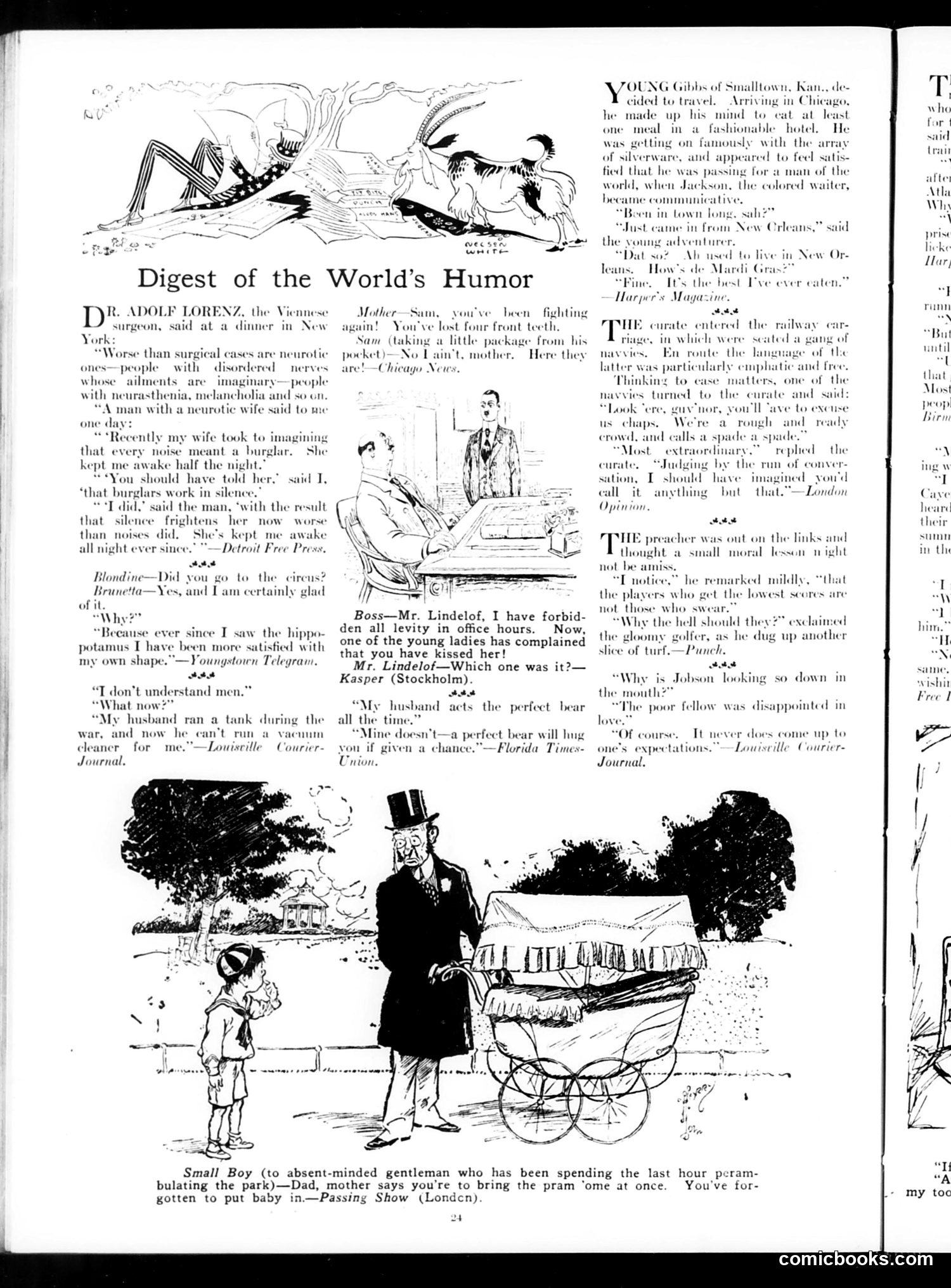
This page collects brief humorous anecdotes and jokes from various international sources, typical of Judge's "humor digest" format. The cartoons and jokes satirize early 20th-century social anxieties and gender dynamics. **Key humor targets:** - **Neuroticism and hypochondria**: A surgeon's anecdote mocks imaginary ailments and nervous disorders among wealthy urbanites. - **Gender roles**: Jokes about wives' irrational fears, women's vanity about appearance, and husbands' domestic incompetence (running a tank but not a vacuum cleaner). - **Class and pretension**: A Kansas farm boy tries to appear sophisticated at a Chicago hotel but is exposed by the waiter's familiarity. - **Workplace propriety**: A boss forbids "levity," creating awkwardness around a kissing incident. - **Male behavior**: Golf and religious hypocrisy—swearing golfers and a curate lectured by working-class "navvies" on proper language. The final cartoon shows an absentminded father who's spent an hour in the park without remembering to bring the baby carriage home—mocking paternal obliviousness.
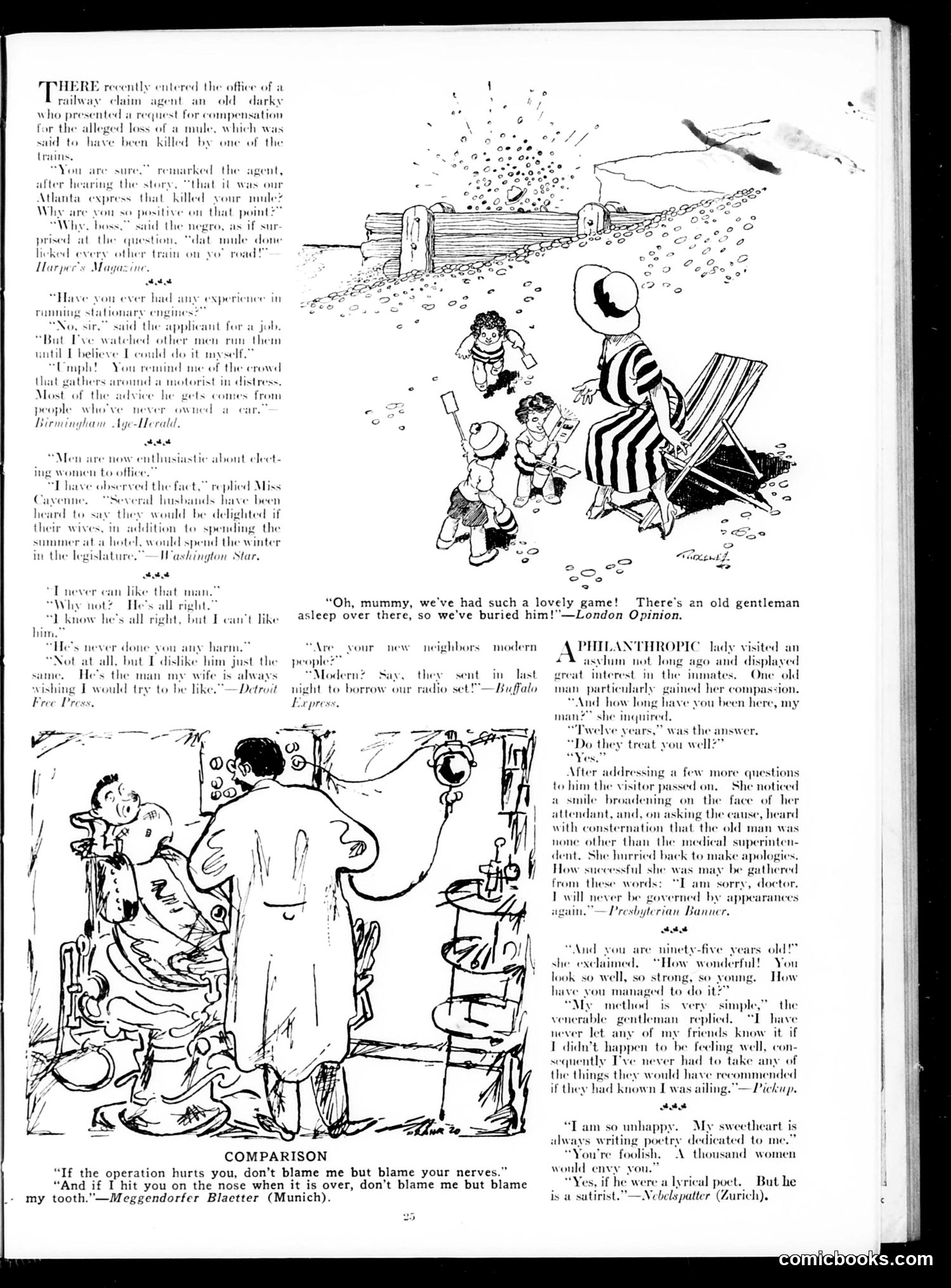
This page contains several satirical humor pieces reflecting early 20th-century American social attitudes: **"The Mule Claim"** (top): A railroad agent questions a Black man's claim that an Atlanta express killed his mule. The joke relies on a racial stereotype—the agent assumes the man is lying, and the punchline involves dialect humor about the train being faster than others. This reflects both racial prejudice and skepticism toward Black claimants in that era. **"The Radio Set"** (middle): A couple's "modern" new neighbors are depicted as so unsophisticated they must borrow a radio—mocking working-class attempts at modernity during the early radio era. **"The Philanthropic Lady"** (right): A wealthy woman visiting an asylum unknowingly mistakes the medical superintendent for an inmate, embarrassing herself. It satirizes upper-class assumptions and condescension toward institutions and the poor. The remaining anecdotes mock relationship dynamics, gender politics around women voting, and romantic melodrama—typical Judge magazine fare targeting middle-class readers.
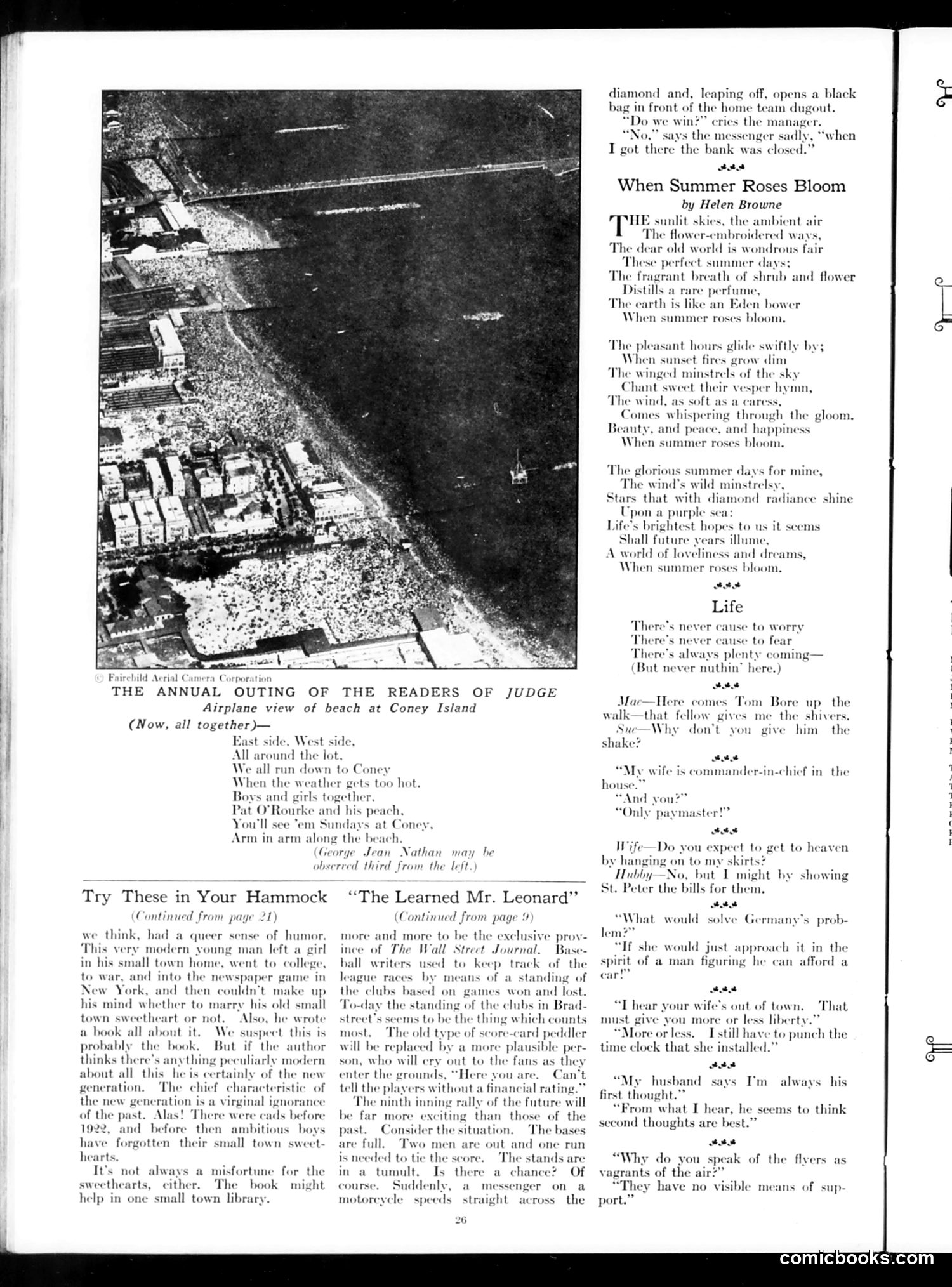
This page from **Judge** magazine (a prominent American satirical publication) contains several distinct elements: **Main Cartoon**: An aerial photograph of Coney Island beach labeled "The Annual Outing of the Readers of Judge." The accompanying verse humorously depicts working-class and immigrant New Yorkers (referencing "Pat O'Rourke") enjoying seaside recreation on Sundays—mocking Judge's readership as ordinary people rather than the sophisticated elite the magazine typically targeted. **Notable Reference**: George Jean Nathan (a famous theater critic) is sardonically identified as visible in the crowd, suggesting even prominent cultural figures mingled with common beachgoers. **Other Content**: The page includes a humorous piece titled "The Learned Mr. Leonard" mocking how Wall Street financial metrics have replaced traditional baseball statistics, and various short jokes about marriage and domestic life—typical Judge humor focused on modern social anxieties and gender relations. The overall tone is self-deprecating satire about Judge's actual readership versus its pretensions.
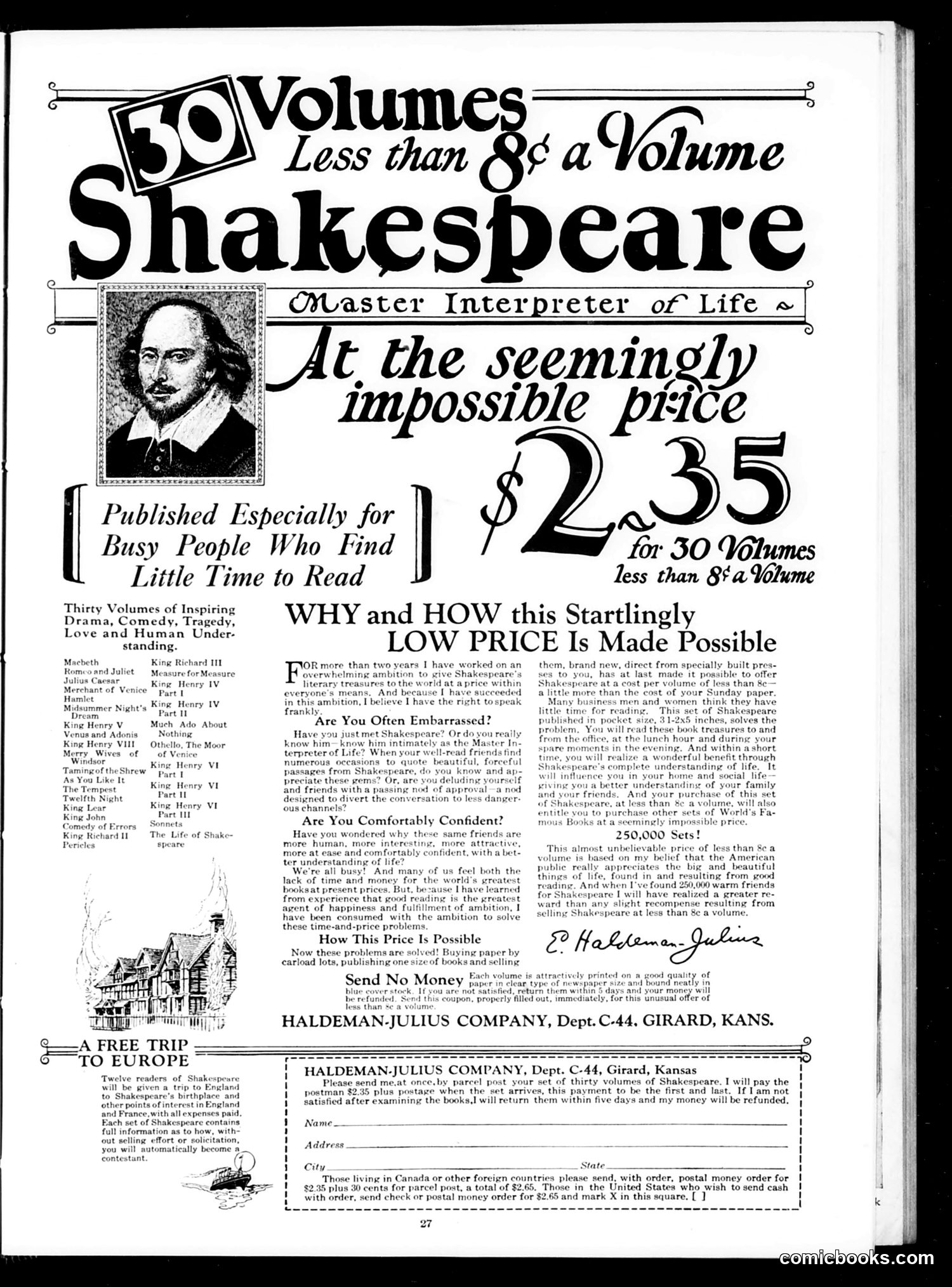
This is primarily a **full-page advertisement**, not a political cartoon. It advertises a 30-volume Shakespeare collection sold by the Haldeman-Julius Company of Girard, Kansas. The marketing pitch targets "busy people who find little time to read"—reflecting early 20th-century anxieties about modern life's pace and cultural literacy. The ad emphasizes an "impossibly low price" of $2.35 for 30 volumes (less than 8¢ each), achieved through bulk printing and direct sales without middlemen. The social commentary is implicit: the ad suggests educated Americans felt embarrassed not knowing Shakespeare intimately, yet lacked time or money to acquire complete works. The company positions itself as democratizing high culture for the masses. A secondary element promises a "free trip to Europe" as a sales incentive, typical of aggressive mail-order marketing of this era. No recognizable political figures or satirical commentary appear—this is straightforward commercial messaging, reflecting how Judge magazine monetized through advertising.
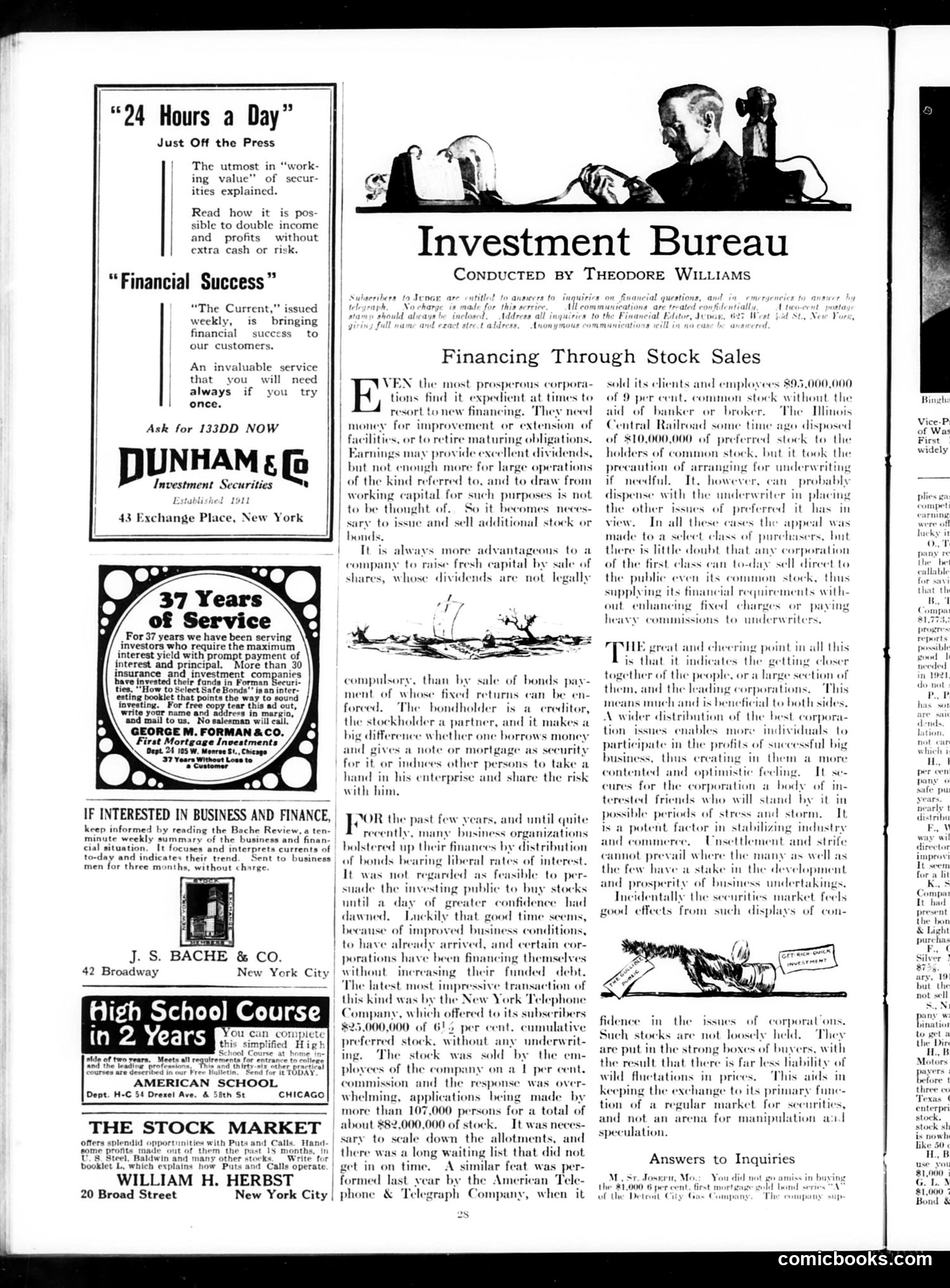
This page is **primarily advertising** for investment securities and financial services, not satirical content. The main illustration shows a businessman at a desk with a telephone—a visual metaphor for the "Investment Bureau" advice column that follows. The article "Financing Through Stock Sales" discusses how corporations raise capital by issuing stock rather than bonds. It's presented as financial education, explaining that stock sales allow companies to raise money without the fixed obligations of bond payments. The piece uses the recent New York Telephone Company stock offering as a contemporary example—a major 1920s event where the company offered $25 million in preferred stock to employees and the public, receiving $82 million in applications. The surrounding advertisements promote investment guides, bond services, and stock-trading information to readers interested in financial gain. This reflects the pre-1929 stock market boom era, when investment was heavily marketed to ordinary Americans. No satire or political commentary is present on this page.
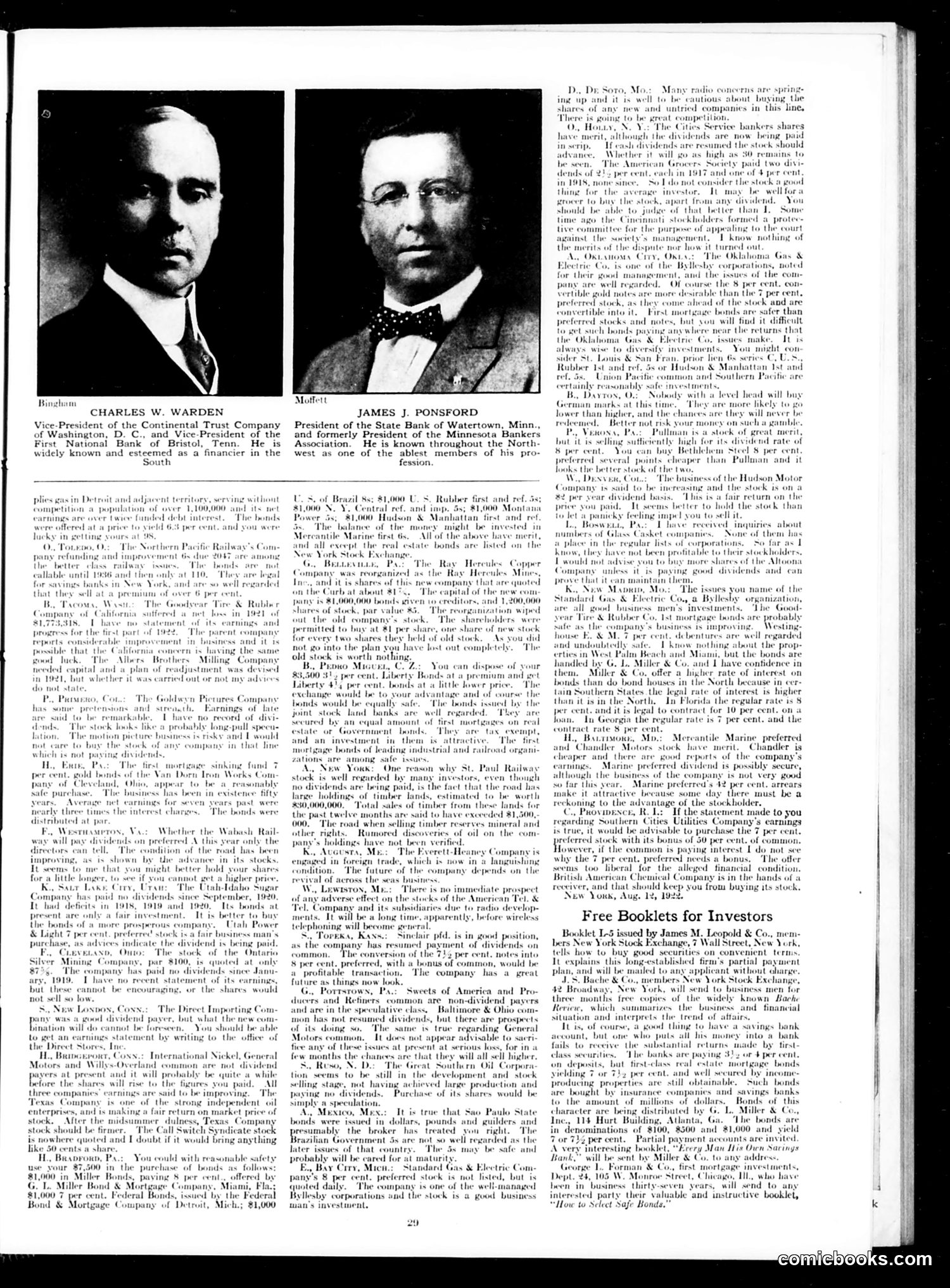
This page is primarily **investment advice content**, not a political cartoon. It features portraits of two financial figures—Charles W. Warden (Vice-President of Continental Trust Company) and James J. Ponsford (President of State Bank of Watertown, Minnesota)—alongside detailed text discussing bond investments and corporate securities. The content addresses **post-WWI financial concerns**: dividend yields, mortgage bonds, industrial stocks, and railroad securities. The advice appears aimed at conservative investors seeking stable returns during economic uncertainty. This represents Judge magazine functioning as a **business publication** for its affluent readership, offering practical financial guidance rather than satire. The page reflects early 1920s investment priorities and corporate finance discussions.
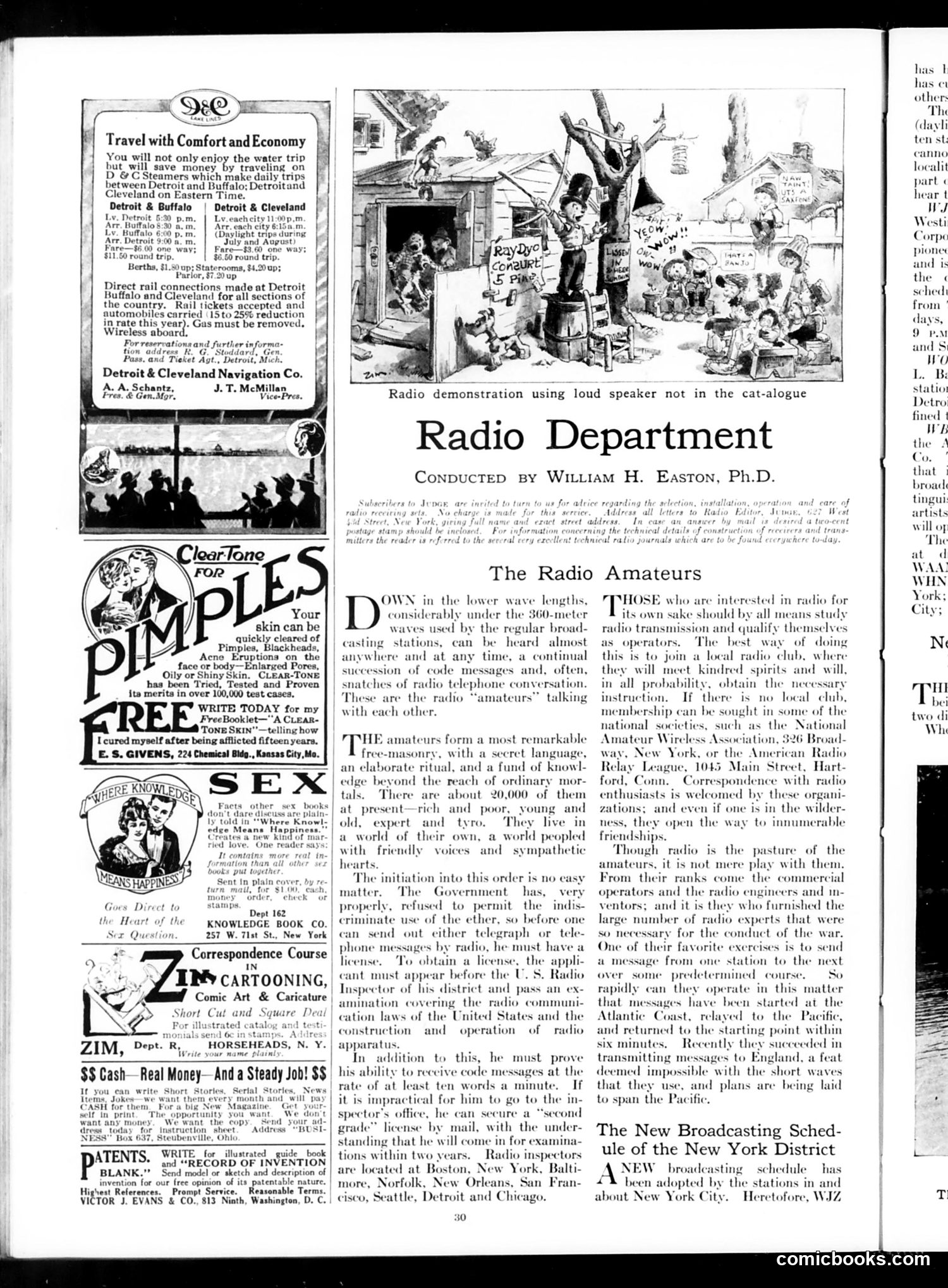
This page is primarily **advertisements and a radio column**, not political satire. The main content is "Radio Department," conducted by William H. Easton, Ph.D., describing amateur radio operators—a growing hobbyist community of about 20,000 people in this era. The piece explains that amateurs operate on lower wave frequencies and must obtain government licenses by passing exams administered by U.S. Radio Inspectors. The tone is informative and encouraging toward radio enthusiasts. The accompanying cartoon (top right) humorously depicts a radio demonstration using a loud speaker "not in the catalogue"—showing a makeshift backyard setup, likely satirizing amateur radio operators' improvised equipment and enthusiastic but informal approach. The remainder of the page consists of vintage advertisements for steamship travel, skin cream, correspondence courses in cartooning, and patent services—typical classified ads from this period.
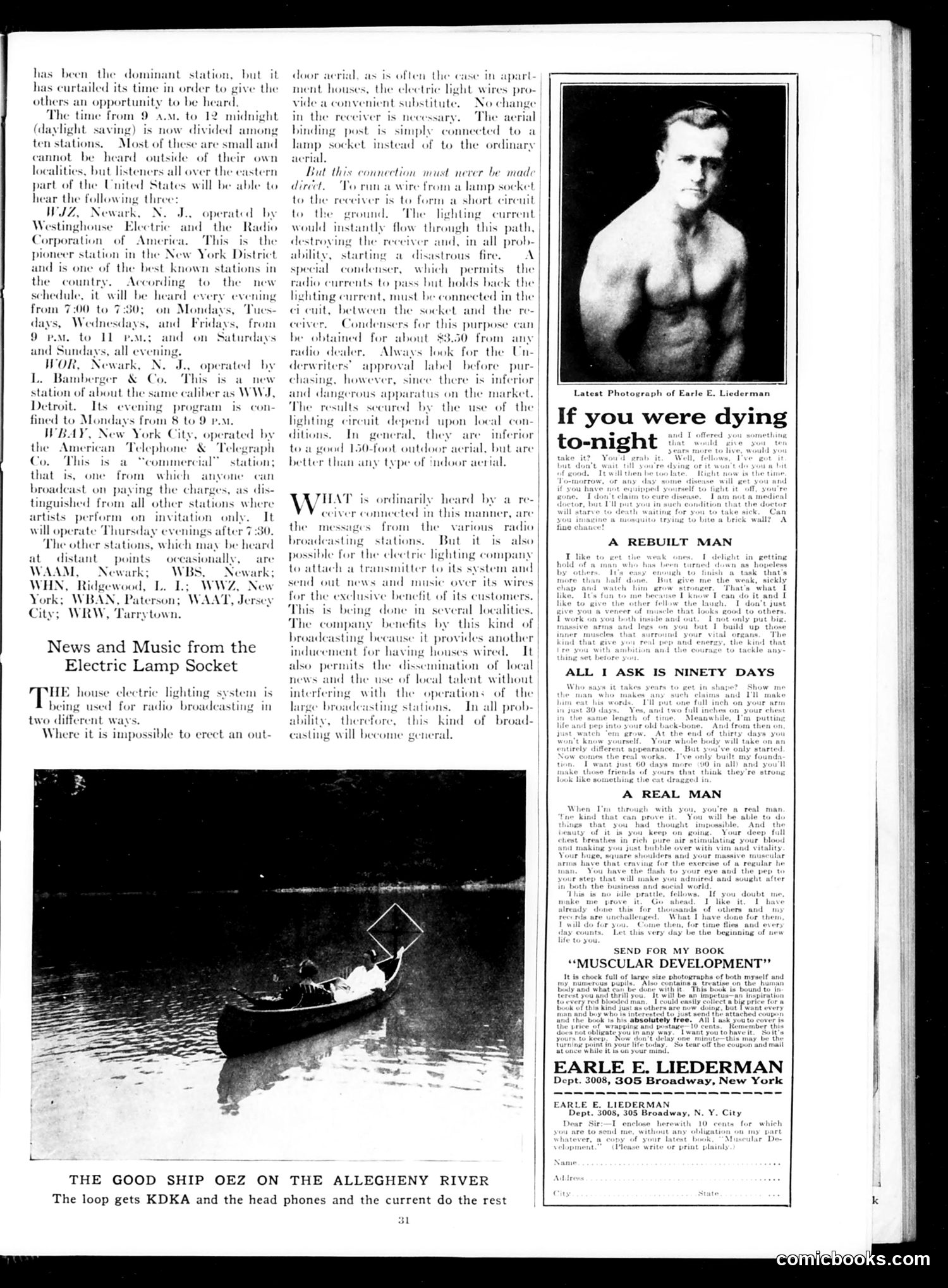
This is primarily a **technical article about early radio broadcasting** (circa 1920s), not a political cartoon. The page explains how house electrical wiring can serve as a radio antenna—a practical solution for apartment dwellers who cannot erect outdoor aerials. The key technical warning is important: **never connect a lamp socket directly to a radio receiver**, as this creates a short circuit that destroys the equipment and risks fire. A special condenser ($3.50) must be installed between them for safety. The article also discusses how electric companies could broadcast news and music over their own wiring systems to promote house electrification—an early example of utility companies using new technology for customer incentives. The photograph shows "The Good Ship OEZ on the Allegheny River," likely demonstrating early radio transmission capability. The page includes an advertisement for Earle E. Liederman's physical development course, unrelated to the radio content. This reflects the era's novelty of radio technology and safety concerns.
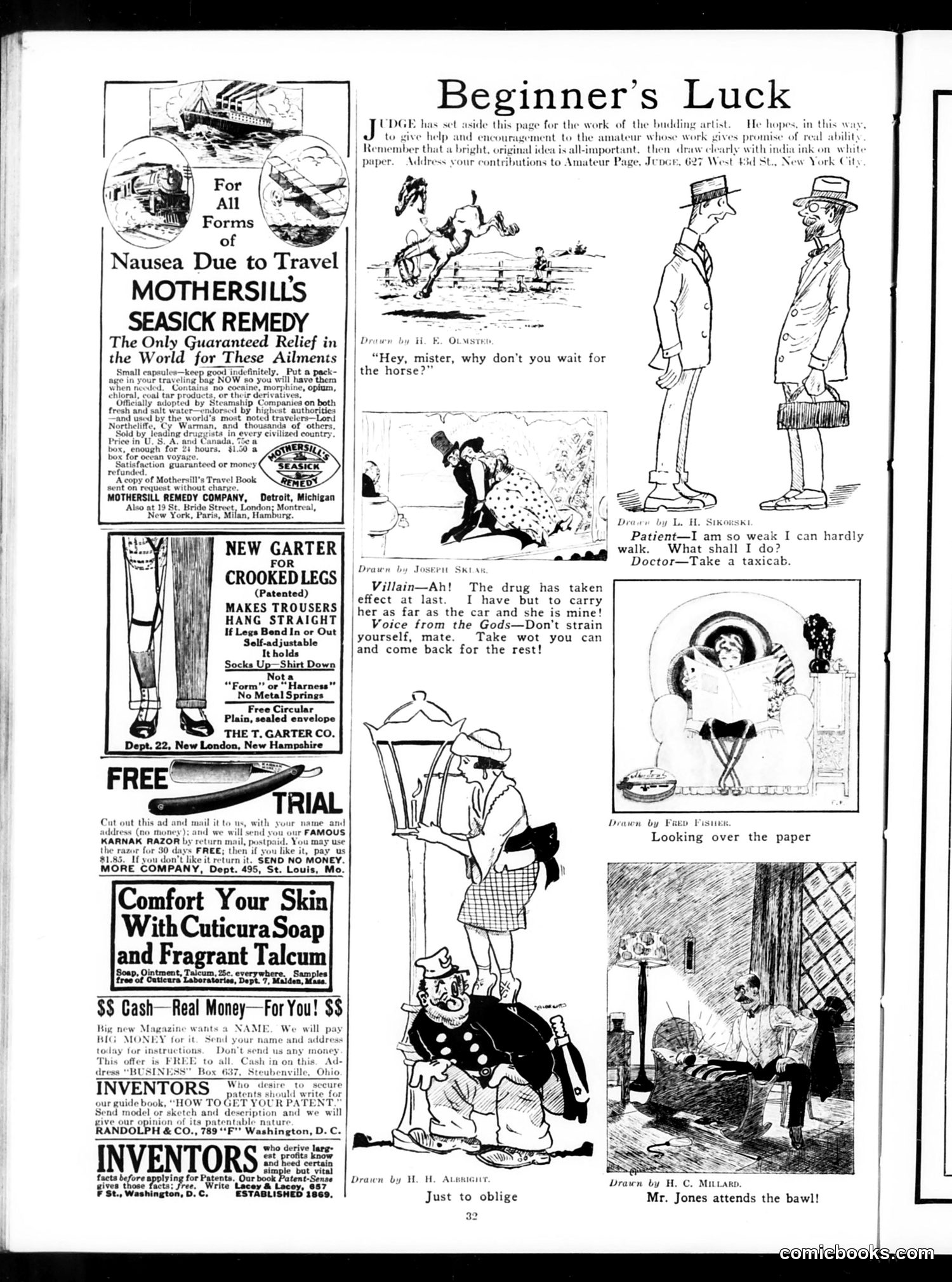
This page features **amateur cartoons** submitted by readers to *Judge* magazine's budding artist section. The cartoons showcase simple, domestic humor typical of early 20th-century comic strips: 1. **"Why don't you wait for the horse?"** — A man eagerly pursues a woman while her horse remains behind, suggesting impatience in courtship. 2. **The villain/drug scene** — A melodramatic kidnapper is mocked by an unseen voice ("Voice from the Gods") advising him not to strain himself carrying the unconscious woman, implying she's too heavy. This satirizes overwrought villain tropes in popular entertainment. 3. **Patient/taxicab joke** — A doctor's cure for weakness is taking a taxi instead of walking—absurdist humor about modern conveniences. 4. **"Mr. Jones attends the bawl"** — Unclear without seeing the illustration, but likely plays on "ball" (social event). The page is primarily **advertising** (seasickness remedy, garters, razors, patent services) with amateur cartoons interspersed—characteristic of early *Judge* layout.
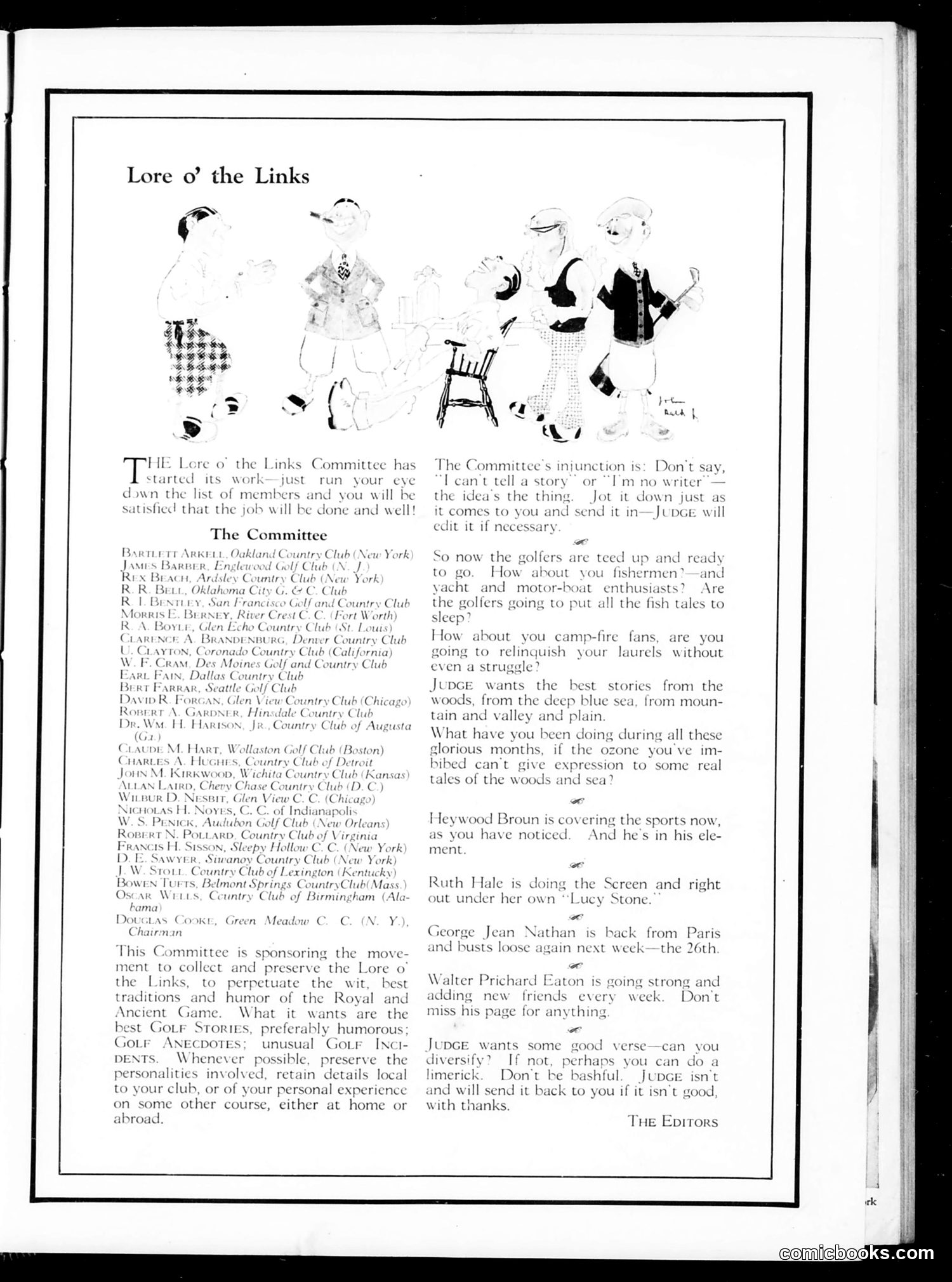
This page announces a content-gathering initiative by Judge magazine's "Lore o' the Links Committee"—a group of prominent country club members (names listed) tasked with collecting humorous golf stories and anecdotes from readers. The cartoon figures at top represent golfers in various poses and attire, illustrating the sport's social culture. The satire operates on multiple levels: Judge is calling upon not just golfers, but also fishermen, boaters, and campers to contribute their best stories and tall tales. The editors playfully shame these outdoor enthusiasts, suggesting golfers monopolize the storytelling ("Are the golfers going to put all the fish tales to sleep?"). The page also cross-promotes Judge's staff contributors—Heywood Broun (sports), Ruth Hale (film criticism), and Walter Prichard Eaton—as examples of the magazine's quality content. The underlying joke: Judge positions itself as arbiter of leisure-class humor and good taste, while soliciting amateur contributions it will "edit if necessary"—a genteel way of saying they'll fix subpar submissions.
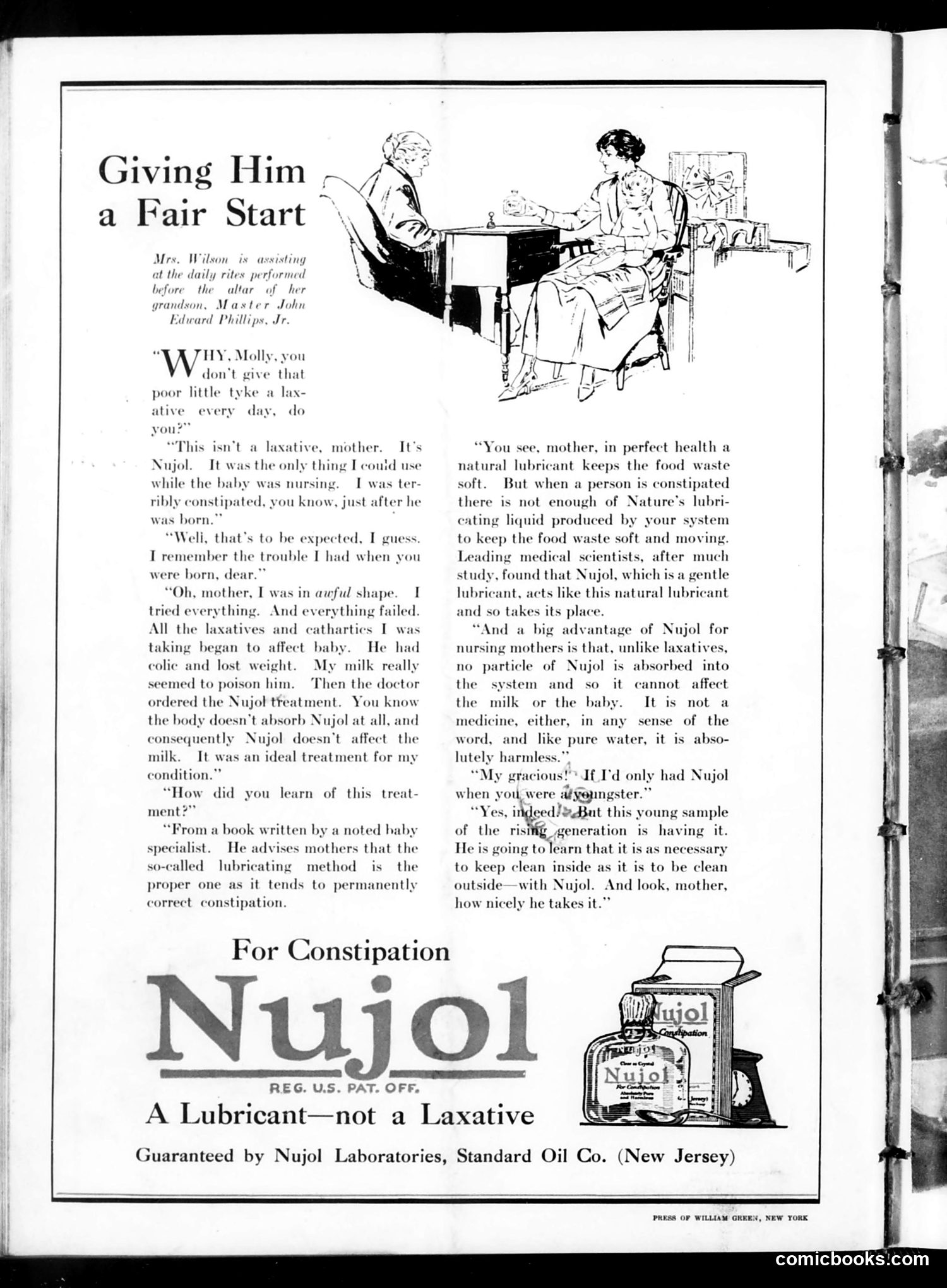
This is primarily a **Nujol laxative advertisement** disguised as editorial content in Judge magazine. The "cartoon" is actually a narrative advertisement featuring a conversation between a young mother (Mrs. Wilson) and her elderly mother about constipation remedies. The setup depicts a modern, health-conscious daughter educating her old-fashioned mother about a new medical treatment. The daughter explains that Nujol—a mineral oil "lubricant, not a laxative"—solved her post-natal constipation without affecting her breast milk or baby's health, unlike traditional laxatives which caused colic. The satirical angle, typical of Judge's advertising style, is mild: the contrast between the grandmother's outdated remedies and the scientifically-endorsed modern solution. The granddaughter's final line about teaching the baby "to keep clean inside" extends the product's appeal to child care. This reflects early 20th-century advertising's use of pseudo-medical authority and generational conflict to sell products. The reference to "noted baby specialist" literature lends credibility through appeals to expertise.