
Judge, 1922-08-19 · page 30 of 36
Judge — August 19, 1922 — page 30: what you’re looking at
What you’re looking at
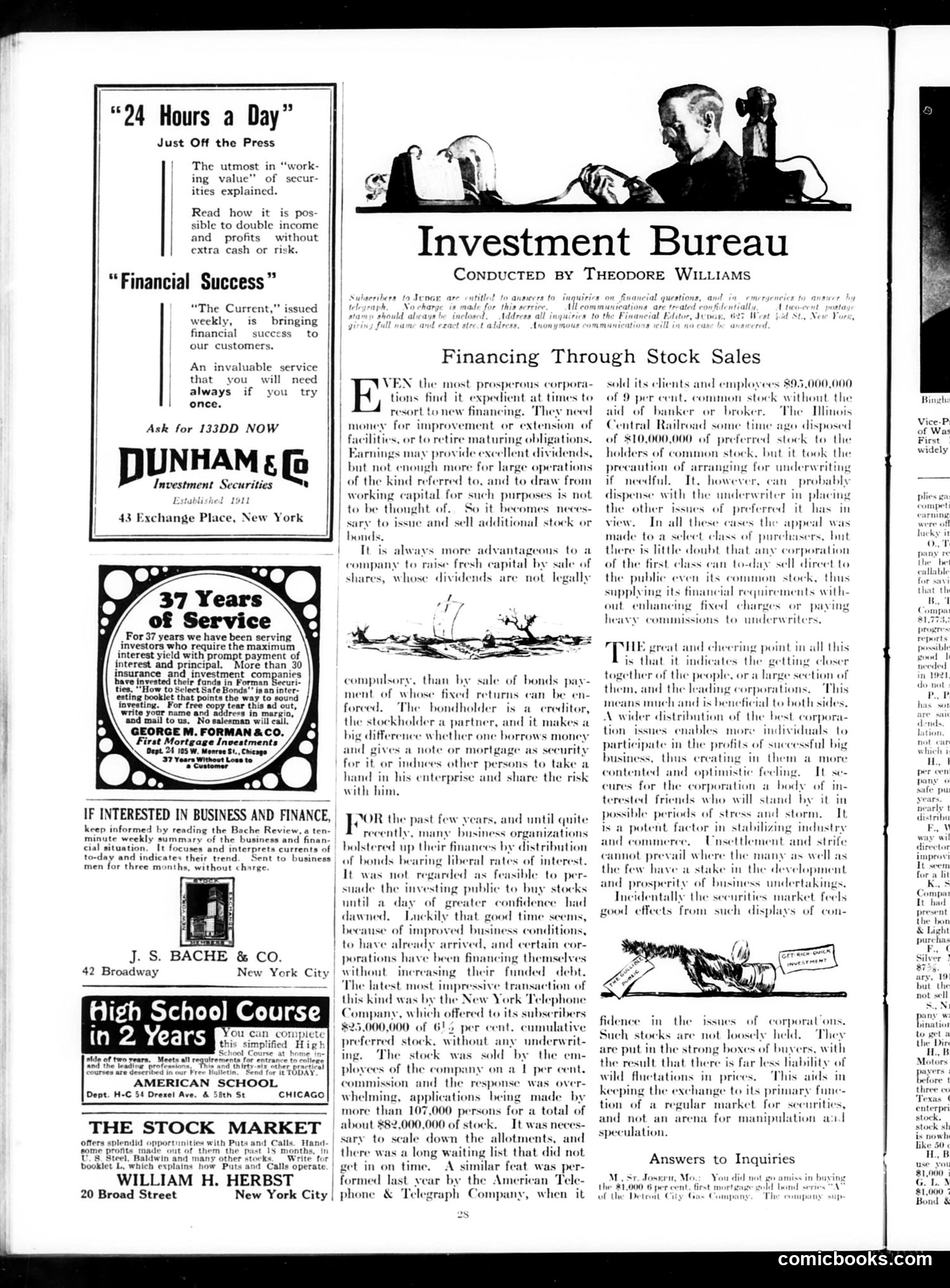
This page is **primarily advertising** for investment securities and financial services, not satirical content. The main illustration shows a businessman at a desk with a telephone—a visual metaphor for the "Investment Bureau" advice column that follows. The article "Financing Through Stock Sales" discusses how corporations raise capital by issuing stock rather than bonds. It's presented as financial education, explaining that stock sales allow companies to raise money without the fixed obligations of bond payments. The piece uses the recent New York Telephone Company stock offering as a contemporary example—a major 1920s event where the company offered $25 million in preferred stock to employees and the public, receiving $82 million in applications. The surrounding advertisements promote investment guides, bond services, and stock-trading information to readers interested in financial gain. This reflects the pre-1929 stock market boom era, when investment was heavily marketed to ordinary Americans. No satire or political commentary is present on this page.
📄 Transcribed text from this page (OCR, searchable)
Machine-transcribed from the original scan — historical spelling and the odd misread are preserved.
24 Hours a Day” Just Off the Press The utmost in “work- ing value” of secur- ities explained. Read how it is pos- sible to double income and profits without extra cash or risk. “Financial Success” “The Current,” issued weekly, is bringing financial success to our customers. service need try An invaluable that you will always if you iu once. Ask for 133DD NOW DUNHAM g f Jnvesiment Securities 119 43 eae Plac ‘e, New York For 37 years we have been serving investors who require the maximum interest yield with prompt payment of interest and principal. More than 30 insurance and investment companies bave invested their funds in Fi ties. “How to Select Safe Bonds” is a esting booklet that points the way to sound investing. For free copy tear this ad out, write your name and address in margin, and mail to us, No salesman will call. GEORGE M. FORMAN &CO. First Mortgage Investments Dept. 24 105 W. Monree St... Chicago ‘37 Years Without Loss to ‘a Customer IF INTERESTED IN BUSINESS AND FINANCE, keep informed by reading the Bache Review, a ten- minute weekly summary of the business cial situation. It focuses and interprets c to-day and indicates their trend. Sent to business men for three months, without charge. J. S. BACHE & CO. 42 Broadway New York City High School Course in 2 Years ou can complete this simplified High ee AMERICAN SCHOOL Dept. H-C 54 Drexel Ave. & 58th St CHICAGO THE STOCK MARKET offers splendid opportunities with Puts and Calls. Hand. some pronts outof them the past 1S months, tt U win and many oth ks. Write for Dooklet h explains how Puts and Calls operate WILLIAM H. HERBST | 20 Broad Street New York City | | but not eno Investment Bureau ConpucTeD BY THEODORE WILLIAMS cial questions, and at Financing Through Stock Sales VEN the most prosperous corpora- tions find it expedient at times to resort to new finan Y nee money for improvement 0 facilities, or to retire maturing obli E xcel ¢ for large operations of the kind referred to, and to draw from working capital for such purposes is not to be thought of. So it becomes ne sary to issue and sell additional stock or ations. nt dividends, mings 0 bonds. Tt is always more advantageous to a company to raise fresh eapital by sale of shares, whose dividends are not legally compulsory, than by sale ment of whose fixed returns ¢ forced. The bondholder is a_ creditor, the stockholder a partner, and it makes a hig difference whether one borrows money and gives a note or mortg: as security for it or induces other persons to take it hand in his enterprise and share the risk with him, n be peor the past few years, and until quite recently, many business organizations bolstered up tl s by distribution of bonds bearing liberal rates of interest. It was not re ible to. per- suade the investing public to buy stocks until a day of greater confidence had dawned. Luckily that good time seems, because of improved business conditions, toh tlready arrived, and certain cor- porations have been financing themselves debt. without increasing their funded The latest: most impressive tra ths kind was by the New York ympany, which offered to its subscribers 5,000,000 of 615 per cent. cumulative preferred stock, without any underwrit- ing. The stock sold by the em- ployees of the company on a 1 per cent. commission and the was over- whelming, applications by made by was response more than 107,000 persons for a total of about $82,000,000 of stock. It was neces- sary to scale down the allotments, and there was a long waiting list that did not get in on time. A similar feat was per- formed last year by the American Tele- phone & Telegraph Company, when. it its clients and empk 9 per cent. common s dof banker or broker. he Central Railroad some time ago disposed of $10,000,000 of preferred stock to the holders of common stock, but it took the ution of arranging for underwriting edful. It. however, can probably ise with the underwriter in placing ther issues of preferred: it has in In all these cases the appeal was t class of purchasers, but subt the ‘ation of the first class can to-day sell direct to the public even its common. stock, thus supplying its financial requirements with- out enhancing fixed ch paying heavy commissions to underwriters. any corpe es or Te great and cheering point in all this is that it indicates the together of the people, or a section of them, and the leading corporations. ‘This means much and is beneficial to both sides. A wider distribution of the best. corpora. tion issues enables more individuals to participate in the profits of successful big thus creating in them a more tting closer contented and optimistic feeling. [It se- cures for the corporation a body of in- terested friends who will stand by it in possible periods of stress and storm. It is a potent factor in stabilizing industry and commerce. Unsettlement and strife cannot prevail where the many as well as the few have a stake in the development and prosperity of business undertakings. Incidentally the securities market fe good effects from such displays of con- fidence in’ the issues of corporalons. Such stocks are not loosely held. are put in the strong boxes of buyers, with the result that there is far less liability of wild fluctations in prices. ‘This aids in keeping the exchange to its primary func- 1 of a regular market for securities, and not an arena for manipulation aad speculation. Answers to Inquiries Bingl: Vice-P of Was First widely good I needed in 1921 do not for a lit Compa Tt had 81,000 G.L.N $1,000 7 Bond & comicbooks.com