
Judge, 1922-08-19 · page 23 of 36
Judge — August 19, 1922 — page 23: what you’re looking at
What you’re looking at
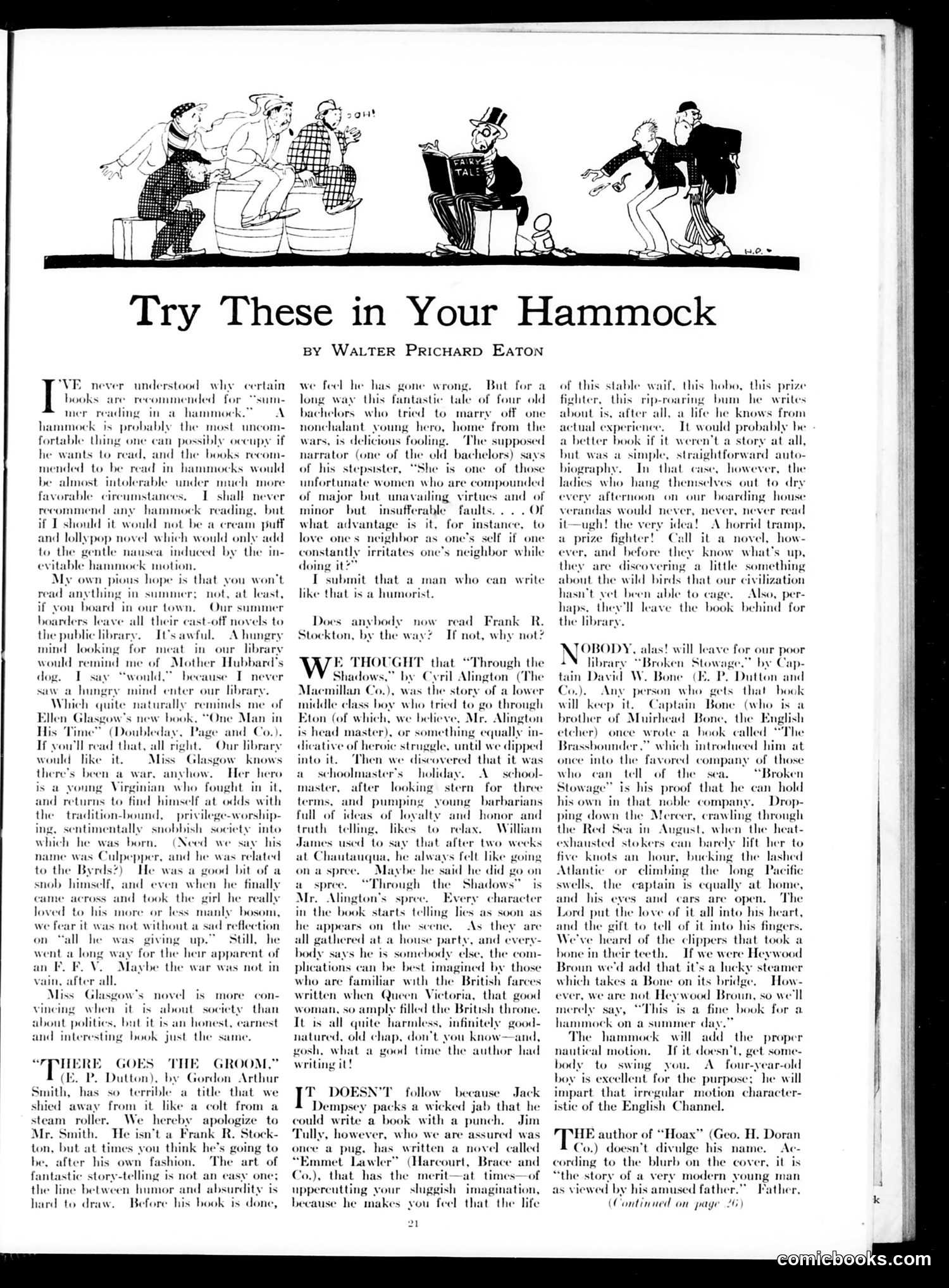
This is a book review column by Walter Prichard Eaton recommending summer reading. The cartoons at the top humorously illustrate people attempting to read in hammocks—showing the physical awkwardness and discomfort of the activity. Eaton reviews three novels: Ellen Glasgow's *One Man in His Time* (about a post-WWI Virginian struggling with tradition-bound society); Gordon Arthur Smith's *There Goes the Groom* (a comedic tale of bachelors trying to marry off a war veteran); and Cyril Alington's *Through the Shadows* (about a schoolmaster's holiday escape). The column's running joke mocks the literary convention of recommending books for "hammock reading"—Eaton argues hammocks are inherently uncomfortable and unfit for serious literature. He also gently satirizes his town's library as receiving summer donations of discarded novels from vacationing residents, creating a collection nobody actually reads.
📄 Transcribed text from this page (OCR, searchable)
Machine-transcribed from the original scan — historical spelling and the odd misread are preserved.
“VE never understood why certain I hooks are recommended for “sum- mer reading ina hammock.” A hammock is probably the most uncom- fortable thing one can possibly occupy: if he wants to read, and the books recom- mended to be read in hammocks would most intolerable under much more dle circumstances. [shall never ymmend any hammock reading, but if I should it would not be a cream putt and lollypop novel which would only add to the gentle nausea induced by the in- evitable hammock motion, My own pious hope is that you won't read anything in summer; not, at least, i 1 board in our town, Our summer ull their cast-off novels to public library. It'sawful. A hungry mind looking for meat in our libr: would remind me of Mother Hubbard's dog. I say “would,” beeause IT never saw a hungry mind enter our library. Which quite naturally reminds me of Ellen Glasgow's new book, “One Man in (Doubleday, Page and ad that, all right. Our library would like it. Miss Glasgow” knows there’s been a war, anyhow Her hero is a young Virginian who fought in it, and returns to find himself at odds with the tradition-bound, — privilege-worship- ing, sentimentally snobbish society into which he was born, (Need we say his name was Culpepper, and he was related to the Byrds?) He was a good bit of a snob himself, and even when he finally came across and took the girl he really loved to his more or less manly bosom, we fear it was not without a sad reflection on “all he was giving up.” Still, he went a long way for the heir apparent of an PL FLV. Maybe the war was not in vain, after all. be fave His ‘Time Miss Glasgow's novel ism con- vincing when it is about society than about politics, but it isan honest, earnest and interesting hook just the same, “FRHERE GOES THE GROOM,” (E. P. Dutton), by Gordon Arthur Smith, has so terrible a title that we shied away from it like a colt from a steam roller. We heret wologize to Mr. Smith. He isn’t a Frank R. Stock- ton, but at times you think he’s going to be, after his own fashion, The art of fantastic story-telling is not_an casy one; the line between humor and absurdity is hard to draw. Before his book is done, Try These in Your Hammock BY WALTER PRICHARD EaTON we feel he has gone wrong. But for a long way this fantastic tale of four old bachelors who tried to marry off one nonchalant young hero, home from. the wars, is delicious fooling. The supposed or (one of the old helors) says of his stepsister, “She is one of those unfortunate women who are compounded of major but unavailing virtues and of minor but insufferable faults... . Of what advantage is it, for instance, to ones neighbor as one’s self if one constantly irritates one’s neighbor while doing it?” I submit that a man who can write like that is a humorist. ds Frank R. If not, why not? Does anybody now Stockton, by the way? { THOUGHT that “Through the Shadows,” by Cyril Alington (The Macmillan Co.), was the story of a lower middle class boy who tried to go through Eton (of which, we believe, Mr. Alington is head master), or something equally in- dicative of heroic struggle, until we dipped into it. Then we discovered that it was a schoolmaster’s — holid A school- master, after looking stern for three terms, and pumping young barbarians full of ideas of loyalty and honor and truth telling, likes tor W James used to say that after two weeks at Chautauqua, he s felt like going on aspree. Maybe he said he did go on a spree. the Shadows” is Mr. Alington’s spree. Every. character in the book starts telling. lic he appears on the. seene. : all gathered at a house party, and every- body says he is somebody else. the com- pheations can be best imagined by those who are f: ue with the British farces written when Queen Vietoria, that good woman, so amply filled the British throne. It is all quite harmless, infinitely good- natured, old chap, don’t you know—and, vosh, what a good time the author had writing it! I follow because Jack packs a wicked jab that he could write a book with a punch. Jim Tully, however, who we are assured was once a pug, has written a novel called “Emmet Lawler” (Harcourt, Brace and Co.), that has the merit—at times—of uppercutting your sluggish imagination, because he makes you feel that the life 21 of this stable waif, this hobo, this prize fighter, this rip-roaring bum he writes about is, after all, a life he knows from actual experience. It would probably be a better book if it weren't a story at all, a simple, straightforward auto- aphy. In that howe the s out to ¢ never, never ! A horrid tramp, 1 it a novel, how- ever, and before they know what's up, they are discovering a little something about the wild birds that our civilization n't vet been able to cage. Also, per- they'll leave the book behind for the library. adas would ne it—ugh! the very ic a pri fighter! ¢ IBODY, alas! will leave for our poor library “Broken Stowage.” by Cap- tain David W. Bone (EB. P. Dutton and Co). Any person who gets that book will keep it. Captain Bone (who is a brother of Muirhead Bone, the English etcher) once wrote hook called “The Brassbounder.” which introdu him at once into the favored company of those who can tell of the sea. “Broken Stowage” is his proof that he can hold his own in that noble company. —Drop- ping down the Mercer, crawling through the Red Sea in August, when the heat- exhausted stokers can barely lift her to five knots an hour, bucking the lashed Atlantic or climbing the long Pa swells, the captain is equally at he and his eyes and cars are open. Lord put the love of it all into his heart, and the gift to tell of it into his fingers. We've heard of the clippers that took a bone in their teeth. If we were Heywood Broun we'd add that it’s a lucky steamer which takes a Bone on its bridg How- wood Broun, so we'll y say, “This is a fine book for a hammock on a summer day.” The hammock will add) the proper nautical motion. If it doesn’t, body to swing you. A_ four boy is excellent for the purpose; he will impart that irregular motion character- istic of the English Channel. HE author of “Hoax” (Geo. H. Doran Co.) doesn’t. divulge his name. Ac- cording to the blurb on the cover, it is “the story of a very modern young man as viewed by his amused father.” Father, (Continued on page 26)