
Judge, 1922-08-19 · page 17 of 36
Judge — August 19, 1922 — page 17: what you’re looking at
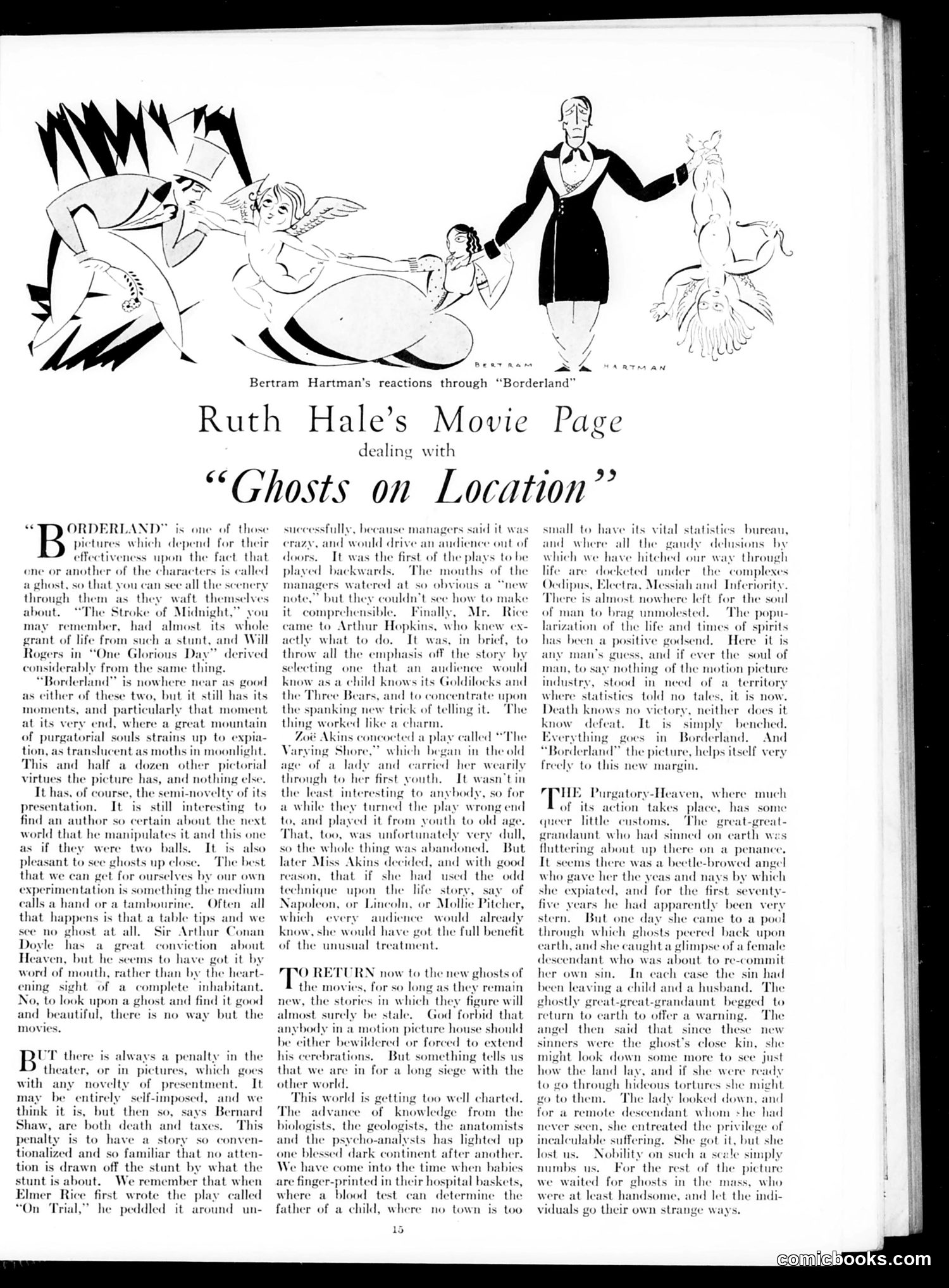
What you’re looking at
This is Ruth Hale's review of the film *Borderland*, illustrated by Bertram Hartman's cartoon reactions. The page critiques a movie featuring ghosts as visual novelty—characters appearing transparent so viewers see scenery "through them." Hale argues that while the ghost-visualization trick is cinematically interesting, the film suffers from a familiar problem: novelty of *presentation* requires novelty of *story* to succeed. She references successful precedents (*The Stroke of Midnight*, *One Glorious Day*) where filmmakers solved this by using widely-known plots (like "Goldilocks and the Three Bears") so audiences focus on the innovative technique rather than following an unfamiliar narrative. The review concludes that *Borderland*'s ghost imagery, though visually appealing, cannot compensate for its stale storyline—a common penalty in early cinema when directors prioritized technical gimmicks over substantive storytelling.
📄 Transcribed text from this page (OCR, searchable)
Machine-transcribed from the original scan — historical spelling and the odd misread are preserved.
Bertram Hartman's reactions through “Borderland” Ruth Hale’s Movie dealing with Page “Ghosts on Location” “ LAND” of those B which depend for their tiveness upon the that ene or another of the characters is called a ghost, so that you can see all the scenery through them as they waft. themselves about. “The Stroke of Midnight,” you remember, had almost its whole nt of life from such a stunt, and Will rs in “One Glorious Day” derived considerably from the same thin “Borderland” is nowhere near as good as cither of these two, but it still has its moments, and particularly that moment at its very end, where a great mountain rial souls strains up to expia- tion, as translucent as moths in moonlight. This and half a dozen other pictorial virtues the picture has, and nothing else, It has, of course, the semi-novelty of its presentation. It is. still interesting to find an author so certain about the next world that he manipulates it and this one as if they were two balls. It is also pleasant to see ghosts up close. The best that we can get for ourselves by our own experimentation is something the medium calls a hand or a tambourine, Often all that happens is that a table tips and we see no ghost at all. Sir Arthur Conan Doyle has a great’ conviction about Heaven, but he seems to have got it by word of mouth, rather than by the heart- ning sight of a complete inhabitant. No, to look upon a ghost and find it good and beautiful, there is no way but the movies. I UT there is always a penalty in the theater, or in pictures, which goes with any novelty of presentment. It may be entirely” self-imposed, and we think it but then so, says Bernard Shaw, are both death and taxes. This is to have a story so conven- d and so familiar that no atten- rwn off the stunt by what the rout. We remember that when wrote the play called peddled it around) un- tion is ¢ stunt i Elmer Rice first “On Trial,” he successfully, because managers said it was . and would drive an audience out of It was the first of the plays to be played backwards. The mouths of the managers watered at so obvious a “new note,” but they couldn't sce how to make it comprehensible. Finally, Mr. Rice came to Arthur Hopkins, who knew ex- actly what to do. It was, in brief, to throw all the emphasis off the story by selecting one that) an audience would know as a child knows its Goldilocks and the Three Bears, and to concentrate upon the spanking new trick of telling it. The thing worked like a charm. Zoé Akins concocted a play called “The Varying Shore.” which began in the old age of a lady and carried her wearily through to her first youth, It wasn't in the least interesting to anybody, so for a while they turned the play wrong end to, and played it from youth to old age. That, too, was unfortunately very dull, so the whole thing was ndoned, But later Miss Akins decided, and with good reason, that if she had used the odd technique upon the life story, say of Napoleon, or Lincoln, or Mollie Pitcher, which every audience would already know, she would have got the full benefit of the unusual treatment. crazy doors. T? RETURN now to the new ghosts of the movie so long as they remain new, the stories in which they figure will almost surely be stale. God forbid that anybody in a motion picture house should be either bewildered or forced to extend brations. But something tells us in for a long siege with the his cei that we are other world, This world i getting too well charted, The advance of knowledge from the hiologists, the geologists, the anatomists and the psycho-analysts has lighted up one blessed dark continent after another. We have come into the time when bi are finger-printed in their hospital baskets, where a blood test can determine the father of a child, where no town is too 15 small to have its vital statisties bureau, and where all the gaudy delusions by which w hitched our way through life ar ed under the ‘complexes Oedipus, 1, Messiah and Inferiority. There is almost nowhere left for the soul of man to brag unmolested. The popu- larization of the life and times of spirits has been a positive godsend. Here it is any man’s guess, and if ever the soul of man, to say nothing of the motion picture industry, stood in need of a_ territory where statistics told no tales, it is now. Death knows no victory, neither does it know d It is ‘simply benched. Borderland. And . helps itself very n. Everything goes in “Borderland” the pictu freely to this new mi “He Purgatory-Heaven, whe much its action takes place, has some queer little customs, The great-great- grandaunt who had sinned on earth wes fluttering about up there on a penance, Tt seems there was a beetle-browed angel who gave her the yeas and nays by which she expiated, and for the first: seventy- five years he apparently been very stern. But one day she came to a pool through which ghosts peered back upon earth, and she caught a glimpse of a female descendant who was about to re-commit In each case the sin had chil 1and a husband. The int begged to return to ear warning. The angel then said that since these new sinners were the ghost’s close kin, she might look down some more how the land lay, and if she were rez to go through hideous tortures she mi go to them. The lady looked down for a remote descendant whom she had never seen, she entreated the privilege of incalculable suffering. She got it, but she her own sin. been leaving ghostly g to see just lost us. Nobility on such a sczle simply numbs us. For the rest of the picture we waited for ghosts in the mass, who were at least handsome, and let the indi- viduals go their own strange way's. comm €Ebooks.com